
- Home
- »
- Clothing, Footwear & Accessories
- »
-
Watches Market Size, Share & Trends, Industry Report, 2033GVR Report cover

Watches Market (2026 - 2033) Size, Share & Trends Analysis Report By Type (Analog, Digital), By Price (Economy, Premium, Mid-range, Luxury, Ultra Luxury), By End User (Men, Women), By Distribution Channel, By Region, And Segment Forecasts
Market Size, 2025
$69.1BMarket Estimate, 2026
$71.9BMarket Forecast, 2033
$96.8BCAGR, 2026–2033
4.3%Watches Market Summary
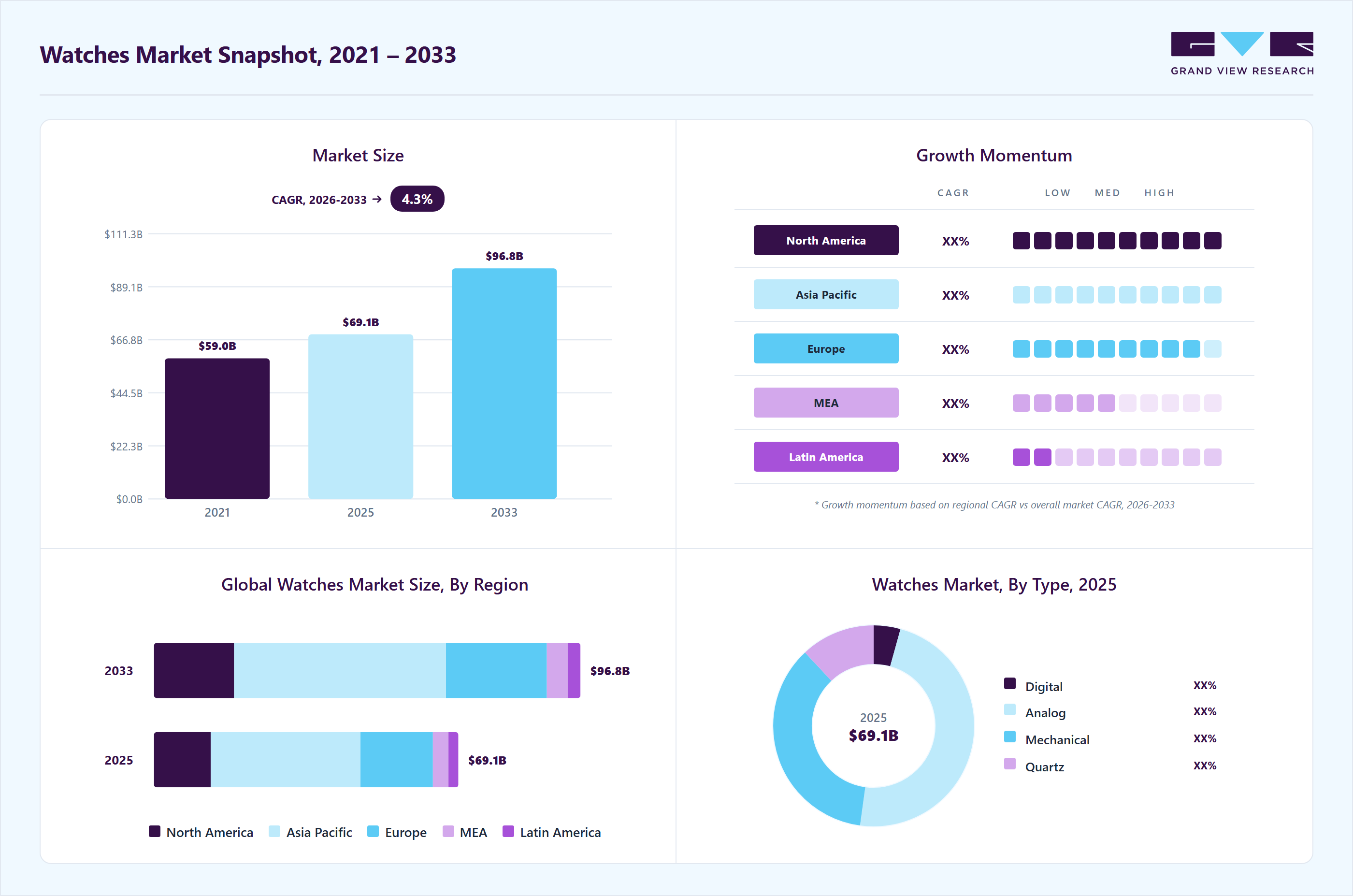
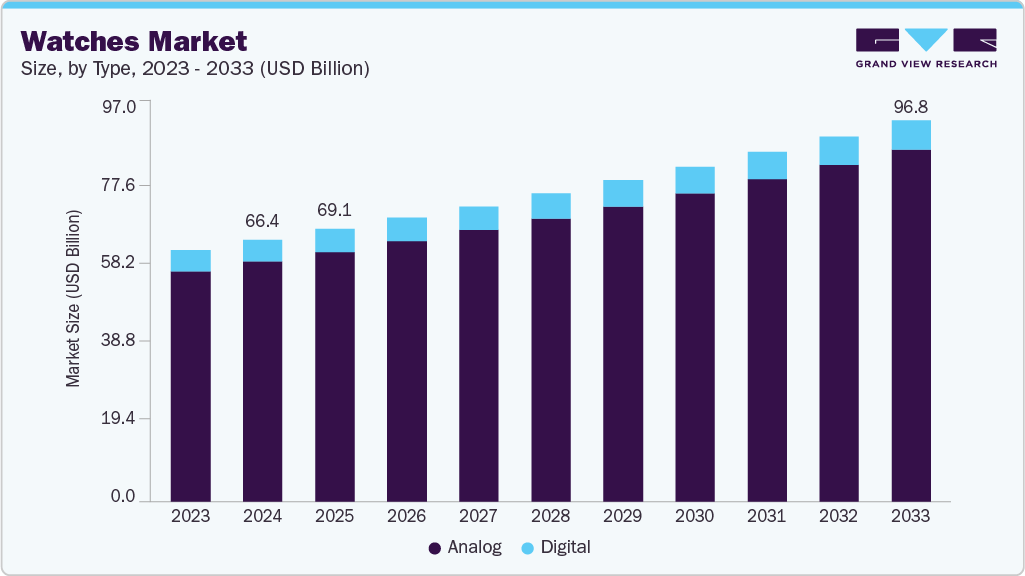
The global watches market size was valued at USD 69.1 billion in 2025 and is projected to grow from USD 71.9 billion in 2026 to USD 96.8 billion by 2033, at a CAGR of 4.3% from 2026 to 2033. The Asia Pacific watches market held the largest share of 49.2% of the global market in 2025. This can be attributed to rising demand for premium and mid-range quartz and mechanical watches, driven by consumers seeking precision, craftsmanship, and stylish everyday timepieces.
 Source: Grand View Research, IR Documents, Primary Interviews, Paid DatabasesTo learn more about this report,
 Download Free Sample Report
 Key Market Trends & Insights
- By type: Analog watches led the market with a share of 91.8% in 2025.
- By end user: Men led the market and accounted for a share of 75.9% in 2025.
- By distribution channel: Offline sales held the highest market share of 75.6% in 2025.
Regional Highlights
- Largest regional market: Asia Pacific (49.2% revenue share, 2025)
- The watches market in India is projected to grow at a CAGR of 5.4% from 2026 to 2033.
Market Size & Forecast
- Market size in 2025: USD 69.1 Billion
- Estimated market size in 2026: USD 71.9 Billion
- Projected market size by 2033: USD 96.8 Billion
- CAGR (2026-2033): 4.3%
Three ways to get this report
Buy it, customize it, or ask a question.Ask an Analyst
Analyst response in 1 business day
- AccessReport author, directly
- Reply timeWithin 1 working day
- No sales callDirect answer only
- FormatEmail reply
- CostFree, no cost
Get the Full Report
What the study covers
- FormatsPDF · Excel · Dashboard
- Timeline2026–2033 annual, 2025 base
- Coverage20+ countries, 5 regions
- Companies10+ key players profiled
Customize the Report
20% free customization
- IncludeCountries, segments, points
- TailorTo your product definition
- ExtendDeeper competitor detail
- OrA fully bespoke study
- Turnaround5–10 working days
A key trend in the global traditional watch market is the rising popularity of compact, minimalist quartz watches that combine precision with everyday wear. Across regions, from Europe’s stylish cities to Asia’s urban millennials, consumers are increasingly choosing slimmer, versatile designs over bulky or purely mechanical models. This shows a global shift toward functional yet trendy timepieces.
A sustained consumer preference for classic craftsmanship and long-term value continues to drive growth in the traditional watch market. According to an article by Luxury Tribune, published in October 2025, 26% of consumers still wear traditional watches. Furthermore, purchasing intentions remain robust, with 54% of respondents planning to buy a mechanical or quartz watch within the next year. This strong purchase intent reflects the enduring appeal of traditional timepieces as symbols of personal identity, heritage, and status. Many consumers view these watches not only as functional accessories but also as collectible assets that retain emotional and resale value over time, which continues to support steady demand across both mid-range and luxury price segments.
 To learn more about this report, Download Free Sample Report
 The wrist watch market is evolving quickly as the online watch market expands, reshaping how consumers research, compare, and purchase both mass and premium timepieces. Beyond affordability, functionality and product quality have become decisive purchase drivers in the traditional watch market, particularly in value-focused regions. According to a 2025 analysis by Clootrack based on 10,691 consumer surveys in India, daily usability emerged as the top factor influencing adoption, indicating that consumers prefer watches suitable for regular wear rather than purely fashion-led accessories. Warranty expectations ranked second, with buyers demanding a minimum of 1-2 years of coverage as a measure of long-term reliability. The study also highlighted that competitive pricing within the affordable-to-mid range, design that reflects personal style, and durability features such as strap strength and water resistance significantly influence brand preference. This suggests that consumers now evaluate watches as a balance of practicality, aesthetics, and value rather than price alone.
Emerging markets are becoming a key demand driver for the traditional watch industry as rising disposable incomes fuel aspirational purchasing. According to an article by Luxury Tribune published in October 2025, India’s watch imports grew nearly 7% between January and August 2025 and approximately 30% over the past two years, reflecting sustained consumer appetite for international brands.
JCK Online reported in October 2025 that 62% of consumers in Mexico are considering the purchase of a traditional watch, positioning Latin America as another growth market. At the same time, global trade policies are reshaping pricing and supply strategies; JCK Online noted that a 39% tariff on Swiss watch imports into the U.S. took effect in August 2025, prompting brands such as Rolex and Patek Philippe to implement price increases, which has introduced pricing uncertainty and moderated near-term demand in the U.S. market.
Key Watches Company Insights
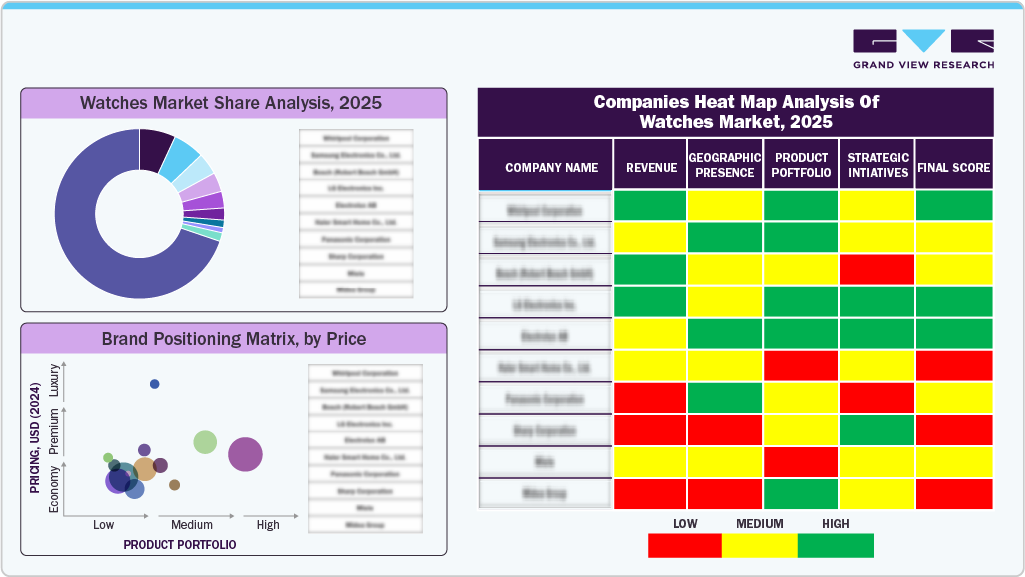
A mix of heritage brands, premium luxury houses, and rising regional players shapes the global market, each catering to different consumer segments.
-
Iconic Swiss and Japanese brands like Rolex, Omega, Grand Seiko, and Citizen lead the premium and mid-range segments, leveraging craftsmanship, precision, and brand prestige to appeal to collectors and enthusiasts.
-
Luxury-focused labels such as Patek Philippe and Audemars Piguet target affluent buyers seeking investment-grade timepieces and status symbols.
-
At the same time, regional players like Titan in India and Seiko in select Asian markets focus on affordable mechanical and quartz models, capturing value-conscious consumers and broadening market reach in emerging economies, reinforcing the overall global footprint of traditional watches.
 To learn more about this report, Download Free Sample Report
Consumer Insights
 To learn more about this report, Download Free Sample Report
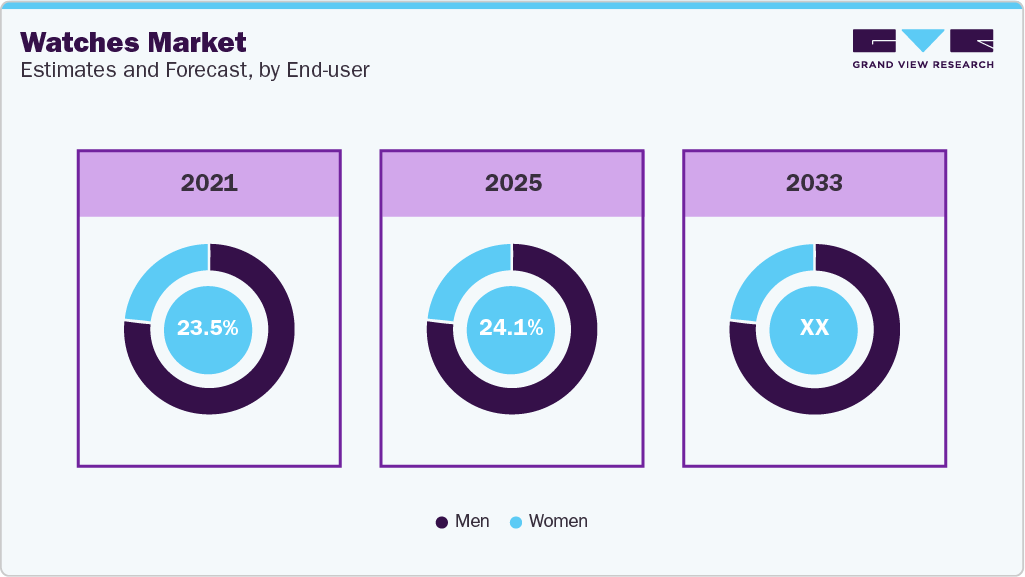
 The global traditional watch industry is mainly made up of male users, who represent about 75% of consumers, while women make up 25%. This imbalance comes from the long-standing belief that watches are masculine status symbols and collectible items, especially in the mechanical and luxury categories. Men see watches not only as practical accessories but also as ways to express personal identity, appreciate craftsmanship, and invest. Although female participation is smaller, it is slowly increasing as fashion and premium lifestyle brands expand their women-specific collections in mid and affordable luxury ranges.
In terms of age distribution, consumers aged 25 to 44 make up the largest group at 48%. This age range includes working professionals with increasing buying power who purchase watches for professional style, luxury goals, and personal milestones. The 45 and older group accounts for 38%, made up of loyal mechanical watch buyers and collectors who value heritage brands and long-term ownership. Meanwhile, younger buyers aged 18 to 24 represent 14% of the market. Although they have a smaller share, this group is influencing future demand, particularly for affordable automatic and quartz watches from brands like Seiko, Tissot, and Citizen.
Even with steady demand, consumers face significant challenges that affect their buying decisions. High prices are the biggest barrier, especially in Europe and Asia, where import duties raise costs. Service delays and limited warranty coverage frustrate buyers in both entry-level and luxury segments due to high maintenance times and costs. The issue of counterfeit products is serious in markets like India, Southeast Asia, and the Middle East, especially for popular Swiss and Japanese brands. Import taxes raise final retail prices in many growing markets, making it hard for middle-income buyers to access products. These challenges are driving demand toward local distributors and certified pre-owned sellers.
Among brands, Rolex continues to lead in global consumer preference due to its unmatched brand strength, resale value, and prestige. Seiko and Citizen are prominent in the mid-range category, viewed as reliable daily-use brands with strong movements. Tissot is favored by first-time luxury buyers, especially in Europe and Asia, due to its accessible Swiss quality. Omega has a strong appeal due to its sports heritage and design credibility. These brands succeed by balancing durability, heritage value, and wide product availability, ensuring relevance across income levels and regions.
Type Insights
Analog watches held a market share of 91.8% in 2025, as they remain the preferred choice for consumers seeking timeless design, mechanical craftsmanship, and precision. Their dominance is reinforced by heritage brands and classic collections that appeal to both collectors and everyday users, making analog timepieces the cornerstone of the traditional watch industry.
 To learn more about this report, Download Free Sample Report
 Digital watch is anticipated to witness a CAGR of 3.6% from 2026 to 2033, driven by affordable pricing, durability, and functional features such as alarms, timers, and chronographs. They appeal to consumers seeking practical, easy-to-read timepieces for everyday use, sports, and casual wear, maintaining steady demand alongside analog watches.
Price Range Insights
Premium watches accounted for 28.2% of global watch revenue in 2025, driven by their role as luxury status symbols, investment assets, and heirloom pieces with prices far above mass-market alternatives. The segment benefits from strong brand equity and heritage craftsmanship, with Swiss makers like Rolex, Patek Philippe, and Audemars Piguet achieving unit prices ranging from thousands to hundreds of thousands of dollars. According to an article by JCK published in October 2025, the premium segment shows resilience through value retention, with 16% of consumers considering resale value when buying new and 17.0% of secondhand buyers viewing purchases as investments. Although premium watches make up fewer units, their much higher prices generate a disproportionately large share of market revenue.
 To learn more about this report, Download Free Sample Report
 Luxury watches are anticipated to grow at a CAGR of 4.8% from 2026 to 2033, driven by rising demand in emerging markets, investment appeal, and evolving consumer demographics. Increasing disposable incomes across Asia-Pacific markets such as China, India, Japan, and Singapore are expanding the high-net-worth consumer base seeking luxury timepieces as status symbols. According to an article by Finshots, published in September 2024, 78% of Indian consumers plan to buy a watch for themselves within the next year, while the Knight Frank Luxury Investment Index reports that luxury watches have appreciated 138.0% over the past decade, surpassing art as a top investment choice for affluent Indians.
End User Insights
Watches for men accounted for 75.9% in 2025, primarily due to the long-standing perception of watches as a male accessory and status symbol, especially in mechanical and luxury segments. Men are more likely to purchase watches as personal style statements, professional accessories, and collectibles. The dominance of mid-range and luxury mechanical watches, which historically target male buyers, further reinforces this skew, with brands like Rolex, Omega, and Seiko designing collections that emphasize masculine aesthetics, larger case sizes, and technical features appealing to male consumers.
 To learn more about this report, Download Free Sample Report
 Watches for women are anticipated to witness a CAGR of 5.0% from 2026 to 2033, driven by increasing fashion-consciousness, rising disposable incomes, and expanding availability of female-focused collections. Brands are introducing designs that combine style, functionality, and luxury appeal, attracting both first-time buyers and collectors. In addition, growth in emerging markets and the rising popularity of affordable luxury and mid-range watches for women are supporting steady demand in this segment.
Distribution Channel Insights
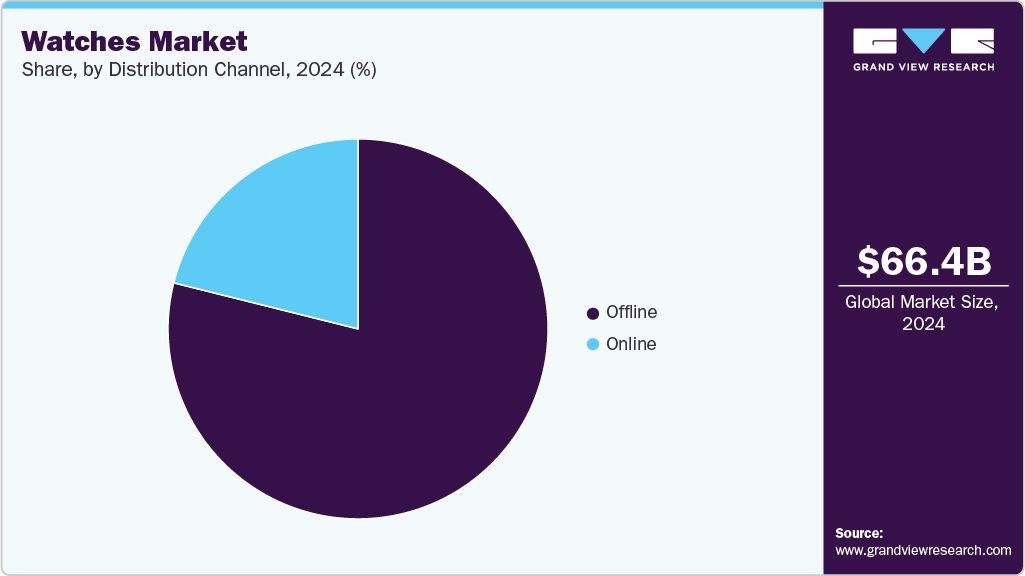
The sale of watches through offline channels accounted for 75.6% in 2025. Physical retail remains dominant in the traditional watch market, driven by consumers’ preference for hands-on experiences and personal interaction. According to an October 2025 article by JCK, 60% of consumers prefer buying luxury watches in brick-and-mortar stores, citing the ability to try and test products (51%), personal interaction with sales staff (44%), and convenience or proximity (39%) as key motivators.
 To learn more about this report, Download Free Sample Report
 The sale of watches through the online channel is expected to grow at a CAGR of 5.6% from 2026 to 2033, driven by 24/7 convenience, easy price comparison, and wider product selection. Growth is particularly strong in emerging markets and mid-range segments, as consumers increasingly embrace digital platforms for research and purchase, complementing traditional brick-and-mortar experiences.
Regional Insights
The North America watches market is projected to grow at a CAGR of 4.4% from 2026 to 2033, supported by a mature consumer base that values heritage, mechanical craftsmanship, and brand prestige. Strong demand in the luxury segment, particularly for Swiss watches, sustains growth, while mid-range watches gain traction through multi-brand retailers. Online sales are gradually rising, but brick-and-mortar stores remain dominant, reflecting the preference for in-person shopping and expert guidance.
U.S. Watches Market Trends
The watches market in the U.S. accounted for a revenue share of 86.2% in 2025, shaped by premium and aspirational consumer segments, where buyers prioritize brand heritage, quality, and investment potential. Offline retail dominates, particularly for high-value purchases, with consumers emphasizing tactile experience, personal interaction, and after-sales service. The growth of mid-range watches and the support market expansion among younger, value-conscious buyers.
Canada watches market is projected to grow at a CAGR of 4.4% from 2026 to 2033, due to strong demand for Swiss and luxury watches among affluent urban consumers, growing e-commerce penetration enabling access to international brands, and a cultural preference for high-quality, durable timepieces in major cities like Toronto and Vancouver.
Asia Pacific Watches Market Trends
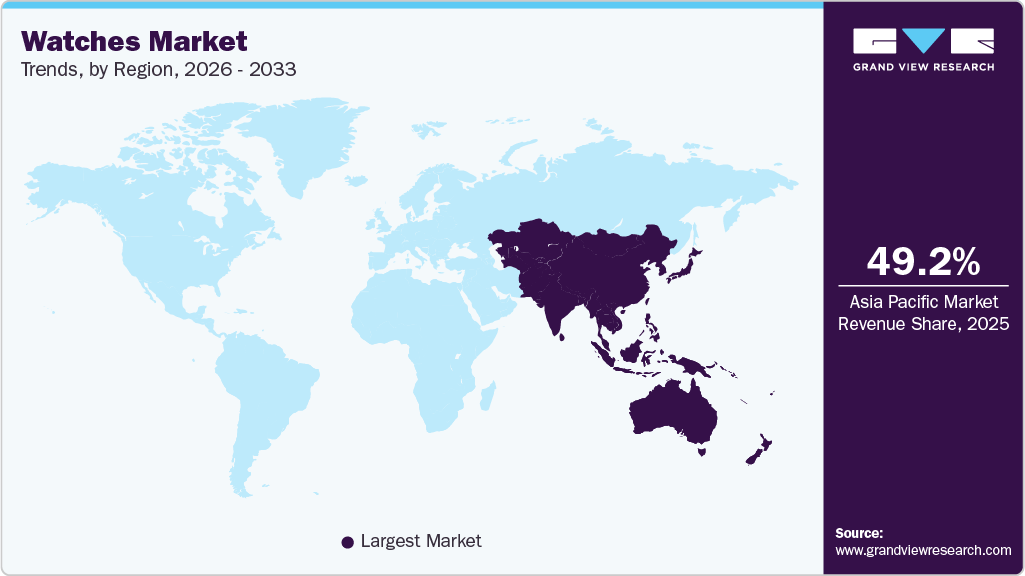
The watches market in the Asia Pacific accounted for a share of 49.2% of the global market in 2025, driven by rapidly growing disposable incomes, rising brand awareness, and a strong appetite for luxury and mid-range watches. Countries like China, India, Japan, and Singapore are key contributors, with consumers increasingly purchasing watches as status symbols, fashion accessories, and investment items. The region’s large population, expanding middle class, and growing presence of international and regional brands continue to make APAC the largest revenue contributor globally.
 To learn more about this report, Download Free Sample Report
 In December 2024, Seiko launched the Asia Pacific-exclusive Grand Seiko SBGJ283, limited to 150 pieces. The watch features a Washi-inspired off-white dial with a red Kozo GMT hand, a 40 mm Ever-Brilliant Steel 44GS case with Zaratsu finishing, and dual-curved sapphire. Powered by the hi-beat Caliber 9S86 with quick-set GMT, it offers 10 bar water resistance and comes with a steel bracelet plus a brown crocodile strap, available only at Grand Seiko boutiques and authorized retailers in the Asia Pacific. The luxury watch market is seeing strong momentum in Asia, with rising demand across the Indian luxury watch market and continued scale and brand traction in China.
The watches market in China accounted for a revenue share of 45.9% in 2025, as consumers increasingly favored mid-to-high-end watches as status symbols, and major cities like Shanghai and Beijing drove demand through luxury retail hubs and premium mall expansions.
The watches market in India is projected to grow at a CAGR of 5.4% from 2026 to 2033, fueled by rising disposable incomes in Tier-1 and Tier-2 cities, growing demand for smart and hybrid watches among young professionals, and localized manufacturing, reducing prices and improving accessibility.
Japan watches market is projected to grow at a CAGR of 3.9% from 2026 to 2033, reflecting steady growth in domestic mechanical and high-end watches, supported by a mature collector base, strong after-sales service networks, and traditional brands maintaining cultural relevance amid slow adoption of wearable tech.
Europe Watches Market Trends
The watches market in Europe is anticipated to grow at a CAGR of 4.2% from 2026 to 2033, supported by demand for heritage luxury brands, high disposable incomes in Western Europe, and strong cross-border sales through both boutique retail and online channels.
Germany watches market accounted for a revenue share of 20.5% in 2025, due to a preference for precision-engineered, high-quality mechanical and smartwatches, coupled with a strong domestic manufacturing base and affluent urban consumers in cities like Munich and Frankfurt.
The watches market in the UK is anticipated to witness a CAGR of 4.0% from 2026 to 2033, driven by growing interest in premium fashion and smartwatch hybrids, expanding e-commerce platforms, and rising demand from young professionals in London and major metropolitan areas.
France watches market is anticipated to witness a CAGR of 4.2% from 2026 to 2033, due to strong consumption of luxury and designer watches, the influence of Paris as a fashion hub, and increasing adoption of limited-edition and heritage collections by collectors.
Central & South America Watches Market Trends
The watches market in Central & South America is anticipated to witness a CAGR of 3.2% from 2026 to 2033, due to rising affordability and accessibility, with growth in entry-level and mid-range watches for urban middle-class consumers, alongside gradual interest in premium watches in major cities like São Paulo and Mexico City.
Middle East & Africa Watches Market Trends
The watches market in the Middle East & Africa is anticipated to witness a CAGR of 3.7% from 2026 to 2033, driven by high demand for luxury and gold timepieces in the Gulf countries, strong tourism-driven retail in the UAE, and increasing penetration of smart and hybrid watches in South Africa and other urban centers.
Key Watches Companies:
The following key companies have been profiled for this study on the watches market.
- Rolex
- Omega
- Seiko
- Citizen
- Tissot
- Casio
- Patek Philippe
- Audemars Piguet
- Longines
- Timex
Recent Developments
-
In September 2025, Citizen announced that it would be launching three new quartz-powered Eco-Drive Promaster Skyhawk watches in October 2025, featuring the Caliber U830 movement. Housed in 43mm stainless steel cases with sapphire glass, they are priced between USD 795 and USD 850.
-
In November 2024, Tissot added a new 25 mm quartz model to its PRX collection. This watch combines the brand’s 1970s integrated-bracelet design with a modern touch. The watch includes a Swiss quartz movement with an End-of-Life indicator and is water-resistant up to 100 m. Available in several finishes, including carnation-gold PVD, it appeals to those looking for an elegant, vintage-inspired timepiece that is also compact and durable.
-
In May 2024, Audemars Piguet introduced a set of three compact Royal Oak models powered by quartz, each featuring a petite 23mm diameter.
Watches Market Report Scope
Report Attribute
Details
Market size in 2025
USD 69.1 billion
Estimated market size in 2026
USD 71.9 billion
Projected market size by 2033
USD 96.8 billion
Growth rate (revenue)
CAGR of 4.3% from 2026 to 2033
Actuals
2021 - 2025
Forecast period
2026 - 2033
Quantitative units
Revenue in USD million/billion, and CAGR from 2026 to 2033
Report coverage
Revenue forecast, company ranking, competitive landscape, growth factors, and trends
Segments covered
Type, price range, end user, distribution channel, region
Regional scope
North America; Europe; Asia Pacific; CSA; MEA
Country scope
U.S.; Canada; Mexico; UK; Germany; France; Italy; Spain; China; Japan; Australia; South Korea; Thailand; Singapore; Brazil; South Africa
Key companies profiled
Rolex; Omega; Seiko; Citizen; Tissot; Casio; Patek Philippe; Audemars Piguet; Longines; Timex
Customization scope
Free report customization (equivalent up to 8 analysts working days) with purchase. Addition or alteration to country, regional & segment scope.
Pricing and purchase options
Avail customized purchase options to meet your exact research needs. Explore purchase options
Global Watches Market Report Segmentation
This report forecasts revenue growth at the global, regional, and country levels and provides an analysis of the latest industry trends and opportunities in each of the sub-segments from 2021 to 2033. For this study, Grand View Research has segmented the global watches market report based on type, price range, end user, distribution channel, and region:
-
Type Outlook (Revenue, USD Million, 2021 - 2033)
-
Analog
-
Mechanical
-
Quartz
-
-
Digital
-
-
Price Outlook (Revenue, USD Million, 2021 - 2033)
-
Economy
-
Mid-range
-
Premium
-
Luxury
-
Ultra Luxury
-
-
End User Mode Outlook (Revenue, USD Million, 2021 - 2033)
-
Men
-
Women
-
-
Distribution Channel (Revenue, USD Million, 2021 - 2033)
-
Online
-
Offline
-
-
Regional Outlook (Revenue, USD Million, 2021 - 2033)
-
North America
-
U.S.
-
Canada
-
Mexico
-
-
Europe
-
UK
-
Germany
-
France
-
Italy
-
Spain
-
-
Asia Pacific
-
China
-
Japan
-
India
-
Australia
-
South Korea
-
Thailand
-
Singapore
-
-
Central & South America
-
Brazil
-
-
Middle East & Africa
-
South Africa
-
-
Frequently Asked Questions About This Report
The global watches market size was estimated at USD 69.10 billion in 2025 and is expected to reach USD 71.96 billion in 2026.
The global watches market is expected to grow at a compound annual growth rate of 4.3% from 2026 to 2033 to reach USD 96.81 billion by 2033.
Some key players operating in the watches market include Rolex; Omega; Seiko; Citizen; Tissot; Casio; Patek Philippe; Audemars Piguet; Longines; and Timex
Key factors that are driving the market growth include rising demand for premium and mid-range quartz and mechanical watches, driven by consumers seeking precision, craftsmanship, and stylish everyday timepieces.
Asia Pacific dominated with a 49.2% revenue share in 2025.
Asia Pacific dominated the watches market with a share of 49.2% in 2025, driven by rapidly growing disposable incomes, rising brand awareness, and a strong appetite for luxury and mid-range watches. Countries like China, India, Japan, and Singapore are key contributors, with consumers increasingly purchasing watches as status symbols, fashion accessories, and investment items.
About the Author(s)
Clothing, Footwear & Accessories Research Team
Consumer Goods · Clothing, Footwear & AccessoriesThis report was authored by the clothing, footwear & accessories research team at Grand View Research - comprising two research analysts, one senior research analyst, and one industry expert - with specialized expertise in the clothing, footwear & accessories segment of the consumer goods industry. All findings are based on proprietary consumer goods databases, executive interviews, and regulatory analysis, subject to internal peer review prior to publication.
Last Updated:
Speak to Analyst

Customize this report to your needs - add regions, segments, or data points, with 20% free customization.
Or view our licence options:


ISO 9001:2015 & 27001:2022 Certified
We are GDPR and CCPA compliant! Your transaction & personal information is safe and secure. For more details, please read our privacy policy.


