
- Home
- »
- Advanced Interior Materials
- »
-
Water Cut Monitors Market Size & Share Report, 2026-2033GVR Report cover

Water Cut Monitors Market (2026 - 2033)
Size, Share & Trends Analysis Report By Function (Onshore, Offshore), By Design (Well Testing, Separation Vessel, LACT, Tank Farm & Pipeline), By Application (Upstream, Midstream, Downstream), By Region, And Segment Forecasts
Market Size, 2025
$271.2MMarket Estimate, 2026
$284.5MMarket Forecast, 2033
$414.6MCAGR, 2026–2033
5.5%Water Cut Monitors Market Summary
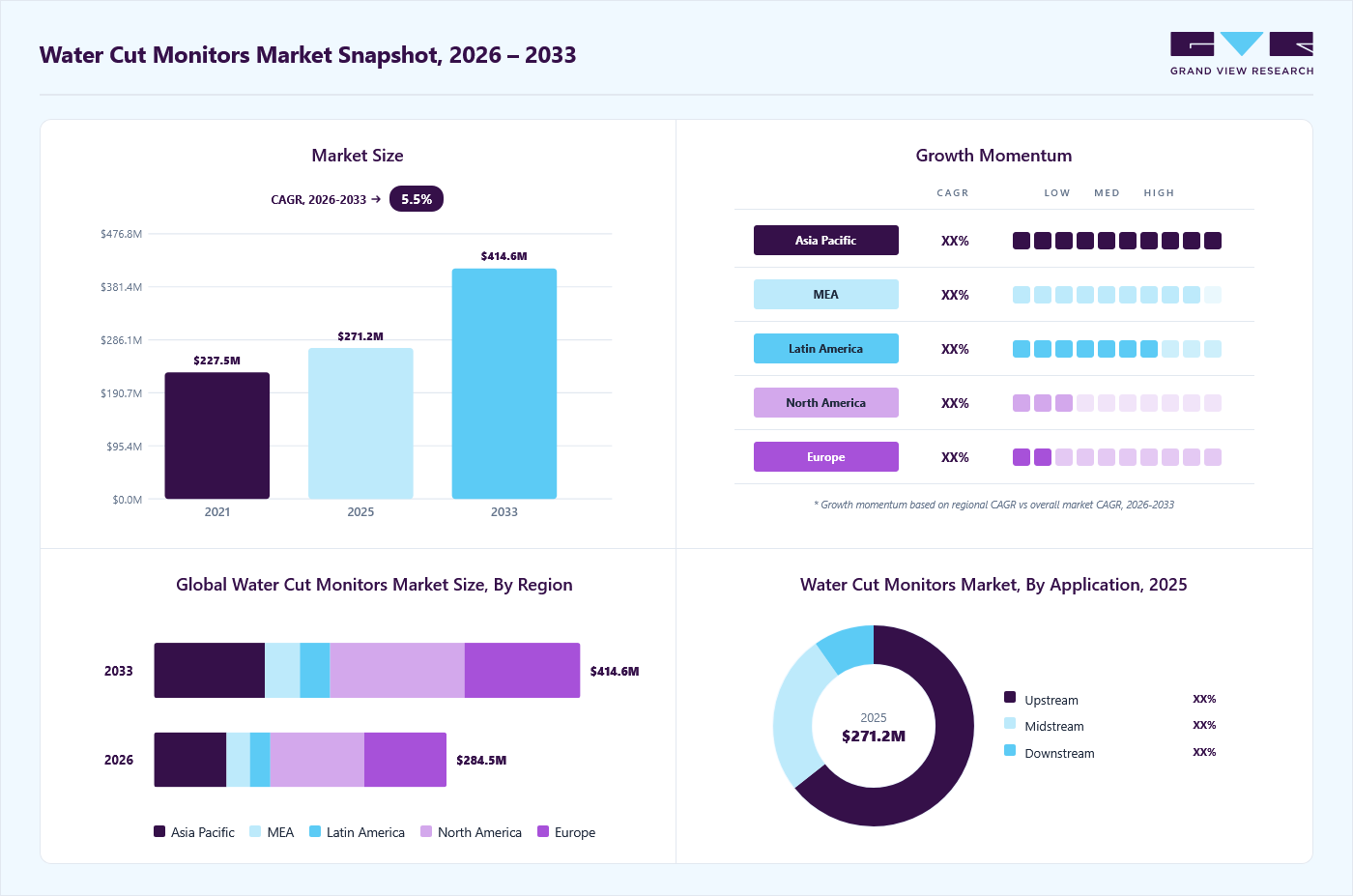
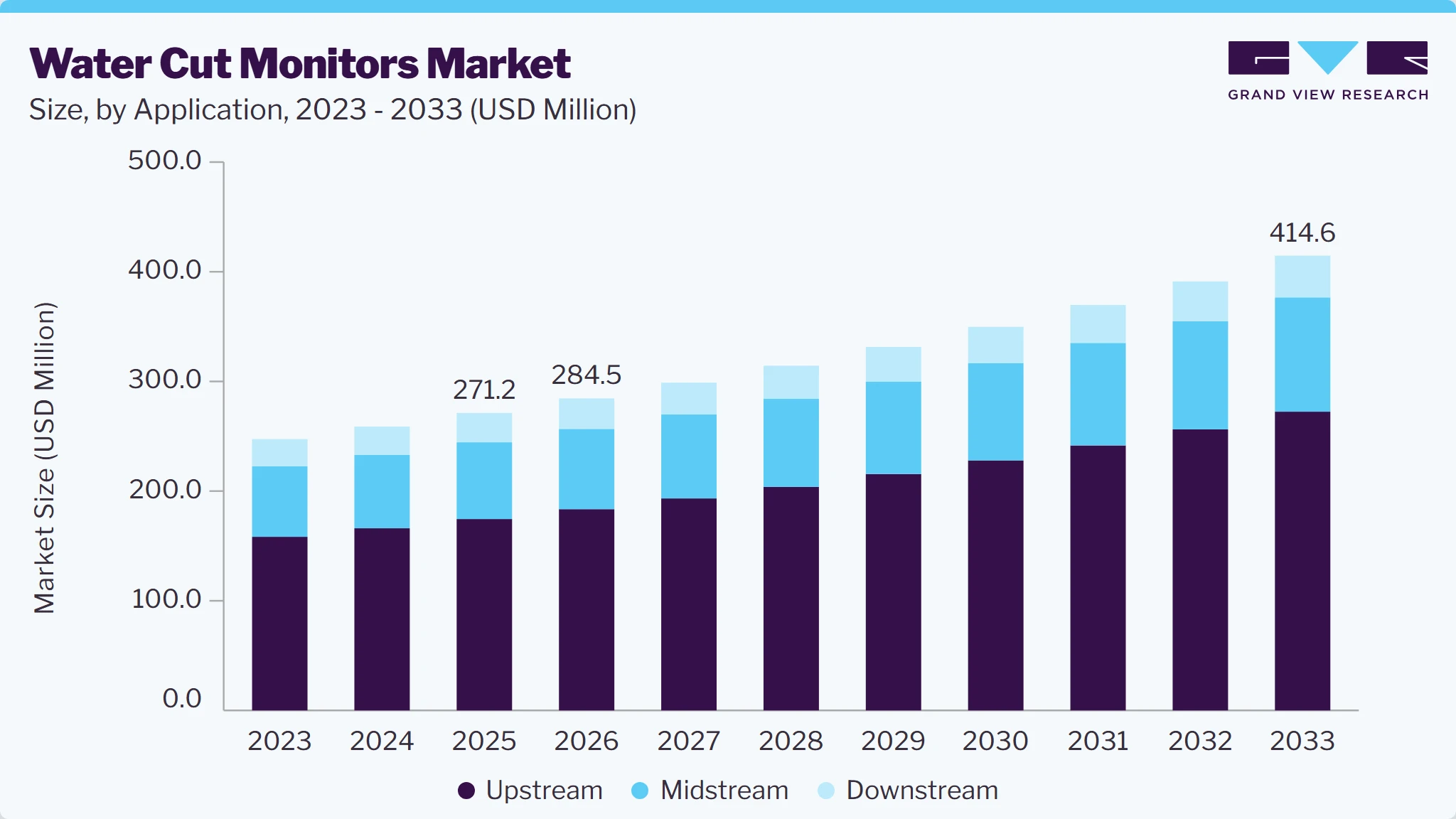
The global water cut monitors market size was valued at USD 271.2 million in 2025 and is projected to grow from USD 284.5 million in 2026 to USD 414.6 million by 2033, growing at a CAGR of 5.5% from 2026 to 2033. North America dominated the market with the largest revenue share of 32.2% in 2025. The increasing focus on optimizing oil and gas production processes, coupled with the rising need for accurate measurement of water content in hydrocarbons, is driving the demand for water cut monitors.
 Source: Grand View Research, IR Documents, Primary Interviews, Paid DatabasesTo learn more about this report,
 Download Free Sample Report
Key Market Trends & Insights
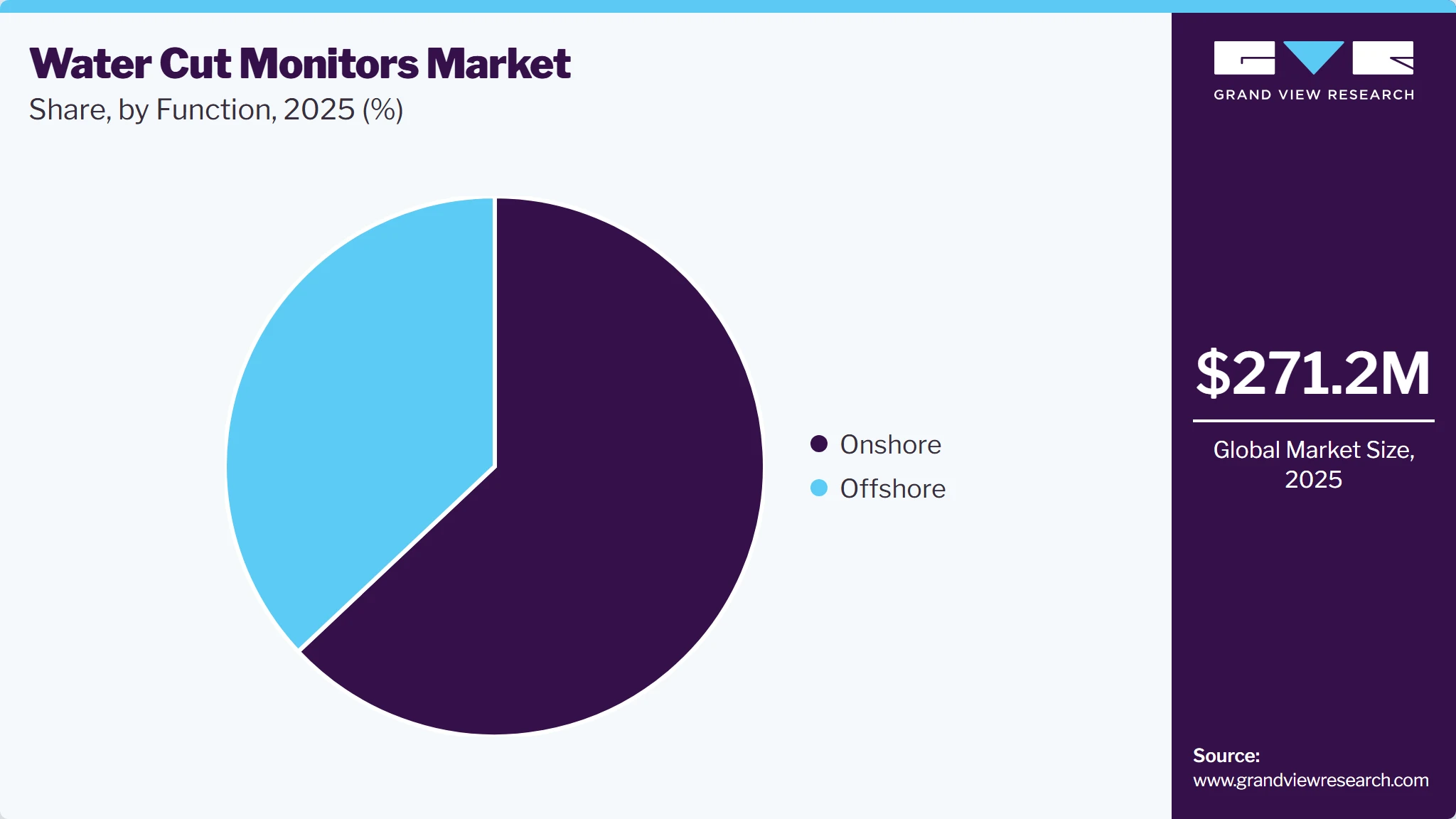
- By function: Onshore segment led the market with the largest revenue share of 63.0% in 2025.
- BY design: Well testing segment led the market with the largest revenue share of 24.6% in 2025.
- By application: Upstream segment led the market with the largest revenue share of 64.3% in 2025.
Regional Highlights
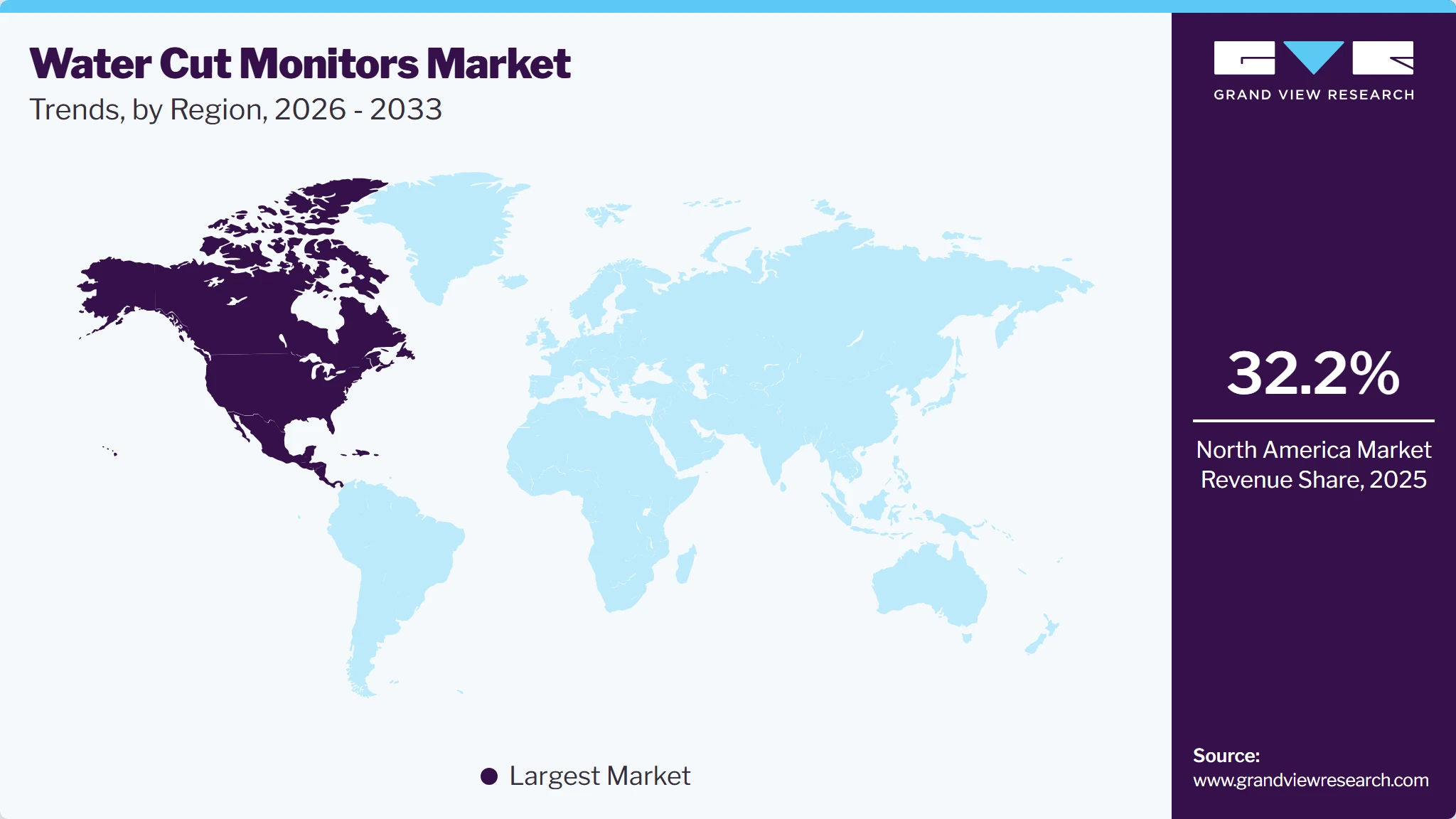
- Largest regional market: North America (32.2% revenue share, 2025)
- By country: The U.S. held the largest market share in 2025.
Market Size & Forecast
- Market size in 2025: USD 271.2 Million
- Estimated market size in 2026: USD 284.5 Million
- Projected market size by 2033: USD 414.6 Million
- CAGR (2026-2033): 5.5%
Prism AI by Grand View Research Free to tryAsk a question about the water cut monitors marketTry asking✓Every figure cited from GVR research Prefer the report? Download free sample →
These devices are essential for enhancing the efficiency of oil extraction and refining operations by providing real-time data on water content, which is critical for process control and ensuring product quality. Water cut monitors are gaining traction due to their ability to provide continuous, real-time monitoring of the water-to-oil ratio, which is crucial for managing production processes and maintaining equipment integrity. The adoption of advanced monitoring technologies is also being driven by the need to comply with stringent environmental regulations and industry standards. The integration of digital solutions and automation in the oil and gas industry is further propelling the demand for these devices, as companies seek to improve operational efficiency and reduce downtime.The market is also benefiting from the growing emphasis on sustainable and cost-effective production practices. As the oil and gas industry continues to evolve, there is a rising demand for technologies that can optimize resource utilization and minimize environmental impact. Water cut monitors play a crucial role in achieving these goals by enabling precise control over production processes and reducing the risk of water contamination in hydrocarbons.
 To learn more about this report, Download Free Sample Report
The water cut monitors market is driven by several factors, including the increasing need for accurate and real-time monitoring of water content in oil and gas streams, the growth of the upstream and downstream oil and gas sectors, and the rising focus on operational efficiency and cost reduction. The implementation of stringent regulatory standards related to environmental protection and product quality is also contributing to market growth.
The integration of advanced sensor technologies and digital solutions presents significant opportunities for market expansion. The development of innovative water cut monitors that offer enhanced accuracy, reliability, and ease of use is expected to drive market growth. Furthermore, the expansion of oil and gas exploration activities in offshore and remote locations is expected to boost the demand for water cut monitors.
Market Dynamics
The water cut monitors market is witnessing steady growth owing to the increasing need for accurate measurement of water content in hydrocarbon streams across oil and gas operations. As oil fields mature and water production levels rise, operators are deploying advanced water cut monitoring systems to obtain real-time measurements and improve production efficiency. Technological advancements in microwave, radio frequency, and capacitance-based sensing technologies are enhancing measurement accuracy across varying flow conditions, further supporting market adoption in onshore and offshore applications.
A significant proportion of the world's producing oil fields are in mature stages, resulting in increasing volumes of produced water being extracted alongside crude oil. Higher water content creates a greater need for continuous monitoring to accurately determine the oil-to-water ratio and assess production performance. Water cut monitors provide operators with reliable real-time data, enabling informed decisions regarding well productivity and hydrocarbon recovery.
Increasing water cut levels directly impact production economics and reservoir management strategies. Operators are investing in advanced monitoring technologies to improve measurement precision and maintain production efficiency across aging assets. As mature field development continues across regions such as North America, the Middle East, and offshore basins worldwide, demand for water cut monitoring equipment is expected to increase steadily.
The adoption of advanced water cut monitoring systems can be constrained by their relatively high upfront investment requirements, particularly for offshore installations and complex multiphase flow environments. Technologies such as microwave and gamma-ray-based systems often require specialized integration and engineering expertise, making them less accessible for smaller operators. In regions with limited production budgets or low-volume wells, companies may delay equipment upgrades, which can restrict market penetration.
The ongoing digital transformation of the oil and gas industry presents significant opportunities for water cut monitor manufacturers. Operators are increasingly integrating real-time monitoring instruments with automated control systems, industrial IoT platforms, and data analytics solutions to improve operational visibility. Water cut monitors serve as a critical source of production data within these digital ecosystems, enabling continuous measurement and remote monitoring capabilities. As investments in smart field and digital oilfield infrastructure continue to expand, demand for advanced connected water cut monitoring solutions is expected to grow substantially.
Analyst Perspective
The water cut monitors market is expected to witness consistent growth driven by the increasing need for accurate water content measurement across oil and gas production, transportation, and refining operations. As mature oil fields generate higher volumes of produced water and operators focus on maximizing hydrocarbon recovery, demand for reliable real-time monitoring solutions continues to rise. Advanced technologies such as microwave, radio frequency, and multiphase measurement systems are improving measurement accuracy and operational efficiency, making water cut monitors an essential component of modern production infrastructure.
Function Insights
Based on function, onshore segment led the market with the largest revenue share of 63.0% in 2025. This growth is attributed to the extensive network of oilfields and processing facilities located onshore. Water cut monitors are widely used in onshore well testing, separation vessels, and pipelines to ensure efficient operations and product quality.
 To learn more about this report, Download Free Sample Report
The offshore segment is expected to grow at a CAGR of 5.9% over the forecast period, driven by the expansion of offshore exploration and production activities and the need for accurate measurement of water content in challenging environments. The development of advanced water cut monitors capable of operating in harsh offshore conditions is expected to further drive the adoption of these devices.
Design Insights
Based on design, well testing segment led the market with the largest revenue share of 24.6% in 2025, primarily driven by the need for accurate measurement of water content during the testing and evaluation of oil wells. Water cut monitors are essential for optimizing production rates and enhancing the efficiency of well operations.
The LACT design segment is expected to grow at a CAGR of 6.5% over the forecast period, owing to its reliance on water cut monitors for accurate measurement and transfer of hydrocarbons, ensuring compliance with regulatory standards and maintaining product quality. The tank farm & pipeline application segment utilizes water cut monitors to ensure efficient storage and transportation of hydrocarbons, minimizing the risk of water contamination and optimizing operational efficiency.
Application Insights
TBased on application, upstream segment led the market with the largest revenue share of 64.3% in 2025, driven by the need for precise measurement of water content during oil extraction and well-testing processes. Water cut monitors are crucial for optimizing production rates and enhancing the efficiency of oil recovery operations.
The midstream segment is expected to grow at a significant CAGR of 4.9% from 2025 to 2030, owing to the need for accurate measurement of water content in pipelines and storage facilities to ensure product quality and compliance with regulatory standards. The downstream sector, which includes refineries and processing plants, relies on water cut monitors to ensure the quality of final products and to optimize refining processes.
Regional Insights
North America dominated the water cut monitors market with the largest revenue share of 32.2% in 2025, primarily driven by the presence of a well-established oil and gas industry and the adoption of advanced monitoring technologies. The region's focus on operational efficiency and compliance with stringent regulatory standards is driving the demand for water cut monitors. In addition, the adoption of real-time monitoring technologies is increasing due to the need for precise water-to-oil ratio measurements, which optimize production processes. Furthermore, ongoing investments in digitalization and automation of oilfields are further propelling demand. The region's focus on sustainability and reducing environmental impact also supports the expansion of this market.
 To learn more about this report, Download Free Sample Report
U.S. Water Cut Monitors Market Trends
The water cut monitors market in the U.S. held the largest share in the North America region in 2025. The U.S. is one of the largest oil producers in the world, has a significant share of the water cut monitors market. The adoption of advanced technologies and the focus on optimizing production processes are driving the demand for water cut monitors in the country.
Asia Pacific Water Cut Monitors Market Trends
Asia Pacific water cut monitors market is expected to grow at the fastest CAGR of 5.9% over the forecast period, owing to the expansion of oil and gas exploration activities and the rising demand for efficient production technologies. The region’s focus on energy security and the development of new oilfields are driving the adoption of water cut monitors. Furthermore, the region’s focus on energy security and efficient resource utilization has led to widespread deployment of advanced monitoring systems, making Asia Pacific a key market.
The water cut monitors market in China led the Asia Pacific market and accounted for the largest revenue share in 2024 due to its substantial investments in oilfield development and refinery expansions. Furthermore, the country’s focus on improving energy efficiency and meeting growing domestic demand for hydrocarbons has accelerated the adoption of advanced monitoring technologies.
Europe Water Cut Monitors Market Trends
Europe water cut monitors market is expected to be driven by the region’s commitment to environmental sustainability and the adoption of advanced oil and gas production technologies. The presence of key oil-producing countries and the implementation of stringent regulatory standards are supporting market growth.
The water cut monitors market in Germany led the European market with the largest revenue share in 2024, owing to its role as a major exporter of refined petroleum products. The country's emphasis on precision in hydrocarbon processing has led to increased adoption of real-time monitoring devices. Furthermore, rising investments in refining capacity and pipeline infrastructure further support market growth.
Key Water Cut Monitors Company Insights
Some of the key players operating in the water cut monitors market include Emerson Electric Co., Schlumberger Limited, TechnipFMC, AMETEK Inc. among others.
-
Emerson Electric Co. is a leading provider of water cut monitors and related equipment. The company's focus on innovation and advanced technology has solidified its position in the market. Emerson's water cut monitors are known for their high efficiency, reliability, and user-friendly design.
-
Schlumberger Limited is a prominent player in the water cut monitors market, known for its high-quality products and extensive industry experience. The company's water cut monitors are widely used in various oil and gas applications, including well testing and separation vessels.
-
TechnipFMC is a global leader in oil and gas technology, offering a comprehensive range of water cut monitors. The company's commitment to innovation and customer satisfaction has made it a trusted name in the market.
Key Water Cut Monitors Companies
The following key companies have been profiled for this study on the water cut monitors market.
-
Emerson Electric Co.
-
Schlumberger Limited
-
TechnipFMC
-
AMETEK Inc
-
Weatherford
-
ZelenTech
-
Sentech AS
-
Agar Corporation
-
Lemis Process
-
Eesiflo
Competitive Benchmarking
Category
Operating Strategies
Competitive Edge
Weakness
Established Players (e.g., Emerson Electric Co., Schlumberger Limited, TechnipFMC, AMETEK Inc, Weatherford)
- Expansion of real-time monitoring and integrated production optimization solutions for upstream and downstream operations
- Investments in high-accuracy sensing technologies, remote monitoring, and predictive analytics platforms
- Extensive global service, engineering, and aftermarket support networks for oil & gas operators
- Strong global brand recognition and diversified energy technology portfolios
- Advanced technological expertise in flow measurement, instrumentation, and process control systems
- High reliability and accuracy in harsh offshore and onshore operating environments
- Premium pricing compared to regional instrumentation suppliers
- High dependence on oil & gas capital expenditure cycles
- Complex installation and calibration requirements
- Exposure to fluctuations in global energy investments and crude oil prices
Emerging & Regional Players (e.g., AES Arabia Ltd., INTECH, Integrated Flow Solutions LLC, Petroserve International, Carotek Inc.)
- Increasing emphasis on compact, cost-effective, and high-precision monitoring systems
- Expansion into regional oil production, pipeline monitoring, and process optimization applications
- Strengthening partnerships with EPC contractors and oilfield service providers
- Competitive pricing and flexibility in customized monitoring solutions
- Strong responsiveness to niche operational requirements and complex flow conditions
- Growing adoption in offshore, marginal field, and independent oil production operations
- Comparatively lower global market penetration and brand visibility
- Limited financial scale for large R&D and international expansion investments
- Lower diversification compared to multinational oilfield technology providers
Recent Developments
-
In January 2024, Badger Meter Inc. announced the acquisition of specific remote water monitoring hardware and software from Trimble, including the Telog brand of remote telemetry units (RTUs) and the Trimble Unity Remote Monitoring software. This acquisition enhances Badger Meter's portfolio with real-time monitoring hardware and software.
Water Cut Monitors Market Report Scope
Report Attribute
Details
Market size in 2025
USD 271.2 million
Estimated market size in 2026
USD 284.5 million
Projected market size by 2033
USD 414.6 million
Growth rate
CAGR of 5.5% from 2026 to 2033
Base year for estimation
2025
Historical data
2021 - 2024
Forecast period
2026 - 2033
Quantitative units
Revenue in USD million and CAGR from 2026 to 2033
Report coverage
Revenue forecast, company ranking, competitive landscape, growth factors, and trends
Segments covered
Equipment, region.
Regional scope
North America; Europe; Asia Pacific; Latin America; Middle East & Africa
Country scope
U.S.; Canada; Mexico; Germany; UK; France; Italy; Spain; China; India; Japan; South Korea; Australia; Brazil; Argentina; Saudi Arabia; UAE; South Africa
Key companies profiled
MicroAssembly Technologies, Ltd.; West·Bond, Inc.; Kulicke & Soffa Industries; TRESKY GmbH; Shibuya Corporation; ASM Pacific Technology; Palomar Technologies; Hybond Inc.; MRSI Systems; Finetech GmbH & Co. KG; Besi; ITEC; SHINKAWA Electric Co., Ltd.
Customization scope
Free report customization (equivalent up to 8 analysts' working days) with purchase. Addition or alteration to country, regional & segment scope.
Pricing and purchase options
Avail customized purchase options to meet your exact research needs. Explore purchase options
Global Water Cut Monitors Market Report Segmentation
This report forecasts revenue growth at global, regional, and country levels and analyzes the latest industry trends in each sub-segment from 2021 to 2033. For this study, Grand View Research has segmented the global water cut monitors market report based on function, design, application, and region.
 To learn more about this report, Download Free Sample Report
-
Function Outlook (Revenue, USD Million, 2021 - 2033)
-
Onshore
-
Offshore
-
-
Design Outlook (Revenue, USD Million, 2021 - 2033)
-
Well Testing
-
Separation Vessel
-
LACT (Lease Automatic Custody Transfer)
-
Tank Farm & Pipeline
-
MPFM (Multiphase Flow Meters)
-
Refinery
-
Others
-
-
Application Outlook (Revenue, USD Million, 2021 - 2033)
-
Upstream
-
Midstream
-
Downstream
-
-
Regional Outlook (Revenue, USD Million, 2021 - 2033)
-
North America
-
U.S.
-
Canada
-
Mexico
-
-
Europe
-
Germany
-
UK
-
France
-
Spain
-
Italy
-
-
Asia Pacific
-
China
-
Japan
-
India
-
South Korea
-
Australia
-
-
Latin America
-
Brazil
-
Argentina
-
-
Middle East and Africa
-
Saudi Arabia
-
UAE
-
South Africa
-
-
Research Methodology
The water cut monitors market figures in this report are based on a proven research process that combines executive interviews with secondary research from proprietary databases, company filings, and recognized regulatory and institutional sources. Market size is built through value-chain sizing - reconciling supply-side and demand-side estimates - and triangulated with bottom-up and top-down approaches. Every estimate passes multiple levels of expert validation before publication, with each water cut monitors segment quantified using the revenue-capture definitions in the table below.
Segment Definition
Function
Revenue Capture Definition
Onshore
Revenue generated from the sale of water cut monitoring systems installed in land-based oil and gas production facilities, including wellheads, gathering stations, separation units, and processing facilities.
Offshore
Revenue generated from water cut monitors deployed on offshore platforms, floating production systems, subsea production networks, and offshore processing facilities for continuous water content measurement.
Design
Revenue Capture Definition
Well Testing
Revenue derived from water cut monitors used during well testing operations to determine water content in produced fluids and evaluate well performance.
Separation Vessel
Revenue generated from monitors integrated with production separators and treatment vessels to measure water concentration during oil-water separation processes.
LACT (Lease Automatic Custody Transfer)
Revenue associated with water cut monitoring systems installed in LACT units to verify crude oil quality and ensure custody transfer compliance.
Tank Farm & Pipeline
Revenue generated from water cut monitors deployed in storage terminals, tank farms, and pipeline networks for product quality monitoring and transportation management.
MPFM (Multiphase Flow Meters)
Revenue derived from water cut measurement modules integrated within multiphase flow metering systems used to determine water fraction in mixed production streams.
Refinery
Revenue generated from water cut monitoring equipment used in refinery operations for crude oil feedstock quality assessment and process optimization.
Others
Revenue associated with water cut monitors deployed in applications such as export terminals, produced water treatment facilities, petrochemical plants, and storage infrastructure.
Application
Revenue Capture Definition
Upstream
Revenue generated from water cut monitors used during exploration and production activities, including well testing, production monitoring, separation processes, and reservoir management operations.
Midstream
Revenue derived from monitoring systems installed in transportation, storage, custody transfer, and terminal operations to measure water content in hydrocarbon streams.
Downstream
Revenue generated from water cut monitoring equipment used in refining, petrochemical processing, and hydrocarbon treatment facilities to maintain feedstock quality and operational efficiency.
Estimation Model
Layer Name
Key Question
Description
Global Oil & Gas Production Equipment
What is the total spending on equipment used across oil and gas production, transportation, and processing operations?
Represents the broad market for equipment deployed throughout the oil and gas value chain, including production systems, process equipment, monitoring devices, and instrumentation solutions.
Oil & Gas Instrumentation & Measurement
What portion of production equipment spending is directed toward measurement, sensing, and monitoring technologies?
Narrows the analysis to instrumentation products used for process control, flow measurement, pressure monitoring, quality assessment, and operational optimization across oil and gas facilities.
Fluid Analysis & Hydrocarbon Quality Monitoring
What share of instrumentation demand is associated with fluid characterization and hydrocarbon quality measurement?
Focuses on equipment used to analyze fluid properties, phase composition, water concentration, and product quality within production, transportation, and refining processes.
Water Cut Monitors Revenue
What revenue is generated specifically from water cut monitoring systems and associated measurement technologies?
Captures revenues from water cut monitors used to measure water content in crude oil and multiphase streams across well testing, separation vessels, LACT units, pipelines, MPFMs, tank farms, refineries, and related applications.
Delivered Customizations
This report has been delivered with the following In-depth customizations
Client Request
Customization Delivered
Value Adds
Regional Segmentation
Detailed market estimates and forecasts for the water cut monitors market across North America, Europe, Asia Pacific, Latin America, and Middle East & Africa. Country-level demand analysis covering upstream, midstream, downstream oil & gas, offshore production, and refinery operations.
Identify high-growth regional markets and oilfield investment hotspots. Support regional expansion planning, distributor network optimization, and demand forecasting.
Competitive Benchmarking
Detailed benchmarking of leading water cut monitor manufacturers based on sensing technology, measurement accuracy, automation integration, regional presence, product portfolio, and strategic initiatives.
Enable competitive intelligence and technology benchmarking. Support product positioning, partnership evaluation, and innovation strategy development.
Opportunity Assessment
Identification of emerging growth opportunities driven by offshore exploration expansion, digital oilfield adoption, enhanced oil recovery projects, refinery modernization, and increasing demand for real-time production monitoring systems.
Prioritize high-growth applications and investment opportunities. Support innovation roadmap development and long-term strategic planning.
Frequently Asked Questions About This Report
The global water cut monitors market size was estimated at USD 271.2 million in 2025 and is expected to be USD 284.5 million in 2026.
The global water cut monitors market, in terms of revenue, is expected to grow at a compound annual growth rate of 5.5% from 2026 to 2033 to reach USD 414.6 million by 2033.
North America dominated the market with the largest revenue share of 32.2% in 2025.
Some of the key players operating in the water cut monitors market include Emerson Electric Co., Schlumberger Limited, TechnipFMC, AMETEK Inc , Weatherford, ZelenTech, Sentech AS, Agar Corporation, Lemis Process, Eesiflo.
The demand for water cut monitors is driven by increasing focus on optimizing oil and gas production processes, coupled with the rising need for accurate measurement of water content in hydrocarbons.
The Middle East & Africa is anticipated to be one of the fastest-growing regional markets over the forecast period, driven by increasing upstream investments, enhanced oil recovery projects, and growing deployment of production monitoring technologies.
The onshore segment led the market with the largest revenue share of 63.0% in 2025.
The well testing segment accounted for the largest revenue share of 24.6% in 2025.
The upstream segment led the market with the largest revenue share of 64.3% in 2025.
About the Author(s)
Advanced Interior Materials Research Team
Advanced Materials · Advanced Interior MaterialsThis report was authored by the advanced interior materials research team at Grand View Research - comprising two research analysts, one senior research analyst, and one industry expert - with specialized expertise in the advanced interior materials segment of the advanced materials industry. All findings are based on proprietary advanced materials databases, executive interviews, and regulatory analysis, subject to internal peer review prior to publication.
Last Updated:
Speak to Analyst

Customize this report to your needs - add regions, segments, or data points, with 20% free customization.
Or view our licence options:


ISO 9001:2015 & 27001:2022 Certified
We are GDPR and CCPA compliant! Your transaction & personal information is safe and secure. For more details, please read our privacy policy.


