
- Home
- »
- Water & Sludge Treatment
- »
-
Water Recycle & Reuse Market Size & Share Report, 2033GVR Report cover

Water Recycle & Reuse Market (2026 - 2033)
Size, Share & Trends Analysis Report By Equipment (Filtration, Machinery, Tanks, Pipes & Drains), By End Use (Residential, Commercial, Industrial), By Region, and Segment Forecasts
Market Size, 2025
$19.3BMarket Estimate, 2026
$21.1BMarket Forecast, 2033
$41.5BCAGR, 2026–2033
10.2%Water Recycle & Reuse Market Summary
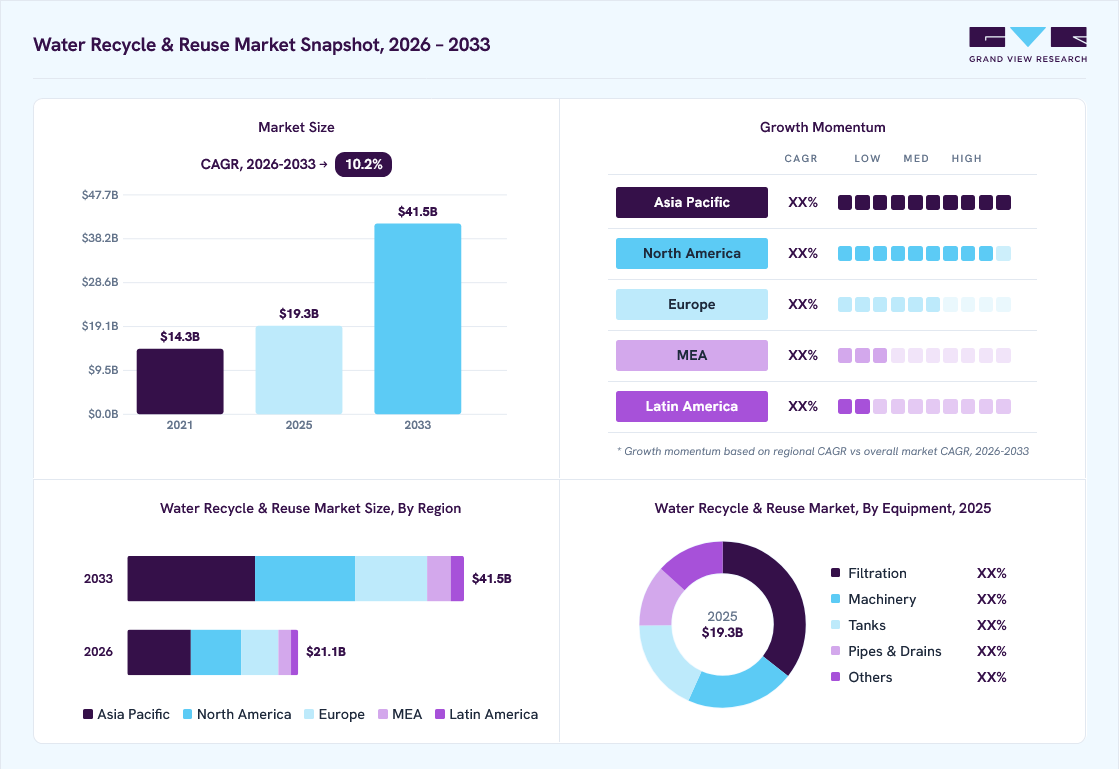
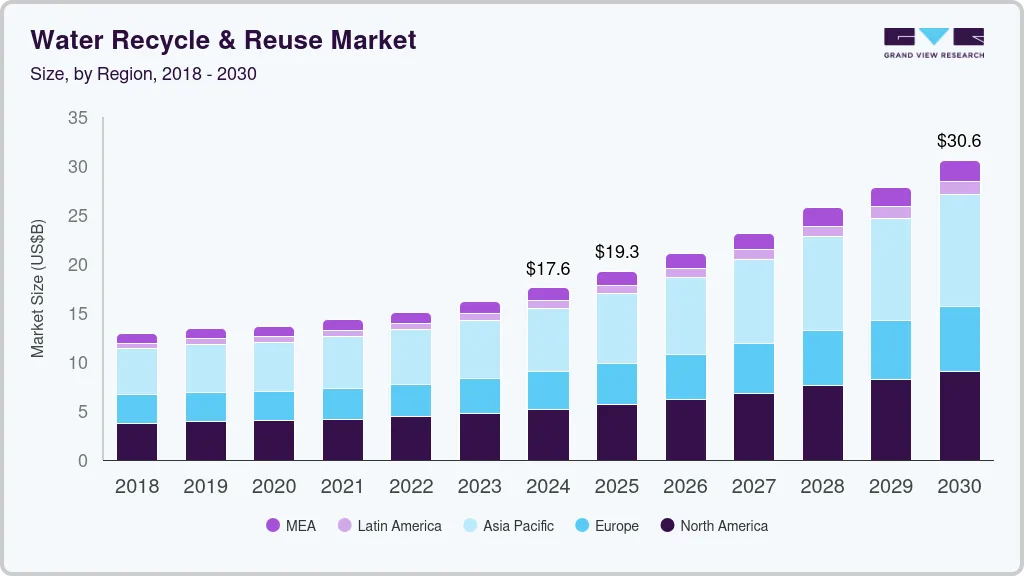
The global water recycle & reuse market size was valued at USD 19.3 billion in 2025 and is projected to grow from USD 21.1 billion in 2026 to USD 41.5 billion by 2033, at a CAGR of 10.2% from 2026 to 2033. Asia Pacific dominated the market, accounting for a revenue share of 37.0% in 2025. The increasing scarcity of freshwater resources, rising environmental awareness, and stringent regulations on wastewater discharge are driving the demand for water recycling and reuse solutions.
 Source: Grand View Research, IR Documents, Primary Interviews, Paid DatabasesTo learn more about this report,
 Download Free Sample Report
Key Market Trends & Insights
- By equipment: Filtration segment led the market with the largest revenue share of 35.5% in 2025.
- By end use: Industrial segment led the market with the largest revenue share of 47.9% in 2025.
Regional Highlights
- Largest regional market: Asia Pacific (37.0% revenue share, 2025)
- By country: China held the largest market share in Asia Pacific in 2025.
Market Size & Forecast
- Market size in 2025: USD 19.3 Billion
- Estimated market size in 2026: USD 21.1 Billion
- Projected market size by 2033: USD 41.5 Billion
- CAGR (2026-2033): 10.2%
Three ways to get this report
Buy it, customize it, or ask a question.Ask an Analyst
Analyst response in 1 business day
- AccessReport author, directly
- Reply timeWithin 1 working day
- No sales callDirect answer only
- FormatEmail reply
- CostFree, no cost
Get the Full Report
What the study covers
- FormatsPDF · Excel · Dashboard
- Timeline2026–2033 annual, 2025 base
- Coverage20+ countries, 5 regions
- Companies10+ key players profiled
Customize the Report
20% free customization
- IncludeCountries, segments, points
- TailorTo your product definition
- ExtendDeeper competitor detail
- OrA fully bespoke study
- Turnaround5–10 working days
 To learn more about this report, Download Free Sample Report
Moreover, water recycling and reuse involve the treatment of wastewater to make it suitable for various non-potable and potable applications. The process helps in conserving water resources, reducing pollution, and promoting sustainable water management practices.Market Dynamics
Growing concerns over freshwater scarcity, rising water treatment costs, and increasingly stringent environmental regulations are accelerating the adoption of water recycle and reuse solutions across residential, commercial, and industrial sectors. Governments and industries are investing in advanced water treatment infrastructure to improve water security, reduce wastewater discharge, and support sustainable resource management. Technological advancements in membrane filtration, biological treatment, UV disinfection, and digital monitoring systems are further improving the efficiency and economic viability of water recycling projects, driving market expansion.
Rapid urbanization, industrialization, and population growth are placing significant pressure on available freshwater resources worldwide. Many regions are experiencing declining groundwater levels and recurring droughts, prompting governments and industries to prioritize water recycling and reuse as a reliable alternative water source. This has increased investments in wastewater treatment facilities and decentralized water reuse systems.
At the same time, stricter environmental regulations governing wastewater discharge and industrial water consumption are encouraging organizations to adopt advanced recycling technologies. Industries are implementing closed-loop water management systems to reduce freshwater intake, lower operating costs, and comply with regulatory standards, making water recycling an integral part of long-term sustainability strategies.
The installation of water recycle, and reuse systems requires substantial investment in treatment equipment, storage infrastructure, distribution networks, and ongoing maintenance. These high upfront costs can discourage adoption, particularly among small municipalities, commercial facilities, and small and medium-sized enterprises. Additionally, upgrading existing infrastructure to integrate advanced recycling technologies often involves complex engineering and regulatory approvals, slowing project implementation.
The growing integration of IoT-enabled monitoring, AI-driven process optimization, and automated water treatment systems is creating new opportunities for the market. Smart water management solutions enable real-time monitoring of water quality, predictive maintenance, and improved operational efficiency, making recycling systems more reliable and cost-effective.
Additionally, expanding investments in industrial sustainability and circular economy initiatives are increasing demand for high-quality recycled water in manufacturing, power generation, food and beverage, pharmaceuticals, and semiconductor industries. As companies seek to reduce water-related risks and achieve environmental targets, advanced water reuse solutions are expected to witness significant growth over the forecast period.
Market Concentration & Characteristics
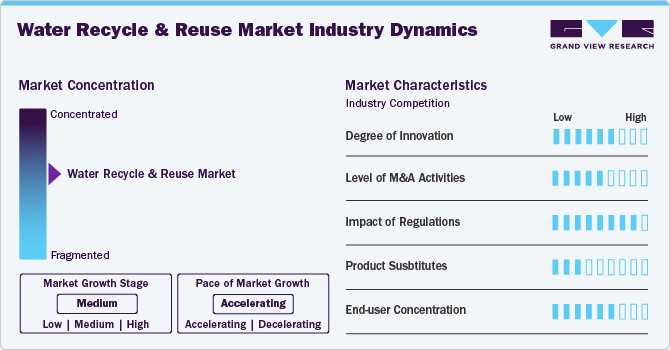
The water recycle and reuse industry displays a moderately fragmented competitive landscape, featuring a mix of established global players and emerging regional companies. Leading firms such as Veolia, SUEZ, Xylem, Pentair, and A. O. Smith maintain strong market positions with extensive product portfolios and global operations. Simultaneously, regional and local players play a significant role by addressing specific regional needs and complying with local environmental regulations and water management standards.
Market growth is primarily driven by increasing water scarcity, the rising demand for sustainable water management solutions, and stricter government regulations aimed at promoting water conservation and reducing environmental impact. Governments and municipalities are increasingly mandating the implementation of water recycling and reuse systems across industries and urban centers, fostering demand for advanced water treatment technologies and infrastructure development.
 To learn more about this report, Download Free Sample Report
Technological advancements are pivotal in shaping the water recycle and reuse industry. Innovations such as membrane filtration, reverse osmosis, UV disinfection, and smart water management systems are enhancing water quality, improving efficiency, and lowering operational costs. These technologies help industries and municipalities optimize water use, reduce waste, and meet regulatory requirements while promoting sustainability.
Regionally, the Asia-Pacific region holds a significant share of the water recycle and reuse industry, driven by rapid industrialization, urbanization, and water scarcity issues in countries such as China, India, and Southeast Asia. Europe follows with a focus on sustainability and water conservation initiatives, while North America also contributes strongly, supported by governmental policies encouraging water reuse and the growing focus on water stewardship.
Analyst Perspective
The water recycle & reuse market is expected to witness sustained growth over the forecast period, driven by increasing water scarcity, stricter environmental regulations, and rising investments in sustainable water management infrastructure. Industrial facilities remain the primary adopters due to their high water consumption and growing focus on reducing freshwater dependency and wastewater discharge. At the same time, advances in membrane filtration, digital monitoring, and energy-efficient treatment technologies are improving system performance and lowering lifecycle costs, making water recycling more economically viable. As governments promote circular water management and industries prioritize resource efficiency and ESG commitments, the market is expected to evolve from regulatory compliance toward becoming a strategic component of long-term water security and operational resilience.
End Use Insights
Based on end use, industrial segment led the market with the largest revenue share of 47.9% in 2025. The increasing adoption of water recycling and reuse solutions in various industries, such as power generation, oil & gas, chemicals, and pharmaceuticals, is driving the market demand. Moreover, industries are focusing on reducing their water footprint and complying with environmental regulations, which is boosting the adoption of water recycling and reuse systems.
The commercial sector, including hospitality, healthcare, and education, is increasingly adopting water recycle & reuse to ensure operational efficiency and reduce costs.Increasing adoption of water recycling systems in buildings, hotels, and residential complexes to reduce water consumption and promote sustainability is likely to boost the market growth over the forecast period.
Equipment Insights
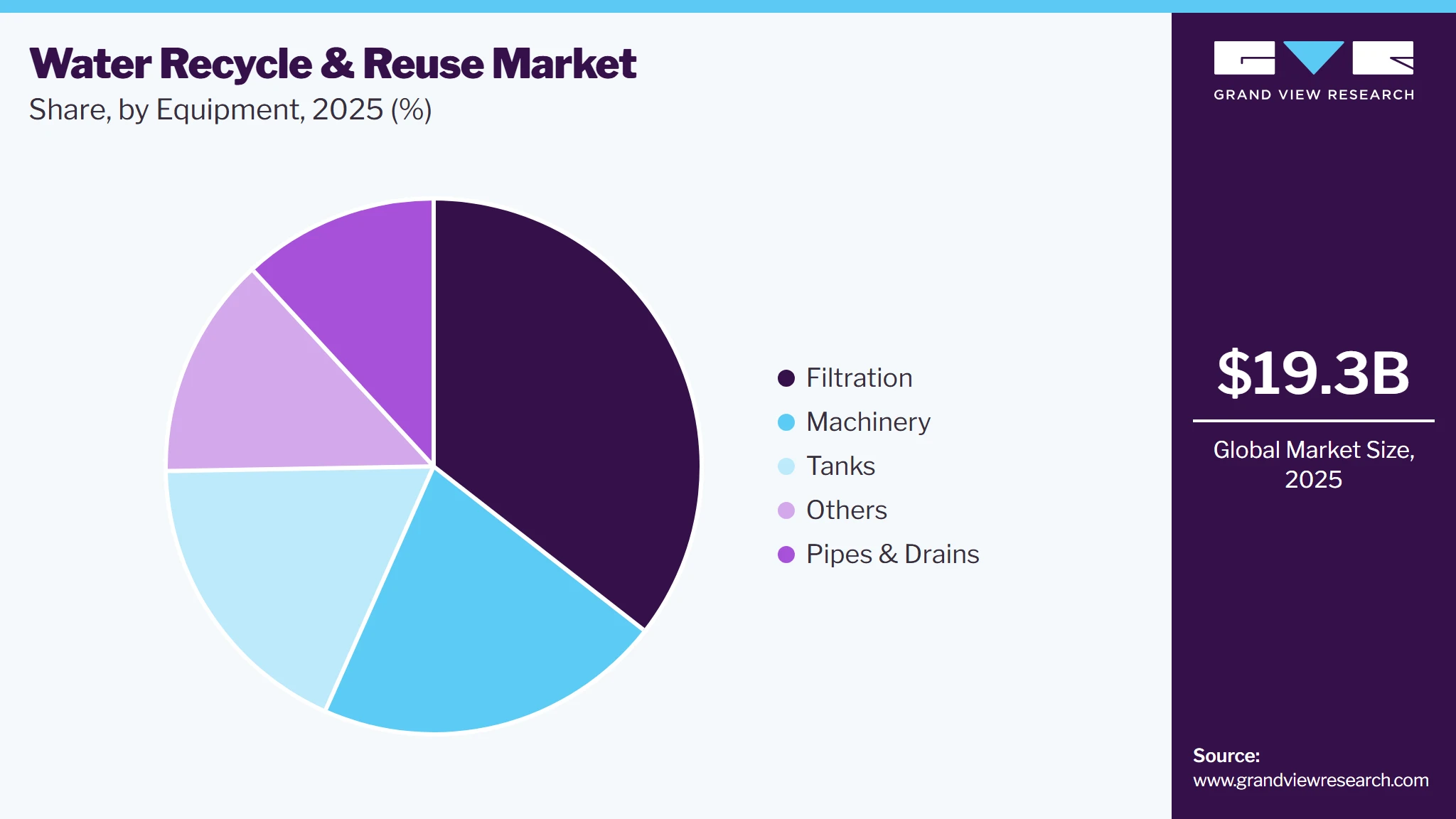
Based on equipment, filtration segment led the market with the largest revenue share of 35.5% in 2025. Filtration technologies, such as reverse osmosis, ultrafiltration, and nanofiltration, are widely used in water recycling and reuse due to their high efficiency and ability to remove a wide range of contaminants. The increasing adoption of filtration technologies in industrial and municipal water treatment applications is driving the demand in this segment.
 To learn more about this report, Download Free Sample Report
Tackling rising water scarcity and shortages, the demand for water storage solutions is also rapidly increasing for various commercial and residential applications, driving the demand for the tank equipment segment. The treated and reclaimed water is reused mostly for non-potable applications, including irrigation, sanitation purposes, firefighting, car wash, etc.
Regional Insights
The water recycle & reuse industry in North America is being shaped by increasing concerns over water scarcity and environmental sustainability. Industries and municipalities are focusing on advanced treatment technologies to improve water conservation and reduce dependency on freshwater sources. Supportive regulatory frameworks, coupled with growing public awareness, are encouraging the adoption of decentralized and smart water reuse systems.
U.S. Water Recycle & Reuse Market Trends
The water recycle & reuse industry in the U.S. is expected to grow at a CAGR of 9.6% from 2026 to 2033. The market is driven by proactive state-level initiatives and stringent environmental regulations aimed at promoting sustainable water use. Leading states are implementing innovative policies that support industrial and municipal water recycling, while technology providers are advancing solutions in membrane filtration and smart monitoring to optimize usage.
The water recycle & reuse industry in Canada is expected to grow at a CAGR of 10.9% from 2026 to 2033. Canada’s market for water recycle and reuse is growing steadily, supported by environmental policies and urban development pressures. Emphasis is placed on sustainable water practices across industries, and municipalities are investing in infrastructure that integrates advanced treatment solutions. The focus is also on ensuring long-term water security, particularly in regions vulnerable to seasonal water stress.
Europe Water Recycle & Reuse Market Trends
The water recycle & reuse industry in Europe is driven by strong regulatory standards, circular economy goals, and climate resilience initiatives, as the region is at the forefront of water reuse. The region is adopting advanced treatment technologies to support water reuse in agriculture, industry, and urban applications. Sustainability and compliance with EU directives are key priorities, encouraging innovation and cross-border collaboration.
Germany's water recycle & reuse industryis driven by rising technological innovation and integration of smart monitoring systems to ensure optimal water quality and minimal environmental impact. Urban areas are also focusing on stormwater reuse and decentralized water management.
The UK water recycle & reuse industry is driven by rising adopting of water reuse practices in response to climate variability and growing water demand in urban centers. The market is focused on infrastructure upgrades and the use of treated wastewater in non-potable applications such as agriculture and landscaping. Sustainability policies and public engagement campaigns are supporting wider acceptance and implementation.
Asia Pacific Water Recycle & Reuse Market Trends
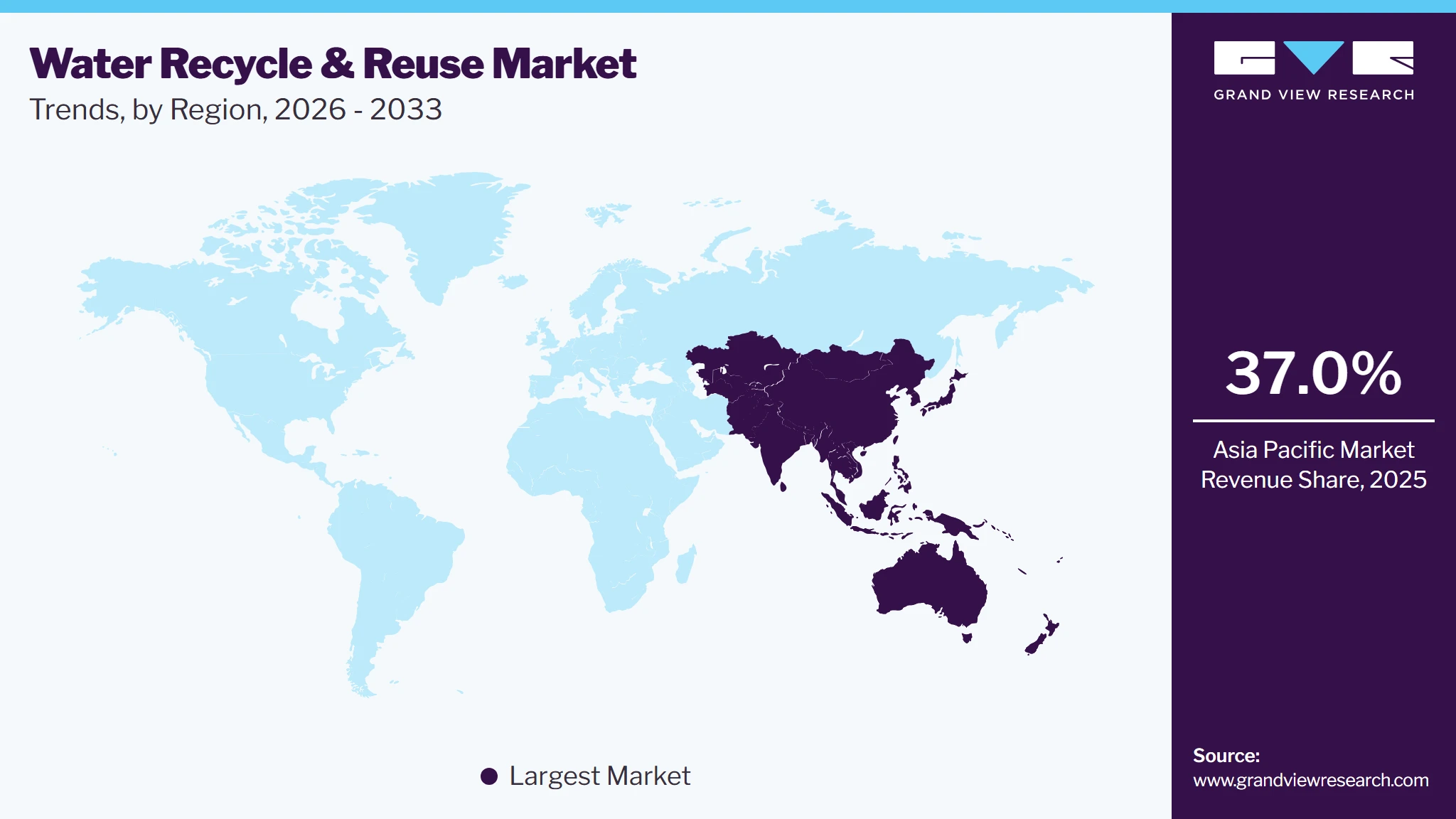
Asia Pacific dominated the water recycle & reuse market with the largest revenue share of 37.0% in 2025. The region is witnessing rapid growth in the water reuse market due to urbanization, industrial expansion, and mounting water scarcity. Governments across the region are investing in water infrastructure and encouraging industries to adopt closed-loop water systems. Technological adoption is accelerating, with a focus on cost-effective and scalable solutions tailored to diverse local needs.
 To learn more about this report, Download Free Sample Report
The water recycle & reuse market in the China held the largest share in the Asia Pacific region in 2025. China is prioritizing water reuse as part of its broader environmental and resource management strategy. Industrial sectors are key adopters, and the government supports infrastructure projects that enable large-scale wastewater treatment and recycling. Urban centers are increasingly adopting reclaimed water for landscaping, cleaning, and industrial cooling purposes.
The water recycle & reuse industry in India is expected to grow at a CAGR of 10.6% from 2026 to 2033. India’s market for water recycle & reuse is gaining momentum amid rising demand and shrinking freshwater reserves. Both public and private sectors are investing in water recycling systems, especially in urban areas and water-intensive industries. Policy initiatives and smart city programs are fostering growth, with an emphasis on low-cost, high-impact technologies for widespread implementation.
Middle East & Africa Water Recycle & Reuse Market Trends
The Middle East & Africa water recycle & reuse industry is projected to grow over the forecast period. The Middle East & Africa region is focusing heavily on water recycling due to acute water shortages and arid climate conditions. Governments are investing in large-scale desalination and wastewater reuse projects to ensure long-term water security. The market is also expanding in urban centers through integrated water resource management and sustainable development goals.
Saudi Arabia water recycle & reuse industry is anticipated to grow over the forecast period. Saudi Arabia has made water reuse a central pillar of its national water strategy. Driven by extreme water scarcity, the country is deploying advanced treatment technologies and building infrastructure to recycle wastewater for agricultural, industrial, and municipal applications. Policy mandates and investment in smart water systems are accelerating market growth.
Latin America Water Recycle & Reuse Market Trends
Latin America water recycle & reuse industry is projected to grow over the forecast period. Latin America is gradually embracing water reuse as a strategic response to water stress and urbanization. The market is being shaped by initiatives to modernize water infrastructure and reduce environmental pollution. Regional governments are promoting treated wastewater use in agriculture and industry, while international collaboration is helping build technical capacity.
Brazil water recycle & reuse industry is projected to grow over the forecast period. In Brazil, water reuse is emerging as a critical solution to address water scarcity, especially in densely populated and drought-prone regions. Industrial zones and municipal authorities are beginning to implement advanced treatment systems for non-potable applications. Regulatory development and growing environmental awareness are driving gradual but steady progress.
Key Water Recycle & Reuse Company Insights
Some of the key players operating in the market include Veolia, Fluence Corporation Limited, Kubota Corporation, Siemens, among others.
-
Veolia is a leading provider of water recycling and reuse solutions, offering a wide range of technologies and services for various applications. The company’s focus on innovation, efficiency, and sustainability has solidified its position in the market.
-
Siemens Water Technologies specializes in providing advanced water treatment solutions for industrial and municipal applications. The company’s products are recognized for their durability, efficiency, and advanced technology.
Dow Corporate, Evoqua Technologies & Solutions, Hitachi Ltd., Membracon, Genesis Water Technologies Inc., are some of the emerging market participants in the water recycle & reuse industry.
-
Hitachi Ltd. is known for its advanced water treatment technologies and high-quality products. The company offers a range of solutions that cater to the needs of different industries, ensuring reliable and efficient water recycling operations.
-
Dow Corporate, Dow Water & Process Solutions division, is a key player in the market, offering a comprehensive range of water treatment technologies, including reverse osmosis and ultrafiltration systems. The company’s focus on quality, innovation, and customer-centric solutions has strengthened its market position.
Key Water Recycle And Reuse Companies:
The following key companies have been profiled for this study on the water recycle & reuse market.
-
Veolia
-
Evoqua Technologies & Solutions
-
Fluence Corporation Limited
-
Dow Corporate
-
Hitachi Ltd.
-
Kubota Corporation
-
Siemens
-
Alfa Laval
-
Hydraloop
-
Membracon
-
Toshiba Infrastructure Systems & Solutions Corporation
-
Genesis Water Technologies Inc.
-
NEWater China
Competitive Benchmarking
Category
Operating Strategies
Competitive Edge
Weakness
Established Players (e.g., Veolia; Fluence Corporation Limited; Xylem; Pentair; Siemens)
- Established companies in the water recycle and reuse market focus on long-term municipal contracts, industrial partnerships, technology upgrades, and expansion of integrated water treatment services.
- Many companies invest in membrane filtration, desalination, digital monitoring, and wastewater recovery technologies to improve operational efficiency.
- Large companies benefit from strong engineering capabilities, established distribution networks, broad project portfolios, and experience in regulatory compliance.
- Their ability to handle large-scale municipal and industrial projects supports customer confidence and long-term contracts. Mature players also possess stronger financial resources for research, infrastructure investment, and acquisitions.
- Established firms often face challenges related to high operating costs, complex organizational structures, and slower decision-making processes.
- Dependence on large infrastructure projects and government approvals can increase project delays and financial risks. In some cases, legacy systems and higher maintenance requirements may reduce operational flexibility.
Emerging & Regional Players (e.g., Dow Corporate; Hitachi Ltd.; Membracon; Genesis Water Technologies Inc.)
- Emerging companies mainly focus on modular treatment systems, decentralized recycling solutions, and specialized industrial wastewater applications.
- Many prioritize flexible project execution, technology partnerships, and lower-cost treatment solutions targeting commercial facilities and small industries.
- Smaller companies benefit from faster technology adoption, flexible business models, and specialization in niche treatment applications.
- Emerging players often provide cost-competitive solutions for decentralized recycling projects and smaller industrial users.
- Emerging firms may face limitations related to restricted financial resources, smaller production capacity, and limited geographic reach.
- Lower brand recognition and reduced experience in large-scale municipal projects can affect customer trust and contract acquisition.
Recent Developments
-
In March 2025, El Paso Water broke ground on the Pure Water Center in Texas, marking the nation's first direct-to-distribution potable reuse facility. The project is set to be built by a joint venture between PCL and Sundt Construction and will treat secondary effluent from the Roberto R. Bustamante Wastewater Treatment Plant to produce up to 10 million gallons of high-quality purified water per day. With construction now underway, the facility is expected to be operational by 2028.
-
In April 2023, Hydraloop launched water recycling systems for residential purposes, which recycle water from baths, showers, and laundry activities. The new system enables the reuse of water for flushing toilets and irrigation of gardens and landscaping.
-
In March 2022, WOTA Corp. and Kao entered into a partnership in the water and sanitation field. This partnership is expected to create new opportunities in the market.
Water Recycle & Reuse Market Report Scope
Report Attribute
Details
Market size in 2025
USD 19.3 billion
Estimated market size in 2026
USD 21.1 billion
Projected market size by 2033
USD 41.5 billion
Growth rate
CAGR of 10.2% from 2026 to 2033
Base year for estimation
2025
Historical data
2021 - 2024
Forecast period
2026 - 2033
Quantitative units
Revenue in USD billion and CAGR from 2026 to 2033
Report coverage
Revenue forecast, company ranking, competitive landscape, growth factors, and trends
Segments covered
Equipment, end use, region
Regional scope
North America; Europe; Asia Pacific; Latin America; Middle East & Africa
Country scope
U.S.; Canada; Mexico; Germany; France; Italy; UK; Spain; China; Japan; India; South Korea; Australia; Brazil; Argentina; South Africa; Saudi Arabia; UAE
Key companies profiled
Veolia; Kurita Water Industries Ltd.; Fluence Corporation Limited; Xylem; TORAY INDUSTRIES, INC.; Pentair; Dow Chemical Company; Hitachi Ltd.; Kubota Corporation; Siemens; Alfa Laval; Hydraloop; Membracon; Toshiba Infrastructure Systems & Solutions Corporation; Genesis Water Technologies Inc.; NEWater China.
Customization scope
Free report customization (equivalent up to 8 analysts' working days) with purchase. Addition or alteration to country, regional & segment scope.
Pricing and purchase options
Avail customized purchase options to meet your exact research needs. Explore purchase options
Global Water Recycle & Reuse Market Report Segmentation
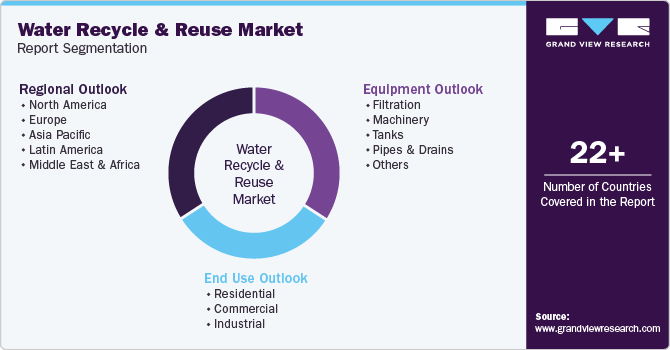
This report forecasts revenue growth at global, regional & country levels and provides an analysis on the industry trends in each of the sub-segments from 2021 to 2033. For this study, Grand View Research has segmented the global water recycle & reuse market report based on equipment, end use, and region:
 To learn more about this report, Download Free Sample Report
-
Equipment Outlook (Revenue, USD Million; 2021 - 2033)
-
Filtration
-
Machinery
-
Tanks
-
Pipes & Drains
-
Others
-
-
End Use Outlook (Revenue, USD Million; 2021 - 2033)
-
Residential
-
Commercial
-
Industrial
-
-
Regional Outlook (Revenue, USD Million; 2021 - 2033)
-
North America
-
U.S.
-
Canada
-
Mexico
-
-
Europe
-
UK
-
Germany
-
France
-
Italy
-
Spain
-
-
Asia Pacific
-
Japan
-
China
-
India
-
Australia
-
South Korea
-
-
Latin America
-
Brazil
-
Argentina
-
-
Middle East & Africa
-
South Africa
-
Saudi Arabia
-
UAE
-
-
Research Methodology
The water recycle & reuse market figures in this report are based on a proven research process that combines executive interviews with secondary research from proprietary databases, company filings, and recognized regulatory and institutional sources. Market size is built through value-chain sizing - reconciling supply-side and demand-side estimates - and triangulated with bottom-up and top-down approaches. Every estimate passes multiple levels of expert validation before publication, with each water recycle & reuse segment quantified using the revenue-capture definitions in the table below.
Segment Definition
Equipment
Revenue Capture Definition
Filtration
Revenue generated from the sale of filtration systems and components, including membrane filtration, sand filters, activated carbon filters, microfiltration, ultrafiltration, nanofiltration, and reverse osmosis systems used in water recycling and reuse applications.
Machinery
Revenue generated from sales of water treatment machinery such as pumps, blowers, mixers, aerators, clarifiers, dosing systems, sludge handling equipment, and other mechanical systems used in water recycling facilities.
Tanks
Revenue generated from sale of the storage and process tanks used for raw water, treated water, reclaimed water, sludge storage, and equalization in water recycling and reuse systems.
Pipes & Drains
Revenue generated from the sales of piping networks, drainage systems, valves, fittings, and related conveyance infrastructure designed for the transport and distribution of wastewater and reclaimed water.
Others
Revenue generated from sales of ancillary equipment and components, including UV disinfection systems, sensors, monitoring instruments, control panels, chemical dosing units, and other solutions used in water recycling operations.
End Use
Revenue Capture Definition
Residential
Revenue generated from sale of water recycling and reuse systems in residential buildings, housing complexes, and individual homes for applications such as greywater recycling, rainwater harvesting, toilet flushing, landscape irrigation, and other non-potable water uses.
Commercial
Revenue generated from sale of water recycling and reuse solutions deployed in commercial buildings, hotels, shopping malls, office complexes, educational institutions, hospitals, airports, and other commercial facilities to reduce freshwater consumption and improve water efficiency.
Industrial
Revenue generated from sales of water recycling and reuse systems across industries such as manufacturing, food & beverages, chemicals, pharmaceuticals, power generation, mining, semiconductors, oil & gas, and pulp & paper for process water recovery, wastewater treatment, and water reuse applications.
Estimation Model
Layer Name
Key Question
Description
Water Demand & Reuse Potential Assessment
Where is the demand for water recycle and reuse solutions generated?
The first layer estimates the addressable market in residential, commercial, and industrial sectors by evaluating freshwater scarcity, wastewater generation, industrial water consumption, urbanization, and regulatory policies.
Technology & Equipment Adoption Analysis
Which equipment categories are being adopted to enable water recycling?
This layer assesses the penetration of filtration systems, treatment machinery, storage tanks, pipes & drains, and supporting equipment based on technology adoption, replacement cycles, project investments, and operational requirements across end-use industries.
End-Use Deployment Analysis
Which end-use sectors contribute the highest demand for water recycle and reuse systems?
This layer evaluates equipment deployment across residential, commercial, and industrial applications by analyzing installed capacity, capital expenditure, water reuse projects, regulatory compliance, and sector-wise adoption trends.
Revenue Estimation
What is the total revenue generated by the water recycle & reuse market?
The final layer calculates market revenue by combining equipment sales, replacement demand, and end-use adoption rates across regions to derive the overall market size and forecast.
Delivered Customizations
This report has been delivered with the following In-depth customizations
Client Request
Customization Delivered
Value Adds
Regional Segmentation
Detailed analysis of the water recycle & reuse market across North America, Europe, Asia Pacific, Latin America, and Middle East & Africa, including country-level evaluation. The study assessed wastewater treatment infrastructure, industrial water reuse adoption, desalination activities, freshwater scarcity trends, and regulatory frameworks influencing recycled water demand across regional markets.
Helps identify regions with increasing investments in wastewater treatment, industrial water recycling, and sustainable water infrastructure projects. Supports regional expansion planning and prioritization of high-growth water recycle and reuse markets.
Opportunity Assessment
Identification of growth opportunities linked to rising water scarcity, industrial wastewater treatment demand, municipal water reuse projects, desalination investments, smart water management systems, and adoption of advanced membrane filtration technologies. The study also evaluated opportunities in ancillary systems, decentralized water treatment facilities, and sustainable industrial water management infrastructure development.
Helps companies align long-term growth strategies with water conservation activities, sustainability initiatives, and increasing investments in wastewater recycling infrastructure. Supports investment planning and market expansion strategies.
Competitive Benchmarking
Detailed benchmarking of key water recycle & reuse companies based on treatment technology portfolio, automation capabilities, geographic presence, distribution network, after-sales service, and positioning across municipal and industrial water treatment applications. The study also assessed innovation in membrane filtration, digital water monitoring systems, and energy-efficient recycling technologies.
Provides a clearer understanding of technology capabilities, product differentiation, and competitive positioning within the water recycle & reuse market. Helps identify partnership opportunities, expansion strategies, and technology development gaps.
Frequently Asked Questions About This Report
The global water recycle & reuse market size was estimated at USD 19.3 billion in 2025 and is projected to grow from USD 21.1 billion in 2026.
The global water recycle & reuse market, in terms of revenue, is expected to grow at a compound annual growth rate of 10.2% from 2026 to 2033 to reach USD 41.5 billion by 2033.
The filtration segment dominated the market, accounting for 35.5% of the global revenue share in 2025, driven by its extensive use in removing contaminants and enabling high-quality water recovery across municipal and industrial recycling applications.
The industrial segment led the market with a 47.9% revenue share in 2025, supported by increasing adoption of water recycling systems in industries such as power generation, chemicals, food & beverages, pharmaceuticals, semiconductors, and manufacturing to reduce freshwater consumption and comply with environmental regulations.
China accounted for the largest share of the Asia Pacific market in 2025, supported by large-scale investments in municipal wastewater treatment, industrial water reuse projects, and stringent water conservation policies.
Asia Pacific held the largest market share of 37.0% in 2025, driven by rapid industrialization, urbanization, increasing water stress, and significant government investments in wastewater treatment and water reuse infrastructure.
The market is primarily driven by growing freshwater scarcity and stringent water conservation regulations, which are encouraging municipalities and industries to adopt advanced water recycling and reuse systems to improve water security, reduce wastewater discharge, and achieve sustainability goals.
Some of the key players operating in the water recycle & reuse market include Veolia; TORAY INDUSTRIES, INC.; Fluence Corporation Limited; Xylem; Kurita Water Industries Ltd.; Pentair; Dow Chemical Company; Hitachi Ltd.; Kubota Corporation; Siemens; Alfa Laval; Hydraloop; Membracon; Toshiba Infrastructure Systems & Solutions Corporation; Genesis Water Technologies Inc.; NEWater China.
About the Author(s)
Water & Sludge Treatment Research Team
Bulk Chemicals · Water & Sludge TreatmentThis report was authored by the water & sludge treatment research team at Grand View Research - comprising two research analysts, one senior research analyst, and one industry expert - with specialized expertise in the water & sludge treatment segment of the bulk chemicals industry. All findings are based on proprietary bulk chemicals databases, executive interviews, and regulatory analysis, subject to internal peer review prior to publication.
Last Updated:
Speak to Analyst

Customize this report to your needs - add regions, segments, or data points, with 20% free customization.
Or view our licence options:


ISO 9001:2015 & 27001:2022 Certified
We are GDPR and CCPA compliant! Your transaction & personal information is safe and secure. For more details, please read our privacy policy.


