
- Home
- »
- Medical Devices
- »
-
Wellness Retreats Market Size, Share & Trends Report, 2033GVR Report cover

Wellness Retreats Market (2026 - 2033)
Size, Share & Trends Analysis Report By Retreat Type (Yoga & Meditation Retreats, Fitness & Weight Management Retreats), By Duration (3-5 Nights, 7 Nights, 2-3 Nights), By Setting, By Region, And Segment Forecasts
Market Size, 2025
$192.9BMarket Estimate, 2026
$210.3BMarket Forecast, 2033
$402.1BCAGR, 2026–2033
9.7%Wellness Retreats Market Summary
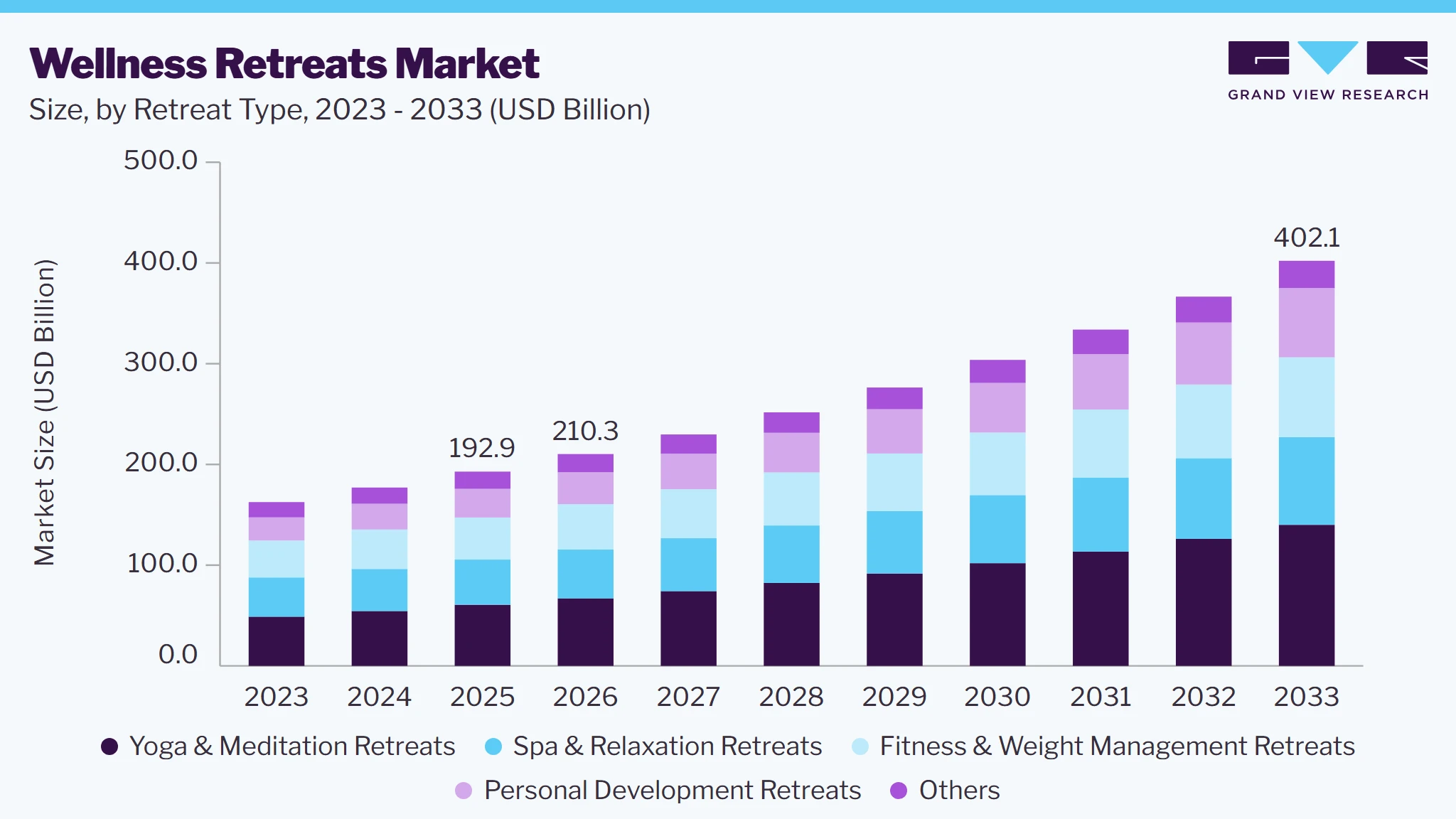
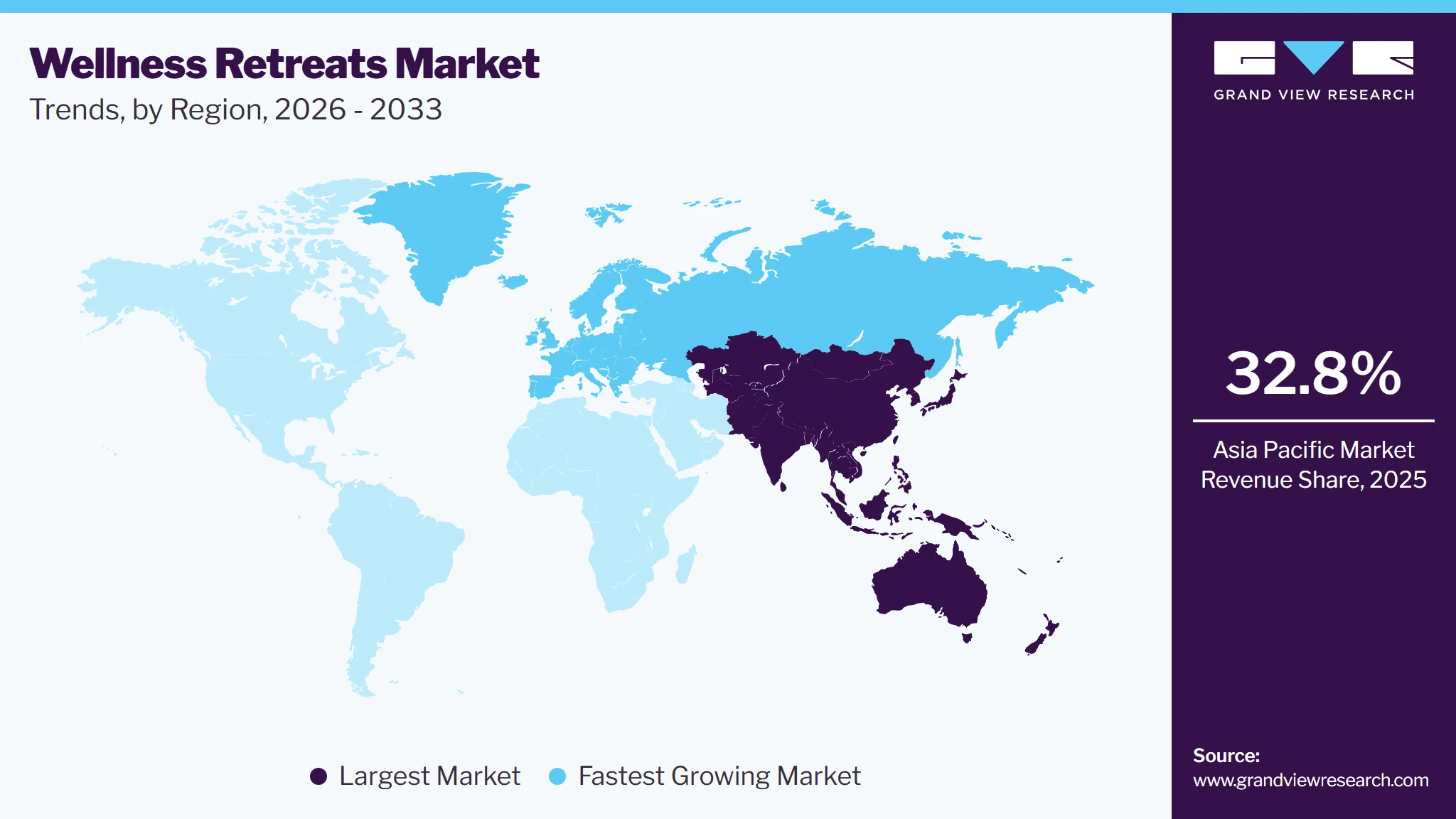
The global wellness retreats market size was valued at USD 192.9 billion in 2025 and is projected to grow from USD 210.3 billion in 2026 to USD 402.1 billion by 2033, at a CAGR of 9.7% from 2026 to 2033. Asia Pacific dominated the market, accounting for the largest revenue share of 32.8% in 2025. This growth is driven by the rising consumer focus on physical & mental well-being, increasing awareness of preventive health, growing stress & burnout levels, and rising demand for holistic health experiences.
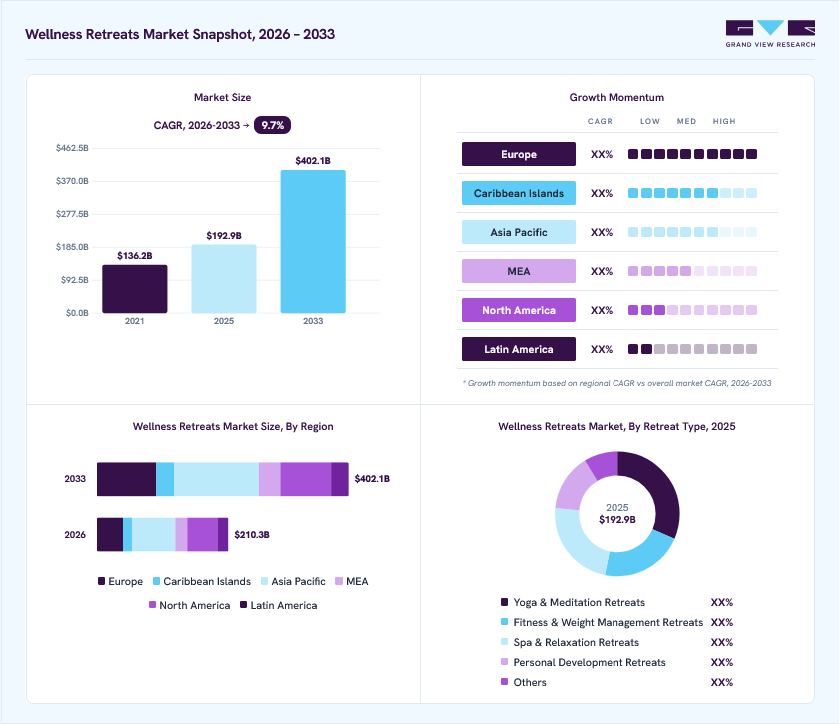 Source: Grand View Research, IR Documents, Primary Interviews, Paid DatabasesTo learn more about this report,
 Download Free Sample Report
Key Market Trends & Insights
- By retreat type: The yoga & meditation retreats segment held the largest revenue share of 31.5% in 2025.
- By duration: The 3 -5 nights’ segment held the largest revenue share of 51.3% in 2025.
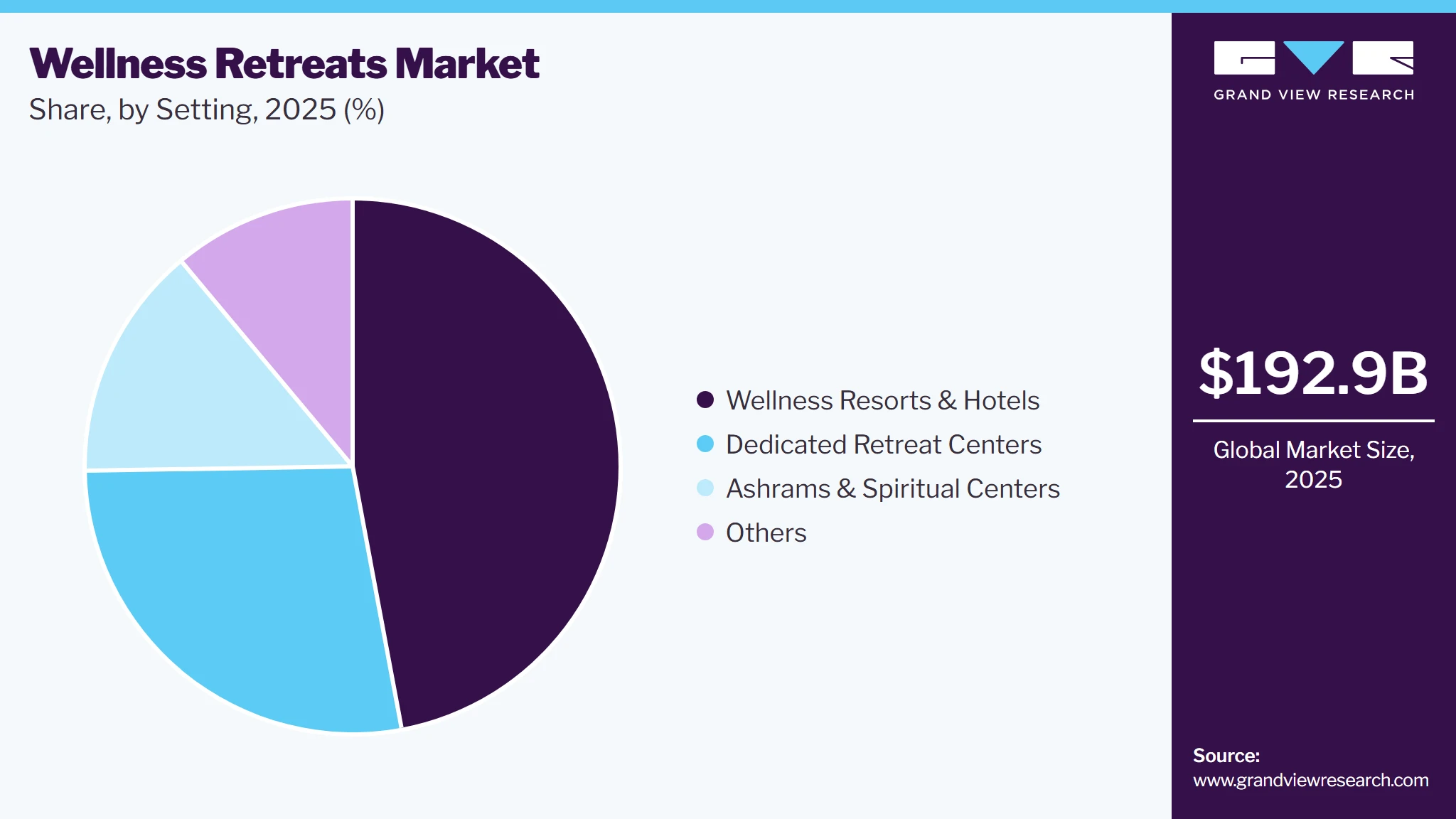
- By setting: The wellness resorts & hotels segment held the largest revenue share of 47.1%in 2025.
Regional Highlights
- Largest regional market: Asia Pacific (32.8% revenue share, 2025)
- Fastest-growing regional market: Europe (highest CAGR, 2026-2033)
- By country: The Thailand dominated the Asia Pacific with the largest revenue share in 2025
Market Size & Forecast
- Market size in 2025: USD 192.9 Billion
- Estimated market size in 2026: USD 210.3 Billion
- Projected market size by 2033: USD 402.1 Billion
- CAGR (2026-2033): 9.7%
Three ways to get this report
Buy it, customize it, or ask a question.Ask an Analyst
Analyst response in 1 business day
- AccessReport author, directly
- Reply timeWithin 1 working day
- No sales callDirect answer only
- FormatEmail reply
- CostFree, no cost
Get the Full Report
What the study covers
- FormatsPDF · Excel · Dashboard
- Timeline2026–2033 annual, 2025 base
- Coverage20+ countries, 5 regions
- Companies10+ key players profiled
Customize the Report
20% free customization
- IncludeCountries, segments, points
- TailorTo your product definition
- ExtendDeeper competitor detail
- OrA fully bespoke study
- Turnaround5–10 working days
 To learn more about this report, Download Free Sample Report
Moreover, increasing disposable incomes and the expansion of wellness tourism are further supporting market growth. In addition, the growing preference for experiential travel and personalized wellness programs is also encouraging consumers to choose dedicated retreats over conventional vacations.Market Dynamics
The market is witnessing increasing diversification of wellness retreats with personalized programs, digital wellness, physical activities, nutrition guidance, mindfulness programs, and nature-based wellness experiences. The trend toward diversifying wellness retreats with holistic treatments, yoga and meditation practices, sleep-enhancement programs, detoxification and nutrition programs, and stress-management activities is becoming increasingly evident. The use of technology such as wearables, digital health evaluations, and personal wellness tracking is contributing to this trend.
The growing focus on mental health, stress reduction, and emotional resilience is causing more people to seek wellness retreats. People are increasingly seeking travel experiences that combine relaxation, mindfulness, meditation, better sleep, exercise, and psychological well-being into a single package. According to the Global Wellness Institute's 2025 Wellness Tourism Initiative Trends report, integrative mental health retreats are emerging as a major trend in wellness tourism, combining evidence-based approaches such as psychotherapy with meditation, yoga, and breathwork. The report also reveals a growing need for brain wellness and stress management programs, urging retreat centers to develop unique mental wellness offerings.
Background
Consumer wellness preferences are shifting from reactive healthcare toward proactive and holistic self‑care, emphasizing mental and emotional well‑being as a key component of overall wellness. Circana’s April 2026 consumer insights highlight this trend, showing that consumers are increasingly investing in activities and products intended to manage stress, improve emotional well‑being, and support overall health.
Key Findings
• 67% of Americans currently practice mental and emotional self‑care, increasing from 59% in 2022.
• 60% of U.S. consumers are actively attempting to manage or reduce stress as part of their health and wellness efforts.
• 37% of consumers identify reducing stress and anxiety as their top personal health and wellness goal.
• 26% of consumers have incorporated achieving greater joy and happiness into their health and wellness priorities.
• Demand is expanding across stress‑management products, sleep and recovery solutions, and other personalized wellness technologies.Relevance to the Market
The findings indicate a favorable demand environment for wellness retreats centered on stress reduction, mental rejuvenation, mindfulness, sleep improvement, emotional well‑being, and holistic self‑care. The growing proportion of consumers practicing mental and emotional self‑care suggests that wellness retreats can position themselves as proactive lifestyle and well‑being experiences rather than leisure vacations. Rising interest in personalized wellness and sleep/recovery solutions creates opportunities for operators to integrate meditation, mindfulness, stress‑management programs, sleep optimization, digital detox, yoga, and personalized wellness programs into retreat packages. This supports a broader transition of wellness retreats toward holistic mind‑body experiences and provides strong demand‑side rationale for market growth.
Market Research Implication
For wellness retreat markets, this case study supports mental and emotional wellness as a key demand driver, particularly among consumers seeking preventive, personalized, and experience‑based approaches to well‑being. It also indicates an opportunity for operators to diversify beyond traditional spa and fitness offerings toward structured programs addressing stress, anxiety, sleep, mindfulness, and emotional resilience.
The growing trend of implementing wellness programs in hospitality establishments has increased the availability of various retreat programs. Hotels and resorts have been increasingly adding dedicated wellness retreats, yoga and meditation classes, spa services, fitness centers, nature-based activities, and tailor-made wellness programs to their portfolios. This enables the hospitality industry to cater to tourists seeking wellness experiences. For instance, in July 2025, Accor announced the opening of Fairmont Udaipur Palace in India, featuring a dedicated wellness sanctuary and experiences centered on rejuvenation and the region's heritage. The property includes 327 rooms and suites, an 18-acre estate, and a wellness offering integrated into the resort experience.
Moreover, WorldHotels’ July 2026 expansion provides a significant industry instance of the growing integration of wellness retreats and experience-driven travel into premium hospitality portfolios. The company reported more than 40 hotels in development after adding approximately 100 hotels in 2025, with its expansion strategy increasingly incorporating wellness retreats, outdoor hospitality, and distinctive experiential properties. Examples include Hotel Terme San Michele & SPA in Italy, which offers thermal pools and spa experiences, and Asheville River Cabins in North Carolina, which provides nature-focused retreat experiences. The addition of properties such as Acqua di Mare Resort in Honduras further demonstrates the growing emphasis on destination-based leisure and nature experiences. This expansion indicates that major hospitality groups are increasingly using wellness, nature, authenticity, and immersive experiences as portfolio-growth strategies, supporting the broader demand outlook for wellness retreats and experiential travel.
Major Hotel Chains Increasingly Integrate Wellness as a Core Hospitality Offering
The hospitality industry is witnessing a growing shift toward wellness-integrated hotels and dedicated wellness brands, as major hotel chains increasingly view wellness as a core commercial opportunity instead of an ancillary amenity. In April 2026, HOTELS Magazine highlighted how Marriott, Hyatt, and IHG have expanded their wellness strategies through initiatives such as Marriott’s partnership with Lefay, Hyatt’s Miraval platform, and IHG’s acquisition of Six Senses. The trend is also moving beyond conventional spa services toward multiday wellness programs, wellness-focused food and beverages, outdoor experiences, personalized treatments, memberships, and curated retreat programming. This is encouraging hotels and independent retreat operators to monetize wellness through ancillary revenue streams and differentiated guest experiences, thereby supporting the expansion of the broader wellness retreats industry.
In June 2026, Marriott announced a partnership with Italy’s Lefay to develop a luxury wellness brand, illustrating how major hotel groups are increasingly creating dedicated wellness propositions instead of treating wellness as a supplementary hotel service
The relatively high cost of wellness retreats can limit market accessibility, especially for price-sensitive customers. Wellness retreats typically include accommodation and a variety of other features, such as specialized wellness professionals, customized programs, spas, healthy food, exercise sessions, and luxurious destinations. All these factors make wellness retreats much more expensive than traditional leisure travel. In addition, the premium nature of many retreats makes them inaccessible to budget travelers. For instance, in June 2025, The Washington Post reported that luxury wellness retreats, such as Mountain Trek in British Columbia, were charging approximately USD 6,900 per person for a week-long program, while others were priced at more than USD 14,000. The report also highlighted the challenge of integrating retreat-based wellness practices into everyday life after returning home.
The integration of traditional wellness practices with systematic, science-based health and wellness programs offers retreat facilities an opportunity to distinguish themselves and attract international wellness tourists. Places that have already gained experience in such disciplines as Ayurveda, Yoga, meditation, naturopathy, nutrition, and many others can create special retreat programs by merging traditional wellness methods with modern wellness services. For instance, in May 2025, researchers from ESIC Medical College, NIMHANS, and the University of Washington published research highlighting the opportunity for India to expand the export of evidence-based wellness services by leveraging its established expertise in Ayurveda, Yoga, and Naturopathy and other traditional systems. The research emphasizes the potential for government initiatives, international recognition of Indian certifications, and structured development of wellness services to support international demand.
Market Characteristics
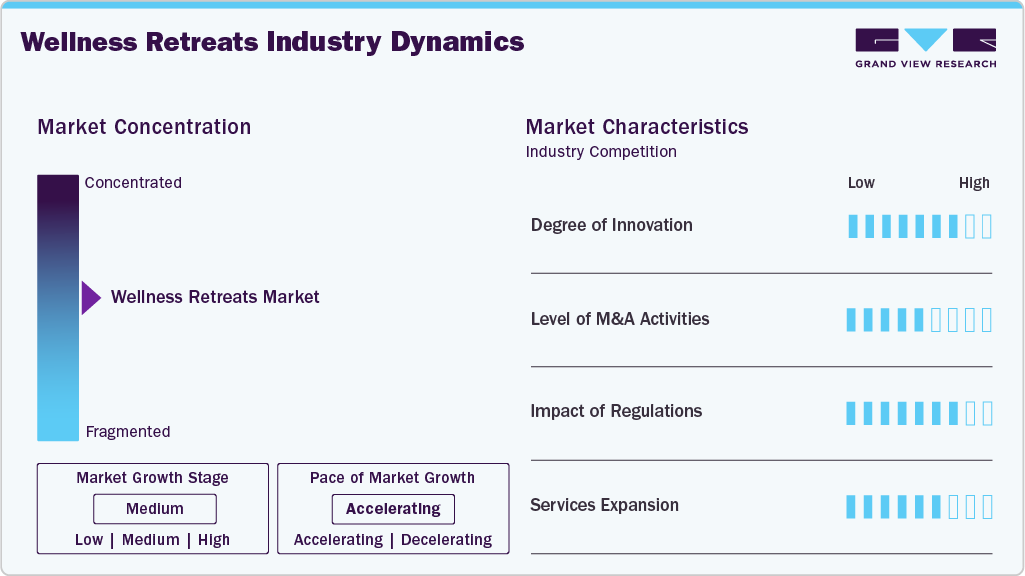
The chart below illustrates the relationship between industry concentration, industry characteristics, and key market participants in the wellness retreats industry. The market is moderately fragmented, with the presence of hospital-affiliated providers, independent infusion center operators, and specialty pharmacy networks.
The wellness retreats industry is experiencing significant innovation, driven by personal wellness programs, diagnostics, artificial intelligence, longevity programs, and data-driven health optimization. Wellness retreat providers are incorporating technology into nutrition, sleep, exercise, mindfulness, and preventive wellness programs. For instance, in March 2025, SHA Wellness Clinic introduced its Tailor-Made Health Optimization Program, integrating advanced diagnostic assessments with an AI-based algorithm to create personalized wellness plans. The program addresses areas such as nutrition, sleep, stress management, mindfulness, and preventive health, demonstrating the growing integration of artificial intelligence and data-driven tools into wellness retreat programs.
 To learn more about this report, Download Free Sample Report
The level of M&A activity is moderate, as hospitality companies are entering the wellness segment and acquiring established wellness retreat operators to strengthen their portfolios and tap into growing demand for wellness tourism. For instance, in November 2025, Indian Hotels Company (IHCL) announced an agreement to acquire a 51% stake in Sparsh Infratech, the owner of Atmantan wellness retreat, for USD 2.51 million. The transaction marked IHCL's increased presence in the integrated wellness segment and provided access to Atmantan's established wellness programs and expertise.
The wellness retreats industry is moderately influenced by regulations, as companies are subject to laws governing tourism, hospitality, health and safety, sanitation, and practitioners' licensing, as well as destination-based laws. There are also more regulatory and accreditation programs being developed to enhance service delivery and consumer satisfaction. For instance, in August 2026, the Goa Tourism Department announced plans to introduce the 'Leaf' accreditation program for wellness centers, covering areas such as cleanliness, service quality, trained staff, and authenticity of wellness practices. Such initiatives are increasing the emphasis on standardized quality and professional practices across wellness destinations.
Market participants are actively expanding their wellness retreat offerings through specialized programs focused on mindfulness, meditation, movement, nature, relationships, sleep, and holistic well-being. For instance, in March 2026, Banyan Tree expanded its Connections wellness program by introducing Connections Retreats, which offer a series of wellness journeys for a limited number of participants and which include elements of mindfulness, movement, meditation, and activities specific to each destination. In addition, the company was planning to expand the private Connections program to eight more destinations.
Analyst Perspective
The wellness retreats market is experiencing strong growth, driven by increasing consumer focus on holistic well-being, rising demand for experiential travel, and growing adoption of wellness-focused tourism. Travelers are increasingly participating in wellness retreats that integrate fitness, diet, meditation, yoga, spa treatments, outdoor exercise, and wellness programs for their physical and mental well-being. The emergence of luxury hospitality, wellness resorts, corporate wellness programs, and customized services plays an important role in increasing the demand. In addition, the emergence of digital wellness platforms, health assessments, wearable technologies, wellness apps, and wellness retreats improves customization and engagement. The rising significance of preventive wellness, self-care, customized experiences, and health-based travel is assisting the competitiveness of wellness retreat providers with their wellness programs, premium facilities, and unique locations.
Retreat Type Insights
The yoga & meditation retreats segment led the market with the largest revenue share of 31.5% in 2025. The category is boosted by the increasing popularity of yoga, meditation, mindfulness, breathwork, and other techniques as a means to relax and manage stress more easily. These retreats are popular among consumers who want to enhance their physical and mental well-being. For instance, in February 2026, the Global Wellness Institute highlighted wellness getaways and yoga retreats as part of Thailand's rapidly expanding wellness tourism sector, reflecting continued consumer and destination-level interest in yoga- and mindfulness-oriented travel experiences.
The personal development retreats segment is anticipated to grow at the fastest CAGR during the forecast period. Growth is supported by increasing consumer interest in self-discovery, emotional resilience, life coaching, leadership development, stress management, and personal transformation. The program developers are coming up with special programs for the purpose of fulfilling the development goals of individuals in an immersive environment outside their normal working and private lives. The broader wellness retreat industry has begun incorporating life coaching, leadership development, emotional intelligence, self-discovery, empowerment, and resilience programs.
Duration Insights
The 3-5-night segment led the market with the largest revenue share of 51.3% in 2025. Retreats of this duration provide sufficient time for consumers to participate in multiple wellness activities while remaining shorter and more accessible than extended programs. They commonly combine yoga, meditation, fitness, nutrition, spa treatments, mindfulness, and relaxation activities within a structured multi-day itinerary. The availability of programs spanning several nights across wellness destinations supports demand for medium-duration retreats. Current wellness retreat offerings include programs ranging from three nights to longer stays, demonstrating the availability of this format across the industry. For instance, in September 2025, Sarovar Hotels launched The Shoonyam Retreat, held at Marasa Sarovar Premiere in Bodhgaya, as a series of 3-night immersive wellness programs that combine yoga, meditation, healing therapies, and mindful living. This demonstrates the availability and commercial adoption of multi-night wellness retreat formats.
The 2-3-night segment is anticipated to grow at the fastest CAGR during the forecast period, driven by rising consumer preference for shorter wellness vacations that fit into their busy schedules. Shorter vacation packages take less time and cost less, and offer consumers opportunities for stress relief, mindfulness, exercise, and relaxation. For instance, in November 2025, wellness retreat Camp KA in La Quinta, California, was conducted as an intimate three-day wellness experience combining workouts, self-reflection, cooking, sound healing, and community activities. This highlights the growing use of short-duration formats to deliver concentrated wellness experiences.
Setting Insights
The wellness resorts & hotels segment led the market with the largest revenue share of 47.1% in 2025. Wellness resorts and hotels benefit from established accommodation infrastructure, premium amenities, spa facilities, fitness centers, restaurants, and dedicated wellness programming, allowing operators to provide integrated retreat experiences. These properties also benefit from established hospitality brands and destination locations that attract both domestic and international wellness travelers. The increasing incorporation of wellness experiences into hotels and resorts is further strengthening the segment
 To learn more about this report, Download Free Sample Report
The dedicated retreat centers segment is anticipated to grow at the fastest CAGR during the forecast period, as consumers increasingly seek immersive environments specifically designed around wellness, self-development, spirituality, and holistic health. The ability to offer a structured timetable, qualified instructors, and specially designed facilities makes this segment attractive to consumers seeking a more immersive wellness experience.
The difference between regular accommodation and dedicated retreat facilities is increasingly defined by residential wellness programs. For instance, in August 2025, the Telangana government announced plans the develop the Amargiri Island Wellness Retreat Center and the Somasila Wellness and Spiritual Retreat as part of its tourism infrastructure initiatives. Purpose-built retreat centers indicate a growing interest in developing specialized wellness centers rather than traditional wellness programs based on accommodation services.
Regional Insights
The wellness retreats market in North America held a significant market share in 2025, supported by high consumer spending on wellness, mature hospitality and wellness tourism infrastructure, and strong demand for personalized health, fitness, mindfulness, and longevity experiences. The region benefits from a well-established network of luxury wellness resorts, destination spas, and retreat centers, especially in the U.S.
In addition, the increased consumer interest in mental wellness, stress management, healthy living, and wellness prevention adds to the need for such experiences. For instance, in June 2026, Canyon Ranch announced the opening of Canyon Ranch Austin in Texas for October 2026, with the 600-acre destination combining a 141-room wellness resort, health and performance facilities, destination spa, outdoor adventure programming, and a private residential community. The development demonstrates continued investment in large-scale, integrated wellness destinations in North America.
The Mexico wellness retreats marketis supported by the country's established luxury tourism infrastructure, proximity to the U.S., diverse natural landscapes, and growing consumer interest in holistic health, mindfulness, relaxation, and personalized wellness experiences. The integration of indigenous medicine practices, such as Mayan and Mesoamerican medicine, with contemporary wellness programs is another strength Mexico enjoys. For instance, in February 2025, MGallery opened Armony Marival Resort & Spa Punta de Mita on Mexico’s Pacific coast, introducing a 212-room wellness-focused resort featuring the Mélange Spa, yoga, sound healing, hiking, and a Digital Detox Challenge, with treatments that incorporate Huichol traditions. The development demonstrates the expansion of integrated wellness resort offerings in Mexico and the growing incorporation of local cultural practices into premium wellness experiences.
Asia Pacific Wellness Retreats Market Trends
The Asia Pacific wellness retreats market held the largest revenue share of 32.8% in 2025, supported by expanding wellness tourism, increasing tourism infrastructure, traditional wellness practices, and rising consumer interest in yoga, Ayurveda, meditation, mindfulness, and holistic health. For instance, in July 2026, IHG Hotels & Resorts officially started Kimpton Nine Trees Shanghai in China, introducing a large-scale lifestyle and wellness destination in Fengxian designed to attract residents and travelers from across the region and internationally. The opening reflects the increasing investment in wellness-oriented hospitality infrastructure in the Asia-Pacific region.
 To learn more about this report, Download Free Sample Report
The wellness retreats market in China is expanding due to its large domestic tourism population and the rising demand for health, wellness, fitness, and relaxation among consumers. China is one of the largest wellness tourism markets in the Asia-Pacific region, supported by its large domestic tourism population.
The India wellness retreats market benefits from the country's established presence of ancient practices of yoga, Ayurveda, meditation, and holistic wellness in the nation. For instance, in November 2025, ELIVAAS launched the Energize Soul Retreat in Trimbak, Maharashtra, combining luxury hospitality with a holistic wellness concept and offering 32 rooms accommodating up to 100 guests. This is indicative of growing private-sector investment in wellness destinations in India.
Europe Wellness Retreats Market Trends
The wellness retreats market in Europe is anticipated to grow at the fastest CAGR during the forecast period, supported by mature spa and wellness tourism infrastructure, established thermal destinations, strong hospitality networks, and increasing consumer interest in restorative and preventive wellness experiences. For instance, in January 2026, Six Senses announced its first UK destination, Six Senses London, introducing a 109-room wellness-focused hotel with Six Senses Spa London and dedicated spaces for well-being, sustainability, and community. The launch demonstrates the continued expansion of premium wellness-oriented hospitality in Europe.
The Germany wellness retreats market benefits from its established spa, thermal, and medical wellness infrastructure. The presence of robust healthcare and hospitality industries in the country creates a conducive environment for wellness resorts and retreats, while consumers demand a combination of relaxation, fitness, and other health-related activities.
The wellness retreats market in the UK is supported by increasing consumer interest in mindfulness, mental well-being, fitness, sleep, and restorative travel. The country's established hospitality industry, of the country along with increasing numbers of countryside getaways, yoga and meditation centers, and holistic wellness facilities, is conducive to market growth.
Latin America Wellness Retreats Market Trends
The wellness retreats market in Latin America is developing due to increasing wellness tourism, the desire for nature-based activities, and rising consumer inclination toward holistic health, fitness, meditation, and relaxation. The region has many natural settings and tourist destinations that support the emergence of destination-based wellness retreats.
The Brazil wellness retreats market represents a major market in Latin America, supported by its large domestic tourism base, wide variety of natural destinations, and growing consumer interest in wellness activities. Its hospitality and tourism industry offers opportunities to develop wellness resorts, nature retreats, yoga sessions, and holistic wellness activities.
Middle East & Africa Wellness Retreats Market Trends
The wellness retreats market in the Middle East & Africa is expanding due to increasing investment in luxury tourism, destination development, hospitality, and wellness tourism. Wellness is becoming an integral part of luxury tourism in the region, with resorts incorporating it into their services. For instance, in January 2026, Nammos announced the opening of its first Middle Eastern resort at AMAALA in Saudi Arabia, featuring 110 rooms and suites, a dedicated wellness hub, and Nammos Spa's proprietary “Boundless Wellbeing” concept. The development demonstrates that the region is increasingly investing in high-end wellness destinations.
The UAE wellness retreats market is supported by its strong, flourishing luxury hospitality and tourism industries and the development of wellness destinations. Dubai and Abu Dhabi have been integrating wellness services into luxury hotels and resorts, thereby fueling demand for luxury wellness retreats.
Caribbean Islands Wellness Retreats Market Trends
The wellness retreats market in the Caribbean Islands is supported by the region's natural landscapes, tropical climate, established luxury tourism infrastructure, and rising demand for holistic, nature-based, and wellness-oriented travel. The region is increasingly shifting from reliance on traditional forms of tourism, such as beach and leisure tourism, to include yoga, meditation, spa, exercise, nature, indigenous medicine, and wellness programs in its tourism activities.
The Jamaica wellness retreats market is particularly supported by government and private-sector efforts to expand wellness tourism and utilize the country's natural and cultural resources. For instance, in March 2025, Jamaica allocated USD 158,210 to elevate Bath Fountain into a premier wellness destination, building on the USD 216,400 invested during fiscal year 2024/25. The mineral-rich thermal springs are being positioned as a distinctive wellness attraction, supporting the development of spa and retreat experiences based on Jamaica's natural resources.
Key Wellness Retreats Company Insights
The market players in the global wellness retreats industry are focusing on devising innovative business growth strategies in the form of service portfolio expansions, partnerships & collaborations, mergers & acquisitions, and business footprint expansions.
Key Wellness Retreats Companies
The following key companies have been profiled for this study on the wellness retreats market
-
Six Senses Hotels Resorts Spas
-
Canyon Ranch
-
Chiva-Som Hua Hin Wellness Resort
-
IHHR Hospitality Ananda Pvt. Ltd. (IHHR Hospitality Ananda Pvt. Ltd.)
-
COMO Hotels and Resorts
-
SHA
-
Miraval Resorts & Spas (Hyatt Corporation)
-
Kamalaya Co Ltd
-
Lanserhof
-
Aman Group S.a.r.l.
-
The Salt Sisterhood Limited
-
ZOYA Health & Wellbeing Resort
-
Rosewood Hotel Group
-
Cure & Wellness
-
PELANGI BEACH RESORT & SPA, LANGKWAI
-
Dominican Tree House Village
Competitive Benchmarking
Market Players
Operating Strategies
Competitive Edge
Weakness
Established players:
Six Senses Hotels Resorts Spas; Canyon Ranch; Chiva-Som Hua Hin Wellness Resort
Focus on expanding premium wellness retreat portfolios through destination wellness resorts, wellness programs, spa and relaxation treatments, longevity and preventive wellness programs, yoga and meditation, fitness programs, and accommodation packages. This is in addition to increasing their portfolio through the opening of new properties, retreat programs, and collaboration with luxury hospitality groups.
Strong global or regional brand recognition established luxury hospitality infrastructure, premium service positioning, experienced wellness professionals, diversified retreat programs, and established customer bases provide broad market reach and support strong customer loyalty. Six Senses, Canyon Ranch, Aman, COMO, Chiva-Som, and Miraval are examples of resorts that offer combined accommodation and wellness services.
Premium pricing, high operating and property development costs, dependence on luxury tourism and discretionary consumer spending, and concentration in established wellness destinations can limit accessibility for price-sensitive customers and restrict expansion into lower-income markets.
Emerging Players:
IHHR Hospitality Ananda Pvt. Ltd.; SHA; Kamalaya Co Ltd
Focus on differentiated wellness concepts, specialized longevity and preventive-health programs, Ayurveda and holistic therapies, personalized nutrition, mental wellness, sleep and recovery, and immersive retreat experiences. These players increasingly target specific wellness needs and geographic markets while expanding specialized programs and destination-based offerings.
Greater specialization and flexibility enable emerging players to develop targeted wellness experiences around longevity, holistic health, Ayurveda, mental well-being, sleep, nutrition, and personal development. Their specialized programs and unique locations set them apart from other multi-property hotels and attract customers seeking customized, immersive retreats.
Smaller geographic footprints, fewer properties, comparatively lower brand recognition, limited financial resources, and smaller customer networks than established luxury wellness groups can restrict large-scale market penetration. Reliance on individual destination characteristics may also heighten vulnerability to changes in regional tourism.
Recent Developments
-
In June 2026, Layan Life by Anantara launched a new collection of women-focused longevity retreats at Anantara Layan Phuket Resort, combining advanced diagnostics, nutrition, movement, therapeutic treatments, and traditional Thai healing practices. The launch demonstrates the growing personalization and specialization of wellness retreats focused on women's health, healthy aging, and longevity.
-
In February 2026, Hotel Indigo London K West Shepherd's Bush announced the development of a large-scale destination spa featuring a thermal suite, spa gardens, treatment rooms, gym, and relaxation spaces.
-
In June 2025, Westin Hotels & Resorts opened The Westin Nirup Island Resort & Spa in Batam, Indonesia, positioning the private island destination as a wellness-focused retreat with a Heavenly Spa, WestinWORKOUT fitness facilities, yoga experiences, wellness activities, and nature-based experiences. The opening demonstrates the continued expansion of integrated wellness retreat destinations in the Asia Pacific region.
Wellness Retreats Market Report Scope
Report Attribute
Details
Market size in 2025
USD 192.9 billion
Estimated market size in 2026
USD 210.3 billion
Projected market size by 2033
USD 402.1 billion
Growth rate
CAGR of 9.7% from 2026 to 2033
Base year for estimation
2025
Historical data
2021 - 2024
Forecast period
2026 - 2033
Quantitative units
Revenue in USD billion, and CAGR from 2026 to 2033
Report coverage
Revenue forecast, company ranking, competitive landscape, growth factors, and trends
Segments covered
Retreat type, duration, setting, region
Regional scope
North America; Europe; Asia Pacific; Latin America; MEA
Country scope
U.S.; Canada; Mexico; Germany; UK; France; Italy; Spain; Switzerland; Austria; Portugal; Greece; Rest of Europe; Thailand; Indonesia; India; Japan; Australia; Malaysia; Sri Lanka; Rest of Asia Pacific; Costa Rica; Brazil; Colombia; Rest of Latin America; UAE; Morocco; South Africa; Egypt; Jordan; Rest of MEA; Jamaica; Dominican Republic; Bahamas; Barbados; Saint Lucia
Key companies profiled
Aman Group S.a.r.l.; Canyon Ranch; Chiva-Som Hua Hin Wellness Resort; COMO Hotels and Resorts; IHHR Hospitality Ananda Pvt. Ltd. (IHHR Hospitality Ananda Pvt. Ltd.); Kamalaya Co Ltd; Lanserhof; Miraval Resorts & Spas (Hyatt Corporation); SHA; Six Senses Hotels Resorts Spas; The Salt Sisterhood Limited; ZOYA Health & Wellbeing Resort; Rosewood Hotel Group; Cure & Wellness; PELANGI BEACH RESORT & SPA; LANGKWAI; Dominican Tree House Village
Customization scope
Free report customization (equivalent up to 8 analysts working days) with purchase. Addition or alteration to country, regional & segment scope.
Pricing and purchase options
Avail customized purchase options to meet your exact research needs. Explore purchase options
Global Wellness Retreats Market Report Segmentation
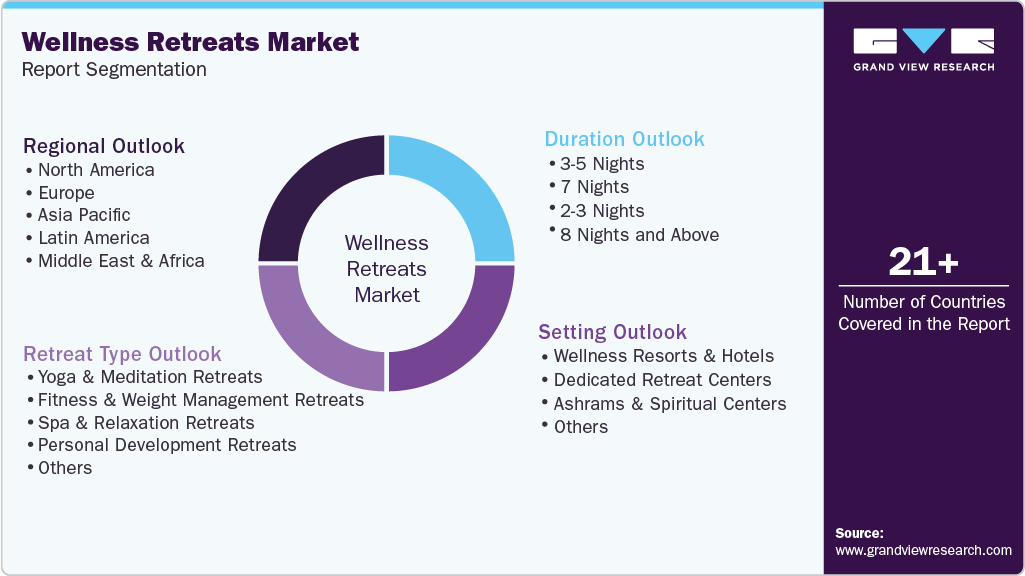
This report forecasts revenue growth at global, regional, and country levels and provides an analysis of industry trends in each of the segments from 2021 to 2033. For this study, Grand View Research, Inc. has segmented the global wellness retreats market report based on the retreat type, duration, setting, and region:
 To learn more about this report, Download Free Sample Report
-
Retreat Type Outlook (Revenue, USD Billion, 2021 - 2033)
-
Yoga & Meditation Retreats
-
Fitness & Weight Management Retreats
-
Spa & Relaxation Retreats
-
Personal Development Retreats
-
Others
-
-
Duration Outlook (Revenue, USD Billion, 2021 - 2033)
-
3-5 Nights
-
7 Nights
-
2-3 Nights
-
8 Nights and Above
-
-
Setting Outlook (Revenue, USD Billion, 2021 - 2033)
-
Wellness Resorts & Hotels
-
Dedicated Retreat Centers
-
Ashrams & Spiritual Centers
-
Others
-
-
Regional Outlook (Revenue, USD Billion, 2021 - 2033)
-
North America
-
U.S.
-
Canada
-
Mexico
-
-
Europe
-
Germany
-
UK
-
France
-
Italy
-
Spain
-
Switzerland
-
Austria
-
Portugal
-
Greece
-
Rest of Europe
-
-
Asia Pacific
-
Thailand
-
Indonesia
-
India
-
Japan
-
Australia
-
Malaysia
-
Sri Lanka
-
Rest of Asia Pacific
-
-
Latin America
-
Costa Rica
-
Brazil
-
Colombia
-
Rest of Latin America
-
-
Middle East & Africa
-
UAE
-
Morocco
-
South Africa
-
Egypt
-
Jordan
-
Rest of MEA
-
-
Caribbean Islands
-
Jamaica
-
Dominican Republic
-
Bahamas
-
Barbados
-
Saint Lucia
-
-
Research Methodology
The wellness retreats marketfigures in this report are based on a proven research process that combines executive interviews with secondary research from proprietary databases, company filings, and recognized regulatory and institutional sources. Market size is built through value-chain sizing-reconciling supply-side and demand-side estimates-and triangulated with bottom-up and top-down approaches. Every estimate passes multiple levels of expert validation before publication, with eachwellness retreat segment quantified using the revenue-capture definitions in the table below.
Segment Definition
Segment - Retreat Type
Revenue capture definition
Yoga & Meditation Retreats
Wellness retreats are primarily centered on yoga, meditation, mindfulness, breathwork, and related mind-body practices. The purpose of these retreats is to foster relaxation, mental clarity, emotional balance, stress relief, and overall well-being through various programs and workshops.
Fitness & Weight Management Retreats
Retreats focused on physical fitness, exercise, nutrition, healthy eating, weight management, and lifestyle modification. Most programs include the following components: supervised exercise sessions, nutritional advice, fitness testing, and behavioral counseling.
Spa & Relaxation Retreats
Wellness retreats are centered on relaxation and physical rejuvenation through spa treatments, massages, hydrotherapy, thermal experiences, beauty treatments, and other restorative services. These getaways are primarily aimed at stress relief, relaxation, recovery, and overall physical wellness.
Personal Development Retreats
Retreats designed to support personal growth, emotional well-being, self-awareness, confidence, resilience, and lifestyle improvement. Personal development programs usually include practices such as coaching, workshops, mindfulness, journaling, and group discussions.
Others
Includes specialized wellness retreats focused on spiritual and holistic wellness, sleep and recovery, adventure and outdoor wellness, and beauty and rejuvenation. Wellness retreats incorporate various types of wellness programs with accommodation and programs designed to enhance the physical, psychological, emotional, or spiritual well-being of the participants.
Segment - Duration
Revenue capture definition
3-5 nights
Short-duration wellness retreats lasting two to three nights, generally designed around focused wellness programs such as relaxation, spa treatments, mindfulness, fitness, or weekend rejuvenation.
7 nights
Wellness retreats lasting three to five nights, providing sufficient time for participants to undertake structured wellness programs while maintaining a relatively short travel commitment. These retreats commonly combine accommodation with several days of yoga, meditation, fitness, spa treatments, nutrition, or personal development activities.
2-3 nights
Wellness retreats last approximately one week, allowing participants to undertake more comprehensive, structured wellness programs with multiple sessions, treatments, activities, and lifestyle interventions.
8 nights and above
Extended wellness retreats lasting eight nights or longer generally offer intensive, immersive wellness programs with multiple components, including fitness, nutrition, meditation, spa treatments, personal development, holistic therapies, and longevity-focused activities.
Segment - Setting
Revenue capture definition
Wellness Resorts & Hotels
Hotels and resorts that provide dedicated wellness facilities, programs, treatments, and experiences alongside conventional accommodation and hospitality services. These properties may include spas, gymnasiums, yoga studios, meditation studios, wellness food, swimming pools, thermal treatment facilities, and planned wellness programs.
Dedicated Retreat Centers
Specialized facilities are primarily established to offer immersive wellness retreat programs rather than conventional hotel accommodations. They typically offer structured programs focused on areas such as yoga, meditation, fitness, personal development, holistic health, recovery, or longevity.
Ashrams & Spiritual Centers
Retreat facilities centered on spiritual, contemplative, and traditional practices, including yoga, meditation, mindfulness, Ayurveda, spiritual teachings, and other holistic or religious practices. These centers generally emphasize personal reflection, inner development, and spiritual well-being.
Others (Eco-Lodges/Nature Retreats; Villas & Private Retreats)
Includes eco-lodges/nature retreats and villas/private retreats that provide wellness experiences in nature-oriented or private settings. These properties may combine accommodation with activities such as outdoor wellness, meditation, yoga, spa treatments, fitness, nature immersion, and personalized wellness programs.
Estimation Model
Section
Key Summary
1.1 Research Approach
A hybrid research approach combining secondary and primary research methodologies. Market assessment is based on the number of wellness retreat centers and facilities, participant volumes, retreat bookings, average retreat duration, average spend per participant, service utilization, accommodation capacity, wellness tourism trends, and retreat operators' expansion strategies. Insights from wellness retreat providers, hotels and resorts, wellness practitioners, travel agencies, tourism boards, consumers, and industry experts are used to validate market estimates.
1.2 Market Estimation Framework
Market size is estimated using three approaches: (1) retreat facility revenue and participant volume model, (2) participant volume, average spend, and retreat duration model, and (3) provider revenue validation model. These approaches are triangulated to determine the overall market size and forecast projections.
1.2.1 Demand Model
Estimates market demand based on the number of wellness retreat participants; consumer interest in preventive health and holistic wellness; demand for stress management and mental well-being programs; adoption of fitness and mindfulness; lifestyle-related health concerns; wellness tourism activity; disposable income; travel trends; and the increasing preference for experiential and personalized wellness programs.
1.2.2 Revenue Model
Market value is calculated based on the average revenue generated per participant, retreat package pricing, retreat duration, booking frequency, accommodation, wellness service utilization, ancillary service expenditure, and variations across business models such as independent retreat centers, resort-based retreats, hotel-based wellness programs, destination wellness resorts, and specialized wellness operators.
1.2.3 Vendor Model
Market estimates are validated using revenues of key wellness retreat operators, the number of retreat locations, participant volumes, accommodation capacity, retreat offerings, geographic expansion, partnerships, acquisitions, and financial disclosures of leading wellness and hospitality companies.
1.3 Forecast Development
Forecast projections are developed by analyzing increasing consumer focus on physical and mental well-being, rising wellness tourism expenditure, growing demand for preventive and holistic health practices, increasing adoption of mindfulness and meditation programs, expansion of luxury and destination wellness retreats, growth in personalized wellness experiences, rising disposable income, digital wellness integration, and investments in wellness-focused hospitality infrastructure.
1.4 Segmentation Method
Market segmentation is determined using weighted analysis of retreat participation patterns, consumer demographics, wellness program adoption, retreat duration, pricing levels, accommodation models, geographic attractiveness, destination tourism activity, service offerings, provider structure, and regional wellness infrastructure.
1.5 Scope & Assumptions
Market is measured in USD based on revenues generated from wellness retreat services and associated retreat packages, including accommodation-linked wellness programs, fitness and movement activities, yoga and meditation, mindfulness and stress management, nutrition and healthy eating programs, spa and relaxation therapies, holistic and alternative wellness practices, and other wellness-focused experiences. Estimates incorporate participant volumes, average spend per participant, retreat duration, booking frequency, accommodation utilization, service mix, provider revenues, and regional variations in wellness tourism and retreat delivery models.
Delivered Customizations
This report has been delivered with the following In-depth customizations
Client Request
Customization Delivered
Value Adds
Retreat Capacity & Utilization Analysis
Assessment of retreat center capacity, number of rooms/beds, retreat duration, operating days, participants per retreat, occupancy rates, program frequency, and capacity requirements across different retreat formats.
Helps clients identify capacity gaps, optimize facility utilization, and determine where additional retreat capacity or infrastructure is required.
Participant Demographic & Demand Analysis
Analysis of retreat participation by age group, gender, income level, travel purpose, wellness interest, booking behavior, and preferred retreat duration and format.
Helps clients refine target customer segments, tailor retreat offerings, and improve customer acquisition strategies.
Traditional Tourism-to-Wellness Retreat Migration Analysis
Quantification of the opportunity created by the increasing shift from conventional leisure tourism toward wellness-focused travel, including demand for yoga, meditation, fitness, nutrition, spa, mindfulness, and holistic wellness experiences.
Helps clients estimate the addressable traveler pool that can be converted into wellness retreat participants.
Staffing & Practitioner Requirement Analysis
Assessment of wellness practitioners, yoga and meditation instructors, fitness trainers, nutritionists, therapists, spa professionals, chefs, hospitality staff, and administrative personnel is required according to participant volume, retreat duration, and facility size.
Helps clients estimate workforce requirements, optimize staff-to-participant ratios, and identify talent constraints before expansion.
Retreat Pricing & Spend Analysis
Evaluation of average package prices, participant expenditure, accommodation costs, ancillary wellness spending, retreat duration, and pricing differences across budget, mid-range, premium, and luxury retreat formats..
Enables clients to optimize pricing strategies, identify premiumization opportunities, and maximize revenue per participant.
Frequently Asked Questions About This Report
The wellness retreats market size was estimated at USD 192.9 billion in 2025 and is projected to grow from USD 210.3 billion in 2026.
The wellness retreats market size is projected to reach at a value of USD 402.1 billion by 2033, growing at a CAGR of 9.7% from 2026 to 2033.
The yoga & meditation retreats segment accounted for the largest share of around 31.5% in 2025 in the market. The category is boosted by the increasing popularity of yoga, meditation, mindfulness, breath work, and other such techniques as a means to relax and deal with stress in an easy manner
The 3–5 nights segment accounted for the largest share of 51.3% in 2025 in the market. Retreats of this duration provide sufficient time for consumers to participate in multiple wellness activities while remaining shorter and more accessible than extended programs.
The wellness resorts & hotels segment accounted for the largest share of 47.1% in 2025 in market.
The market growth is driven by the rising consumer focus on physical & mental well-being, increasing awareness of preventive health, growing stress & burnout levels, and rising demand for holistic health experiences.
Key players in the market include Aman Group S.a.r.l., Canyon Ranch, Chiva-Som Hua Hin Wellness Resort, COMO Hotels and Resorts, IHHR Hospitality Ananda Pvt. Ltd. (IHHR Hospitality Ananda Pvt. Ltd.), Kamalaya Co Ltd, Lanserhof, Miraval Resorts & Spas (Hyatt Corporation), SHA, Six Senses Hotels Resorts Spas, The Salt Sisterhood Limited, ZOYA Health & Wellbeing Resort, Rosewood Hotel Group, Cure & Wellness, PELANGI BEACH RESORT & SPA, LANGKWAI, Dominican Tree House Village
Asia Pacific held the largest market share of 32.8% in 2025, supported by expanding wellness tourism, increasing tourism infrastructure, traditional wellness practices, and rising consumer interest in yoga, Ayurveda, meditation, mindfulness, and holistic health
Europe is the fastest-growing region over the forecast period.
About the Author(s)
Medical Devices Research Team
Healthcare · Medical DevicesThis report was authored by the medical devices research team at Grand View Research - comprising two research analysts, one senior research analyst, and one industry expert - with specialized expertise in the medical devices segment of the healthcare industry. All findings are based on proprietary healthcare databases, executive interviews, and regulatory analysis, subject to internal peer review prior to publication.
Last Updated:
Speak to Analyst

Customize this report to your needs - add regions, segments, or data points, with 20% free customization.
Or view our licence options:


ISO 9001:2015 & 27001:2022 Certified
We are GDPR and CCPA compliant! Your transaction & personal information is safe and secure. For more details, please read our privacy policy.


