
- Home
- »
- Advanced Interior Materials
- »
-
Western U.S. Flat Steel Market Size Report, 2026-2033GVR Report cover

Western U.S. Flat Steel Market (2026 - 2033)
Size, Share & Trends Analysis Report By Product (Hot Rolled Coil, Coated Steel, Cold Rolled Coil), By Application (Buildings & Construction, Energy), And Segment Forecasts
Market Size, 2025
$32.6BMarket Estimate, 2026
$34.1BMarket Forecast, 2033
$48.6BCAGR, 2026–2033
5.2%Western U.S. Flat Steel Market Trends
The western U.S. flat steel market size was valued at USD 32.6 billion in 2025 and is projected to grow from USD 34.1 billion in 2026 to USD 48.6 billion by 2033, at a CAGR of 5.2% from 2026 to 2033. The rising construction activities in the region are driving market growth. According to the U.S. Census Bureau, the country's economy significantly benefits from its construction industry, which carries out construction activities close to USD 1.4 trillion annually. Furthermore, the construction industry accounted for approximately 4% of the U.S. GDP in 2021. The industry has been thriving in the Western U.S. due to the ongoing economic developments and rising infrastructure projects.
Key Market Trends & Insights
- By product: Cold rolled coil segment led the market with the largest revenue share of 36.8% in 2025.
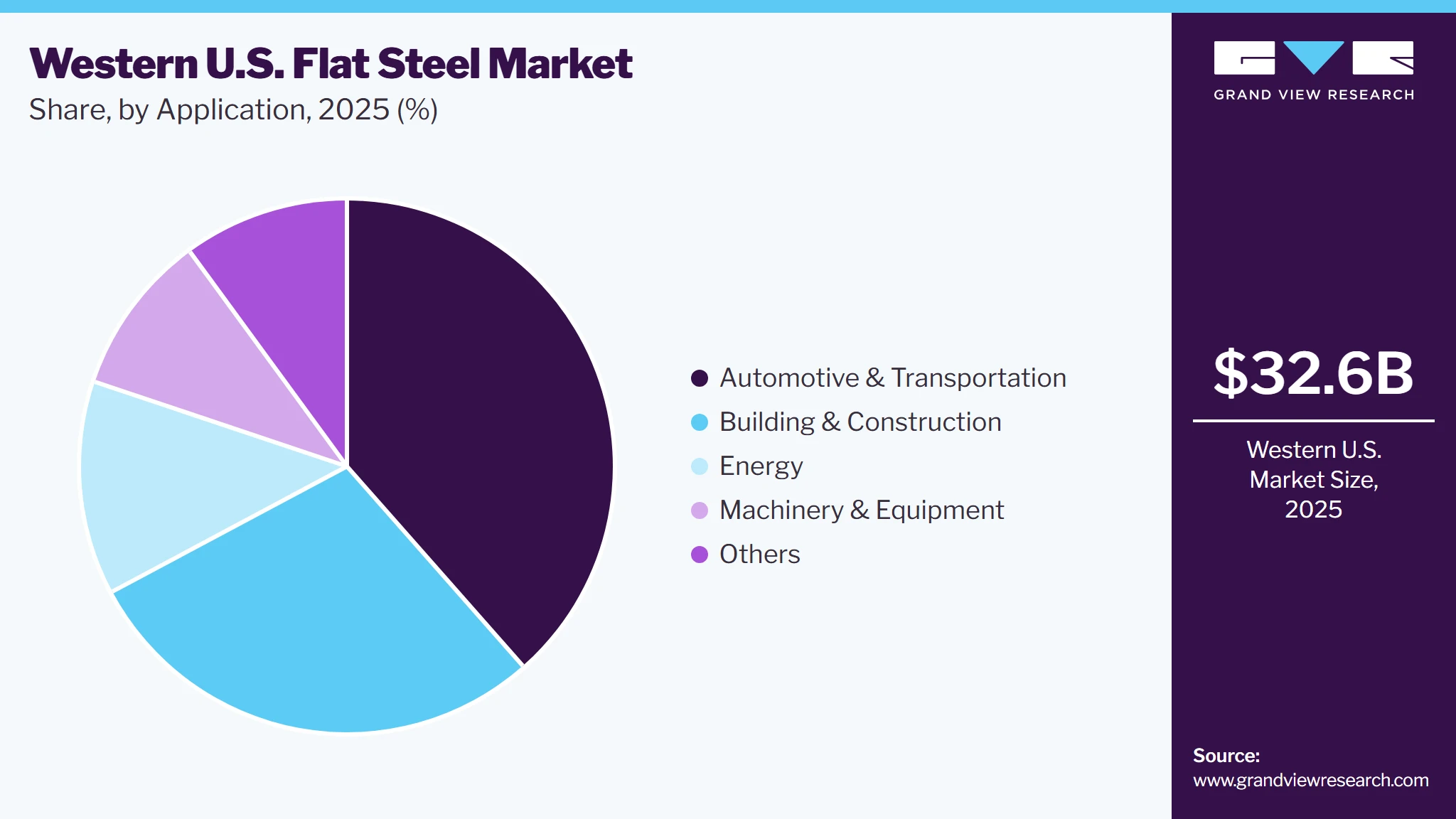
- By application: Automotive & transportation segment led the market with the largest revenue share of 38.5% in 2025.
Market Size & Forecast
- Market size in 2025: USD 32.6 Billion
- Estimated market size in 2026: USD 34.1 Billion
- Projected market size by 2033: USD 48.6 Billion
- CAGR (2026-2033): 5.2%
Prism AI by Grand View Research Free to tryAsk a question about the western U.S. flat steel marketTry asking✓Every figure cited from GVR research Prefer the report? Download free sample →
The steel industry in the western U.S. is increasingly focused on decarbonization, with Electric Arc Furnace (EAF) technology emerging as a pivotal solution. This method significantly lowers carbon emissions compared to traditional blast furnaces. Innovations such as hydrogen-fueled production and renewable energy-powered EAF plants are set to redefine market dynamics. The automotive sector is crucial in driving demand for flat steel, as manufacturers seek materials that meet stringent environmental standards while ensuring vehicle safety and comfort.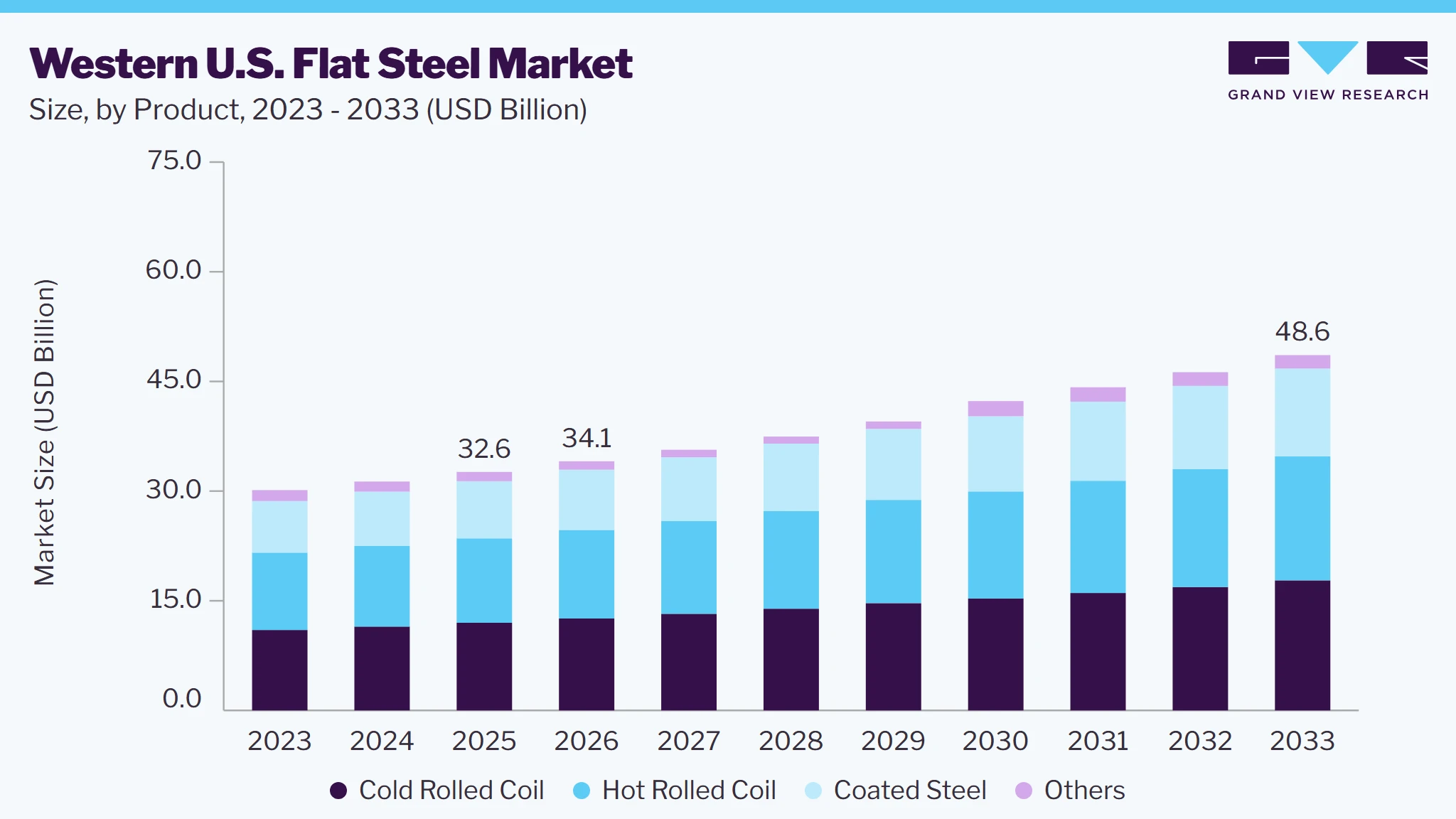 Source: Grand View Research, IR Documents, Primary Interviews, Paid DatabasesTo learn more about this report,
 Download Free Sample Report
In addition, the primary drivers for the growth of the construction industry in the U.S. are the increasing population, ongoing urbanization, and accelerated nuclear family growth. The rising popularity of multiple-home ownerships and the growing number of home renovation and redevelopment projects contribute to the growth of the construction industry in the region and, thus, benefit demand for flat steel. Furthermore, the ongoing automotive manufacturing and upcoming developments in the Western U.S. are expected to be potential growth generators for flat steel manufacturers in the region, owing to the presence of companies such as Rivian Automotive and Tesla, Inc.
Moreover, the fluctuations in the steel market act as restraints for market growth. The product has experienced daily price swings in the U.S. and fluctuations in the costs of raw materials such as iron, coal, and scrap. The impact of demand and supply dynamics leads to extreme volatility in the prices of raw materials, which, thus, affects the production and supply of flat steel.
Market Dynamics
The western U.S. flat steel market is primarily driven by robust investments in residential, commercial, and public infrastructure projects across states such as California, Washington, Arizona, Colorado, and Nevada. Increasing urbanization, population growth, and government spending on highways, bridges, airports, renewable energy facilities, and public transit systems continue to generate strong demand for hot rolled, cold rolled, and coated flat steel products. The growing adoption of prefabricated construction techniques and steel intensive building designs further supports consumption, particularly in commercial buildings, warehouses, logistics facilities, and industrial parks.
The Western U.S. flat steel market is benefiting from robust investments in residential, commercial, and infrastructure construction. Rapid population growth, urban expansion, and government funded transportation and public utility projects are increasing demand for flat steel products such as hot rolled, cold rolled, and galvanized steel used in structural components, roofing, bridges, and industrial buildings.
The region's expanding manufacturing base, renewable energy installations, and distribution infrastructure are further supporting flat steel consumption. Growing investments in warehouses, logistics centers, solar projects, and industrial facilities require high quality flat steel products, driving steady demand from fabricators, OEMs, and construction contractors.
The Western U.S. flat steel market faces challenges from fluctuations in steel scrap, iron ore, and energy prices, which directly affect production costs and product pricing. Supply chain disruptions, transportation bottlenecks, and changing trade policies can further impact raw material availability and delivery schedules, creating uncertainty for manufacturers, distributors, and end users.
Government initiatives to localize battery manufacturing and secure critical material supply The rapid expansion of renewable energy projects and electric vehicle manufacturing facilities across the Western U.S. presents significant opportunities for flat steel producers. Increasing investments in solar farms, wind energy infrastructure, battery manufacturing plants, and EV production facilities are expected to boost demand for high strength, corrosion resistant, and value added flat steel products over the forecast period.
Analyst Perspective
The Western U.S. flat steel market is expected to witness steady long-term growth, supported by sustained investments in residential and commercial construction, public infrastructure modernization, and expanding manufacturing activity across the region. Demand for hot-rolled, cold-rolled, and coated steel is being reinforced by large-scale transportation projects, warehouses, renewable energy installations, and electric vehicle manufacturing facilities that require high-strength, corrosion-resistant steel products. The market is also benefiting from increasing adoption of prefabricated construction methods and the continued expansion of logistics and industrial infrastructure across key Western states.
Product Insights
Based on product, cold rolled coil segment led the market with the largest revenue share of 36.8% in 2025. These coils have low carbon content. In addition, compared to the hot rolled coil, steel produced by this technique has a wider variety of surface finishes and is superior in terms of tolerance, concentricity, and straightness. Furthermore, projects requiring extreme precision are best served by cold rolled. The CRC coil has significant demand due to its smooth surface finish and better corrosion resistance.
The coated steel segment is expected to grow at a CAGR of 5.4% over the forecast period, owing to a strong commitment to sustainable construction practices and innovative architectural designs. In addition, the region's focus on green building initiatives promotes the use of coated steel due to its energy efficiency and recyclability. Furthermore, rapid urbanization and population growth in cities such as San Francisco and Los Angeles fuel demand for residential and commercial projects incorporating coated steel.
Application Insights
Based on application, automotive & transportation segment led the market with the largest revenue share of 38.5% in 2025. primarily driven by the increasing urbanization and population growth creating a higher demand for residential and commercial structures. In addition, ongoing infrastructure projects and government investments in construction further stimulate this demand. Furthermore, the emphasis on sustainable building practices encourages the use of flat steel due to its durability and recyclability. Moreover, trends toward energy-efficient designs and modern architectural solutions are enhancing the appeal of flat steel in construction applications.
 To learn more about this report, Download Free Sample Report
The automotive and transportation segment is expected to register the fastest CAGR of 5.0% from 2025 to 2033, owing to rising economic growth, improving transportation, and major investments by state governments in the EV industry propelling segment growth. For instance, California discounts consumers for compact plug-in hybrid electric vehicles (PHEVs) and zero-emission vehicles (ZEVs). Families with low incomes are also entitled to an additional discount of USD 2,000 in California.
Key Western U.S. Flat Steel Company Insights
Major companies in the western U.S. flat steel industry include Rolled Steel Products Corporation, Steel Dynamics, Steelco USA, and others. The market is fragmented, with established producers and smaller-scale service centers. Partners, collaborations, acquisitions, mergers, and agreements are some strategies leading manufacturers use to succeed. Furthermore, investing in sustainable practices and innovative manufacturing technologies is a focus, enabling firms to meet evolving customer demands while addressing environmental concerns.
-
Commercial Metals Company (CMC) manufactures long steel products, including rebar, angles, channels, flats, and rounds, utilizing advanced Electric Arc Furnace technology. Operating within the Americas Mills segment, the company serves diverse industries by providing high-quality steel solutions for construction and infrastructure needs. Their extensive product range and commitment to innovation position them as a key supplier in the flat steel sector.
-
Phoenix Steel Service, Inc. specializes in manufacturing flat rolled steel, including sheets and coils, tailored for various applications in construction and manufacturing. Operating primarily within the building and construction segment, the company provides high-quality materials that meet industry standards.
Key Western U.S. Flat Steel Companies
- California Steel Industries
- Commercial Metals Company
- Phoenix Steel Service, Inc.
- Rolled Steel Products Corporation
- Steel Dynamics
- Steelco USA
- United States Steel Corporation
Competitive Benchmarking
Category
Operating Strategies
Competitive Edge
Weakness
Established Players (e.g. California Steel Industries, Commercial Metals Company)
- Mature participants in the Western U.S. flat steel market primarily focus on operating integrated and electric arc furnace (EAF)-based steel production facilities supported by extensive service center networks and strategically located distribution hubs across the western U.S.
- Their strategies emphasize manufacturing a broad portfolio of hot rolled coil, cold rolled coil, galvanized steel, and coated flat steel products for construction, automotive, energy, machinery, appliance, and infrastructure applications.
- Established players possess significant competitive advantages through their large-scale steelmaking facilities, vertically integrated operations, and well-established logistics infrastructure across the Western U.S.
- Their proximity to major construction markets, manufacturing hubs, ports, and transportation corridors enables faster deliveries, lower freight costs, and improved supply reliability.
- Despite their strong market positions, mature players face challenges related to volatile steel scrap and raw material prices, rising energy costs, and increasingly stringent environmental regulations.
- Steel manufacturing requires substantial capital investment in melting, rolling, finishing, and emissions control equipment, while maintaining aging production assets can significantly increase maintenance expenses.
Emerging & Regional Players (e.g., Phoenix Steel Service, Inc., Rolled Steel Products Corporation)
- Emerging participants in the Western U.S. flat steel market generally focus on regional production, downstream steel processing, and specialized flat steel products tailored to local customer requirements.
- Rather than competing directly with established producers on production volume, these companies emphasize operational flexibility, shorter lead times, and customized processing services for construction, renewable energy, industrial equipment, and manufacturing sectors.
- Emerging companies benefit from operational flexibility and the ability to establish modern steel processing facilities using advanced automation and energy-efficient technologies without the burden of extensive legacy infrastructure.
- Their streamlined operations enable quicker production scheduling, faster delivery times, and greater responsiveness to regional customer requirements.
- Emerging participants face significant challenges related to limited production capacity, restricted financial resources, and lower economies of scale compared with established steel manufacturers.
- Smaller operations may experience higher production costs, greater exposure to raw material price fluctuations, and limited bargaining power with suppliers.
Recent Development
-
In May 2023, United States Steel Corporation has successfully closed a USD 240 million financing deal through Arkansas Development Finance Authority, issuing green bonds to support its new flat rolled steelmaking facility, Big River 2. This advanced facility, currently under construction near Osceola, Arkansas, is expected to recycle and process scrap steel into finished products. With a focus on sustainability, Big River 2 aims to operate with significantly reduced greenhouse gas emissions compared to traditional methods.
Western U.S. Flat Steel Market Report Scope
Report Attribute
Details
Market definition
The market size represents the apparent consumption of flat steel-in various applications in the western U.S.
Market size in 2025
USD 32.6 billion
Estimated market size in 2026
USD 34.1 billion
Projected market size by 2033
USD 48.6 billion
Growth rate
CAGR of 5.2% from 2026 to 2033
Base year for estimation
2025
Historical data
2021 - 2024
Forecast period
2026 - 2033
Quantitative units
Revenue in USD million, volume in kilotons, and CAGR from 2026 to 2033
Report coverage
Revenue forecast, company ranking, competitive landscape, growth factors, and trends
Segments covered
Product, application, region
Country scope
Western U.S.
Key companies profiled
California Steel Industries; Commercial Metals Company; Phoenix Steel Service, Inc.; Rolled Steel Products Corporation; Steel Dynamics; Steelco USA; United States Steel Corporation
Customization scope
Free report customization (equivalent up to 8 analysts' working days) with purchase. Addition or alteration to country, regional & segment scope.
Pricing and purchase options
Avail customized purchase options to meet your exact research needs. Explore purchase options
Western U.S. Flat Steel Market Report Segmentation
This report forecasts revenue growth at global, regional, and country levels and analyzes the latest industry trends in each sub-segment from 2021 to 2033. For this study, Grand View Research has segmented the global Western U.S. flat steel market report based on product, application, end use, and region.
-
Product Outlook (Volume, Kilotons; Revenue, USD Million, 2021 - 2033)
-
Hot Rolled Coil
-
Cold Rolled Coil
-
Coated Steel
-
Others
-
-
Application Outlook (Volume, Kilotons; Revenue, USD Million, 2021 - 2033)
-
Building & Construction
-
Automotive & Transportation
-
Machinery & Equipment
-
Energy
-
Others
-
Research Methodology
The western U.S. flat steel market figures in this report are based on a proven research process that combines executive interviews with secondary research from proprietary databases, company filings, and recognized regulatory and institutional sources. Market size is built through value-chain sizing - reconciling supply-side and demand-side estimates - and triangulated with bottom-up and top-down approaches. Every estimate passes multiple levels of expert validation before publication, with each western U.S. flat steel segment quantified using the revenue-capture definitions in the table below.
Segment Definition
Product
Revenue Capture Definition
Hot Rolled Coil
The hot rolled coil segment captures revenue generated from flat steel products manufactured through hot rolling processes and supplied in coil form for construction, automotive, energy, machinery, and pipe manufacturing applications.
Cold Rolled Coil
The cold rolled coil segment represents revenue generated from flat steel products processed through cold rolling to achieve superior surface finish, tighter dimensional tolerances, and enhanced mechanical properties.
Coated Steel
The coated steel segment includes revenue generated from galvanized, galvalume, pre painted, and other coated flat steel products designed to provide enhanced corrosion resistance and longer service life.
Others
The others segment captures revenue generated from specialty flat steel products such as electrical steel, tinplate, stainless flat steel, and alloy coated steel used in niche industrial applications.
Application
Revenue Capture Definition
Building & Construction
The building and construction segment captures revenue generated from flat steel products used in residential, commercial, industrial, and infrastructure projects across the Western U.S.
Automotive & Transportation
The automotive and transportation segment represents revenue generated from flat steel supplied for the production of passenger vehicles, commercial vehicles, trailers, railcars, shipbuilding, and transportation equipment.
Machinery & Equipment
The machinery and equipment segment includes revenue generated from flat steel used in industrial machinery, agricultural equipment, mining equipment, material handling systems, and heavy manufacturing machinery.
Energy
The energy segment captures revenue generated from flat steel used in oil and gas pipelines, storage tanks, renewable energy structures, transmission equipment, and power generation facilities.
Others
The others segment represents revenue generated from flat steel used in appliances, packaging, consumer goods, defense, electrical equipment, and other specialized industrial applications.
Estimation Model
Layer No.
Layer Name
Key Question
Description
01
Regional Steel Demand Base Layer
What forms the demand base?
Identify flat steel demand across the Western U.S. states from major end use industries including building & construction, automotive & transportation, machinery & equipment, energy, and manufacturing. Assess regional infrastructure investments, commercial and residential construction activity, industrial output, and manufacturing capacity to establish the total addressable demand for flat steel products.
02
Flat Steel Application Penetration Layer
Where is flat steel utilized?
Estimate the penetration of flat steel across key applications including structural construction, roofing and cladding, automotive body panels, industrial machinery, storage tanks, pipelines, HVAC equipment, renewable energy projects, and fabricated metal products. Analyze the adoption of hot rolled coils, cold rolled coils, coated steel, and specialty flat steel products across industries within the Western U.S. region.
03
Flat Steel Consumption Intensity Layer
How much flat steel is consumed?
Analyze flat steel consumption intensity based on construction spending, manufacturing output, automotive production, machinery manufacturing, and energy infrastructure development across the Western U.S. Evaluate steel usage according to project size, industrial production volumes, and engineering specifications. Consumption intensity varies according to regional economic activity, infrastructure investments, and industrial expansion.
04
Revenue Layer
How is market revenue generated?
Market revenue is quantified through the sale of flat steel products including hot rolled coils, cold rolled coils, coated steel, and value added processed steel. Revenue generation is driven by demand from construction, automotive, machinery, energy, and industrial manufacturing sectors throughout the Western U.S. Market value is influenced by steel prices, service center processing, raw material costs, regional manufacturing activity, and supply demand dynamics.
Delivered Customizations
This report has been delivered with the following In-depth customizations
Client Request
Customization Delivered
Value Adds
Regional Segmentation
Detailed regional analysis of the Western U.S. flat steel market across California, Washington, Oregon, Arizona, Nevada, Utah, Colorado, New Mexico, Idaho, Montana, Wyoming, Alaska, and Hawaii. Included state level assessment of flat steel consumption, manufacturing capacity, service center networks, construction activity, automotive production, energy infrastructure, shipbuilding, aerospace manufacturing, and public infrastructure investments.
Identified high growth states, major steel consuming industries, and regional supply demand dynamics. Enabled strategic expansion planning, distribution network optimization, and targeted market penetration across the Western U.S.
Cross Segmentation
Comprehensive cross segmentation analysis by product, application, and state, including hot rolled coil, cold rolled coil, coated steel, and other flat steel products across building and construction, automotive and transportation, machinery and equipment, energy, and other industrial applications. Evaluated regional consumption patterns, customer preferences, product specifications, and demand outlook across end use industries.
Enabled identification of the most attractive product application combinations and high growth customer segments. Supported product portfolio optimization, sales planning, and investment prioritization strategies.
Opportunity Assessment
Identification of high growth opportunities across infrastructure modernization, renewable energy projects, electric vehicle manufacturing, semiconductor fabrication facilities, commercial construction, industrial manufacturing, aerospace production, and data center development.
Enabled prioritization of high return investment opportunities and emerging regional markets. Supported long term capacity planning, product innovation, distribution expansion, and strategic business development aligned with industrial growth and infrastructure investments across the Western U.S.
Frequently Asked Questions About This Report
Coated steel is anticipated to register the fastest CAGR over the forecast period.
Automotive & transportation accounted for largest revenue share of 38.5% in 2025.
Building & construction is anticipated to grow at a CAGR of 5.6% over the forecast period.
The western U.S. flat steel market size was estimated at USD 32.6 billion in 2025 and is expected to reach USD 34.1 billion in 2026.
The western U.S. flat steel market is expected to grow at a compound annual growth rate of 5.2% from 2026 to 2033 to reach USD 48.6 billion by 2033.
Based on product, cold rolled coil accounted for largest revenue share of 36.8% in 2025.
The key players operating in the western U.S. flat steel market are California Steel Industries; Commercial Metals Company; Phoenix Steel Service, Inc.; Rolled Steel Products Corporation; Steel Dynamics; Steelco USA; United States Steel Corporation
The western U.S. flat steel market is primarily driven by the booming construction, infrastructure development, and manufacturing sectors, which continue to generate strong demand for flat steel products across commercial, residential, and industrial applications.
About the Author(s)
Advanced Interior Materials Research Team
Advanced Materials · Advanced Interior MaterialsThis report was authored by the advanced interior materials research team at Grand View Research - comprising two research analysts, one senior research analyst, and one industry expert - with specialized expertise in the advanced interior materials segment of the advanced materials industry. All findings are based on proprietary advanced materials databases, executive interviews, and regulatory analysis, subject to internal peer review prior to publication.
Last Updated:
Speak to Analyst

Customize this report to your needs - add regions, segments, or data points, with 20% free customization.
Or view our licence options:


ISO 9001:2015 & 27001:2022 Certified
We are GDPR and CCPA compliant! Your transaction & personal information is safe and secure. For more details, please read our privacy policy.


