
- Home
- »
- Consumer F&B
- »
-
Whipping Cream Market Size And Share Report, 2026-2033GVR Report cover

Whipping Cream Market (2026 - 2033)
Size, Share & Trends Analysis Report By Product (Dairy, Non-dairy), By Application (B2B, B2C), By Distribution Channel (Online, Offline), By Region (North America, Europe, APAC), And Segment Forecasts
Market Size, 2025
$9.9BMarket Estimate, 2026
$10.7BMarket Forecast, 2033
$19.5BCAGR, 2026–2033
9.0%Whipping Cream Market Summary
The global whipping cream market size was valued at USD 9.9 billion in 2025 and is projected to grow from USD 10.7 billion in 2026 to USD 19.5 billion by 2033, at a CAGR of 9.0% from 2026 to 2033. North America dominated the market with the largest revenue share of 38.2% in 2025. The rising global population and growing consumption of food and beverage items such as ice creams, cupcakes, pies, cakes, waffles, and hot chocolate milkshakes have created substantial demand for whipping cream.
 Source: Grand View Research, IR Documents, Primary Interviews, Paid DatabasesTo learn more about this report,
 Download Free Sample Report
 Key Market Trends & Insights
- By product: Dairy-based whipping cream led the market with the largest revenue share of 68.9% in 2025.
- By application: B2B segment held the largest revenue share of 64.4% in 2025.
- By distribution channel: Offline distribution channel segment accounted for the largest revenue share of 78.6% in 2025.
Regional Highlights
- Largest regional market: North America (38.2% revenue share, 2025)
- Fastest-growing regional market: Asia Pacific (highest CAGR, 2026-2033)
- By country: The U.S. held the largest market share in 2025.
Market Size & Forecast
- Market size in 2025: USD 9.9 Billion
- Estimated market size in 2026: USD 10.7 Billion
- Projected market size by 2033: USD 19.5 Billion
- CAGR (2026-2033): 9.0%
Three ways to get this report
Buy it, customize it, or ask a question.Ask an Analyst
Analyst response in 1 business day
- AccessReport author, directly
- Reply timeWithin 1 working day
- No sales callDirect answer only
- FormatEmail reply
- CostFree, no cost
Get the Full Report
What the study covers
- FormatsPDF · Excel · Dashboard
- Timeline2026–2033 annual, 2025 base
- Coverage20+ countries, 5 regions
- Companies10+ key players profiled
Customize the Report
20% free customization
- IncludeCountries, segments, points
- TailorTo your product definition
- ExtendDeeper competitor detail
- OrA fully bespoke study
- Turnaround5–10 working days
Moreover, innovations such as ultra-high temperature processing have helped extend the shelf life of this product while preserving texture and flavor. This method allows manufacturers to offer products that require no refrigeration until opened, improving user convenience.The continued expansion of the baking industry presents another notable growth avenue for the whipping cream industry. Whipping cream is used in various baking recipes, including cakes, scones, muffins, and cookies, to add moisture, richness, and a tender crumb. The fat content in whipping cream helps to create a finer crumb in cakes and other baked goods, leading to a lighter, fluffier texture. Additionally, whipping cream can be added to various doughs and batters, such as those for biscuits, pancakes, or waffles, to achieve a softer and more delicate texture. Recent advancements and innovations in emulsification technology have helped improve the stability of whipped cream, thus lowering the risk of separation and improving its performance in culinary and baking applications.
 To learn more about this report, Download Free Sample Report
 The increasing popularity and sales of light whipping cream products containing around 30% fat have also been a major driver of market growth. This trend has been driven by the increase in health-conscious populations that aim to reduce their caloric intake while still enjoying creamy textures in their food. Furthermore, the emergence of flavored whipping creams such as chocolate, vanilla, coffee, orange, and cinnamon is expected to further boost the appeal of the whipping cream industry. Social media has played an important role in aiding product demand because of a steadily increasing number of food bloggers and the extensive availability of posts and videos that showcase various unique ways to utilize whipping cream as a decorative component in tarts, pies, and cakes, among other items.
Market Dynamics
The whipping cream market is witnessing steady growth due to its extensive use in bakery, confectionery, desserts, beverages, and foodservice applications. Consumers are increasingly seeking premium and indulgent food products, driving demand for whipping cream in cakes, pastries, ice creams, specialty coffees, and ready-to-eat desserts. Product innovations such as low-fat, plant-based, and long-shelf-life whipping cream variants are further expanding consumer adoption. In addition, the growth of home baking trends, rising disposable incomes, and the expansion of café and restaurant chains are supporting market growth. Manufacturers are also focusing on improving product quality, texture, and convenience, which is expected to further drive demand for whipping cream globally.
The increasing consumption of bakery products, confectioneries, and premium desserts is a major factor driving demand for whipping cream globally. Changing consumer lifestyles, rising disposable incomes, and growing preference for indulgent food experiences have significantly increased the consumption of cakes, pastries, mousses, ice creams, specialty beverages, and dessert toppings. The expansion of cafés, quick-service restaurants, bakeries, and foodservice establishments has further accelerated the use of whipping cream in both commercial and household applications. In addition, growing interest in home baking, fueled by social media influence and online cooking content, has increased retail demand for whipping cream products. Manufacturers are also introducing innovative formulations, including low-fat, lactose-free, and plant-based alternatives, to cater to evolving consumer preferences. As consumers continue to seek premium-quality and visually appealing food products, demand for whipping cream is expected to remain strong across developed and emerging markets.
Volatility in dairy raw material prices and increasing health concerns associated with high-fat dairy products remain key restraints for the whipping cream market. The production of whipping cream depends heavily on milk and cream supplies, making manufacturers vulnerable to fluctuations in milk prices caused by changing feed costs, weather conditions, livestock diseases, and supply chain disruptions. These fluctuations can increase production costs and affect profit margins. In addition, growing consumer awareness regarding obesity, cardiovascular diseases, and excessive saturated fat consumption has encouraged some consumers to reduce their intake of full-fat dairy products. The rising popularity of low-calorie diets and healthier food alternatives may also limit the growth potential of traditional whipping cream products. Furthermore, lactose intolerance among a significant portion of the global population can restrict consumption, particularly in regions where dairy-free alternatives are gaining popularity.
The growing popularity of plant-based diets and clean-label food products presents significant growth opportunities for the whipping cream industry. Consumers are increasingly seeking dairy-free, vegan, organic, and allergen-friendly alternatives that align with health, sustainability, and ethical consumption trends. This has encouraged manufacturers to develop plant-based whipping creams derived from coconut, oat, soy, almond, and other non-dairy sources. In addition, demand for value-added products such as flavored whipping creams, reduced-fat variants, and long-shelf-life formulations is creating new revenue opportunities across retail and foodservice channels. The rapid growth of e-commerce grocery platforms and premium bakery chains is further expanding product accessibility and consumer reach. Moreover, advancements in food processing technologies are enabling manufacturers to improve texture, stability, and performance characteristics, making alternative whipping cream products increasingly attractive to both consumers and professional foodservice operators.
Analyst Perspective
The whipping cream market is positioned at the convergence of several favorable industry trends, including rising consumption of premium bakery and confectionery products, expanding foodservice networks, and increasing demand for convenience-based dairy ingredients. Growth is being supported by both commercial users seeking consistent product performance and consumers pursuing indulgent dessert experiences at home. At the same time, evolving preferences for clean-label, organic, and plant-based products are reshaping product development strategies across the industry. The key competitive advantage will belong to manufacturers that successfully balance product functionality, shelf-life stability, and evolving dietary preferences through diversified portfolios spanning dairy and non-dairy whipping cream solutions. Companies that can deliver superior whipping performance, broad distribution reach, and innovative formulations tailored to bakery, beverage, and dessert applications will be best positioned to capture long-term growth in an increasingly preimmunized and application-driven market.
Product Insights
Based on product, the dairy-based whipping cream led the market with the largest revenue share of 68.9% in 2025 and is expected to grow at a CAGR of 8.7% over the forecast period. Dairy whipping cream has been conventionally preferred by retail customers as well as commercial bakers and chefs, owing to its widespread availability and economical nature when compared to its vegan alternatives. Furthermore, dairy-based products with different fat contents are available to help address a wider demographic of diet-conscious consumers. This type of whipping cream is generally associated with indulgence and premium quality, particularly in desserts and baked goods. As consumers look for richer and more luxurious options in food products, the demand for dairy-based whipping cream is expected to grow in the coming years.
Meanwhile, the non-dairy segment is expected to grow at a faster CAGR during the forecast period. The rapidly expanding vegan population and increasing prevalence of lactose intolerance have compelled manufacturers to launch non-dairy plant-based alternatives. Common examples of this type include coconut cream, soy-based cream, oat-based cream, cashew cream, and almond-based cream. Depending on the base used, plant-based whipping creams can offer a range of subtle flavors, enhancing both sweet and savory dishes. Many plant-based creams, especially those from oats, almonds, or soy, have a lower environmental impact compared to dairy products, including reduced water usage and lower greenhouse gas emissions. In January 2023, Alamance Foods announced the launch of the ‘Whipt’ dairy-free whipped cream alternative in three variants - almond, oat, and coconut. Similar developments by other companies have enabled healthy segment growth.
Application Insights
The B2B segment accounted for a leading revenue share in the global market in 2024. Whipping cream remains in high demand from several major industries, including food service, bakery, dairy, and confectionery, which heavily depend on this product during food and beverage production. Restaurants, cafes, and hotels use whipping cream in various applications, such as toppings for coffee drinks, desserts, and creamy sauces. Moreover, large-scale catering businesses that supply food for events such as weddings, parties, and corporate functions generally utilize whipping cream for desserts and creamy dishes, thus creating a steady demand. The trend toward premium products, convenience foods, and indulgent experiences has helped keep a consistent demand for high-quality dairy whipping cream in the B2B sector.
The B2C segment is anticipated to grow at the fastest CAGR from 2025 to 2030, as whipping cream plays a crucial role in households, catering to consumers who use it for various cooking and baking applications. The increasing popularity of home baking trends, particularly after the COVID-19 pandemic, has resulted in the increased use of whipping cream to enhance cakes, cupcakes, pies, pastries, and other baked goods. It is essential for making whipped cream for toppings and for integrating into batters and frostings. Moreover, consumers also use whipping cream to make rich sauces, soups, and creamy dishes at home, such as Alfredo sauce, creamy soups, or mashed potatoes. As a result, companies are launching different types of whipping creams that can effectively address varied consumer requirements.
Distribution Channel Insights
Based on distribution channel, the offline distribution channel segment led the market with the largest revenue share of 78.6% in 2025, as this mode ensures instant availability of the product, making it a preferred choice for customers. Furthermore, consumers generally prefer purchasing whipping cream in a fresh form without the presence of preservatives, which ensures steady product sales through convenience stores and supermarkets. Retailers often introduce seasonal packaging or promotions during peak periods such as holidays, which encourages higher sales. Consumers are more likely to buy whipped cream when it is promoted alongside other holiday-specific ingredients such as pies, cakes, or baking supplies.
 To learn more about this report, Download Free Sample Report
 The online segment is anticipated to grow from 2025 to 2030. Consumers are increasingly opting for online shopping platforms such as Amazon and Walmart and local grocery delivery services to purchase whipped cream. These channels offer consumers the ability to shop from home and have products delivered to their doorsteps. Brands are extensively making use of social media platforms to promote their products, which helps generate more sales. Online retailers typically list more options than local stores, including both dairy and non-dairy options, thus giving consumers more choices and the ability to compare different products easily.
Regional Insights
North America dominated the whipping cream market with the largest revenue share of 38.2% in 2025. Increasing use of this product in baking and culinary preparations and consistently strong demand for desserts and sweet food items have driven industry expansion. Additionally, the availability of plant-based and organic options has helped companies cater to a wider customer base in regional economies such as the U.S. and Canada, which have a steadily growing demographic of vegans.
 To learn more about this report, Download Free Sample Report
 U.S. Whipping Cream Market Trends
The whipping cream market in the U.S. held the largest share in the North America region in 2025. The market has been mainly driven by factors ranging from consumer preferences in food preparation and dining trends to shifts in the broader dairy industry. The prevalent coffee culture in the economy has contributed significantly to market demand, as whipped cream is widely used in coffee shops for specialty drinks and seasonal offerings.
Europe Whipping Cream Market Trends
The European market for whipping cream accounted for a significant revenue share in 2024. Economies such as France, Italy, and Germany have traditionally been leading consumers of whipping cream in various savory and sweet dishes. Whipping cream is a staple ingredient in European cuisines, from making sauces and soups to creating rich pastries, desserts, and beverages. Moreover, the increasing demand for premium and gourmet food products across the region has contributed to the rising consumption of whipping cream.
Asia Pacific Whipping Cream Market Trends
The Asia Pacific region is anticipated to expand at the fastest CAGR from 2025 to 2030. The steadily increasing population in regional economies such as China, Japan, and India and a continued shift in dietary preferences have created a competitive market for whipped cream products. The emergence of a health-conscious customer base has led to a rise in demand for low-fat and sugar-free whipping creams. Many consumers are opting for healthier versions of traditionally indulgent products, and brands are addressing this requirement by introducing reduced-fat or zero-sugar whipping cream varieties. Such initiatives have created promising growth prospects for the regional market.
China accounted for the largest revenue share in the Asia Pacific market in 2024 and is expected to maintain its position during the forecast period. Increasing westernization and urbanization in the country have resulted in a substantial demand for Western-style desserts, including cakes, pastries, and ice cream, which often use whipping cream as a key ingredient.
Key Whipping Cream Company Insights
Some major companies in the global whipping cream industry include Hanan Products, Conagra Brands, and Cabot Creamery.
-
Hanan Products is a leading global manufacturer of high-quality whipped toppings, icings, and dessert fillings that food distributors and bakeries extensively use. The company develops a range of products, including natural whipped toppings, dairy whipped toppings, vegan whipped toppings, ready-to-whip, and pre-whipped icings, and tres leches.
-
Conagra Brands is a major packaged food company that is known for offering products across various categories, such as frozen foods, snacks, condiments, and meals. The company operates with a portfolio of well-known brands, catering to both consumers and food service markets.
Key Whipping Cream Companies
The following are the leading companies in the whipping cream market.
-
Rich Products & Solutions Pvt Ltd
-
Hanan Products Co., Inc.
-
GCMMF
-
Conagra Brands
-
Gay Lea Foods Co-operative Ltd.
-
Cabot Creamery
-
Borden Dairy
-
Gruenewald Manufacturing Company, Inc.
-
LACTALIS
-
Granarolo S.p.A
Competitive Benchmarking
Category
Operating Strategies
Competitive Edge
Weakness
Established Players (LACTALIS, Granarolo S.p.A, Conagra Brands, GCMMF, Gay Lea Foods Co-operative Ltd.)
- Expand production capacity and distribution networks across retail, foodservice, and industrial channels
- Invest in product innovation, including UHT whipping cream, low-fat variants, clean-label offerings, and premium formulations for bakery and confectionery applications
- Strong brand recognition, extensive distribution reach, and established relationships with foodservice operators and retailers
- Large-scale manufacturing capabilities, reliable dairy sourcing networks, and broad product portfolios
- Higher exposure to fluctuations in milk and dairy commodity prices
- Large operational structures may result in slower response times to emerging consumer trends and niche product demands
Emerging & Specialized Players (Rich Products & Solutions Pvt Ltd, Hanan Products Co., Inc., Cabot Creamery, Borden Dairy, Gruenewald Manufacturing Company, Inc.)
- Focus on premium, specialty, and value-added whipping cream products targeted at bakeries, cafés, dessert manufacturers, and foodservice customers
- Leverage product differentiation through superior whipping performance, customized formulations, plant-based alternatives, and regional market expansion
- Greater flexibility in product development and ability to cater to specific customer requirements
- Strong expertise in niche applications such as bakery toppings, dessert fillings, frozen toppings, and specialty cream solutions
- Limited geographic presence and lower brand visibility compared to multinational dairy companies
- Dependence on specific customer segments and distribution partners can constrain large-scale market expansion
Recent Developments
-
In October 2023, Hanan Products announced the launch of its novel ‘Top 'n Fil Deluxe’ ready-to-whip icing and filling. The topping can be used to fill doughnuts and decorate cakes and pies, offering a consistent texture and stability that makes it suitable for commercial usage.
-
In July 2023, Lactalis American Group announced the launch of the Président Whipped Crème gourmet-style line of whipped crème for outdoor occasions such as parties and gatherings.
Whipping Cream Market Report Scope
Report Attribute
Details
Market size in 2025
USD 9.9 billion
Estimated market size in 2026
USD 10.7 billion
Projected market size by 2033
USD 19.5 billion
Growth rate
CAGR of 9.0% from 2026 to 2033
Base year for estimation
2025
Historical data
2021 - 2024
Forecast period
2026 - 2033
Quantitative units
Revenue in USD million/billion and CAGR from 2026 to 2033
Report coverage
Revenue forecast, company ranking, competitive landscape, growth factors, and trends
Segments covered
Product, application, distribution channel, region
Regional scope
North America; Europe; Asia Pacific; Central & South America; Middle East & Africa
Country scope
U.S.; Canada; Mexico; Germany; UK; France; Italy; Spain; China; Japan; India; South Korea; Australia & New Zealand; Brazil; Saudi Arabia; South Africa
Key companies profiled
Rich Products & Solutions Pvt Ltd; Hanan Products Co., Inc.; GCMMF; Conagra Brands; Gay Lea Foods Co-operative Ltd.; Cabot Creamery; Borden Dairy; Gruenewald Manufacturing Company, Inc.; LACTALIS; Granarolo S.p.A.
Customization scope
Free report customization (equivalent up to 8 analysts' working days) with purchase. Addition or alteration to country, regional & segment scope.
Pricing and purchase options
Avail customized purchase options to meet your exact research needs. Explore purchase options
Global Whipping Cream Market Report Segmentation
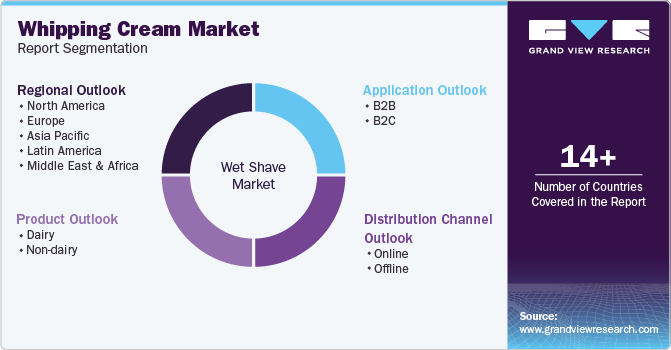
This report forecasts revenue growth at the global, regional, and country levels and provides an analysis of the latest industry trends in each of the sub-segments from 2021 to 2033. For this study, Grand View Research has segmented the global whipping cream market report based on product, application, distribution channel, and region:
 To learn more about this report, Download Free Sample Report
 -
Product Outlook (Revenue, USD Million, 2021 - 2033)
-
Dairy
-
Non-dairy
-
-
Application Outlook (Revenue, USD Million, 2021 - 2033)
-
B2B
-
B2C
-
-
Distribution Channel Outlook (Revenue, USD Million, 2021 - 2033)
-
Online
-
Offline
-
-
Regional Outlook (Revenue, USD Million, 2021 - 2033)
-
North America
-
U.S.
-
Canada
-
Mexico
-
-
Europe
-
Germany
-
U.K.
-
France
-
Spain
-
Italy
-
-
Asia Pacific
-
China
-
India
-
Japan
-
Australia & New Zealand
-
South Korea
-
-
Latin America
-
Brazil
-
-
MEA
-
Saudi Arabia
-
South Africa
-
-
Research Methodology
Segment Definition
Segment - Product
Revenue capture definition
Dairy
This segment includes the sales of dairy-based whipping cream products manufactured from milk fat and other dairy ingredients.
Non-Dairy
This segment includes the sales of non-dairy based whipping cream products formulated using plant-based ingredients such as coconut, soy, oat, almond, palm, or other vegetable-derived fats.
Estimation Model
Layer Title
Guiding Question
Description
Consumer Demand Layer
Who consumes products containing whipping cream?
Identify consumers of bakery products, desserts, confectionery, beverages, and home-prepared recipes that utilize whipping cream. Analyze dietary habits, dessert consumption trends, bakery penetration, and foodservice demand to define the potential consumer base.
Accessibility Layer
Who can access whipping cream products?
Apply region-specific retail penetration, cold-chain infrastructure availability, supermarket presence, and e-commerce grocery access rates to the eligible consumer base to estimate the addressable whipping cream market.
Usage Layer
Who actively purchases whipping cream?
Apply whipping cream adoption rates among households, bakeries, cafés, restaurants, hotels, and confectionery manufacturers. Factor in demand for premium desserts, home baking activities, and foodservice applications to convert the addressable market into active users.
Monetization Layer
How much revenue is generated?
Multiply active whipping cream users by average annual consumption volumes and spending per user. Incorporate revenue generated from retail sales, foodservice channels, bakery applications, and industrial food manufacturing to estimate the total market value.
Delivered Customizations
This report has been delivered with the following In-depth customizations
Client Request
Customization Delivered
Value Adds
Bakery, Confectionery & Dessert Application Trends
Conducted a focused analysis of whipping cream demand across bakery products, confectionery items, desserts, specialty beverages, and foodservice applications, covering premiumization trends, product innovations, consumer preferences, and usage patterns in commercial and household segments.
Helps stakeholders identify high-growth application areas, evaluate evolving consumer consumption patterns, and assess commercialization opportunities across premium bakery, dessert, and beverage categories.
Dairy-Free Innovation & Consumer Preference Trends
Evaluated adoption trends for plant-based whipping cream, clean-label formulations, organic products, low-fat variants, and lactose-free alternatives, including consumer purchasing behavior, sustainability preferences, and retail expansion strategies.
Provides insights into emerging dietary trends, unmet consumer needs, and commercially attractive product segments to support product development, brand positioning, and innovation strategies.
Foodservice Expansion & Product Development Opportunity Assessment
Assessed demand from cafés, bakeries, restaurants, quick-service restaurants, and industrial food manufacturers, along with advancements in whipping performance, shelf-life extension, UHT processing, packaging innovations, and distribution channel development.
Supports investment and expansion strategies by identifying high-potential customer segments, evaluating technology adoption, and strengthening long-term growth opportunities across retail and foodservice channels.
Frequently Asked Questions About This Report
The global whipping cream market size was valued at USD 9.9 billion in 2025 and is expected to reach USD 10.7 billion in 2026.
The global whipping cream market is expected to grow at a CAGR of 9.0% from 2026 to 2033, reaching USD 19.5 billion.
North America dominated with a 38.2% revenue share in 2025.
B2B segment dominated with a 64.4% revenue share in 2025.
Dairy-based whipping cream led the market with the largest revenue share of 68.9% in 2025.
Offline distribution channel segment accounted for the largest revenue share of 78.6% in 2025.
Asia Pacific is the fastest-growing region over the forecast period.
Some of the key players operating in whipping cream market include Rich Products & Solutions Pvt Ltd; Hanan Products Co., Inc.; GCMMF; Conagra Brands; Gay Lea Foods Co-operative Ltd.; Cabot Creamery; Borden Dairy; Gruenewald Manufacturing Company, Inc.; LACTALIS; Granarolo S.p.A.
The rising global population and growing consumption of food and beverage items such as ice creams, cupcakes, pies, cakes, waffles, and hot chocolate milkshakes have created substantial demand for whipping cream.
About the Author(s)
Consumer F&B Research Team
Consumer Goods · Consumer F&BThis report was authored by the consumer f&b research team at Grand View Research - comprising two research analysts, one senior research analyst, and one industry expert - with specialized expertise in the consumer f&b segment of the consumer goods industry. All findings are based on proprietary consumer goods databases, executive interviews, and regulatory analysis, subject to internal peer review prior to publication.
Last Updated:
Speak to Analyst

Customize this report to your needs - add regions, segments, or data points, with 20% free customization.
Or view our licence options:


ISO 9001:2015 & 27001:2022 Certified
We are GDPR and CCPA compliant! Your transaction & personal information is safe and secure. For more details, please read our privacy policy.


