
- Home
- »
- Automotive & Transportation
- »
-
X-ray Vehicle Scanner Market Size, Share Report, 2026-2033GVR Report cover

X-ray Vehicle Scanner Market (2026 - 2033)
Size, Share & Trends Analysis Report By Component (Product, Services), By Type (Fixed, Portable), By Application (Government/ Critical Infrastructure Protection, Private), By Region, And Segment Forecasts
Market Size, 2025
$2.2BMarket Estimate, 2026
$2.3BMarket Forecast, 2033
$4.5BCAGR, 2026–2033
9.7%X-ray Vehicle Scanner Market Summary
The global x-ray vehicle scanner market size was valued at USD 2.2 billion in 2025 and is projected to grow from USD 2.3 billion in 2026 to USD 4.5 billion by 2033, at a CAGR of 9.7% from 2026 to 2033. The market in North America dominated with a revenue share of 33.6% in 2025. The growth of the market is driven by increasing investments in border security, customs modernization, and critical infrastructure protection across the globe.
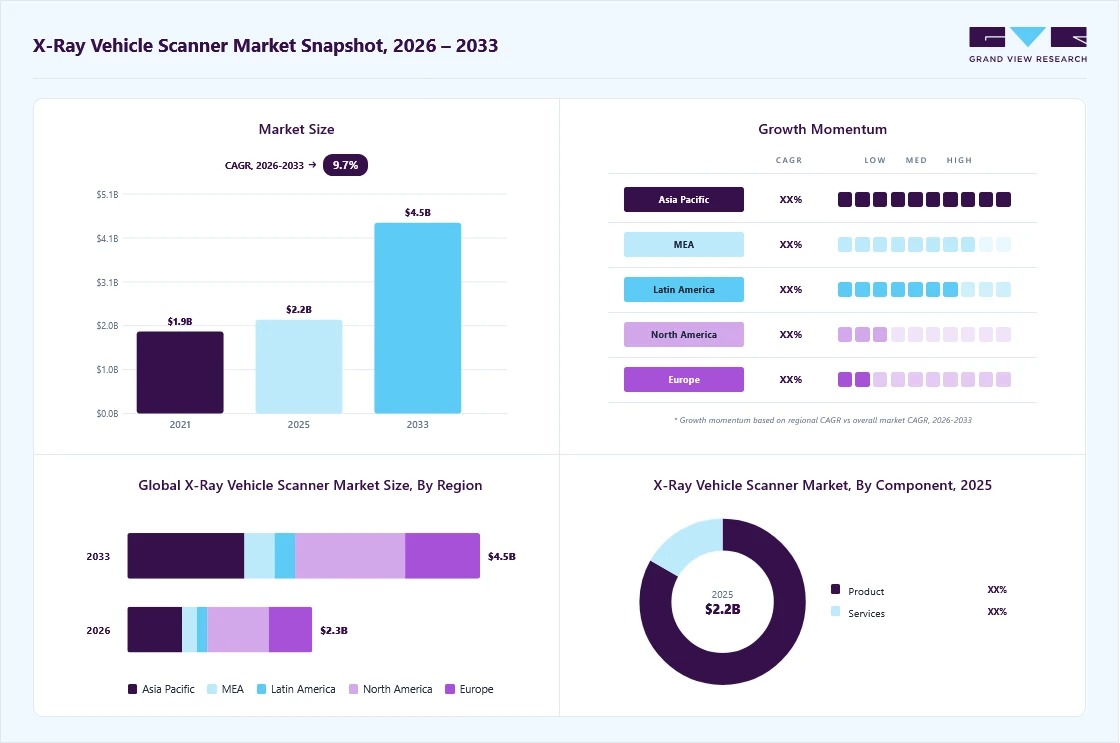 Source: Grand View Research, IR Documents, Primary Interviews, Paid DatabasesTo learn more about this report,
 Download Free Sample Report
Key Market Trends & Insights
- By component: Product segment held the largest market share of 83.1% in 2025.
- By type: Fixed segment held the largest market share in 2025.
- By application: Government/ critical infrastructure protection segment held the largest market share in 2025.
Regional Highlights
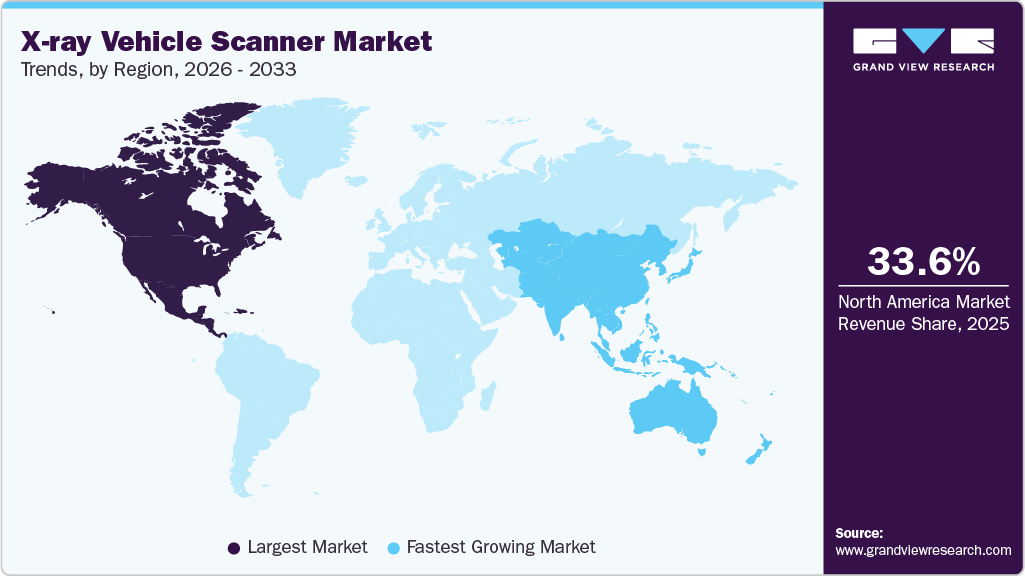
- Largest regional market: North America (33.6% revenue share, 2025)
- Fastest-growing regional market: Asia Pacific (highest CAGR, 2026-2033)
- By country: The U.S. held the largest market share in 2025
Market Size & Forecast
- Market size in 2025: USD 2.2 Billion
- Estimated market size in 2026: USD 2.3 Billion
- Projected market size by 2033: USD 4.5 Billion
- CAGR (2026-2033): 9.7%
Three ways to get this report
Buy it, customize it, or ask a question.Ask an Analyst
Analyst response in 1 business day
- AccessReport author, directly
- Reply timeWithin 1 working day
- No sales callDirect answer only
- FormatEmail reply
- CostFree, no cost
Get the Full Report
What the study covers
- FormatsPDF · Excel · Dashboard
- Timeline2026–2033 annual, 2025 base
- Coverage20+ countries, 5 regions
- Companies10+ key players profiled
Customize the Report
20% free customization
- IncludeCountries, segments, points
- TailorTo your product definition
- ExtendDeeper competitor detail
- OrA fully bespoke study
- Turnaround5–10 working days
The demand for high-energy drive-through X-ray scanning systems is increasing significantly across border checkpoints, ports, and customs facilities. Governments and security agencies are increasingly deploying these systems to inspect trucks, cargo containers, and commercial vehicles without interrupting traffic flow. These scanners offer deep penetration capability and high-throughput inspection, making them suitable for detecting concealed contraband, weapons, explosives, and smuggled goods. Rising international trade volumes and growing concerns regarding cross-border illegal activities are accelerating investments in large-scale drive-through inspection infrastructure. In addition, modernization of customs operations and the need for faster cargo clearance are supporting the growth of the market globally.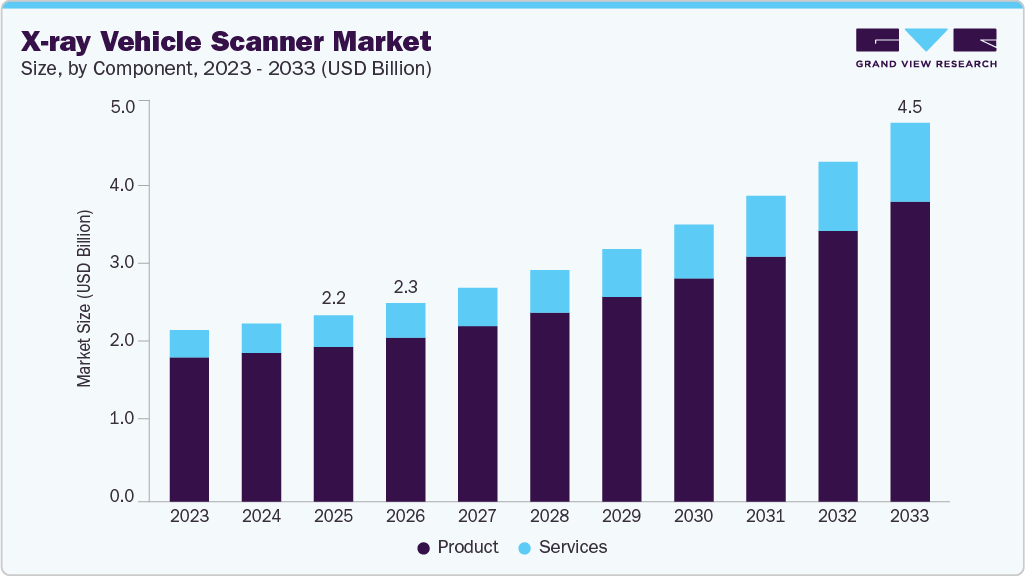 To learn more about this report, Download Free Sample Report
Artificial intelligence (AI) and advanced image analytics are becoming increasingly integrated into X-ray vehicle scanning systems. Vendors are focusing on AI-powered software that automatically identifies suspicious objects, abnormal cargo patterns, and concealed threats in scanned images. The use of machine learning algorithms helps reduce operator dependency, minimize human error, and improve inspection accuracy and operational efficiency. Automated threat recognition systems are also enabling faster decision-making in high-traffic border and port environments. Governments are increasingly prioritizing smart security infrastructure, driving the adoption of AI-enabled vehicle scanning solutions as a major technological trend in the market.
Manufacturers are increasingly focusing on improving image resolution, scanning speed, and operational efficiency in X-ray vehicle scanning systems. Advanced detector technologies, enhanced imaging software, and dual-energy X-ray systems are enabling more accurate identification of concealed materials and cargo contents. Vendors are also developing systems with lower radiation exposure, faster image processing, and improved material discrimination capabilities to enhance operational safety and inspection reliability. In addition, the integration of cloud-based monitoring and remote diagnostics is improving system maintenance and reducing downtime. These technological advancements are helping security agencies achieve higher inspection accuracy while maintaining efficient traffic and cargo movement.
Governments across multiple regions are increasing investments in modernizing border security and port inspection infrastructure to strengthen national security and trade monitoring capabilities. Large-scale deployment of advanced X-ray scanning systems is being observed at seaports, airports, land border crossings, and logistics hubs. Growing concerns related to terrorism, drug trafficking, illegal trade, and cross-border smuggling are encouraging authorities to adopt high-performance non-intrusive inspection technologies. In addition, increasing containerized trade and expanding international shipping activities are creating substantial demand for efficient cargo inspection systems. Emerging economies are also investing heavily in smart border initiatives and integrated customs management systems, contributing to overall market growth.
The high capital investment required for system procurement, installation, and infrastructure development is one of the major factors that could hamper the growth of the market. High-energy drive-through scanning systems used at ports, border crossings, and airports require substantial investments in radiation shielding, dedicated inspection lanes, power supply systems, and integrated security infrastructure. The cost of advanced scanning equipment can reach several million dollars per installation, making adoption difficult for developing economies and smaller private operators. In addition, ongoing maintenance, software upgrades, and operator training further increase the total cost of ownership. These financial barriers can limit large-scale deployment, particularly in cost-sensitive regions.
Market Dynamics
The aviation industry is emerging as an important application area for X-ray vehicle and aircraft scanning systems. Airports are increasingly deploying advanced scanning systems for air cargo inspection, aircraft maintenance security, and perimeter vehicle screening. Growing global air cargo transportation volumes and rising aviation security requirements are supporting demand for high-performance inspection infrastructure.
Airport authorities are also integrating vehicle scanning systems with broader surveillance and airport security management platforms. Expanding investments in airport modernization and aviation security upgrades are expected to contribute significantly to market expansion.
The operation of advanced X-ray vehicle scanning systems requires trained personnel capable of accurately interpreting complex inspection images and managing high-throughput screening environments. Many customs authorities and security agencies face challenges related to workforce training, shortage of skilled operators, and retention of experienced inspection personnel. In addition, integration of AI-enabled analytics, cloud-based monitoring systems, and automated threat detection platforms increases technical complexity for end users.
System downtime, calibration issues, and software integration challenges can also impact inspection efficiency and operational reliability. These operational limitations may affect adoption among organizations lacking sufficient technical expertise or infrastructure support.
The rising demand for flexible security infrastructure is creating significant opportunities for portable and mobile X-ray vehicle scanning systems. Defense agencies, law enforcement organizations, and emergency response teams are increasingly seeking rapidly deployable scanning technologies capable of operating in remote locations, temporary checkpoints, and tactical security environments.
Manufacturers are focusing on lightweight, compact, and vehicle-mounted systems that provide operational mobility without compromising inspection performance.
Advancements in wireless connectivity, battery-powered operation, and AI-assisted imaging are further improving portability and field deployment capabilities. The growing need for mobile surveillance and temporary inspection infrastructure is expected to drive strong growth opportunities within the portable scanning segment.
Market Concentration & Characteristics
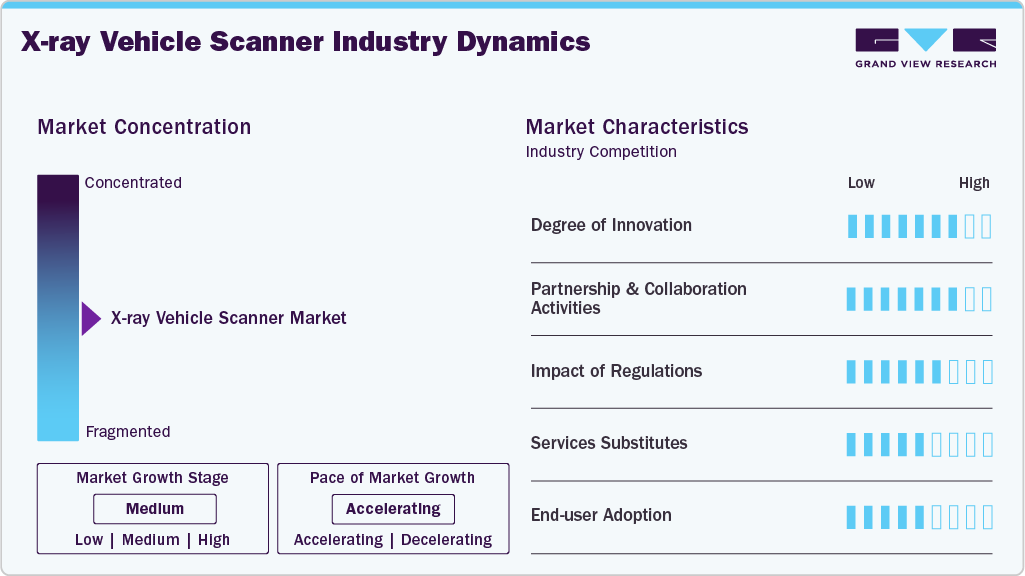
The global X-ray vehicle scanner industry is moderately fragmented, indicating the presence of a mix of large multinational manufacturers and numerous regional or niche players. While leading companies such as Leidos, Smiths Detection, and Nuctech maintain significant market share through government contracts and large-scale infrastructure projects, smaller specialized vendors are actively serving defense, logistics, port, and private sector requirements. This fragmented structure encourages competition based on technology innovation, AI integration, system throughput, and tailored service offerings rather than pure market concentration. The market is currently in a medium growth stage, with accelerating adoption driven by rising trade volumes, border security modernization, and infrastructure development across multiple regions.
 To learn more about this report, Download Free Sample Report
The market characteristics reveal a moderately high degree of innovation, with companies increasingly investing in AI-based threat detection, high-energy imaging, and portable scanning solutions. Partnership and collaboration activities are significant, as vendors often work with governments, ports, and logistics operators to implement integrated inspection solutions. Regulatory compliance, particularly regarding radiation safety, remains a critical factor shaping market dynamics. In addition, growing end user adoption and demand for portable scanning services are further driving growth of the market.
Component Insights
The product segment dominated the market in 2025 and accounted for the largest share of 83.1%. The segment includes products such as vehicle, watercraft, and aircraft scanners. The segment’s growth is driven by increasing investments in border security, port modernization, airport infrastructure, and critical infrastructure protection. Governments and defense agencies are increasingly deploying advanced high-energy drive-through scanning systems to strengthen cargo inspection capabilities and combat smuggling, terrorism, and other illegal trafficking. Rising global trade volumes and growing containerized freight movement are also generating strong demand for vehicle and cargo scanning systems capable of high-throughput inspection.
The services segment is expected to grow at the fastest CAGR during the forecast period. The segment’s growth is driven by the expanding installed base of X-ray vehicle-scanning systems at border checkpoints, ports, airports, and government facilities worldwide. Increasing demand for preventive maintenance, system calibration, software upgrades, and technical support services is contributing significantly to segment growth. As scanning systems become more technologically advanced and integrated with AI-based analytics platforms, end users are increasingly requiring specialized training, remote monitoring, and lifecycle management services to ensure operational efficiency and regulatory compliance.
Type Insights
The fixed segment accounted for the largest market share in 2025. The segment’s growth is driven by increasing investments in permanent border security infrastructure, customs modernization programs, and high-volume cargo inspection facilities. Governments and port authorities are increasingly deploying fixed drive-through X-ray scanning systems at border checkpoints, seaports, and airports to improve inspection efficiency and strengthen national security. These systems offer high throughput, deep penetration capability, and continuous operational performance, making them suitable for large-scale cargo and vehicle screening applications.
The portable segment is expected to grow at the fastest CAGR during the forecast period. Portable X-ray vehicle scanners are witnessing growing adoption across military operations, temporary checkpoints, emergency response applications, and remote border regions. Security agencies are increasingly demanding flexible inspection solutions that can be rapidly deployed without requiring permanent infrastructure. Manufacturers are responding by developing compact, vehicle-mounted, and trailer-based scanning systems with enhanced mobility and lower operational complexity. These systems are particularly useful for defense forces, law enforcement agencies, and customs authorities operating in dynamic or high-risk environments. The increasing need for mobile surveillance and tactical security operations is expected to drive strong growth in this segment over the coming years.
Application Insights
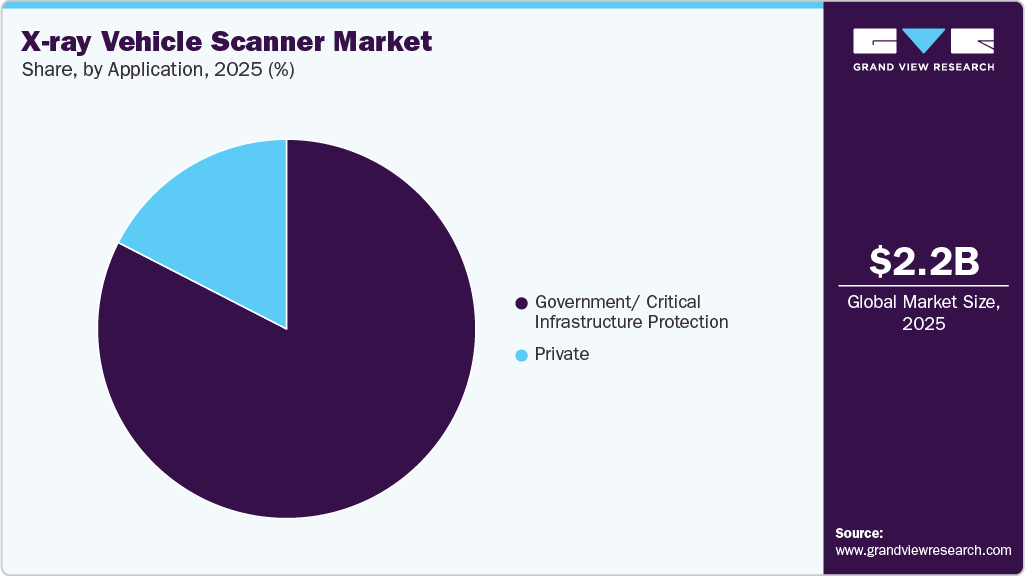
The government/ critical infrastructure protection segment dominated the market in 2025. The rising investments in national security, border control modernization, and anti-smuggling initiatives across multiple countries are driving the growth of the segment. Governments are increasingly deploying advanced X-ray vehicle-scanning systems at border crossings, customs checkpoints, airports, seaports, military bases, and other high-security facilities to strengthen surveillance and threat-detection capabilities. Growing concerns related to terrorism, illegal trafficking, weapons smuggling, and unauthorized cargo movement are further accelerating demand for high-energy drive-through and cargo inspection systems.
 To learn more about this report, Download Free Sample Report
The private segment is expected to grow at the fastest CAGR during the forecast period. Increasing security requirements across logistics hubs, industrial facilities, mining operations, private ports, warehouses, and commercial infrastructure are expected to drive the growth of the segment. Private operators are increasingly adopting X-ray vehicle scanning systems to enhance perimeter security, monitor cargo movement, prevent theft, and ensure compliance with transportation and safety regulations. The growth of global supply chains, e-commerce logistics networks, and high-value cargo transportation is further increasing the need for advanced inspection technologies across private facilities.
Regional Insights
North America dominated the global X-ray vehicle scanner industry and accounted for a share of 33.6% in 2025. This growth can be attributed to the region’s extensive investments in homeland security, border protection, and transportation security infrastructure. The region has a well-established deployment base of high-energy vehicle and cargo scanning systems across border crossings, airports, seaports, and customs facilities. Rising concerns related to illegal trafficking, cross-border smuggling, and national security threats continue to drive the procurement of advanced inspection systems throughout the region.
 To learn more about this report, Download Free Sample Report
U.S. X-ray Vehicle Scanner Market Trends
The U.S. held a dominant position in the region in 2025. In the United States X-ray vehicle scanning system market , federal agencies continue to deploy advanced drive-through cargo and vehicle scanning systems across land borders, ports, airports, and military installations to strengthen national security and improve cargo inspection efficiency. Increasing concerns regarding drug trafficking, unauthorized cargo movement, and terrorism threats are driving demand for high-performance x-ray vehicle scanners in the country.
Asia Pacific X-ray Vehicle Scanner Market Trends
The Asia Pacific X-ray vehicle scanner industry is expected to grow at the fastest CAGR during the forecast period. Increasing cross-border trade activities, expanding containerized cargo movement, and growing concerns regarding smuggling and illegal trafficking are driving the adoption of advanced non-intrusive inspection systems throughout the region, thereby driving the market’s growth.
India’s X-ray vehicle scanner industry is expected to grow at the fastest growth rate during the forecast period. The growing movement of cargo through ports, inland container depots, and cross-border trade corridors is generating strong demand for high-throughput cargo and vehicle inspection systems across the country. Government agencies are increasingly investing in advanced X-ray scanning technologies across airports, customs facilities, and critical infrastructure projects to strengthen surveillance and inspection efficiency.
The China X-ray vehicle scanner industry held a significant market share in 2025, due to its extensive trade infrastructure, large port network, and strong investments in national security technologies. In addition, increasing focus on smart port development, automated logistics infrastructure, and integrated surveillance systems is further driving the adoption of advanced scanning technologies.
Europe X-ray Vehicle Scanner Market Trends
Europe X-ray vehicle scanner industry is expected to register a moderate CAGR from 2026 to 2033. Countries across the region are increasingly investing in advanced X-ray security scanner for cargo and vehicle inspection systems to improve cross-border trade monitoring, strengthen anti-smuggling operations, and enhance the efficiency of customs and border security inspections. Growing trade activities, rising container traffic through European ports, and increasing investments in airport modernization projects are contributing to market growth.
The UK X-ray vehicle scanner industry is expected to grow at a significant CAGR during the forecast period. Ongoing investments in smart border initiatives and digital security infrastructure are expected to support continued demand for advanced X-ray scanning systems in the UK
The Germany X-ray vehicle scanner industry held a substantial market share in 2025, due to its strong logistics infrastructure, large industrial base, and high trade volumes. The growing focus on industrial security, cross-border cargo inspection, and automated logistics operations is driving demand for advanced scanning technologies, such as X-ray scanners, in the country.
Key X-ray Vehicle Scanner Company Insights
Some of the key companies in the X-ray vehicle scanner industry include Leidos, Nuctech Company Limited, Smiths Detection Group Ltd., among others. These companies are focusing on advanced imaging capabilities, AI-enabled threat detection, high-throughput cargo inspection, and mobile scanning solutions. They are competing through continuous product innovation, strategic government contracts, expansion into emerging markets, and integration of intelligent inspection software.
-
Leidos offers advanced cargo and vehicle inspection systems for border security, ports, airports, and critical infrastructure applications. The company is widely recognized for its VACIS series of high-energy vehicle and cargo-scanning systems, designed for rapid, non-intrusive inspection of trucks, containers, and other commercial vehicles.
-
Nuctech Company Limited is a major global provider of X-ray security and cargo inspection systems with extensive deployments across ports, border checkpoints, airports, and customs facilities. The company offers a broad portfolio of fixed, mobile, and drive-through vehicle scanning systems capable of inspecting trucks, cargo containers, passenger vehicles, and freight shipments.
Key X-ray Vehicle Scanner Companies:
The following key companies have been profiled for this study on the X-ray vehicle scanner market.
- Vantage Security
- Leidos
- LINEV Systems
- Nuctech Company Limited
- Shenzhen Security Electronic Equipment Co., Limited.
- 3DX-RAY Ltd.
- PKI Electronic Intelligence
- CGN Group
- Smiths Detection Group Ltd.
- Mircea Tudor Scan Tech
Recent Developments
- In July 2025, DP World, UAE-based logistics company launched a drive-through X-ray scanner at Romania’s Black Sea Port of Constanta, marking the first installation of its kind in Central and Eastern Europe. The system was deployed at DP World’s newly established Roll-On, Roll-Off (RO-RO) terminal to improve customs inspection efficiency and strengthen security measures for import and transit cargo entering Romania.
X-ray Vehicle Scanner Market Report Scope
Report Attribute
Details
Market size in 2025
USD 2.2 billion
Estimated market size in 2026
USD 2.3 billion
Projected market size by 2033
USD 4.5 billion
Growth Rate
CAGR of 9.7% from 2026 to 2033
Base year for estimation
2025
Historical data
2021 - 2024
Forecast period
2026 - 2033
Quantitative units
Revenue in USD million/billion and CAGR from 2026 to 2033
Report coverage
Revenue forecast, company ranking, competitive landscape, growth factors, and trends
Segments covered
Component, type, application, region
Regional scope
North America; Europe; Asia Pacific; Latin America; MEA
Country scope
U.S.; Canada; Mexico; Germany; UK; France; China; Japan; India; South Korea; Australia; Brazil; KSA; UAE; South Africa
Key companies profiled
Vantage Security; Leidos; LINEV Systems; Nuctech Company Limited; Shenzhen Security Electronic Equipment Co., Limited; 3DX-RAY Ltd.; PKI Electronic Intelligence; CGN Group; Smiths Detection Group Ltd.; Mircea Tudor Scan Tech
Customization scope
Free report customization (equivalent up to 8 analysts working days) with purchase. Addition or alteration to country, regional & segment scope.
Pricing and purchase options
Avail customized purchase options to meet your exact research needs. Explore purchase options
Global X-ray Vehicle Scanner Market Report Segmentation
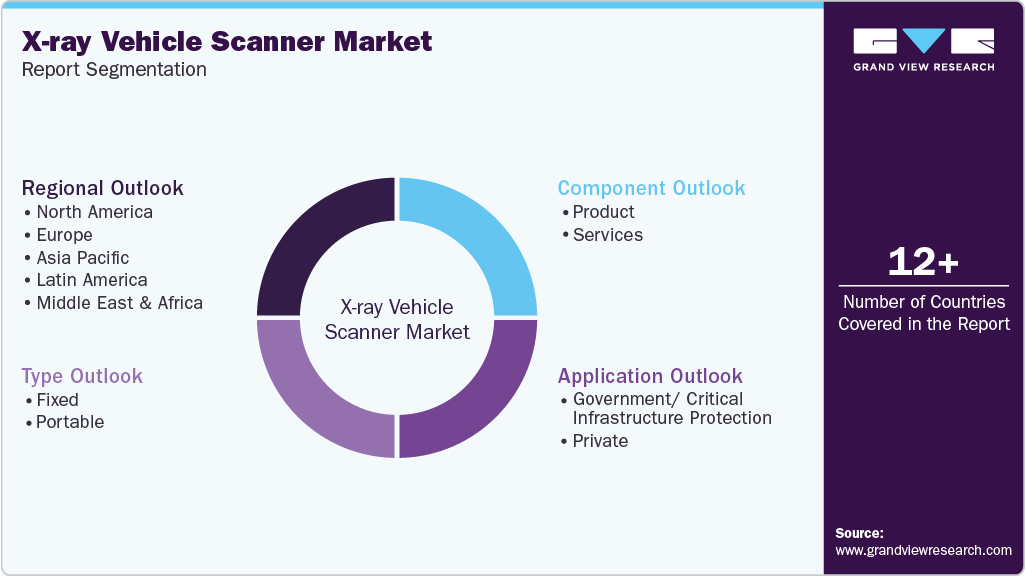
This report forecasts revenue growth at global, regional, and country levels and provides an analysis of the latest industry trends in each of the sub-segments from 2021 to 2033. For this study, Grand View Research has segmented the global X-ray vehicle scanner market report based on component, type, application, and region.
 To learn more about this report, Download Free Sample Report
-
Component Outlook (Revenue, USD Million, 2021 - 2033)
-
Product
-
Services
-
-
Type Outlook (Revenue, USD Million, 2021 - 2033)
-
Fixed
-
Portable
-
-
Application Outlook (Revenue, USD Million, 2021 - 2033)
-
Government/ Critical Infrastructure Protection
-
Private
-
-
Regional Outlook (Revenue, USD Million, 2021 - 2033)
-
North America
-
U.S.
-
Canada
-
Mexico
-
-
Europe
-
Germany
-
UK
-
France
-
-
Asia Pacific
-
China
-
Japan
-
India
-
South Korea
-
Australia
-
-
Latin America
-
Brazil
-
-
Middle East and Africa (MEA)
-
KSA
-
UAE
-
South Africa
-
-
Delivered Customizations
This report has been delivered with the following In-depth customizations
Client Request
Customization Delivered
Value Adds
Regional X-Ray Vehicle Scanner Market Opportunity Assessment
Country/region-wise market sizing and forecasts
Analysis of demand, adoption trends, and regulatory landscape
Identification of high-growth regions and investment hotspots
Identified region-specific growth opportunities
Supported expansion and go-to-market strategy
Enabled informed regional investment decisions
Cross-Segmentation Analysis for the X-Ray Vehicle Scanner Market
Criss-cross market analysis by component, type, and application
Demand and adoption assessment across key segments
Segment attractiveness and growth potential benchmarking
Identified high-potential market segments
Supported targeted product positioning and marketing strategy
Improved customer and segment prioritization
Competitive Benchmarking and Strategic Positioning in the X-ray Vehicle Scanner Market
Benchmarking of key competitors across products, pricing, partnerships, and innovation
Comparative assessment of market share, capabilities, and strategies
Analysis of competitive strengths, gaps, and differentiation areas
Identified competitive white spaces and growth gaps
Supported strategic positioning and differentiation
Enabled data-driven competitive strategy development
Frequently Asked Questions About This Report
The global x-ray vehicle scanner market size was valued at USD 2.2 billion in 2025 and is estimated at USD 2.3 billion for 2026.
The global x-ray vehicle scanner market is expected to grow at a CAGR of 9.7% from 2026 to 2033, reaching USD 4.5 billion by 2033.
North America dominated the X-ray vehicle scanner industry and accounted for a share of 33.6% in 2025. This growth can be attributed to the region’s extensive investments in homeland security, border protection, and transportation security infrastructure.
The growth of the X-ray vehicle scanner market is driven by increasing investments in border security, customs modernization, and critical infrastructure protection across the globe.
Asia Pacific is the fastest-growing region over the forecast period.
The product segment led with a 83.1% revenue share in 2025, while services is the fastest-growing component.
The fixed segment held the largest revenue share in 2025, while portable is the fastest-growing type.
The government/ critical infrastructure protection segment held the largest revenue share in 2025, while private is the fastest-growing application.
Key players include Vantage Security; Leidos; LINEV Systems; Nuctech Company Limited; Shenzhen Security Electronic Equipment Co., Limited; 3DX-RAY Ltd.; PKI Electronic Intelligence; CGN Group; Smiths Detection Group Ltd.; Mircea Tudor Scan Tech.
About the Author(s)
Automotive & Transportation Research Team
Technology · Automotive & TransportationThis report was authored by the automotive & transportation research team at Grand View Research - comprising two research analysts, one senior research analyst, and one industry expert - with specialized expertise in the automotive & transportation segment of the technology industry. All findings are based on proprietary technology databases, executive interviews, and regulatory analysis, subject to internal peer review prior to publication.
Last Updated:
Speak to Analyst

Customize this report to your needs - add regions, segments, or data points, with 20% free customization.
Or view our licence options:


ISO 9001:2015 & 27001:2022 Certified
We are GDPR and CCPA compliant! Your transaction & personal information is safe and secure. For more details, please read our privacy policy.


