
- Home
- »
- Medical Devices
- »
-
CGM Product Intelligence: Revenue, Pricing & ForecastsGVR Report cover
![Continuous Glucose Monitoring (CGM) Product IntelligenceReport]()
Continuous Glucose Monitoring (CGM) Product Intelligence
Product Revenue, Sensor Volume, Pricing & Competitive Outlook, Manufacturer-level estimates, Product migration & Commercialization, Excel-based Datasets
Performance of Individual CGM Products & Brands
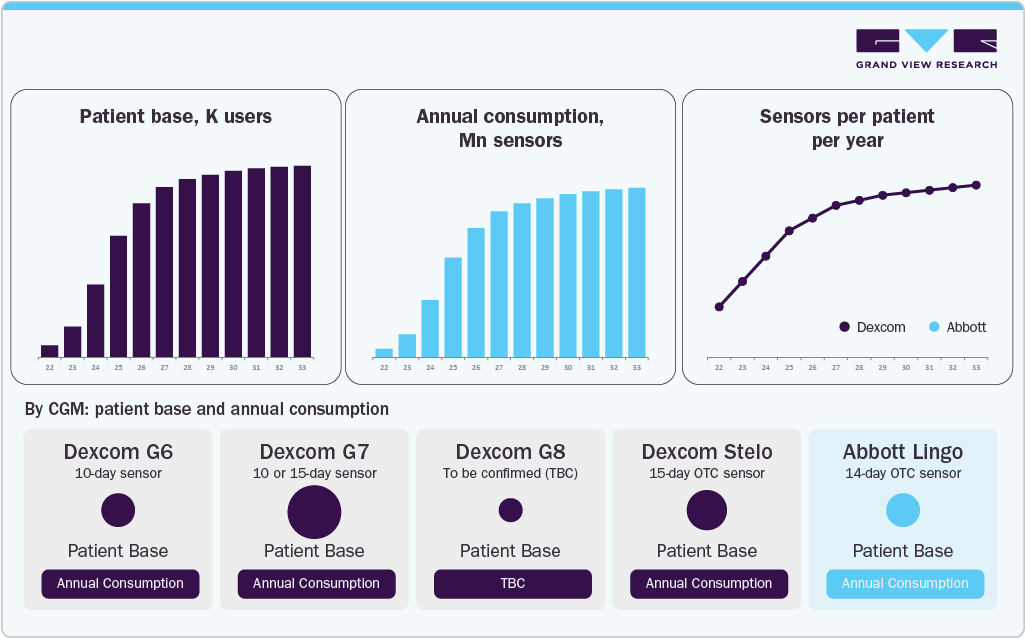
The commercial evolution of continuous glucose monitoring across Dexcom and Abbott products, along with others have been centrally analyzed. Our product-level intelligence combines annual estimated revenue, sensor volumes, manufacturer average selling prices (ASP), patient base and consumption patterns with analysis of device launches, wear-duration changes, market access and competitive substitution.
Six featured product coverages below and choose a focused, multi-product or cross-brand package aligned with your commercial decisions.
Six featured product coverages
Product coverage
What intelligence helps assess
Dexcom G6
G6 phase-out, remaining revenue and volume, and migration toward newer Dexcom systems.
Dexcom G7 / G7 15 Day
Revenue and sensor trends; 10-day versus extended-wear uptake and their effect on unit demand.
Dexcom G8
Forecast-only revenue and volume outlook, anticipated launch pathway, and G7-to-G8 transition.
Dexcom Stelo
OTC glucose monitoring adoption, consumer channels, subscription dynamics and international expansion.
Abbott Lingo
Consumer metabolic-wellness demand, retail pricing context, repeat purchases and adoption outlook.
Abbott Libre Duo and Libre Duo 10 Day / dual-analyte monitoring
Emerging glucose-and-ketone monitoring, commercialization opportunity and implications for CGM competition.
Key questions answered in this analysis
-
Which CGM products are generating revenue, and how might their product-level sales projections change through 2033?
-
How do longer sensor-wear durations affect annual unit consumption and manufacturer revenue per CGM sensor?
-
Where are established CGM devices losing demand to successor products?
-
How do prescription CGM products compare with emerging OTC and dual-analyte offerings?
-
What shifts in product adoption, pricing, reimbursement, distribution and regulatory status could change competitive positioning of CGMs?
What the deliverable contains
Intelligence module
Standard coverage / measurement
Product revenue
Annual estimated product-attributable revenue, USD million.
Sensor volume
Annual estimated sensor units sold; wear-duration effects where applicable.
Manufacturer ASP
Estimated net manufacturer revenue per sensor (USD), not retail or reimbursement pricing.
Patient base & consumption
Modeled user population and annual sensor consumption, subject to data availability.
Geographic breakdown
U.S., Europe and International as the core regional framework; additional regional details where supported.
Forecast and migration drivers
Launch timing, substitutions, patient adoption, coverage and manufacturer pricing assumptions.
Temporal treatment: Historical estimates start when a product is commercially available; unlaunched products such as G8 are forecast-only. The 2022–2033 headline denotes the overall dataset window, not a claim of observed sales for every product in every year.
CGM Products : Currently Available & To be Launched
From G6 to G7 15 Day: Transition economics
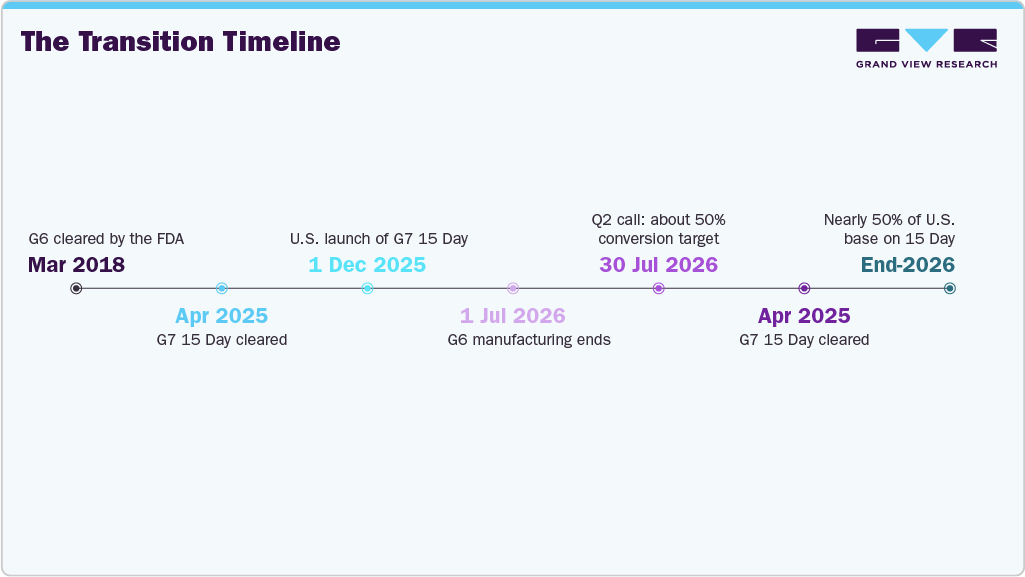
The Dexcom G6 is an earlier-generation continuous glucose monitoring (CGM) system from Dexcom. In March 2018, it became the first CGM authorized by the FDA, cleared through the De Novo pathway as an integrated CGM system that allows interoperability with compatible diabetes devices and removes the need for routine fingerstick calibration. The system includes a 10-day sensor, glucose readings every five minutes, predictive alerts, and smartphone connectivity. Dexcom announced Medicare coverage for eligible beneficiaries in October 2018, helping to broaden access to technology. In February 2019, the FDA cleared the G6 as a factory-calibrated CGM system through the 510(k) pathway, reinforcing its role in diabetes management.
Dexcom G7 Continuous Glucose Monitoring (CGM) Revenue & Volume Analysis: A Deep Dive Into Dexcom G7, 2022–2033
Dexcom, Inc. is a U.S.-based medical device company that specializes in continuous glucose monitoring (CGM) systems; it was founded in 1999 and is headquartered in San Diego, California. Its portfolio comprises the Dexcom G7, G7 15 Day, G6, and Stelo, an over-the-counter glucose biosensor intended for eligible adults. These products deliver real-time glucose readings, customizable alerts, and connectivity with compatible digital health platforms.
The Dexcom G7 gained FDA clearance in December 2022 and was launched in the U.S. in 2023, offering an integrated sensor-transmitter design and a shorter warm-up time than the G6. In April 2025, Dexcom announced that the G7 15 Day had received FDA clearance for eligible adults aged 18 years and older with diabetes. Providing up to 15 days of sensor wear, the system was launched commercially in the U.S. on December 1, 2025, broadening Dexcom's product portfolio and its extended-wear CGM offering.
When
Development
Oct 2022
International roll-out of G7 begins (U.K., Ireland, Germany, Austria, Hong Kong)
Dec 2022
FDA clearance of Dexcom G7
Feb 2023
U.S. launch; Medicare coverage within days and commercial DME coverage on par with G6
2023
CMS widens Medicare CGM access to people using basal insulin
Apr 2025
FDA clearance of G7 15 Day for adults 18+
2025
G7 access widened in Canada under the Ontario Drug Benefit program
1 Dec 2025
U.S. commercial launch of G7 15 Day
After 1 Jul 2026
Dexcom stops manufacturing the G6; customers are directed to G7 or G7 15 Day
Mid-2027
Dexcom anticipates CMS coverage expansion for type 2 diabetes not on insulin
Late 2027–early 2028
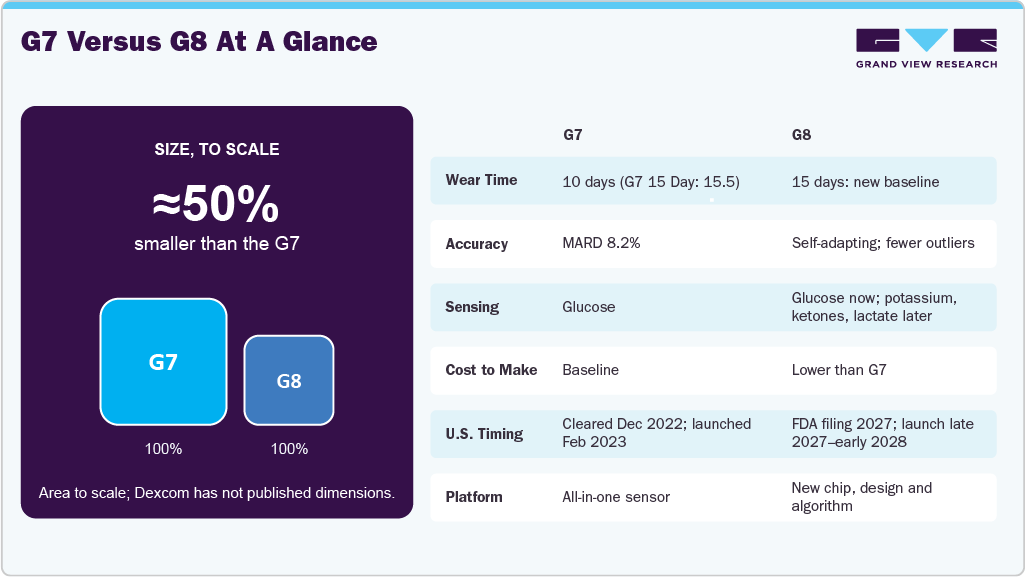
Dexcom plans a smaller G8 sensor (assumed to begin replacing G7 volumes); a multi-analyte version follows later, with no timeline given
Dexcom G8 vs. G7: Revenue and Volume Outlook, 2027–2033
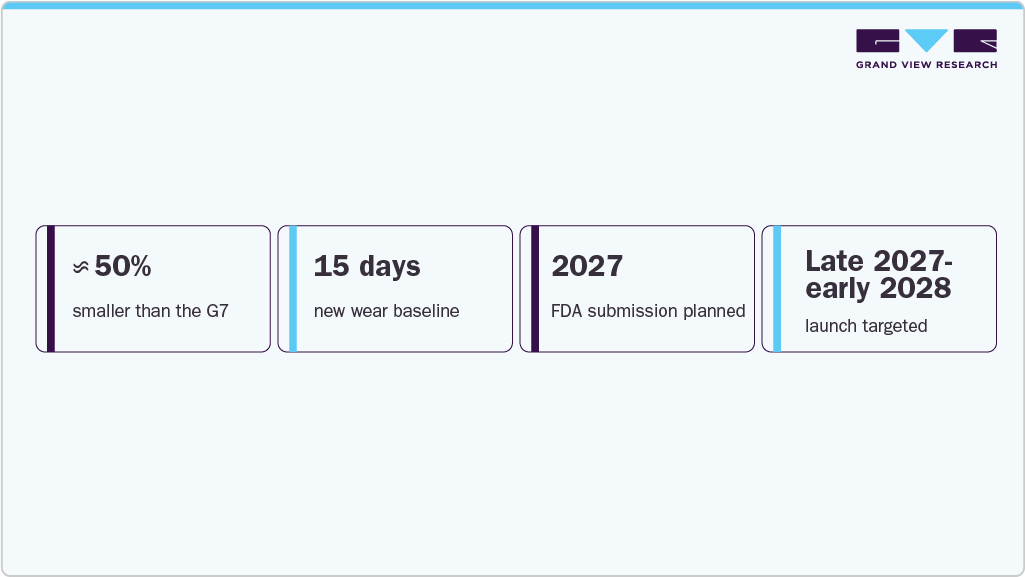
Dexcom unveiled the G8, its next-generation CGM, during its Investor Day in May 2026. The sensor is roughly 50% smaller than the G7 and is based on a new silicon chip, design, and algorithm. A self-adapting algorithm reads extra signals from the sensor to adapt to each user's body and cut down on outlier readings. Dexcom has established 15-day wear as the baseline for its sensors and says the G8 will cost less to manufacture than the G7. The company is aiming for an FDA submission in 2027, which would enable a launch in late 2027 or early 2028, along with a launch outside the U.S. planned for 2028. A multi-analyte version is planned to follow the first G8, with potassium, ketone, and lactate sensing in development and no timeline provided. During its Q2 2026 call in July, Dexcom maintained the G8 timeline and lifted its 2026 revenue guidance to USD 5.18–5.25 billion. Competitor Abbott secured FDA authorization for its dual glucose-ketone Libre Duo 10 Day in August 2026. Dexcom will report Q3 results in October 2026, the next opportunity for a G8 update.
G7 versus G8 at a glance
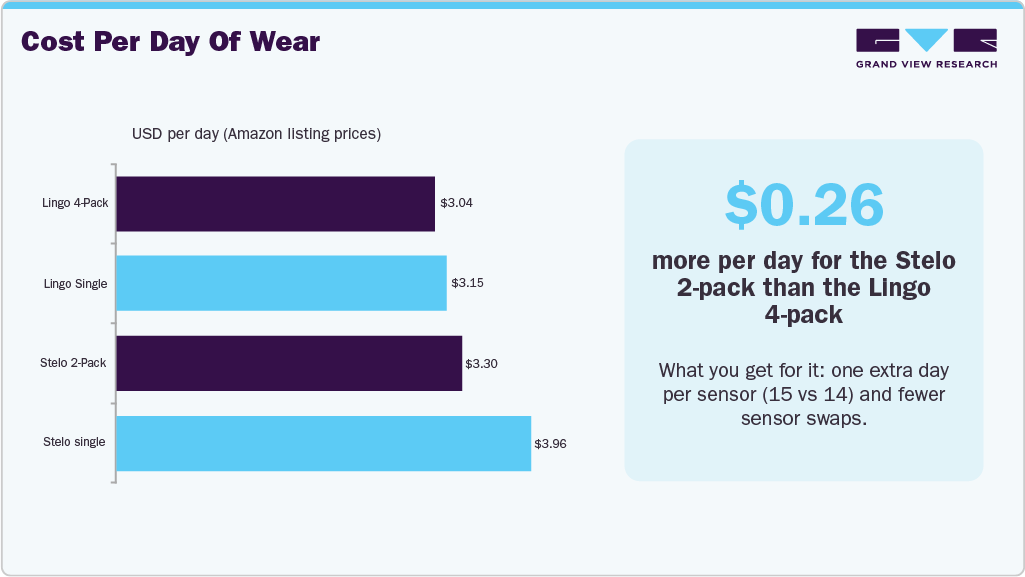
Dexcom Stelo: Revenue and Volume Outlook, 2024-2033
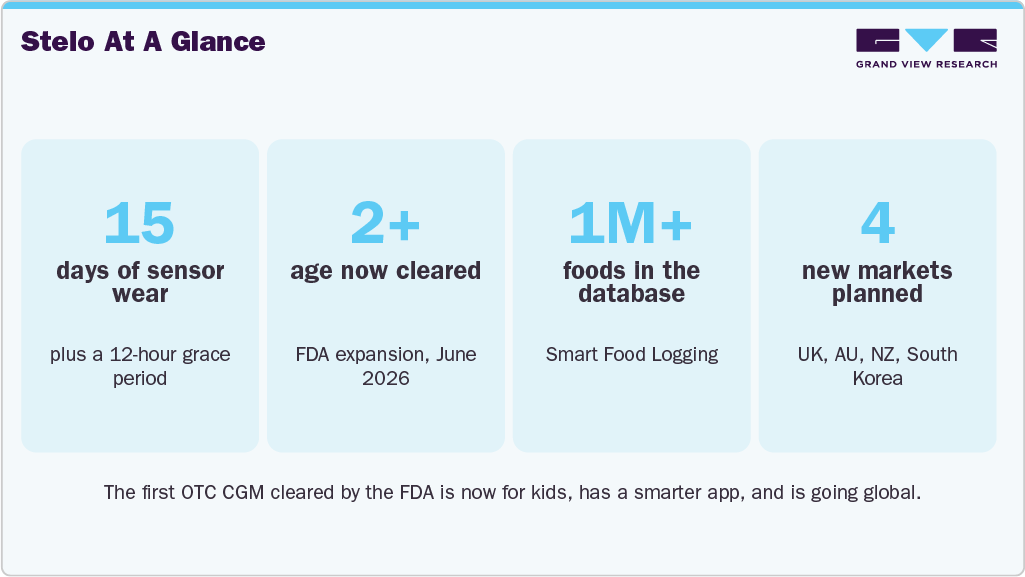
Dexcom's Stelo Glucose Biosensor, which launched in the U.S. in August 2024, represented the company's first step into the over-the-counter (OTC) glucose-monitoring market. Stelo was initially cleared for adults 18 years and older who do not use insulin, and it is intended for people with type 2 diabetes, prediabetes, and consumers looking for lifestyle-related glucose insights. Through a wearable sensor and a smartphone application, the system delivers continuous glucose readings without the need for a prescription.
In February 2026, Dexcom introduced enhanced AI-enabled food logging and personalized daily insights designed to help users see how nutrition and everyday behaviors influence their glucose patterns. A significant regulatory milestone came in June 2026, when the U.S. FDA cleared Stelo for children aged two years and older who do not use insulin, broadening its potential user base. Dexcom also revealed plans to expand internationally into the United Kingdom, Australia, New Zealand, and South Korea, starting later in 2026 and carrying on through 2027. These launches are planned and do not confirm that the product will be commercially available in every market.
The broadening of Stelo's indications, its digital features, and its potential geographic reach open up opportunities for growth in consumer glucose biosensing. Our report would estimate Stelo-specific revenue, sensor volumes, average selling prices, and regional expansion from 2024 to 2033, independent of Dexcom's prescription-based CGM systems.
Abbott Lingo: Revenue and Volume Outlook, 2024–2033
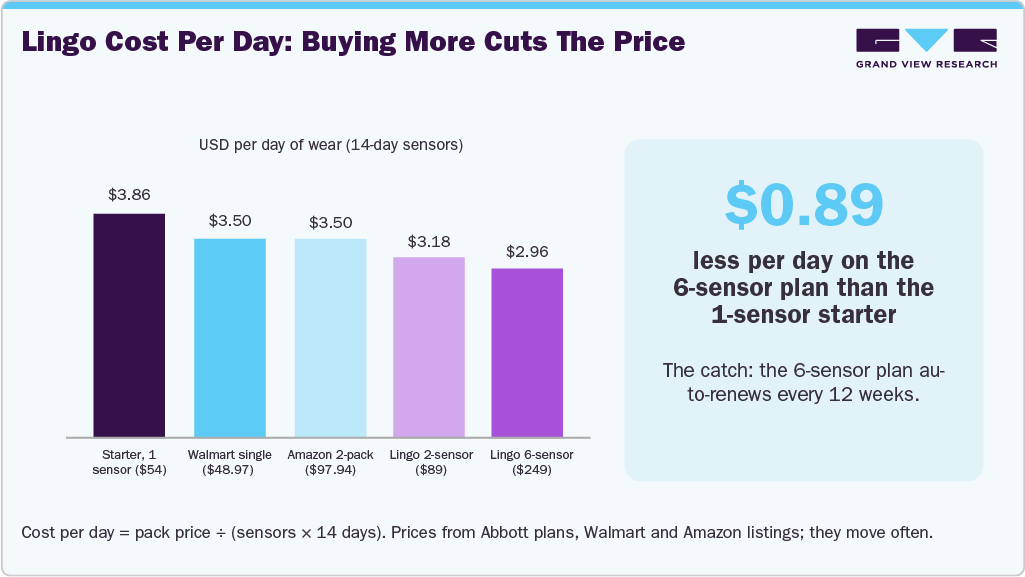
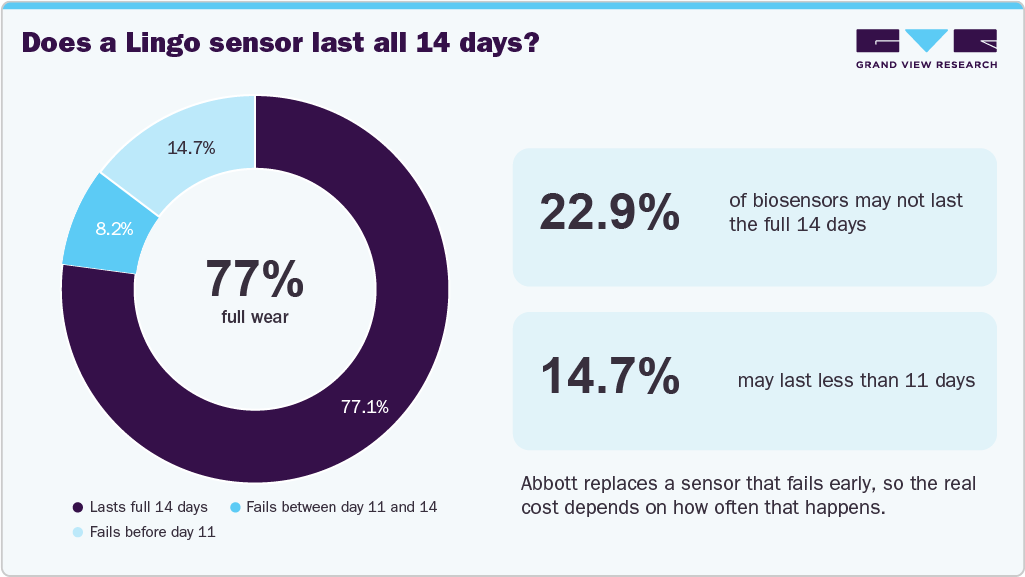
Abbott is extending its continuous glucose monitoring portfolio past conventional diabetes care with Lingo, an over the counter (OTC) glucose biosensor aimed at consumers who want to understand their glucose patterns and enhance their metabolic health. Lingo was introduced in the U.K. in early 2024 and became available in the U.S. in September 2024. The system pairs a wearable biosensor, usable for up to 14 days, with a smartphone app that delivers glucose trends, food and activity logging, personalized insights, and behavioral coaching.
A major step in Lingo’s expansion came with the addition of Android compatibility in December 2025, extending access to users beyond iOS. Abbott has further broadened the product’s retail availability, with purchases offered via its website and retailers such as Amazon and Walmart. In August 2026, Abbott and Google announced a partnership aimed at combining glucose insights with artificial intelligence to support everyday health and wellness, opening a potential opportunity to strengthen personalized consumer insights.
Lingo’s revenue outlook through 2033 will hinge on consumer awareness, how often sensors are replaced, subscription adoption, pricing, retail distribution, digital engagement, and entry into additional markets. The report will estimate Lingo-specific revenue, sensor volume, and average selling price separately from Abbott’s wider FreeStyle Libre portfolio and other diabetes-care products. Because Abbott does not publicly disclose standalone Lingo revenue and sensor sales, these figures will be derived through a documented estimation model rather than presented as reported company results.
Libre Duo and Libre Duo 10 Day: Revenue and Volume Outlook, 2026–2033
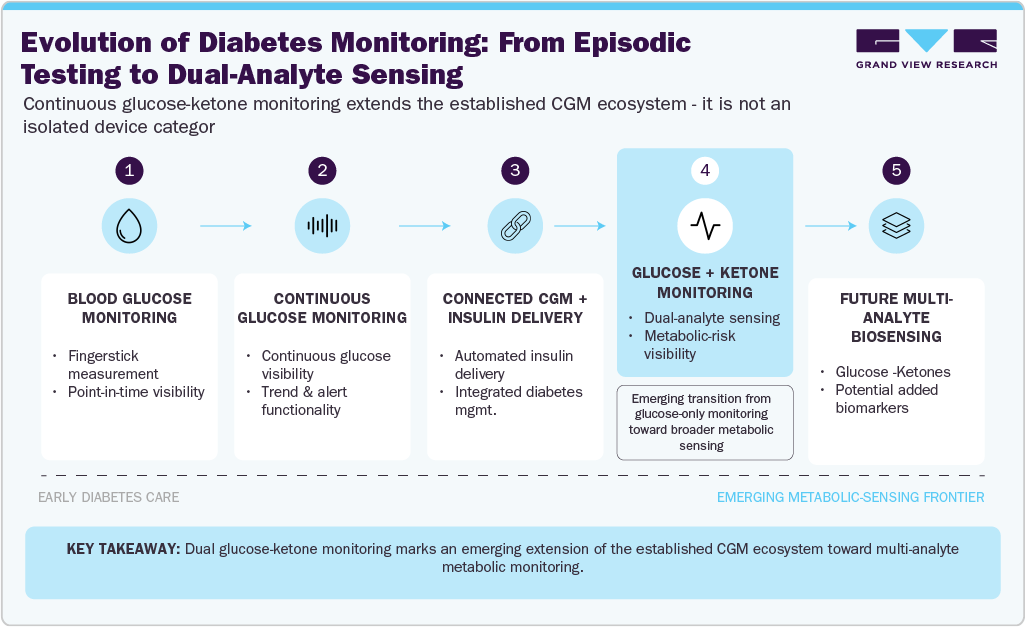
Abbott is expanding its continuous glucose monitoring portfolio through Libre Duo and Libre Duo 10 Day, wearable biosensors designed to measure glucose and ketone levels continuously. The systems represent an emerging development in diabetes monitoring, particularly for individuals at elevated risk of diabetic ketoacidosis (DKA). Abbott received CE marking in May 2026 for Libre Duo (adults, up to 15 days of wear) and Libre Duo 10 Day (ages 2 and older), and U.S. FDA authorization for Libre Duo 10 Day in August 2026, with commercial launches planned from late 2026. Sources: Abbott announcements and FDA information.
A key milestone in 2026 was the product's regulatory progress in Europe and the U.S., establishing a foundation for initial commercialization. The 10-day sensor wear period creates recurring replacement demand, while the combination of glucose and ketone monitoring may appeal to patients seeking greater visibility into their metabolic status.
Libre Duo's revenue outlook through 2033 will depend on market availability, eligible patient populations, sensor pricing, replacement frequency, reimbursement, physician recommendations, and adoption of continuous ketone monitoring. North America and Europe may represent important early markets, with Asia Pacific offering longer-term potential as access to advanced diabetes technologies expands.
The report will estimate Libre Duo-specific revenue, sensor volume, and average selling price separately from Abbott's broader FreeStyle Libre portfolio. As standalone product revenue and sales volumes are not publicly disclosed, these figures will be developed through a documented estimation model rather than presented as reported company results.
Market Opportunity
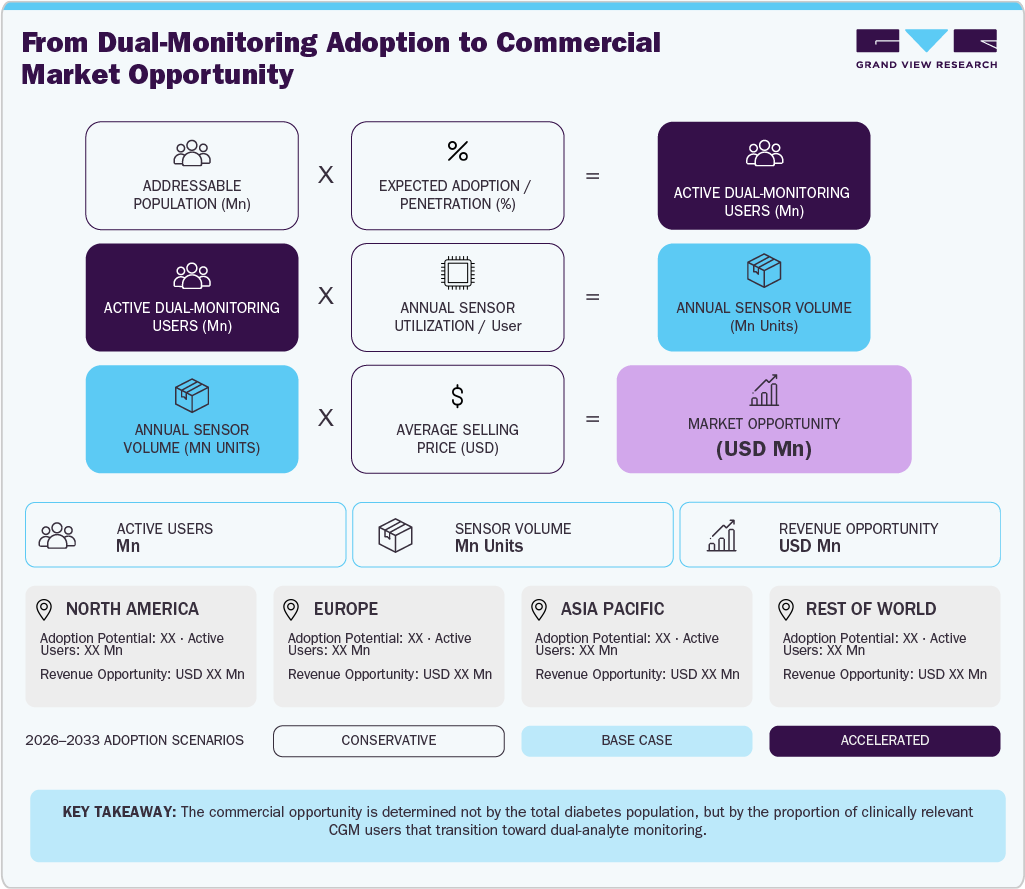
The adoption potential for continuous dual glucose-ketone monitoring is expected to be varied across regions according to existing CGM penetration, diabetes technology infrastructure, reimbursement environments, regulatory availability and patient purchasing power.
North America is expected to represent an important early commercialization market owing to its established CGM ecosystem and high adoption of advanced diabetes technologies. Europe represents another significant opportunity with increasing CGM adoption and expanding availability of connected diabetes-management solutions.
Asia Pacific can represent a substantial longer-term opportunity owing to its large diabetes population, although adoption is expected to vary significantly between developed and emerging markets. Other regions may demonstrate comparatively gradual penetration as affordability and access remain important determinants of advanced monitoring adoption
Cross-brand Competitive Intelligence
We also support an extended universe of CGMs, primarily, Abbott FreeStyle Libre family and Libre Rio, MiniMed (spun out of Medtronic, March 2026), Senseonics Eversense 365, Roche Accu-Chek SmartGuide, i-SENS CareSens Air, Sinocare iCan.
The current status of CGM Products (October 2026) & Inclusion Criteria in the Product
Brand and product
Where it stands, October 2026
Why it is in the study
Abbott FreeStyle Libre family and Libre Rio
Prescription Libre sensors and the OTC Libre Rio, sized separately from Lingo and Libre Duo. Abbott also makes the Instinct sensor sold with MiniMed pumps.
Dexcom’s largest direct rival; needed for true share
MiniMed (spun out of Medtronic, March 2026)
Simplera Sync, Simplera, Guardian 4 and the Abbott-made Instinct (15-day wear, CE-marked, EU rollout started). Simplera wears 6 to 7 days.
Third full-stack player; pump pull-through shapes sensor mix
Senseonics Eversense 365
Implantable, year-long CGM cleared by the FDA in 2024. Senseonics took distribution back from Ascensia in 2025 and integrated with Sequel’s twiist pump.
One insertion a year; very different consumption pattern
Roche Accu-Chek SmartGuide
14-day CGM with predictive AI, CE-marked for adults on flexible insulin; reported MARD 9.2%. Selling in selected European markets; analysts see limited threat to Abbott and Dexcom for now.
Large diabetes-care brand entering CGM in Europe
i-SENS CareSens Air
Korea’s first home-grown CGM (2023), in Europe since 2024 and supplied to 29 countries. CareSens Air 2 CE application filed July 2026; company targets Korea and EU approvals in 2027, U.S. in 2028.
Price-led Asian challenger
Sinocare iCan
First Chinese CGM brand certified under CE-MDR; expanding in Europe, Southeast Asia and the Middle East.
China-origin brand with Asia and EMEA reach
-


Customize this report to your needs - add regions, segments, or data points, with 20% free customization.
Or view our licence options:


ISO 9001:2015 & 27001:2022 Certified
We are GDPR and CCPA compliant! Your transaction & personal information is safe and secure. For more details, please read our privacy policy.


