
- Home
- »
- Pharmaceuticals
- »
-
Epilepsy And Seizure Drug Market Intelligence & Forecast, 2033GVR Report cover
![Epilepsy And Seizure Drug-Level Market Intelligence, Commercial Forecasting, Estimations & Portfolio Report]()
Epilepsy And Seizure Drug-Level Market Intelligence, Commercial Forecasting, Estimations & Portfolio Analysis, 2021 - 2033
Overview
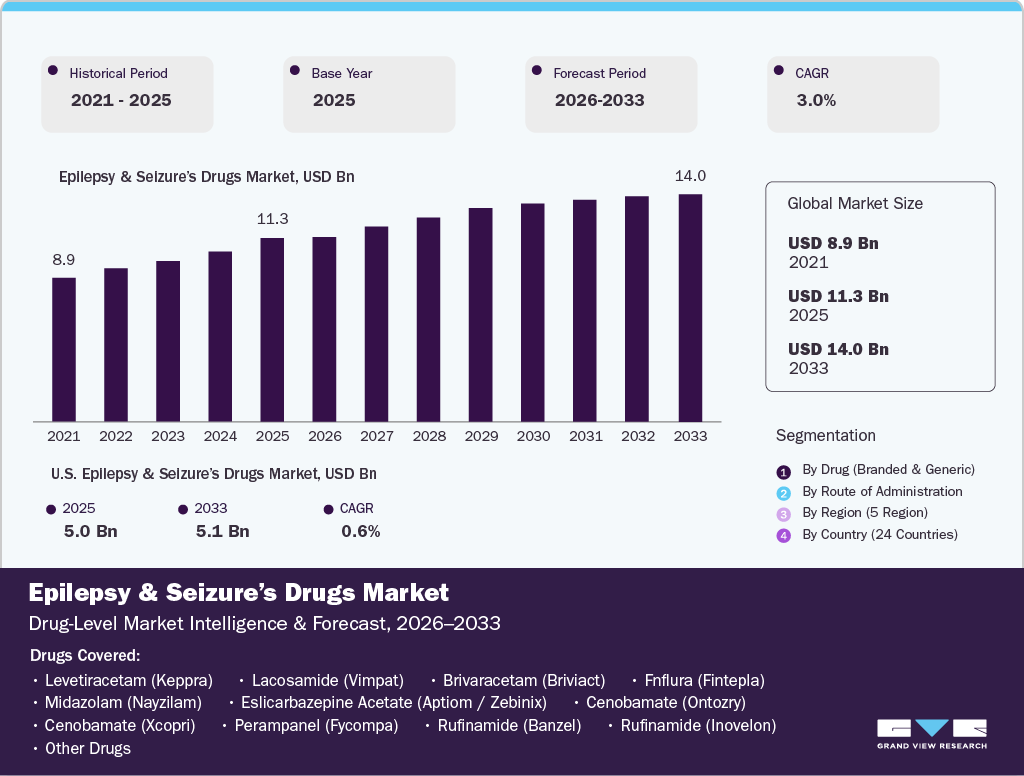
The global epilepsy and seizure drugs market was valued at USD 11.3B in 2025 and is projected to reach USD 14.0B by 2033, expanding at a CAGR of 3.0%. The market is shifting from conventional anti-seizure medications (ASMs) to newer therapies with different mechanisms of action. Third-generation ASMs and orphan drugs are gaining market share, particularly for treatment-resistant epilepsy. Cenobamate, marketed as Xcopri in the U.S. and Ontozry in Europe, and Epidiolex/Epidyolex (cannabidiol) reflect this trend. These therapies have shown strong commercial growth due to their use in patients whose seizures are not adequately controlled with older treatments. However, conventional ASMs, including levetiracetam, valproate, lamotrigine, phenytoin, and carbamazepine, continue to account for most prescription volumes worldwide. These medicines remain the first-line treatment in many countries because they are widely available as generics.
GVR's Parkinson's disease drug intelligence database tracks 36+ branded and generic formulations across 40+ molecules. The database tracks branded and generic therapies across first-, second-, and third-generation anti-seizure medications (ASMs). The database includes widely used therapies such as phenytoin, carbamazepine, valproate, phenobarbital, levetiracetam, lamotrigine, oxcarbazepine, topiramate, gabapentin, lacosamide, brivaracetam, perampanel, eslicarbazepine, and cenobamate. It also covers newer therapies for rare epilepsy syndromes, including cannabidiol, fenfluramine, and ganaxolone. Epilepsy affects an estimated 50 million people worldwide. Nearly 80% of patients live in low- and middle-income countries, where access to diagnosis and treatment remains limited. In high-income countries, about one-third of patients with focal epilepsy continue to have seizures despite treatment with available ASMs. This unmet need is driving the development and adoption of newer therapies with different mechanisms of action.
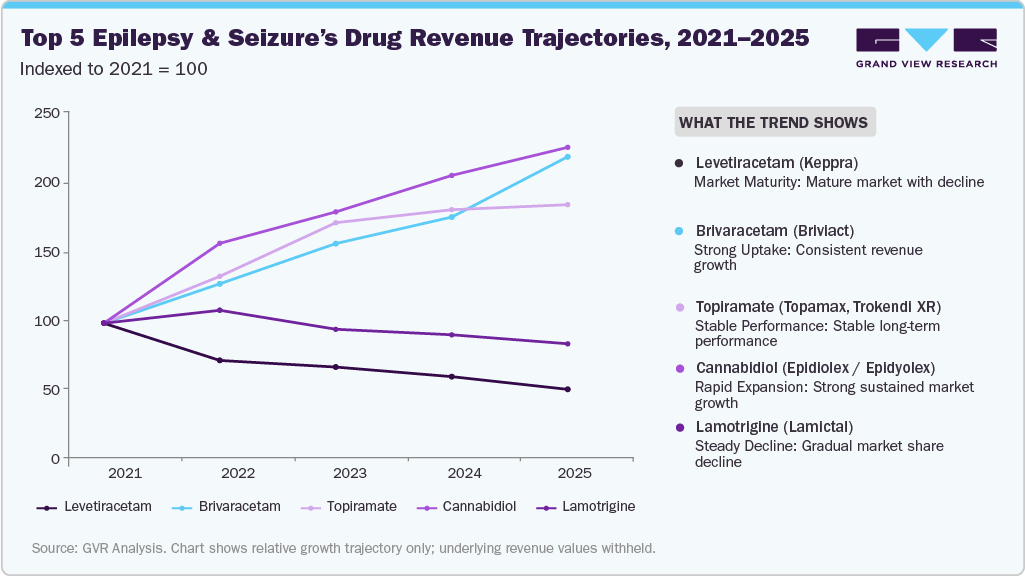
Older branded anti-seizure medications are losing market value due to patent expiry and generic competition. Lacosamide (Vimpat) began facing U.S. generic competition in 2026, while levetiracetam (Keppra) has already lost much of its branded sales. Companies are shifting their focus to newer, patent-protected therapies and expanding existing products through new formulations and indications. Future market growth will depend on the adoption of newer therapies, including azetukalner, for difficult-to-treat epilepsy.
Net effect: Revenue growth is shifting toward newer, differentiated anti-seizure therapies, while generic anti-seizure medications continue to dominate global prescription volumes.
Current Market Scenario
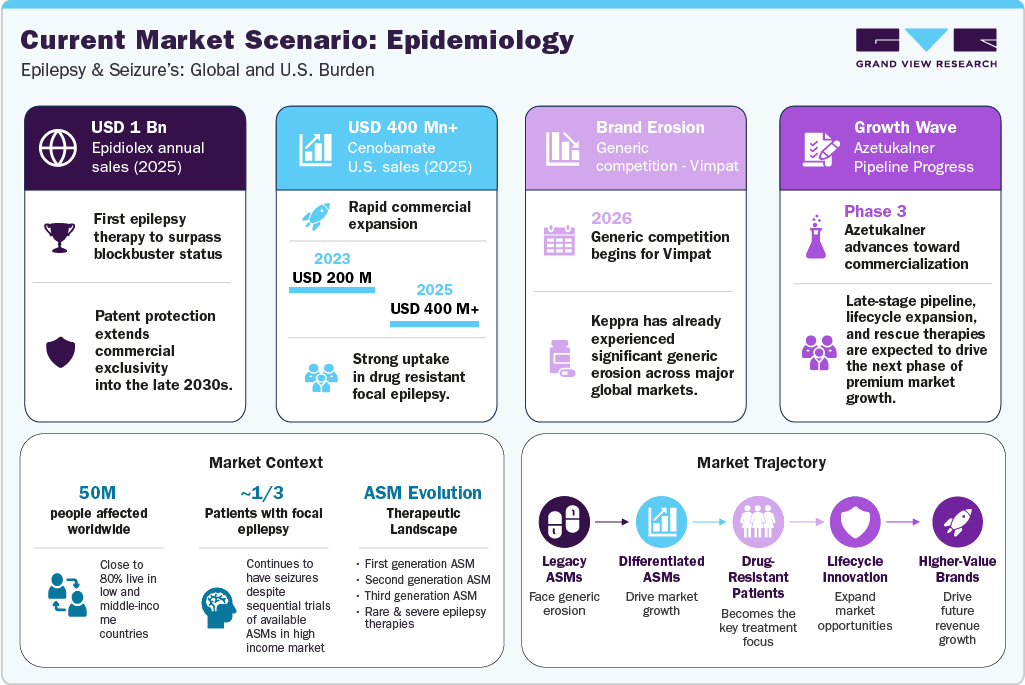
The epilepsy and seizure disorder drug market has two main segments. Conventional anti-seizure medications (ASMs), including levetiracetam, valproate, lamotrigine, carbamazepine, and phenytoin, continue to account for most prescription volumes worldwide. They remain the first-line treatment in many countries because they are effective, inexpensive, and widely available as generics. However, their commercial growth is limited by generic competition. Market value is increasingly driven by newer branded therapies for drug-resistant epilepsy and rare epilepsy syndromes. Cenobamate (Xcopri/Ontozry) has shown strong uptake for focal seizures. Epidiolex/Epidyolex (cannabidiol) is widely used for Dravet syndrome, Lennox-Gastaut syndrome, and tuberous sclerosis complex. Continued development of targeted therapies is expected to support market growth, while generic ASMs are likely to remain the foundation of epilepsy treatment.
The epilepsy and seizure disorder market includes both generic and branded therapies. Generic anti-seizure medications such as levetiracetam, valproate, lamotrigine, phenytoin, carbamazepine, topiramate, and gabapentin are marketed by many manufacturers. Competition in this segment is primarily driven by price. The branded segment focuses on drug-resistant epilepsy and rare epilepsy syndromes. Cenobamate, brivaracetam, and perampanel are used for drug-resistant focal epilepsy. Epidiolex and Fintepla are approved for Dravet syndrome and Lennox-Gastaut syndrome. Generic lacosamide is expected to increase competition and reduce brand sales. Late-stage pipeline therapies, including azetukalner, may further expand treatment options if approved.
Table: Drug Estimations & Forecast 2025 & 2033 by Country (USD Mn)
Drug
Country
2025
2033
Analyst Perspective
Perampanel
U.S.
125.8
58.3
Sales are expected to decline as branded competition increases and newer therapies such as cenobamate continue to gain share in patients with focal epilepsy.
Germany
21.0
8.3
Demand is expected to decrease as generic prescribing policies and increasing use of newer ASMs limit growth of branded perampanel.
UK
18.2
7.1
Market value is likely to decline as NHS cost-containment measures and wider use of generic ASMs reduce uptake of branded therapies.
France
12.2
3.7
Sales are expected to soften as physicians increasingly use lower-cost alternatives and newer treatment options for appropriate patients.
Lacosamide
U.S.
138.2
113.5
Growth is expected to reverse as generic lacosamide enters the U.S. market following loss of exclusivity, shifting prescriptions away from branded Vimpat.
Germany
36.8
34.0
Demand is expected to decline further as generic competition, established since 2022, continues to replace branded use.
UK
32.0
29.0
Sales are expected to decrease as generic substitution remains the standard practice across the NHS.
France
21.4
15.2
Revenue is likely to decline as physicians and payers increasingly favor lower-cost generic lacosamide over the branded product.
Source: GVR Analysis
Competitive Landscape
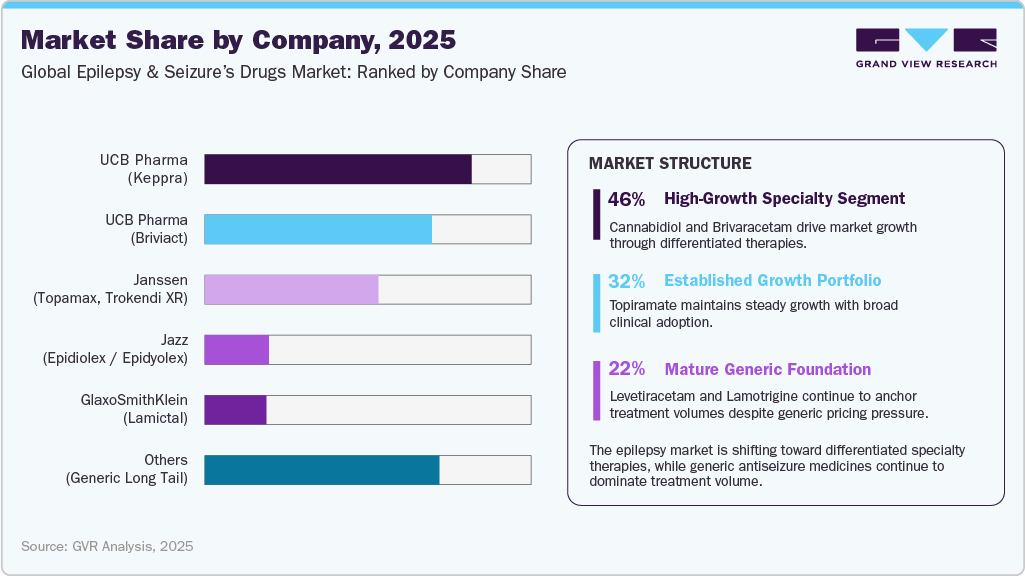
The epilepsy & seizure disorder market is highly competitive. Several companies offer therapies for different seizure types. UCB has a broad epilepsy portfolio that includes Keppra, Vimpat, Briviact, Nayzilam, and Fintepla. Eisai markets Fycompa and Banzel, while SK Life Science and Angelini Pharma market cenobamate under the brand names Xcopri and Ontozry, respectively. Jazz Pharmaceuticals markets Epidiolex following its acquisition of GW Pharmaceuticals in 2021. Sumitomo Pharma markets Aptiom. Ztalmy (ganaxolone) is approved for CDKL5 deficiency disorder. Neurelis markets Valtoco, while Supernus Pharmaceuticals markets Oxtellar XR and Trokendi XR.
The generic market is highly competitive, with manufacturers competing mainly on price and product availability. The branded market is focused on drug-resistant epilepsy and rare epilepsy syndromes. Cenobamate, brivaracetam, and perampanel are used as add-on therapies for focal epilepsy. Epidiolex and Fintepla are approved for Dravet syndrome and Lennox-Gastaut syndrome.
Generic lacosamide is expected to increase competition in the U.S. market. It may reduce sales of the branded product. UCB is expected to rely more on Briviact and Fintepla for future growth. Azetukalner, developed by Xenon Pharmaceuticals, has shown positive Phase 3 results in focal epilepsy. If approved, it could provide a new treatment option and compete with existing branded therapies, including cenobamate.
Market Dynamics
In 2022, the World Health Organization launched a global action plan on epilepsy. It encourages countries to offer diagnosis and treatment at the primary-care level, not just in specialist hospitals. This matters most in low- and middle-income countries, home to nearly 80% of the world's 50 million people with epilepsy. In many of these countries, 75% or more of patients still do not get proper treatment. In wealthier countries, more EEG testing and specialist referrals are helping identify drug-resistant patients, the people most likely to need newer ASMs.
About one in three people with focal epilepsy continue to have seizures despite treatment with several ASMs. This group is the main target for newer branded therapies. It is supporting the growth of cenobamate and the development of Xenon's azetukalner. Healthcare systems are increasingly recognizing drug-resistant epilepsy as a major unmet need rather than simply treatment failure. As a result, newer therapies may be used earlier in the treatment pathway.
Key Market Trends
“Third-Generation ASMs Are Capturing Value in Drug-Resistant Focal Epilepsy”
In the U.S., cenobamate sales increased from about USD 200 million in 2023 to more than USD 400 million in 2025. This growth was supported by a larger sales team and more doctors prescribing the drug. The company is also seeking approval for generalized tonic-clonic seizures and a liquid formulation for children. These approvals could expand its use beyond adult focal epilepsy. Brivaracetam and perampanel are also gaining market share, although at a slower pace.
“Generic Erosion of Legacy Branded ASMs Is Entering a New Phase”
Lacosamide lost patent protection in the U.S. in 2026, and Levetiracetam lost patent protection earlier in the U.S. and Europe, and later in Japan. This is a common trend in the epilepsy market. Most widely used ASMs eventually lose patent protection and become low-cost generic drugs. As a result, companies are focusing on new therapies and treatments for rare diseases that still have patent protection.
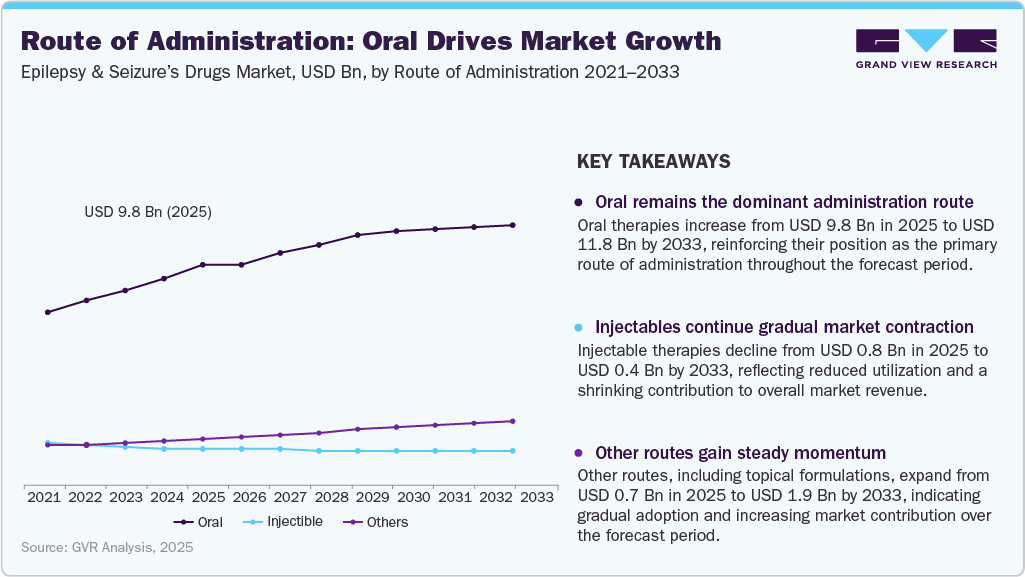
ROA Analysis
Regional Analysis
U.S. Epilepsy & Seizure Drugs Market
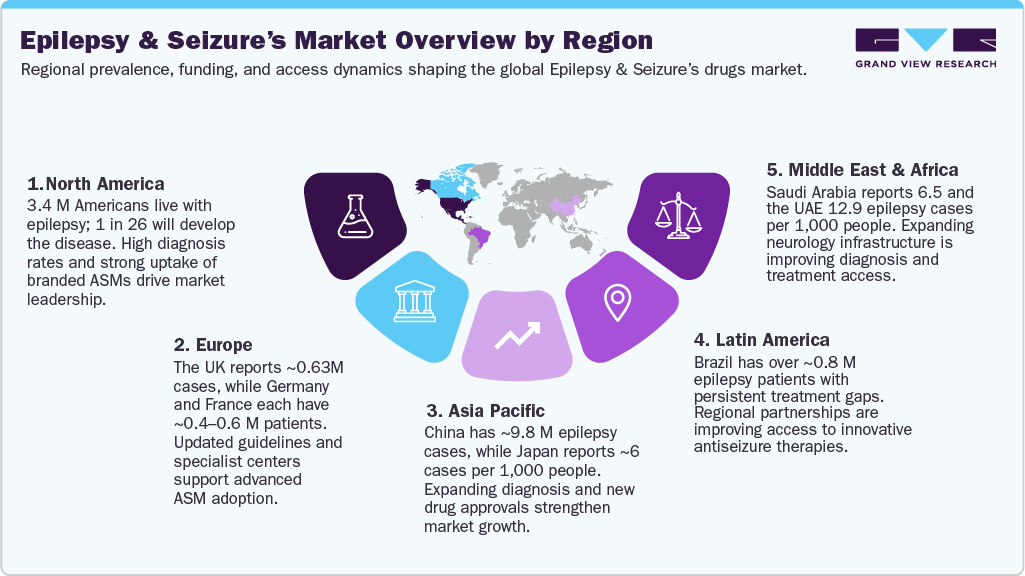
The U.S. is the largest market for epilepsy drugs. This is due to high diagnosis rates and broad insurance coverage. According to the CDC, about 3.4 million people in the U.S. have active epilepsy, including 3 million adults and 456,000 children. About one in 26 people will develop epilepsy during their lifetime. Most sales growth for cenobamate and Epidiolex has come from the U.S. Generic lacosamide entered the market in 2026, and increased competition. Direct-to-consumer advertising is also becoming more important, as shown by the review of cenobamate TV advertisements by regulators in late 2025.
UK Epilepsy & Seizure Drugs Market
The UK has an estimated 633,000 people with epilepsy, or about 1 in every 100 people, according to Epilepsy Action and the Epilepsy Research Institute. About 30% still have seizures that are not well controlled. NICE updated its epilepsy treatment guideline in January 2025. The NHS also continues to expand specialist care, helping more patients access newer therapies earlier.
Germany Epilepsy & Seizure Drugs Market
Germany is one of the largest epilepsy markets in Europe. An estimated 400,000 to 600,000 people have epilepsy, or about 0.5% to 1% of the population, according to the German Society for Epileptology. Certified epilepsy centers in Bethel, Erlangen, Freiburg, and Berlin provide specialist care for patients with drug-resistant epilepsy. However, studies show that many eligible patients are still referred to these centers after the recommended time. Improving referral rates could help more patients access newer anti-seizure medications.
France Epilepsy & Seizure Drugs Market
France has an estimated 600,000 people with epilepsy, according to Inserm and the Fondation Française pour la Recherche sur l'Épilepsie. Nearly half of all cases begin before age 20, and about one-third of patients continue to have seizures despite treatment. Epilepsy care is covered through France's national health insurance system. Patient groups such as Épilepsie-France continue to call for a dedicated national epilepsy plan.
Japan Epilepsy & Seizure Drugs Market
Japan is one of Asia's largest epilepsy drug markets. About 6 in every 1,000 people have epilepsy, roughly 700,000 to 1 million patients. Levetiracetam has lost much of its market to generics, while lacosamide continues to grow. Cenobamate and brivaracetam are moving through Japan's approval process with local partners.
China Epilepsy & Seizure Drugs Market
China is the largest epilepsy market in Asia Pacific. An estimated 9.8 million people are affected, based on Global Burden of Disease data. Gaps in diagnosis and treatment are wider than in Japan or South Korea. Ignis Therapeutics holds the rights to sell cenobamate in China, licensed from SK Biopharmaceuticals. This is helping more patients gradually gain access to newer ASMs.
Brazil Epilepsy & Seizure Drugs Market
Brazil is Latin America's largest epilepsy drug market. An estimated 800,000 people are affected, and treatment gaps are wider than in high-income countries. SK Biopharmaceuticals has partnered with Eurofarma on AI-based epilepsy care, and Eurofarma is the commercial partner for cenobamate across 17 Latin American markets.
Saudi Arabia Epilepsy & Seizure Drugs Market
Saudi Arabia has one of the highest epilepsy rates reported in the Arab world, at about 6.5 per 1,000 people. Public awareness is still limited, and stigma continues to affect diagnosis and how patients are treated socially. Investment in neurology care under the Vision 2030 plan is expected to gradually improve diagnosis and access to newer ASMs.
UAE Epilepsy & Seizure Drugs Market
The UAE has built a strong epilepsy care infrastructure. This includes long-term EEG monitoring since 2016 and surgery programs at centers such as the Cleveland Clinic Abu Dhabi. A 2014 study estimated lifetime prevalence at 12.9 per 1,000 people, one of the highest rates reported in the region. Patients can access nearly all ASMs approved by the FDA and EMA, making the UAE one of the more advanced markets in the region for newer epilepsy drugs.
Analyst Perspective
- Value growth is concentrated in a small number of on-patent drugs
Cenobamate and rare-disease drugs such as Epidiolex and Fintepla are expected to drive most of the market's revenue growth. This is true even though they treat far fewer patients than older generic drugs.
- Drug-resistant epilepsy, not new diagnosis, is the main growth lever
How well doctors identify and refer drug-resistant patients matters more for growth than the number of new epilepsy cases.
- Patent expiry is the biggest swing factor for branded revenue
Lacosamide's 2026 U.S. generic entry is the clearest example. In response, companies are directing more investment toward newer mechanisms and rare-disease treatments that still carry years of market exclusivity.
- Formulation and route of administration are becoming competitive differentiators
Nasal spray rescue treatments, extended-release pills, and child-friendly formats let companies stand out beyond just controlling seizures. This helps them find new uses in a market that is otherwise mostly generic.


Customize this report to your needs - add regions, segments, or data points, with 20% free customization.
Or view our licence options:


ISO 9001:2015 & 27001:2022 Certified
We are GDPR and CCPA compliant! Your transaction & personal information is safe and secure. For more details, please read our privacy policy.


