
- Home
- »
- Pharmaceuticals
- »
-
Gastric Cancer Drug Market Intelligence, Forecast & Portfolio Analysis, 2033GVR Report cover
![Gastric Cancer Drug-Level Market Intelligence, Commercial Forecasting, Estimations & Portfolio Report]()
Gastric Cancer Drug-Level Market Intelligence, Commercial Forecasting, Estimations & Portfolio Analysis, 2021-2033
Overview
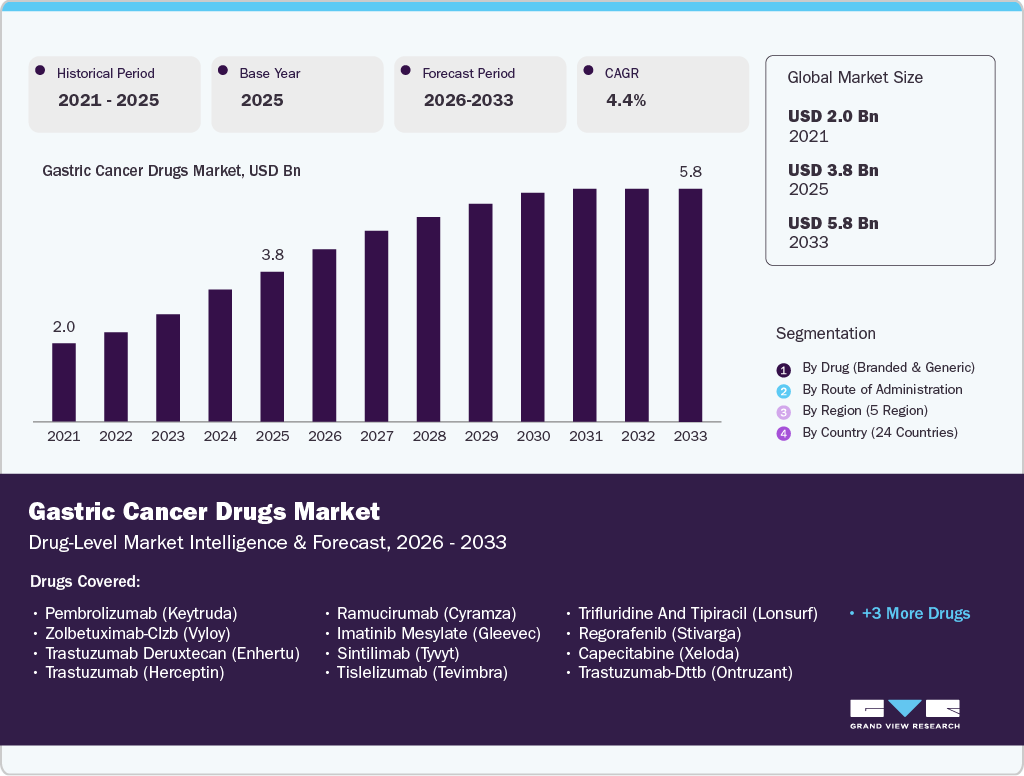
The global gastric cancer drugs market was valued at approximately USD 3.8B in 2025 and is projected to reach USD 5.8B by 2033, growing at a CAGR of 4.4%. This analysis covers 15 leading marketed drugs for gastric malignancy, highlighting the industry's transition toward biomarker-driven treatment selection, with HER2, PD-L1, and CLDN18.2 guiding clinical decision-making in advanced gastric and gastroesophageal junction (GEJ) adenocarcinoma. In October 2024, the U.S. FDA approved Vyloy (zolbetuximab-clzb) in combination with fluoropyrimidine- and platinum-containing chemotherapy for the first-line management of CLDN18.2-positive, HER2-negative advanced gastric/GEJ adenocarcinoma. Vyloy (zolbetuximab-clzb), the first and only CLDN18.2-targeted therapy approved in the U.S., is expected to witness strong commercial growth following its approval for use in combination with chemotherapy. The drug generated USD 0.4B in revenue in 2025 and is projected to reach USD 1.7B by 2033, driven by increasing biomarker testing, expanding physician adoption, and broader commercialization.
The pipeline is advancing with HER2-targeted antibodies. In June 2026, subgroup data from the Phase III HERIZON-GEA-01 trial were reported for zanidatamab plus tislelizumab and chemotherapy in HER2-positive advanced gastroesophageal adenocarcinoma. This demonstrated improvements in progression-free survival and overall survival across both PD-L1-positive and PD-L1-negative patients. The Phase III study has the potential to support the broader adoption of HER2-targeted combination therapies in the first-line setting. Zanidatamab-based regimens could expand therapeutic options and strengthen the HER2-positive treatment landscape.
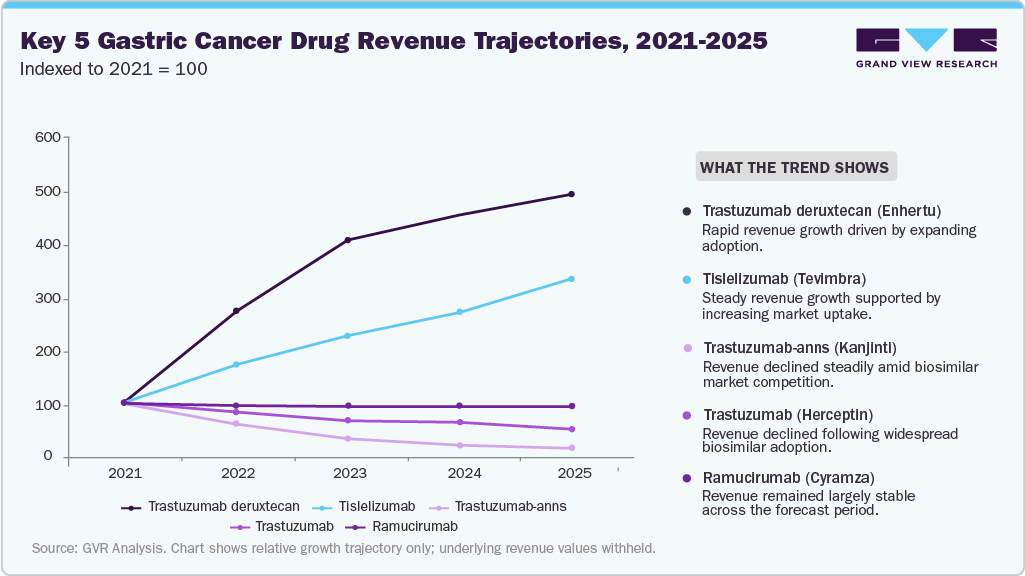
GVR analysis includes marketed therapies such as trastuzumab (Trazimera), trastuzumab-anns (Kanjinti), trastuzumab-dttb (Ontruzant), tislelizumab (Tevimbra), and other drugs. In June 2026, Innovent Biologics announced that the Phase III G-HOPE-001 trial of arcotatug tavatecan (IBI343/TAK-921) met its primary endpoint in previously treated CLDN18.2-positive advanced gastric or gastroesophageal junction adenocarcinoma. The therapy was accepted for priority review by China's National Medical Products Administration (NMPA). This clinical and regulatory progress highlights the growing commercial potential of CLDN18.2-targeted therapies and is expected to expand the competitive landscape.
Net effect: These clinical and regulatory advancements are expected to broaden targeted therapeutic options and support the long-term growth of the global commercial landscape for gastric malignancies.
Current Market Scenario
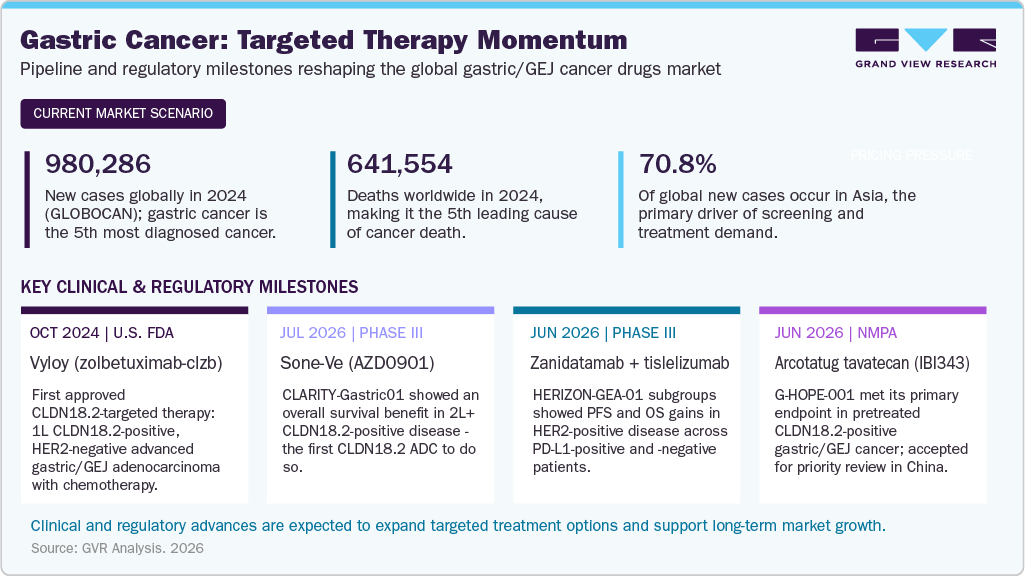
According to the Global Cancer Observatory (GLOBOCAN) 2024, gastric (stomach) cancer ranks as the fifth most diagnosed malignancy and the fifth leading cause of cancer-related deaths worldwide. In 2024, an estimated 980,286 new cases and 641,554 deaths were reported globally. Asia has the highest disease burden in the world, accounting for 70.8% of global new cases, 69.7% of deaths, and 74.8% of the global 5-year prevalence, making the region the primary driver of demand for screening, diagnosis, and disease management.
The management of gastric cancer is becoming more personalized, especially for patients with advanced disease. According to Nature Reviews Clinical Oncology (2026), treatment selection is increasingly based on biomarker testing, including HER2, PD-L1, mismatch repair deficiency (dMMR)/microsatellite instability-high (MSI-H), and Claudin 18.2 (CLDN18.2). These biomarkers enable the identification of patients who are most likely to benefit from targeted therapies and immunotherapies, such as trastuzumab, nivolumab, pembrolizumab, and zolbetuximab. In July 2026, AstraZeneca reported positive Phase III CLARITY-Gastric01 results, where sonesitatug vedotin (Sone-Ve; AZD0901) improved overall survival in second- and later-line CLDN18.2-positive advanced gastric/GEJ adenocarcinoma, becoming the first CLDN18.2-targeted ADC to demonstrate an overall survival benefit in a Phase III trial. These developments are accelerating the adoption of CLDN18.2-targeted therapies and advancing precision medicine in this therapeutic area.
The treatment landscape for advanced gastric malignancies continues to evolve with the development of targeted therapies against emerging molecular targets. Agents such as the FGFR2b-targeted monoclonal antibody bemarituzumab, FGFR inhibitors (derazantinib and futibatinib), and the MET inhibitor savolitinib are expanding therapeutic options for biomarker-selected patients. In addition, anti-angiogenic agents such as fruquintinib and apatinib are being evaluated in combination regimens, highlighting the growing focus on precision medicine and personalized care for advanced disease.
Strategic Partnerships And Collaborations
Strategic collaborations are playing an important role in advancing the management of gastric/gastroesophageal junction (GEJ) malignancies. Pharmaceutical and biotechnology companies are partnering to accelerate the development, clinical evaluation, and commercialization of new therapies. Many of these collaborations focus on CLDN18.2-targeted therapies, antibody-drug conjugates (ADCs), bispecific antibodies, and companion diagnostics to improve patient selection and clinical outcomes. These partnerships also help expand global development efforts and improve access to innovative therapeutic options for patients with gastric malignancies.
Year
Collaboration
Description
2025
Takeda & Innovent Biologics
Global licensing agreement for IBI343 (CLDN18.2 ADC) to develop and commercialize the therapy for gastric cancer outside Greater China.
2025
Astellas & Evopoint Biosciences
Exclusive global licensing agreement for XNW27011 (CLDN18.2 ADC) targeting gastric/GEJ cancer.
2025
Antengene & MSD (Merck & Co.)
Clinical collaboration to evaluate ATG-022 + pembrolizumab for CLDN18.2-positive gastric/GEJ cancer.
2024
Astellas & Roche Diagnostics (Ventana)
Companion diagnostic partnership supporting the commercialization of Vyloy (zolbetuximab) for CLDN18.2-positive gastric/GEJ cancer.
2024
I-Mab & Bristol Myers Squibb
Clinical collaboration to evaluate Givastomig + nivolumab + chemotherapy as first-line treatment for advanced gastric/GEJ cancer.
2023
AstraZeneca & Keymed Biosciences (KYM Biosciences)
Global licensing agreement for CMG901 (AZD0901) to develop and commercialize a CLDN18.2 ADC for gastric/GEJ cancer.
2022
Transcenta & Bristol Myers Squibb
Clinical collaboration to evaluate TST001 (osemitamab) + nivolumab for advanced gastric/GEJ cancer.
Competitive Landscape
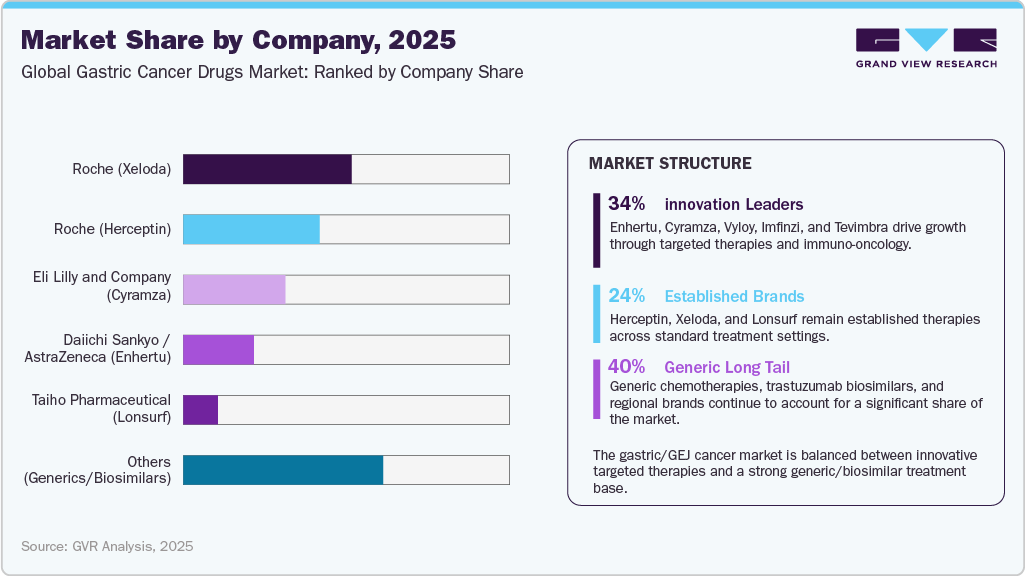
Recent regulatory approvals have significantly expanded the therapeutic landscape for gastric/gastroesophageal junction (GEJ) malignancies. Vyloy (zolbetuximab) was approved in 2024, followed by Tevimbra (tislelizumab) and an expanded indication for Keytruda (pembrolizumab) in 2025, and Imfinzi (durvalumab) in 2026. These approvals have broadened therapeutic options across biomarker-defined and perioperative settings, while late-stage therapies targeting CLDN18.2, FGFR2b, and HER2 continue to strengthen the development pipeline and intensify the competitive landscape.
Company
Key Marketed Drug
Drug Position
Astellas Pharma
Vyloy (zolbetuximab)
First-in-class CLDN18.2-targeted therapy for first-line CLDN18.2-positive gastric/GEJ cancer.
Merck & Co. (MSD)
Keytruda (pembrolizumab)
PD-1 inhibitor for first-line HER2-positive, PD-L1-positive gastric/GEJ cancer.
Bristol Myers Squibb
Opdivo (nivolumab)
PD-1 inhibitor for first line and adjuvant gastric/GEJ cancer.
BeOne Medicines (formerly BeiGene)
Tevimbra (tislelizumab)
PD-1 inhibitor for first-line HER2-negative gastric/GEJ cancer.
Daiichi Sankyo / AstraZeneca
Enhertu (trastuzumab deruxtecan)
HER2-directed ADC for previously treated HER2-positive gastric/GEJ cancer.
AstraZeneca
Imfinzi (durvalumab)
PD-L1 inhibitor for perioperative resectable gastric/GEJ cancer.
Roche
Herceptin (trastuzumab)
HER2-targeted therapy for first-line HER2-positive gastric/GEJ cancer.
Eli Lilly
Cyramza (ramucirumab)
VEGFR-2 inhibitor for second-line advanced gastric/GEJ cancer.
Taiho Oncology
Lonsurf (trifluridine/tipiracil)
Oral chemotherapy for previously treated metastatic gastric/GEJ cancer.
Market Dynamics
Growing research on the gut microbiome is creating new opportunities in the gastric oncology landscape. Studies suggest that modulating the gut microbiome may improve the effectiveness of chemotherapy and immunotherapy while reducing treatment-related side effects. Although still in the early stages of development, microbiome-based therapies have the potential to enhance clinical outcomes and support the development of next-generation therapeutics for gastric malignancies.
Reimbursement challenges continue to limit the adoption of novel therapies for gastric malignancies. Delays or restrictions in reimbursement can reduce patient access and slow commercial uptake. For example, in March 2025, the UK's National Institute for Health and Care Excellence (NICE) did not recommend zolbetuximab plus chemotherapy for routine NHS use due to uncertainties in its comparative clinical benefit and cost-effectiveness.
Analyst Perspective
CLDN18.2 is Emerging as a High-Growth Therapeutic Segment
Strong clinical results, recent approvals, and an expanding pipeline position CLDN18.2 as a key growth segment, with increasing competition across monoclonal antibodies, ADCs, and combination therapies.
- Accelerating Shift Toward Biomarker-Driven Treatment
Biomarker-guided therapy selection is becoming the standard of care, with testing for HER2, PD-L1, MSI-H, and CLDN18.2 driving personalized clinical decision-making and supporting greater adoption of targeted therapies and immunotherapy.
- Immunotherapy is Expanding into Earlier Therapeutic Settings
Positive perioperative trial outcomes are extending immunotherapy beyond advanced disease, increasing the eligible patient population, and creating new commercial opportunities across earlier stages of gastric malignancies.
- Strategic Partnerships are Accelerating Innovation.
Licensing, co-development, and companion diagnostic partnerships are accelerating product development, expanding global commercialization, and strengthening competitive positioning across the rapidly evolving gastric oncology landscape.
Key Market Trends
“Growing Adoption of CLDN18.2-Targeted Triplet Therapy in First-Line Gastric Cancer”
The commercial landscape is increasingly focused on CLDN18.2-targeted combination therapies for first-line management of advanced disease. Positive Phase II ILUSTRO results for zolbetuximab plus mFOLFOX6 and nivolumab in CLDN18.2-positive, HER2-negative gastric/gastroesophageal junction adenocarcinoma highlight the potential of targeted chemoimmunotherapy. The findings support ongoing Phase III development and reinforce the growing industry focus on biomarker-guided treatment strategies, pipeline expansion, and precision oncology.
“Expansion of Perioperative Immunotherapy into Curative-Intent Gastric Cancer”
Positive Phase III MATTERHORN trial results have increased the adoption of perioperative immunotherapy for resectable gastric and gastroesophageal junction (GEJ) adenocarcinoma. The addition of durvalumab to perioperative FLOT chemotherapy significantly improved event-free survival (EFS) compared with FLOT alone, supporting the use of immunotherapy in earlier-stage disease. This shift increases the number of patients eligible for immunotherapy, extends therapy duration, and supports commercial growth in earlier-stage gastric malignancies.
Regional Analysis
U.S. Gastric Cancer Drugs Market
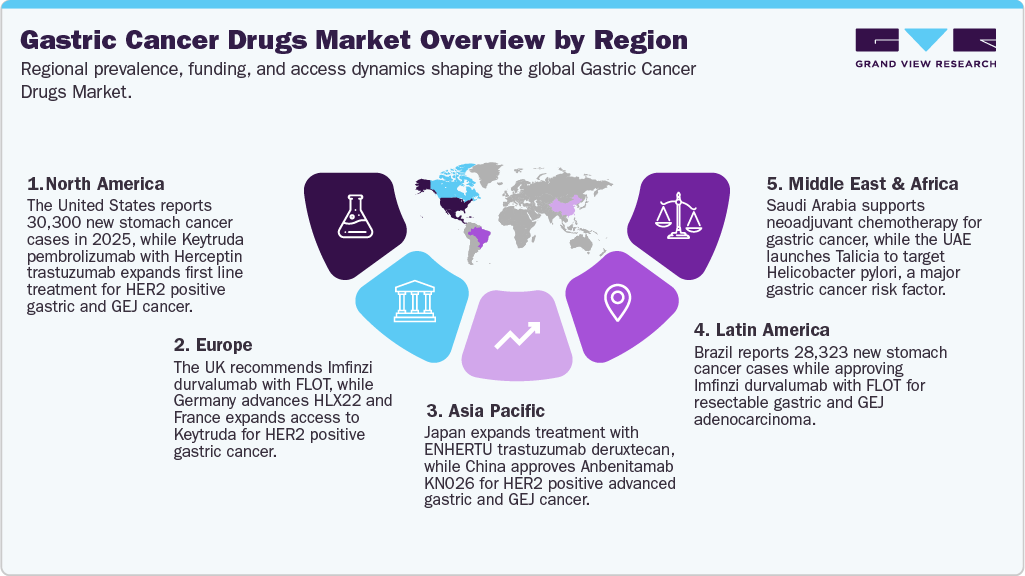
In March 2025, the U.S. FDA granted traditional approval to pembrolizumab (Keytruda) with trastuzumab (Herceptin) and fluoropyrimidine- and platinum-based chemotherapy. The regimen is approved as a first-line therapy for adults with PD-L1-positive (CPS ≥1), HER2-positive, locally advanced unresectable or metastatic gastric or gastroesophageal junction (GEJ) adenocarcinoma. The approval was based on the Phase III KEYNOTE-811 trial. According to the American Cancer Society, the U.S. is expected to report 30,300 new stomach cancer cases and 10,780 deaths in 2025. The growing disease burden continues to support demand for targeted and immunotherapy-based treatments.
UK Gastric Cancer Drugs Market
NICE recommended durvalumab (Imfinzi) in May 2026 in combination with fluorouracil, leucovorin, oxaliplatin, and docetaxel (FLOT) for the perioperative management of resectable gastric and gastro-oesophageal junction (GOJ) adenocarcinoma. It is the first immunotherapy recommended by NICE for this patient population and is expected to benefit more than 1,500 people each year in England. According to Cancer Research UK, the UK records around 6,816 new stomach malignancy cases and 3,600 deaths annually, supporting the demand for innovative therapies for gastric malignancies.
Germany Gastric Cancer Drugs Market
According to GLOBOCAN 2024, Germany recorded 13,774 new stomach cancer cases, 9,666 deaths, and 19,903 prevalent cases (5-year) in 2024, highlighting the significant disease burden. In May 2025, the European Commission granted Orphan Drug Designation (ODD) to HLX22. It is the first anti-HER2 monoclonal antibody to receive ODD from both the European Commission and the U.S. FDA for this indication. HLX22 is currently being evaluated in the global Phase III HLX22-GC-301 trial as a first-line therapy for HER2-positive metastatic gastric or gastroesophageal junction (GEJ) adenocarcinoma.
France Gastric Cancer Drugs Market
Following European Commission approval, pembrolizumab (Keytruda), in combination with trastuzumab and platinum- and fluoropyrimidine-based chemotherapy, became available in France as a first-line therapy for adults with HER2-positive, PD-L1-positive (CPS ≥1), locally advanced unresectable or metastatic gastric or gastroesophageal junction (GEJ) adenocarcinoma. According to GLOBOCAN 2024, France reported 7,159 new stomach cancer cases and 4,608 deaths, highlighting the continued demand for innovative targeted therapies and supporting commercial growth.
Japan Gastric Cancer Drugs Market
In March 2026, trastuzumab deruxtecan (ENHERTU) became available in Japan for the second-line management of HER2-positive unresectable advanced, recurrent, or metastatic gastric cancer. The approval was based on positive results from the DESTINY-Gastric04 Phase III trial, which showed improved overall survival compared with ramucirumab plus paclitaxel. According to GLOBOCAN 2024, Japan reported 142,506 new stomach malignancy cases and 51,440 deaths. Stomach cancer is the second most common malignancy and the third leading cause of cancer-related deaths in Japan, supporting the demand for innovative targeted therapies.
China Gastric Cancer Drugs Market
Anbenitamab (KN026) received NMPA approval in May 2026 for use in combination with chemotherapy. It is indicated for the second-line management of adults with HER2-positive locally advanced or metastatic gastric or gastroesophageal junction (GEJ) adenocarcinoma previously treated with a trastuzumab-containing regimen. It is the first domestically developed HER2 bispecific antibody approved for this indication in China. According to GLOBOCAN 2024, China reported 358,672 new stomach cancer cases and 260,372 deaths, highlighting the strong demand for innovative targeted therapies.
Brazil Gastric Cancer Drugs Market
According to GLOBOCAN 2024, Brazil reported 28,323 new stomach cancer cases and 18,981 deaths. Stomach cancer is the fifth most common malignancy and the fifth leading cause of cancer-related deaths in the country. In February 2026, durvalumab (Imfinzi) received ANVISA approval in combination with FLOT (fluorouracil, leucovorin, oxaliplatin, and docetaxel) for the perioperative management of adults with resectable gastric or gastroesophageal junction (GEJ) adenocarcinoma, expanding immunotherapy options for eligible patients in Brazil.
Saudi Arabia Gastric Cancer Drugs Market
Stomach cancer was the 9th leading cause of cancer-related deaths in Saudi Arabia, with 377 deaths and 566 new cases reported in 2024. It was also the 14th most common malignancy in the country. In 2025, a study from King Khalid Hospital in Najran showed that neoadjuvant chemotherapy improved survival among patients with gastric malignancies. The findings support the use of preoperative chemotherapy and may help improve clinical outcomes in Saudi Arabia.
UAE Gastric Cancer Drugs Market
In August 2024, Talicia (omeprazole magnesium/amoxicillin/rifabutin) was launched in the United Arab Emirates for the management of Helicobacter pylori (H. pylori) infection, a major risk factor for gastric cancer. It is the first approved low-dose rifabutin-containing all-in-one combination therapy in the UAE. The United Arab Emirates reported 239 new stomach malignancy cases and 174 deaths in 2024. Stomach cancer ranked as the 10th most common malignancy and the 6th leading cause of cancer-related deaths in the country.


Customize this report to your needs - add regions, segments, or data points, with 20% free customization.
Or view our licence options:


ISO 9001:2015 & 27001:2022 Certified
We are GDPR and CCPA compliant! Your transaction & personal information is safe and secure. For more details, please read our privacy policy.


