
- Home
- »
- Clothing, Footwear & Accessories
- »
-
Global Golf Products Market: Brand Share Analysis & Top-Selling ModelsGVR Report cover
![Global Golf Products Market Brand Share Report]()
Global Golf Products Market Brand Share Analysis & Top-Selling Model
Report Overview
The global golf products market is a structurally mature yet steadily evolving segment of the sports equipment industry, supported by consistent participation in established golf economies and increasing adoption across emerging premium leisure markets. While core hardware such as golf clubs and balls continues to anchor industry revenues, adjacent categories, including performance accessories, electric mobility solutions, technical footwear, and golf-specific apparel, are expanding the market’s commercial scope.
Growth is increasingly being shaped by technology-led equipment innovation, premium customization trends, and lifestyle-driven demand expansion, particularly among urban affluent consumers and recreational players.
Top 3 Most Anticipated Trends
AI-driven club design and performance optimization is becoming mainstream
-
Golf equipment design is increasingly shifting toward AI- and simulation-led engineering, where brands like Callaway, TaylorMade, and Titleist use advanced modeling to optimize clubface geometry, spin consistency, and forgiveness patterns. Instead of traditional incremental upgrades, manufacturers are now launching products developed through millions of simulated swing datasets. This reduces trial-and-error innovation cycles, accelerates product refresh frequency, and strengthens consumers' perception of measurable performance gains.
Custom fitting evolving from premium service to standard purchase behavior
-
Custom fitting is rapidly transitioning from a niche, premium service to a core purchase expectation across mid-to-high-end golf consumers. Driven by the widespread availability of launch monitors (TrackMan, GCQuad) in retail stores and golf academies, players increasingly expect clubs tailored to their swing profile rather than off-the-shelf sets. This shift is structurally increasing ASPs, improving brand stickiness, and reducing price-based competition, as purchasing decisions become performance-driven rather than purely brand-led.
Strong growth in hybrid golf-lifestyle apparel and crossover branding
-
Golf apparel is increasingly influenced by athleisure and lifestyle fashion convergence, with brands like Nike Golf, Adidas, and emerging DTC players repositioning golf wear for both on-course and off-course use. Polo shirts, stretch trousers, waterproof jackets, and performance sneakers are being designed with streetwear aesthetics, expanding demand beyond traditional golfers. This trend is also attracting younger demographics who associate golf with a premium lifestyle identity rather than just sport participation.
Brand Share Analysis
The U.S. golf equipment market demonstrates a highly concentrated competitive structure at the top, with the leading two brands collectively accounting for more than 25% of total market revenue. The market exhibits a clear tiered hierarchy, where a small set of global OEMs dominate premium segments, while mid- and entry-tier categories remain fragmented.
Revenue market share by brand
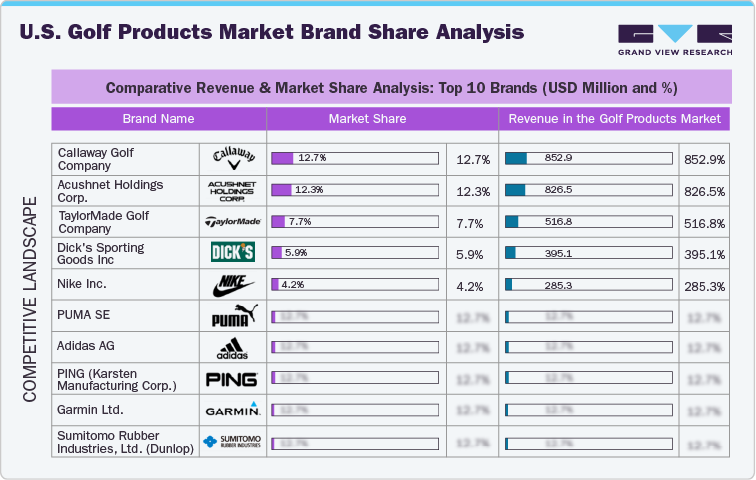
The global golf equipment market features a high degree of product differentiation at the stock-keeping unit (SKU) level, where distinct pricing thresholds directly influence consumer purchasing decisions.
Market dynamics are evaluated through the performance tracking of three primary hardware categories: golf rangefinders, manual golf trolleys, and electric golf trolleys, each segmented across competitive price bands.
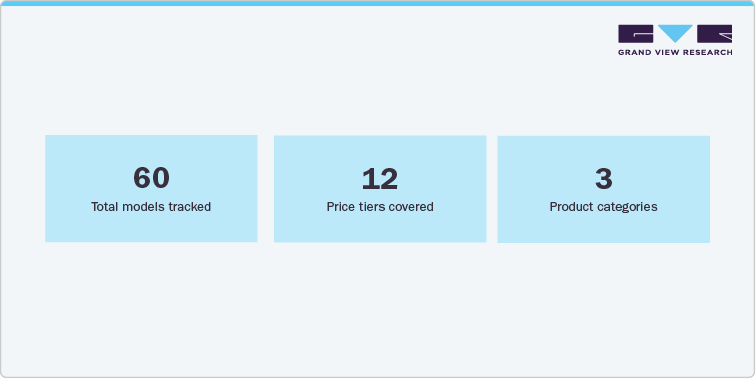
Regional brand share data - 5 regions, 16 countries
North America
Europe
Asia Pacific
Central & South America
Middle East & Africa
Golf Rangefinders
The rangefinder segment shows a clear behavioral threshold around the USD 250 price point, where consumer preference shifts from basic functionality to advanced optical precision, brand trust, and performance accuracy.
Price Tier
Models Tracked
Best-Selling Models
Up to USD 150
5 models
Redtiger Golf Rangefinder
Revasri Golf RangefinderUSD 150 - USD 250
5 models
Blue Tees Series 3 Max Rangefinder
Callaway 300 ProUSD 250 - USD 350
5 models
Bushnell Tour V5 Shift
Bushnell Tour V6 ShiftAbove USD 350
5 models
Garmin Approach Z82

Manual Golf Trolleys
The manual trolley segment is primarily driven by utility, durability, and ease of mobility, with relatively lower brand loyalty compared to performance electronics. Purchasing behavior is influenced more by structural design efficiency than brand prestige.
Price Tier
Models Tracked
Best-Selling Models
Up to USD 150
5 models
Caddytek CaddyLite Compact Golf Push CartPRECISE Cruiser 3-Wheel Golf Push Cart
USD 150 - USD 250
5 models
Rovic RV1S 2.0
Sun Mountain PX3USD 250 - USD 350
5 models
Clicgear Model 4.0Motocaddy QB2 Push Cart
Above USD 350
5 models
Sun Mountain PX4 Big Max Blade IP 2 Trolley
Electric Golf Trolleys
The electric trolley category represents a high-growth, premiumized utility segment, with increasing adoption of GPS integration, remote-control systems, and automated mobility features.
Price Tier
Models Tracked
Best-Selling Models
Up to USD 500
5 models
Motocaddy SE
PowaKaddy FX3USD 500 - USD 1,000
5 models
Motocaddy M1 DHC Motocaddy M5 GPS
USD 1,000 - USD 1,500
5 models
PowaKaddy CT8 GPS
Motocaddy ME RemoteAbove USD 1,500
5 models
PowaKaddy RX12 GPS Motocaddy PRO Series
Key Insights & Strategic Implications
-
Duopoly at the top - U.S.
-
The top two brands together hold over 25% of U.S. golf equipment revenue. The gap to Brand #3 is significant, creating a two-tier competitive structure.
-
-
Premium rangefinder segment is brand-loyal
-
The USD 250-350 price tier shows the highest brand concentration of any rangefinder segment. Three of the five best-selling models come from a single brand, a signal of strong repeat purchase intent at the performance tier.
-
-
Electric trolley market moving upmarket
-
The USD 1,000+ segment is the fastest-growing tier in the electric trolley category. GPS integration and remote-control capability are becoming baseline expectations, pulling average selling prices upward.
-
-
Entry-tier fragmentation across all categories
-
Below USD 150 (rangefinders) and USD 500 (electric trolleys), the market is fragmented with no single brand holding more than 20% of the segment. This creates both risk for incumbents and opportunity for challenger brands with strong digital distribution.
-
-


Customize this report to your needs - add regions, segments, or data points, with 20% free customization.
Or view our licence options:


ISO 9001:2015 & 27001:2022 Certified
We are GDPR and CCPA compliant! Your transaction & personal information is safe and secure. For more details, please read our privacy policy.


