
- Home
- »
- Pharmaceuticals
- »
-
Parkinson’s Drug Market Intelligence And Forecast, 2033GVR Report cover
![Parkinson’s Drug-Level Market Intelligence, Commercial Forecasting, Estimations & Portfolio Report]()
Parkinson’s Drug-Level Market Intelligence, Commercial Forecasting, Estimations & Portfolio Analysis, 2021 - 2033
Overview
The global Parkinson's drugs market was valued at USD 3.7B in 2025 and is projected to reach USD 7.2B by 2033, expanding at a CAGR of 8.5%. The market is gradually shifting from mature, generic dopaminergic therapies toward premium formulations, continuous dopaminergic delivery systems, and specialty therapies that improve motor fluctuation management and treatment adherence. Recent product introductions such as Vyalev (foslevodopa/foscarbidopa), Crexont (IPX203), and Inbrija, together with established device-assisted therapies including Duopa and APO-go, are expanding the value segment across developed markets. The U.S. remains the largest revenue contributor, supported by favorable reimbursement and early adoption of advanced therapies, while Europe and Japan continue to drive demand for device-assisted treatments. China is emerging as an important growth market, supported by rapid population aging, improving neurological care infrastructure, broader access to reimbursement, and rising diagnosis rates. Despite these innovations, levodopa-based therapies and other generic dopaminergic agents continue to account for the majority of global prescription volumes.
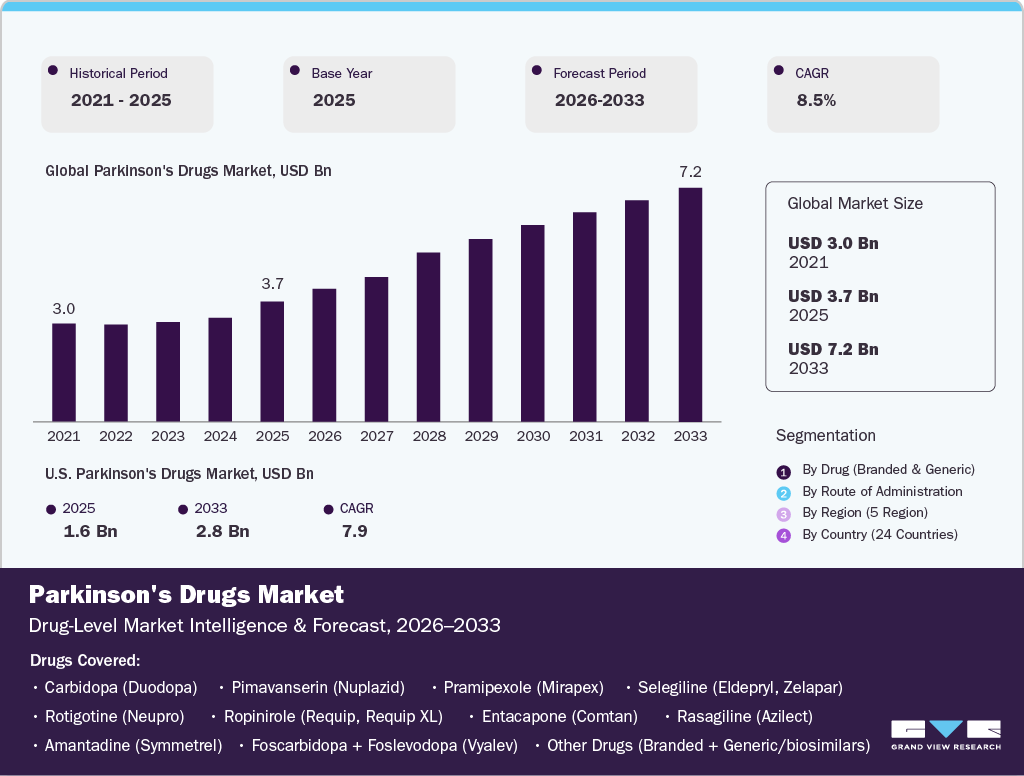
GVR's Parkinson's disease drugs intelligence database tracks 23+ branded and generic formulations across 30+ molecules, covering levodopa formulations, dopamine agonists, MAO-B inhibitors, COMT inhibitors, adenosine A2A receptor antagonists, amantadine products, apomorphine therapies, and continuous dopaminergic delivery systems. Parkinson's affects over 11.8 million people globally, with prevalence expected to increase further as populations age. While conventional levodopa-based therapies continue to dominate treatment volumes, continuous infusion therapies and premium formulations are driving market value growth across the U.S., Europe, and Japan, supported by favorable reimbursement and specialized movement disorder care.
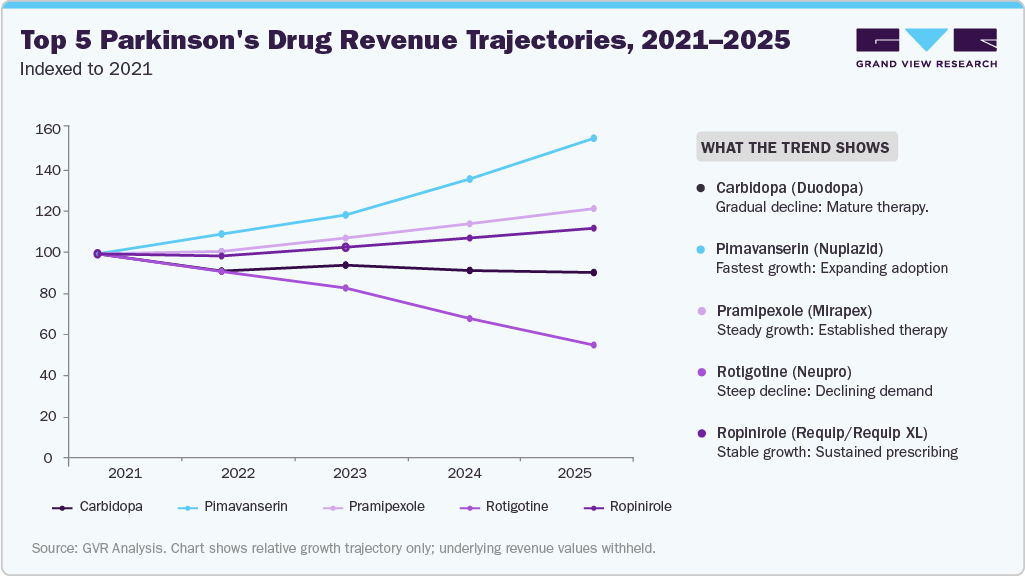
The Parkinson's drugs market is witnessing two distinct commercial trajectories. Advanced formulations and continuous dopaminergic delivery systems are driving revenue growth, while mature oral therapies continue to face pricing pressure from generic competition. Vyalev (foslevodopa/foscarbidopa) is expanding the premium treatment segment by addressing motor fluctuations through continuous subcutaneous delivery, whereas Nuplazid (pimavanserin) continues to strengthen the specialty market for Parkinson's disease psychosis. Meanwhile, established therapies including levodopa formulations, dopamine agonists, and MAO-B inhibitors remain high-volume products, although widespread genericization continues to constrain revenue growth.
Future market expansion will increasingly be driven by advanced symptomatic therapies, continuous dopaminergic delivery platforms, and lifecycle innovation rather than conventional oral treatments. Pharmaceutical companies are prioritizing next-generation levodopa formulations and device-assisted therapies to improve motor fluctuation management, treatment persistence, and patient convenience. Concurrently, the clinical pipeline is expanding across alpha-synuclein, LRRK2, GBA, GLP-1 receptor agonists, gene therapies, and cell-based therapies, reflecting increased investment in precision medicine. Recent research also highlights the growing role of biomarker-driven patient stratification and digital technologies to improve early diagnosis, optimize clinical trial design, and accelerate therapeutic development. Consequently, future commercial value is expected to shift toward differentiated specialty therapies and advanced drug-delivery platforms, while generic dopaminergic therapies continue to account for most treatment volume.
Net effect: Revenue growth is shifting toward differentiated specialty therapies, while generic dopaminergic treatments continue to dominate global prescription volumes.
Current Market Scenario
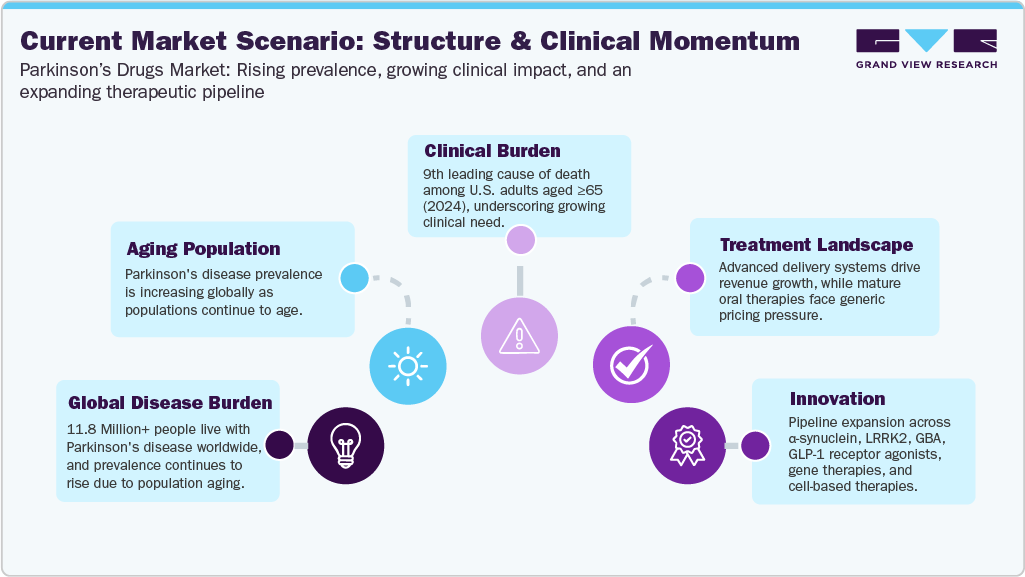
The Parkinson's disease drugs market is increasingly segmented between high-volume generic oral therapies and premium specialty treatments. Established products, including Rytary, Mirapex, Requip, Azilect, Xadago, Ongentys, and Duodopa, continue to account for most treatment volumes owing to their established clinical use and widespread generic availability. In contrast, Vyalev, Produodopa, Inbrija, APO-go, and Nuplazid are expanding the premium treatment segment by addressing advanced Parkinson's disease, motor fluctuations, and Parkinson's disease psychosis. According to the CDC report titled, “Parkinson mortality Among Adults Age 65 and Older: United States, 2024," Parkinson's ranked as the ninth leading cause of death among U.S. adults aged 65 years and older in 2024, highlighting the growing clinical burden and the increasing need for advanced therapeutic options.
Adoption of advanced Parkinson's therapies depends on timely referral, individualized patient selection, and access to device-aided treatment programs. Despite proven clinical benefits, utilization of continuous dopaminergic delivery remains limited by referral variability, reimbursement, and availability of specialized movement disorder centers. For example, the Phase III BouNDless trial reported that subcutaneous ND0612 (Vyalev) provided an additional 1.72 hours of ON time without troublesome dyskinesia compared with optimized oral levodopa–carbidopa (95% CI: 1.08–2.36; p<0.0001), supporting the clinical value of continuous levodopa delivery in patients with motor fluctuations.
Table: Drug Estimations & Forecast 2025 & 2033 by Country (USD Mn)
Country
2025
2033
Analyst Perspective
Apomorphine
U.S.
39.9
23.2
High adoption in advanced Parkinson's supported by specialist care and favorable reimbursement.
Germany
6.6
5.0
Strong utilization through established infusion therapies and specialized movement disorder centers.
UK
11.0
7.6
NHS-supported access sustains demand for advanced rescue and infusion therapies.
France
5.4
4.0
Growing specialist-led treatment supports steady uptake of advanced apomorphine therapies.
Pramipexole
U.S.
70.0
96.9
Generic availability limits value growth despite continued use in early-stage Parkinson's
Germany
13.9
20.2
Established prescribing practices sustain demand across early and moderate disease management.
UK
9.3
14.3
Broad clinical acceptance and reimbursement support continued utilization of dopamine agonists.
France
10.3
14.8
Long-standing clinical use maintains stable prescription volumes despite generic competition.
Source: GVR Analysis
Competitive Landscape
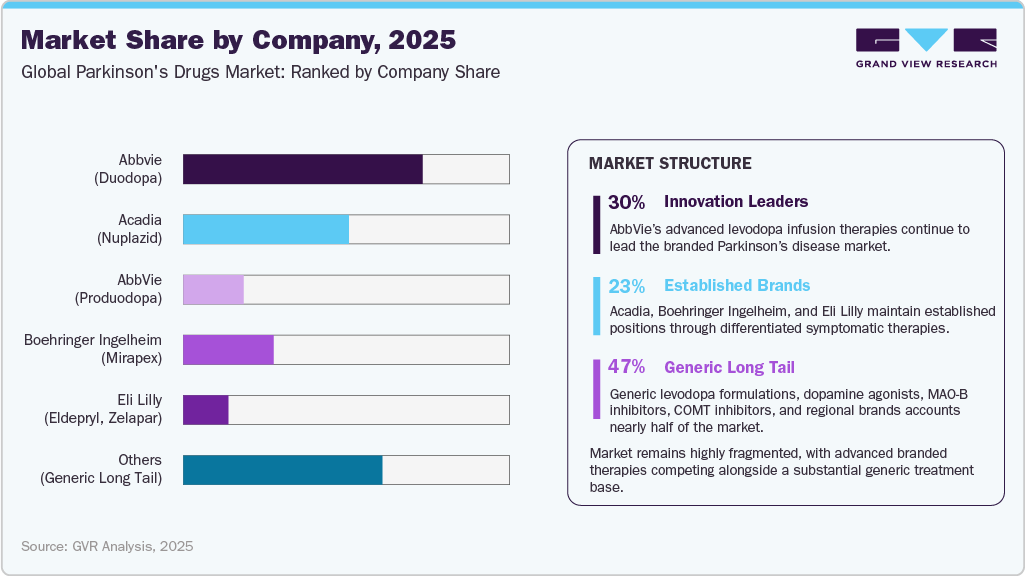
Competition in the Parkinson's drugs market is increasingly centered on product differentiation rather than novel mechanisms of action. Companies are expanding portfolios through continuous dopaminergic delivery, extended-release formulations, and therapies targeting motor fluctuations and psychosis. AbbVie (Vyalev), Amneal (Rytary, Ongentys), Acadia (Nuplazid), and Supernus (Apokyn) compete across distinct stages of disease management, while generic dopaminergic therapies continue to dominate treatment volume.
The Parkinson's drugs market comprises multiple branded and generic manufacturers across established dopaminergic therapies, where competitive differentiation is largely influenced by pricing, reimbursement, lifecycle management, and formulation innovation rather than therapeutic efficacy.
Competition in advanced Parkinson's therapies is increasingly focused on improving management of motor fluctuations through continuous dopaminergic delivery. Clinical studies have demonstrated that continuous levodopa infusion can increase ON time without troublesome dyskinesia and reduce OFF time compared with optimized oral therapy, supporting the growing role of advanced treatment options for patients with advanced Parkinson's.
Market Dynamics
Rising disease burden and population aging continue to expand the addressable patient population. The prevalence of Parkinson's has more than doubled over the past 25 years, making it the fastest-growing neurological disorder globally. WHO estimated over 8.5 million people were living with Parkinson's in 2019, while the PubMed identifies aging populations as the primary driver of future disease burden. This is expected to sustain long-term demand for symptomatic therapies and advanced treatment options.
The absence of approved disease-modifying therapies presents a significant opportunity for next-generation Parkinson's treatments. Advances in understanding α-synuclein aggregation, mitochondrial dysfunction, lysosomal pathways, and neuroinflammation are accelerating the development of targeted therapeutic approaches, supporting pipeline expansion and long-term innovation beyond symptomatic disease management.
Key Market Trends
“Vyalev's Rapid Uptake Signals a Shift toward Continuous Dopaminergic Delivery”
AbbVie's Vyalev (foscarbidopa/foslevodopa), the first 24-hour subcutaneous levodopa infusion, is scaling quickly since its October 2024 FDA approval. Quarterly net revenues rose from USD 183 million in Q4 2025 to $201 million in Q1 2026, up approximately 10% sequentially, putting Vyalev on track for blockbuster (over USD 1 billion annualized) sales in 2026. AbbVie has simultaneously submitted a New Drug Application to the FDA for tavapadon, a once-daily oral dopamine D1/D5 receptor partial agonist, based on positive Phase 3 TEMPO trial data. Together, these signal a shift from oral symptomatic dosing toward continuous-delivery devices and novel receptor-targeted mechanisms in Parkinson's care.
“Disease-Modifying Drug Development Is Diversifying the Parkinson's Pipeline”
The Parkinson's drugs pipeline is increasingly shifting beyond conventional dopaminergic therapies toward disease-modifying approaches targeting distinct biological pathways. According to the 2024 Parkinson's Disease Drug Therapies in the Clinical Trial Pipeline Update, 136 active Phase 1–3 clinical trials were underway as of January 2024, including 60 disease-modifying therapy (DMT) trials (44%) and 76 symptomatic therapy trials (56%). Among DMT programs, α-synuclein-targeted therapies accounted for 9 trials, followed by 7 GBA-targeted therapies, 5 GLP-1 receptor agonist programs, and 2 LRRK2-targeted therapies, highlighting a transition toward mechanism-based therapeutic innovation and precision medicine.
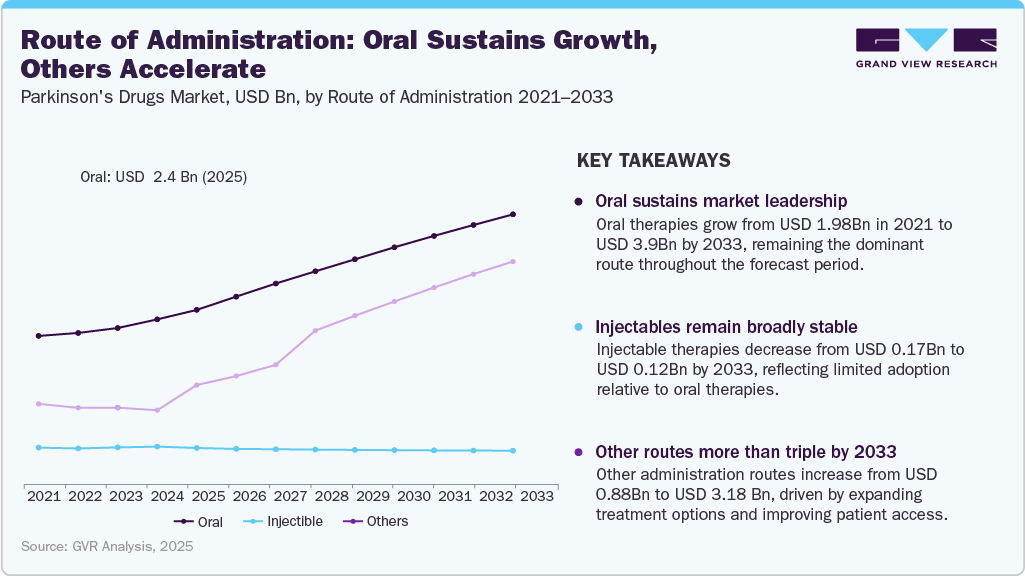
ROA Analysis
Regional Analysis
U.S. Parkinson’s Drugs Market
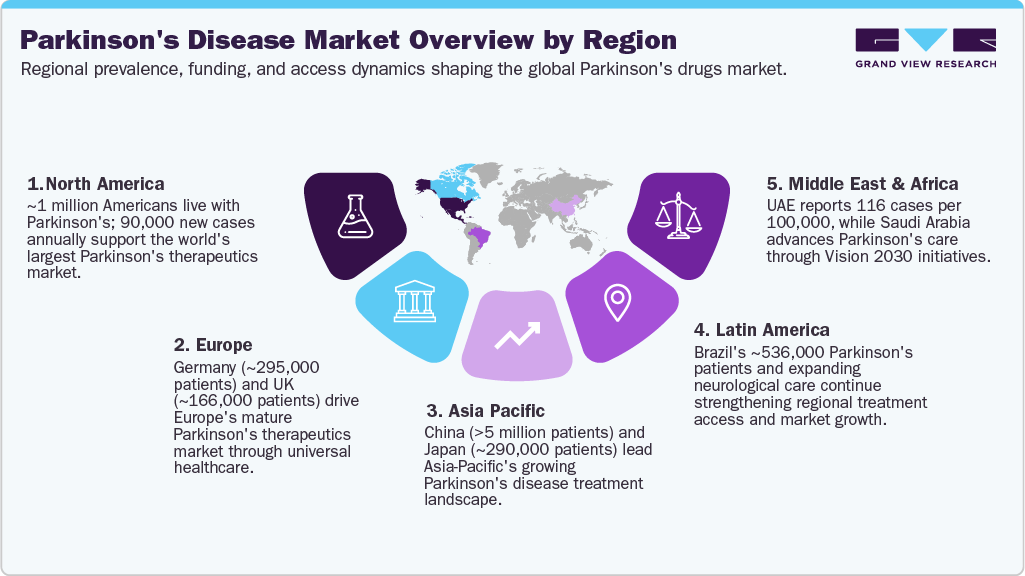
According to the Parkinson's Foundation, nearly 1 million people in the U.S. are living with Parkinson's, with approximately 90,000 new cases diagnosed annually, and the patient population is projected to reach 1.2 million by 2030. Increasing awareness, improved diagnostic capabilities, and wider access to specialized neurological care are supporting earlier diagnosis and better disease management. Recent state-level initiatives, including Vermont's ban on paraquat, California's proposed USD 12 billion science and health research fund, USD 65 million for biotechnology initiatives in New York, and USD 6 million for Parkinson's research in Florida, are strengthening the research landscape. These efforts, together with continued funding from the American Parkinson Disease Association and clinical research at UF Health, are expected to support sustained market growth.
UK Parkinson’s Drugs Market
According to Parkinson's UK, around 166,000 people are living with Parkinson's across the UK, with around 28,000 new diagnoses each year, and this number is projected to increase to 173,000 by 2030 as the population ages. The 2025 UK Parkinson's Audit found that 86% of people with Parkinson's rated their overall NHS care as good or very good, reflecting continued improvements in service delivery. Government initiatives and NHS efforts to strengthen multidisciplinary care, improve timely diagnosis, and enhance access to specialist Parkinson's services are expected to support better patient outcomes and drive sustained growth in the UK Parkinson's disease drugs market.
Germany Parkinson’s Drugs Market
According to the 2025 Robert Koch Institute (RKI), approximately 295,000 people in Germany were living with Parkinson's, with a prevalence of 0.35% in the total population. The prevalence increases with age, reaching 1.42% among individuals aged 65 years and older, highlighting the growing demand for long-term treatment and disease management. Germany continues to strengthen Parkinson's care through multidisciplinary treatment approaches, specialized movement disorder centers, and ongoing clinical research. Expanding access to advanced diagnostic technologies and innovative therapeutic strategies is expected to improve early diagnosis and patient outcomes, supporting sustained growth in the Germany Parkinson's disease drugs market.
France Parkinson’s Drugs Market
According to the Institut Pasteur, around 200,000 people in France are living with Parkinson's, with approximately 25,000 new cases diagnosed each year. As the population continues to age, the need for earlier diagnosis and effective treatment options is expected to rise. In 2025, France marked an important milestone with the launch of the NS-PARK Master Trial, the country's first adaptive clinical trial platform for Parkinson's supported by EUR 2.5 million (USD 2.90 million) in funding to accelerate the development of new therapies. Ongoing research by organizations such as the Paris Brain Institute and Fondation de France is further advancing innovation and strengthening the outlook for the France Parkinson's disease drugs market.
Japan Parkinson’s Drugs Market
According to Kyoto University's Center for iPS Cell Research and Application (CiRA), about 290,000 people are living with Parkinson's in Japan. In 2026, Japan became the first country to approve an induced pluripotent stem cell (iPSC)-derived therapy for Parkinson's, offering a new treatment option beyond conventional symptomatic therapies. The therapy, developed by Sumitomo Pharma and RACTHERA in collaboration with Kyoto University, has received continuous support from the Japan Agency for Medical Research and Development (AMED) through multiple regenerative medicine funding programs. Combined with ongoing investments in cell therapy research, specialized neurological care, and clinical innovation, these developments are expected to strengthen Japan's leadership in Parkinson's treatment and drive sustained market growth.
China Parkinson’s Drugs Market
According to the China Parkinson's Disease Report 2025, more than 5 million people in China were living with Parkinson's disease in 2021, accounting for over 43% of the global Parkinson's patient population. China continues to strengthen its research ecosystem through government support for neuroscience, precision medicine, and innovative therapies. In 2026, China continued to strengthen its Parkinson's research landscape through national efforts to accelerate research into neurodegenerative disorders and the development of innovative therapies. These initiatives, together with increasing clinical research activities and improved access to specialized neurological care, are expected to enhance patient outcomes and support sustained growth in China's Parkinson's disease drugs market.
Brazil Parkinson’s Drugs Market
According to a 2025 study published in The Lancet Regional Health Americas, the prevalence rate of Parkinson's among Brazilians aged 50 years and older was 0.84%, corresponding to an estimated 535,999 people living with Parkinson's in 2024. The study projects that this number will increase to 1,250,000 cases by 2060, highlighting the growing healthcare burden. In 2025, Brazil strengthened its Parkinson's disease research ecosystem through a Euro-BioImaging-supported international collaboration, enabling Brazilian researchers to work with leading European institutions to advance imaging technologies and translational Parkinson's disease research. These initiatives are expected to enhance access to care and support sustained growth in Brazil's Parkinson's disease drugs market.
Saudi Arabia Parkinson’s Drugs Market
A 2025 nationwide survey found that 49.1% of respondents had heard of Parkinson's, while only 24.5% demonstrated good knowledge of the condition, highlighting the need for greater public awareness and earlier diagnosis. The study also reported that 96.7% of participants supported public education initiatives and 93.9% recommended stronger social support for people living with Parkinson's. The prevalence of Parkinson's in Saudi Arabia is estimated at 27 cases per 100,000 population, with higher prevalence among males and a marked increase with advancing age, reaching its highest levels among individuals aged 85 years and older. These factors are expected to improve access to care and support the continued growth of the Saudi Arabia Parkinson's disease drugs market.
UAE Parkinson’s Drugs Market
According to the Global Burden of Disease (GBD) 2019 estimates, the United Arab Emirates recorded an age-standardized Parkinson's prevalence of 116.0 cases per 100,000 population, among the highest in the Middle East and North Africa (MENA) region. A 2025 Frontiers in Aging Neuroscience study further evaluated 50 Emirati patients and reported the absence of the common LRRK2 G2019S mutation, highlighting the need for population-specific genetic research to better understand Parkinson's in the UAE. Continued investment in genomic medicine, specialized movement disorder services, and advanced neurological research is expected to strengthen early diagnosis and support sustained growth in the UAE Parkinson's disease drugs market.
Analyst Perspective
- Commercial growth is increasingly linked to treatment differentiation
Products such as Vyalev, Produodopa, Inbrija, and Nuplazid are expanding higher-value treatment segments by addressing advanced Parkinson's disease, motor fluctuations, and Parkinson's disease psychosis. Rytary, Mirapex, Requip, Azilect, and Xadago are expected to remain the primary contributors to prescription volumes across established treatment settings.
- Continuous dopaminergic delivery represents the most significant product innovation
Vyalev, Produodopa, Duodopa, and APO-go reflect the industry's focus on maintaining stable dopaminergic stimulation for patients with advanced diseases. Future product differentiation is likely to depend on delivery technologies that improve symptom control, treatment persistence, and patient convenience.
- Lifecycle innovation is becoming a key competitive strategy
Manufacturers are increasingly extending product value through formulation improvements, novel delivery platforms, and indication expansion rather than developing additional dopaminergic agents. This approach supports portfolio differentiation while maximizing the commercial potential of established therapeutic mechanisms.
- Precision medicine is becoming a strategic investment priority
Ongoing development of α-synuclein-, GBA-, and LRRK2-targeted therapies, together with GLP-1 receptor agonists, gene therapies, and cell-based therapies, indicates a gradual shift toward biologically targeted treatment approaches that could reshape long-term competition if clinical success is achieved.


Customize this report to your needs - add regions, segments, or data points, with 20% free customization.
Or view our licence options:


ISO 9001:2015 & 27001:2022 Certified
We are GDPR and CCPA compliant! Your transaction & personal information is safe and secure. For more details, please read our privacy policy.


