
- Home
- »
- Plastics, Polymers & Resins
- »
-
U.S. Virgin & Recycled Polyethylene & Polypropylene MarketGVR Report cover
![U.S. Virgin and Recycled Polyethylene And Polypropylene MarketReport]()
U.S. Virgin and Recycled Polyethylene And Polypropylene Market
Industry Overview
The U.S. virgin and recycled polyethylene (PE) & polypropylene (PP) market demand in 2025 was 20,396.7 Kilotons and is expected to reach 27,527.5 Kilotons by 2040, growing at a CAGR of 35.0% over the forecast period. Growing demand for flexible and rigid packaging, automotive parts, construction products, and logistics materials is supporting the U.S. Virgin and recycled PE & PP market. Rising circularity initiatives, improved collection infrastructure, and downstream conversion capacity are strengthening recycled resin adoption across packaging, pipe and infrastructure, consumer goods, and industrial applications.
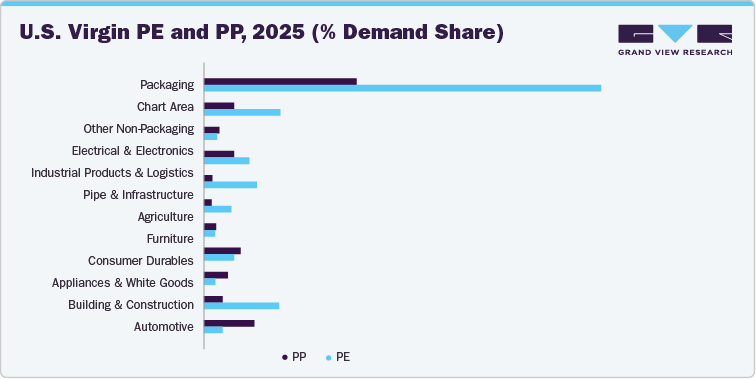
Polyethylene is the largest material type segment within the U.S. Virgin PE & PP market, supported by its extensive use across packaging and non-packaging applications. LDPE and LLDPE are widely consumed in films, shopping bags, stretch and shrink films, pouches, sachets, liners, and agricultural packaging. PE accounts for approximately 72.2% of packaging demand, reflecting its strong penetration in flexible packaging. PP represents 27.8% of packaging demand and is primarily used in rigid containers, caps and closures, food containers, woven sacks, BOPP films, and thermoformed trays. Strong demand for lightweight packaging, recyclability, and cost-efficient processing continues to support PE and PP consumption. Growing recycled resin adoption is further strengthening circular material use across packaging applications.
Polyethylene (PE) and Polypropylene (PP) Technical Recycled-Content Potential by Sector, 2025 - 2040
The Industrial Products & Logistics sector represents a high-potential application area for recycled PE within the U.S. Virgin and the recycled PE & PP market. Mechanical recycled PE can achieve approximately 50% to 80% penetration in pallets, crates, totes, tanks, drums, bulk containers, and industrial films. Advanced recycling potential can reach 70% to 90%, supported by relatively low regulatory barriers, limited aesthetic requirements, and growing recycled-content procurement targets. PE offers adequate mechanical performance for thick-wall, non-food, and non-critical applications. However, impact performance, colour consistency, and material quality remain technical constraints. Commercial adoption is increasingly influenced by the availability of certified feedstock, consistent recycled resin quality, and cost competitiveness.
The Industrial Products & Logistics sector represents a high-potential application area for recycled PP within the U.S. Virgin and the Recycled PE & PP market. Mechanical recycled PP can achieve approximately 55% to 85% penetration in crates, bins, pallets, totes, strapping, industrial containers, and returnable transport packaging. Advanced recycling potential can reach 70% to 90%, supported by straightforward qualification requirements, limited aesthetic specifications, and increasing corporate recycled-content targets. Recycled PP provides suitable mechanical performance for rigid logistics and industrial products. However, impact strength, melt flow consistency, and color variation remain technical constraints. Commercial adoption is increasingly influenced by resin availability, feedstock consistency, certified recycled material supply, and cost competitiveness against virgin PP.
Sector Adoption Drivers and Attractiveness Scoring
Advanced/Chemical
The packaging sector represents a highly attractive application area for advanced recycled PE within the U.S. Virgin and Recycled PE & PP market. The sector records a weighted attractiveness score of 4.1, reflecting strong potential for chemical recycled resin adoption. Regulatory recycled-content mandates are increasing demand for recycled PE in packaging applications. Food-contact compliance requirements are also encouraging the development of higher-purity advanced recycled grades. Brand sustainability commitments further strengthen adoption, particularly among companies seeking to increase recycled content while maintaining consistent material performance. Advanced recycled PE can address quality, consistency, and application requirements that limit conventional mechanical recycling. However, qualification requirements, regulatory compliance, and premium pricing remain important considerations. Overall, packaging offers strong long-term potential for advanced recycled PE adoption.
The Packaging sector represents a highly attractive application area for advanced recycled PP within the U.S. Virgin and Recycled PE & PP market. The sector records a weighted attractiveness score of 4.1, indicating strong potential for chemical recycled resin adoption. Recycled-content regulations are increasing demand for recycled PP across packaging applications. Food-contact compliance requirements are supporting the development of higher-purity recycled grades for high-value rigid packaging. Brand sustainability commitments are further accelerating adoption as manufacturers seek higher recycled content without compromising material performance. Advanced recycled PP can address consistency and quality limitations associated with mechanical recycling. However, regulatory qualification, food-contact approvals, supply availability, and premium pricing remain key considerations. These factors will influence the pace of advanced recycled PP adoption across packaging.
Mechanical
The packaging sector represents a strong application area for recycled PE within the U.S. Virgin and Recycled PE & PP market. The sector records a weighted attractiveness score of 3.4, supported by recycled-content regulations, extended producer responsibility schemes, and brand sustainability commitments. Mechanically recycled PE is primarily used in non-food-contact and secondary packaging applications, including liners, films, and protective packaging. Food-contact regulations, contamination risks, and stringent quality requirements constrain broader adoption in primary packaging. Advanced recycling can improve resin purity, consistency, and suitability for demanding packaging applications. However, higher processing costs, feedstock availability, regulatory qualification, and supply consistency remain key considerations. Continued regulatory pressure and corporate recycled-content targets are expected to strengthen recycled PE demand across packaging applications.
The Packaging sector represents a leading application area for recycled PP within the U.S. Virgin and Recycled PE & PP market. The sector records a weighted attractiveness score of 3.6, supported by stringent recycled-content regulations, brand sustainability commitments, and increasing recycled-content targets. Mechanically recycled PP is primarily used in non-food-contact and lower-specification packaging applications, including containers, transport packaging, and flexible packaging components. Broader adoption remains constrained by food-contact regulations, quality consistency, product safety requirements, and the limited availability of suitable recycled grades. Advanced recycling can improve resin purity and consistency for higher-value packaging applications. However, higher processing costs, qualification requirements, and feedstock availability remain important commercial considerations. These factors will shape the pace of recycled PP adoption across the packaging sector.
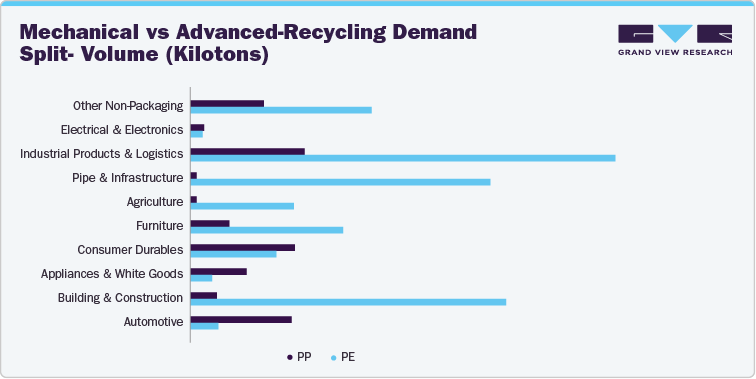
The automotive sector is a key growth area in the U.S. Virgin and Recycled PE & PP market. Demand is projected to rise from 843.9 kilotons in 2025 to 2,196.2 kilotons by 2040, supported by expanding vehicle production and increasing recycled material use. Mechanical recycled PE & PP are widely applied in bumpers, wheel liners, underbody shields, interior trims, dashboards, door panels, and battery covers. Advanced recycled PP offers greater potential in battery housings, high-performance trims, interior components, and safety-related parts requiring consistent properties. Vehicle light weighting and EV adoption are strengthening demand. However, impact strength, melt flow consistency, durability, qualification requirements, resin availability, feedstock quality, and cost competitiveness remain key factors influencing broader adoption.
Sector-Specific Mechanical-Recycling Adoption Curves
The industrial products & logistics sector represents a highly attractive application area for mechanically recycled PE within the U.S. Virgin and Recycled PE & PP market. The sector is expected to record the fastest adoption curve due to strong acceptance of post-consumer recycled PE in pallets, crates, containers, drums, and other industrial products. These applications have relatively low regulatory barriers and limited aesthetic requirements, supporting higher recycled-content integration. Growing corporate sustainability targets are further strengthening demand for PCR materials across logistics and material-handling products. However, adoption remains dependent on the availability of consistent, high-quality recycled PE. Impact performance, resin consistency, and supply reliability remain key constraints. Improving collection systems, sorting efficiency, and recycling capacity will support broader commercial adoption of mechanically recycled PE.
The Industrial Products & Logistics sector represents a leading application area for mechanically recycled PP within the U.S. Virgin and Recycled PE & PP market. The sector is expected to exhibit the highest adoption curve due to broad compatibility of recycled PP across industrial and logistics products. Recycled PP is widely suitable for pallets, crates, totes, bins, material-handling containers, and returnable transport packaging. Limited aesthetic requirements and relatively straightforward qualification processes support higher recycled-content integration. Corporate sustainability targets are further strengthening demand for PCR PP across logistics applications. However, broader adoption remains constrained by the availability of consistent, high-quality recycled PP, impact performance, melt flow consistency, and reliable feedstock supply. Improving collection, sorting, and processing infrastructure will support sustained adoption.
OEM Validation
Recycled PE/PP adoption is already established across a wide range of end-use sectors, according to OEM, converter, and brand-owner validation. Automotive, appliances & white goods, electrical & electronics, industrial products & logistics, and pipe & infrastructure show particularly strong evidence of current applications. Automobile wheel liners and underbody shields, appliance tubs and structural parts, electronics housings and enclosures, reusable logistics packaging, and plastic piping are among the components that have been verified. While chemical/advanced recycling is still more selective and is mostly seen in applications that demand certain material performance or recycled-content quality, mechanical recycling is the most common recycling method.
The validation also shows that future demand for recycled PE/PP is being supported more and more by OEM and brand-owner sustainability commitments. With target years often falling between 2030 and 2050, companies such as Ford, GM, Toyota, Honda, LG, Electrolux, Apple, Dell, Cisco, ADS, JM Eagle, and Berry Global have set recycled-material, circularity, or recycled-content goals. A firmer foundation for future adoption than more general carbon-reduction targets alone is provided by a number of promises that are directly related to boosting recycled plastics or circular materials.
Overall, the validation is in favor of a slow but widespread rise in the use of recycled PE/PP, driven by applications where recycled material may satisfy current performance and technical standards. While established use of PCR and recycled PE/PP grades benefits pipe, logistics, packaging, and other durable industries, automotive and consumer/electrical applications provide substantial medium-to long-term prospects. Therefore, in order to estimate sector-level adoption potential, the assessment uses current application adoption, specific recycled resin type, recycling route, and closely connected future OEM commitments as important factors.
Report Attribute
Details
Market Sizing & Estimates Years
2025, 2030, 2035, 2040
Deliverable format
Excel and PPT
Country scope
The U.S.
Sections Covered
U.S. Sector Virgin Demand, Technical Recycled-Content Potential by Sector, Advanced Recyled Resins-Adoption Drivers, Mechical Recyled Resins-Adoption Driver, Mechanical vs Advanced-Recycling Demand Split, Sector-Specific Recycling Adoption Curves, Bottom-Up OEM, Converter and Brand-Owner Validation


Customize this report to your needs - add regions, segments, or data points, with 20% free customization.
Or view our licence options:


ISO 9001:2015 & 27001:2022 Certified
We are GDPR and CCPA compliant! Your transaction & personal information is safe and secure. For more details, please read our privacy policy.


