
- Home
- »
- Animal Health
- »
-
Veterinary Semen Import & Export Trade Intelligence, 2021 - 2025GVR Report cover
![Global Veterinary Semen Import & Export Trade Intelligence, 2021 - 2025Report]()
Global Veterinary Semen Import & Export Trade Intelligence, 2021 - 2025
Report Overview
The global veterinary semen trade is evolving from a conventional reproductive-input business into a cross-border genetics and breeding-efficiency ecosystem, with trade flows shaped by livestock productivity objectives, artificial insemination adoption, genetic selection, disease-control requirements, and country-specific market-access protocols. Bovine semen represents the clearest established trade category, with 2024 WITS data showing the U.S. at USD 266.0 million and Canada at USD 121.6 million in exports, followed by the Netherlands and France at approximately USD 47.3 million and USD 47.2 million, respectively. This concentration positions established genetics-producing economies as principal suppliers to dairy and beef breeding markets, while creating sourcing opportunities for countries seeking access to specialized genetics without importing breeding animals. Trade dynamics are increasingly determined by market-access readiness rather than genetics availability alone. Veterinary semen must satisfy country eligibility, approved collection and storage requirements, animal-health certification, disease-status conditions, and destination-specific import protocols.
The UK, for instance, restricts bovine semen imports to approved trading partners and requires collection through approved centres under defined veterinary and hygiene conditions, creating a regulatory filter that directly determines which suppliers can participate in a destination market. Australia applies a comparable framework, requiring export permits and health certificates while restricting imports to approved countries and defined commodity conditions. Disease events therefore have direct commercial consequences because changes in eligibility can disrupt established corridors, redirect sourcing, and alter supplier competitiveness. Demand is simultaneously shifting toward higher-value reproductive technologies. Sex-sorted semen adoption in Great Britain reached 84% of dairy semen use in 2025, indicating that breeding programs increasingly prioritize targeted herd replacement and genetic progress rather than undifferentiated semen volume. For instance, in June 2026, Australia resumed bull-semen exports to China after a five-year interruption, with 24,000 straws shipped during April and May following re-accreditation of an Australian export facility. The development demonstrates how regulatory reopening can rapidly reactivate a commercially important genetics corridor when destination demand and supplier capability are already established.
GVR’s trade intelligence report provides the ability to connect trade statistics with the structural factors governing trade accessibility and competitiveness. Rather than presenting import and export values in isolation, the study will link species-level trade flows with major sourcing and destination markets, trading-partner relationships, animal population context, breeding practices, artificial insemination adoption, cold-chain infrastructure, regulatory requirements, tariffs, and emerging market-access developments. The scope provides coverage across bovine, swine, equine, ovine & caprine, and other species, with analysis spanning 2021-2025 across North America, Europe, Asia Pacific, Latin America, and Middle East & Africa. The flow of study will progress from global trade mapping to species-level analysis, followed by regional and country trade intelligence, major importer-exporter identification, bilateral trade-flow assessment, regulatory and supply-chain analysis, and exporter competitiveness. This structure will allow users to identify where trade is concentrated, which corridors are expanding or exposed to disruption, which destinations present market-access opportunities, and where genetics suppliers can strengthen international positioning.
Top 10 Veterinary Semen Export Markets, by Key Species, 2025
The leading veterinary semen export markets in 2025 are concentrated in countries with established livestock genetics industries, advanced breeding infrastructure, and regulatory systems that support international movement of germplasm. Export strength is particularly associated with economies serving organized dairy and beef breeding programs, where artificial insemination and genetic selection create sustained demand for internationally sourced semen. Established exporters also benefit from approved collection facilities, cold-chain capabilities, veterinary certification systems, and established bilateral trade routes, allowing them to serve multiple destination markets across species. The competitive landscape therefore remains shaped by a combination of genetic quality, production capacity, disease-control credentials, and market-access coverage rather than domestic livestock population alone. The study will compare leading exporters across Bovine, Swine, Equine, Ovine & Caprine, and Other Species to identify the countries shaping global semen trade flows.
Top 10 Bovine Semen Import Markets, 2025
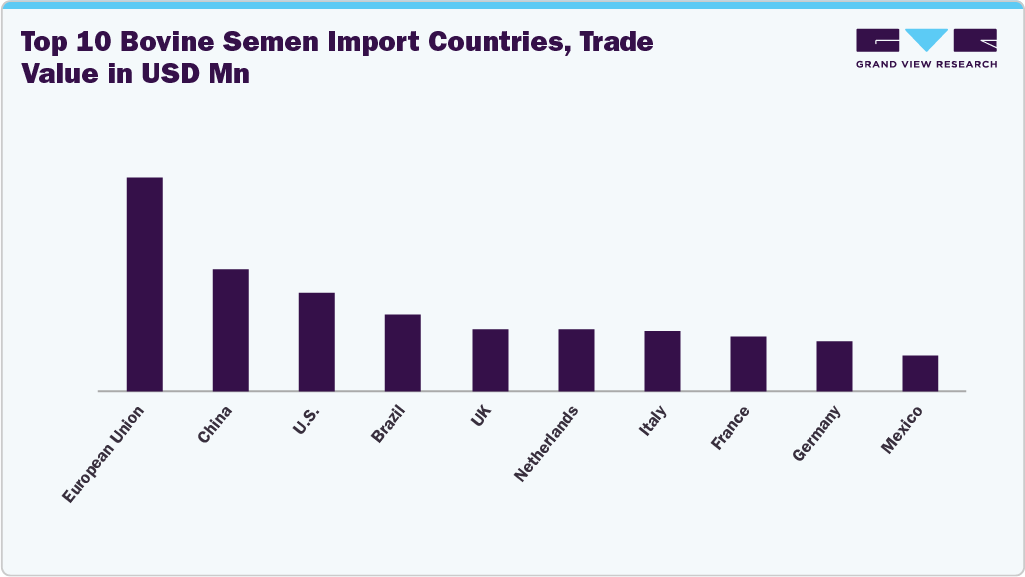
The 2025 import landscape is led by the European Union, followed by China and the U.S., with Brazil, the UK, Netherlands, Italy, France, Germany, and Mexico forming the remainder of the leading group shown in the chart. The composition indicates a broad mix of mature dairy and beef breeding markets alongside countries expanding genetic improvement programs through imported germplasm. European markets maintain a strong position through established breeding systems and extensive cross-border movement within the region, while China and Brazil represent major destination markets supported by large-scale livestock production and ongoing productivity improvement initiatives. The presence of both individual European countries and the European Union as a separate trade entity also makes partner-country and reporting conventions an important consideration when interpreting global import rankings.
Top 10 Veterinary Semen Export Markets, by Key Species, 2025
The leading veterinary semen export markets in 2025 are concentrated across countries with established livestock genetics industries, specialized breeding programs, and infrastructure for semen collection, processing, storage, and international distribution. Export activity is supported by adoption of artificial insemination, demand for superior genetics, and established veterinary certification systems that facilitate access to overseas breeding markets. Species composition also differs across exporting countries, with some markets serving primarily dairy and beef genetics while others have stronger positioning in swine, equine, or small-ruminant breeding. The study will benchmark the leading exporters across bovine, swine, equine, ovine & caprine, and other species, linking export positioning with trade corridors, destination markets, regulatory access, and breeding-system characteristics. This provides a structured view of the countries shaping international veterinary semen supply.
Top 10 Bovine Semen Export Markets, 2025
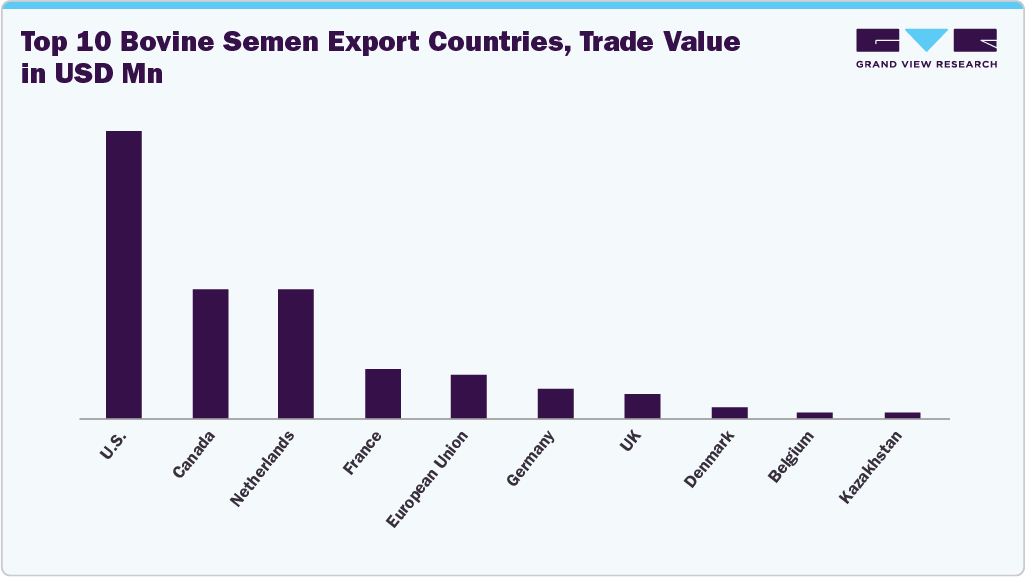
The leading bovine semen export markets in 2025 are supported by developed cattle genetics industries serving dairy and beef producers across international breeding markets. Export competitiveness is shaped by genetic quality, established artificial insemination programs, approved semen collection facilities, disease-control systems, and the ability to meet destination-specific veterinary and certification requirements. Export markets with established breeding programs can serve multiple international destinations, while countries with specialized cattle genetics can develop focused trade corridors around particular breeds and production systems. The study will assess the leading bovine semen exporters through export value, trade volume, destination markets, trading partners, and historical trade movement. This analysis will identify the geographic concentration of bovine genetics supply and provide visibility into how established exporters position themselves across international breeding markets.
Global Trade Dynamics, Ecosystem, Regulatory Environment, and Export Competitiveness
Global veterinary semen trade is transitioning from a product shipment model toward a cross-border genetics supply ecosystem, where export performance is shaped by breeding economics, artificial insemination adoption, disease-control status, market-access protocols, and the ability to maintain biological integrity across international logistics. The report positions these factors as interconnected components of trade intelligence, moving from international trade trends and genetic-improvement demand toward supply-chain infrastructure, regulatory access, and country competitiveness.
Trade Dimension
Structural Development
Potential Commercial Implication
International trade trends
Trade flows are increasingly concentrated around established genetics-producing and breeding-intensive markets
Incumbent exporters with multiple destination approvals gain wider access to international buyers
Demand for genetic improvement
Commercial livestock operators seek higher productivity, herd quality, and breeding efficiency
Premium genetics suppliers gain relevance where producers prioritize herd-level productivity
Shift in breeding practices
Breeding programs are moving toward more selective and technology-enabled reproductive strategies
Suppliers offering differentiated genetics can compete beyond conventional semen volumes
Artificial insemination adoption
Wider AI utilization expands the addressable market for transported semen across livestock systems
Countries with organized breeding infrastructure become more attractive import destinations
Semen collection, processing, and cryopreservation
Improvements in handling and storage support longer-distance movement while preserving biological quality
Exporters with specialized facilities can access geographically broader trade corridors
Global Trade Ecosystem
The trade ecosystem is structured across genetics producers, specialized collection centers, processing and cryopreservation facilities, veterinary authorities, logistics providers, distributors, breeding organizations, and end users. This creates a chain in which a weakness at any stage can restrict international trade even when underlying demand is present. Cold-chain infrastructure is particularly important because semen requires controlled storage and handling from collection through final delivery, making logistical capability a component of export competitiveness rather than a support function. The distribution network also varies by species and destination. Bovine trade is closely connected with organized dairy and beef breeding systems, while equine and swine trade can be more dependent on specialized breeding establishments and tighter biosecurity controls. This creates different entry requirements by species and prevents a single distribution model from serving the entire veterinary semen market.
Regulatory & Trade Environment
Regulation is a central determinant of whether a trade corridor is commercially accessible. Veterinary health certification, approved collection facilities, disease-status requirements, import permits, quarantine procedures, and destination-country compliance determine whether semen can enter a market and under which conditions. The report therefore places regulatory analysis alongside trade statistics rather than treating regulation as a standalone background topic. Tariffs and trade agreements add a further commercial layer by influencing landed economics once market access has been established. For exporters, the strategic priority is therefore to maintain access across multiple approved destinations, reducing exposure to a single-country regulatory or policy change.
Export Competitiveness Assessment
Competitive Factor
What the Study Will Assess
Strategic Relevance
Major exporting countries
Export scale, species footprint, and destination reach
Identifies established supply hubs
Key import markets
Import concentration and sourcing patterns
Reveals demand centers and market-entry targets
Trade-flow structure
Bilateral corridors and partner relationships
Identifies concentrated and diversified trade routes
Competitive positioning
Relative strength of leading export nations
Clarifies where exporters possess geographic or structural advantages
Emerging opportunities
New corridors, expanding breeding systems, and market-access developments
Supports entry and expansion decisions
Animal population context
Key-country livestock population by species
Establishes the underlying breeding-market base
The study flow will therefore progress from global trade mapping to species analysis, country and regional trade flows, ecosystem assessment, regulatory screening, and exporter competitiveness, with animal population data providing demand-side context. This structure is designed to answer not just where veterinary semen is traded, but why specific corridors develop, what conditions sustain them, and where future trade opportunities are forming. The report specifically provides for country-wise import and export values, trade volumes, major trading partners, historical trends, and regional trade dynamics across 5 target geographies.
Species Analysis
Bovine semen represents the broadest and most internationally established trade segment, supported by global dairy and beef breeding programs, artificial insemination adoption, and established genetics exporters across the globe. Swine semen trade is more concentrated within intensive pig-production systems, with African swine fever and other biosecurity requirements strongly influencing cross-border sourcing and destination access. Equine semen follows a specialized trade model, centered on high-value breeding programs and stringent disease-control and certification requirements. Ovine and caprine semen trade remains more selective, with activity linked to breed improvement, productivity programs, and developing small-ruminant breeding systems.
Other species comprise narrower international corridors, generally driven by specialized genetics and local breeding objectives. Across species, regulatory eligibility, disease status, breeding-system sophistication, and cold-chain capability increasingly determine the continuity and expansion of international trade. Trade patterns also vary by the maturity of national breeding systems and the role of specialized genetics providers. Bovine trade benefits from large commercial dairy and beef operations, while swine flows are concentrated around intensive production clusters with strict biosecurity controls. Equine trade remains specialized and premium-oriented, whereas ovine, caprine, and other species are more closely linked to targeted breed-improvement programs. Across markets, bilateral approvals, animal-health certification, reproductive technology adoption, and reliable cryogenic logistics determine which exporters can consistently access international buyers.
Regional Insights
North America Veterinary Semen Import & Export Trade Intelligence Insights
North America functions as a diversified genetics hub spanning bovine, swine, equine, and other reproductive-material categories. The U.S. combines large-scale genetics production with extensive destination coverage, while Canada maintains established dairy-semen and swine genetics capabilities. Cross-border integration supports recurring trade, although species-specific health certification remains central to corridor continuity. Strong breeding infrastructure and specialized reproductive facilities position the region as both a major supply base and a sophisticated demand centre.
U.S. Veterinary Semen Import & Export Trade Intelligence Insights
The U.S. occupies a central position across international veterinary semen trade, with established capabilities spanning bovine, swine, equine, and small-ruminant germplasm. Its competitive position combines specialized collection facilities, advanced breeding programs, broad export protocols, and extensive destination-market coverage. Multiple trade data places the U.S. among the leading bovine semen trading economies, while USDA protocols demonstrate the breadth of species-specific export requirements. This combination supports diversified international sourcing and export relationships.
Europe Veterinary Semen Import & Export Trade Intelligence Insights
The EU represents a highly integrated veterinary semen ecosystem covering bovine, porcine, ovine, caprine, and equine reproductive material. Harmonized rules govern approved germinal-product establishments, donor eligibility, traceability, health status, certification, and movement across Member States and third countries. This regulatory alignment facilitates intra-European trade while maintaining stringent biological safeguards. The region's dense breeding infrastructure and broad species coverage position it as both a major genetics-consuming market and an important international supply base.
UK Veterinary Semen Import & Export Trade Intelligence Insights
The UK combines advanced breeding practices with a highly regulated germplasm trade environment. Dairy breeding is increasingly oriented toward sex-sorted semen, while beef genetics are also incorporated within dairy breeding programs, expanding demand for differentiated reproductive material. At the same time, imports of ovine, caprine, bovine, porcine, and equine germplasm remain subject to approved-country, health, and certification requirements. This combination favors suppliers with specialized genetics and sustained regulatory access.
Asia Pacific Veterinary Semen Import & Export Trade Intelligence Insights
Asia Pacific combines major livestock populations, expanding artificial-insemination systems, specialized genetics producers, and highly varied regulatory environments. China is a major demand centre, Australia is an established reproductive-material exporter, India is strengthening structured germplasm controls, and Southeast Asian markets are developing species-specific breeding corridors. Trade access remains closely tied to disease status, bilateral protocols, and certification, creating differentiated opportunities across bovine, buffalo, swine, and equine genetics.
China Veterinary Semen Import & Export Trade Intelligence Insights
China is a major destination for international livestock genetics, with demand spanning cattle and other reproductive-material categories as domestic producers seek productivity and herd-quality improvements. WITS places China among the leading bovine semen import markets, while recent Australia-China trade reopening demonstrates the importance of bilateral market access. China also features in emerging buffalo-genetics corridors, creating opportunities for suppliers with differentiated breeds, established certification, and destination-specific market approvals.
India Veterinary Semen Import & Export Trade Intelligence Insights
India is developing a more structured germplasm ecosystem spanning cattle, buffalo, sheep, goats, and equine reproductive material. Government guidelines require screening of imported germplasm, veterinary certification, traceability of imported semen doses, and registration of imported bulls, creating a controlled route for international genetics. Growing emphasis on productivity and breed improvement supports demand for specialized genetics, while domestic breeding infrastructure creates opportunities for both imported and locally processed reproductive material.
Latin America Veterinary Semen Import & Export Trade Intelligence Insights
Latin America combines extensive livestock production with an established artificial-insemination base and expanding genetics trade. Brazil anchors regional supply through bovine, buffalo, ovine, caprine, and equine semen collection and processing infrastructure, while other markets maintain import links for specialized cattle and reproductive genetics. The region's breed diversity creates opportunities around tropical-adapted genetics, productivity improvement, and cross-border breeding programs, with regulatory approval increasingly shaping access to international destinations.
Brazil Veterinary Semen Import & Export Trade Intelligence Insights
Brazil has developed a diversified reproductive-material ecosystem spanning bovine, buffalo, ovine, caprine, equine, and swine-related activities. Its domestic regulatory framework requires structured registration, sanitary controls, and reporting across species, supporting traceability throughout commercial semen production. Brazil also serves as an important international genetics source, particularly where tropical cattle characteristics align with destination breeding objectives. Its combination of livestock scale, breed specialization, and processing infrastructure supports expansion across emerging international genetics corridors.
Middle East & Africa Veterinary Semen Import & Export Trade Intelligence Insights
The Middle East and Africa remain diverse reproductive-material markets, with livestock productivity programs, breed improvement, and imported genetics supporting trade across cattle, sheep, goats, and equine segments. South Africa has established breeding and export infrastructure, while Gulf markets are predominantly shaped by imported genetics and controlled veterinary access. Disease status, approved collection facilities, certification, and cold-chain handling remain decisive because trade corridors can change rapidly when animal-health conditions are revised.
South Africa Veterinary Semen Import & Export Trade Intelligence Insights
South Africa combines domestic breeding capability with diversified international sourcing across livestock genetics. Its trade ecosystem covers bovine and other reproductive materials, while government controls require export permits and breeder or registering-authority recommendations for semen and related germplasm. Trade data indicate sourcing from North America, APAC, and Europe, indicating a geographically diversified supply base. This structure supports access to varied genetics while creating a regulated pathway for domestic and regional breeding programs.
Saudi Arabia Veterinary Semen Import & Export Trade Intelligence Insights
Saudi Arabia is primarily an import-oriented genetics market where cattle and broader livestock breeding requirements support demand for international reproductive material. U.S. genetics account for a large share of bovine semen sourcing, while European and Canadian suppliers provide additional access. The country's breeding modernization agenda creates demand for productivity-oriented genetics, but veterinary certification, import approvals, disease controls, and temperature-controlled handling remain important conditions for maintaining reliable international supply corridors.
Recent Developments
-
In September 2026, Malaysia approved imports of Taiwanese breeding pigs and boar semen, opening a new export corridor following Taiwan’s return to ASF-free status. Finalization of veterinary health certificates remains the condition for commercial shipments to begin. The development creates a new regulated destination for Taiwanese porcine genetics and demonstrates how disease-status clearance can unlock additional international semen trade corridors.
-
In May 2026, India introduced a draft veterinary health certificate framework for importing equine semen, establishing specific sanitary documentation requirements for international equine germplasm movement. The measure expands the formal regulatory architecture governing specialized semen imports. Clearer import certification can improve market-access visibility for overseas equine genetics suppliers while establishing additional compliance requirements for cross-border shipments.
-
In March 2026, the Netherlands Food and Consumer Product Safety Authority (NVWA) opened a criminal investigation into alleged exports of horse semen without required certification, demonstrating the enforcement exposure associated with non-compliant international germplasm shipments. The case highlights the importance of documentation and approved export procedures in equine trade.
-


Customize this report to your needs - add regions, segments, or data points, with 20% free customization.
Or view our licence options:


ISO 9001:2015 & 27001:2022 Certified
We are GDPR and CCPA compliant! Your transaction & personal information is safe and secure. For more details, please read our privacy policy.


