Tools and Components Industry Trends 2026 & Beyond: Integrated Systems, Precision Components, and Lifecycle Value
Explore all 7 industry trends
Use the contents below to jump directly to the trend relevant to your research.
Forces Shaping The Tools and Equipment Industry
- Competition is moving beyond stand-alone products toward compatible tools, accessories, and component systems supported by application expertise.
- Engineered fasteners, cutting inserts, abrasives and tool holding components are becoming more important to process quality and productivity.
- Cordless technology is entering heavier-duty applications, increasing the importance of battery, attachment, and consumable compatibility.
- Connected tightening and assembly solutions bring traceability closer to the tool, fastener and finished joint.
- Digital tool management and automated replenishment are helping companies control both durable equipment and high-volume consumables.
- Safety, component longevity, repairability and total cost of ownership are increasingly influencing purchasing decisions.
Section I: How the Tools and Component Industry Is Evolving (Market landscape, product breadth, and competitive models)
One of the defining tools and components industry trend is the shift from a market often evaluated through individual product specifications toward one in which the performance of the complete working system matters. Durability, power, precision, and price remain important, but buyers are increasingly considering how tools interact with batteries, holders, cutting edges, fastening elements, accessories, service arrangements and digital applications.
The industry encompasses a wide variety of products, including hand tools, power tools, fasteners, measuring devices, industrial cutting tools, torque devices, and attachments. While these products differ in terms of their respective uses, there is an increased trend toward greater productivity, efficiency, and user-friendliness. There is also more emphasis on precision, process control, and calibration management in industrial usage.
These changes have slowly been affecting the competitive scenario within the sector of tool manufacturers. Apart from providing quality products at affordable prices, firms have started to differentiate themselves by offering compatible batteries, tool management, technical assistance, maintenance, and even digital solutions. The tools that these firms produce, which include drills, wrenches, saws and cutting tools, are now starting to be backed by ecosystems of products and services.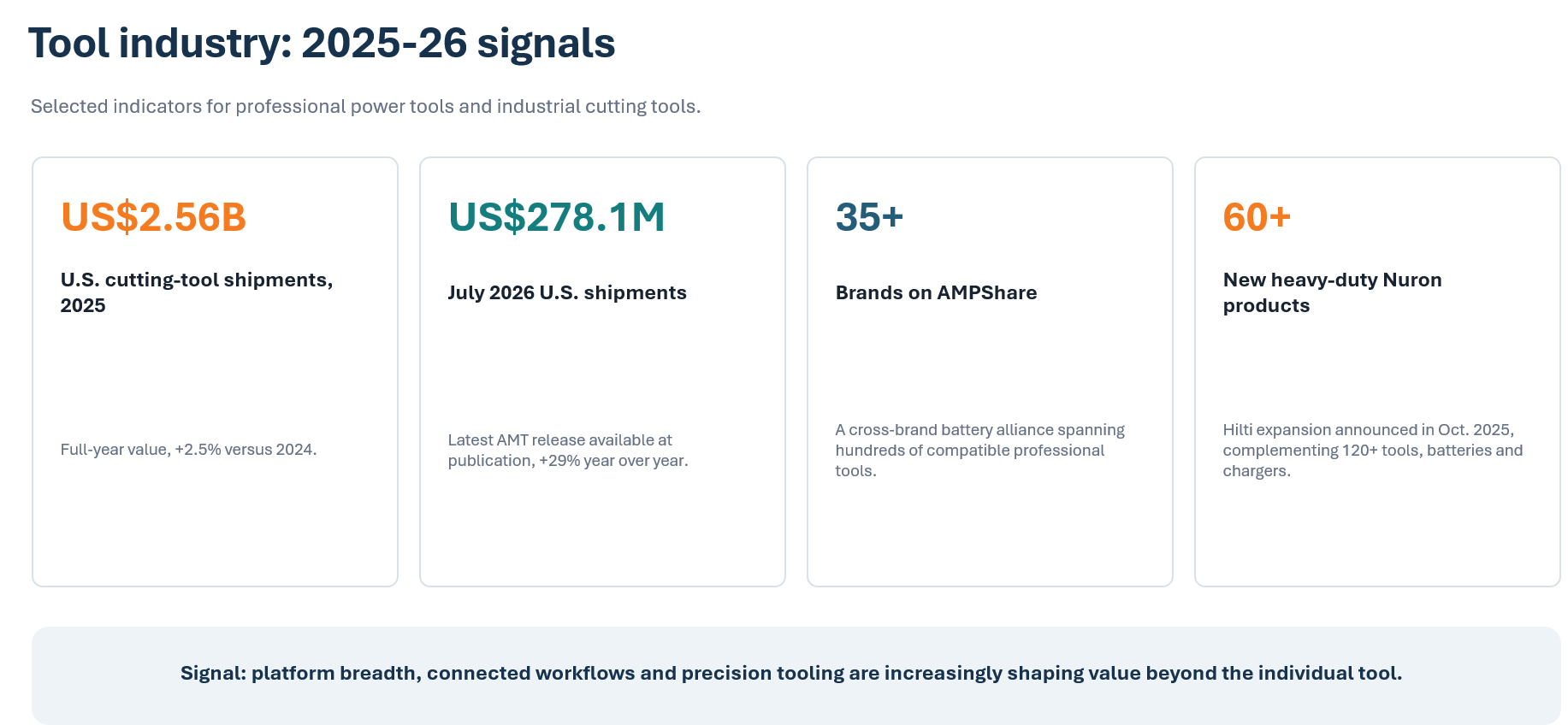
Sources: AMT & U.S. Cutting Tool Institute; Hilti; Bosch Professional AMPShare.
01Competition Is Shifting from Products to Platforms
Reputation of brand has been an integral part of the tools industry for a long time since purchasing decisions depend on the reliability, performance, ergonomics, logistics, and servicing of the products. At the same time, an increasing use of integrated battery platforms and connected tools with digital platforms of management strengthens connections of customers with the companies producing these brands. Users of compatible batteries, chargers, and tool management platforms face extra expenses and difficulties in changing the brand.
The trends are posing both opportunities and challenges to the tool vendors. The vendors that have comprehensive product portfolios and batteries will be able to gain from customer retention and the need for interoperable tools, positioning them to capture a larger share of tools and components industry growth. The maintenance of these relationships will require innovation, compatibility, service, and portfolio upgrades. The smaller and specialized vendors might have to depend on battery alliances and technology partnerships in order to compete without having their own tool ecosystem.
In the industrial sector, competition is increasingly driven by performance and pricing. Producers of metal cutting tools, precise machine equipment, and assembly machines try to distinguish themselves in their activities thanks to application engineering, processes optimization, and IT services provided. The solutions that make possible to increase tool life, to improve machining processes, shorten production cycles, and provide a better traceability of quality will give extra advantage. In such a way, the competitive environment becomes a product of the mixture of quality, technology, application knowledge, and customer support.
02Engineered Fasteners Are Moving Beyond Commodity Selection
Components such as screws, bolts, nuts, washers, threaded inserts, and other fastening parts may have relatively low individual purchase prices, yet their specifications can affect the reliability of an entire assembly. Differences in material grade, coating, corrosion resistance, geometry, and installation method influence joint integrity, assembly time, and maintenance requirements. Fastener selection is therefore increasingly considered alongside product design and process engineering, rather than evaluating unit prices alone.
Engineering requirements vary widely by application. Construction fastening systems must account for substrates, installation methods, and environmental exposure, while automotive and industrial assemblies may place greater emphasis on joint strength, vibration resistance, lightweight materials, and serviceability. In each case, choosing the appropriate fastener design, surface treatment and installation process can help manufacturers avoid rework and improve consistency across repeated assembly operations.
STANLEY Engineered Fastening provides an example of this engineering-led approach. In a published case study involving an automotive OEM’s electric-vehicle battery assembly program, the supplier describes combining stud welding, self-piercing rivets, rivet nuts, and threaded screws to address aluminum and steel joining requirements. The example illustrates why fastener choice, installation tooling and joint validation increasingly need to be considered together in demanding assemblies.
Section II: Where Tool Technology Is Advancing (Cordless power, precision, and worker safety)
03Cordless Technology Is Moving into Heavier Applications
Cordless tools have seen significant uptake in the professional and industrial sectors, as advances in technology have led to the adoption of these devices in areas beyond drilling and fastening tasks. With the progress made in terms of batteries and brushless motors, manufacturers can now produce cordless equipment to perform more difficult tasks such as concrete demolition, cutting, and compaction, among others.
A notable example of this transition is Hilti's expansion of its Nuron cordless platform in October 2025, when the company announced more than 60 additional heavy-duty products. These additions complemented an existing portfolio of over 120 tools, batteries, and chargers, extending the platform's capabilities into applications such as concrete breaking, cutting, and soil compaction. Such developments highlight the growing importance of integrated battery platforms, as consumers are increasingly considering product compatibility, equipment availability, and long-term platform support while selecting tools.
Interoperability of batteries has become another aspect of professional tools that is gaining importance in the industry. The battery alliances by companies such as Bosch Professional's AMPShare program, which encompasses over 35 participants and has hundreds of interoperable products, highlights the rising importance of cross-branding. By means of such alliances, contractors and industrial personnel can use various devices powered by the same batteries and chargers. Consequently, battery platform compatibility is emerging as one of the critical factors in purchase decisions, along with the traditionally evaluated criteria like quality, durability, and pricing.
04Precision and Traceability Are Moving Closer to Tools & Fasteners
Interconnectivity is becoming increasingly important in the automotive industry, aerospace, electronics, and others that require precise and high-quality control of production processes. Connected devices are capable of collecting information on the torque value, rotation angle, identification of the device itself, status of its work, and details of the produced part. With this information collected, manufacturers will be able to monitor all fastening operations and perform necessary tracking.
Advanced solutions by companies like Atlas Copco include intelligent assembly tools and torque management software which ensure real-time data communications, accurate tightening, and integration with production management systems. Such advanced options give manufacturers an opportunity to track the fastening processes, validate the tightening outcomes, and record all production data. Integration of the tool’s data into the company’s quality management system ensures better traceability and identification of assembly problems.
The rise in the use of networked torque tools has also meant that these devices have been put to use for applications other than the conventional fastening application. These tools are now being used increasingly in manufacturing settings where the use of the tool is integrated into the manufacturing and quality assurance systems. Instead of being used just to achieve the right amount of torque, it becomes possible for manufacturers to ensure that the fastening was done in the correct way on the correct parts.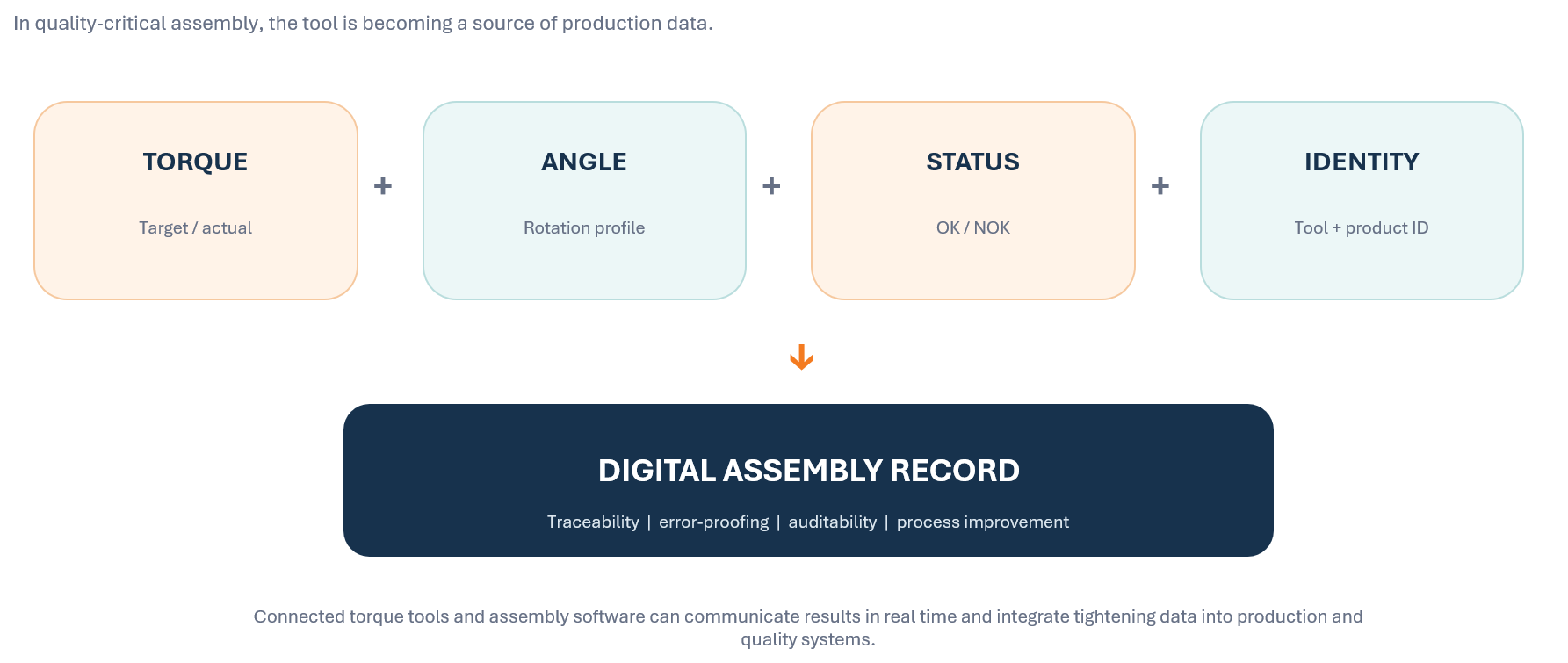
05Safety and Ergonomics Are Becoming Product Differentiators
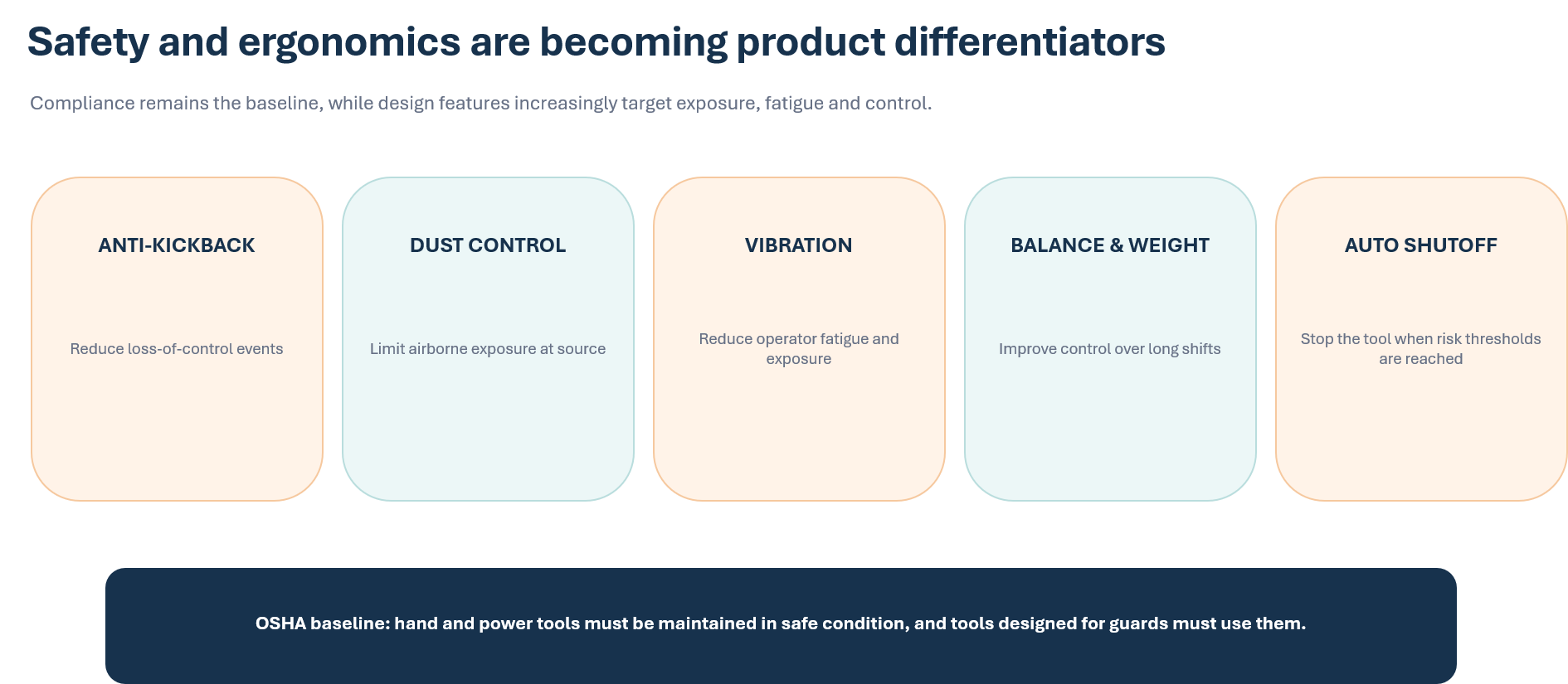
Safety and ergonomics have become significant concerns in the design of professional and industrial tools. Tool manufacturers are now designing features such as anti-kickback features, built-in dust collection systems, vibration dampening, better weight distribution, and shut-off switches. This is especially true in harsh conditions where operators spend long periods of time operating the tools under vibrations and exposure to dust.
Regulatory demands still remain an important factor in tool design and safety at work. In fact, the Occupational Safety and Health Administration (OSHA) mandates that employers keep their hand and power tools in good working order, as well as proper machine guards when necessary. Nevertheless, modern tool producers strive to design more efficient safety mechanisms than those demanded by regulation. In particular, advanced control systems, ergonomic design, and protection systems are becoming essential components of tool design.
Apart from protecting workers, ergonomics can also be used in improving the efficiency of the processes. Tools that are light and well balanced will minimize physical exhaustion by the workers using them for long hours, whereas the technology used in minimizing vibrations makes the operators more comfortable while working repetitively. Dust extraction is one of the ergonomic features that will make it easier for industries to handle dust in the work environment. With industries becoming more productive and finding it hard to deal with the problems of their workforce, manufacturers will develop better tools.
Section III: How Tools and Components Are Managed (Digital inventory, supply reliability and lifecycle economics)
06Tool Fleets and Component Inventories Are Becoming Managed Assets
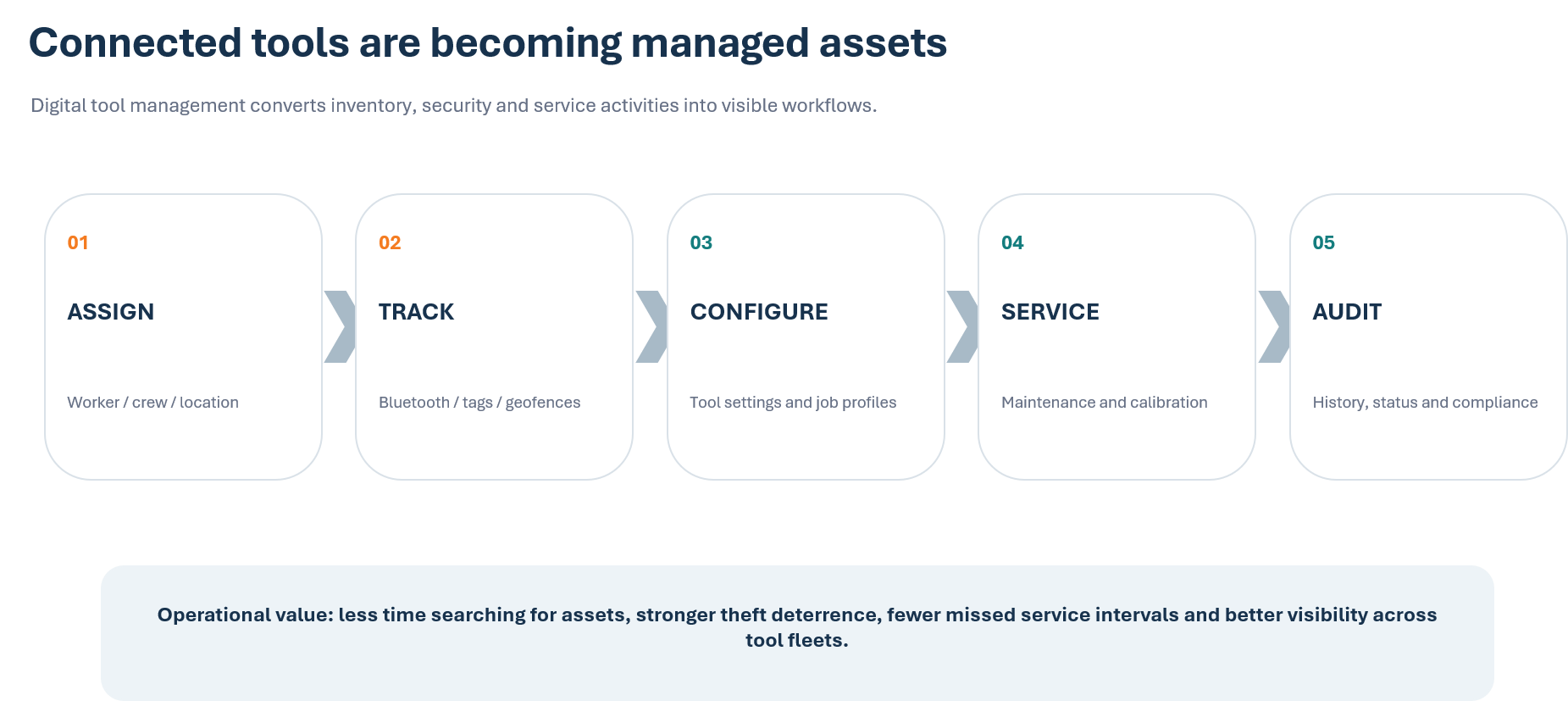
Large contractors and manufacturers face two overlapping asset-management challenges. High-value tools need to be located, assigned, maintained, and repaired; consumables and small components need to be available in the right quantity at the right workstation. Treating these as separate purchasing problems can lead to duplicate tool purchases, missing service records, excess component inventory, and production interruptions. Managing tools and components as connected assets is becoming one of the more practical tools and components industry trends for large operators.
These types of requirements have forced some of the major manufacturers of such tools to develop their digital capabilities. For instance, the Milwaukee Tool ONE-KEY solution includes Bluetooth tracking and inventory, as well as security features that include remote locking of tools that are compatible with this technology. Similarly, Hilti integrates its Nuron cordless system with the ON Track asset management solution, which allows the user to get necessary information on tools and batteries.
Fastening inventory increasingly uses a complementary model built around automated replenishment. Bossard’s Smart Factory Logistics and SmartBin solutions illustrate this approach. In its published Komax customer case, Bossard describes how a wire-processing equipment manufacturer managed approximately 2,000 C-parts from 40 suppliers before streamlining component supply and reordering. Although small components are not managed in the same way as Bluetooth-enabled power tools, the objective is similar: reduce administrative effort and stock-outs while making the correct item available when work needs to proceed.
07Lifecycle Economics Are Gaining Weight
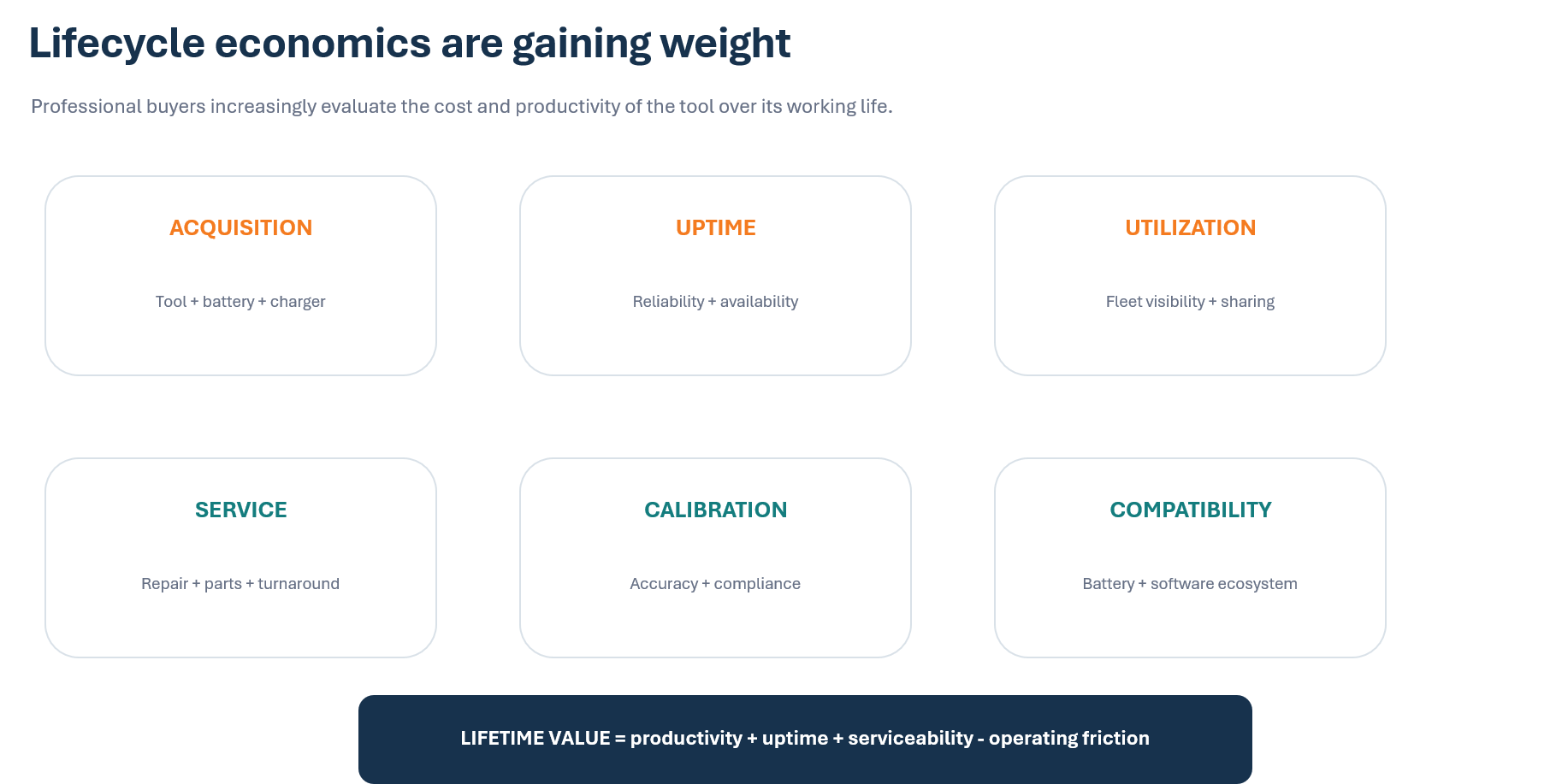
When it comes to professional tools and industrial tools, consumers are looking for the total cost of ownership rather than just the purchase price. Durability, battery life, maintenance expenses, availability of spare parts, repair service, and usage of equipment are key aspects that should be considered in order to make proper decisions. These aspects are especially significant for construction firms and factories having many equipment units.
Manufacturers are adapting to this concern by adding services like preventive maintenance, calibration, and repair services. For instance, Hilti has a fleet management service subscription plan aimed at making it easier for users to handle equipment requirements and associated costs. On the other hand, increased demand for durable and reparable equipment is forcing manufacturers to enhance product designs and services in order to increase the lifetime of the equipment.
Tool and Component Industry Outlook: 2026 and Beyond
The tools and components industry outlook points to development along several connected paths through 2026 and beyond. Heavy-duty cordless equipment and connected assembly tools will remain prominent, but product differentiation will also depend on cutting-edge geometry, surface engineering, reliable fastening solutions, interchangeable accessories, and practical inventory services. The relevant innovation may be in the tool itself, in a small component that determines performance, or in the system that keeps both available and correctly applied.
Construction and infrastructure development will continue to be one of the key drivers of tools and components industry growth, sustaining the need for power tools, fastening tools, and asset management tools, whereas automotive, aerospace, electronics, and manufacturing industries will provide growth opportunities for precision tools, connected assembly tools, and industrial cutting tools. Together, these tools and components industry trends suggest that the strongest competitors will be those that combine product performance with ecosystems, data, and service.
Last updated:


