
- Home
- »
- Next Generation Technologies
- »
-
3D Motion Capture Market Size And Share Report, 2026-2033GVR Report cover

3D Motion Capture Market (2026 - 2033)
Size, Share & Trends Analysis Report By Component (Hardware, Software, Services), By System Outlook (Optical, Non-optical), By End Use (Education, Sports), By Region, And Segment Forecasts
Market Size, 2025
$281.6MMarket Estimate, 2026
$318.8MMarket Forecast, 2033
$759.4MCAGR, 2026–2033
13.2%3D Motion Capture Market Summary
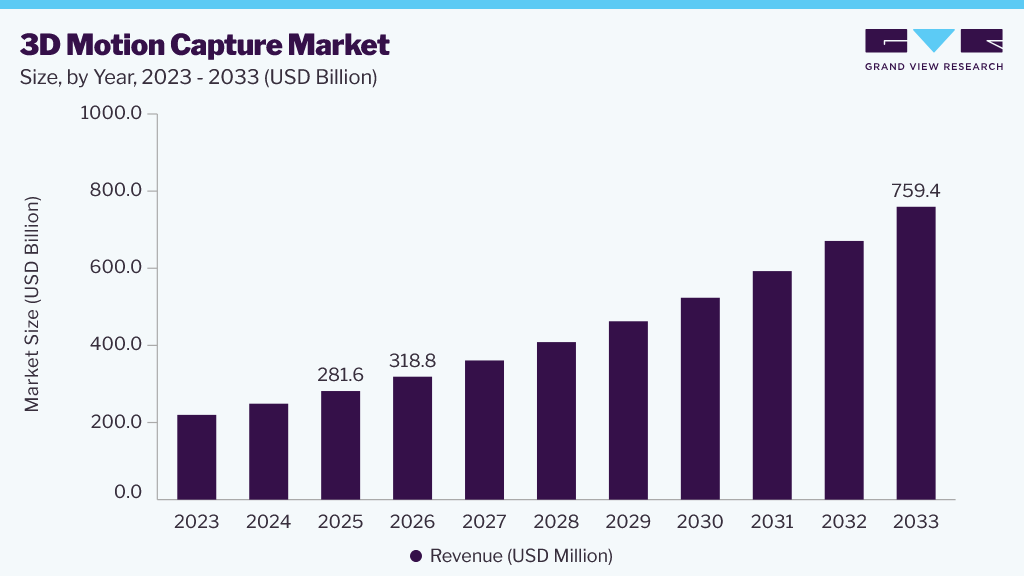
The global 3D motion capture market size was valued at USD 281.6 million in 2025 and is projected to grow from USD 318.8 million in 2026 to USD 759.4 million in 2033, at a CAGR of 13.2% from 2026 to 2033. North America dominated the market, accounting for a revenue share of 37.0% in 2025. The increasing use of 3D motion capture systems in sports biomechanics is propelling market growth by transforming how athletes and their coaches evaluate and improve performance.
Key Market Trends & Insights
- By component: The hardware segment held the largest market share of approximately 44.0% in 2025.
- By system: The optical 3D motion capture systems segment held the largest market share, exceeding 55.0% in 2025.
- By end use: The media & entertainment segment held the largest market share of over 20.0% in 2025.
Regional Highlights
- Largest regional market: North America (37.0% revenue share, 2025)
- Fastest-growing regional market: Asia Pacific (highest CAGR, 2026-2033)
Market Size & Forecast
- Market size in 2025: USD 281.6 Million
- Estimated market size in 2026: USD 318.8 Million
- Projected market size by 2033: USD 759.4 Million
- CAGR (2026-2033): 13.2%
Three ways to get this report
Buy it, customize it, or ask a question.Ask an Analyst
Analyst response in 1 business day
- AccessReport author, directly
- Reply timeWithin 1 working day
- No sales callDirect answer only
- FormatEmail reply
- CostFree, no cost
Get the Full Report
What the study covers
- FormatsPDF · Excel · Dashboard
- Timeline2026–2033 annual, 2025 base
- Coverage20+ countries, 5 regions
- Companies10+ key players profiled
Customize the Report
20% free customization
- IncludeCountries, segments, points
- TailorTo your product definition
- ExtendDeeper competitor detail
- OrA fully bespoke study
- Turnaround5–10 working days
These systems deliver accurate measurements of joint movements, muscle functions, and biomechanical forces, facilitating comprehensive biomechanical analyses. Such analyses help examine an athlete's strengths and weaknesses and identify opportunities to enhance their technique. Motion capture technology enables sports experts to refine training approaches, avert injuries, and boost overall performance. In addition, integrating motion capture technology with Virtual Reality (VR) and Augmented Reality (AR) platforms provides immersive training scenarios that help athletes visualize and adjust their actions in real time. This growing reliance on motion capture in biomechanical studies drives market expansion as sports entities focus more on optimizing performance and implementing injury-prevention strategies.
 Source: Grand View Research, IR Documents, Primary Interviews, Paid DatabasesTo learn more about this report,
 Download Free Sample Report
 The growing need for real-time analytics in the market creates a substantial opportunity for 3D motion capture (mocap) technology, prompting the development of advanced mocap systems that provide feedback and insights. With real-time analytics, users can examine mocap data as soon as it is collected, enabling immediate modifications and interventions across applications such as live performances, sports coaching, and virtual productions. Such capabilities improve decision-making, performance, and user experience by providing prompt feedback and actionable intelligence. In January 2025, Sony introduced XYN Motion Studio, enabling creators to capture, edit, and manage motion data in real time through automatic motion interpolation and tagging functions, supporting faster decision-making in animation, gaming, and virtual production workflows. Real-time analytics, coupled with mocap technology, enables industries to achieve efficiency, quick response times, and interactive experiences. This leads to market growth and opens up new avenues of innovation. For instance,
The applications of 3D motion capture systems in various fields, such as sports, film production, and advertising, support market growth. Animators can use motion capture data as a foundation, then adjust or add details to create a range of character movements and styles. Moreover, motion capture allows filmmakers to capture subtle nuances in actors' performances that wouldn't be possible with traditional animation techniques. It also enables the creation of advanced creatures or characters that wouldn't be possible with real-life actors. Furthermore, motion capture helps create consistent and high-quality animation for advertising campaigns, leading to faster turnaround times and cost savings.
Analyst Perspective
The market is gaining momentum, driven by growing adoption of motion capture technologies across fields such as entertainment, gaming, sports analytics, and virtual production, where the need for realistic digital content and performance analysis continues to rise. However, the high initial investment and technical complexity associated with advanced motion capture systems remain key barriers for widespread adoption. Despite these challenges, the rising demand from users for real-time analytics, AI-powered markerless tracking, and cloud-based motion processing solutions offers significant opportunities, enabling quick decision-making, enhanced user experiences, and expansion into healthcare, industrial, and immersive technology applications.
Component Insights
The hardware segment led the market in 2025, accounting for more than 44.0% of global revenue. The market is predominantly driven by its hardware segment for several key reasons. Several components, such as sensors, cameras, and suits, are at the core of mocap systems. They are vital for accurately capturing and processing motion data. Hence, hardware components are a vital component in numerous fields, such as animation, VR, biomechanics, and sports performance analysis. In May 2025, Vicon Motion Systems launched Active Crown, a dedicated camera-tracking hardware solution for virtual production environments. The system improves tracking reliability and reduces interference on LED stages, enabling more accurate real-time camera tracking for in-camera visual effects (ICVFX) workflows. Continuous improvements in hardware technology have refined the quality of motion capture and broadened its use across sectors.
The software segment is expected to register the highest CAGR of approximately 14.5% from 2026 to 2033. Motion capture software enables the creation of highly realistic and nuanced character movements and animations in films, TV shows, and video games. This elevates the overall visual quality and emotional impact of the content. Moreover, advancements in software enable real-time processing of motion-capture data, making it suitable for applications such as virtual production and live events with integrated motion-capture elements. Motion capture software offers extensive tools for editing, refining, and adding details to the captured motion data. Animators can leverage the captured data as a foundation and then customize it to create personalized character styles and movements.
System Insights
The optical 3D motion capture systems segment accounted for the largest revenue share in 2025. Optical systems that use multiple high-speed cameras offer the most accurate and detailed movement tracking compared to other technologies. This is crucial for various applications, such as film production, animation, and biomechanics, where precise character movements or detailed human motion analysis are required. Developments in high-speed camera technology, with higher resolutions and faster frame rates, enable the capture of movement details.
The non-optical 3D motion capture systems segment is expected to witness significant growth in the coming years. While 3D motion capture platforms offer powerful tools, managing them effectively requires specialized skills and expertise. Businesses often lack the in-house resources or knowledge to handle the complexities of AI data pipelines, data governance, and model training data preparation. 3D motion capture services address this gap by providing access to specialists who can plan, implement, and optimize 3D motion capture strategies. Moreover, 3D motion capture service providers can help businesses get started with AI more quickly by offering prebuilt solutions, migration assistance, and expertise in integrating AI into existing data infrastructure. This quicker implementation translates to a faster return on investment (ROI) for AI initiatives.
End Use Insights
The media & entertainment segment accounted for the largest revenue share, exceeding 20.0% in 2025. 3D motion capture enables lifelike character movements and performances, enhancing viewers' emotional impact and overall cinematic experience. This is crucial for films with various creatures or characters that wouldn't be possible with traditional animation techniques. Motion capture provides a foundation for creating high-quality character animation in movies, TV shows, and other media. It allows for more realistic movements compared to traditional animation methods.
The healthcare & fitness segment is expected to grow significantly in the coming years. Motion capture enables detailed analysis of human movement patterns, helping healthcare professionals assess gait abnormalities, posture issues, and potential injury risks. This data can inform diagnoses, treatment plans, and physical therapy interventions. Motion capture data can track a patient's progress during postoperative rehabilitation, allowing therapists to objectively measure recovery and adjust rehabilitation programs for optimal results. In physical therapy or athletic training, motion capture can create personalized exercise programs tailored to an individual's needs and limitations. For instance, in May 2025, Movella, a leading inertial motion capture provider, launched Xsens Analyze, further enhancing its movement analysis software. Xsens Analyze digitizes human movement for researchers in health, safety, humanoid robotics, and performance analysis, delivering motion data with unrivaled accuracy.
Regional Insights
The 3D motion capture market in North America accounted for the largest revenue share of approximately 37.0% in 2025. North American companies are at the forefront of developing new and improved motion capture technologies, such as high-resolution cameras, miniaturized sensors, and AI-powered software. Hollywood, the global center of filmmaking, and numerous animation studios in North America rely heavily on 3D motion capture for creating realistic characters and immersive experiences. The high demand for high-quality animation and VFX in films, TV shows, and video games fuels the adoption of advanced motion capture solutions.
 To learn more about this report, Download Free Sample Report
 U.S. 3D Motion Capture Market Trends
The 3D motion capture market in the U.S. is expected to grow at a CAGR of approximately 12.0% from 2026 to 2033. The U.S. is a major center for video game development. Game developers leverage motion capture to create realistic in-game character movements and enhance the overall player experience, driving demand for sophisticated motion capture solutions. A bibliometric analysis published in Sage Journals identified the U.S. as the leading global contributor to AI-driven motion-capture research in rehabilitation, with 1,014 published studies.
The 3D motion capture market in Canada held a significant share in the North American region. Canada boasts a robust animation industry known for creating high-quality content. Studios utilize motion capture to enhance animation quality and streamline workflows, which fuels demand for this technology.
Mexico 3D motion capture market held a significant share in 2025. Compared to the U.S. and Canada, the cost of doing business in Mexico can be lower. This could make Mexico a preferable location for studios seeking cost-effective solutions, potentially leading to increased outsourcing of animation projects that use motion capture. Studios in Mexico are adopting non-optical motion capture systems for their lower cost and portability, especially when budgets are tight.
Europe 3D Motion Capture Market Trends
The 3D motion capture market in Europe held a significant share in the global region. European companies are actively involved in developing advanced motion capture technologies. Research centers and universities contribute to advancements in areas such as sensor technology, markerless capture, and real-time processing. This focus on innovation fosters a competitive landscape that drives the development of more efficient, accurate, and potentially lower-cost motion capture solutions.
The UK 3D motion capture market held a significant share in the European region. The UK boasts a world-renowned film and animation industry, including studios such as Pinewood and Aardman Animations. These studios rely on motion capture to create high-quality animation and VFX for films, TV shows, and commercials, driving demand for advanced capture technology. Government initiatives, such as tax breaks for film production, further incentivize the use of advanced technologies like motion capture in the UK. According to a 2024 study published in the Journal of Neuro-Engineering and Rehabilitation that examined the use of markerless motion capture in stroke rehabilitation, there is growing interest among healthcare providers and patients in remote movement assessment and personalized rehabilitation programs.
The 3D motion capture market in Germany is expected to grow at a significant CAGR from 2026 to 2033. Germany is a prominent country in the automotive industry. This translates into strong demand for motion capture technology across various applications. Motion capture helps car manufacturers design safer, more comfortable car interiors by analyzing human movement and posture in vehicles.
France 3D motion capture market is expected to grow at a significant CAGR from 2026 to 2033. The country's government is actively supporting collaboration among studios, universities, and technology providers through initiatives such as the Images & Réseaux national network. This accelerates innovation within the market.
Asia Pacific 3D Motion Capture Market Trends
The 3D motion capture market in the Asia Pacific is anticipated to register the highest CAGR over the forecast period. The APAC market is witnessing a rise in motion-capture applications across industries such as manufacturing, healthcare, rehabilitation, and sports. Governments across the region recognize the potential of 3D motion capture technology and offer grants or funding programs to support research and development in this field. This can foster innovation and lead to new applications tailored to regional needs.
India 3D motion capture market held a significant share in the Asia Pacific region. India's film industry is the world's largest producer of films by volume. This massive industry, along with regional film industries, is increasingly adopting motion capture technology to plan and create realistic action sequences, stunts, and large crowd simulations, thereby improving visual effects.
The 3D motion capture market in China held a significant share of the Asia-Pacific region. China boasts a rapidly growing film and animation industry. Studios are heavily invested in advanced high-quality animation and VFX for films, TV shows, and online content, driving demand for advanced motion capture solutions.
Japan 3D motion capture market held a considerable revenue share of the APAC regional market. Japan boasts a well-established talent pool with expertise in animation, 3D modeling, and related fields. This skilled workforce is adaptable and able to integrate motion capture technology into existing workflows. Universities and institutions across the country offer specialized animation and motion capture programs, fostering a future-ready generation of professionals skilled in these technologies.
The 3D motion capture market in South Korea held a significant share of the Asia-Pacific market. South Korea's market is rising due to the growing entertainment industry, increasing technological adoption, and supportive government initiatives. Moreover, South Korea is a global leader in the eSports and gaming industry, with a large and engaged player base. Game developers are increasingly adopting motion capture to create Lifelike In-Game Characters.
Australia 3D motion capture market held a significant share in the Asia Pacific. Australian companies and research institutions are actively involved in developing innovative applications for motion capture, such as virtual production with real-time integration, facial capture and performance, and Indigenous storytelling and cultural preservation.
Middle East & Africa 3D Motion Capture Market Trends
The 3D motion capture market in MEA is anticipated to thrive over the forecast period. The film and animation industries in the MEA region are experiencing growth, with an increase in local productions and rising demand for high-quality content. Advancements in sensor technology, markerless capture techniques, and cloud-based processing are making motion capture solutions more affordable and user-friendly.
The UAE 3D motion capture market held a significant share in the MEA region. The UAE government actively supports the creative industries through various initiatives, such as Twofour54 and funding & grants. Twofour54 is a media and entertainment free zone that provides infrastructure and support for film and animation production, potentially including motion-capture facilities.
The 3D motion capture market in KSA held a significant share in the MEA region. The government's Vision 2030 plan prioritizes diversification and growth within the entertainment sector. This translates to a demand for high-quality content creation, fueling the need for advanced motion capture solutions, localization, and cultural relevance.
South Africa 3D motion capture market held a significant share in the MEA region. South Africa's gaming industry is experiencing significant growth, particularly in mobile gaming. Game developers are increasingly adopting motion capture to create immersive gaming experiences and capture local styles.
Key 3D Motion Capture Company Insights
Key companies in the market include Codamotion Ltd., Motion Analysis, and Movellaactive. These companies focus on expanding their customer base and gaining a competitive edge over their rivals. Hence, they pursue various strategic initiatives, including partnerships, mergers & acquisitions, collaborations, and new product/technology development. In December 2025, HoloMotion joined the Microsoft Global Sports Innovation Center to expand the adoption of AI-powered 3D motion capture technologies across global sports organizations. The collaboration supports research initiatives and performance analysis applications using markerless motion capture systems.
Key 3D Motion Capture Companies
The following key companies have been profiled for this study on the 3D motion capture market.
-
Codamotion Ltd.
-
Motion Analysis
-
Movella
-
Noraxon
-
Notch Interfaces Inc.
-
OptiTrack
-
PTI Phoenix Technologies Inc.
-
Qualisys AB
-
Tracklab
-
Vicon Motion Systems Ltd.
Recent Developments
-
In May 2026, GreenEDGE Cycling entered into a partnership with ai.io to leverage 3D motion capture and athlete movement analysis technologies. The collaboration focuses on performance optimization, injury prevention, and talent identification through advanced motion analytics.
-
For instance, in June 2025, England Athletics partnered with Ochy, an AI-powered biomechanics platform, to provide motion capture-based gait analysis and movement assessment solutions for runners.
3D Motion Capture Market Report Scope
Report Attribute
Details
Market size in 2025
USD 281.6 million
Estimated market size in 2026
USD 318.8 million
Projected market size by 2033
USD 759.4 million
Growth rate
CAGR of 13.2% from 2026 to 2033
Base year estimation
2025
Actual data
2021 – 2024
Forecast period
2026 – 2033
Quantitative units
Revenue in USD million, and CAGR from 2026 to 2033
Report coverage
Revenue forecast, company ranking, competitive landscape, growth factors, and trends
Segments covered
Component, system, end use, region
Regional scope
North America; Europe; Asia Pacific; Latin America; MEA
Country scope
U.S.; Canada; Mexico; Germany; UK; France; China; Japan; India; Australia; South Korea; Brazil; UAE; KSA; South Africa
Key companies profiled
Codamotion Ltd.; Motion Analysis; Movella; Noraxon; Notch Interfaces Inc.; OptiTrack; PTI Phoenix Technologies Inc.; Qualisys AB; Tracklab; Vicon Motion Systems Ltd.
Customization scope
Free report customization (equivalent up to 8 analysts working days) with purchase. Addition or alteration to country, regional & segment scope.
Pricing and purchase options
Avail of customized purchase options to meet your exact research needs. Explore purchase options
Global 3D motion capture Market Report Segmentation
This report forecasts revenue growth at global, regional, and country levels and provides an analysis of the latest industry trends and opportunities in each of the sub-segments from 2021 to 2033. For this study, Grand View Research has segmented the global 3D motion capture market report based on component, system, end use, and region.
-
Component Outlook (Revenue, USD Million, 2021 - 2033)
-
Hardware
-
Cameras
-
Sensors
-
Accessories
-
-
Software
-
Services
-
-
System Outlook (Revenue, USD Million, 2021 - 2033)
-
Optical 3D Motion Capture Systems
-
Active 3D Motion Capture Systems
-
Passive 3D Motion Capture Systems
-
-
Non-optical 3D Motion Capture Systems
-
Inertial 3D Motion Capture Systems
-
Electromagnetic 3D Motion Capture Systems
-
Motorized 3D Motion Capture Systems
-
-
-
End Use Outlook (Revenue, USD Million, 2021 - 2033)
-
Media & Entertainment
-
Education
-
Sports
-
Healthcare & Fitness
-
Industrial/Robotics
-
Others
-
-
Regional Outlook (Revenue, USD Million, 2021 - 2033)
-
North America
-
U.S.
-
Canada
-
Mexico
-
-
Europe
-
Germany
-
UK
-
France
-
-
Asia Pacific
-
China
-
Japan
-
India
-
South Korea
-
Australia
-
-
South America
-
Brazil
-
-
Middle East and Africa (MEA)
-
UAE
-
KSA
-
South Africa
-
-
Frequently Asked Questions About This Report
Some key players in the 3D motion capture market include Codamotion Ltd.; Motion Analysis; Movella; Noraxon; Notch Interfaces Inc.; OptiTrack; PTI Phoenix Technologies Inc.; Qualisys AB; Tracklab; Vicon Motion Systems Ltd.
North America dominated with a 37.0% revenue share in 2025.
The global 3d motion capture market size was valued at USD 281.6 million in 2025 and is estimated at USD 318.8 million for 2026.
The global 3d motion capture market is expected to grow at a CAGR of 13.2% from 2026 to 2033, reaching USD 759.4 million by 2033.
Hardware dominated the 3D motion capture market with a share of 44.0% in 2025, while software is the fastest-growing segment.
About the Author(s)
Next Generation Technologies Research Team
Technology · Next Generation TechnologiesThis report was authored by the next generation technologies research team at Grand View Research - comprising two research analysts, one senior research analyst, and one industry expert - with specialized expertise in the next generation technologies segment of the technology industry. All findings are based on proprietary technology databases, executive interviews, and regulatory analysis, subject to internal peer review prior to publication.
Last Updated:
Speak to Analyst

Customize this report to your needs - add regions, segments, or data points, with 20% free customization.
Or view our licence options:


ISO 9001:2015 & 27001:2022 Certified
We are GDPR and CCPA compliant! Your transaction & personal information is safe and secure. For more details, please read our privacy policy.


