
- Home
- »
- Clothing, Footwear & Accessories
- »
-
3D Printed Jewelry Market Size, Share, Growth Report, 2033GVR Report cover

3D Printed Jewelry Market (2026 - 2033)
Size, Share & Trends Analysis Report By Product (Necklace, Ring, Earring, Bracelet), By Distribution Channel (Online, Offline), By Region (North America, Europe, Asia Pacific, Central & South America, Middle East & Africa), And Segment Forecasts
Market Size, 2025
$1.2BMarket Estimate, 2026
$1.4BMarket Forecast, 2033
$5.1BCAGR, 2026–2033
19.9%3D Printed Jewelry Market Summary
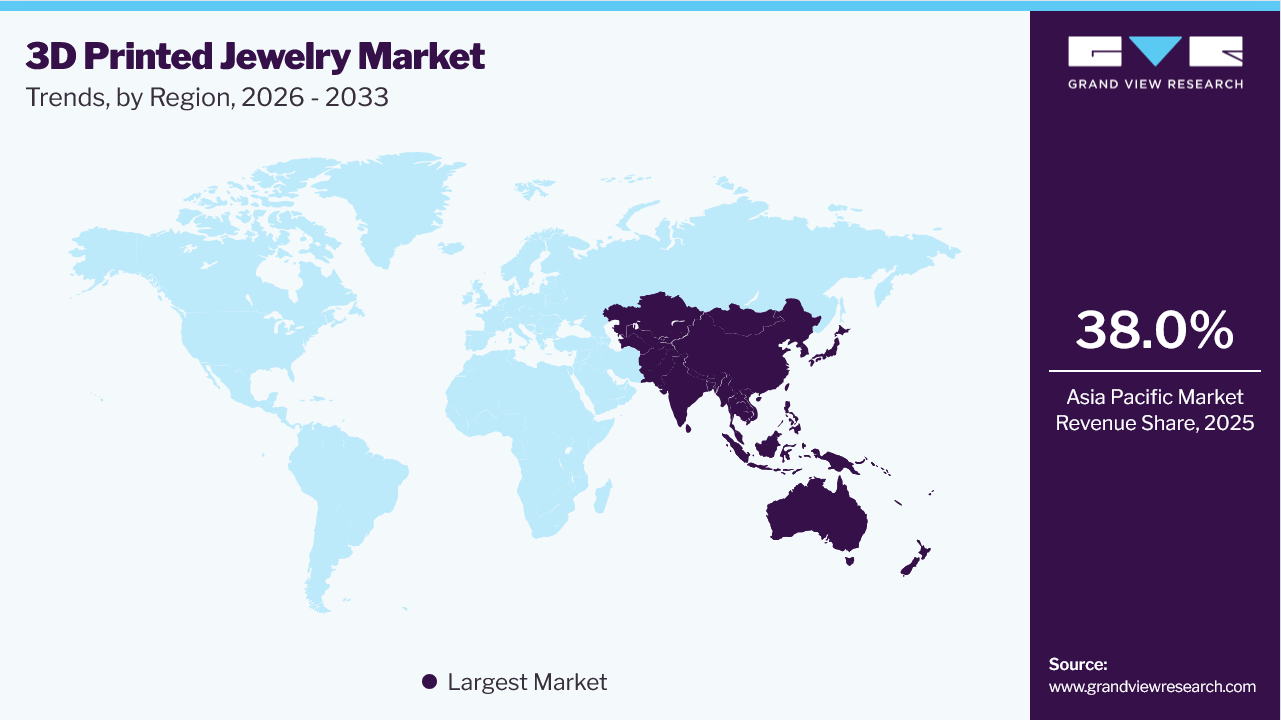
The global 3D printed jewelry market size was valued at USD 1.2 billion in 2025 and is projected to grow from USD 1.4 billion in 2026 to USD 5.1 billion in 2033, at a CAGR of 19.9% from 2026 to 2033. Asia Pacific dominated the market, accounting for a revenue share of 38.0% in 2025. The rising trend of customization and personalization in the jewelry industry has led to an increased demand for unique, one-of-a-kind pieces, which 3D printing technology can readily accommodate.
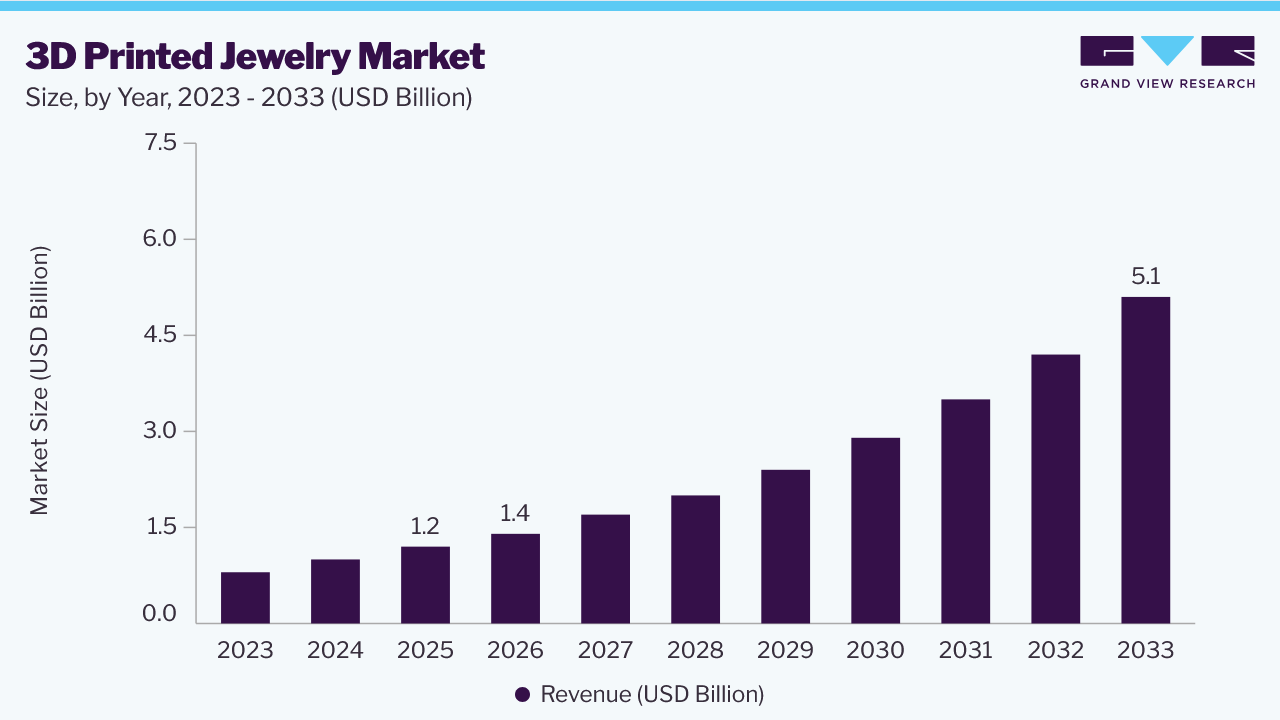 Source: Grand View Research, IR Documents, Primary Interviews, Paid DatabasesTo learn more about this report,
 Download Free Sample Report
 Key Market Trends & Insights
- By product: The 3D-printed ring segment held the largest market share of 34.0% in 2025.
- By distribution channel: The offline distribution channel segment held the largest market share of 69.0% in 2025.
Regional Highlights
- Largest regional market: Asia Pacific (38.0% revenue share, 2025)
- Fastest-growing regional market: Asia Pacific (highest CAGR, 2026-2033)
Market Size & Forecast
- Market size in 2025: USD 1.2 Billion
- Estimated market size in 2026: USD 1.4 Billion
- Projected market size by 2033: USD 5.1 Billion
- CAGR (2026-2033): 19.9%
Three ways to get this report
Buy it, customize it, or ask a question.Ask an Analyst
Analyst response in 1 business day
- AccessReport author, directly
- Reply timeWithin 1 working day
- No sales callDirect answer only
- FormatEmail reply
- CostFree, no cost
Get the Full Report
What the study covers
- FormatsPDF · Excel · Dashboard
- Timeline2026–2033 annual, 2025 base
- Coverage20+ countries, 5 regions
- Companies10+ key players profiled
Customize the Report
20% free customization
- IncludeCountries, segments, points
- TailorTo your product definition
- ExtendDeeper competitor detail
- OrA fully bespoke study
- Turnaround5–10 working days
Advancements in 3D printing materials have expanded the range of possible designs, allowing for intricate and complex jewelry pieces that were previously challenging to produce using traditional methods. Another driving force is the efficiency and cost-effectiveness of 3D printing in jewelry production.
Traditional jewelry manufacturing processes often involve time-consuming and labor-intensive tasks, such as casting and molding. In contrast, 3D printing enables the rapid prototyping and production of designs, reducing lead times and production costs. This efficiency is particularly attractive for small-scale jewelry designers and independent artisans, allowing them to compete in the market with unique designs without the burden of high production costs. Furthermore, the sustainability aspect of 3D printing aligns with the growing consumer demand for eco-friendly and ethically sourced products.
3D printing generates less waste compared to traditional manufacturing methods, as it allows for precise material usage. This resonates with environmentally conscious consumers who prioritize sustainable practices and seek products with a smaller ecological footprint. In addition, technological advancements in 3D printing materials, such as the development of new alloys and polymers, contribute to the market's growth. These materials offer enhanced durability, flexibility, and aesthetic possibilities, expanding the range of jewelry designs that can be created through 3D printing.
Analyst Perspective
The global 3D printed jewelry market is currently growing steadily as people are increasingly buying more personalized pieces reflecting their individual tastes and styles. One of the key aspects contributing to the high degree of innovation is the ability to create highly detailed and precise structures with 3D printing. This technology enables jewelers to craft intricate patterns, textures, and shapes with a level of precision that surpasses traditional handcrafting techniques. As a result, consumers have access to a diverse range of unique and personalized jewelry options that cater to individual tastes and preferences. Besides, the advancements in digital design, e-commerce platforms, and increased demand among millennials and Gen Z consumers are further supporting market growth. The advancements in metal additive manufacturing are contributing to the quality of jewelry produced, which makes 3D printed jewelry a profitable business opportunity for high-end and independent designers worldwide.
Product Insights
The 3D-printed ring segment accounted for a dominant share of approximately 34.0% in 2025. 3D printing allows for intricate and complex designs that would be challenging or impossible to achieve through traditional manufacturing methods. This has led to a surge in innovative and artistic ring designs that cater to a diverse range of tastes and aesthetics. The technology enables jewelry designers to push creative boundaries and experiment with unconventional shapes and patterns for rings, attracting customers who appreciate the novelty and uniqueness of these creations. For instance, in September 2025, 3D Systems launched the MJP 300W Plus wax 3D printer for jewelry manufacturing, enabling the production of highly intricate wax patterns with improved speed, reduced material usage, and greater design flexibility. The development highlights the increasing adoption of 3D printing technologies in jewelry production, allowing manufacturers to create complex ring designs and customized products more efficiently.
The 3D-printed necklace segment is expected to grow at a CAGR of around 21.0% from 2026 to 2033. The technology itself has evolved significantly, making 3D printing more accessible and cost-effective for jewelers. This has allowed designers to experiment with intricate and personalized designs that were previously difficult or expensive to produce through traditional manufacturing methods. The growing commercial adoption of the technology is further supporting segment growth. For instance, in February 2025, renowned jewelry designer Maeve Gillies launched the Tùsaire Collection, featuring necklaces produced using direct metal 3D printing technology. The collection incorporates complex geometric structures and customized design elements that showcase the design flexibility offered by additive manufacturing. Such developments highlight the increasing acceptance of 3D printing in fine jewelry production and are expected to drive demand for 3D-printed necklaces during the forecast period.
Distribution Channel Insights
The offline distribution channel segment accounted for the largest share of approximately 69.0% in 2025. The offline distribution channel allows for personalized and expert assistance. In physical stores, customers can engage with knowledgeable staff who can guide them in terms of design, quality, and customization options. The expertise of in-store professionals adds a layer of trust and assurance for consumers, especially when making significant investments in high-value items like jewelry.
The online distribution channel segment is projected to grow at a CAGR of 21.5% from 2026 to 2033. The customization capabilities provided by online platforms play a crucial role in driving market demand. 3D technology allows customers to personalize jewelry designs according to their preferences, enabling a unique and tailored shopping experience. This level of customization is often challenging to achieve through traditional retail channels, making online platforms more attractive to consumers seeking personalized and distinctive jewelry pieces.
Regional Insights
The North America 3D printed jewelry market is projected to grow at a CAGR of over 18.0 from 2026 to 2033. Consumers in North America are increasingly seeking personalized and one-of-a-kind jewelry pieces that reflect their individual styles and preferences. 3D printing enables designers and consumers to bring their unique visions to life, fostering a sense of exclusivity and personal connection with jewelry. This shift toward customization aligns with the broader trend in the retail market where consumers are valuing experiences and uniqueness over mass-produced items. For instance, in March 2025, Signet Jewelers, the largest specialty jewelry retailer in the U.S., reported continued growth in its custom jewelry offerings and digital design capabilities across brands, including Kay Jewelers, Zales, and Jared. The company highlighted increasing consumer demand for personalized engagement rings and custom-designed jewelry, underscoring the growing importance of digital design and advanced manufacturing technologies in the North American jewelry market.
U.S. 3D Printed Jewelry Market Trends
The 3D printed jewelry market in the U.S. accounted for a regional share of approximately 93.0% in 2025. The increasing accessibility and cost-effectiveness of 3D printing technology in recent years have emerged as significant drivers for market growth. This affordability has transformed 3D printing into a viable option for jewelry production, presenting a more economical alternative to traditional manufacturing methods. Consequently, this cost advantage empowers consumers to explore diverse designs and styles, encouraging experimentation and fostering a dynamic and accessible landscape within the U.S. jewelry industry.
Asia Pacific 3D Printed Jewelry Market
The 3D printed jewelry market in Asia Pacific held a share of over 38.0% in 2025. Technology offers greater design flexibility and agility to jewelry designers and manufacturers. Technological advancements in 3D printing technology have made it more accessible and cost-effective, allowing jewelry designers and manufacturers in the region to adopt this innovative manufacturing process. This has led to increased efficiency in production, reduced lead times, and the ability to create intricate & customized designs that were previously challenging with traditional methods. For instance, in 2025, Flashforge reported that its WaxJet series became the world's best-selling MultiJet wax 3D printer platform for jewelry manufacturing. The company's WaxJet 530 system offers high-precision printing and faster production speeds, enabling jewelers to create complex, customized designs while reducing lead times and material waste, thereby supporting the adoption of 3D printing in jewelry production.
 To learn more about this report, Download Free Sample Report
 Middle East & Africa 3D Printed Jewelry Market Trends
The 3D printed jewelry market in the Middle East & Africa is expected to grow at a CAGR of approximately 16.5% from 2026 to 2033. The increasing disposable income and changing consumer lifestyles have led to a higher demand for personalized and avant-garde fashion accessories in the region. 3D-printed jewelry not only offers a novel and customizable option but also aligns with sustainability concerns, as it enables less material wastage compared to traditional jewelry manufacturing methods.
Key 3D Printed Jewelry Market Company Insights
The competitive landscape of the global 3D printed jewelry market is dynamic and multifaceted, featuring the presence of established players alongside a rising number of innovative startups and niche designers. Key established players continue to drive market growth through their extensive experience, robust distribution networks, and ongoing technological advancements. At the same time, the market is witnessing the emergence of a new wave of 3D printing jewelry startups, leveraging cutting-edge technology and novel designs to capture market share and appeal to a younger, more design-conscious demographic. For instance, in April 2024, Italy-based Legor Group launched its 3D Metal Jet Printing Service through its 3D Metal Hub division, enabling the production of complex jewelry and fashion accessories using metal additive manufacturing. The initiative highlights how established industry players are investing in advanced 3D printing capabilities to enhance design possibilities and strengthen their market position.
Key 3D Printed Jewelry Market Companies
The following key companies have been profiled for this study on the 3D Printed Jewelry Market:
-
Imaginarium
-
MIRAKIN
-
NERVOUS SYSTEM
-
Shapeways, Inc.
-
Diana Law Printed Accessories
-
American Pearl
-
Janne Kyttanen Productions
-
Continuum Fashion
-
Materialise
-
Sculpteo
Recent Developments
- In February 2025, Imaginarium showcased the scalability of advanced additive manufacturing by leveraging HP Multi Jet Fusion technology to improve customization, reduce production costs by 40%, and shorten turnaround times by 30% in complex 3D-printed product development, reflecting the company's continued investment in high-precision additive manufacturing capabilities.
- In April 2025, Materialise launched the 2025 release of Magics software at RAPID + TCT 2025, introducing nTop implicit geometry integration that reduces build-preparation time from days to seconds and enables production of highly complex geometries. The development is expected to improve efficiency and scalability across additive manufacturing applications, including jewelry production workflows.
3D Printed Jewelry Market Report Scope
Report Attribute
Details
Market size in 2025
USD 1.2 billion
Estimated market size in 2026
USD 1.4 billion
Projected market size by 2033
USD 5.1 billion
Growth rate
CAGR of 19.9% from 2026 to 2033
Base year for estimation
2025
Historical data
2021 – 2024
Forecast period
2026 – 2033
Quantitative units
Revenue in USD billion, and CAGR from 2026 to 2033
Report coverage
Revenue forecast, company ranking, competitive landscape, growth factors, and trends
Segments covered
Product, distribution channel, region
Regional scope
North America; Europe; Asia Pacific; Central & South America; Middle East & Africa
Country scope
U.S.; Canada; Mexico; Germany; UK; Spain; Italy; France; China; India; Japan; South Korea; Australia & New Zealand; Brazil; Argentina; South Africa; Saudi Arabia
Key companies profiled
Imaginarium; MIRAKIN; NERVOUS SYSTEM; Shapeways; Inc.; Diana Law Printed Accessories; American Pearl; Janne Kyttanen Productions; Continuum Fashion; i.materialise; Sculpteo
Customization scope
Free report customization (equivalent up to 8 analysts working days) with purchase. Addition or alteration to country, regional & segment scope.
Pricing and purchase options
Avail of customized purchase options to meet your exact research needs. Explore purchase options
Global 3D Printed Jewelry Market Report Segmentation
This report forecasts revenue growth at the global, regional, and country levels and provides an analysis of the latest industry trends and opportunities in each of the sub-segments from 2021 to 2033. For this study, Grand View Research has segmented the global 3D printed jewelry market report based on product, distribution channel, and region:
-
Product Outlook (Revenue, USD Billion, 2021 - 2033)
-
Necklace
-
Ring
-
Earring
-
Bracelet
-
Others
-
-
Distribution Channel Outlook (Revenue, USD Billion, 2021 - 2033)
-
Online
-
Offline
-
-
Regional Outlook (Revenue, USD Billion, 2021 - 2033)
-
North America
-
U.S.
-
Canada
-
Mexico
-
-
Europe
-
Germany
-
UK
-
Spain
-
Italy
-
France
-
-
Asia Pacific
-
China
-
India
-
Japan
-
South Korea
-
Australia & New Zealand
-
-
Central & South America
-
Brazil
-
Argentina
-
-
Middle East & Africa
-
South Africa
-
Saudi Arabia
-
-
Frequently Asked Questions About This Report
The global 3D printed jewelry market size was valued at USD 1.2 billion in 2025 and is estimated at USD 1.4 billion for 2026.
The global 3D printed jewelry market is expected to grow at a CAGR of 19.9% from 2026 to 2033, reaching USD 5.1 billion.
Asia Pacific dominated with approximately 38.0% revenue share in 2025.
Key players in the market include Imaginarium, MIRAKIN, NERVOUS SYSTEM, Shapeways, Inc., Diana Law Printed Accessories, American Pearl, Janne Kyttanen Productions, Continuum Fashion, i.materialise, Sculpteo, and others.
The 3D-printed ring segment accounted for the largest revenue share of approximately 34.0% in 2025.
About the Author(s)
Clothing, Footwear & Accessories Research Team
Consumer Goods · Clothing, Footwear & AccessoriesThis report was authored by the clothing, footwear & accessories research team at Grand View Research - comprising two research analysts, one senior research analyst, and one industry expert - with specialized expertise in the clothing, footwear & accessories segment of the consumer goods industry. All findings are based on proprietary consumer goods databases, executive interviews, and regulatory analysis, subject to internal peer review prior to publication.
Last Updated:
Speak to Analyst

Customize this report to your needs - add regions, segments, or data points, with 20% free customization.
Or view our licence options:


ISO 9001:2015 & 27001:2022 Certified
We are GDPR and CCPA compliant! Your transaction & personal information is safe and secure. For more details, please read our privacy policy.


