
- Home
- »
- Advanced Interior Materials
- »
-
Food Packaging Equipment Market Size Report, 2026-2033GVR Report cover

Food Packaging Equipment Market (2026 - 2033)
Size, Share & Trends Analysis Report, By Equipment (Primary Packaging, Secondary/ Tertiary Packaging), By End Use (Bakery & Confectionery, Dairy Products, Fruits & Vegetables), By Region, And Segment Forecasts
Market Size, 2025
$18.6BMarket Estimate, 2026
$19.5BMarket Forecast, 2033
$28.9BCAGR, 2026–2033
5.8%Food Packaging Equipment Market Summary
The global food packaging equipment market size was valued at USD 18.6 billion in 2025 and is projected to grow from USD 19.5 billion in 2026 to USD 28.9 billion by 2033, at a CAGR of 5.8% from 2026 to 2033. The market in Asia Pacific dominated with a revenue share of 38.4% in 2025. The market is driven by rising demand for packaged, ready-to-eat, and convenience foods supported by changing consumer lifestyles and urbanization.
 Source: Grand View Research, IR Documents, Primary Interviews, Paid DatabasesTo learn more about this report,
 Download Free Sample Report
 Key Market Trends & Insights
- By equipment: Primary packaging equipment segment held the largest market share of 53.1% in 2025.
- By end use: Dairy products segment held the largest market share of 15.7% in 2025.
Regional Highlights
- Largest regional market: Asia Pacific (38.4% revenue share, 2025)
- By country: China held the largest market share in 2025
Market Size & Forecast
- Market size in 2025: USD 18.6 Billion
- Estimated market size in 2026: USD 19.5 Billion
- Projected market size by 2033: USD 28.9 Billion
- CAGR (2026-2033): 5.8%
Three ways to get this report
Buy it, customize it, or ask a question.Ask an Analyst
A direct answer, usually in 1 working day
- AccessReport author, directly
- Reply timeWithin 1 working day
- No sales callDirect answer only
- FormatEmail reply
- CostFree, no cost
Get the Full Report
What the study covers
- FormatsPDF · Excel · Dashboard
- Timeline2026–2033 annual, 2025 base
- Coverage20+ countries, 5 regions
- Companies10+ key players profiled
Customize the Report
20% free customization
- IncludeCountries, segments, points
- TailorTo your product definition
- ExtendDeeper competitor detail
- OrA fully bespoke study
- Turnaround5–10 working days
Growing focus on food safety, hygiene, and regulatory compliance is encouraging manufacturers to adopt automated packaging systems that improve product quality and reduce contamination risks. Increasing investment in smart manufacturing, faster production lines, and sustainable packaging solutions is accelerating the adoption of advanced food packaging equipment across the global food industry.
 To learn more about this report, Download Free Sample Report
 The global market is witnessing strong growth driven by increasing investments in food processing infrastructure, rising demand for hygienic, contamination-free packaging, and stringent regulatory emphasis on product traceability and labeling accuracy. Manufacturers are increasingly implementing intelligent packaging lines equipped with digital monitoring and predictive maintenance capabilities to enhance operational efficiency and minimize unplanned downtime. Growing consumption of frozen foods, dairy products, beverages, and snack products, along with the expansion of private-label offerings, is further accelerating global demand for advanced food packaging equipment.
Market Concentration & Characteristics
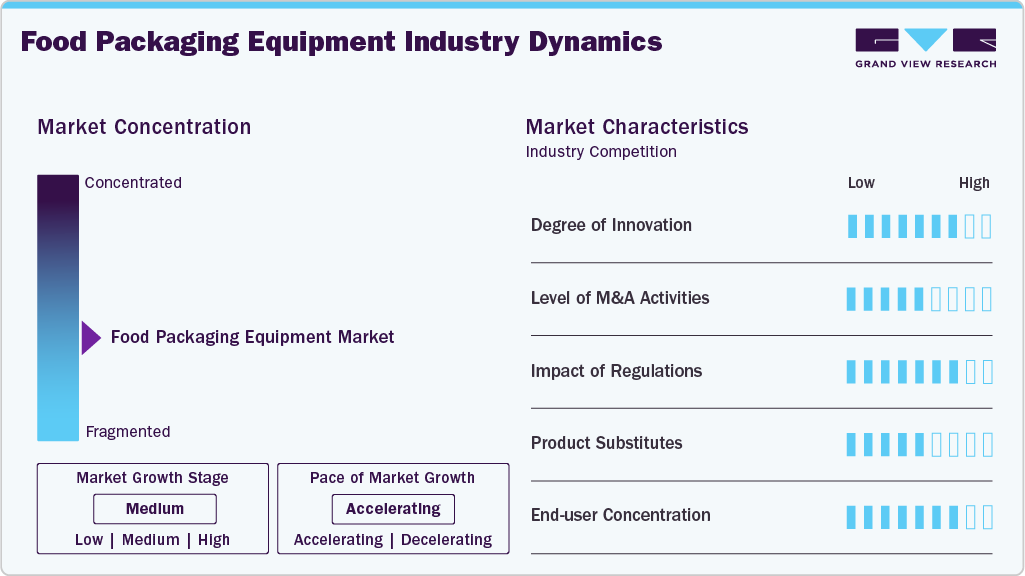
The food packaging equipment industry is consolidated, with a combination of global machinery manufacturers, regional equipment suppliers, and specialized automation providers operating across different product segments and geographies. Large multinational companies hold a strong presence in high-volume processing markets due to their advanced technologies, integrated product portfolios, and established customer relationships. Regional and niche manufacturers primarily serve small- and medium-sized food producers with cost-effective, customized equipment solutions. High capital requirements, technical expertise, and strict compliance standards limit the entry of new participants.
Innovation within the food packaging equipment industry remains a key competitive factor, as manufacturers prioritize improvements in processing speed, packaging precision, hygienic performance, and operational flexibility. Companies are increasingly integrating robotics, vision inspection technologies, smart sensors, and digital monitoring platforms to optimize production efficiency, reduce downtime, and enhance line performance. Equipment compatible with recyclable materials, lightweight packaging formats, and lower material consumption is gaining greater importance as sustainability objectives become more prominent across the food industry.
 To learn more about this report, Download Free Sample Report
 Merger and acquisition activity is steadily increasing as companies seek to expand geographic presence, strengthen technological capabilities, and diversify product portfolios. Established market participants are acquiring regional firms and specialized equipment manufacturers to access new customer segments and enhance automation expertise. Strategic partnerships with software providers, packaging material companies, and distribution networks are also supporting broader market reach, improved service capabilities, and stronger competitive positioning.
Regulatory standards play a significant role in shaping the market by emphasizing food safety, hygiene, labeling accuracy, and product traceability requirements. Manufacturers are developing equipment that aligns with sanitary design principles, contamination control measures, and consistent packaging quality standards. Compliance with environmental regulations and waste reduction initiatives is further encouraging the adoption of energy-efficient systems and machinery compatible with sustainable packaging materials.
Drivers, Opportunities & Restraints
The food packaging equipment industry is influenced by several growth factors, including the increasing demand for packaged and convenience food products, the expansion of the food processing industry, and the need for efficient, high-speed packaging operations. Manufacturers are focusing on advanced equipment that improves production efficiency, packaging accuracy, and product protection during storage and transportation. Greater emphasis on food safety, hygiene standards, and shelf-life enhancement is also contributing to wider adoption of modern packaging systems.
Certain challenges continue to affect market expansion, particularly high capital expenditures for advanced machinery and the technical complexity of installation, integration, and maintenance. Smaller food producers may face budget constraints when replacing conventional systems with automated equipment. In addition, fluctuations in packaging material requirements and compliance with changing regulatory standards can create operational difficulties for manufacturers.
The market also presents strong opportunities through the adoption of smart factory technologies, sustainable packaging trends, and growing demand for flexible production capabilities. Equipment designed for recyclable materials, rapid format changes, and digitally connected operations is gaining importance. The expansion of e-commerce food sales, private-label food production, and increased industrialization in emerging economies are further creating favorable conditions for long-term market growth.
Equipment Insights
The primary packaging equipment segment accounted for the largest market revenue share in 2025, as it is directly involved in filling, sealing, wrapping, and protecting food products before distribution. Its importance spans processed foods, dairy, beverages, frozen items, snacks, and ready meals, where hygiene, freshness retention, portion accuracy, and product integrity remain essential. Demand is shifting toward automated systems that enable higher throughput, reduced material waste, improved sanitation, and compatibility with flexible and sustainable packaging formats.
The secondary and tertiary packaging equipment segment is projected to grow at the fastest CAGR of 6.4% during the forecast period, driven by its role in grouping, handling, and preparing packaged products for storage, transportation, and retail display. These systems enhance logistics efficiency, consistency, traceability, and product protection throughout the supply chain, with growth linked to expanding distribution networks, increasing warehouse automation, and rising demand from e-commerce food channels.
End Use Insights
The dairy products segment led the market with the largest revenue share of 15.7% in 2025, driven by the need for highly controlled and hygienic packaging environments for products with limited shelf life and strict safety requirements. Equipment used in this segment focuses on precise filling, leak-proof sealing, tamper-evident closures, and seamless integration with cold chain logistics to maintain product quality. Demand is further influenced by the expansion of value-added dairy offerings, including protein-rich and fortified products, along with increasing preference for convenient, portioned packaging suited for everyday consumption.
 To learn more about this report, Download Free Sample Report
 The snack products segment is expected to register at the fastest CAGR during the forecast period, reflecting strong consumer preference for on-the-go, resealable, and convenience-oriented food options. Packaging operations in this segment require high-speed handling of varied product shapes, lightweight materials, and frequent product innovations, making flexibility and rapid changeovers essential. Manufacturers are increasingly focusing on packaging formats that enhance shelf appeal, maintain product texture and freshness, and align with growing demand for single-serve and multi-pack formats.
Regional Insights
The food packaging equipment market in North America is supported by a mature food and beverage manufacturing sector, advanced industrial infrastructure, and strong adoption of automated production technologies. The region benefits from consistent demand for packaged foods, ready-to-eat meals, frozen products, beverages, and convenience-oriented packaging formats. Food producers are actively investing in high-speed, precision-based equipment to improve productivity, maintain packaging consistency, and meet labor-efficiency requirements. Strict regulatory standards for food safety, hygiene, labeling, and traceability are also driving continuous equipment upgrades. Growing focus on sustainable packaging materials, recyclable formats, and digitally connected production lines further strengthens regional demand.
U.S. Food Packaging Equipment Market Trends
The food packaging equipment market in the U.S. emerged as the dominant market within North America, driven by the presence of major food processing companies, extensive retail distribution networks, and high consumer spending on packaged food products. Manufacturers in the country continue to modernize facilities with robotics, smart sensors, vision inspection systems, and integrated packaging lines to enhance operational performance and reduce downtime. Demand for flexible packaging, portion-controlled packs, premium product presentation, and e-commerce-ready packaging formats is increasing across multiple food categories. Ongoing investments in cold chain logistics, warehouse automation, and innovative packaging solutions continue to support long-term market expansion in the United States.
Europe Food Packaging Equipment Market Trends
The food packaging equipment market in Europe held a considerable market share in 2025, supported by a well-developed food processing sector, advanced manufacturing capabilities, and a strong regulatory framework for food safety and packaging standards. The region continues to see steady demand for equipment used in bakery, dairy, confectionery, beverages, frozen foods, and ready-meal applications. Manufacturers are prioritizing automation, precision engineering, and energy-efficient systems to improve operational performance and manage labor-cost pressures. Increasing adoption of recyclable materials, lightweight packaging formats, and digital production monitoring solutions is also influencing purchasing decisions across the region.
The Germany food packaging equipment market is growing with its strong industrial base, extensive food manufacturing capacity, and leadership in engineering and automation technologies. Food producers in the country are investing in high-performance packaging lines, robotics, and intelligent control systems to enhance efficiency, maintain quality standards, and improve production flexibility. Demand remains strong for machinery compatible with sustainable packaging materials and advanced traceability requirements.
The food packaging equipment market in the UK accounts for a significant share of the regional market, with strong demand for packaged convenience foods, private-label products, and modern retail distribution channels shaping its position. Manufacturers are upgrading packaging facilities to support shorter production runs, rapid product changeovers, and premium packaging presentation across diverse food categories. Growth in online grocery sales, increased focus on reducing packaging waste, and continued investment in automated systems are driving market development in the country.
Asia Pacific Food Packaging Equipment Market Trends
Asia Pacific dominated the global food packaging equipment market with the largest revenue share of 38.4% in 2025 and is projected to grow at the fastest CAGR during the forecast period, with expanding food production capacity, rising consumption of packaged products, and the ongoing shift toward organized retail channels shaping its growth. Demand across the region centers on machinery capable of handling high production volumes, multiple packaging formats, and cost-efficient operations. The development of supermarket networks, convenience stores, and temperature-controlled supply chains is increasing the requirement for modern packaging solutions. Preference for compact systems, lower energy usage, and equipment compatible with recyclable materials is also shaping purchasing patterns.
 To learn more about this report, Download Free Sample Report
 The food packaging equipment market in China accounted for the largest market revenue share in the Asia Pacific in 2025, with its large-scale food manufacturing base, well-integrated supply chains, and ongoing upgrades in processing infrastructure shaping its position. Food producers are implementing intelligent packaging lines, automated inspection systems, and digitally connected machinery to improve consistency, speed, and production control. Strong demand for equipment used in beverages, ready meals, frozen foods, and export-oriented packaged products continues to support market expansion, while environmental targets are encouraging upgrades to lower-waste packaging processes.
The India food packaging equipment is driven by increasing formalization of the food sector and expanding demand for packaged staples, dairy products, snacks, and beverages. Manufacturers are deploying flexible and scalable machinery suited to varying batch sizes, regional product diversity, and multiple pack formats. Expansion of e-commerce grocery platforms, policy support for food processing infrastructure, and broader cold chain connectivity are further strengthening demand for food packaging equipment across the country.
Middle East & Africa Food Packaging Equipment Market Trends
The food packaging equipment market in the Middle East and Africa is growing steadily, driven by rising demand for processed and packaged food products. The expansion of food manufacturing activities, along with higher urban consumption, is driving the adoption of automated packaging systems. The need for improved food safety, longer shelf life, and efficient distribution across wide geographic areas is also supporting the use of advanced filling, sealing, and labeling equipment. In several African countries, growth in the food and beverage sector and the gradual modernization of supply chains are further driving equipment demand. In addition, efforts to reduce food wastage in high-temperature environments are supporting investment in more reliable and efficient packaging solutions.
The Saudi Arabia food packaging equipment market is expanding due to the development of the domestic food processing industry and a stronger focus on local production. Demand for packaged dairy, bakery, and beverage products is driving the adoption of automated, high-speed packaging lines. Growth in commercial and industrial infrastructure is supporting the installation of modern packaging facilities across production units. At the same time, changing consumer preferences toward branded and convenience food products are encouraging manufacturers to adopt flexible and efficient packaging systems suitable for large-scale operations.
Latin America Food Packaging Equipment Market Trends
The food packaging equipment market in Latin America is undergoing steady expansion, with growth in the processed food and beverage sector across major countries shaping demand. Rising urban populations and evolving consumption patterns are increasing the need for packaged and convenience food products, encouraging manufacturers to adopt automated packaging systems that improve efficiency, ensure hygiene, and extend shelf life. The spread of modern retail formats and organized distribution networks is increasing the use of advanced filling, sealing, and labeling technologies, while efforts to reduce post-harvest losses and enhance food preservation are accelerating the adoption of efficient packaging solutions.
The Brazil food packaging equipment market held a significant share in Latin America in 2025, with a well-established food processing industry spanning meat, dairy, beverages, and packaged snacks. Large-scale facilities are increasingly integrating automated, high-capacity packaging systems to meet both domestic and export demand. The growth of supermarket chains and online grocery platforms is increasing the need for flexible and efficient packaging formats, while ongoing focus on operational efficiency and adherence to food safety standards is driving the modernization of packaging lines across key manufacturing hubs.
Key Food Packaging Equipment Company Insights
Some of the key players operating in the market include Tetra Pak, Syntegon Technology, Krones AG, Multivac Group.
-
Tetra Pak operates in the food packaging equipment sector with a strong focus on aseptic processing and carton-based packaging systems for liquid food and beverages. Demand for its solutions is supported by the need for longer shelf life, food safety assurance, and efficient distribution of dairy products, juices, and ready-to-drink beverages. The company’s offerings include filling machines, processing equipment, and integrated packaging lines designed for hygienic and high-volume production environments. Its key segments are dairy, beverages, and prepared food liquids, where packaging integrity and product preservation are critical factors influencing equipment adoption.
-
Syntegon Technology provides packaging machinery and automation systems used across food, pharmaceutical, and consumer goods industries, with a strong presence in food applications such as bakery, confectionery, and frozen products. Growth is supported by increasing adoption of automated production lines and demand for flexible, high-speed packaging solutions. Its portfolio includes form-fill-seal machines, flow wrapping systems, cartoning equipment, and inspection technologies. These solutions are widely used by food manufacturers seeking improved efficiency, reduced manual handling, and consistent packaging quality across different product formats.
Key Food Packaging Equipment Companies:
The following key companies have been profiled for this study on the food packaging equipment market.
- Tetra Pak
- Syntegon Technology
- Krones AG
- IMA Group
- Multivac Group
- Ishida Co., Ltd.
- Coesia Group.
- Marchesini Group
- Uhlmann Group
- OPTIMA packaging group
- ProMach
- Sidel
- Rovema GmbH
- Gerhard Schubert GmbH
- Nichrome India Ltd.
Recent Developments
-
In March 2025, ULMA Packaging introduced its TFX thermoforming machines, designed for automated forming, filling, and sealing of food products. These systems are applied across fresh, processed, and ready-to-eat food categories, with emphasis on improving packaging efficiency, maintaining hygiene standards, and ensuring product protection. The launch reflects the continued shift toward higher automation, improved operational performance, and flexible packaging solutions aligned with evolving food industry requirements.
-
In December 2025, Sacmi Packaging & Chocolate completed the acquisition of a 65% stake in France-based Groupe Emballage Technologies, a manufacturer of flowpack, cartoning, and end-of-line packaging systems used in food applications. The transaction strengthens Sacmi’s secondary packaging capabilities, particularly in chocolate and confectionery operations, while expanding its portfolio of integrated packaging solutions. The development reflects efforts to combine primary and secondary packaging expertise to improve automation and broaden market reach across food packaging segments.
Food Packaging Equipment Market Report Scope
Report Attribute
Details
Market size in 2025
USD 18.6 billion
Estimated market size in 2026
USD 19.5 billion
Projected market size by 2033
USD 28.9 billion
Growth rate
CAGR of 5.8% from 2026 to 2033
Base year for estimation
2025
Historical data
2021 - 2024
Forecast period
2026 - 2033
Quantitative units
Revenue in USD million/billion, and CAGR from 2026 to 2033
Report coverage
Revenue forecast, company ranking, competitive landscape, growth factors, and trends
Segments covered
Equipment, end use, region.
Regional scope
North America; Europe; Asia Pacific; Latin America; Middle East & Africa
Country scope
U.S.; Canada; Mexico; UK; Germany; France; Italy; Spain; China; Japan; India; Australia; South Korea; Brazil; Argentina; UAE; Saudi Arabia; South Africa
Key companies profiled
Tetra Pak; Syntegon Technology; Krones AG; IMA Group; Multivac Group; Ishida Co., Ltd.; Coesia Group; Marchesini Group; Uhlmann Group; OPTIMA packaging group; ProMach; Sidel; Rovema GmbH; Gerhard Schubert GmbH; Nichrome India Ltd.
Customization scope
Free report customization (equivalent up to 8 analysts working days) with purchase. Addition or alteration to country, regional & segment scope.
Pricing and purchase options
Avail customized purchase options to meet your exact research needs. Explore purchase options
Global Food Packaging Equipment Market Report Segmentation
This report forecasts revenue growth at global, regional, and country levels and provides an analysis of the latest industry trends in each of the sub-segments from 2021 to 2033. For this study, Grand View Research has segmented the global food packaging equipment market report based on equipment, application, and region.
 To learn more about this report, Download Free Sample Report
 -
Equipment Outlook (Revenue, USD Billion, 2021 - 2033)
-
Primary Packaging Equipment
-
Form-fill-seal Equipment
-
Vertical
-
Vertical Fill & Seal
-
Vertical Form, Fill & Seal
-
Others
-
-
Horizontal
-
Thermoforming
-
Horizontal Bagging
-
Flow Wrapping
-
Tray Sealing Machines
-
Others
-
-
-
Vacuum Packaging Equipment
-
Others
-
-
Secondary/ Tertiary Packaging
-
Cartoning
-
Case Packing
-
Wrapping & Bundling
-
Labeling & Coding Equipment
-
Inspection, Detection, & Checkweighing Equipment
-
Others
-
-
-
End Use Outlook (Revenue, USD Billion, 2021 - 2033)
-
Bakery & Confectionary
-
Bread & Buns
-
Cakes & Pastries
-
Biscuits & Cookies
-
Frozen Bakery Products
-
Others
-
-
Dairy Products
-
Dairy Desserts / Ice Cream
-
Milk
-
Yogurt & Cultured Dairy
-
Mozzarella Cheese
-
Grated / Shredded Cheese
-
Hard Cheese
-
Soft Cheese
-
Other Cheese Products (Slices, Processed Cheese)
-
Butter & Cream
-
-
Fruits & Vegetables
-
Fresh Produce
-
Cut / Ready-to-Eat Produce
-
Frozen Fruits & Vegetables
-
Processed / Canned Produce
-
-
Meat, Poultry & Seafood
-
Red Meat
-
Poultry
-
Seafood & Fish
-
Sausages & Cold Cuts
-
Marinated / Frozen Meat
-
Ready Meals
-
-
Chocolate & Confectionery
-
Snack Food
-
Liquid Foods
-
Ready Meals & Convenience Food
-
Chilled Ready Meals
-
Frozen Ready Meals
-
Microwaveable Meal Trays
-
Others (snack kits, meal components, RTE packs)
-
-
Others
-
-
Regional Outlook (Revenue, USD Billion, 2021 - 2033)
-
North America
-
U.S.
-
Canada
-
Mexico
-
-
Europe
-
Germany
-
France
-
Italy
-
UK
-
-
Asia Pacific
-
China
-
India
-
Japan
-
Australia
-
South Korea
-
-
Latin America
-
Brazil
-
Argentina
-
-
Middle East and Africa
-
Saudi Arabia
-
UAE
-
South Africa
-
-
Frequently Asked Questions About This Report
Asia Pacific dominated with a 38.4% revenue share in 2025.
The dairy products segment led with a 15.7% revenue share in 2025, while snack food is the fastest-growing segment.
Primary packaging equipment segment held the largest share (over 53.0%) in 2025, while the secondary and tertiary packaging equipment is the fastest-growing equipment.
The global food packaging equipment market size was valued at USD 18.6 billion in 2025 and is estimated at USD 19.5 billion for 2026.
The global food packaging equipment market is expected to grow at a CAGR of 5.8% from 2026 to 2033, reaching USD 28.9 billion by 2033.
The form-fill-seal (FFS) equipment segment accounts for the largest share of the global food packaging equipment market, supported by its ability to combine forming, filling, and sealing in a single efficient process. Its widespread use is driven by growing demand for packaged and convenience foods, along with the need for faster, cost-effective, and automated packaging solutions that enhance productivity, ensure consistent quality, and improve product safety and shelf life.
Key players include Tetra Pak; Syntegon Technology; Krones AG; IMA Group; Multivac Group; Ishida Co., Ltd.; Coesia Group; Marchesini Group; Uhlmann Group; OPTIMA packaging group; ProMach; Sidel; Rovema GmbH; Gerhard Schubert GmbH; Nichrome India Ltd.
Key factors driving the global food packaging equipment market include rising demand for packaged and convenience foods, increasing automation in food processing, and the need for improved food safety and hygiene standards. Stringent government regulations on packaging and labeling, along with a growing focus on sustainable and eco-friendly packaging solutions, further support adoption, while expansion of the food processing industry and advancements in smart and efficient packaging technologies continue to fuel market growth.
About the Author(s)
Advanced Interior Materials Research Team
Advanced Materials · Advanced Interior MaterialsThis report was authored by the advanced interior materials research team at Grand View Research - comprising two research analysts, one senior research analyst, and one industry expert - with specialized expertise in the advanced interior materials segment of the advanced materials industry. All findings are based on proprietary advanced materials databases, executive interviews, and regulatory analysis, subject to internal peer review prior to publication.
Last Updated:
Speak to Analyst

Customize this report to your needs - add regions, segments, or data points, with 20% free customization.
Or view our licence options:


ISO 9001:2015 & 27001:2022 Certified
We are GDPR and CCPA compliant! Your transaction & personal information is safe and secure. For more details, please read our privacy policy.


