
- Home
- »
- Plastics, Polymers & Resins
- »
-
Acrylates Copolymer Market Size Report, 2026-2033GVR Report cover
![Acrylates Copolymer Market (2026 - 2033)Report]()
Acrylates Copolymer Market (2026 - 2033)
Size, Share & Trends Analysis Report By Product Form (Liquid Emulsion, Powder/Solid, Solution, Beads), By Application (Paints & Coatings, Personal Care & Cosmetics, Textiles & Nonwovens), By Region, And Segment Forecasts
Market Size, 2025
$13.0MMarket Estimate, 2026
$13.7MMarket Forecast, 2033
$20.4MCAGR, 2026–2033
5.9%Acrylates Copolymer Market Summary
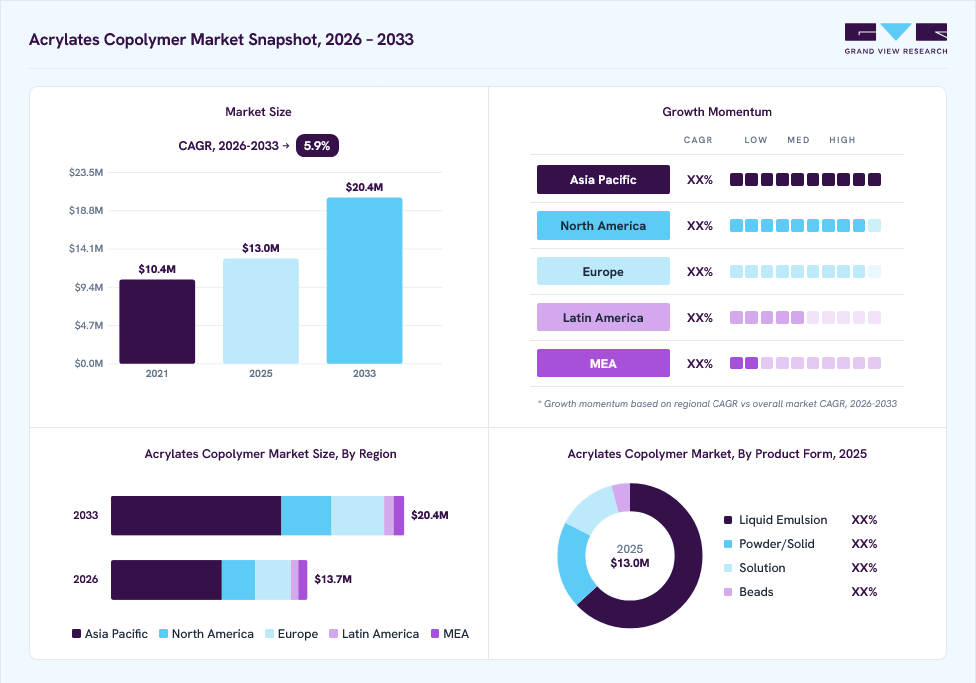
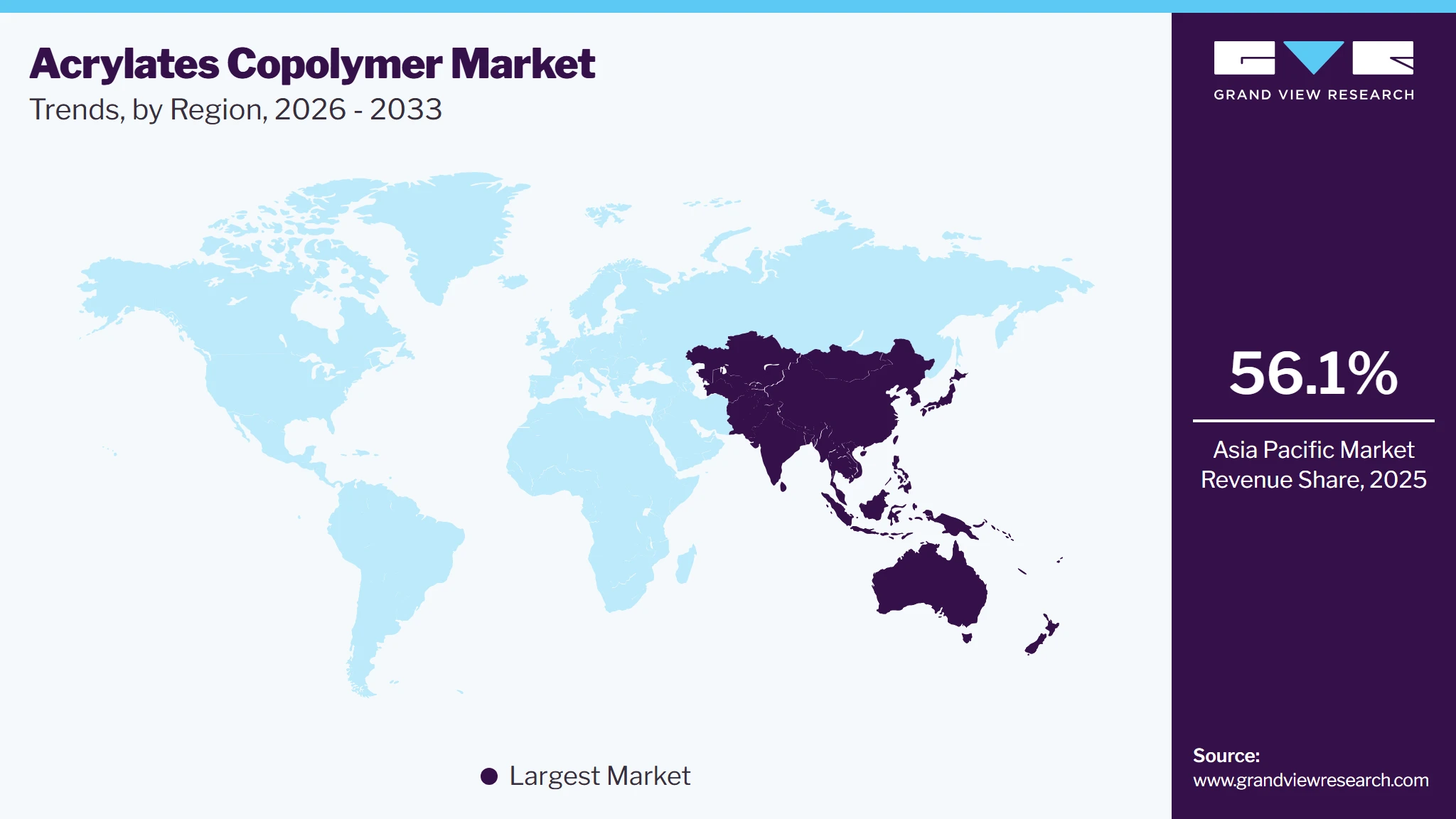
The global acrylates copolymer market size was valued at USD 13.0 million in 2025 and is projected to grow from USD 13.7 million in 2026 to USD 20.4 million by 2033, at a CAGR of 5.9% from 2026 to 2033. Asia Pacific dominated the market, accounting for a revenue share of 56.1% in 2025. The global market is driven by rising demand for high-performance personal care and cosmetic formulations, particularly skin care, hair care, sunscreens, and long-wear cosmetics.
Key Market Trends & Insights
- By product form: The powder/solid segment is anticipated to grow at a CAGR of 6.2% over the forecast period.
- By application: The personal care & cosmetics segment is expected to grow at a 7.5% CAGR from 2026 to 2033.
Regional Highlights
- Largest regional market: Asia Pacific (56.1% revenue share, 2025)
- By country: China held the largest market share in 2025.
Market Size & Forecast
- Market size in 2025: USD 13.0 Million
- Estimated Market size in 2026: USD 13.7 Million
- Projected market size by 2033: USD 20.4 Million
- CAGR (2026 - 2033): 5.9%
Three ways to get this report
Buy it, customize it, or ask a question.Get the Full Report
What the study covers
- FormatsPDF · Excel · Dashboard
- Timeline2026–2033 annual, 2025 base
- Coverage20+ countries, 5 regions
- Companies10+ key players profiled
Customize the Report
20% free customization
- IncludeCountries, segments, points
- TailorTo your product definition
- ExtendDeeper competitor detail
- OrA fully bespoke study
- Turnaround5–10 working days
Ask Prism AI
A cited answer in seconds
- Corpus30K studies, 1.2M points
- ScopeAll markets, not just this
- CitationTraced to report & table
- HonestySays "not covered" if so
- SpeedSeconds, not days
A key trend in the market is the shift toward sustainable, bio-based, and biodegradable polymer systems. Manufacturers are developing acrylate copolymers with lower carbon footprints and renewable feedstocks to address tightening environmental regulations and growing demand for cleaner formulations. This trend is particularly visible in personal care, where formulators are seeking alternatives that maintain film-forming, rheology, and durability performance while improving environmental profiles.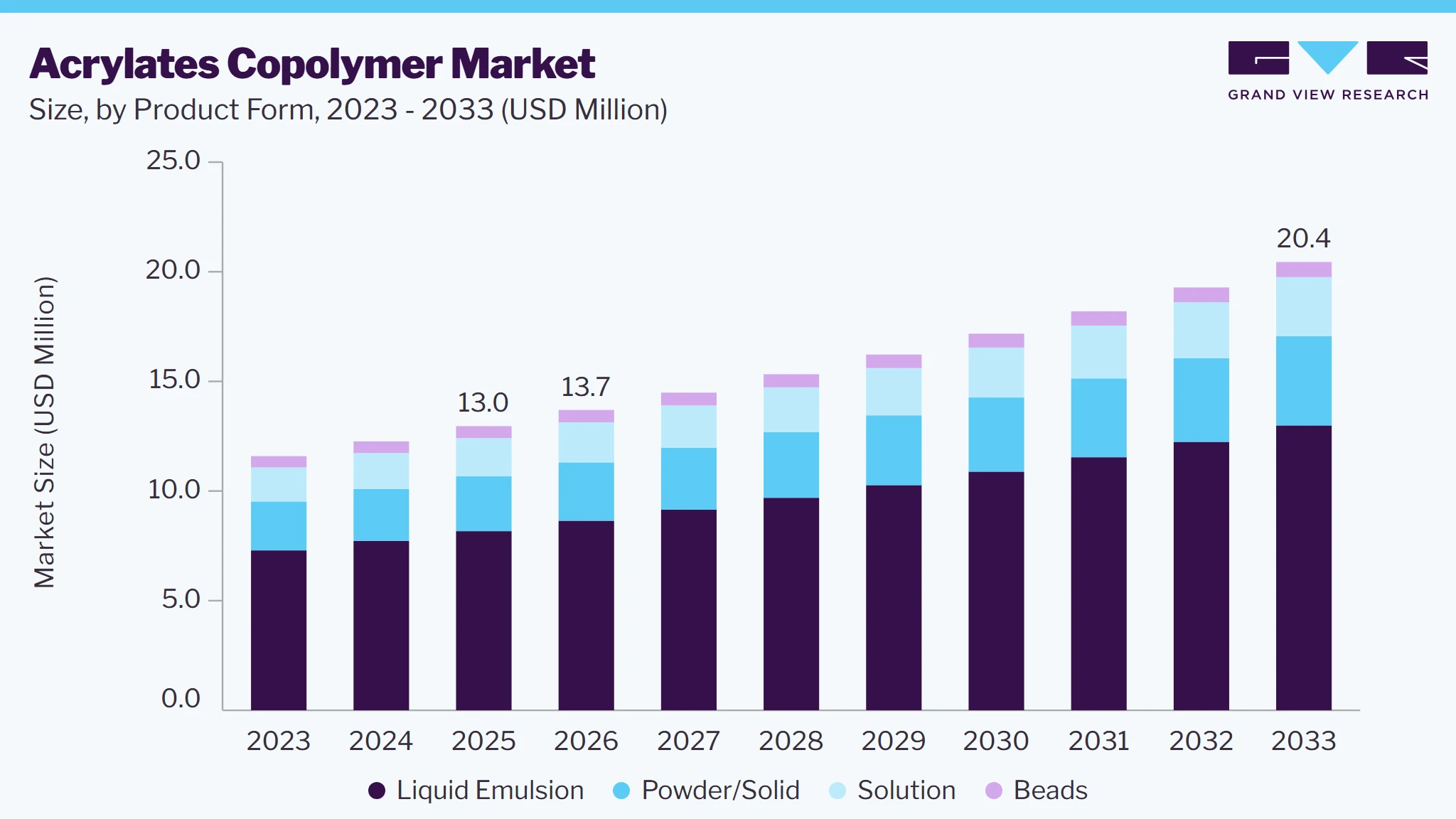
Another emerging trend is the development of high-performance, multifunctional acrylates copolymers for water-based coatings, cosmetics, adhesives, and sealants. Manufacturers are focusing on polymers that combine low VOC emissions with improved adhesion, flexibility, water resistance, chemical resistance, and long-lasting film performance. In cosmetics, demand is increasing for flexible and breathable film formers that provide transfer resistance and extended wear, while regulatory pressure on persistent synthetic polymers is encouraging innovation in next-generation formulations.
Market Dynamics
Coatings & construction remains a major demand area for acrylates copolymers, particularly in architectural paints and protective coatings. These materials function as effective binders that improve pigment dispersion, film formation, adhesion, and coating stability. Their compatibility with waterborne formulations also supports their use in interior and exterior applications, where manufacturers seek durable coatings with low odor and reduced environmental impact.
Demand is further supported by the growing need for coatings that withstand moisture, UV exposure, temperature fluctuations, abrasion, and alkaline substrates. Acrylate copolymers help enhance weather resistance, flexibility, water resistance, and color retention, making them suitable for building facades, walls, primers, and waterproofing systems. The development of advanced acrylic and styrene-acrylic binders is also improving durability and performance in demanding construction environments.
Raw material price volatility remains a key restraint for the market, as acrylic monomers and propylene are closely linked to petrochemical feedstock conditions and supply availability. Sudden supply tightness can increase input costs and create uncertainty in procurement and production planning. These cost fluctuations can compress profit margins for manufacturers and blending specialists, particularly when higher raw material costs cannot be fully passed on to customers.
Rising demand for high-performance skincare and color cosmetics is creating opportunities for acrylates copolymers that provide effective thickening, film formation, stabilization, and improved sensory properties. These polymers support smooth textures, consistent product application, water resistance, and longer-lasting formulations. Growing interest in cold-process skincare bases also favors grades that can be easily incorporated without heating, enabling efficient formulation of serums, gels, lotions, sunscreens, and other advanced cosmetic products.
Market Concentration & Characteristics
The market growth stage is exponential, at an accelerating pace. The market exhibits fragmentation, with key players dominating the industry landscape. Major companies such as Guangzhou Tinci Materials Technology, Nouryon, Dow, Brenntag Beauty & Personal Care, Ningbo MOS Chemical, Relco Pharma, Chemipol, Latan Texchem, Vinayak Chemical Industries, Labh Ingredients, and others play a significant role in shaping the market dynamics. These leading players often drive innovation in the market by introducing new products, technologies, and materials to meet the industry's evolving demands.
Innovation in the market is increasingly centered on multifunctional performance and formulation efficiency. Manufacturers are developing polymers that combine rheology control, suspension, film formation, water resistance, and sensory benefits within specialized grades. Dow, for instance, offers Acrylates Copolymer grades for low-pH cleansing systems and sunscreen formulations, including cold-processable film-forming technology. Recent product development also emphasizes bio-based ingredients and improved sustainability profiles, indicating a shift from single-function polymers toward performance-oriented and formulation-efficient solutions.
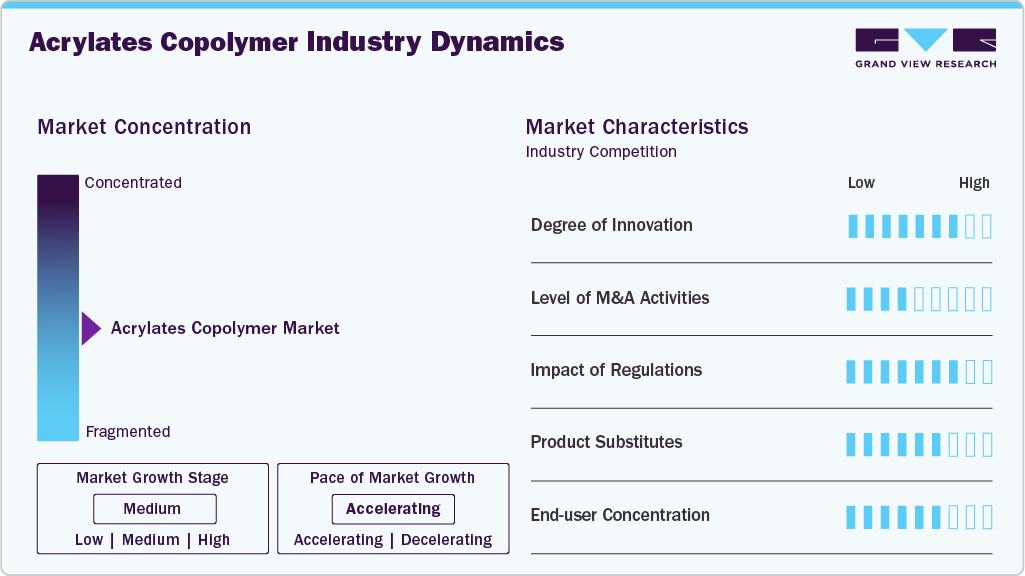
Regulatory requirements are influencing the development of acrylates copolymer, particularly in cosmetics and products containing polymeric particles. The EU Cosmetics Regulation requires a safety assessment before cosmetic products enter the market, while specific requirements apply to certain forms of Styrene/Acrylates Copolymer nanomaterials. In addition, EU Regulation 2023/2055 restricts intentionally added synthetic polymer microparticles under the REACH framework. These measures are encouraging suppliers to strengthen ingredient documentation, particle characterization, safety evaluation, and regulatory compliance.
Analyst Perspective
The market is expected to transition from volume-led growth to a more value-driven, innovation-focused phase over the next 5 to 10 years. Demand will remain anchored by personal care and cosmetics, paints and coatings, adhesives and sealants, plastics modification, and textiles, while premium formulations create opportunities for multifunctional polymers with enhanced rheology, film formation, water resistance, stability, and sensory performance. Regulatory scrutiny of synthetic polymers and rising sustainability expectations are expected to accelerate development of lower-impact, compliant, and application-specific grades. Supply chain resilience is expected to become increasingly important as raw material volatility, regional capacity additions, and pricing pressure influence margins.
Product Form Insights
The liquid emulsion segment dominated the market in terms of revenue, accounting for 63.0% market share in 2025. Liquid emulsion remains important because it integrates readily into water-based formulations and simplifies processing. Acrylates copolymer emulsions can deliver film formation, rheology control, adhesion, and surface protection without requiring extensive dispersion steps. This is particularly relevant as formulators favor waterborne systems and efficient manufacturing routes. Dow’s acrylic copolymer emulsion portfolio targets low-VOC coatings, while BASF offers acrylic emulsions for architectural and industrial applications. The segment, therefore, benefits from compatibility with aqueous formulations and established production infrastructure.
The powder/solid segment is expected to expand at the fastest CAGR of 6.2% over the forecast period. Powder and solid forms are used in applications where dry handling, storage stability, and controlled incorporation are important. Their value increases when formulators need concentrated polymer functionality without introducing additional liquid carrier into the formulation. This format can support dry blends, solid cosmetic systems, and specialty formulations requiring precise polymer addition. Product development is also moving toward multifunctional polymer technologies. Dow, for instance, markets polymer systems designed to deliver controlled viscosity and formulation benefits with simplified processing. These characteristics support continued demand for solid polymer formats in specialized applications.
Application Insights
The paints & coatings segment led the market by application, accounting for 39.5% of revenue in 2025, and is projected to grow at a 6.4% CAGR from 2026 to 2033. In paints and coatings, demand is increasingly shaped by the performance requirements of waterborne formulations. Acrylate-based polymers provide a combination of adhesion, durability, water resistance, hardness, and rheology control that supports architectural and industrial coatings. Manufacturers are also targeting lower-VOC systems without sacrificing coating performance. BASF's portfolio includes acrylic emulsions for architectural coatings and specialized systems for wood, printing, and industrial applications. Dow similarly offers acrylic emulsions for exterior and interior coatings. This broad formulation versatility strengthens acrylates copolymer adoption across coating technologies.
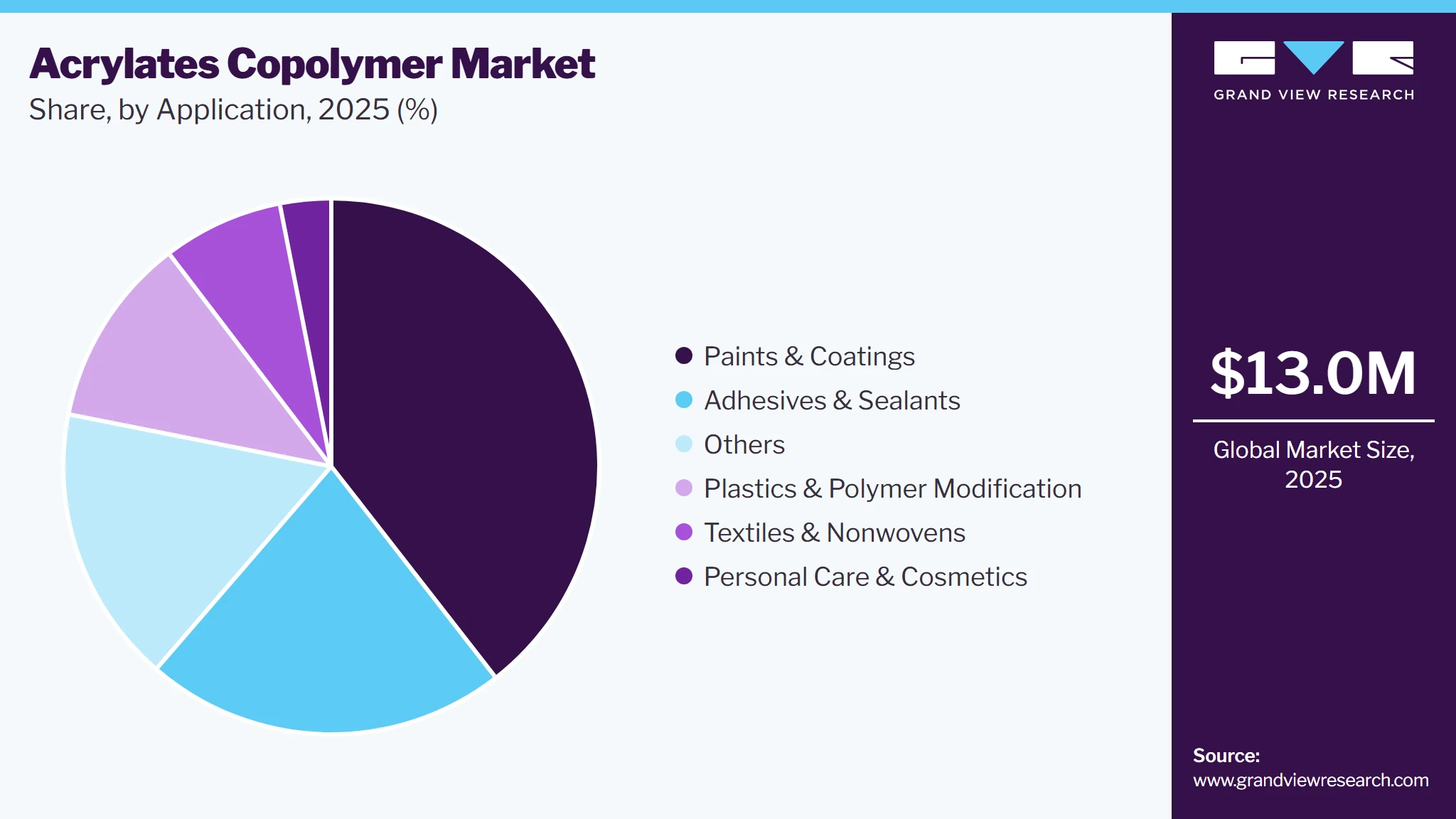
The personal care & cosmetics segment is expected to grow at the fastest CAGR of 7.5% over the forecast period. Personal care and cosmetics represent a performance-driven application area for acrylates copolymers. Formulators use these polymers as film formers, rheology modifiers, opacifiers, and texture-enhancing ingredients across skin care, sun care, hair care, and color cosmetics. Product differentiation increasingly depends on wear resistance, water resistance, transfer control, and sensory performance. Dow's silicone acrylate copolymer targets long-lasting color cosmetics and sun care, while Ashland's polymer technologies focus on durable film formation and water resistance. These multifunctional properties expand the use of polymers in advanced cosmetic formulations.
Regional Insights
The Asia Pacific acrylates copolymer industry held the largest revenue share of 56.1% in 2025. The region is expected to grow at a CAGR of 6.3% over the forecast period. Asia Pacific represents a major growth engine because of its expanding manufacturing base for coatings, adhesives, personal care products, and consumer goods. China and other Asian economies provide extensive downstream production capacity, while regional suppliers are expanding polymer and formulation capabilities. BASF's operations in Greater China demonstrate continued investment in advanced chemical production and sustainability-oriented materials. For acrylates copolymers, the region's competitive manufacturing environment and growing demand for functional cosmetic and coating formulations create favorable conditions for both commodity and specialty grades.
India Acrylates Copolymer Market Trends
India acrylates copolymer industry offers growing opportunities as domestic chemical manufacturing and downstream formulation industries expand. Acrylates copolymers benefit from demand across architectural coatings, construction chemicals, adhesives, personal care, and specialty formulations. The country's chemicals sector is also receiving greater attention as manufacturers seek stronger domestic production capabilities and value-added specialty chemicals. Government chemical-industry data highlights the scale and continued development of India's broader chemicals ecosystem. This supports local distribution, formulation, and manufacturing capabilities for acrylic-based polymers and reduces dependence on highly concentrated supply channels.
North America Acrylates Copolymer Market Trends
North America acrylates copolymer industry benefits from a mature coatings and specialty chemicals ecosystem that supports consistent demand for acrylates copolymers. The region’s emphasis on waterborne and lower-emission formulations is strengthening opportunities for acrylic polymer technologies in architectural and industrial coatings. Dow’s portfolio includes acrylic copolymer emulsions, rheology modifiers, and acrylic binders for coatings, demonstrating the depth of local formulation capabilities. Demand is also supported by established personal care and adhesive industries, where polymer performance and formulation flexibility remain important purchasing criteria.
The acrylates copolymer industry in the U.S. is being driven by the modernization of coatings formulations and the continued demand for high-performance acrylic systems. Manufacturers are increasingly focused on durability, weatherability, viscosity control, and low-emission formulations. Dow supplies acrylic emulsions and rheology technologies for interior, exterior, and specialty coating applications, supporting domestic formulators seeking performance without relying heavily on solvent-based systems. The country's large personal care, construction, packaging, and adhesive industries further broaden the application base for acrylates copolymers, creating diversified demand across both consumer and industrial formulations.
Europe Acrylates Copolymer Market Trends
The acrylates copolymer industry in Europe presents a regulation-led market environment in which formulation performance must increasingly align with environmental requirements. Acrylates copolymers used in coatings face growing attention due to material impacts, VOC emissions, and sustainability characteristics. The European Commission's ongoing review of EU Ecolabel criteria evaluates the environmental profile of paints and varnishes, including acrylic copolymer binder production. At the same time, REACH restrictions on intentionally added synthetic polymer microparticles are influencing polymer selection and product design. These conditions favor well-characterized, compliant, and lower-impact acrylate technologies.
Central & South America Acrylates Copolymer Market Trends
The acrylates copolymer industry in Central & South America is supported by demand from construction, automotive production, paints, adhesives, and consumer products. Brazil, Mexico, and Argentina are particularly relevant markets for acrylic-based formulations, with regional demand linked to construction activity and industrial manufacturing. Acrylic emulsions already have an established role in local coating applications, providing a downstream base for acrylates copolymers. Suppliers that can offer durable, waterborne, and application-specific polymer systems are positioned to benefit as formulators seek improved coating performance while adapting products to regional climate and processing conditions.
Middle East and Africa Acrylates Copolymer Market Trends
The acrylates copolymer industry in Middle East & Africa is supported primarily by construction-related coatings, infrastructure development, industrial maintenance, and expanding consumer product applications. Acrylates copolymers are relevant where formulations require adhesion, durability, weather resistance, and controlled rheology under demanding environmental conditions. The region's hot climate increase the importance of coating stability and long-term surface performance. Growing local formulation activity also creates opportunities for specialty polymer suppliers to provide customized acrylic systems for architectural coatings, construction materials, adhesives, and personal care products.
Key Acrylates Copolymer Company Insights
Some of the key players operating in the market include Dow and Nouryon.
-
Dow has a broad position in the market through its integrated acrylic materials, specialty polymers, and beauty and personal care portfolio. Its product range includes acrylate-based film formers for color cosmetics, skin care, and sun care, alongside acrylic binders and rheology technologies for coatings. DOWSIL FA 4103, for instance, provides flexible film formation, water and sebum repellency, and abrasion resistance. This portfolio allows Dow to address both performance-driven cosmetic formulations and industrial applications.
-
Nouryon participates in the market through its specialty chemicals platform serving personal care, paints and coatings, and polymer-related applications. The company emphasizes formulation performance and sustainable chemistry, with its portfolio spanning specialty solutions designed to improve product functionality. Its broad customer base across coatings and personal care provides opportunities to develop application-specific polymer technologies. Nouryon is also expanding formulation support capabilities, including digital tools such as BeautyCreations, which can strengthen collaboration with cosmetic formulators and accelerate development of specialized polymer-based formulations.
Ningbo MOS Chemical and Relco Pharma are some of the emerging participants in the acrylates copolymer industry.
-
Ningbo MOS Chemical has a market position centered on specialty coating materials and acrylic-based technologies. Its portfolio includes acrylic and styrene-acrylic copolymer systems for applications such as protective and intumescent coatings. Products listed by the company emphasize adhesion, water resistance, weatherability, durability, and adjustable rheology. This positions the company toward performance-sensitive coating applications where acrylate chemistry provides functional benefits beyond basic film formation. Its focus on specialized coating formulations gives it relevance in segments requiring enhanced protection and long-term surface performance.
-
Relco Pharma has a specialized position in the market through its ORYNOPOL range, which is targeted primarily at pharmaceutical and cosmetic formulations. The company offers Acrylates Copolymer grades, including ORYNOPOL Aquagel LC 1, LC 2, and LC 3. These products support applications such as conditioning shampoos, anti-dandruff shampoos, and baby shampoos. Relco's manufacturing and technical support capabilities, combined with certifications covering pharmaceutical and cosmetic operations, strengthen its position in formulation-focused polymer supply.
Key Acrylates Copolymer Companies
The following key companies have been profiled for this study on the acrylates copolymer market.
-
Guangzhou Tinci Materials Technology
-
Nouryon
-
Dow
-
Brenntag Beauty & Personal Care
-
Ningbo MOS Chemical
-
Relco Pharma
-
Chemipol
-
Latan Texchem
-
Vinayak Chemical Industries
-
Labh Ingredients
Competitive Benchmarking
Operating Strategies
Competitive Edge
Weakness
Mature Players: Dow, Nouryon, Guangzhou Tinci Materials Technology, Brenntag Beauty & Personal Care
- Focus on high-performance acrylates copolymers, rheology modifiers, film formers, thickeners, and suspension agents for personal care, cosmetics, coatings, and specialty formulations.
- Invest in advanced polymer formulations offering improved thickening, suspension, electrolyte tolerance, film formation, stability, and sensory properties
- Expand through global distribution networks, technical partnerships, customer development, and broader personal-care ingredient portfolios to strengthen market penetration.
- Established global presence, broad product portfolios, and strong technical expertise support relationships with multinational formulators and large-volume customers.
- Strong formulation-development and application-support capabilities enable customization across skin care, hair care, cleansing, and color cosmetics.
- Brand recognition, established customer relationships, and cross-selling capabilities provide an advantage over smaller regional suppliers.
- High R&D, manufacturing, regulatory, and technical-support costs increase operating expenses.
- Complex global operations and broad portfolios can result in longer product-development and customer-qualification cycles.
- Intense competition among specialty polymer suppliers can create pricing pressure and require continuous investment in product innovation.
Emerging Players: Ningbo MOS Chemical, Relco Pharma, Chemipol, Latan Texchem, Vinayak Chemical Industries, Labh Ingredients
- Focus on acrylates copolymers, rheology modifiers, thickeners, suspension agents, and specialty cosmetic ingredients for personal care and home-care formulations.
- Emphasize competitive pricing, regional supply, customized grades, technical support, and shorter customer response times to strengthen relationships with regional formulators.
- Expand through regional distribution, export markets, product portfolio development, certifications, and direct engagement with cosmetic and pharmaceutical manufacturers.
- Flexible product development and application-specific solutions allow suppliers to address customized formulation requirements.
- Regional suppliers can provide cost-effective products and responsive technical support for small and mid-sized cosmetic and pharmaceutical manufacturers.
- Specialized grades and formulation flexibility provide opportunities in applications requiring thickening, suspension, stabilization, electrolyte tolerance, and viscosity control
- Smaller production scale and geographic presence can limit competitiveness against multinational suppliers.
- Comparatively lower R&D resources, brand recognition, and international customer qualification can restrict access to major multinational accounts.
- Dependence on raw-material availability and the need for regulatory approvals, certifications, and customer testing can increase commercialization timelines and market-entry costs.
Recent Developments
-
In November 2025, Dow launched four new personal care ingredients in the Asia Pacific, including ACUDYNE 2000 Polymer, a dual-phase styling polymer designed to provide long-lasting hold, humidity resistance, and no flaking. The launch expanded Dow’s polymer portfolio for haircare and styling formulations across the Asia Pacific beauty market.
-
In November 2025, Anhui Newman Fine Chemical showcased its carbomer and acrylates copolymer portfolio at in-cosmetics Asia 2025 in Bangkok. The company used the event to promote its rheology-modifying polymers, including acrylates copolymer grades, strengthening its visibility among personal-care ingredient manufacturers and formulators in the Asia Pacific region.
Acrylates Copolymer Market Report Scope
Report Attribute
Details
Market size in 2025
USD 13.0 million
Estimated market size in 2026
USD 13.7 million
Revenue forecast in 2033
USD 20.4 million
Growth rate
CAGR of 5.9% from 2026 to 2033
Historical data
2021 - 2024
Forecast period
2026 - 2033
Quantitative units
Revenue in USD million, volume in tons, and CAGR from 2026 to 2033
Report coverage
Revenue & volume forecast, competitive landscape, growth factors, and trends
Segments covered
Product form, application, and region
Regional scope
North America; Europe; Asia Pacific; Central & South America; Middle East & Africa
Country Scope
U.S.; Canada; Mexico; Europe; Germany; UK; France; Italy; Spain; China; India; Japan; South Korea; Australia; Brazil; Argentina; Saudi Arabia; UAE; South Africa
Key companies profiled
Guangzhou Tinci Materials Technology; Nouryon; Dow; Brenntag Beauty & Personal Care; Ningbo MOS Chemical; Relco Pharma; Chemipol; Latan Texchem; Vinayak Chemical Industries; Labh Ingredients
Customization scope
Free report customization (equivalent to up to 8 analyst working days) with purchase. Addition or alteration to country, regional & segment scope
Pricing and purchase options
Avail customized purchase options to meet your exact research needs. Explore purchase options
Global Acrylates Copolymer Market Report Segmentation
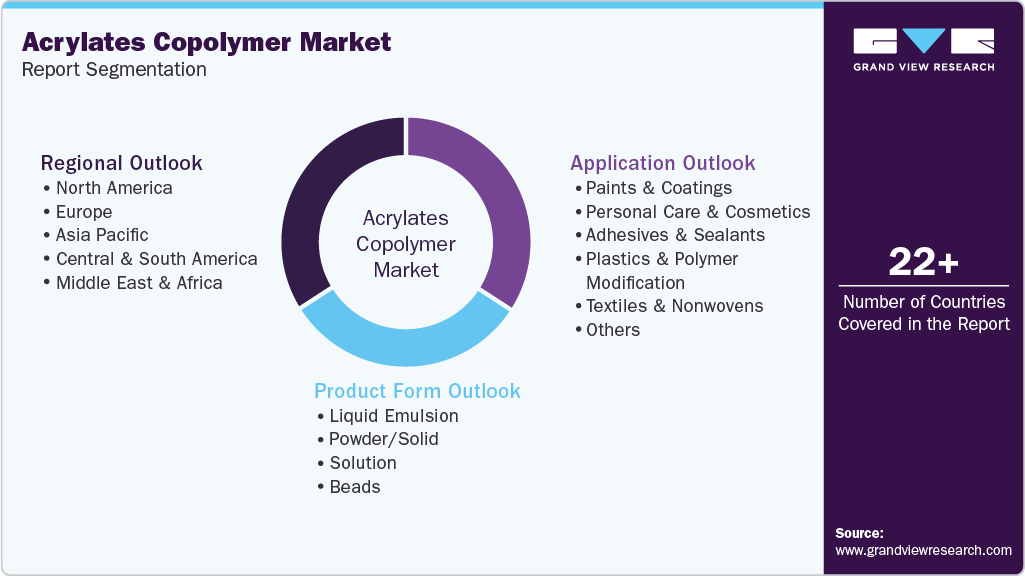
This report forecasts revenue growth at the global, regional, and country levels and provides an analysis of the latest industry trends across sub-segments from 2021 to 2033. For this study, Grand View Research has segmented the global acrylates copolymer market report based on product form, application, and region:
-
Product Form Outlook (Volume, Tons; Revenue, USD Million, 2021 - 2033)
-
Liquid Emulsion
-
Powder/Solid
-
Solution
-
Beads
-
-
Application Outlook (Volume, Tons; Revenue, USD Million, 2021 - 2033)
-
Paints & Coatings
-
Personal Care & Cosmetics
-
Adhesives & Sealants
-
Plastics & Polymer Modification
-
Textiles & Nonwovens
-
Others
-
-
Regional Outlook (Volume, Tons; Revenue, USD Million, 2021 - 2033)
-
North America
-
U.S.
-
Canada
-
Mexico
-
-
Europe
-
Germany
-
UK
-
France
-
Italy
-
Spain
-
-
Asia Pacific
-
China
-
India
-
Japan
-
South Korea
-
Australia
-
-
Central & South America
-
Brazil
-
Argentina
-
-
Middle East & Africa
-
Saudi Arabia
-
UAE
-
South Africa
-
-
Research Methodology
The acrylates copolymer market figures in this report are based on a proven research process that combines executive interviews with secondary research from proprietary databases, company filings, and recognized regulatory and institutional sources. Market size is built through value-chain sizing - reconciling supply-side and demand-side estimates - and triangulated with bottom-up and top-down approaches. Every estimate passes multiple levels of expert validation before publication, with each acrylates copolymer segment quantified using the revenue-capture definitions in the table below.
Segment Definition
Segment - Product Form
Revenue capture definition
Liquid Emulsion
Revenue is captured through acrylates copolymer supplied as liquid emulsions for personal care, cosmetics, paints and coatings, adhesives, and textile formulations requiring viscosity control, film formation, stabilization, suspension, water resistance, and smooth application properties.
Powder/Solid
Revenue is generated through powdered or solid acrylates copolymers used in dry formulations, coatings, adhesives, plastics modification, and personal care products requiring controlled rheology, film formation, binding, durability, and improved formulation stability.
Solution
Revenue is captured through acrylates copolymer supplied in solution form for paints and coatings, adhesives and sealants, personal care, textiles, and polymer modification applications requiring easy incorporation, controlled viscosity, film formation, adhesion, and surface performance.
Beads
Revenue comes from bead-form acrylates copolymers used in specialized personal care, coatings, and polymer formulations requiring controlled particle size, improved dispersion, film formation, texture modification, and consistent processing characteristics.
Segment - Application
Revenue capture definition
Paints & Coatings
Revenue is generated through acrylates copolymers used in architectural, industrial, automotive, protective, and specialty coatings requiring improved adhesion, film formation, durability, water resistance, weatherability, gloss, and surface protection.
Personal Care & Cosmetics
Revenue is captured through acrylates copolymers used in skin care, hair care, sun care, color cosmetics, cleansing products, and styling formulations requiring viscosity control, suspension, film formation, texture enhancement, water resistance, and formulation stability.
Adhesives & Sealants
Revenue is generated through acrylates copolymers used in pressure-sensitive adhesives, construction adhesives, packaging adhesives, and sealants requiring strong adhesion, flexibility, cohesive strength, durability, and resistance to moisture and environmental exposure.
Plastics & Polymer Modification
Revenue is captured through acrylates copolymers used to modify plastics and polymer systems, improving impact resistance, flexibility, compatibility, processing behavior, surface properties, and overall mechanical performance across engineered and specialty polymer applications.
Textiles & Nonwovens
Revenue is generated through acrylates copolymers used as binders, finishing agents, and performance modifiers for textiles and nonwovens requiring improved fiber adhesion, stiffness control, durability, flexibility, abrasion resistance, and resistance to washing or environmental exposure.
Others
Revenue comes from acrylates copolymers used in specialty applications, including inks, paper coatings, construction materials, packaging, printing formulations, and industrial formulations requiring customized rheological, adhesive, film-forming, or surface-performance characteristics.
Estimation Model
Layer Name
Key Question
Description
Top-Down Acrylates Copolymer Demand Assessment Layer
What defines overall market demand?
Establishes global demand for acrylates copolymers across liquid emulsion, powder/solid, solution, and bead forms. The assessment covers paints and coatings, personal care and cosmetics, adhesives and sealants, plastics and polymer modification, textiles and nonwovens, and other industrial applications.
Application Demand Validation Layer
Where is demand concentrated?
Maps demand across major applications based on formulation volumes, polymer functionality, rheology requirements, film-forming needs, coating performance, adhesive requirements, cosmetic formulation trends, plastics consumption, and adoption of high-performance polymer modifiers.
Consumption-to-Revenue Conversion Layer
How is demand monetized?
Converts acrylates copolymer consumption into revenue using product form, polymer grade, functional properties, application requirements, formulation concentration, production capacity, manufacturing costs, selling prices, product specifications, order volumes, and purchasing patterns of downstream manufacturers and formulators.
Regional Demand Verification Layer
Where is demand validated?
Validates demand across North America, Europe, Asia Pacific, Central & South America, and Middle East & Africa using personal care and cosmetics production, coatings and construction activity, adhesives manufacturing, plastics processing, textile production, local polymer capacity, import dependence, supplier presence, and regulatory developments.
Delivered Customizations
This report has been delivered with the following In-depth customizations
Client Request
Customization Delivered
Value Adds
Regional segmentation
Customized the market across North America, Europe, Asia Pacific, Latin America, and Middle East & Africa, with country-level assessment for major cosmetic and personal care manufacturing hubs. Regional analysis evaluates demand for acrylates copolymers across skin care, hair care, sun care, color cosmetics, and toiletries, along with local formulation trends and supplier presence.
Identifies high-growth regional markets, demand centers, supply hubs, and expansion priorities. Asia Pacific receives particular attention due to its large personal care manufacturing base and growing demand for functional polymers.
Competitive benchmarking
Benchmarked Dow, Nouryon, Guangzhou Tinci Materials Technology, Brenntag Beauty & Personal Care, Ningbo MOS Chemical, Relco Pharma, Chemipol, Latan Texchem, Vinayak Chemical Industries, and Labh Ingredients across product portfolio, application coverage, technical capabilities, geographic reach, customization, distribution strength, and customer support.
Distinguishes mature multinational suppliers from emerging and regional participants, highlighting differences in product breadth, technical differentiation, market access, and competitive positioning.
Opportunity assessment
Evaluated opportunities across premium skin care, sun care, long-wear color cosmetics, multifunctional rheology modifiers, water-resistant formulations, high-electrolyte systems, and multifunctional hair-care products. Additional opportunity mapping covers regional expansion, customized polymer grades, sustainable formulation requirements, and applications requiring cold processing or enhanced formulation stability.
Highlights high-value application niches and product-development priorities. Demand for multifunctional polymers is supported by grades that combine thickening, suspension, film formation, water resistance, and formulation flexibility.
About the Author(s)
Plastics, Polymers & Resins Research Team
Bulk Chemicals · Plastics, Polymers & ResinsThis report was authored by the plastics, polymers & resins research team at Grand View Research - comprising two research analysts, one senior research analyst, and one industry expert - with specialized expertise in the plastics, polymers & resins segment of the bulk chemicals industry. All findings are based on proprietary bulk chemicals databases, executive interviews, and regulatory analysis, subject to internal peer review prior to publication.
Last Updated:
Speak to Analyst


Customize this report to your needs - add regions, segments, or data points, with 20% free customization.
Or view our licence options:


ISO 9001:2015 & 27001:2022 Certified
We are GDPR and CCPA compliant! Your transaction & personal information is safe and secure. For more details, please read our privacy policy.


