
- Home
- »
- Plastics, Polymers & Resins
- »
-
Adhesives And Sealants Market Size & Share Report, 2033GVR Report cover

Adhesives And Sealants Market (2026 - 2033)
Size, Share & Trends Analysis Report By Technology (Water Based, Solvent Based, Hot Melt, Reactive & Others), By Product (Acrylic, PVA), By Application, By Region, And Segment Forecasts
Market Size, 2025
$77.1BMarket Estimate, 2026
$81.7BMarket Forecast, 2033
$123.2BCAGR, 2026–2033
6.0%Adhesives And Sealants Market Summary
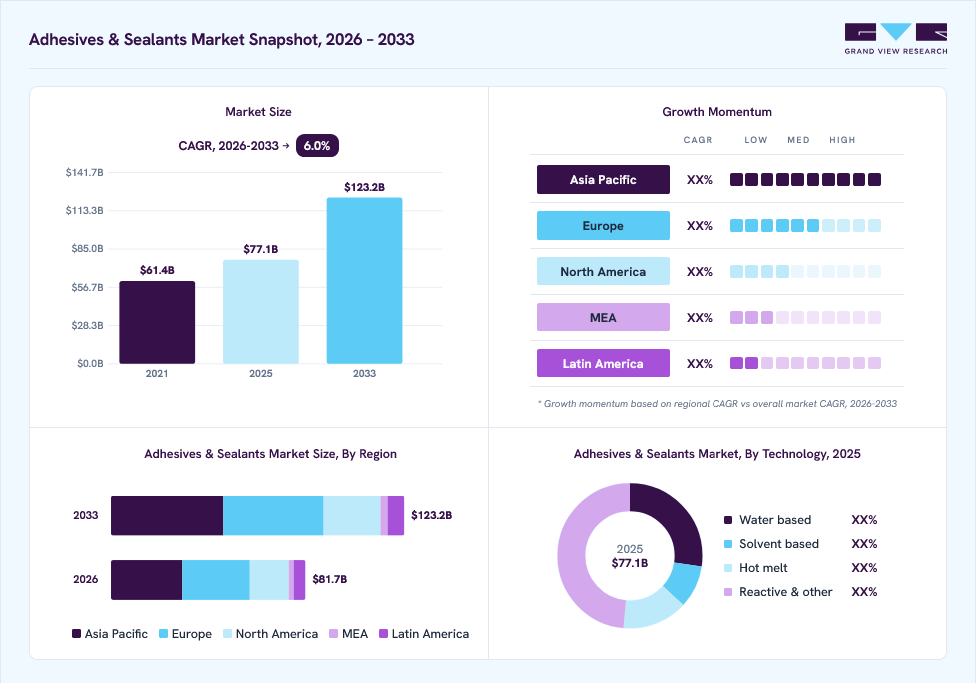
The global adhesives and sealants market size was valued at USD 77.1 billion in 2025 and is projected to grow from USD 81.7 billion in 2026 to USD 123.2 billion by 2033, at a CAGR of 6.0% from 2026 to 2033. Asia Pacific dominated the market, accounting for a revenue share of 36.4% in 2025. Technological advancements and rising performance requirements across end-use industries support the industry.
 Source: Grand View Research, IR Documents, Primary Interviews, Paid DatabasesTo learn more about this report,
 Download Free Sample Report
Key Market Trends & Insights
- By adhesive technology: Reactive & others held a dominant position, contributing 48.7% of total revenue in 2025.
- By adhesive product: Acrylic segment accounted for the largest revenue share of 36.9% in 2025.
- By adhesive application: Paper & packaging segment held the dominant position in the market with a revenue share of 29.4% in 2025.
- By sealants product: Silicones segment captured the largest revenue share of 33.2% in 2025.
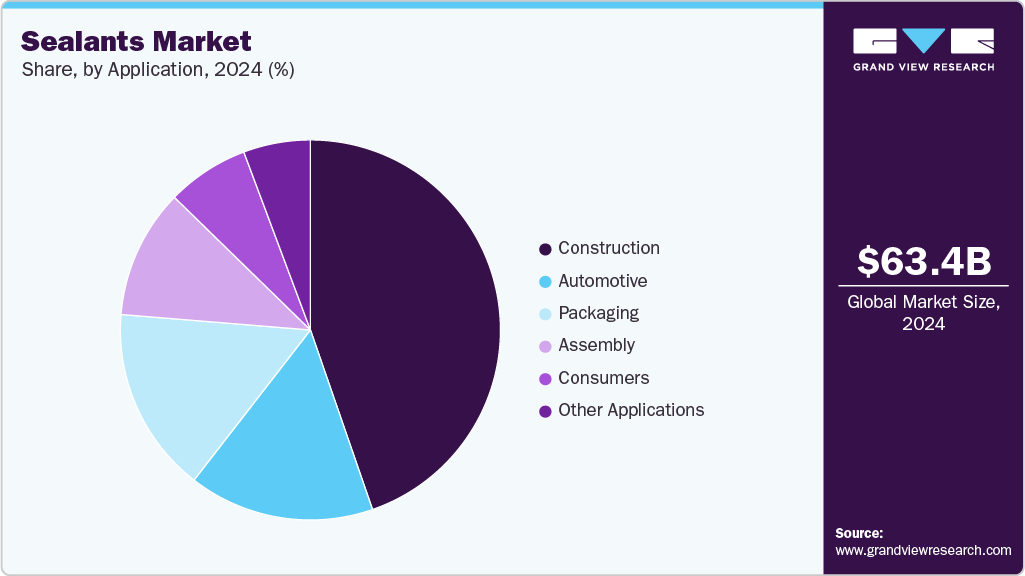
- By sealants application: Construction segment dominated the market in 2025, contributing 44.8% of the total revenue.
Regional Highlights
- Largest regional market: Asia Pacific (36.4% revenue share, 2025)
- By country: China held the largest market share in 2025.
Market Size & Forecast
- Market size in 2025: USD 77.1 Billion
- Estimated market size in 2026: USD 81.7 Billion
- Projected market size by 2033: USD 123.2 Billion
- CAGR (2026-2033): 6.0%
Three ways to get this report
Buy it, customize it, or ask a question.Ask an Analyst
Analyst response in 1 business day
- AccessReport author, directly
- Reply timeWithin 1 working day
- No sales callDirect answer only
- FormatEmail reply
- CostFree, no cost
Get the Full Report
What the study covers
- FormatsPDF · Excel · Dashboard
- Timeline2026–2033 annual, 2025 base
- Coverage20+ countries, 5 regions
- Companies10+ key players profiled
Customize the Report
20% free customization
- IncludeCountries, segments, points
- TailorTo your product definition
- ExtendDeeper competitor detail
- OrA fully bespoke study
- Turnaround5–10 working days
Increasing demand for automotive adhesives and sealants and silicone adhesives and sealants reflects a broader shift toward advanced bonding solutions that offer enhanced flexibility, vibration resistance, and durability. In addition, the high-temperature adhesives and sealants market is gaining traction as manufacturers seek materials capable of maintaining bond integrity under extreme thermal and mechanical conditions.In the construction and transportation sectors, infrastructure modernization and next-generation mobility platforms are accelerating the use of specialized adhesive systems. Aerospace adhesives and sealants market growth is supported by the need for lightweight, high-strength bonding solutions in aircraft structures, while the aviation adhesives and sealants market benefits from increasing aircraft maintenance, repair, and overhaul activities. These applications demand materials with superior chemical resistance, fatigue performance, and long service life, reinforcing the role of advanced adhesive technologies in critical structural assemblies.
 To learn more about this report, Download Free Sample Report
From a materials and end-use perspective, sustainability and healthcare innovation are creating new growth avenues. The bio-based adhesives and sealants market is expanding as industries adopt low-VOC and renewable formulations to meet regulatory and environmental goals. Simultaneously, rising demand for minimally invasive procedures and advanced medical devices is driving the medical adhesives and sealants market, including strong growth in the surgical sealants and adhesives market and the dental adhesives and sealants market, where precision bonding, biocompatibility, and reliability are essential.
Market Dynamics
The adhesives and sealants market is witnessing steady growth, driven by increasing demand from the construction, automotive, packaging, electronics, and healthcare industries. Rising infrastructure development, lightweight vehicle manufacturing, and the shift toward sustainable and high-performance bonding solutions are supporting market expansion. Technological advancements in water-based, hot-melt, and bio-based formulations are further enhancing product adoption across diverse applications. However, volatility in raw material prices, stringent environmental regulations on VOC emissions, and supply chain disruptions remain key challenges. To strengthen their competitive position, manufacturers are focusing on product innovation, capacity expansion, strategic partnerships, and the development of eco-friendly adhesive and sealant solutions.
The growing investments in residential, commercial, and infrastructure development are a major driver of the adhesives and sealants market. Adhesives and sealants are increasingly replacing conventional mechanical fastening methods due to their superior bonding strength, durability, flexibility, and ability to improve structural integrity. Their extensive use in flooring, roofing, insulation, glazing, panel installation, and waterproofing applications is expanding as construction projects prioritize energy efficiency, faster installation, and long-term performance. Rapid urbanization and government-led infrastructure initiatives across emerging economies are further accelerating product demand.
The increasing adoption of sustainable and high-performance building materials is driving the need for advanced adhesive and sealant formulations. Manufacturers are developing low-VOC, water-based, and hybrid products that comply with stringent environmental regulations while delivering enhanced performance. The continued growth of smart buildings, green construction practices, and infrastructure modernization projects is expected to create sustained demand for innovative bonding and sealing solutions, strengthening the long-term growth outlook of the adhesives and sealants market.
Fluctuations in the prices of key raw materials, including petrochemical-derived resins, solvents, polyurethane, epoxy, acrylics, and silicones, remain a significant restraint for the adhesives and sealants market. Changes in crude oil prices, supply chain disruptions, and geopolitical uncertainties can increase production costs and reduce manufacturers' profit margins. These pricing pressures often result in higher product costs for end users, particularly in price-sensitive industries such as construction and packaging.
Stringent environmental regulations governing volatile organic compound (VOC) emissions and the use of hazardous chemicals pose challenges for manufacturers. Compliance with evolving regulatory standards requires continuous investment in research and development to formulate low-VOC, solvent-free, and bio-based products. While these innovations support long-term sustainability goals, they also increase development costs and extend product commercialization timelines, creating operational and financial challenges for market participants.
The increasing emphasis on sustainability and environmental compliance is creating significant growth opportunities for the adhesives and sealants market. Rising demand for low-VOC, solvent-free, and bio-based products across construction, automotive, packaging, and consumer goods industries is encouraging manufacturers to develop environmentally friendly bonding solutions. Stricter environmental regulations and growing corporate sustainability initiatives are further accelerating the transition toward renewable raw materials and green adhesive technologies.
Advancements in bio-based polymers and high-performance formulations are expanding the application scope of sustainable adhesives and sealants without compromising bonding strength or durability. Increasing investments in green buildings, lightweight vehicles, and recyclable packaging are expected to drive long-term demand for innovative products that support circular economy objectives. As end users continue to prioritize sustainable materials and regulatory compliance, manufacturers have significant opportunities to strengthen their market presence through product innovation, strategic partnerships, and capacity expansion.
Market Concentration & Characteristics
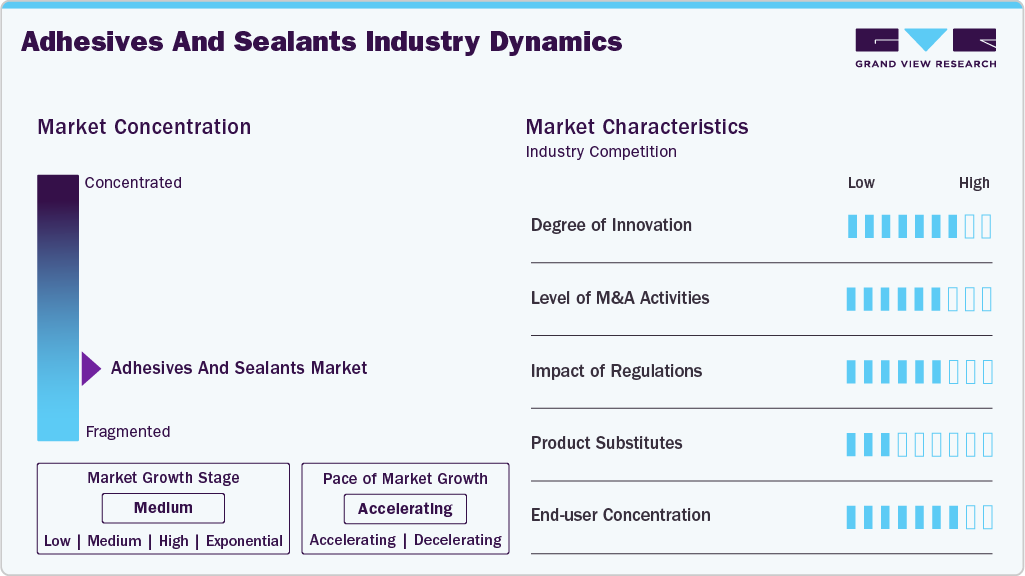
The industry remains highly fragmented and competitive, characterized by the presence of numerous small and medium-sized players alongside established manufacturers. Companies operating across segments such as automotive adhesives and sealants, silicone adhesives and sealants, and high-temperature adhesives and sealants are actively pursuing growth through product launches, strategic collaborations, and technology upgrades to strengthen their market positioning.
 To learn more about this report, Download Free Sample Report
In addition, market participants are expanding production capacities and pursuing regional acquisitions to enhance geographic reach and portfolio depth across applications including medical adhesives and sealants and aerospace and aviation adhesives and sealants. Strategic acquisitions remain a key growth lever; for instance, H.B. Fuller’s acquisition of Beardow Adams supports its expansion in the European market, reflecting the broader trend of consolidation to capture regional demand and improve competitive advantage.
Analyst Perspective
The Adhesives & Sealants Market is expected to witness steady growth, supported by expanding applications across construction, automotive, packaging, electronics, healthcare, and consumer goods industries. Increasing demand for lightweight materials, sustainable bonding solutions, and high-performance formulations is encouraging manufacturers to invest in product innovation and advanced chemistries. At the same time, the transition toward low-VOC and bio-based products, coupled with strategic capacity expansions and technological advancements, is reshaping the competitive landscape, positioning the market for sustained long-term growth despite challenges related to raw material price volatility and regulatory compliance.
Adhesives Technology Insights
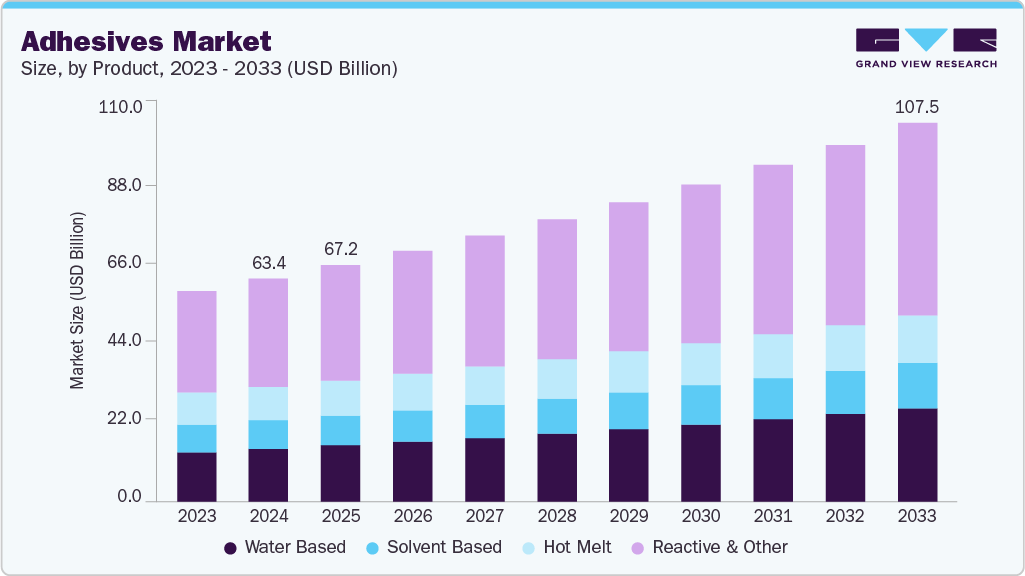
By technology, reactive & others held a dominant position, contributing 48.7% of total revenue in 2025. Water-based adhesive technology is highly versatile and delivers reliable bonding across a wide range of applications, including automotive adhesives and sealants and select medical adhesives and sealants. Formulated using water, polymers, and functional additives, these adhesives are suitable for both porous and non-porous substrates and are typically applied in liquid form, becoming effective as the water evaporates or is absorbed. Available in both natural and synthetic variants, water-based adhesives are widely adopted due to their adaptability, low-VOC profile, and environmental compatibility.
The solvent-based adhesives segment is expected to grow at the fastest CAGR of 5.2% from 2026 to 2033, driven by strong demand across packaging, medical, and tape applications. These formulations are increasingly used within automotive adhesives and sealants and medical adhesives and sealants due to their superior resistance to moisture, heat, and chemicals, along with strong adhesion to both porous and non-porous substrates. Upon solvent evaporation, they form a durable bonding layer, supporting their widespread adoption across automotive components, food packaging, household products, and graphic materials.
Adhesives Product Insights
Acrylic segment accounted for the largest revenue of 36.9% in 2025. The expansion of this market segment is largely due to the versatility of acrylic adhesives, which can effectively bond a wide range of materials such as metals, plastics, glass, ceramics, and wood. They also offer strong resistance to moisture, harsh temperatures, chemicals, and UV exposure, making them well-suited for use in both indoor and outdoor environments.
The EVA segment is expected to grow with a CAGR of 6.5% from 2026 to 2033, due to its versatility, fast setting time, and capability to bond a wide variety of polar and non-polar substrates without the use of water or solvents. Their formulations can be customized to meet specific industrial requirements, offering features such as flexibility, high strength, low-temperature performance, and resistance to various conditions. Commonly utilized in industries like packaging, paper, woodworking, automotive, and mattress production, EVA adhesives are preferred for their durability, ease of use, and cost-efficiency across a broad temperature range. Their strong bonding capabilities and adaptability make them highly valuable in fast-paced manufacturing and assembly operations.
Adhesives Application Insights
With a revenue share of 29.4% in 2025, the paper & packaging segment held the dominant position in the market, supported by the growing reliance on adhesives for strength, durability, and process efficiency across the packaging value chain. These formulations are critical in corrugated board and box manufacturing, where they ensure secure layer bonding, structural integrity, and resistance to moisture and temperature variations. Increasing demand for high-performance and sustainable packaging is also encouraging the adoption of bio-based adhesives and sealants that align with regulatory and environmental requirements.
The furniture & woodworking segment is expected to register the fastest CAGR of 7.4% from 2026 to 2033, driven by rising demand for durable, aesthetically refined, and eco-friendly furniture products. Adhesives are widely used in edge banding, lamination, cabinet assembly, and solid wood bonding, enabling complex designs and faster production cycles. Advanced solutions such as hot-melt EVA, PUR, and water-based systems-along with high-temperature adhesives and sealants are increasingly preferred for their heat resistance, rapid curing, and low-VOC performance.
Sealants Product Insights
In 2025, the silicones segment captured the largest revenue share of 33.2% in the market, driven by regulatory support promoting the use of these products across various industries. For instance, the implementation of TAFE (Tractors and Farm Equipment Limited) regulations, which require reducing the overall weight of vehicles to help control pollution, has led to a rise in the use of silicone sealants in automotive applications.
The acrylic sealants segment is expected to grow at the fastest CAGR of 6.3% during the forecast period, driven by their versatility, ease of application, and environmental compatibility, making them ideal for various construction and interior applications. As a water-based, paintable, and low-VOC solution, acrylic sealants are increasingly preferred for sealing gaps in trim, molding, cabinetry, windows, and doors, particularly in indoor environments requiring clean air standards. Their strong adhesion, flexibility, quick curing, and ease of cleanup make them cost-effective and user-friendly for professionals and DIY users. The rising demand for sustainable and safe building materials further accelerates their adoption in residential, commercial, and general construction sectors.
Sealants Application Insights
The construction segment dominated the market in 2025, contributing 44.8% of the total revenue, driven by extensive use in concrete joints, expansion gaps, crack sealing, and prefabricated structures. Silicone adhesives and sealants and high-temperature adhesives and sealants are widely used to seal metals, concrete, wood, and composite materials, forming durable and impermeable barriers against water, air, dust, UV radiation, and humidity. These solutions are essential for ensuring long-term structural integrity and weather resistance in windows, doors, sandwich panels, partitions, and precast concrete systems.
 To learn more about this report, Download Free Sample Report
The packaging segment is expected to grow at the fastest CAGR of 6.4% from 2026 to 2033, as sealants play an increasingly critical role in protecting products from moisture, oxygen, and temperature fluctuations. Advanced sealing solutions are gaining traction across automotive adhesives and sealants and industrial packaging applications, supporting extended shelf life, improved handling safety, and chemical stability during storage and transport. The adoption of high-performance barrier packaging also reduces reliance on modified-atmosphere storage, aligning with cost-efficiency and sustainability objectives across multiple end-use industries.
Regional Insights
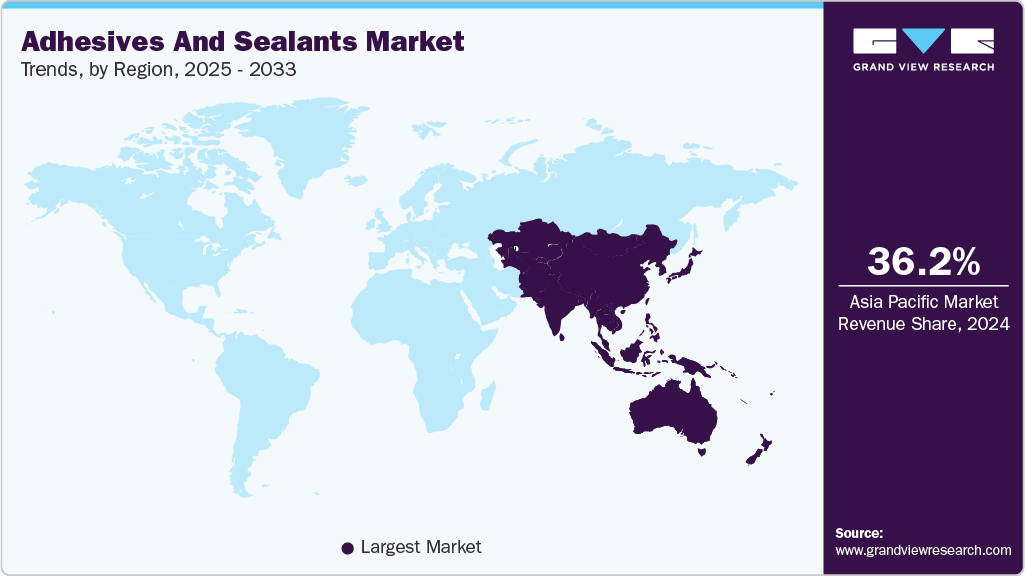
Asia Pacific dominated the adhesives & sealants market with the highest revenue share of 36.4% in 2025, driven by strong demand in building, construction, and automotive sectors across India, Indonesia, and Sri Lanka. Government initiatives such as India’s Smart Cities Mission and PMAY, along with Indonesia’s RPJMN, are boosting residential and commercial projects, increasing the use of silicone adhesives and sealants and high-temperature adhesives and sealants for tiling, insulation, and waterproofing. Rising middle-class income and growth in manufacturing and automotive production, supported by initiatives like “Make in India,” are further fueling market expansion in the region.
 To learn more about this report, Download Free Sample Report
China dominated the Asia Pacific adhesives & sealants market in 2025. China adhesives & sealants market is growing steadily, led by rising automotive production and adoption of fuel-efficient and electric vehicles. Manufacturers are shifting from mechanical fasteners to automotive adhesives and sealants and structural adhesives to reduce vehicle weight, enhance safety, and improve vibration resistance. Companies like Tesla, BYD, and NIO increasingly use adhesives in body-in-white construction and battery assemblies, while the expanding automotive aftermarket is driving demand for sealants in windshield installation, body repair, and engine components. Major global players, including Henkel, 3M, and Sika, are scaling operations to capture this growing demand.
Europe Adhesives And Sealants Market Trends
The adhesives & sealants market in Europe is driven by rising construction activities, automotive production, and technological advancements. Renovation of aging buildings over 90% constructed before 1990 and 40% before 1960 offers significant opportunities for silicone adhesives and sealants and high-temperature adhesives and sealants in structural bonding, insulation, flooring, and waterproofing applications. The region’s robust construction sector and increasing demand for durable, reliable bonding solutions continue to support market expansion across both residential and commercial projects.
North America Adhesives And Sealants Market Trends
The adhesives & sealants market in North America has experienced steady growth, supported by rising building and construction activities and infrastructure projects. In the automotive sector, the shift toward lightweight materials and enhanced vehicle performance is driving demand for automotive adhesives and sealants and high-temperature adhesives and sealants as alternatives to mechanical fasteners and welding. These solutions offer strong bonding, reduce vehicle weight, improve fuel efficiency, and enhance overall durability, reinforcing their adoption across both commercial and passenger vehicle manufacturing.
Middle East & Africa Adhesives And Sealants Market Trends
The adhesives & sealants market in the Middle East & Africa is expected to grow steadily, driven by expanding oil & gas operations and rising investments in the construction sector. Government initiatives to boost the automotive industry including tax incentives, economic zones, and infrastructure development are further supporting market growth. Countries like Morocco are attracting major global automotive players, leveraging strategic locations and favorable policies, which is increasing demand for automotive adhesives and sealants and high-temperature adhesives and sealants in vehicle manufacturing and industrial applications.
Latin America Adhesives And Sealants Market Trends
The adhesives & sealants market in Latin America is projected to emerge as a high-growth region during the forecast period, fueled by new construction and infrastructure projects in countries like Brazil and Argentina. Expansion in key sectors such as automotive, construction, and packaging is driving demand for automotive adhesives and sealants and silicone adhesives and sealants. Industrial development and rising manufacturing activities are further supporting the adoption of advanced bonding solutions across residential, commercial, and industrial applications.
Key Adhesives And Sealants Company Insights
Key players operating in the market are undertaking various initiatives to strengthen their presence and increase the reach of their products and services. Strategies such as expansion activities and partnerships are key in propelling the market growth. Some of the key players operating in the adhesives & sealants market include Henkel AG, Dow, Kuraray Co., and Ashland Inc., among others.
-
Henkel AG is a multinational company that operates in various industries including adhesives, sealants, surface treatments, and other industrial chemicals. The company is known for its well-known brands such as Loctite, Bonderite, Teroson, Technomelt, Aquence, and Schwarzkopf. The company holds leading positions in both industrial and consumer businesses, offering a diverse portfolio that includes hair care products, laundry detergents, fabric softeners, adhesives, sealants and functional coatings.
-
Dow, Inc. specializes in material science. The company’s product portfolio includes plastics, performance materials, coatings, silicones, and industrial intermediates. It offers a wide range of products and solutions in packaging, infrastructure, mobility, and consumer care segments. Dow’s products are used in various sectors such as homes and personal care, durable goods, adhesives and sealants, coatings and food & specialty packaging.
Key Adhesives And Sealants Companies:
The following key companies have been profiled for this study on the adhesives and sealants market.
-
3M Company
-
Ashland Inc.
-
Avery Denison Corporation
-
H B Fuller
-
Henkel AG
-
Sika AG
-
Pidilite Industries
-
Huntsman
-
Wacker Chemie AG
-
RPM International Inc.
-
Dow
-
Kuraray Co., Ltd.
Competitive Benchmarking
Category
Operating Strategies
Competitive Edge
Weakness
Established Players (3M Company, Ashland Inc., Avery Dennison Corporation, H.B. Fuller, Henkel AG, Sika AG, Huntsman Corporation, Wacker Chemie AG, RPM International Inc., Dow)
- Expand production capacity and regional manufacturing footprint to strengthen supply chain resilience.
- Invest in R&D to develop high-performance, sustainable, and low-VOC adhesive and sealant formulations.
- Pursue mergers, acquisitions, and strategic partnerships to broaden product portfolios and geographic presence.
- Focus on industry-specific solutions for automotive, construction, electronics, packaging, and healthcare applications.
- Strong global brand recognition and well-established customer relationships.
- Broad product portfolios serving multiple end-use industries.
- Advanced research capabilities enabling continuous product innovation.
- Extensive manufacturing facilities and robust global distribution networks.
- High operating and compliance costs due to stringent environmental regulations.
- Exposure to fluctuations in petrochemical and specialty chemical raw material prices.
- Complex global supply chains that may be affected by geopolitical and logistics disruptions.
- Slower commercialization of new products due to larger organizational structures and approval processes.
Emerging Players (Pidilite Industries, Kuraray Co., Ltd.)
- Focus on niche, specialty, and high-value adhesive technologies rather than broad product portfolios.
- Invest in sustainable materials, bio-based chemistries, and customized formulations for specific applications.
- Expand through strategic collaborations with regional distributors and OEMs.
- Increase presence in high-growth markets through targeted product launches and localized manufacturing.
- Greater flexibility in responding to changing customer requirements.
- Faster innovation cycles for specialty and customized adhesive solutions.
- Strong expertise in selected polymer technologies and high-performance materials.
- Ability to capitalize on growing demand for sustainable and advanced adhesive solutions.
- Smaller global manufacturing footprint compared with leading multinational competitors.
- Limited brand recognition in several international markets.
- Lower bargaining power with raw material suppliers.
- Relatively narrower product portfolio and end-use industry coverage.
Recent Developments
-
In July 2025, Sonoco committed a $30 million investment to expand its production capacity in the adhesives and sealants market. This strategic move aims to strengthen supply capabilities, meet rising demand across key end-use industries, and enhance the company’s position in high-growth segments such as packaging, automotive, and industrial applications.
-
In May 2024, H.B. Fuller, the world’s largest pure play adhesives company, announced the acquisition of ND Industries Inc., a U.S.-based leader in specialty adhesives and fastener locking and sealing solutions. This strategic move enhances H.B. Fuller’s product portfolio, especially in high-growth, high-margin segments like automotive, electronics, and aerospace, and adds ND’s Vibra-Tite brand to its range of epoxy, cyanoacrylate, UV-curable, and anaerobic technologies. The acquisition also includes ND’s network of pre-applied coating centers and custom equipment capabilities, which will now operate under H.B. Fuller’s Engineering Adhesives unit.
Adhesives And Sealants Market Report Scope
Report Attribute
Details
Market size in 2025
USD 77.1 billion
Estimated market size in 2026
USD 81.7 billion
Projected market size by 2033
USD 123.2 billion
Growth rate
CAGR of 6.0% from 2026 to 2033
Base year for estimation
2025
Historical data
2021 - 2024
Forecast period
2026 - 2033
Quantitative units
Revenue in USD billion/billion, Volume in Kilotons and CAGR from 2026 to 2033
Report coverage
Revenue forecast, company ranking, competitive landscape, growth factors, and trends
Segments covered
Adhesive by technology, adhesive by product, adhesive by application, sealant by product, sealant by application, Region
Regional scope
North America; Europe; Asia Pacific; Latin America; MEA
Country scope
U.S., Canada, Mexico, Germany, UK, France, Italy, Spain, Russia, Turkey, Switzerland, China, Japan, India, South Korea, Brazil, Argentina, Colombia, GCC
Key companies profiled
3M Company; Ashland Inc.; Avery Denison Corporation; H B Fuller; Henkel AG; Sika AG; Pidilite Industries; Huntsman; Wacker Chemie AG; RPM International Inc.; Dow; Kuraray Co., Ltd.
Customization scope
Free report customization (equivalent up to 8 analysts' working days) with purchase. Addition or alteration to country, regional & segment scope.
Pricing and purchase options
Avail customized purchase options to meet your exact research needs. Explore purchase options
Global Adhesives And Sealants Market Report Segmentation
This report forecasts volume & revenue growth at global, regional, and country levels and provides an analysis of the latest industry trends in each of the sub-segments from 2021 to 2033. For this study, Grand View Research has segmented the global adhesives & sealants market report based on product, application, technology, and region
-
Technology Outlook (Volume, Kilotons; Revenue, USD Million, 2021 - 2033)
-
Water Based
-
Solvent Based
-
Hot Melt
-
Reactive & Others
-
-
Adhesives Product Outlook (Volume, Kilotons; Revenue, USD Million, 2021 - 2033)
-
Acrylic
-
PVA
-
Polyurethane
-
Styrenic block
-
Epoxy
-
EVA
-
Other Products
-
-
Adhesives Application Outlook (Volume, Kilotons; Revenue, USD Million, 2021 - 2033)
-
Paper & Packaging
-
Consumer & DIY
-
Building & Construction
-
Furniture & Woodworking
-
Footwear & Leather
-
Automotive & Transportation
-
Medical
-
Other Applications
-
-
Sealants Product Outlook (Volume, Kilotons; Revenue, USD Million, 2021 - 2033)
-
Silicones
-
Polyurethanes
-
Acrylic
-
Polyvinyl Acetate
-
Other Products
-
-
Sealants Application Outlook (Volume, Kilotons; Revenue, USD Million, 2021 - 2033)
-
Construction
-
Automotive
-
Packaging
-
Assembly
-
Consumers
-
Other Applications
-
-
Regional Outlook (Volume, Kilotons; Revenue, USD Million, 2021 - 2033)
-
North America
-
U.S.
-
Canada
-
Mexico
-
-
Europe
-
Germany
-
UK
-
France
-
Italy
-
Spain
-
Russia
-
Turkey
-
Switzerland
-
-
Asia Pacific
-
China
-
India
-
Japan
-
South Korea
-
-
Latin America
-
Brazil
-
Argentina
-
Colombia
-
-
Middle East and Africa
-
GCC
-
-
Research Methodology
The adhesives and sealants market figures in this report are based on a proven research process that combines executive interviews with secondary research from proprietary databases, company filings, and recognized regulatory and institutional sources. Market size is built through value-chain sizing - reconciling supply-side and demand-side estimates - and triangulated with bottom-up and top-down approaches. Every estimate passes multiple levels of expert validation before publication, with each adhesives and sealants segment quantified using the revenue-capture definitions in the table below.
Segment Definition
Segment - Adhesive by Technology
Revenue capture definition
Water based
Revenue generated from the sale of water-based adhesives used across packaging, construction, woodworking, and consumer applications. This segment includes environmentally friendly formulations with low VOC emissions.
Solvent based
Revenue derived from solvent-based adhesives supplied for applications requiring high bonding strength, chemical resistance, and durability. It includes products used in automotive, footwear, furniture, and industrial manufacturing.
Hot melt
Revenue generated from hot melt adhesives used in packaging, labeling, hygiene products, bookbinding, and assembly operations. The segment covers thermoplastic adhesive formulations applied in molten form.
Reactive & other
Revenue from reactive adhesives, including polyurethane, epoxy, cyanoacrylate, and other specialty technologies that cure through chemical reactions. This segment also includes customized formulations for high-performance industrial applications.
Segment - Adhesive by Product
Revenue capture definition
Acrylic
Revenue generated from acrylic-based adhesives used in construction, automotive, electronics, and pressure-sensitive applications. The segment includes products offering excellent weatherability and durability.
PVA
Revenue derived from polyvinyl acetate (PVA) adhesives used primarily in paper, packaging, woodworking, and educational applications. It includes white glues and emulsion-based adhesive products.
Polyurethanes
Revenue generated from polyurethane adhesives used in automotive, construction, footwear, and composite bonding applications. The segment covers moisture-curing and reactive polyurethane formulations.
Styrenic block
Revenue from styrenic block copolymer adhesives used in hygiene products, packaging, tapes, labels, and pressure-sensitive applications. It includes SBS, SIS, and SEBS-based adhesive products.
Epoxy
Revenue generated from epoxy adhesives utilized in structural bonding, electronics, aerospace, automotive, and industrial assembly. This segment includes one-component and two-component epoxy systems.
EVA
Revenue derived from ethylene vinyl acetate (EVA) adhesives widely used in packaging, woodworking, bookbinding, and furniture manufacturing. The segment includes hot melt and specialty EVA adhesive formulations.
Other (including silicones, polyisobutylene etc.)
Revenue generated from specialty adhesive chemistries, including silicones, polyisobutylene, rubber-based, and other customized formulations serving niche industrial and commercial applications.
Segment - Adhesive by Application
Revenue capture definition
Paper & packaging
Revenue generated from adhesives used in carton sealing, flexible packaging, labeling, corrugated boxes, and paper converting applications. This segment serves food, beverage, consumer goods, and logistics industries.
Consumer & DIY
Revenue derived from adhesives used in household repairs, crafts, stationery, home improvement, and hobby applications. It includes retail-packaged products for individual consumers.
Building & construction
Revenue generated from adhesives used in flooring, tiling, insulation, roofing, panel bonding, and other construction applications. The segment supports residential, commercial, and infrastructure projects.
Furniture & woodworking
Revenue from adhesives utilized in furniture manufacturing, cabinetry, engineered wood panels, laminates, and interior wood assembly. It includes products designed for structural and decorative bonding.
Footwear & leather
Revenue generated from adhesives used in shoe manufacturing, leather goods, handbags, belts, and apparel production. This segment includes high-strength formulations for flexible material bonding.
Automotive & transportation
Revenue derived from adhesives used in vehicle assembly, lightweight component bonding, interiors, electronics, and transportation equipment manufacturing.
Medical
Revenue generated from medical-grade adhesives used in wound care, medical devices, transdermal patches, surgical tapes, and healthcare applications. Products comply with medical quality and regulatory standards.
Other
Revenue from adhesives supplied for electronics, textiles, aerospace, marine, renewable energy, and other specialized industrial applications not covered under the primary categories.
Segment - Sealants by Product
Revenue capture definition
Silicones
Revenue generated from silicone sealants used in glazing, weatherproofing, automotive, electronics, and industrial sealing applications. The segment includes high-performance products with superior flexibility and durability.
Polyurethanes
Revenue derived from polyurethane sealants used for expansion joints, flooring, automotive assembly, and infrastructure sealing. Products offer excellent adhesion and mechanical performance.
Acrylic
Revenue generated from acrylic sealants used in interior construction, wall joints, windows, doors, and decorative finishing applications. The segment primarily serves residential and commercial buildings.
Polyvinyl acetate
Revenue from polyvinyl acetate-based sealants utilized in construction, woodworking, and general-purpose sealing applications requiring economical performance.
Other (including polysulphide, EVA etc.)
Revenue generated from specialty sealant formulations, including polysulphide, EVA, butyl, hybrid polymers, and other customized sealing technologies serving industrial and infrastructure applications.
Segment - Sealants by Application
Revenue capture definition
Construction
Revenue generated from sealants used in glazing, expansion joints, façades, roofing, flooring, and waterproofing applications across residential, commercial, and infrastructure projects.
Automotive
Revenue derived from sealants used in vehicle body assembly, windshields, battery systems, engine compartments, and noise, vibration, and harshness (NVH) management applications.
Packaging
Revenue generated from sealants used in flexible packaging, container sealing, food packaging, and protective packaging applications to enhance product integrity and shelf life.
Assembly
Revenue from sealants utilized in industrial assembly operations involving electronics, appliances, machinery, aerospace, and engineered components requiring durable sealing performance.
Consumers
Revenue generated from retail sealant products used for home improvement, repairs, maintenance, DIY projects, and general household sealing applications.
Others
Revenue derived from sealants supplied to marine, energy, railways, electronics, healthcare, and other specialized industrial applications beyond the major end-use sectors.
Estimation Model
Layer Name
Key Question
Description
Production & Supply Layer
What forms the supply base?
Identify the global production capacity of adhesives and sealants supported by the availability of key raw materials, including acrylics, polyurethanes, epoxy resins, silicones, EVA, PVA, styrenic block copolymers, solvents, and additives. Assess resin manufacturing infrastructure, formulation technologies, production capabilities, quality standards, and regional manufacturing facilities to establish the global supply base for industrial and consumer applications.
Technology, Product & Application Adoption Layer
Where is adhesives & sealants utilized?
Estimate the proportion of adhesives and sealants consumed across Water Based, Solvent Based, Hot Melt, and Reactive & Others technologies. Further evaluate demand by adhesive products (Acrylic, PVA, Polyurethanes, Styrenic Block, Epoxy, EVA, and Other Products), sealant products (Silicones, Polyurethanes, Acrylic, Polyvinyl Acetate, and Other Products), and key applications including paper & packaging, consumer & DIY, building & construction, furniture & woodworking, footwear & leather, automotive & transportation, medical, construction, packaging, assembly, and other end-use industries based on performance requirements, regulatory compliance, and regional adoption trends.
Consumption Intensity Layer
How much adhesives & sealants is consumed?
Analyze application-specific consumption intensity by evaluating adhesive and sealant usage per unit of production, manufacturing output, packaging demand, construction activity, automotive production, furniture manufacturing, medical device production, assembly operations, replacement cycles, and regional industrial growth to determine annual consumption across major end-use industries.
Revenue Layer
How is market revenue generated?
Market revenue is quantified through the sale of Water Based, Solvent Based, Hot Melt, and Reactive & Other adhesive and sealant technologies, including acrylic, polyurethane, epoxy, EVA, silicone, PVA, and other formulated products supplied to packaging manufacturers, construction companies, automotive OEMs, furniture manufacturers, footwear producers, healthcare companies, industrial assemblers, consumer product manufacturers, and other commercial end users worldwide.
Delivered Customizations
This report has been delivered with the following In-depth customizations
Client Request
Customization Delivered
Value Adds
Regional Segmentation
A comprehensive regional assessment of the adhesives & sealants market was conducted across North America, Europe, Asia Pacific, Latin America, and Middle East & Africa. The study evaluated country-level demand for water-based, solvent-based, hot melt, and reactive technologies while examining consumption across key adhesive and sealant products and end-use industries, including packaging, construction, automotive, furniture, medical, assembly, and consumer applications.
Provides deeper visibility into regional demand patterns and country-specific consumption trends. Supports geographic expansion, production planning, and identification of high-growth markets across diverse end-use industries.
Cross-Segmentation Analysis
The relationship between technology, product type, and application was assessed to determine adoption trends across water-based, solvent-based, hot melt, and reactive systems. The analysis evaluated product demand for acrylic, polyurethane, epoxy, EVA, silicone, and PVA formulations across packaging, construction, automotive, medical, woodworking, and consumer applications to identify high-value market combinations.
Helps identify competitive strengths, technology leadership, and market positioning gaps. Facilitates strategic differentiation, partnership evaluation, and informed business expansion decisions.
Opportunity Assessment
Emerging growth opportunities were assessed across sustainable water-based technologies, bio-based adhesive formulations, lightweight automotive bonding, green building materials, medical adhesives, and high-performance industrial sealants. The analysis also examined opportunities created by packaging innovation, infrastructure development, and increasing demand for environmentally compliant products.
Enables prioritization of high-growth investment areas and emerging application segments. Supports innovation planning, product portfolio expansion, and long-term strategic growth initiatives.
Frequently Asked Questions About This Report
The global adhesives and sealants market size was estimated at USD 77.1 billion in 2025 and is expected to reach USD 81.7 billion in 2026.
Some of the key players operating in the Adhesives & Sealants Market include 3M Company; Ashland Inc.; Avery Denison Corporation; H B Fuller; Henkel AG; Sika AG; Pidilite Industries; Huntsman; Wacker Chemie AG; RPM International Inc.; Dow; Kuraray Co., Ltd.
The acrylic segment held the highest market share of 36.9% in 2025.
Paper & packaging-based adhesives segment led with a 29.4% revenue share in 2025, while furniture & woodworking is the fastest-growing segment.
Silicone sealants segment held the highest market share of 33.2% in 2025, while acrylic sealants is the fastest-growing segment.
Construction segment led with a 44.8% revenue share in 2025, while packaging is the fastest-growing segment.
The adhesives & sealants market is expected to grow at a compound annual growth rate of 6.0% from 2026 to 2033 to reach USD 123.2 billion by 2033.
Asia Pacific adhesives & sealants market accounted for a 36.4% revenue share in 2025.
The industry is supported by technological advancements and rising performance requirements across end-use industries. Increasing demand for automotive adhesives and sealants and silicone adhesives and sealants reflects a broader shift toward advanced bonding solutions that offer enhanced flexibility, vibration resistance, and durability. In addition, the high-temperature adhesives and sealants market is gaining traction as manufacturers seek materials capable of maintaining bond integrity under extreme thermal and mechanical conditions.
About the Author(s)
Plastics, Polymers & Resins Research Team
Bulk Chemicals · Plastics, Polymers & ResinsThis report was authored by the plastics, polymers & resins research team at Grand View Research - comprising two research analysts, one senior research analyst, and one industry expert - with specialized expertise in the plastics, polymers & resins segment of the bulk chemicals industry. All findings are based on proprietary bulk chemicals databases, executive interviews, and regulatory analysis, subject to internal peer review prior to publication.
Last Updated:
Speak to Analyst

Customize this report to your needs - add regions, segments, or data points, with 20% free customization.
Or view our licence options:


ISO 9001:2015 & 27001:2022 Certified
We are GDPR and CCPA compliant! Your transaction & personal information is safe and secure. For more details, please read our privacy policy.


