
- Home
- »
- Next Generation Technologies
- »
-
ADC & DAC In Quantum Computing Market Report, 2025-2030GVR Report cover

ADC & DAC In Quantum Computing Market (2025 - 2030)
Size, Share & Trends Analysis Report By Type (Digital-to-Analog Converters, Analog-to-Digital Converters), By Architecture, By Qubit Type, By Application Layer, By Region, And Segment Forecasts
Market Size, 2024
$36.8MMarket Estimate, 2026
$65.0MMarket Forecast, 2030
$206.6MCAGR, 2025–2030
34.5%ADC & DAC In Quantum Computing Market Summary
The global ADC & DAC in quantum computing market size was valued at USD 36.8 million in 2024 and is projected to grow from USD 65.0 million in 2026 to USD 206.6 million by 2030, at a CAGR of 34.5% from 2025 to 2030. North America dominated the market, accounting for a revenue share of 38.8% in 2024. The growth of analog-to-digital converters (ADCs) and digital-to-analog converters (DACs) in quantum computing is driven by the need for high-fidelity, low-noise, and high-speed analog types that enable precise qubit control and measurement.
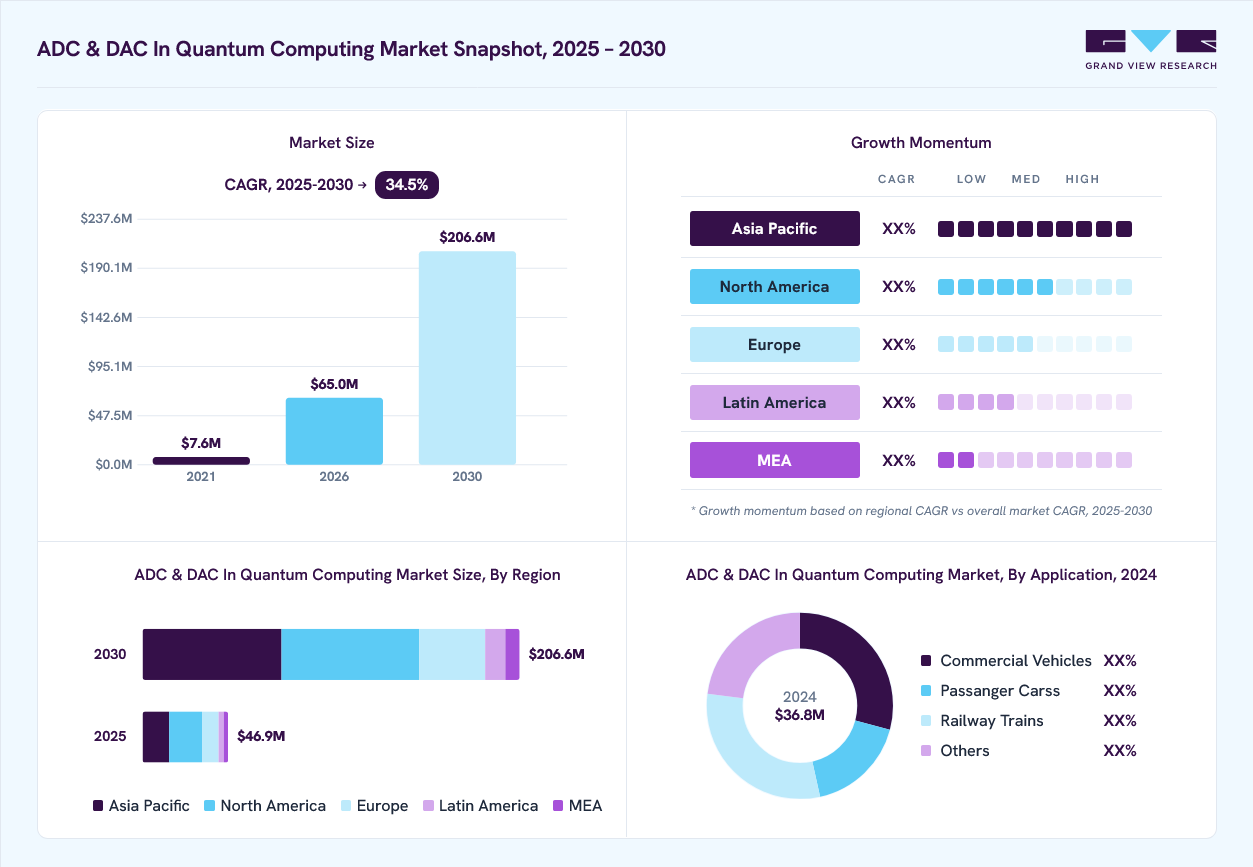 Source: Grand View Research, IR Documents, Primary Interviews, Paid DatabasesTo learn more about this report,
 Download Free Sample Report
 Key Market Trends & Insights
- By type, the DAC segment led the market, holding the largest revenue share of 60.32% in 2024.
- By architecture, the successive approximation register (SAR) segment held the dominant position in the market and accounted for the leading revenue share of 31.16% in 2024.
- By qubit type, the spin qubits segment is expected to grow at the fastest CAGR over the forecast period.
Market Size & Forecast
- 2024 Market Size: USD 36.8 Million
- 2030 Projected Market Size: USD 206.6 Million
- CAGR (2025-2030): 34.5%
- North America: Largest market in 2024
- Asia Pacific: Fastest growing market
Three ways to get this report
Buy it, customize it, or ask a question.Ask an Analyst
Analyst response in 1 business day
- AccessReport author, directly
- Reply timeWithin 1 working day
- No sales callDirect answer only
- FormatEmail reply
- CostFree, no cost
Get the Full Report
What the study covers
- FormatsPDF · Excel · Dashboard
- Timeline2025–2030 annual, 2024 base
- Coverage20+ countries, 5 regions
- Companies10+ key players profiled
Customize the Report
20% free customization
- IncludeCountries, segments, points
- TailorTo your product definition
- ExtendDeeper competitor detail
- OrA fully bespoke study
- Turnaround5–10 working days
Advances in ADC technology have led to converters with high resolution and sensitivity, crucial for reading weak qubit signals and enabling error correction. Similarly, DACs have evolved to provide faster sampling rates and higher resolution for accurate quantum gate operations.The demand for ADCs and DACs in quantum systems differs from their use in traditional electronics. Quantum computing requires converters with very high resolution, low noise, fast sampling speeds, and excellent phase stability. These features ensure that signals sent to and received from qubits are clear and precise, which is essential for high-fidelity quantum operations. The market is driven by the increasing number of qubits in modern processors and the shift toward more scalable and error-corrected systems. Companies working on quantum hardware are actively seeking converter solutions that can meet system-level requirements, including integration with FPGAs, support for cryogenic environments, and reliable synchronization. As a result, ADC and DAC vendors are innovating to fulfill these unique technical demands.
 To learn more about this report, Download Free Sample Report
 Although still a niche market, the ADC & DAC segment in quantum computing is expected to grow steadily as the broader quantum industry expands. Governments, research institutions, and private companies are investing heavily in quantum technologies, which increases the demand for high-quality signal converters. The market presents long-term opportunities for semiconductor manufacturers who can deliver performance, reliability, and integration support. Strategic partnerships between quantum hardware developers and electronics companies are already forming to co-develop suitable converter systems. As the focus shifts from prototypes to commercial quantum computers, this converter market is becoming increasingly important.
Type Insights
The Digital-to-Analog Converters segment led the market, accounting for 60.32% of the global revenue in 2024. DACs are essential for generating accurate analog voltages or microwave pulses needed to manipulate qubit quantum states, where timing accuracy and waveform purity directly affect gate fidelity. Developing ultra-low noise DACs with high bit-depth and wide bandwidth supports complex pulse shaping required for multi-level quantum control, reducing gate errors and crosstalk between qubits. The increasing complexity of quantum circuits requires multi-channel DAC arrays capable of synchronized operation across distributed quantum nodes.
The Analog-to-Digital Converters (ADC) segment is expected to experience significant growth, with a CAGR of 35.6% over the forecast period. The ADC segment converts delicate analog quantum signals into accurate digital data essential for interpreting qubit states during quantum measurement processes. Because quantum states are vulnerable to noise and decoherence, ADCs must provide exceptional resolution, minimal latency, and high signal-to-noise ratios to maintain information integrity. Their integration into cryogenic environments near quantum processors reduces signal degradation and electromagnetic interference, enabling high-fidelity data collection critical for complex quantum algorithms.
Architecture Insights
The Successive Approximation Register (SAR) segment accounted for the largest market revenue share in 2024 due to its rapid access and transfer speeds. SAR analog-to-digital converters (ADCs) have become preferred in quantum computing because of their balanced performance, providing moderate conversion speeds and excellent power efficiency that suit the strict operational needs of quantum readout systems. These converters quickly approximate input signal amplitudes by using stepwise comparison techniques, making them ideal for adaptive measurement cycles and scalable qubit readout arrays where both speed and accuracy are essential. Advanced SAR ADC designs have achieved sub-electron noise levels, which are crucial for accurately distinguishing subtle quantum states, especially in superconducting and spin qubit systems. This sensitive discrimination enables reliable quantum state readout and supports high-fidelity quantum operations.
The Sigma-Delta segment is anticipated to exhibit the highest CAGR during the forecast period. Sigma-delta ADCs enable extremely high-resolution conversion through oversampling and advanced noise shaping techniques, providing key benefits for continuous-variable quantum systems and precision sensor arrays. They naturally produce a noise-filtered output that captures weak analog quantum signals hidden in environmental noise, thereby enhancing measurement accuracy in analytic and sensor-based quantum computing applications. Their design supports multi-megahertz bandwidth inputs, which is crucial for high-speed quantum process tomography.
Qubit Type Insights
The superconducting qubits segment accounted for the largest market revenue share in 2024. Superconducting qubits require extremely precise DACs and ADCs capable of generating and measuring microwave-frequency pulses within millikelvin cryogenic environments. These converters are essential for fast and high-fidelity gating of superconducting circuits, where minimizing latency and noise is crucial for maintaining quantum coherence. They enable the implementation of complex pulse sequences, such as cross-resonance or parametric gates, which are vital to superconducting quantum operations. Integrating conversion electronics closer to the cryogenic qubits reduces signal pathway lengths, decreasing timing jitter and thermal interference that can impair quantum gate performance. Current research focuses on improving mixed-signal cryo-electronics designed for superconducting systems, enhancing features like waveform resolution and readout linearity.
The Spin Qubits segment is projected to have the highest CAGR during the forecast period. For spin qubit architectures, DACs produce finely tuned voltage or magnetic field pulses that gently control spin states, requiring ultra-high resolution and minimal phase noise to maintain coherence and enable accurate gate operations. ADCs convert small electrical signals that represent spin states, often within quantum dots, into digital readouts with exceptional sensitivity despite low signal amplitudes. Tight thermal constraints and device miniaturization demand custom converter designs integrated within cryo-CMOS platforms. Improved precision in DAC and ADC operations allows for quick spin rotations, two-qubit gates, and fast error detection cycles. New converter innovations focus on integrating custom filtering, timing stabilization, and digital feedback directly into the quantum-classical interface electronics.
Application Layer Insights
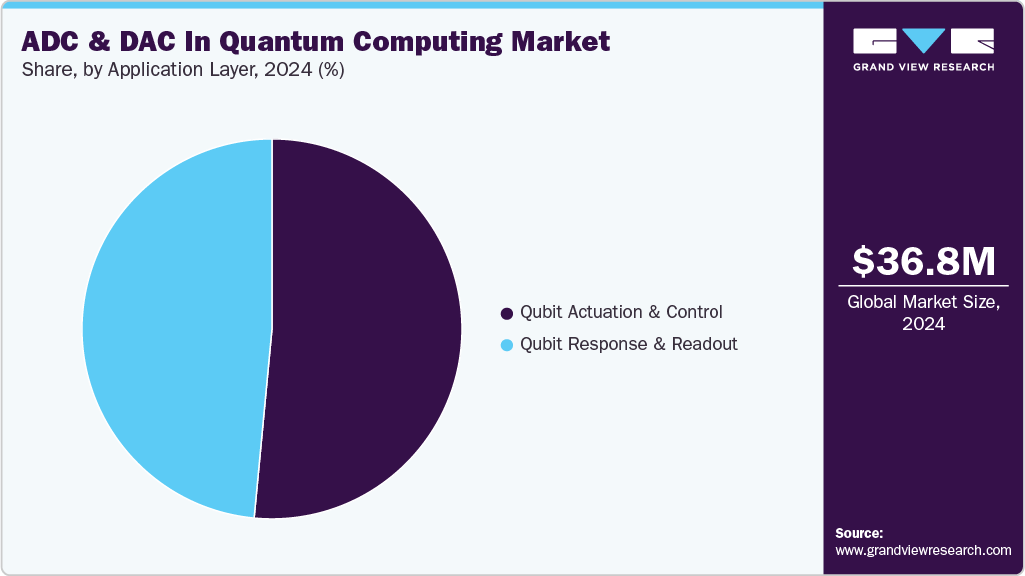
The Qubit Actuation and Control segment accounted for the largest market revenue share in 2024. This segment focuses on digital-to-analog converters (DACs) designed to produce complex, precisely shaped analog waveforms needed for accurate quantum gate operations. These waveforms feature minimal timing jitter and high fidelity, ensuring quantum gates operate correctly and qubit coherence is maintained during computation. Programmable DAC arrays enable the creation of arbitrary waveforms and include distortion compensation techniques to correct hardware imperfections and signal distortions. Placing pulse generation electronics close to qubits helps reduce control signal latency and electromagnetic interference, both essential for preserving delicate quantum states.
 To learn more about this report, Download Free Sample Report
 The Error Correction and Feedback Systems segment is expected to experience the highest CAGR during the forecast period. This segment focuses on converters that are essential for enabling quantum error correction by quickly digitizing qubit measurement signals and producing accurate corrective control pulses. The performance metrics of these ADC and DAC units, such as signal fidelity, bandwidth, and latency, directly influence the effectiveness of error correction protocols and the overall stability of the quantum system. Embedding digital signal processing within these converters reduces classical computing delays, allowing near-instantaneous corrections to qubit states and helping prevent error propagation. Compatibility with cryogenic operation is crucial to ensure converter performance without disrupting the delicate quantum processor environment.
Regional Insights
North America dominated the global ADC & DAC in quantum computing market with a revenue share of over 38.78% in 2024. Rising investments in high-performance computing infrastructure across North America are driving the need for advanced ADC and DAC technologies within the quantum computing sector. Expanded government funding and growing public-private collaborations are raising innovations in quantum hardware, where precise, low-latency signal conversion is critical. The region’s exciting startup scene and strong venture capital support are accelerating the commercialization and continuous refinement of quantum systems. Deepening academic partnerships further bolster ongoing R&D efforts, focusing on scalable and reliable interface electronics vital for future advancements in quantum technology.
 To learn more about this report, Download Free Sample Report
 U.S. ADC & DAC in Quantum Computing Market Trends
The U.S. ADC & DAC in quantum computing market accounted for the largest market revenue share of 68.7% in 2024. The U.S. is at the forefront of quantum computing adoption, powered by a strong research foundation supported by agencies such as the DOE and NSF, with a focus on advanced ADC and DAC development for quantum circuits. Strategic industry-government collaborations are enabling rapid transitions from research to market-ready tools that meet high standards for precision and low noise. Growing enterprise demand for scalable quantum solutions is driving investment in low-latency ADC/DAC types capable of handling complex algorithms and large-scale data workloads.
Europe ADC & DAC in Quantum Computing Market Trends
The ADC & DAC in quantum computing market in the Europe region is expected to witness significant growth over the forecast period. Europe’s quantum computing market is gaining strong power, fueled by substantial public and private investments in scalable, low-latency ADC/DAC technologies that support a variety of quantum architectures. Initiatives such as the quantum technologies flagship are central to integrating high-speed data converters into ion traps and superconducting systems. Leading European HPC centers are driving innovation in hybrid quantum-classical systems, which depend on precise interface electronics for real-time monitoring and control. Emerging quantum technology firms are also advancing error-corrected signal conversion, improving reliability and scalability of quantum platforms.
Asia Pacific ADC & DAC in Quantum Computing Market Trends
The ADC & DAC in Quantum Computing market in the Asia Pacific region is anticipated to register the highest CAGR over the forecast period. The Asia Pacific quantum computing market is progressing rapidly, driven by strong government initiatives and increasing industrial investment in advanced mixed-signal technologies, especially in countries such as China, Japan, South Korea, and India. Targeted R&D into high-throughput ADC and DAC solutions is accelerating the scaling of quantum systems to ensure dependable control and operations. Furthermore, cross-border cooperation is promoting the use of ultra-low-noise, high-speed converters essential for large-scale quantum platforms and the expanding infrastructure of tech talent support the development of advanced quantum hardware compatible with classical systems.
Key ADC & DAC in Quantum Computing Company Insights
Some key companies in the ADC & DAC in quantum computing industry are Analog Devices, Inc; Analog Devices, Inc. and others.
-
Analog Devices, Inc. is a global semiconductor company that designs and supplies products used in sensing, measuring, interpreting, connecting, and powering systems at the intersection of the physical and digital worlds. The company engages in the design, manufacturing, and testing of a broad range of technologies, including software, integrated circuits (ICs), and subsystems. Its products incorporate analog, mixed-signal, and digital signal processing technologies. The product portfolio includes high-precision and high-speed mixed-signal components, power management solutions, data converters, amplifiers, RF ICs, edge processors, and various sensors, serving a diverse range of applications across multiple industries.
-
Texas Instruments Incorporated develops and produces semiconductors that are supplied to electronics designers and manufacturers globally. Its extensive product range supports various functions, including signal conversion and amplification, device interfacing, power management and distribution, data processing, noise reduction, and signal resolution enhancement. This wide-ranging portfolio comprises over 80,000 products that are essential types in nearly all types of electronic equipment.
Key ADC & DAC in Quantum Computing Companies:
The following are the leading companies in the analog-to-digital converters (ADCs) and digital-to-analog converters (DACs) in quantum computing market. These companies collectively hold the largest market share and dictate industry trends.
- IBM Corporation
- Alphabet, Inc.
- Microsoft Corporation
- Amazon
- D-Wave Quantum Inc.
- IonQ, Inc.
- Quantinuum
- Rigetti & Co, LLC.
- Omni Design Technologies, Inc.
- Riverlane Ltd
Recent Developments
-
In May 2025, Texas Instruments Incorporated collaborated with NVIDIA Corporation to advance power management and sensing solutions for 800V high-voltage direct current (HVDC) systems used in data center servers. This innovative power design supports the development of scalable and dependable AI-driven data centers for the future. The collaboration highlights Texas Instruments’ expertise in analog and sensing technologies, crucial for expanding sophisticated computing infrastructures
-
In February 2025, Intel Corporation collaborated with National Institute of Advanced Industrial Science and Technology to industrialize silicon based quantum computing, targeting systems with tens of thousands of qubits by the early 2030s. The collaboration will span materials, cryogenic electronics, qubit integration, and large-scale refrigeration systems.
-
In May 2025, Texas Incorporated launched ADS932x, a dual-channel, high-speed analog-to-digital converter (ADC) capable of simultaneous sampling. It includes an internal reference and reference buffer. Its performance characteristics are suited for applications involving wide-bandwidth data acquisition. The device features an SPI-compatible serial interface, enabling straightforward connectivity with a range of microcontrollers, digital signal processors (DSPs), and field-programmable gate arrays (FPGAs).
ADC & DAC In Quantum Computing Market Report Scope
Report Attribute
Details
Market size in 2024
USD 36.8 million
Estimated market size in 2026
USD 65.0 million
Projected market size by 2030
USD 206.6 million
Growth rate
CAGR of 34.5% from 2025 to 2030
Base year for estimation
2024
Actual data
2017 - 2023
Forecast period
2025 - 2030
Quantitative units
Revenue in USD thousand, and CAGR from 2025 to 2030
Report coverage
Revenue forecast, company ranking, competitive landscape, growth factors, and trends
Segments covered
Type, architecture, qubit type, application layer, region
Regional scope
North America; Europe; Asia Pacific; Latin America; Middle East & Africa
Country scope
U.S.; Canada; Mexico; Germany; UK; France; China; India; Japan; Australia; South Korea; Brazil; UAE; South Africa; Kingdom of Saudi Arabia
Key companies profiled
IBM Corporation; Alphabet, Inc.; Microsoft Corporation; Amazon; D-Wave Quantum Inc.; IonQ, Inc.; Quantinuum; Rigetti & Co, LLC.; Omni Design Technologies, Inc.; Riverlane Ltd
Customization scope
Free report customization (equivalent up to 8 analysts working days) with purchase. Addition or alteration to country, regional & segment scope.
Pricing and purchase options
Avail customized purchase options to meet your exact research needs. Explore purchase options
Global ADC & DAC In Quantum Computing Market Report Segmentation
This report forecasts revenue growth at global, regional, and country levels and provides an analysis of the latest industry trends in each of the sub-segments from 2017 to 2030. For this study, Grand View Research has segmented the global ADC & DAC in quantum computing market report based on the type, architecture, qubit type, application layer, and region.
-
Type Outlook (Revenue, USD Thousand, 2017 - 2030)
-
Digital-to-Analog Converters (DAC)
-
Analog-to-Digital Converters (ADC)
-
-
Architecture Outlook (Revenue, USD Thousand, 2017 - 2030)
-
Successive Approximation Register (SAR)
-
Sigma-delta
-
Pipeline
-
Flash
-
Hybrid & Custom Architectures
-
-
Qubit Type Outlook (Revenue, USD Thousand, 2017 - 2030)
-
Superconducting Qubits
-
Trapped-Ion Qubits
-
Spin Qubits (e.g., quantum dots)
-
Flash
-
Topological and Other Experimental Qubits
-
-
Application Layer Outlook (Revenue, USD Thousand, 2017 - 2030)
-
Qubit Actuation and Control
-
Qubit Response and Readout
-
Error Correction and Feedback Systems
-
-
Regional Outlook (Revenue, USD Thousand, 2017 - 2030)
-
North America
-
U.S.
-
Canada
-
Mexico
-
-
Europe
-
UK
-
Germany
-
France
-
-
Asia Pacific
-
China
-
India
-
Japan
-
Australia
-
South Korea
-
-
Latin America
-
Brazil
-
-
MEA
-
UAE
-
South Africa
-
KSA
-
-
Frequently Asked Questions About This Report
Some key players operating in the ADC & DAC in quantum computing market include Analog Devices, Inc.; Texas Instruments Incorporated; Teledyne Technologies Incorporated; Keysight Technologies; Zurich Instruments AG; Samtec; Intel Corporation; BAE Systems; Amazon; D-Wave Quantum Inc.; IonQ, Inc.; Quantinuum & Rigetti & Co, LLC.
Key factors that are driving the market growth include the demand for ADCs and DACs in quantum systems is different from their use in traditional electronics. Quantum computing requires converters with very high resolution, low noise, fast sampling rates, and excellent phase stability
The global ADC & DAC in quantum computing market size was valued at USD 36.8 million in 2024 and is estimated at USD 65.0 million for 2026.
The global ADC & DAC in quantum computing market is expected to grow at a CAGR of 34.5% from 2025 to 2030, reaching USD 206.6 million by 2030.
North America dominated with a 38.8% revenue share in 2024.
About the Author(s)
Next Generation Technologies Research Team
Technology · Next Generation TechnologiesThis report was authored by the next generation technologies research team at Grand View Research - comprising two research analysts, one senior research analyst, and one industry expert - with specialized expertise in the next generation technologies segment of the technology industry. All findings are based on proprietary technology databases, executive interviews, and regulatory analysis, subject to internal peer review prior to publication.
Last Updated:
Speak to Analyst

Customize this report to your needs - add regions, segments, or data points, with 20% free customization.
Or view our licence options:


ISO 9001:2015 & 27001:2022 Certified
We are GDPR and CCPA compliant! Your transaction & personal information is safe and secure. For more details, please read our privacy policy.


