
- Home
- »
- Next Generation Technologies
- »
-
Aeroponics Market Size, Share & Trends Report, 2026-2033GVR Report cover

Aeroponics Market (2026 - 2033)
Size, Share, & Trends Analysis Report By Component (Hardware, Software), By Farm Type (Indoor Farms, Greenhouse), By Crop Type (Leafy Greens, Fruits & Vegetables, Flowers & Ornamentals), By End-use, By Region, And Segment Forecasts
Market Size, 2025
$4.9BMarket Estimate, 2026
$5.2BMarket Forecast, 2033
$10.0BCAGR, 2026–2033
9.6%Aeroponics Market Summary
The global aeroponics market size was valued at USD 4.9 billion in 2025 and is projected to grow from USD 5.2 billion in 2026 to USD 10.0 billion by 2033, at a CAGR of 9.6% from 2026 to 2033. North America dominated the market, accounting for the largest revenue share of 33.5% in 2025. Growing adoption of controlled-environment agriculture is driving market growth.
 Source: Grand View Research, IR Documents, Primary Interviews, Paid DatabasesTo learn more about this report,
 Download Free Sample Report
 Key Market Trends & Insights
- By component: the hardware segment dominated the market, with a revenue share of 58.8% in 2025.
- By farm type: the indoor farms segment led the market and accounted for a share of 34.5% in 2025.
- By crop type: The leafy greens segment dominated the market, with a revenue share of 39.0% in 2025.
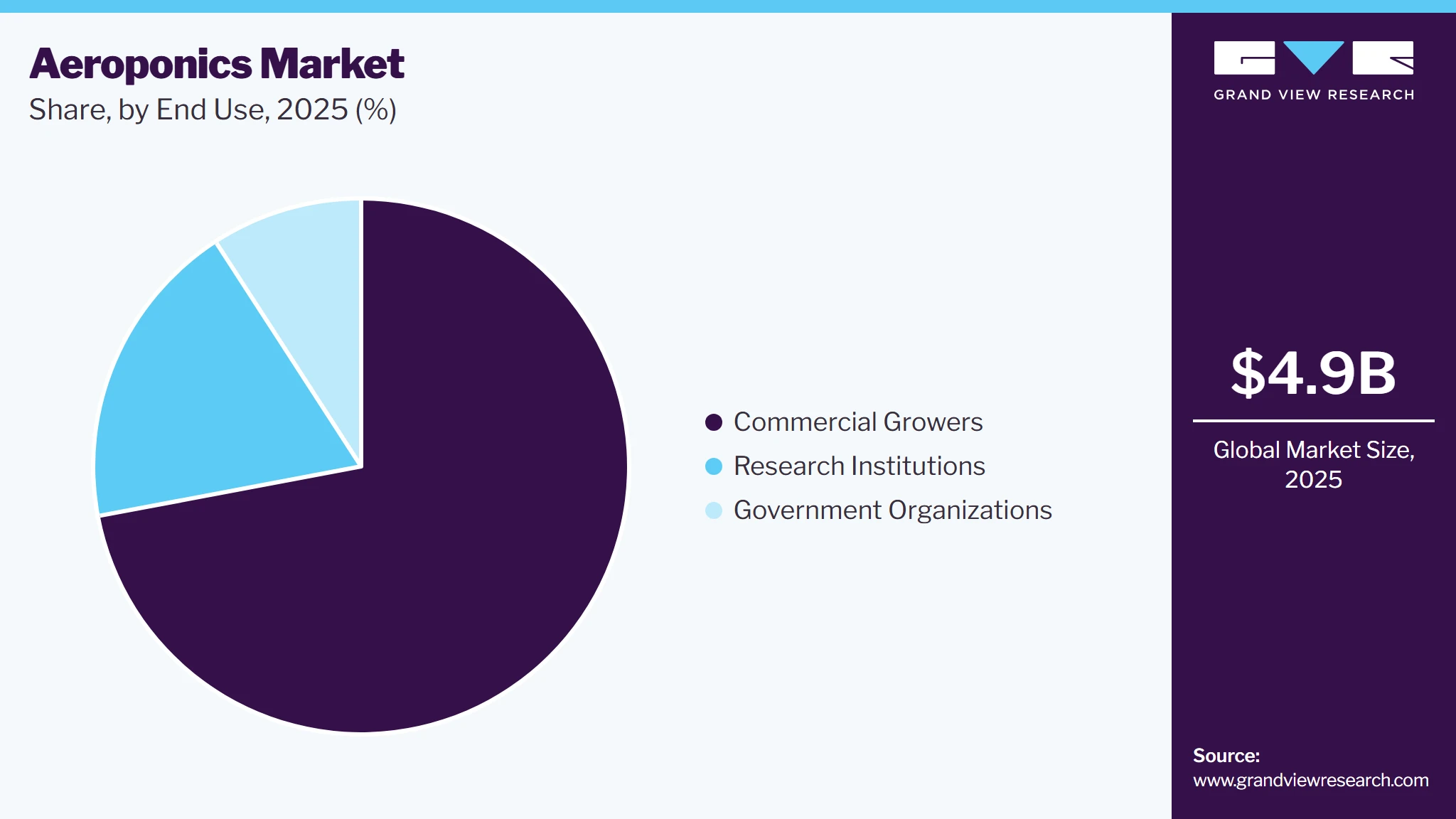
- By end-use: The commercial growers segment held the largest revenue share of 72.0% in 2025.
Regional Highlights
- Largest regional market: North America (33.5% revenue share, 2025)
- Fastest-growing regional market: Asia Pacific (highest CAGR, 2026-2033)
- By country: The U.S. held the largest market share in 2025.
Market Size & Forecast
- Market size in 2025: USD 4.9 Billion
- Estimated market size in 2026: USD 5.2 Billion
- Projected market size by 2033: USD 10.0 Billion
- CAGR (2026-2033): 9.6%
Three ways to get this report
Buy it, customize it, or ask a question.Ask an Analyst
Analyst response in 1 business day
- AccessReport author, directly
- Reply timeWithin 1 working day
- No sales callDirect answer only
- FormatEmail reply
- CostFree, no cost
Get the Full Report
What the study covers
- FormatsPDF · Excel · Dashboard
- Timeline2026–2033 annual, 2025 base
- Coverage20+ countries, 5 regions
- Companies10+ key players profiled
Customize the Report
20% free customization
- IncludeCountries, segments, points
- TailorTo your product definition
- ExtendDeeper competitor detail
- OrA fully bespoke study
- Turnaround5–10 working days
The increasing demand for high-efficiency food production systems is driving growth in the industry as agricultural producers seek cultivation methods that generate higher yields with limited land resources. Aeroponic systems allow plant roots to remain suspended in air while receiving precisely controlled, nutrient-rich mist, enabling faster plant growth, improved nutrient absorption, and more efficient resource utilization than many conventional cultivation methods. Commercial growers increasingly adopt aeroponic technologies to maximize production per square meter while maintaining consistent crop quality across controlled cultivation environments. Urban farming operations, greenhouse producers, research facilities, and commercial vegetable growers increasingly recognize aeroponics as a scalable production technology for intensive cultivation.The rapid expansion of controlled-environment agriculture is driving growth in the market. Greenhouses, indoor farms, vertical farming facilities, plant factories, research laboratories, and climate-controlled cultivation operations increasingly require advanced growing systems capable of delivering consistent production throughout the year. Aeroponic technology allows growers to control temperature, humidity, lighting, nutrient concentration, oxygen availability, and root-zone conditions with high precision across commercial production environments. Controlled cultivation conditions enable producers to optimize crop performance regardless of seasonal weather fluctuations and external environmental variability. The continued expansion of controlled environment farming contributes to sustained demand for aeroponic cultivation technologies.
 To learn more about this report, Download Free Sample Report
 The increasing adoption of automation and precision agriculture technologies is driving growth within the industry. Commercial aeroponic facilities increasingly integrate sensors, automated nutrient-dosing systems, environmental-monitoring platforms, climate-control technologies, artificial-lighting systems, remote-management software, and data-driven cultivation tools to improve operational efficiency and production consistency. Precision management allows growers to optimize nutrient delivery, misting intervals, environmental conditions, crop health monitoring, and resource utilization across large-scale cultivation operations. Agricultural technology providers increasingly develop integrated aeroponic systems that support automated commercial production and scalable facility management. The continued advancement of agricultural automation contributes to sustained demand for sophisticated aeroponic technologies.
The increasing investment in agricultural research and crop innovation is also driving growth within the market. Universities, research institutions, biotechnology companies, seed developers, pharmaceutical producers, and agricultural technology organizations increasingly use aeroponic systems for plant breeding, root development research, nutrient optimization studies, disease management research, and controlled experimental cultivation. Aeroponic environments provide researchers with highly controlled root-zone conditions that support advanced plant science experimentation and crop improvement programs. Research-driven innovation continues expanding the range of crops, production methods, and commercial applications supported by aeroponic technologies. The continued growth of agricultural research and biotechnology activities contributes to sustained demand for aeroponic systems across scientific and commercial sectors.
Market Dynamics
The industry is gaining momentum as growers increasingly seek high-efficiency cultivation systems that produce crops with minimal water use and maximum nutrient utilization. Aeroponic systems suspend plant roots in air and deliver nutrients through a fine mist, enabling rapid plant growth, precise environmental control, and efficient use of cultivation space. Rising concerns regarding water scarcity, declining arable land availability, and the need for year-round agricultural production are encouraging commercial growers, urban farming operators, and research institutions to adopt aeroponic technologies. In addition, advancements in automated nutrient delivery, environmental monitoring, LED grow lighting, and controlled-environment agriculture are improving the scalability and commercial viability of aeroponic farming systems.
The increasing adoption of automation in indoor agriculture is driving growth in the industry, as commercial growers seek production systems that operate with minimal manual intervention while maintaining high crop consistency. Indoor aeroponic facilities rely heavily on automated nutrient delivery, misting systems, environmental control equipment, lighting management, irrigation scheduling, and monitoring technologies that maintain optimal growing conditions throughout the production cycle. Automation enables growers to manage large cultivation facilities more efficiently, reduce labor requirements, and improve operational precision across multiple production zones. Commercial operators increasingly invest in integrated aeroponic systems that combine automated control hardware, sensor networks, programmable controllers, and centralized management software into unified production platforms.
High initial investment in aeroponic infrastructure is constraining growth in the industry, as commercial producers must allocate substantial capital before production can begin. Establishing an aeroponic facility requires specialized grow chambers, nutrient misting systems, pumps, filtration equipment, water circulation networks, environmental control systems, sensors, automation platforms, lighting infrastructure, and structural support components, all of which are significantly more complex than those in many conventional cultivation methods. Commercial growers often need climate-controlled buildings, greenhouses, insulated production environments, electrical infrastructure upgrades, and integrated monitoring systems to maintain optimal operating conditions throughout the year. The cumulative cost of these interconnected technologies can make aeroponic projects financially challenging for small farmers, agricultural startups, educational institutions, and local food production enterprises with limited capital resources.
The rising demand for modular aeroponic farming units is creating substantial opportunities in the industry as growers increasingly seek cultivation systems that can be installed, expanded, relocated, and reconfigured with minimal structural modification. Modular aeroponic units allow producers to start with smaller installations and gradually scale operations by adding standardized cultivation modules, filtration systems, nutrient delivery units, and environmental control components as production requirements change. This flexibility makes aeroponic farming accessible to commercial farms, urban agriculture projects, educational institutions, restaurants, retailers, and community farming initiatives that may not be able to make large upfront infrastructure investments. Manufacturers have opportunities to develop standardized modular platforms that simplify installation, maintenance, transportation, and expansion across different geographic and operational environments.
Analyst Perspective
The market is evolving from a specialized cultivation technique into a high-performance agricultural production platform focused on resource efficiency, crop quality, and production intensity. Unlike traditional farming systems that depend heavily on soil conditions and large land areas, aeroponics is increasingly being evaluated on its ability to deliver higher yields per square meter, faster crop cycles, and consistent production under controlled environmental conditions. Competitive differentiation is shifting toward system reliability, automation capabilities, energy efficiency, and the ability to maintain precise root-zone conditions at a commercial scale. As urban agriculture, vertical farming, and sustainable food production continue to expand, aeroponics is expected to become increasingly important for high-value crop cultivation and regions where land and water constraints make conventional agriculture less efficient.
Component Insights
The hardware segment accounted for the largest share of 58.8% in 2025. The expansion of indoor and vertical farming infrastructure is driving market growth across the hardware segment of the aeroponics market. Indoor cultivation facilities require structural hardware, vertical support systems, modular growing frames, irrigation assemblies, environmental control equipment, lighting fixtures, and integrated cultivation platforms designed specifically for multi-layer production environments. Producers increasingly adopt hardware configurations that maximize production density while maintaining efficient access for planting, monitoring, maintenance, and harvesting operations across compact cultivation spaces. Equipment manufacturers are developing stackable, modular hardware platforms that enable flexible facility design and scalable commercial expansion.
The software segment is anticipated to grow at the fastest CAGR during the forecast period. The growing use of data analytics and production optimization tools is driving market growth across the software segment of the aeroponics market. Commercial aeroponic operations generate large volumes of environmental, operational, and production data that require specialized software for analysis, visualization, benchmarking, forecasting, and performance optimization. Analytics platforms help growers evaluate crop productivity, resource consumption, equipment efficiency, labor utilization, energy usage, water management, and nutrient performance across multiple production cycles. Producers increasingly invest in software that provides detailed operational dashboards, historical trend analysis, production forecasting, and continuous improvement insights across commercial facilities.
Farm Type Insights
The indoor farms segment accounted for the largest market share of 34.5% in 2025. The increasing use of automation technologies in indoor farming operations is driving market growth across the indoor farms segment of the aeroponics market. Commercial indoor facilities increasingly integrate automated nutrient dosing systems, environmental control software, sensor networks, lighting management platforms, irrigation automation, remote monitoring technologies, and predictive maintenance systems that improve operational efficiency across controlled cultivation environments. Automation allows indoor aeroponic farms to maintain precise growing conditions continuously while reducing manual labor requirements and improving production consistency across multiple cultivation zones. Producers increasingly seek intelligent indoor farming systems that support scalable commercial operations and centralized facility management.
The vertical farms segment is expected to register the fastest CAGR from 2026 to 2033. The increasing integration of LiDAR farm type with autonomous agricultural equipment is driving market growth as intelligent machinery requires highly accurate terrain information to navigate safely and efficiently across complex farming environments. LiDAR-generated digital terrain models provide detailed geographic references that improve equipment routing, obstacle identification, field navigation, and operational consistency. More precise terrain data enhances the performance of automated tractors, robotic agricultural equipment, and precision farming systems operating across uneven landscapes. Improved navigation accuracy increases operational efficiency while reducing machinery-related risks. The continued evolution of autonomous farming technologies creates attractive opportunities within the segment.
Crop Type Insights
The leafy greens segment accounted for the largest market share of 39.0% in 2025. The growing emphasis on pesticide-free, clean-label food production is driving market growth in the leafy greens segment of the aeroponics market. Controlled indoor aeroponic environments significantly reduce exposure to many outdoor pests, soil-borne diseases, agricultural runoff, and environmental contaminants that can affect conventional leafy green production. Producers increasingly adopt aeroponic systems that allow stricter control over water quality, nutrient delivery, sanitation protocols, and cultivation conditions throughout the production process. Consumers increasingly associate controlled-environment leafy greens with higher cleanliness, safety, and quality standards across fresh produce categories.
The medicinal & aromatic plants segment is expected to register the fastest CAGR from 2026 to 2033. The increasing demand for premium herbal ingredients is driving market growth within the medicinal and aromatic plants segment of the market. Manufacturers of herbal supplements, botanical extracts, functional foods, natural health products, therapeutic formulations, and traditional medicinal products increasingly seek raw materials with superior purity, uniformity, and predictable phytochemical composition. Aeroponic systems enable growers to optimize cultivation parameters that influence plant quality while minimizing environmental variability throughout the production process. Producers increasingly adopt aeroponic cultivation for high-value herbs such as basil, mint, rosemary, thyme, oregano, chamomile, lavender, and other commercially valuable medicinal and aromatic species. The growing requirement for premium botanical ingredients contributes to sustained demand for aeroponic production systems.
End-use Insights
The commercial growers segment accounted for the largest market share of 72.0% in 2025. The growing participation of institutional investors and agricultural technology companies is driving market growth within the commercial growers segment of the aeroponics market. Large commercial farming enterprises increasingly attract investment from agribusiness corporations, private equity firms, food companies, technology developers, and infrastructure investors seeking scalable controlled-environment agriculture opportunities. Commercial growers increasingly adopt professionally engineered aeroponic systems that provide standardized production performance, technical support, automation compatibility, and flexibility for expansion across multiple cultivation facilities. Investors increasingly prefer commercial production models supported by advanced cultivation technologies and integrated operational management platforms.
 To learn more about this report, Download Free Sample Report
 The research institutions segment is anticipated to register a significant CAGR during the forecast period. The expansion of biotechnology and pharmaceutical plant research is driving market growth across the research institutions segment of the market. Biotechnology companies, pharmaceutical research laboratories, medicinal plant research centers, and botanical science organizations increasingly cultivate plants under controlled aeroponic conditions to study bioactive compounds, secondary metabolites, pharmaceutical crop production, genetic modification, and specialized plant-derived materials. Aeroponic cultivation provides researchers with highly controllable root environments that support advanced biochemical and physiological investigations across medicinal and specialty plant species. Scientific institutions increasingly invest in aeroponic research platforms that support pharmaceutical crop development and plant-based biotechnology applications.
Regional Insights
The North America aeroponics market accounted for 33.5% of revenue in 2025. The growing development of urban warehouse farming facilities is driving growth in the North America aeroponics market. Cities across the region contain large numbers of underutilized warehouses, industrial buildings, logistics facilities, commercial properties, and indoor spaces that can be converted into productive agricultural environments using aeroponic systems. Producers increasingly establish warehouse-based cultivation operations that maximize indoor production density while remaining close to major consumer markets and distribution infrastructure. Aeroponic technology allows these facilities to operate efficiently without dependence on traditional farmland, soil quality, or outdoor weather conditions.
 To learn more about this report, Download Free Sample Report
 U.S. Aeroponics Market Trends
The aeroponics market in the U.S. is projected to grow significantly during the forecast period. The increasing commercialization of premium leafy greens and specialty crops is driving market growth within the U.S. market. Producers increasingly cultivate lettuce, spinach, kale, herbs, microgreens, edible flowers, medicinal plants, and other high-value horticultural products using aeroponic systems that provide exceptional environmental control and production consistency. Retailers and food service companies increasingly require premium produce with uniform quality, predictable availability, and continuous year-round supply across commercial distribution networks. Aeroponic cultivation enables growers to optimize nutrient delivery, lighting conditions, and environmental management specifically for high-value specialty crop production.
Asia Pacific Aeroponics Market Trends
The aeroponics market in Asia Pacific is expected to grow at the fastest CAGR from 2026 to 2033. The expansion of greenhouse and protected cultivation infrastructure is driving market growth within the Asia Pacific. Commercial growers increasingly establish greenhouses, indoor farms, plant factories, and controlled-environment agriculture facilities that require advanced cultivation systems capable of delivering consistent production throughout the year. Aeroponic technology integrates effectively with protected cultivation environments by providing precise nutrient delivery, efficient water use, and optimized root-zone conditions across commercial production facilities. Agricultural enterprises increasingly invest in modern greenhouse infrastructure that supports intensive horticultural production and high-value crop cultivation.
The China aeroponics market is projected to grow significantly during the forecast period. The increasing adoption of agricultural automation and smart farming technologies is driving market growth within the Chinese aeroponics market. Commercial producers increasingly integrate sensors, automated nutrient-dosing systems, artificial intelligence software, climate-control technologies, robotics, remote-monitoring platforms, and digital farm management systems into aeroponic cultivation facilities. Automation enables large-scale indoor farming operations to maintain highly precise growing conditions while improving labor efficiency and operational consistency across multiple cultivation zones. Technology companies increasingly develop intelligent farming solutions specifically designed for commercial aeroponic production and controlled-environment agriculture applications.
The aeroponics market in India is projected to grow significantly during the forecast period. The increasing demand for premium horticultural products is driving market growth across the Indian aeroponics market. Consumers increasingly seek fresh leafy greens, herbs, exotic vegetables, medicinal plants, aromatic crops, and high-quality specialty produce with consistent appearance, nutritional value, and year-round availability. Aeroponic systems allow commercial producers to maintain precise control over nutrient delivery, environmental conditions, and crop development, supporting premium product quality across commercial cultivation facilities. Restaurants, supermarkets, premium grocery retailers, food service companies, and wellness-oriented consumers are increasingly driving demand for high-value crops produced under controlled cultivation conditions.
Europe Aeroponics Market Trends
The aeroponics market in Europe is anticipated to grow steadily from 2026 to 2033. The expansion of high-value medicinal and aromatic plant cultivation is driving market growth across the European aeroponics market. Pharmaceutical companies, cosmetic manufacturers, botanical ingredient suppliers, essential oil producers, and nutraceutical businesses increasingly require standardized cultivation systems that produce herbs and medicinal plants with consistent chemical composition and quality characteristics. Aeroponic technology provides highly controlled growing conditions that support premium botanical production while improving cultivation precision across commercial facilities. Producers increasingly establish dedicated indoor cultivation environments optimized for medicinal herbs, aromatic crops, and specialty botanical products that command premium market value.
The UK aeroponics market is expected to grow significantly during the forecast period. The expansion of premium retail and direct-to-consumer produce distribution is driving market growth across the U.K. Consumers increasingly purchase fresh vegetables and herbs through premium grocery stores, specialty retailers, online food platforms, subscription produce services, and direct farm distribution models that prioritize freshness and product quality. Aeroponic cultivation enables producers to establish facilities near major consumption centers, allowing shorter delivery cycles and more responsive production planning for commercial distribution networks across England, Scotland, Wales, and Northern Ireland. Retail businesses increasingly prefer suppliers capable of providing consistent premium-quality produce throughout the year.
The aeroponics market in Germany is expected to grow significantly during the forecast period. The increasing development of modular indoor farming solutions is driving market growth across the German aeroponics market. Agricultural technology companies increasingly design compact, scalable, and prefabricated aeroponic units that enable commercial growers, startups, research organizations, and food producers to establish cultivation facilities with flexible expansion. Modular systems provide standardized cultivation infrastructure that can be deployed across different locations, including urban areas, industrial sites, and agricultural facilities. Commercial operators increasingly prefer adaptable farming solutions that can be scaled to meet production requirements and market demand.
Key Aeroponics Company Insights
Some prominent players in the aeroponics market include AeroFarms and Esri, among others.
-
AeroFarms is an agricultural technology company specializing in controlled environment agriculture (CEA), indoor vertical farming, and aeroponic growing systems. Its aeroponics products and technologies include the AeroFarms Growing System, aeroponic grow towers, vertical farming modules, controlled-environment growing platforms, LED lighting systems, nutrient delivery systems, environmental monitoring systems, and Farm Wall vertical growing solutions. These systems use precisely controlled conditions, including temperature, humidity, lighting, airflow, and nutrient delivery, to create optimized growing environments for leafy greens, herbs, and other high-value crops.
-
Bifarm Tech is an agricultural technology company focused on developing innovative controlled-environment agriculture solutions, including vertical farming and aeroponic cultivation. Bifarm Tech provides advanced aeroponic growing solutions designed to cultivate plants without traditional soil by supplying nutrient-rich mist directly to plant roots. Its aeroponics products include aeroponic growing systems, vertical farming units, modular indoor farming solutions, nutrient delivery systems, environmental monitoring systems, automated irrigation and misting systems, and controlled environment cultivation platforms. These products are designed to support efficient crop production by maintaining precise control over factors such as nutrient delivery, humidity, temperature, lighting, and root-zone conditions.
Key Aeroponics Companies
The following key companies have been profiled for this study on the aeroponics market.
-
AeroFarms
-
Aessense Corporation
-
Barton Breeze Pvt. Ltd.
-
Bifarm Tech
-
Blue Stallion Equipments Pvt. Ltd.
-
Eden Grow Systems
-
Hydrogreen Energy Private Limited
-
LettUs Grow Ltd.
-
Living Greens Farm, Inc.
-
Neofarms GmbH
Competitive Benchmarking
Operating Strategies
Competitive Edge
Weakness
Mature Players: AeroFarms; LettUs Grow; AEssenseGrows; American Hydroponics
- Established players focus on commercial aeroponic cultivation systems that combine nutrient delivery, environmental control, lighting, and automation for high-value crop production.
- They invest in controlled-environment agriculture technologies, commercial farming partnerships, and scalable production facilities to improve crop yields and resource efficiency.
- These companies benefit from advanced cultivation expertise, proven commercial farming experience, and integrated technology platforms that support large-scale indoor food production.
- Their ability to optimize water use, nutrient delivery, and environmental conditions enables consistent crop quality and operational efficiency.
- High capital investment requirements for controlled-environment infrastructure can increase production costs and slow facility expansion.
- Energy consumption, technical maintenance, and the need for specialized operational expertise may also affect profitability and broader market adoption.
Emerging Players: Eden Grow Systems; Neofarms GmbH; Living Greens Farm, Inc.; Bifarm Tech
- Emerging players focus on modular aeroponic systems, urban farming solutions, and compact commercial platforms designed for localized food production and specialty crop cultivation.
- They emphasize ease of installation, remote monitoring, subscription-based services, and flexible system configurations that support smaller commercial growers and institutional users.
- These companies offer adaptable system designs, faster deployment, and strong capabilities in urban and decentralized farming applications.
- Their technology-driven approaches enable efficient production in space-constrained environments and support the growing demand for locally produced fresh food.
- Limited production scale and smaller distribution networks can restrict expansion into large commercial agriculture markets.
- Building customer awareness and achieving cost competitiveness against conventional farming systems remain important long-term growth challenges.
Recent Developments
-
In July 2026, LettUs Grow Ltd. partnered with QuberTech and the John Innes Center on an initiative supported by the U.K. Government’s Defra Farming Innovation Program and delivered in collaboration with Innovate U.K. The partnership brings together the John Innes Center’s advanced plant science capabilities, QuberTech’s gene-editing expertise, and LettUs Grow’s advanced aeroponic technology to optimize crops for high-density, soil-less indoor farming systems. Through the QuBOOSTR project, LettUs Grow is expanding the application of aeroponics beyond traditional food crops into industrial and specialty crops that have the potential to create new commercial opportunities.
-
In June 2026, AeroFarms was acquired by an affiliate of Palm Ventures, with the partnership focused on sustainable expansion, long-term profitability, stronger customer engagement, and continued development of popular microgreen varieties, while maintaining AeroFarms’ Certified B mission. The investment also reflects growing demand for functional nutrition solutions that support healthier lifestyles and weight management, a trend further accelerated by the increasing adoption of GLP-1 medications among consumers.
-
In May 2025, CambridgeHOK signed a new strategic partnership with agri-tech company LettUs Grow to accelerate the adoption of advanced aeroponics within the U.K. commercial horticulture sector. Through this collaboration, the companies will combine horticultural engineering expertise with innovative growing technologies to support more sustainable and efficient food production.
Aeroponics Market Report Scope
Report Attribute
Details
Market size value in 2025
USD 4.9 billion
Market size value in 2026
USD 5.2 billion
Revenue forecast in 2033
USD 10.0 billion
Growth rate
CAGR of 9.6% from 2026 to 2033
Actual data
2021 - 2025
Forecast period
2026 - 2033
Quantitative units
Revenue in USD billion and CAGR from 2026 to 2033
Report coverage
Revenue forecast, company share, competitive landscape, growth factors, and trends
Segments covered
Component, farm type, crop type, end-use, region
Regional scope
North America; Europe; Asia Pacific; Latin America; MEA
Country scope
U.S.; Canada; Mexico UK; Germany; France; China; India; Japan; Australia; South Korea; Brazil; UAE; Saudi Arabia; South Africa
Key companies profiled
AeroFarms; Aessense Corporation; Barton Breeze Pvt. Ltd.; Bifarm Tech; Blue Stallion Equipments Pvt. Ltd.; Eden Grow Systems; Hydrogreen Energy Private Limited; LettUs Grow Ltd.; Living Greens Farm, Inc.; Neofarms GmbH
Customization scope
Free report customization (equivalent to 8 analysts working days) with purchase. Addition or alteration to country, regional & segment scope.
Pricing and purchase options
Avail customized purchase options to meet your exact research needs. Explore purchase options
Global Aeroponics Market Report Segmentation
This report forecasts revenue growth at global, regional, and country levels and provides an analysis of the latest industry trends in each of the sub-segments from 2021 to 2033. For this study, Grand View Research has segmented the global aeroponics market report based on component, farm type, crop type, end-use, and region:
-
Component Outlook (Revenue, USD Billion, 2021 - 2033)
-
Hardware
-
Software
-
Services
-
-
Farm Type Outlook (Revenue, USD Billion, 2021 - 2033)
-
Indoor Farms
-
Greenhouses
-
Vertical Farms
-
Container Farms
-
-
Crop Type Outlook (Revenue, USD Billion, 2021 - 2033)
-
Leafy Greens
-
Fruits & Vegetables
-
Flowers & Ornamentals
-
Medicinal & Aromatic Plants
-
Others
-
-
End-use Outlook (Revenue, USD Billion, 2021 - 2033)
-
Commercial Growers
-
Research Institutions
-
Government Organizations
-
-
Regional Outlook (Revenue, USD Billion, 2021 - 2033)
-
North America
-
U.S.
-
Canada
-
Mexico
-
-
Europe
-
Germany
-
U.K.
-
France
-
-
Asia Pacific
-
China
-
India
-
Japan
-
South Korea
-
Australia
-
-
Latin America
-
Brazil
-
-
Middle East & Africa
-
UAE
-
Saudi Arabia
-
South Africa
-
-
Research Methodology
The aeroponics market figures in this report are based on a proven research process that combines executive interviews with secondary research from proprietary databases, company filings, and recognized regulatory and institutional sources. Market size is built through value-chain sizing - reconciling supply-side and demand-side estimates - and triangulated with bottom-up and top-down approaches. Every estimate passes multiple levels of expert validation before publication, with each aeroponics segment quantified using the revenue-capture definitions in the table below.
Segment Definition
Component
Revenue capture definition
Hardware
The largest component segment, capturing value through aeroponic cultivation equipment, includes misting systems, nutrient delivery units, pumps, reservoirs, sensors, climate control systems, and automated growing infrastructure. Demand is supported by the growing adoption of controlled-environment agriculture, in which growers invest in precision equipment to improve water efficiency, crop productivity, and environmental control.
Software
Market value is created through farm management platforms, automation software, monitoring dashboards, AI-based crop analytics, and IoT-enabled control systems that optimize nutrient delivery, humidity, temperature, and plant growth conditions. Software providers increasingly monetize through subscription-based solutions that enable remote farm management and data-driven cultivation decisions.
Services
Commercial opportunities arise from installation, system integration, consulting, maintenance, training, crop optimization support, and managed aeroponic farm operations. Service providers play an important role in helping growers adopt complex aeroponic systems and improve operational performance throughout cultivation cycles.
Farm Type
Revenue capture definition
Indoor Farms
The largest farm type segment is driven by fully controlled cultivation environments that enable year-round production, optimized resource utilization, and consistent crop quality. Indoor aeroponic farms benefit from urban agriculture trends, reduced dependence on climate conditions, and the ability to produce high-value crops close to consumers.
Greenhouses
Market value is captured through greenhouse-based aeroponic systems that combine natural lighting with controlled irrigation, nutrient delivery, and environmental management. Growers adopt these systems to improve yields, reduce water consumption, and extend growing seasons while maintaining lower energy requirements compared with fully indoor facilities.
Vertical Farms
The fastest-growing farm-type segment is supported by multilayer cultivation structures that maximize production output on limited land areas. Aeroponics is increasingly integrated into vertical farming due to its ability to deliver nutrients efficiently, reduce water usage, and support high-density urban food production.
Container Farms
Demand is driven by modular aeroponic systems installed in shipping containers or compact structures, enabling localized food production in urban, remote, and resource-constrained areas. These systems provide flexible deployment options for businesses seeking scalable farming solutions with minimal land requirements.
Crop Type
Revenue capture definition
Leafy Greens
The largest crop segment, benefiting from the suitability of aeroponic systems for fast-growing crops such as lettuce, spinach, kale, and herbs. Commercial growers adopt aeroponics for leafy greens due to shorter growth cycles, efficient nutrient absorption, reduced water consumption, and consistent year-round supply.
Fruits & Vegetables
Market opportunities are expanding as aeroponic technology advances, supporting crops that require more complex root structures and longer growth periods. Growers use controlled aeroponic systems to improve crop quality, reduce disease exposure, and achieve higher yields of premium fruits and vegetables.
Flowers & Ornamentals
Value is generated through the controlled cultivation of high-value ornamental plants and flowers that require precise environmental conditions. Aeroponic systems help growers improve root development, maintain consistent quality, and optimize production cycles for specialty horticultural products.
Medicinal & Aromatic Plants
Commercial demand is supported by increasing cultivation of medicinal herbs, pharmaceutical plants, and aromatic crops under controlled environments. Aeroponics enables precise nutrient management, contamination control, and consistent production quality for plants used in healthcare, wellness, and specialty markets.
Others
This category includes microgreens, seedlings, research crops, and specialty plants cultivated through aeroponic systems. Expanding interest in sustainable agriculture, plant-based products, and innovative cultivation methods continues to create opportunities for diverse crop applications.
End Use
Revenue capture definition
Commercial Growers
The largest end-use segment, capturing investment from farms, urban agriculture companies, and controlled-environment agriculture operators seeking higher productivity and efficient resource utilization. Commercial growers adopt aeroponics to achieve consistent crop output, reduce water usage, and address challenges related to land availability and labor shortages.
Research Institutions
Universities, agricultural research centers, and technology developers utilize aeroponic systems for plant science studies, crop optimization, biotechnology research, and the development of advanced cultivation techniques. These applications support innovation in root biology, nutrient management, and sustainable farming practices.
Government Organizations
Public-sector organizations deploy aeroponic systems for food security initiatives, agricultural development programs, climate-resilient farming projects, and demonstration facilities. Government-backed controlled farming projects support adoption in regions facing water scarcity, limited arable land, or increasing demand for local food production.
Estimation Model
Layer
Question
Analysis
Root-Zone Innovation Layer
Where does aeroponic cultivation provide a distinct production advantage?
Identify cultivation environments where suspending plant roots in air and delivering nutrients through fine mist systems creates measurable advantages over soil-based and conventional hydroponic production. These include vertical farms, indoor farms, research facilities, seed propagation operations, pharmaceutical plant cultivation, and high-value horticultural production. This layer defines demand based on the need for faster growth cycles, precise nutrient control, reduced water consumption, and efficient cultivation in space-constrained environments.
Controlled Environment Engineering Layer
What enables successful aeroponic system deployment?
Assess the engineering requirements necessary to maintain stable aeroponic cultivation, including mist generation systems, nutrient atomization, root oxygenation, water filtration, pressure control, environmental monitoring, climate management, and backup power systems. Adoption depends on the ability to maintain uninterrupted nutrient delivery and environmental stability, as root systems are highly sensitive to equipment failures and fluctuations in operating conditions.
High-Precision Cultivation Layer
How are aeroponic systems integrated into commercial production operations?
Analyze the use of aeroponic technologies for leafy greens, herbs, strawberries, seed potatoes, medicinal plants, and propagation material across vertical farming facilities, greenhouses, and specialized controlled-environment agriculture operations. Producers integrate automation, sensors, AI-based monitoring, robotics, and nutrient management software to optimize root-zone conditions, improve crop uniformity, accelerate propagation, and enable year-round high-density production.
Technology-Driven Agricultural Value Layer
How is commercial value generated within the aeroponics ecosystem?
Evaluate revenue streams from aeroponic system sales, misting and nutrient delivery equipment, climate control technologies, automation software, maintenance services, crop production, consulting, and turnkey vertical farming installations. Additional value is created through premium crop quality, rapid propagation capabilities, reduced water and fertilizer use, higher production density, and recurring revenues from system upgrades, monitoring platforms, and specialized cultivation services.
Delivered Customization
This report has been delivered with the following In-depth customizations
Client Request
Customization Delivered
Value Adds
Root-Zone Mist Cultivation & High-Efficiency Crop Production Trends
Conducted a focused analysis of aeroponic cultivation systems covering root-zone mist delivery, nutrient atomization, oxygen-rich root environments, and rapid crop growth across leafy greens, herbs, seed potatoes, and high-value horticultural crops.
Helps stakeholders identify high-productivity cultivation models, evaluate advanced soilless farming adoption trends, and assess commercialization opportunities in ultra-efficient crop production systems.
Controlled Environment Propagation & Seed Production Adoption Trends
Evaluated adoption trends for aeroponics in plant propagation, nursery operations, tissue culture hardening, seed potato production, vertical farming facilities, and research-oriented controlled environment agriculture applications.
Provides insights into specialized propagation opportunities, premium agricultural production segments, and commercially attractive applications supporting high-quality planting material and year-round cultivation.
Advanced Aeroponic Infrastructure & Precision Nutrient Delivery Opportunity Assessment
Assessed demand for automated misting systems, nutrient dosing technologies, root-zone monitoring sensors, climate-controlled chambers, and AI-enabled cultivation management platforms, along with challenges related to system complexity, maintenance requirements, power reliability, and large-scale commercial deployment.
Supports investment and expansion strategies by identifying next-generation cultivation opportunities, evaluating operational readiness, and strengthening long-term growth potential in precision-controlled and resource-efficient agricultural production ecosystems.
Frequently Asked Questions About This Report
Key factors include growing adoption of controlled-environment agriculture, increasing demand for high-efficiency food production systems, and increasing investment in agricultural research and crop innovations.
North America dominated the market with 33.5% revenue share in 2025.
Asia Pacific is the fastest-growing region over the forecast period.
The hardware segment led with an 58.8% revenue share in 2025, while software segment is the fastest-growing segment.
The indoor farms segment led with an 34.5% revenue share in 2025, while the vertical farms is the fastest-growing segment.
Key players operating in the aeroponics market include AeroFarms, Aessense Corporation, Barton Breeze Pvt. Ltd., Bifarm Tech, Blue Stallion Equipments Pvt. Ltd., Eden Grow Systems, Hydrogreen Energy Private Limited, LettUs Grow Ltd., Living Greens Farm, Inc., Neofarms GmbH.
The global aeroponics market size was valued at USD 4.9 billion in 2025 and is expected to reach USD 5.2 billion in 2026.
The global aeroponics market is expected to grow at a CAGR of 9.6% from 2026 to 2033 to reach USD 10.0 billion by 2033.
The leafy greens held the largest share of 39% in 2025, while medicinal & aromatic plants is the fastest-growing segment.
About the Author(s)
Next Generation Technologies Research Team
Technology · Next Generation TechnologiesThis report was authored by the next generation technologies research team at Grand View Research - comprising two research analysts, one senior research analyst, and one industry expert - with specialized expertise in the next generation technologies segment of the technology industry. All findings are based on proprietary technology databases, executive interviews, and regulatory analysis, subject to internal peer review prior to publication.
Last Updated:
Speak to Analyst

Customize this report to your needs - add regions, segments, or data points, with 20% free customization.
Or view our licence options:


ISO 9001:2015 & 27001:2022 Certified
We are GDPR and CCPA compliant! Your transaction & personal information is safe and secure. For more details, please read our privacy policy.


