
- Home
- »
- Next Generation Technologies
- »
-
Aerospace Insurance Market Size And Share Report, 2033GVR Report cover

Aerospace Insurance Market (2026 - 2033)
Size, Share & Trends Analysis Report By Type (Passenger Liability, In-flight), By Aircraft Type (Commercial Aircraft, Helicopters, Business Jets), By End-user (Airlines, General Aviation), By Region, And Segment Forecasts
Market Size, 2025
$4.8BMarket Estimate, 2026
$4.9BMarket Forecast, 2033
$7.0BCAGR, 2026–2033
5.2%Aerospace Insurance Market Summary
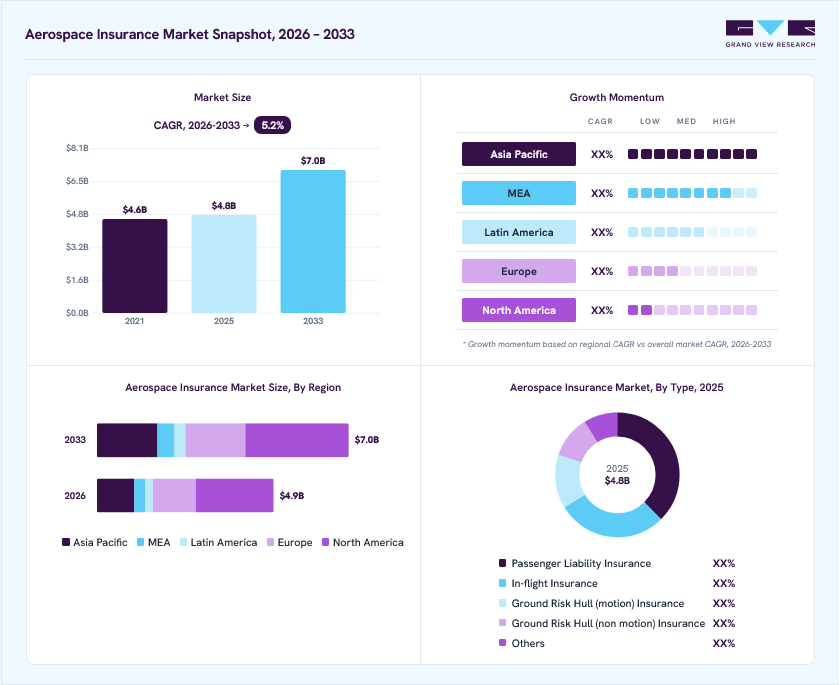
The global aerospace insurance market size was valued at USD 4.8 billion in 2025 and is projected to grow from USD 4.9 billion in 2026 to USD 7.0 billion by 2033, at a CAGR of 5.2% from 2026 to 2033. North American market dominated the market, accounting for a revenue share of 44.5% in 2025. Increasing aircraft production and air traffic are driving demand for aerospace insurance by expanding the need for coverage for aircraft, liability, and operational risks.
 Source: Grand View Research, IR Documents, Primary Interviews, Paid DatabasesTo learn more about this report,
 Download Free Sample Report
Key Market Trends & Insights
- By type: The passenger liability insurance segment led the market and accounted for 37.5% of the global revenue in 2025
- By aircraft type: The commercial aircraft segment led the market, accounting for 54.4% of global revenue in 2025.
- By end user: The Airlines segment accounted for the largest share of global revenue in 2025.
Regional Highlights
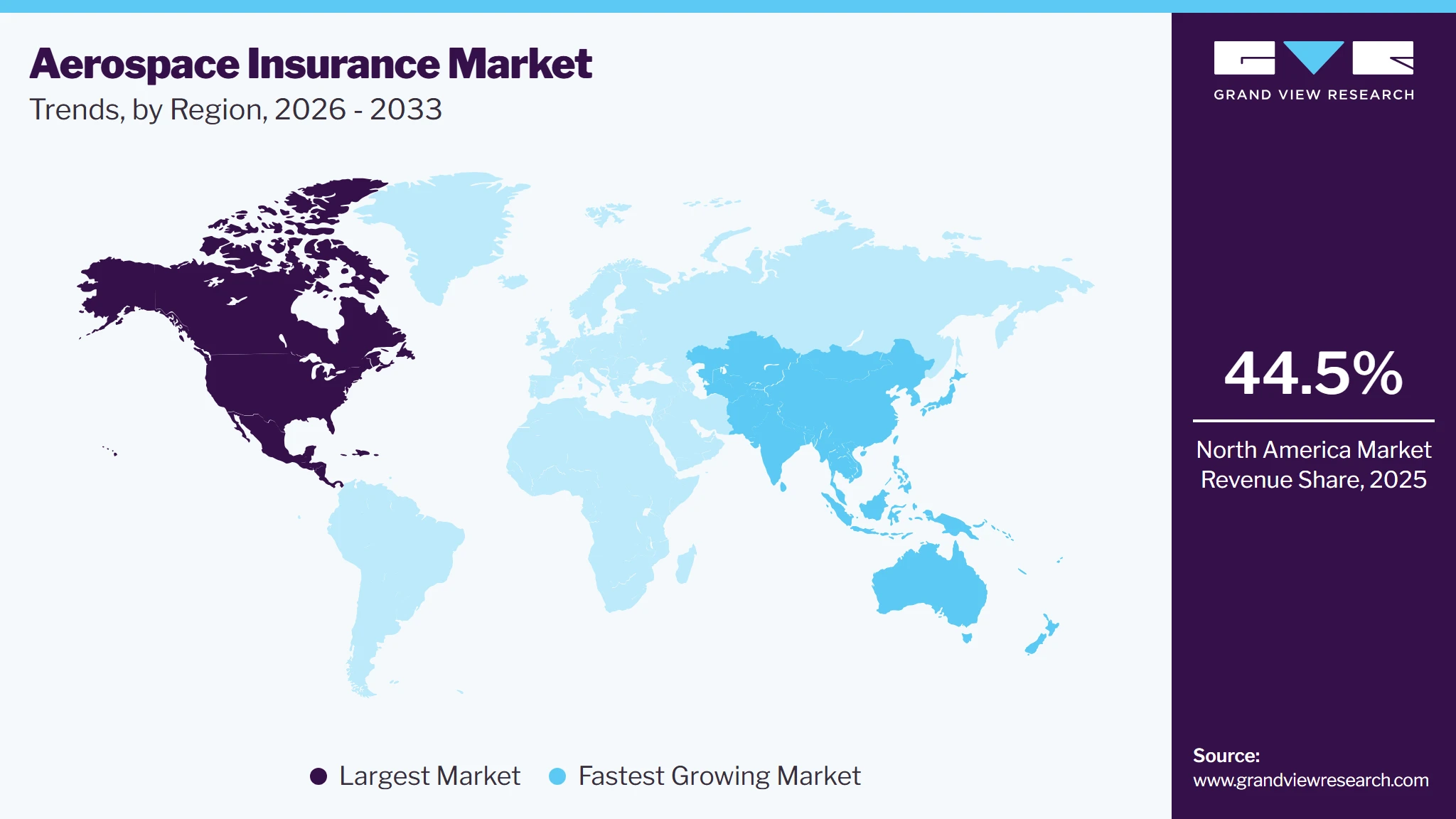
- Largest regional market: North America (44.5% revenue share, 2025)
- Fastest-growing regional market: Asia Pacific (highest CAGR, 2026-2033)
- By country: The U.S. held the largest market share in 2025.
Market Size & Forecast
- Market size in 2025: USD 4.8 Billion
- Estimated market size in 2026: USD 4.9 Billion
- Projected market size by 2033: USD 7.0 Billion
- CAGR (2026-2033): 5.2%
Prism AI by Grand View Research Free to tryAsk a question about the aerospace insurance marketTry asking✓Every figure cited from GVR research Prefer the report? Download free sample →
The increasing demand for commercial aircraft is fueling market growth. As airlines expand their fleets to serve more passengers and connect to more destinations, the number of aircraft requiring insurance coverage is also increasing. With more aircraft in operation, the likelihood of damage, accidents, and other unexpected losses increases the need for financial protection. This is encouraging airlines to maintain suitable insurance coverage for their aircraft, passengers, and other parties. As a result, the continued expansion of commercial aircraft fleets is supporting market growth.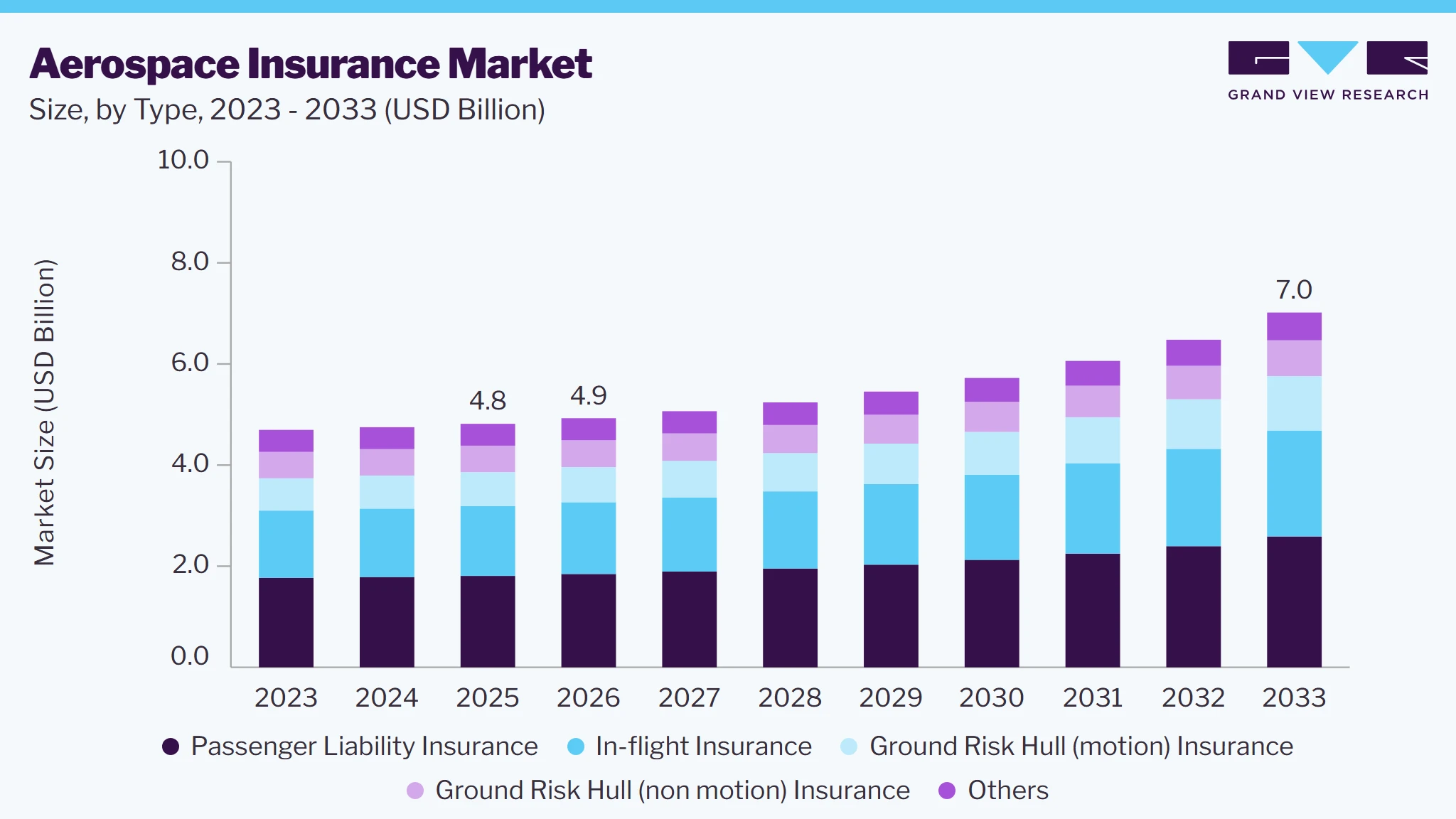 To learn more about this report, Download Free Sample Report
The growing adoption of artificial intelligence is advancing technology in the market. Insurers are using AI to analyze large volumes of data on aircraft, customers, and past claims. This helps insurers identify possible risks and make faster decisions about insurance coverage. Faster and simpler insurance processes are making it easier for customers to manage their policies and claims. As AI becomes more widely used, it is creating new opportunities for market growth.
Stronger government rules for space activities are increasing the focus on safety and risk protection across the aerospace industry. As the number of satellites and other space activities continues to grow, governments are paying greater attention to mitigating potential damage and losses. This growing focus is encouraging companies to take stronger steps to protect their space assets and manage risks. For example, in June 2025, the European Commission proposed the EU Space Act to make space activities safer and more sustainable. The proposal includes measures to reduce space debris, track objects in space, improve cybersecurity, and reduce environmental risks. As these requirements become more important, the need for suitable aerospace insurance coverage is expected to increase.
The high risk of large claims is constraining market growth. A single aircraft accident can result in major losses from aircraft damage, passenger injuries, and third-party claims. These large potential losses can make insurers more cautious and increase insurance costs for customers. As a result, the possibility of high-value claims can limit the availability of affordable aerospace insurance coverage.
Market Dynamics
The market is being influenced by increasing aircraft production, rising air passenger traffic, expanding aerospace manufacturing, and the emergence of new aviation technologies. Growing aircraft utilization increases exposure to hull, passenger liability, third-party liability, and product-related risks. At the same time, connected aircraft, autonomous systems, drones, artificial intelligence, and cybersecurity are creating new and complex risk categories. These developments support demand for specialized insurance products and customized coverage solutions across the aerospace value chain.
The expansion of commercial aviation and aircraft production is increasing the number of aircraft and aerospace assets requiring financial protection. Rising passenger traffic is encouraging airlines to expand fleet capacity and increase aircraft utilization. Higher aircraft activity increases the risk of accidents, physical damage, passenger claims, third-party liabilities, and operational disruptions. Growing aerospace manufacturing and maintenance activities are also creating additional insurance requirements across the industry.
Aerospace insurance provides financial protection against aircraft damage, passenger-related claims, third-party liabilities, and other aviation risks. Coverage can be structured according to aircraft value, fleet size, operational activity, and individual risk exposure. The availability of specialized hull, liability, product liability, and ground-risk coverage helps aerospace businesses manage potential financial losses. This supports continued aircraft operations and fleet expansion while strengthening demand for aerospace insurance.
Aerospace insurance involves high-value assets and potentially severe losses arising from aircraft accidents, manufacturing defects, passenger claims, and third-party incidents. A single major event can generate substantial claims because aircraft values and associated liability exposures are high. Emerging risks related to cybersecurity, artificial intelligence, autonomous systems, and connected aircraft are also difficult to assess using conventional underwriting methods. These conditions increase underwriting complexity and can result in stricter coverage conditions and higher premiums.
The impact is particularly significant for airlines, aircraft manufacturers, airports, and other organizations with large assets and high liability exposure. Smaller operators can also face affordability challenges when risks are difficult to quantify or when historical claims are unfavorable. Limited historical data for new aviation technologies can make risk pricing more difficult and increase uncertainty for insurers. Consequently, complex risk assessment and higher insurance costs can slow down adoption among higher-risk customers.
The increasing use of drones connected to aircraft, artificial intelligence, autonomous aviation systems, and advanced aerospace technologies is creating new categories of insurable risk. These technologies introduce potential exposures related to software failures, cyber incidents, system malfunctions, data breaches, operational errors, and technology-related liabilities. Traditional aviation insurance products may not fully address these emerging exposures. This is creating an opportunity for specialized insurance products designed around new aviation technologies.
The opportunity is particularly strong in UAV insurance, aviation cybersecurity coverage, technology-related liability, and customized protection for advanced aircraft systems. Flexible insurance products can provide protection based on operational characteristics, technology configuration, usage patterns, and individual risk exposure. Advanced underwriting and risk-modeling capabilities can further improve the assessment of emerging aviation risks. Increasing adoption of new aviation technologies is expected to expand the addressable scope of aerospace insurance.
Market Concentration & Characteristics
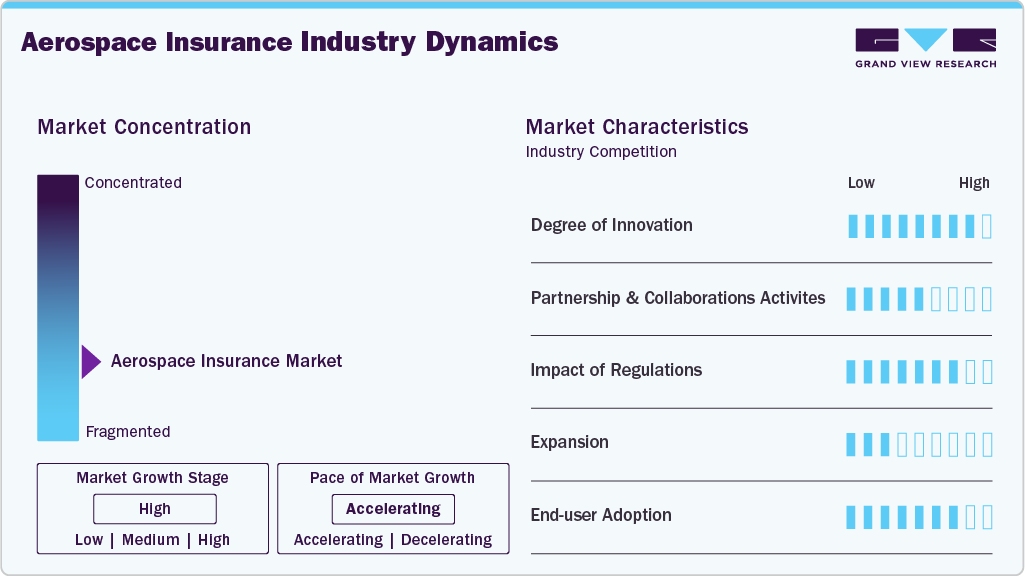
The aerospace insurance industry is moderately consolidated, with several large insurers and specialized aviation insurance providers offering established underwriting capabilities, broad coverage portfolios, and strong financial capacity. However, the market is not dominated by a small number of participants because specialized insurers and regional providers also serve specific aircraft types, aviation activities, and geographic markets. Competition is influenced by underwriting expertise, claims-handling capabilities, risk assessment, coverage flexibility, and the ability to manage high-value and complex aviation risks. The market is also experiencing accelerating growth, supported by increasing aircraft fleets, rising air traffic, expanding aerospace manufacturing, and growing insurance requirements across airlines, general aviation, aircraft manufacturers, and other aviation participants.
 To learn more about this report, Download Free Sample Report
Market characteristics indicate a medium-to-high degree of innovation and end-user adoption, as insurers increasingly use digital underwriting, advanced risk analytics, connected aircraft data, and technology-enabled claims management. Partnership and collaboration activity is moderate, particularly around risk assessment, aviation technology, cybersecurity, and specialized coverage development. The impact of regulations is relatively high because aviation insurance is closely linked with aviation safety, liability requirements, operational standards, and regulatory compliance across different jurisdictions. Substitute pressure remains moderate, as aerospace-specific insurance is difficult to replace for major aviation risks, although self-insurance, captive insurance, and alternative risk-transfer mechanisms can address selected exposures. Moreover, these characteristics support a competitive market in which established providers maintain strong positions, while specialized offerings and emerging aviation risks create opportunities for differentiation.
Analyst Perspective
The market is experiencing steady expansion as aircraft fleets, passenger traffic, aerospace manufacturing, and aviation activity increase. Growing exposure to aircraft damage, passenger liability, product liability, and operational risks is supporting demand for specialized coverage. Digital aircraft systems, drones, artificial intelligence, autonomous technologies, and cybersecurity are also creating new insurance requirements. Future investment is expected to focus on advanced risk assessment, customized policies, digital underwriting, and coverage for emerging aviation risks. The market is likely to favor insurance providers with strong underwriting capabilities, broad risk coverage, and the ability to address increasingly complex aerospace exposures.
Type Insights
The passenger liability insurance segment accounted for 37.5% of global revenue in 2025, the largest share. Rising air passenger traffic is creating greater demand for passenger liability insurance. As more passengers travel by air, the number of people exposed to possible accidents and injuries during journeys is also increasing. This is encouraging airlines and aircraft operators to strengthen financial protection for passenger-related claims. The growing volume of air travel is supporting the adoption of passenger liability insurance.
The Ground risk hull (motion) insurance segment is projected to grow at the fastest CAGR over the forecast period. The increasing demand for digital airport management systems is driving growth in the segment. These systems provide better coordination of aircraft movement and ground activities at airports. Improved coordination is helping reduce the possibility of ground accidents and supporting better risk assessment for insurers. As digital airport systems become more widely adopted, the technology is supporting the adoption of ground risk hull (motion) insurance.
Aircraft Type Insights
The commercial aircraft segment accounted for 54.4%, the largest share of global revenue in 2025. The segment’s growth is driven by its widespread adoption among airlines and commercial aircraft operators for continuous aircraft protection. These policies provide coverage for a specified period, typically one year, offering protection against risks such as accidents, aircraft damage, passenger claims, and ground-related incidents during regular operations. The growing commercial aircraft fleet, rising air passenger traffic, and increasing flight operations continue to drive demand for commercial aircraft insurance. Furthermore, continuous coverage and simplified policy management make these policies a preferred choice for airlines operating aircraft year-round.
The business jets segment is projected to grow at the fastest CAGR over the forecast period. The increasing use of business jets for corporate travel and private transportation reflects the segment's growth. These aircraft require insurance coverage to protect against risks such as accidents, damage, and passenger-related claims during regular operations, making the segment suitable for companies and private aircraft operators with frequent travel needs. The growth of corporate travel, rising private aviation activities, and increasing ownership of business jets are accelerating the adoption of insurance coverage for business jets. Furthermore, the high value of these aircraft and the need for continuous protection are strengthening demand for the business jet segment.
End-user Insights
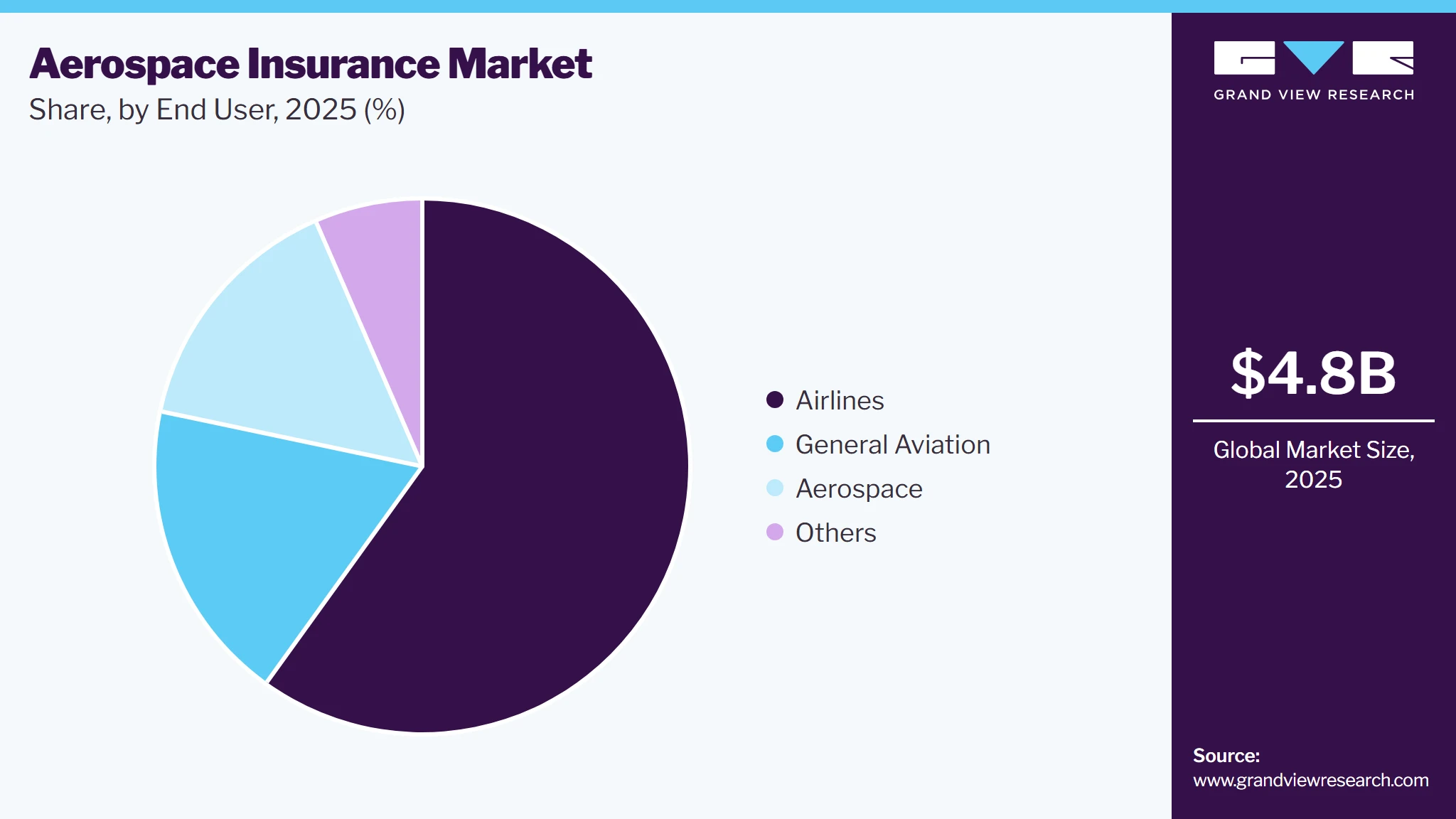
The airlines segment led the market and accounted for the global revenue in 2025. The segment’s growth is driven by airlines' increasing need to protect aircraft, passengers, and daily flight operations against unexpected losses. The expansion of airline fleets and rising flight activity are increasing exposure to aircraft damage, passenger claims, and other operational risks. This growing exposure is encouraging airlines to maintain insurance coverage for their aircraft and related liabilities. Furthermore, the continuous operation of passenger and cargo fleets is supporting sustained demand for aerospace insurance among airlines.
 To learn more about this report, Download Free Sample Report
The aerospace segment is projected to grow at the fastest CAGR over the forecast period. The segment’s growth is driven by the increasing need among aerospace companies to protect aircraft, aircraft components, and other aerospace assets against unexpected losses. Rising aircraft production and expanding aerospace activities are increasing the number of assets and operations requiring insurance protection. This growing exposure is encouraging aerospace companies to adopt coverage for risks related to their products and business activities. Furthermore, the expansion of the aerospace industry is creating a broader customer base for aerospace insurance providers.
Regional Insights
North America aerospace insurance led the global market, accounting for 44.5% of global revenue in 2025. The rising use of digital insurance services is changing how aerospace insurance is managed across North America. Easier policy management and faster claims support are improving the experience for airlines and aircraft operators. This is supporting wider adoption of insurance across commercial aircraft and business jets.
 To learn more about this report, Download Free Sample Report
U.S. Aerospace Insurance Market Trends
The aerospace insurance market in the U.S. held the largest market share in 2025. The growing use of business jets and private aircraft is creating new opportunities for aerospace insurers in the U.S. Increasing corporate and private aviation activity is expanding the customer base beyond traditional airlines. This is supporting greater adoption of tailored insurance coverage for business aircraft.
Asia Pacific Aerospace Insurance Market Trends
The aerospace insurance market in the Asia Pacific is projected to grow at the fastest CAGR over the forecast period. The expansion of commercial aviation infrastructure is driving demand for aerospace insurance across the Asia-Pacific region. New airports and expanding flight networks are increasing aircraft activity and creating greater exposure to operational losses. This supports the wider adoption of insurance among airlines and commercial aircraft operators.
China aerospace insurance market held a dominant share of the Asia-Pacific. The rapid expansion of domestic air travel is increasing demand for commercial aircraft insurance in China. Airlines are adding aircraft and expanding routes to meet growing travel demand, increasing the number of assets that require protection. This is strengthening the adoption of aerospace insurance across the airline sector.
The aerospace insurance market in Japan is expected to grow at a significant CAGR over the forecast period. The increasing use of digital aircraft monitoring is supporting the adoption of aerospace insurance in Japan. Better access to aircraft operating information is helping insurers understand risks associated with aircraft movement and usage. This is encouraging greater adoption of insurance coverage among airlines and aerospace businesses.
Europe Aerospace Insurance Market Trends
The aerospace insurance market in Europe is expected to grow at a significant CAGR over the forecast period. Stronger passenger protection requirements are supporting demand for aerospace insurance across Europe. Airlines need suitable coverage for passenger-related risks as air travel continues to expand across the region. This supports the adoption of passenger liability insurance among commercial aircraft operators.
The UK aerospace insurance market is gaining momentum. Helicopter operations are experiencing significant growth in the UK, creating new opportunities for aerospace insurance. Increasing use across emergency services, offshore activities, private travel, and other sectors is expanding the number of helicopters requiring insurance protection. This growing activity is creating additional demand for aerospace insurance beyond traditional airline operations.
The aerospace insurance market in Germany held a substantial share in Europe. The growing use of business jets is changing the demand for aerospace insurance in Germany. Increasing corporate travel is creating a greater need to protect privately operated aircraft against accidents and other losses. This supports the adoption of insurance coverage among business jet operators.
Key Aerospace Insurance Company Insights
Key market players include Allianz, American International Group, Inc., AXA SA, Chubb, Global Aerospace, Munich Re, Sompo International Holdings Ltd., Swiss Re Executive Education, Tokio Marine HCC, UIB Insurance Brokers Private Limited Key players in the aerospace insurance are focusing on expanding specialized aviation insurance portfolios, strengthening underwriting capabilities, developing customized risk solutions, and expanding their presence across emerging aerospace and aviation risks. Companies also emphasize strategic partnerships, risk analytics, and tailored coverage solutions to strengthen their competitive position.
-
Allianz is an integrated financial services provider. The company provides insurance and asset management products, services, and solutions to private and corporate customers. The company focuses on risk management, global operations, strategic investments, partnerships, and sustainable financial solutions.
-
American International Group, Inc is a global insurance organization. It offers customized aviation insurance solutions covering airlines, aircraft manufacturers, airports, general aviation, and unmanned aircraft. The company focuses on maintaining a broad global platform, specialized insurance expertise, and client-centric risk solutions.
Key Aerospace Insurance Companies:
The following key companies have been profiled for this study on the aerospace insurance market:
-
Allianz
-
American International Group, Inc.
-
AXA SA
-
Chubb
-
Global Aerospace
-
Munich Re
-
Sompo International Holdings Ltd.
-
Swiss Re Executive Education
-
Tokio Marine HCC
-
UIB Insurance Brokers Private Limited
Company Categorization
Operating Strategies
Competitive Edge
Weaknesses
Mature Players: AIG, AXA, Chubb, Munich Re, Sompo International
Mature players in the aerospace insurance are focus on broad aerospace insurance portfolios allow insurers to serve different customer types and aviation risks, while global coverage supports multinational operations. Specialized underwriting helps assess complex aerospace risks and develop suitable coverage based on individual risk profiles.
Mature players gain a competitive advantage through strong financial capacity enables insurers to underwrite high-value aircraft and complex aviation risks, while global presence supports coverage across multiple countries. Extensive aviation risk expertise helps improve risk assessment, pricing, and development of customized insurance solutions.
These companies face challenges related to large-scale operations can increase administrative and operational costs due to complex organizational structures and broader management requirements. This can make it more difficult to respond quickly to specialized customer needs and customize solutions for niche aerospace risks.
Emerging Players: Global Aerospace, Tokio Marine HCC
Emerging players in the aerospace insurance are focus on specialized aviation products allow insurers to address specific aircraft, operational, and liability risks. Targeted risk segments help improve underwriting accuracy and enable customized coverage for customers with unique aerospace requirements.
Emerging players gain market traction through aviation expertise helps insurers understand specialized aircraft and operational risks more accurately. Customized underwriting allows coverage and pricing to be adjusted to the specific risk profiles of aviation customers.
Emerging players face limitations due to smaller scale can limit geographic coverage, underwriting capacity, and the ability to handle large or complex aerospace risks. This can restrict expansion into international markets and reduce flexibility when providing high-value insurance coverage.
Recent Developments
- In January 2026,
Global Aerospace partnered with Polaris Aero, an aviation software company, through its SM4 Aviation Safety Program, which provides eligible aviation clients with access to safety and risk management tools. The partnership helps aviation operators identify potential risks, improve safety practices, and make better safety-related decisions. The initiative strengthens Global Aerospace’s support for customers and promotes safer aviation operations.
-
In June 2025, Tokio Marine HCC
partnered with Adaptive Insurance, a climate resilience company, to expand GridProtect, a short-term power-outage insurance product, across 18 U.S. states. The partnership provides businesses with financial support during power outages. It also helps Tokio Marine HCC expand its specialty insurance offerings and address growing climate-related risks.
Aerospace Insurance Market Report Scope
Report Attribute
Details
Market size in 2025
USD 4.8 billion
Estimated market size in 2026
USD 4.9 billion
Projected market size by 2033
USD 7.0 billion
Growth rate
CAGR of 5.2% from 2026 to 2033
Historical data
2021 - 2025
Forecast period
2026 - 2033
Quantitative units
Revenue in USD billion and CAGR from 2026 to 2033
Report coverage
Revenue forecast, company ranking, competitive landscape, growth factors, and trends
Segments covered
Type, aircraft type, end-user, region
Regional scope
North America; Europe; Asia Pacific; Latin America; MEA
Country scope
U.S.; Canada; Mexico; Germany; UK; France; China; Japan; India; South Korea; Australia; Brazil; Saudi Arabia; UAE; South Africa
Key companies profiled
Allianz; American International Group, Inc.; AXA SA; Chubb; Global Aerospace; Munich Re; Sompo International Holdings Ltd.; Swiss Re Executive Education; Tokio Marine HCC; UIB Insurance Brokers Private Limited
Customization scope
Free report customization (equivalent up to 8 analysts working days) with purchase. Addition or alteration to country, regional & segment scope.
Pricing and purchase options
Avail customized purchase options to meet your exact research needs. Explore purchase options
Global Aerospace Insurance Market Report Segmentation
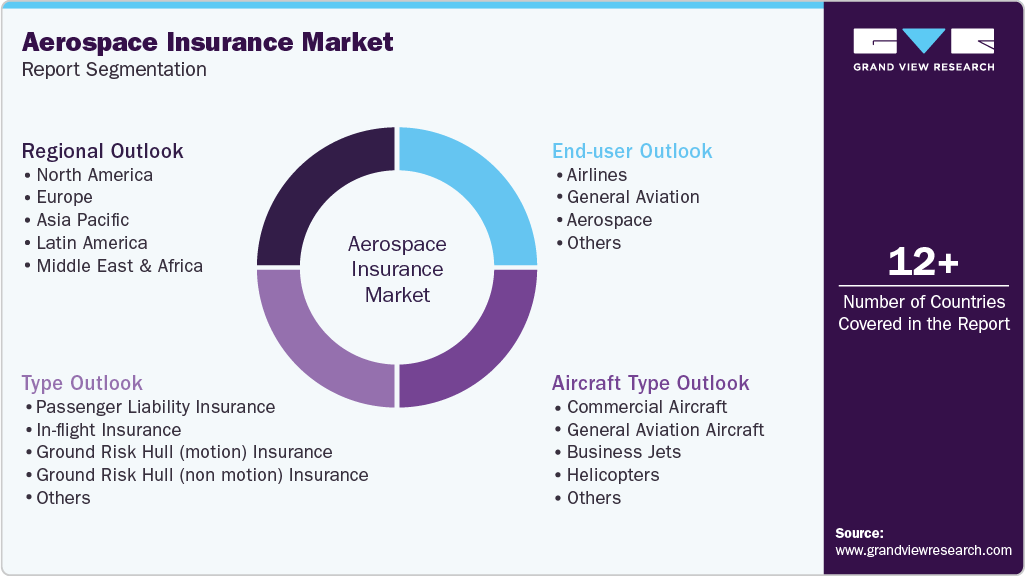
The report forecasts revenue growth at global, regional, and country levels and provides an analysis of the latest industry trends in each of the sub-segments from 2021 to 2033. For this study, Grand View Research has segmented the global aerospace insurance based on type, aircraft type, end-user, and region:
 To learn more about this report, Download Free Sample Report
-
Type Outlook (Revenue, USD Billion, 2021 - 2033)
-
Passenger Liability Insurance
-
In-flight Insurance
-
Ground Risk Hull (motion) Insurance
-
Ground Risk Hull (non motion) Insurance
-
Others
-
-
Aircraft Type Outlook (Revenue, USD Billion, 2021 - 2033)
-
Commercial Aircraft
-
General Aviation Aircraft
-
Business Jets
-
Helicopters
-
Others
-
-
End-user Outlook (Revenue, USD Billion, 2021 - 2033)
-
Airlines
-
General Aviation
-
Aerospace
-
Others
-
-
Regional Outlook (Revenue, USD Billion, 2021 - 2033)
-
North America
-
U.S.
-
Canada
-
Mexico
-
-
Europe
-
Germany
-
UK
-
France
-
-
Asia Pacific
-
China
-
India
-
Japan
-
South Korea
-
Australia
-
-
Latin America
-
Brazil
-
-
Middle East & Africa (MEA)
-
UAE
-
Saudi Arabia
-
South Africa
-
-
Research Methodology
The aerospace insurance market figures in this report are based on a proven research process that combines executive interviews with secondary research from proprietary databases, company filings, and recognized regulatory and institutional sources. Market size is built through value-chain sizing—reconciling supply-side and demand-side estimates—and triangulated with bottom-up and top-down approaches. Every estimate passes multiple levels of expert validation before publication, with each aerospace insurance segment quantified using the revenue-capture definitions in the table below.
Segment Definition
Segment - Type
Revenue capture definition
Passenger Liability Insurance
Segment revenue is generated from premiums for coverage against liabilities arising from passenger injury or death, baggage-related claims, and other passenger incidents associated with aircraft operations.
In-flight Insurance
Segment revenue is generated from premiums for coverage of aircraft risks and associated losses that occur during flight operations, including specified physical damage and operational exposures.
Ground Risk Hull (motion) Insurance
The segment revenue is generated from premiums covering physical damage to aircraft while moving on the ground, including taxiing and other aircraft movements within airports or operating areas.
Ground Risk Hull (non motion) Insurance
The segment revenue is generated from premiums covering physical damage to stationary aircraft while parked, stored, or otherwise not in motion on the ground.
Others
The segment revenue is generated from premiums associated with other aerospace insurance products, including aviation liability, product liability, airport liability, war-risk coverage, and other specialized aerospace risks.
Segment - Aircraft Type
Revenue capture definition
Commercial Aircraft
The segment revenue is generated from premiums covering privately operated, charter, training, recreational, agricultural, and other non-airline aircraft.
General Aviation Aircraft
The segment revenue is generated from premiums covering corporate, private, and charter business aircraft, including hull, liability, passenger, and operational risks.
Business Jets
The segment revenue is generated from premiums covering commercial, private, emergency, utility, and other helicopter operations, including hull and liability risks.
Helicopters
The segment revenue is generated from premiums covering other aircraft categories, including specialized aircraft, uncrewed aircraft, and other aircraft not classified under the major aircraft types.
Others
The segment revenue is generated from premiums covering privately operated, charter, training, recreational, agricultural, and other non-airline aircraft.
Segment - End User
Revenue capture definition
Airlines
Segment revenue is generated from premiums paid by passenger and cargo airlines for aircraft hull, passenger liability, third-party liability, war risk, and other aviation insurance coverage.
General Aviation
The segment revenue is generated from premiums paid by private aircraft owners, charter operators, flight schools, business aviation operators, and other general aviation users.
Aerospace
The segment revenue is generated from premiums paid by aircraft manufacturers, component manufacturers, MRO providers, aerospace suppliers, and other aerospace businesses for product liability, premises liability, and related risks.
Others
The segment revenue is generated from premiums paid by airports, aircraft lessors, ground handlers, air navigation service providers, and other aviation-related organizations.
Estimation Model
Layer Name
Key Question
Description
Aerospace Activity Assessment
What activities create insurance demand?
This layer evaluates the aerospace activities that generate insurable exposure. It covers commercial aviation, general aviation, business aviation, helicopter operations, aircraft manufacturing, MRO, and airport activities. Aircraft fleet size, aircraft utilization, passenger traffic, and aerospace production are considered to determine the underlying risk base.
Insurance Coverage Assessment
What insurance products generate revenue?
This layer identifies the major aerospace insurance products generating premium revenue. Passenger liability, in-flight insurance, ground risk hull insurance, aircraft hull insurance, and other liability covers are assessed. Premium generation is linked to coverage limits, aircraft values, operating conditions, risk exposure, and policy requirements.
Segment Revenue Allocation
Which aircraft types and end users generate revenue?
This layer distributes market revenue across commercial aircraft, general aviation aircraft, business jets, helicopters, and other aircraft types. Revenue is further allocated across airlines, general aviation operators, aerospace businesses, and other aviation-related users. The assessment considers the insurance requirements and risk exposure associated with each customer group.
Market Validation and Forecasting
How will aerospace insurance revenue develop?
This layer validates the estimated market using aircraft deliveries, fleet expansion, passenger traffic, aerospace production, insurance pricing, and claims trends. Historical market performance is compared with underlying aerospace activity to establish a reliable market base. Future growth is forecast based on fleet expansion, emerging aviation technologies, changing risk exposure, and demand for specialized insurance coverage.
Delivered Customization
We have successfully delivered the following deep-dive customizations:
Client Request
Customization Delivered
Value Adds
Regional Aerospace Insurance Market Opportunity Assessment
Country/region-wise market sizing and forecasts
Analysis of demand, adoption trends, and regulatory landscape
Identification of high-growth regions and investment hotspots
Identified region-specific growth opportunities
Supported expansion and go-to-market strategy
Enabled informed regional investment decisions
Cross-Segmentation Analysis for the Aerospace Insurance Market
Criss-cross market analysis by type, aircraft type end user
Demand and adoption assessment across key segments
Segment attractiveness and growth potential benchmarking
Identified high-potential market segments
Supported targeted aircraft type positioning and marketing strategy
Improved customer and segment prioritization
Competitive Benchmarking and Strategic Positioning in the Aerospace Insurance Market
Benchmarking of key competitors across aircraft types, pricing, partnerships, and innovation
Comparative assessment of market share, capabilities, and strategies
Analysis of competitive strengths, gaps, and differentiation areas
Identified competitive white spaces and growth gaps
Supported strategic positioning and differentiation
Enabled data-driven competitive strategy development
Frequently Asked Questions About This Report
The global aerospace insurance market size was valued at USD 4.8 billion in 2025 and is projected to reach USD 4.9 billion in 2026.
The global aerospace insurance market is expected to grow at a CAGR of 5.2% from 2026 to 2033, reaching USD 7.0 billion by 2033.
The passenger liability insurance segment led the market and accounted for 37.5% of the global revenue in 2025, while ground risk hull (motion) insurance segment is the fastest growing type.
North American market dominated the market, accounting for a revenue share of 44.5% in 2025.
Increasing aircraft production and air traffic are driving demand for aerospace insurance by expanding the need for aircraft, liability, and operational risk coverage.
Some key players operating in the aerospace insurance market include Allianz, American International Group, Inc., AXA SA, Chubb, Global Aerospace, Munich Re, Sompo International Holdings Ltd., Swiss Re Executive Education, Tokio Marine HCC, UIB Insurance Brokers Private Limited
The commercial aircraft segment accounted for 54.4%, the largest share of global revenue in 2025, while business jets segment is fastest growing aircraft type.
Airlines segment led the market and accounted for the global revenue in 2025, while aerospace segment is projected to grow at the fastest CAGR over the forecast period
Asia Pacific is the fastest-growing region over the forecast period.
About the Author(s)
Next Generation Technologies Research Team
Technology · Next Generation TechnologiesThis report was authored by the next generation technologies research team at Grand View Research - comprising two research analysts, one senior research analyst, and one industry expert - with specialized expertise in the next generation technologies segment of the technology industry. All findings are based on proprietary technology databases, executive interviews, and regulatory analysis, subject to internal peer review prior to publication.
Last Updated:
Speak to Analyst

Customize this report to your needs - add regions, segments, or data points, with 20% free customization.
Or view our licence options:


ISO 9001:2015 & 27001:2022 Certified
We are GDPR and CCPA compliant! Your transaction & personal information is safe and secure. For more details, please read our privacy policy.


