
- Home
- »
- Consumer F&B
- »
-
Agave Syrup Market Size, Share & Trends Report 2026-2033GVR Report cover

Agave Syrup Market (2026 - 2033)
Size, Share & Trends Analysis Report By Product (Light Agave Syrup, Amber Agave Syrup, Dark Agave Syrup), By Application (Bakery & Confectionery, Alcoholic Beverages & Cocktails), By Distribution Channel, By Region, And Segment Forecasts
Market Size, 2025
$154.8MMarket Estimate, 2026
$163.5MMarket Forecast, 2033
$228.2MCAGR, 2026–2033
4.9%Agave Syrup Market Summary
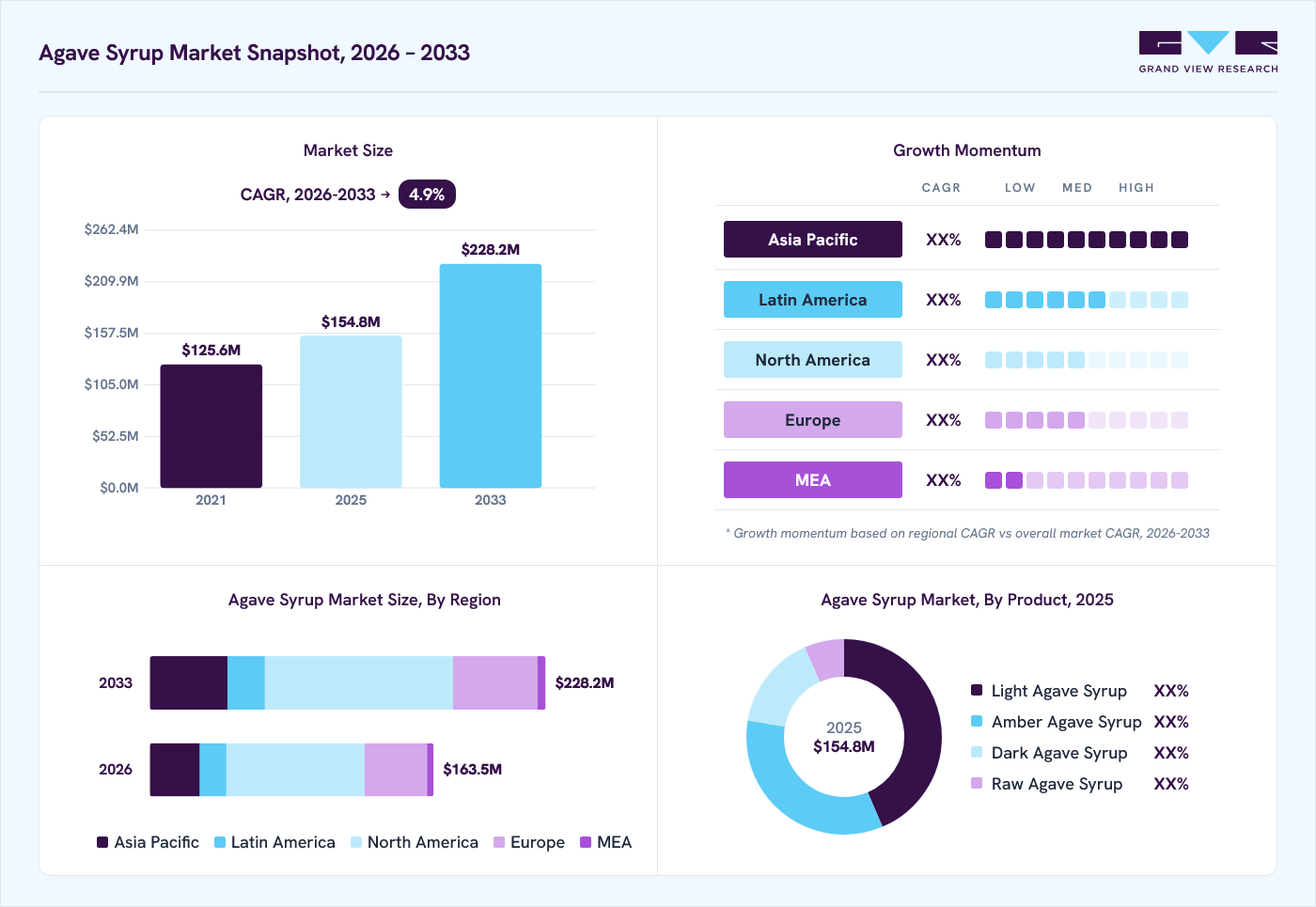
The global agave syrup market size was valued at USD 154.8 million in 2025 and is projected to grow from USD 163.5 million in 2026 to USD 228.2 million by 2033, at a CAGR of 4.9% from 2026 to 2033. North America dominated the market, accounting for a revenue share of 48.8% in 2025. The global market is primarily driven by the rising demand for natural, plant-based, and clean-label sweeteners as consumers increasingly seek healthier alternatives to refined sugar.
 Source: Grand View Research, IR Documents, Primary Interviews, Paid DatabasesTo learn more about this report,
 Download Free Sample Report
 Key Market Trends & Insights
- By product: Light agave syrup led the market and accounted for a share of 43.6% in 2025.
- By application: Alcoholic beverages & cocktails led the market and accounted for a share of 68.0% in 2025.
- By distribution channel: Foodservice & hospitality led the market and accounted for a share of 44.2% in 2025.
Regional Highlights
- Largest regional market: North America (48.8% revenue share, 2025)
- Fastest-growing regional market: Asia Pacific (highest CAGR, 2026-2033)
- By country: The U.S. held the largest market share in 2025.
Market Size & Forecasts
- Market size in 2025: USD 154.8 Million
- Estimated market size in 2026: USD 163.5 Million
- Projected market size by 2033: USD 228.2 Million
- CAGR (2026-2033): 4.9%
Three ways to get this report
Buy it, customize it, or ask a question.Ask an Analyst
A direct answer, usually in 1 working day
- AccessReport author, directly
- Reply timeWithin 1 working day
- No sales callDirect answer only
- FormatEmail reply
- CostFree, no cost
Get the Full Report
What the study covers
- FormatsPDF · Excel · Dashboard
- Timeline2026–2033 annual, 2025 base
- Coverage20+ countries, 5 regions
- Companies10+ key players profiled
Customize the Report
20% free customization
- IncludeCountries, segments, points
- TailorTo your product definition
- ExtendDeeper competitor detail
- OrA fully bespoke study
- Turnaround5–10 working days
In addition, growing adoption of vegan and organic products, along with agave syrup’s mild flavor and versatility, is further supporting market growth. Product innovation and expanding retail accessibility are creating new growth opportunities for agave syrup manufacturers. The increasing availability of agave syrup through supermarkets, specialty stores, and e-commerce platforms is improving consumer access and market penetration. At Gulfood 2026, agave syrup was showcased as a natural sweetener specifically positioned for cocktails, coffee and premium mixers, with the product categorized under beverages and cordials/syrups.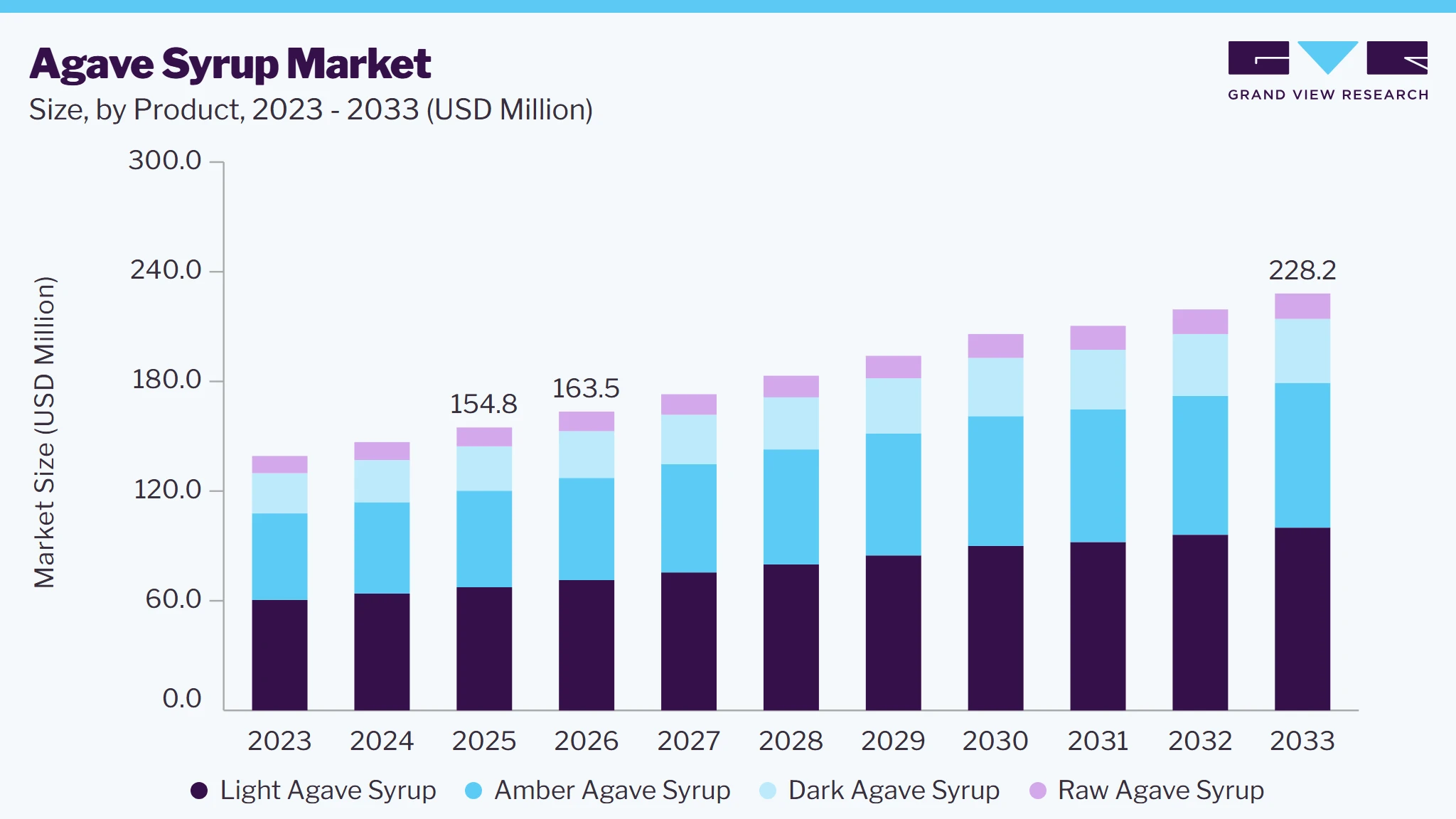 To learn more about this report, Download Free Sample Report
 Furthermore, growing interest in organic, non-GMO, and sustainably sourced ingredients is encouraging manufacturers to strengthen product differentiation and supply-chain transparency. In addition, advancements in sustainable cultivation and processing technologies are helping producers improve resource efficiency while maintaining consistent product quality. According to the data published in February 2026, sustainable agave farming in Oaxaca is helping restore degraded dry forests, protect biodiversity, and strengthen local livelihoods. Agave agroforestry, soil and water conservation, native species, and responsible agave production are supporting healthier ecosystems and a more sustainable agave-mezcal value chain.
Market Dynamics
The growing preference for natural sweetening solutions is encouraging food manufacturers to reformulate products using agave syrup. Its plant-derived origin makes it suitable for products targeting consumers who avoid conventional sweeteners. This trend is particularly relevant in packaged foods and beverages seeking more recognizable ingredient profiles. Manufacturers can therefore incorporate agave syrup into new product formulations to align with evolving consumer expectations. According to the data published by The Tierra Group, agave syrup is gaining traction across food and beverage applications due to its smooth sweetness, easy solubility, and clean-label appeal. It is widely used in beverages, bakery, culinary, wellness, and functional products, supporting consistent flavor, texture, moisture, and product stability.
Agave syrup production faces supply-side limitations because agave plants require several years to mature before harvesting. This makes it difficult for producers to rapidly increase output when demand rises unexpectedly. Weather conditions, crop diseases, and agricultural constraints can further affect raw material availability. Consequently, manufacturers may face sourcing uncertainty and greater difficulty maintaining stable production costs.
The market has significant potential through the development of new applications beyond traditional syrup use. Agave syrup is increasingly being incorporated into ready-to-drink beverages, plant-based foods, nutrition products, sauces, and specialty bakery products. Its liquid form also enables easy blending and consistent distribution within industrial formulations. This creates opportunities for manufacturers to develop innovative products and expand agave syrup consumption across diverse food categories. According to the data published in March 2025, Sprouts’ Tropical Glowgetter uses organic agave syrup with banana, pineapple, coconut milk, collagen, and blue spirulina in a functional smoothie. The trend highlights agave syrup as a natural sweetener in affordable, wellness-focused, and visually appealing beverages.
Analyst Perspective
The global market for agave syrup is expected to benefit from growing consumer preference for natural and plant-based sweeteners. Demand is supported by increasing adoption across beverages, bakery, confectionery, dairy alternatives, and functional food products. Premium, organic, clean-label, and minimally processed variants are gaining attention as manufacturers respond to evolving dietary preferences. Product differentiation through flavor, processing method, origin, and certification is likely to influence pricing and brand positioning. Overall, market growth will be shaped by expanding application areas, retail penetration, and continued innovation in agave-based sweetening solutions.
Consumer Insights for the Agave Syrup Market
 To learn more about this report, Download Free Sample Report
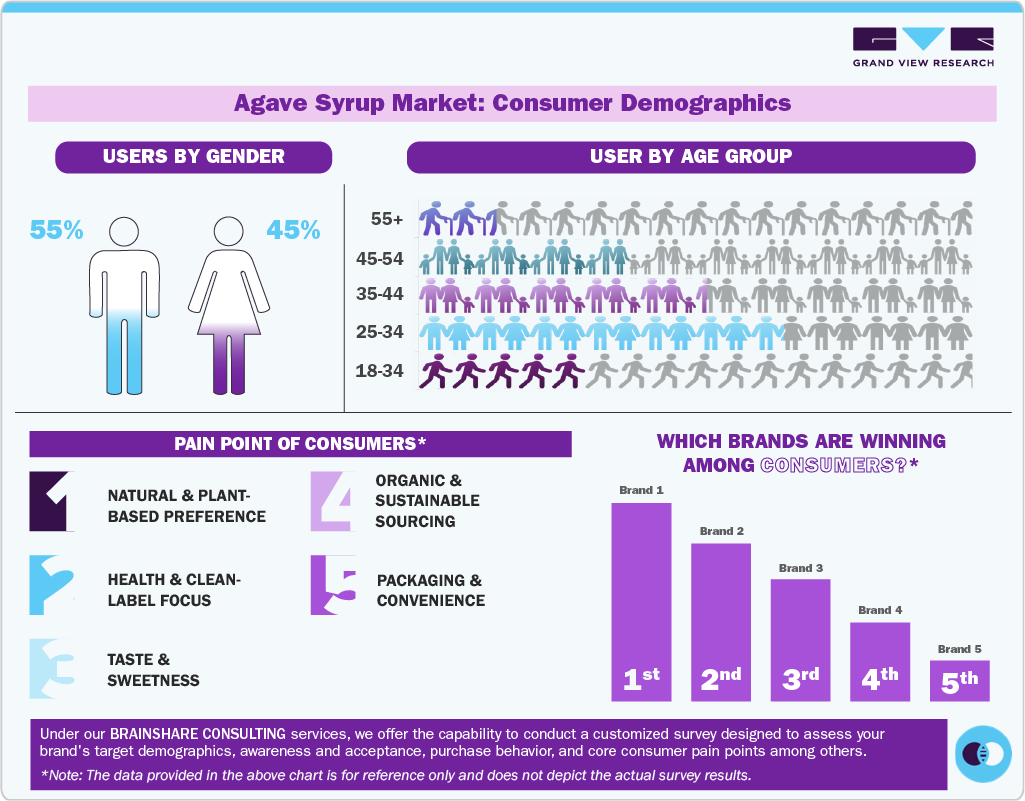
 Consumer insights for the market focus on growing demand for natural, plant-based, and lower-glycemic sweetening alternatives. Consumers increasingly value clean-label products, organic certifications, and minimally processed ingredients, particularly in health-conscious food and beverage categories. Taste, sweetness intensity, product versatility, and perceived health benefits influence purchasing decisions. Premium and sustainably sourced agave syrups are also gaining appeal among environmentally conscious consumers.
Product Insights
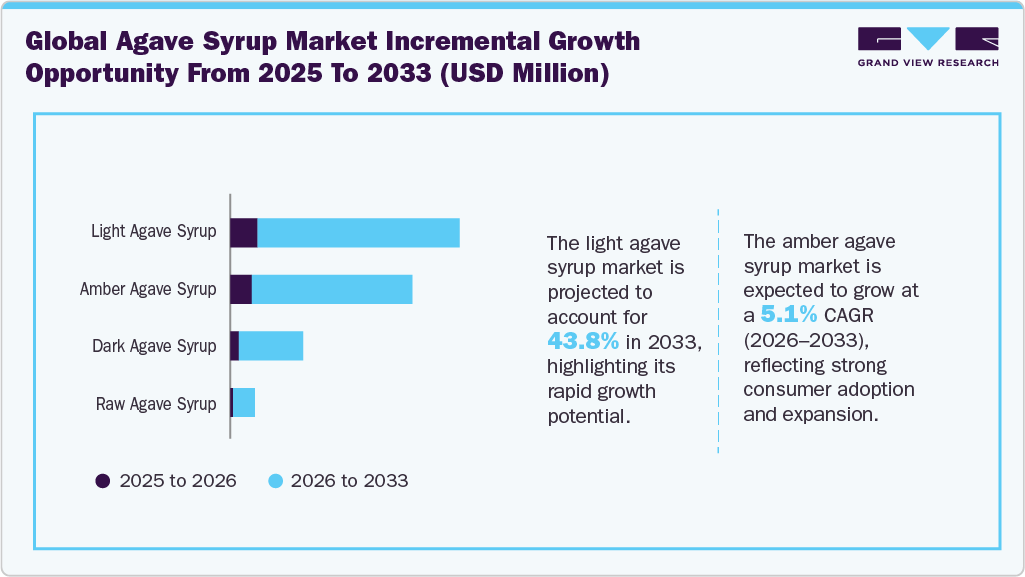
The light agave syrup segment held the largest market share of 43.6% in 2025. Light agave syrup is widely preferred because of its mild flavor and light color, allowing it to sweeten products without significantly changing their taste or appearance. Its high solubility supports its use in beverages, dairy products, cereals, sauces, and baked goods. Food manufacturers also value its versatility when developing formulations that require consistent sweetness. These characteristics make light agave syrup the leading product in the market.
 To learn more about this report, Download Free Sample Report
 The amber agave syrup segment is projected to grow at the fastest CAGR of 5.1% from 2026 to 2033. Amber agave syrup is gaining demand among consumers and manufacturers seeking a richer sweetness with noticeable caramel-like flavor characteristics. Its deeper flavor makes it particularly suitable for bakery products, desserts, confectionery, marinades, and specialty beverages. It can add both sweetness and flavor depth, reducing the need for additional flavoring ingredients in some formulations. Its positioning between lighter and darker varieties also supports its appeal in premium and artisanal food products.
Application Insights
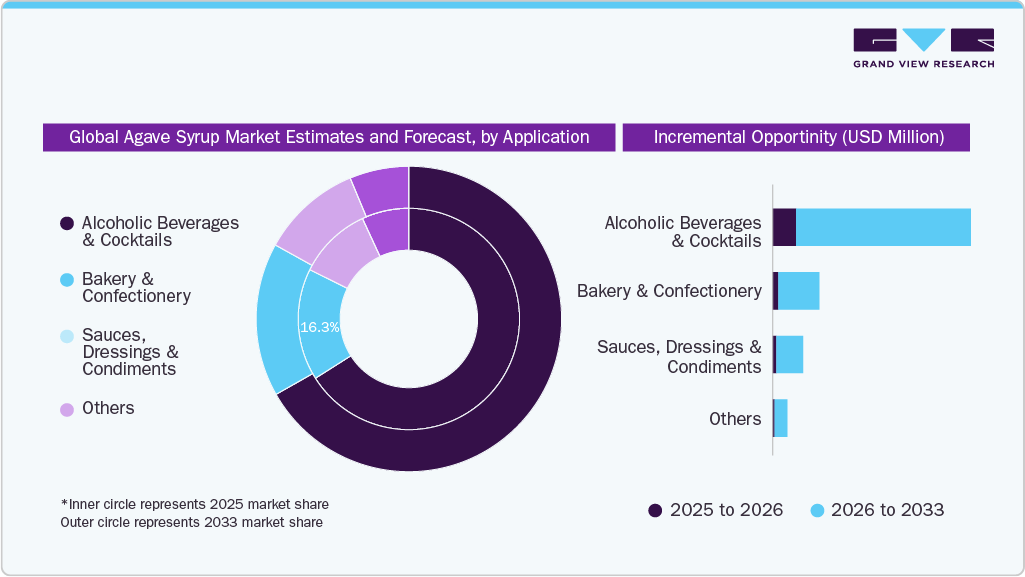
The alcoholic beverages & cocktails segment accounted for the largest share of 68.0% of the revenue in 2025. Agave syrup is increasingly used in alcoholic beverages and cocktails because its liquid form allows it to blend easily with spirits and other ingredients. Its compatibility with tequila- and mezcal-based drinks makes it particularly suitable for cocktail preparation. The growing popularity of craft cocktails and premium mixology is encouraging bartenders to use agave syrup in innovative recipes. Premium bars and restaurants are also expanding their use of specialty mixers to enhance beverage quality and presentation.
 To learn more about this report, Download Free Sample Report
 The use of agave syrups for the bakery & confectionery is projected to grow at a CAGR of 4.8% from 2026 to 2033. Agave syrup has growing applications in bakery and confectionery products due to its ability to provide sweetness while helping retain moisture. This makes it suitable for products such as cakes, cookies, pastries, energy bars, and confectionery preparations. Its liquid consistency enables convenient incorporation into various commercial and artisanal formulations. Increasing innovation in specialty bakery products is creating additional opportunities for agave syrup manufacturers.
Distribution Channel Insights
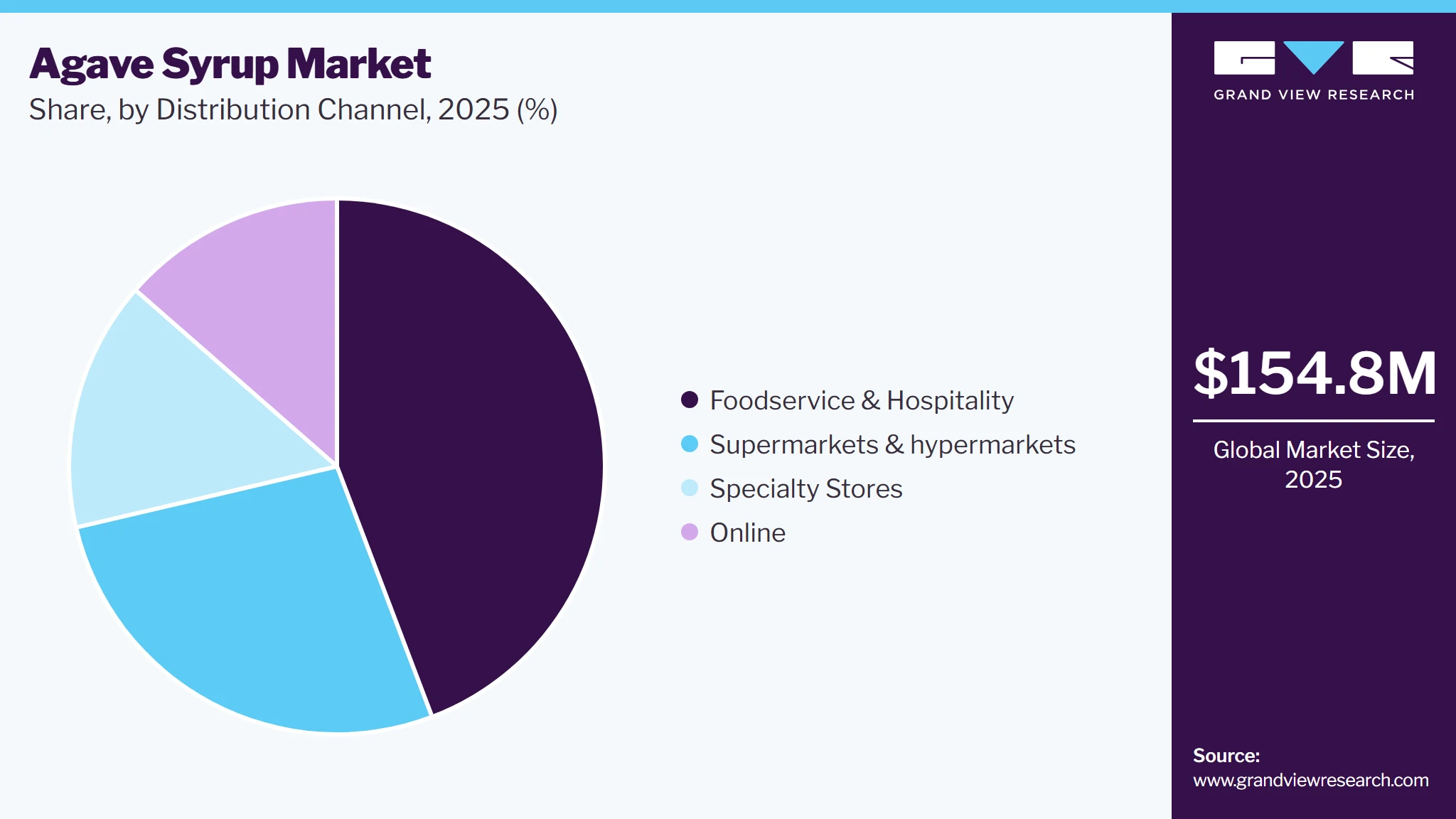
The sales of agave syrups through foodservice and hospitality accounted for the largest share of 44.2% of the revenue in 2025. Foodservice and hospitality establishments use agave syrup as a convenient sweetening ingredient across beverages, desserts, breakfast preparations, and specialty menu items. Its easy handling and ability to blend into both hot and cold preparations support regular commercial use. The expansion of cafés, restaurants, hotels, and cocktail-focused establishments is increasing opportunities for bulk and professional-use formats. Growing menu diversification is also encouraging foodservice operators to incorporate alternative sweetening ingredients into recipes.
 To learn more about this report, Download Free Sample Report
 The sales of agave syrups through the online channel are projected to grow at a CAGR of 5.0% from 2026 to 2033. Online distribution is becoming an important channel for agave syrup because e-commerce platforms provide consumers with access to a broader selection of brands and product variants. Direct-to-consumer websites and online marketplaces also allow smaller brands to reach customers beyond their traditional geographic markets. Walmart's online grocery platform currently has a dedicated agave syrup category containing multiple products, including Agave In The Raw Organic Dark Agave Nectar and Wholesome Regenerative Organic Blue Agave Nectar. The products are offered for shipping, pickup, and delivery, demonstrating the combination of physical retail and e-commerce accessibility.
Regional Insights
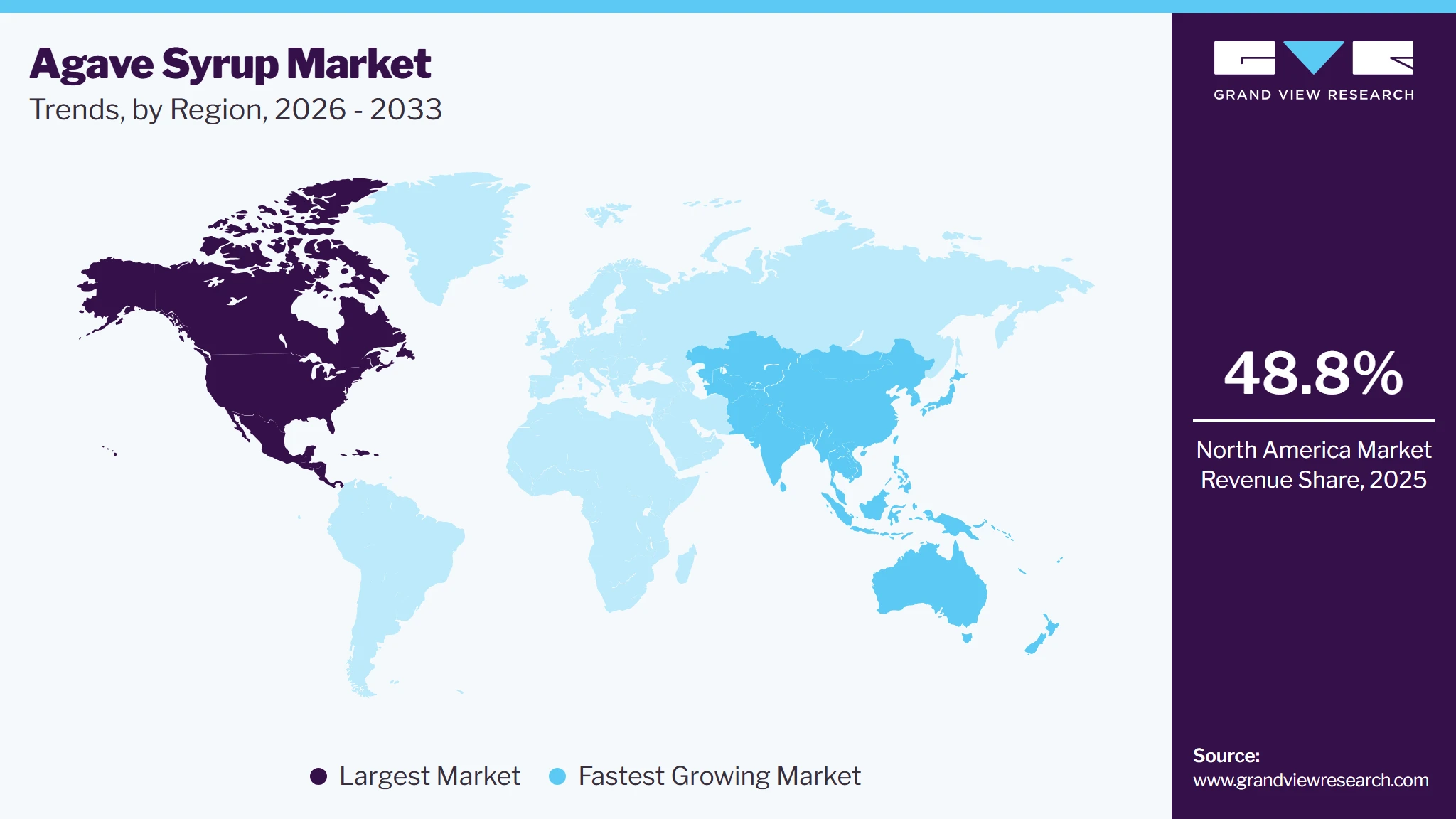
The agave syrup industry in North America led the global market in 2025, holding the largest market share with 48.8% of the total revenue. The market in North America benefits from a mature natural and specialty-food ecosystem in which agave syrup is already familiar to consumers and food manufacturers. The region's established organic and clean-label retail infrastructure makes it easier for brands to introduce premium agave variants. Growing use of plant-based foods and beverages is also creating formulation opportunities for liquid sweeteners. Foodservice and specialty beverage channels provide additional outlets, particularly for flavored agave sweeteners used in drinks and cocktails.
 To learn more about this report, Download Free Sample Report
 U.S. Agave Syrup Market Trends
The agave syrup industry in the U.S. led the North American market in 2025, holding the largest market share of 62.5% of the region’s total revenue. The U.S. market is being driven particularly by product innovation and premium foodservice applications. Agave is increasingly positioned as a versatile ingredient for smoothies, specialty coffee, cocktails, bakery products and plant-based formulations rather than simply as a household syrup. Retailers such as Whole Foods and Sprouts provide established channels for organic and specialty sweeteners, helping new formulations reach consumers. Demand for clean-label and plant-based products further encourages manufacturers to reformulate products with recognizable sweetening ingredients.
Europe Agave Syrup Market Trends
The agave syrup industry in Europe is projected to grow at a CAGR of 4.4% from 2026 to 2033. Europe's market is driven by the strong preference for organic, natural, and transparently labeled food ingredients. European food manufacturers are increasingly interested in natural sweeteners as consumers look for alternatives to artificial ingredients. Agave syrup fits this positioning particularly well because it can be marketed as a plant-derived sweetener with organic certification. The region's sophisticated organic-food distribution network also provides access to specialist and mainstream consumers.
The UK agave syrup industry led the European market in 2025, holding the largest market share with 24.1% of the region’s total revenue. The UK is particularly influenced by reformulation and demand for healthier-positioned food and beverages. Food manufacturers are looking for ways to manage sugar content while retaining sweetness and acceptable sensory characteristics in products. Agave syrup is therefore relevant to premium bakery, breakfast products, beverages and specialty foods where natural-ingredient positioning is important. The country's developed supermarket and health-food retail networks also make niche sweeteners relatively accessible to consumers. Continued interest in plant-based and clean-label products provides another route for agave-based formulations to gain visibility.
Asia Pacific Agave Syrup Market Trends
The Asia Pacific agave syrup industry is projected to grow at the fastest CAGR of 6.5% from 2026 to 2033. The market in Asia Pacific presents opportunities through urbanization, changing dietary habits, and the development of modern food retail. Consumers in major cities are becoming more exposed to Western-style beverages, premium bakery products, and health-oriented packaged foods, creating new applications for imported natural sweeteners. Manufacturers can use agave in products aimed at consumers seeking plant-based or minimally processed ingredients. Expansion of cafés, specialty beverage outlets, and modern grocery formats further increases opportunities for agave-based formulations.
The agave syrup industry in China led the Asia Pacific market in 2025, holding the largest market share with 32.2% of the region’s total revenue. China's opportunity is centered on the premiumization of food and beverage consumption and growing interest in imported natural ingredients. Agave syrup can be incorporated into premium beverages, bakery products, desserts, and health-oriented formulations targeting urban consumers. The growth of modern retail and e-commerce gives international and domestic brands additional routes to introduce unfamiliar sweeteners.
Central & South America Agave Syrup Market Trends
The agave syrup industry in Central & South America is projected to grow at a CAGR of 5.1% from 2026 to 2033. The market in Central and South America benefits from the region's agricultural connection to agave production and proximity to major processing and export networks. Mexico, in particular, provides an established ecosystem of growers, processors, and ingredient suppliers, giving the region expertise in agave cultivation and processing. Beyond exports, local food and beverage producers can use this agricultural base to develop value-added sweeteners and differentiated agave ingredients.
Middle East & Africa Agave Syrup Market Trends
The agave syrup industry in Middle East & Africa is expected to grow at a CAGR of 3.3% from 2026 to 2033. The market in the Middle East region is propelled by opportunities, such as an increasing link to premium hospitality, foodservice, and changing consumer preferences toward natural ingredients. Agave syrup can be incorporated into specialty beverages, desserts, bakery products, and café offerings where operators want differentiated sweetening options. Expansion of modern supermarkets and premium food outlets provides greater exposure to imported natural sweeteners.
Key Agave Syrup Company Insights
The agave syrup industry is characterized by a mix of established natural-sweetener brands, ingredient suppliers, and regional agave producers, rather than being controlled by a single company. Major participants include Madhava Foods, Wholesome Sweeteners, Agave In The Raw, The IIDEA Company, Nekutli and other specialized suppliers.
Competition is differentiated through organic certification, product variety, clean-label positioning, sourcing practices, and retail distribution. For example, Madhava offers organic amber, light and hot agave products and emphasizes source-level bottling in Jalisco, Mexico and independent purity testing.
 To learn more about this report, Download Free Sample Report
 Key Agave Syrup Companies
The following key companies have been profiled for this study on the agave syrup market.
-
Wholesome Sweeteners Inc.
-
Now Foods
-
Ciranda Inc.
-
Sisana Sweeteners
-
Global Goods Inc. (Agave In The Raw)
-
Malt Products Corporation Ingredients
-
The Groovy Food Company
-
Tierra Group
-
Arizona Beverages USA LLC
-
Madhava Natural Sweeteners
Competitive Benchmarking
Category
Operating Strategies
Competitive Edge
Weakness
Established Players (Wholesome Sweeteners Inc.; Now Foods)
- Expand retail and e-commerce presence, secure reliable agave supply, strengthen organic product portfolios, and broaden distribution networks.
- Strong brand recognition, established distribution, broad product portfolios, and strong retailer relationships.
- Dependence on agave crop availability, input-cost fluctuations, and exposure to supply-chain disruptions.
Emerging Players (The Groovy Food Company)
- Focus on organic and premium agave syrup, develop differentiated products, strengthen online channels, and target health-conscious consumers.
- Product differentiation, niche-market focus, flexible product development, and strong natural/organic positioning.
- Smaller scale, limited distribution reach, lower brand awareness, and weaker supplier bargaining power.
Recent Developments
-
In July 2025, Beso de Agave was launched in Mexico, offering an agave syrup concentrate produced in Jalisco to enhance the flavor and aroma of cocktails. The agave syrup is positioned as a versatile cocktail ingredient, reflecting growing interest in agave-based sweeteners within the drinks industry.
-
In March 2025, Sprouts introduced Tropical Glowgetter, which uses organic agave syrup with banana, pineapple, coconut milk, collagen, and blue spirulina in a functional smoothie. The trend highlights agave syrup as a natural sweetener in affordable, wellness-focused, and visually appealing beverages.
Agave Syrup Market Report Scope
Report Attribute
Details
Market size in 2025
USD 154.8 million
Estimated Market size in 2026
USD 163.5 million
Projected market size by 2033
USD 228.2 million
Growth rate (Revenue)
CAGR of 4.9% from 2026 to 2033
Actuals
2021 - 2025
Forecast period
2026 - 2033
Quantitative (Revenue) units
Revenue in USD million and CAGR from 2026 to 2033
Report coverage
Revenue forecast, company ranking, competitive landscape, growth factors, and trends
Segments covered
Product, application, distribution channel, and region
Regional Scope
North America; Europe; Asia-Pacific; Central & South America; Middle East & Africa
Country scope
U.S.; Canada; Mexico; UK; Germany; France; Italy; Spain; China; Japan; India; Australia & New Zealand; South Korea; Brazil; South Africa
Key companies profiled
Wholesome Sweeteners Inc.; Now Foods; Ciranda Inc.; Sisana Sweeteners; Global Goods Inc. (Agave In The Raw); Malt Products Corporation; The Groovy Food Company; Tierra Group; Arizona Beverages USA LLC; Madhava Natural Sweeteners
Customization scope
Free report customization (equivalent up to 8 analysts’ working days) with purchase. Addition or alteration to country, regional & segment scope.
Pricing and purchase options
Avail customized purchase options to meet your exact research needs. Explore purchase options
Global Agave Syrup Market Report Segmentation
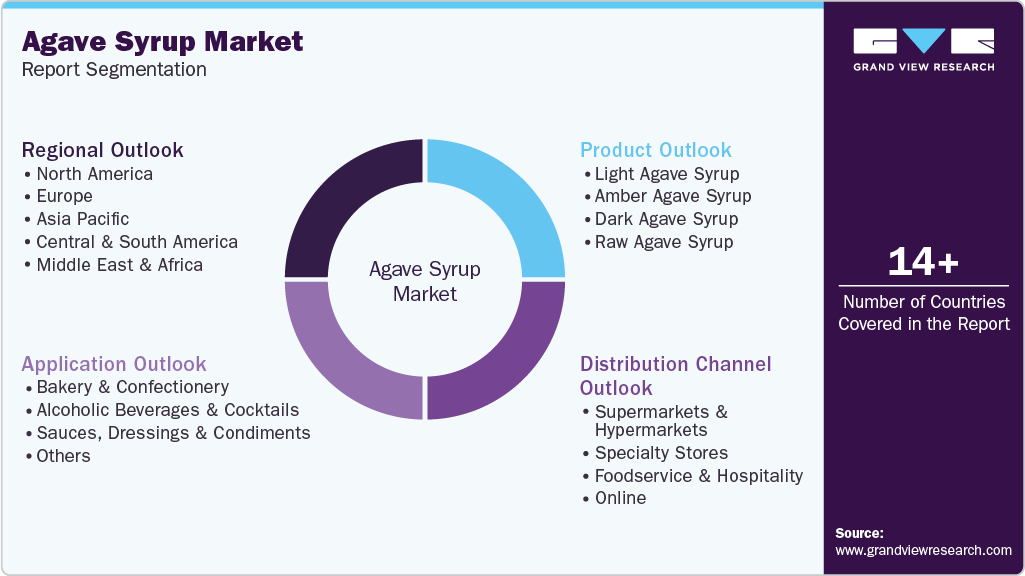
This report forecasts revenue growth at the regional and country levels and provides an analysis of the latest industry trends and opportunities in each of the sub-segments from 2021 to 2033. For this study, Grand View Research has segmented the global agave syrup market report based on product, application, distribution channel, and region.
 To learn more about this report, Download Free Sample Report
 -
Product Outlook (Revenue, USD Million, 2021 - 2033)
-
Light Agave Syrup
-
Amber Agave Syrup
-
Dark Agave Syrup
-
Raw Agave Syrup
-
-
Application Outlook (Revenue, USD Million, 2021 - 2033)
-
Bakery & Confectionery
-
Alcoholic Beverages & Cocktails
-
Sauces, Dressings & Condiments
-
Others
-
-
Distribution Channel Outlook (Revenue, USD Million, 2021 - 2033)
-
Supermarkets & hypermarkets
-
Specialty Stores
-
Foodservice & Hospitality
-
Online
-
-
Regional Outlook (Revenue, USD Million, 2021 - 2033)
-
North America
-
U.S.
-
Canada
-
Mexico
-
-
Europe
-
UK
-
Germany
-
France
-
Italy
-
Spain
-
-
Asia Pacific
-
China
-
Japan
-
India
-
Australia & New Zealand
-
South Korea
-
-
Central & South America
-
Brazil
-
-
Middle East & Africa
-
South Africa
-
-
Research Methodology
The agave syrup market figures in this report are based on a proven research process that combines executive interviews with secondary research from proprietary databases, company filings, and recognized regulatory and institutional sources. Market size is built through value-chain sizing - reconciling supply-side and demand-side estimates - and triangulated with bottom-up and top-down approaches. Every estimate passes multiple levels of expert validation before publication, with each agave syrup segment quantified using the revenue-capture definitions in the table below.
Segment Definition
Segment - Product
Revenue capture definition
Light Agave Syrup
Light Agave Syrup captures revenue through its positioning as a mild-tasting sweetener suited to applications where manufacturers and consumers want sweetness without substantially altering the flavor profile. Sales are generated across consumer-facing bottles, foodservice formats, and ingredient supplies for beverages, breakfast products, sauces, and prepared foods. Product differentiation through organic certification, origin claims, bottle formats, and sweetness characteristics can support pricing variation.
Amber Agave Syrup
Amber Agave Syrup generates revenue from applications where a deeper color and more pronounced caramel-like flavor are desirable. Suppliers monetize the segment through household sweetening products as well as commercial formats supplied to beverage producers, cafés, dessert businesses, and prepared-food manufacturers. Revenue opportunities can increase through premium positioning, certified sourcing, larger professional packs, and application-specific formulations.
Dark Agave Syrup
Dark Agave Syrup captures value from its stronger flavor, darker appearance, and suitability for formulations in which the sweetener contributes both sweetness and sensory character. Revenue is generated through specialty consumer products and B2B ingredient channels serving applications such as desserts, sauces, marinades, baked products, and beverages. Higher-value opportunities can arise from premium-grade sourcing, specialized processing, and food-manufacturing contracts.
Raw Agave Syrup
Raw Agave Syrup generates revenue by targeting consumers and manufacturers seeking minimally processed or lower-processing sweetener alternatives. Its value proposition supports sales through natural and organic food channels, specialty retailers, direct-to-consumer offerings, and ingredient distribution. Suppliers can capture additional value through organic certification, traceability, sustainable sourcing claims, and formulations tailored to clean-label food and beverage products.
Estimation Model
Consumption Universe Layer
Access & Availability Layer
Purchase & Usage Layer
Revenue Conversion Layer
Who consumes agave syrup globally?
Who can access agave syrup?
Who regularly purchases agave syrup?
How is revenue generated from agave syrup consumers?
Consumers using agave syrup as a sweetener in beverages, baking, cooking, desserts, and prepared foods.
Consumers reached through supermarkets, hypermarkets, specialty/organic stores, e-commerce, and foodservice channels.
Consumers who use agave syrup repeatedly for home beverages, baking, cooking, natural-sweetener substitution, and food preparation.
Revenue generated through retail and foodservice sales across conventional and organic agave syrup, with different pack sizes, grades, and product formats.
Delivered Customizations
This report has been delivered with the following In-depth customizations
Client Request
Customization Delivered
Value Adds
Global Agave Syrup Application & Demand Analysis
Analyzed agave syrup demand across key applications, including food & beverage, bakery, confectionery, dairy, and other end-use categories, identifying evolving consumption patterns and application-specific growth drivers.
Helps prioritize high-growth applications, identify emerging demand opportunities, and align product development with changing customer needs.
Global Pistachio Competitive & Brand Assessment
Compared major market participants across brand strength, portfolio positioning, innovation focus, and strategic presence. This highlights how competitors are building relevance within the category.
Helps identify competitive gaps, differentiation opportunities, and areas for strengthening market positioning.
Global Agave Syrup Supply, Sourcing & Production Outlook
Examined agave cultivation, raw-material availability, production trends, processing capacity, sourcing patterns, and factors influencing supply across major producing regions.
Supports procurement planning, supplier strategy, supply-risk assessment, and long-term decisions around capacity and market expansion.
Frequently Asked Questions About This Report
The global agave syrup market size was valued at USD 154.8 million in 2025 and is estimated at USD 163.5 million for 2026.
The global agave syrup market is expected to grow at a CAGR of 4.9% from 2026 to 2033, reaching USD 228.2 million.
Key factors driving the agave syrup market include rising consumer demand for natural and plant-based sweeteners, growing awareness of healthier alternatives to refined sugar, and the increasing adoption of clean-label products.
The light agave syrup market led with a 43.6% revenue share in 2025.
The amber agave syrup market is projected to grow at the fastest CAGR of 5.1% from 2026 to 2033.
The use of agave syrup in alcoholic beverages & cocktails led the market with a 68.0% revenue share in 2025.
The sale of agave syrup through foodservice and hospitality accounted for the largest share of 44.2% of the revenue in 2025.
The sales of agave syrups through the online channel are projected to grow at a CAGR of 5.0% from 2026 to 2033.
Key players include Wholesome Sweeteners Inc., Now Foods, Ciranda Inc., Sisana Sweeteners, Global Goods Inc. (Agave In The Raw), Malt Products Corporation, The Groovy Food Company, Tierra Group, Arizona Beverages USA LLC, and Madhava Natural Sweeteners.
About the Author(s)
Consumer F&B Research Team
Consumer Goods · Consumer F&BThis report was authored by the consumer f&b research team at Grand View Research - comprising two research analysts, one senior research analyst, and one industry expert - with specialized expertise in the consumer f&b segment of the consumer goods industry. All findings are based on proprietary consumer goods databases, executive interviews, and regulatory analysis, subject to internal peer review prior to publication.
Last Updated:
Speak to Analyst

Customize this report to your needs - add regions, segments, or data points, with 20% free customization.
Or view our licence options:


ISO 9001:2015 & 27001:2022 Certified
We are GDPR and CCPA compliant! Your transaction & personal information is safe and secure. For more details, please read our privacy policy.


