
- Home
- »
- Consumer F&B
- »
-
Confectionery Market Size, Share & Trends Report, 2033GVR Report cover

Confectionery Market (2026 - 2033)
Size, Share & Trends Analysis Report By Product (Chocolate, Sugar Confectionery, Cookies, Ice Cream), By Distribution Channel (Offline, Online), By Region (North America, Europe, Asia Pacific, Latin America, MEA), And Segment Forecasts
Market Size, 2025
$350.7BMarket Estimate, 2026
$366.4BMarket Forecast, 2033
$519.3BCAGR, 2026–2033
5.1%Confectionery Market Summary
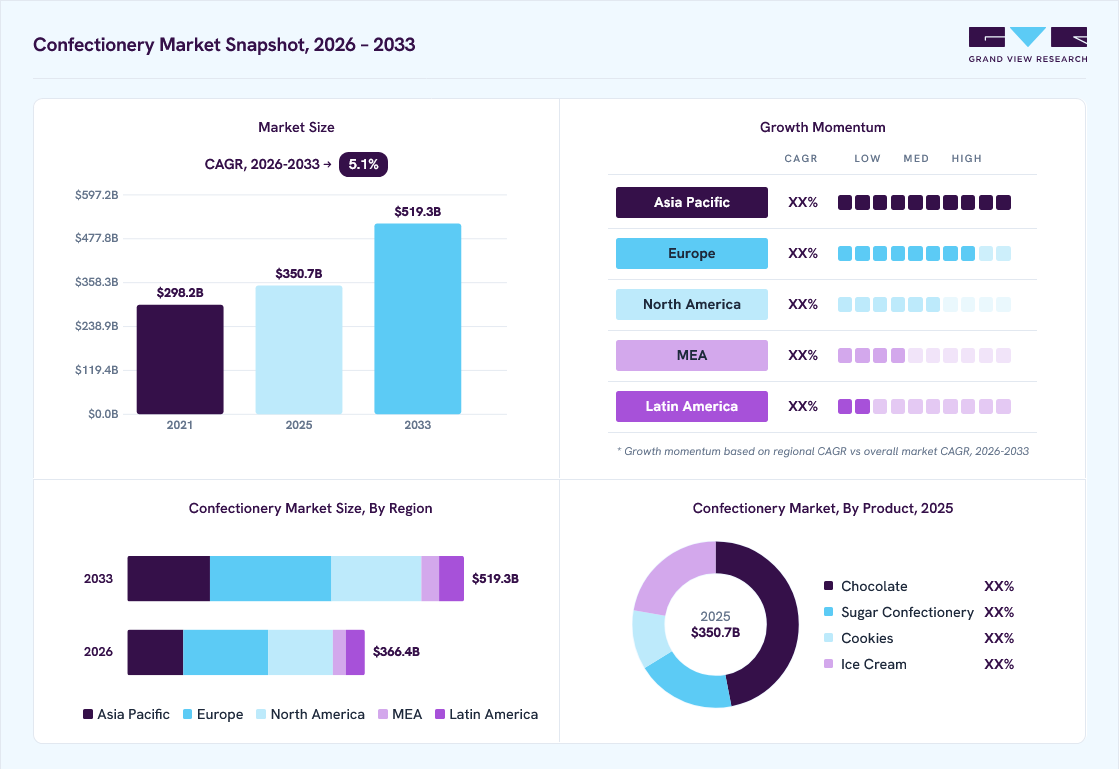
The global confectionery market size was valued at USD 350.7 billion in 2025 and is projected to grow from USD 366.4 billion in 2026 to USD 519.3 billion by 2033, at a CAGR of 5.1% from 2026 to 2033. The market in Europe dominated with a revenue share of 35.7% in 2025. Rising consumer demand for indulgent treats, premium and artisanal products, and innovative flavors and formats is driving growth in the confectionery market.
 Source: Grand View Research, IR Documents, Primary Interviews, Paid DatabasesTo learn more about this report,
 Download Free Sample Report
Key Market Trends & Insights
- By product: Chocolate segment held the largest market share of 46.9% in 2025.
- By distribution channel: Offline segment held the largest market share of 79.0% in 2025.
Regional Highlights
- Largest regional market: Europe (35.7% revenue share, 2025)
- Fastest-growing regional market: Asia Pacific (highest CAGR, 2026-2033)
- By country: Germany held the largest market share in 2025
Market Size & Forecast
- Market size in 2025: USD 350.7 Billion
- Estimated market size in 2026: USD 366.4 Billion
- Projected market size by 2033: USD 519.3 Billion
- CAGR (2026-2033): 5.1%
Three ways to get this report
Buy it, customize it, or ask a question.Ask an Analyst
Analyst response in 1 business day
- AccessReport author, directly
- Reply timeWithin 1 working day
- No sales callDirect answer only
- FormatEmail reply
- CostFree, no cost
Get the Full Report
What the study covers
- FormatsPDF · Excel · Dashboard
- Timeline2026–2033 annual, 2025 base
- Coverage20+ countries, 5 regions
- Companies10+ key players profiled
Customize the Report
20% free customization
- IncludeCountries, segments, points
- TailorTo your product definition
- ExtendDeeper competitor detail
- OrA fully bespoke study
- Turnaround5–10 working days
Additionally, the expansion of gifting occasions, seasonal confectionery, and convenient single-serve products is increasing consumption across both everyday snacking and celebratory occasions. Furthermore, the growing use of confectionery as a gifting product during holidays, festivals, and special occasions is strengthening seasonal demand. Manufacturers are also introducing reduced-sugar, functional, and clean-label formulations to attract consumers seeking indulgence with added nutritional or lifestyle benefits.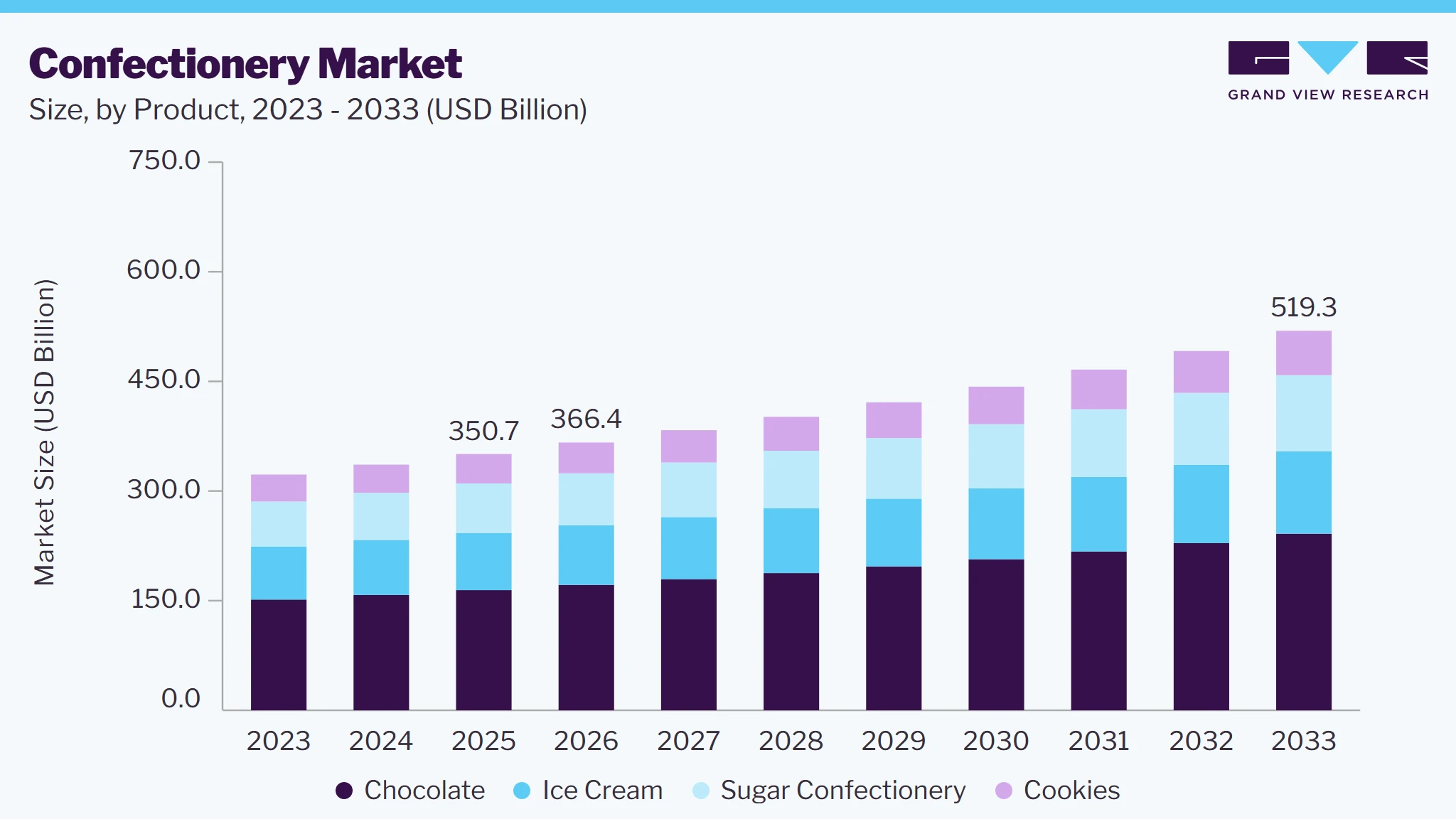 To learn more about this report, Download Free Sample Report
The global confectionery market is undergoing notable shifts across retail, product innovation, and consumer consumption patterns. Current market trends reflect rising demand for premium chocolates, artisanal confectionery, and differentiated flavors, as consumers increasingly seek higher-quality products for indulgence and gifting. At the same time, manufacturers are expanding their offerings of reduced-sugar, clean-label, and functional confectionery to respond to changing dietary preferences without compromising taste. Retail dynamics are also evolving, with e-commerce gaining traction by improving access to premium, imported, and niche products, while convenience-led retail continues to capture impulse purchases. Seasonal occasions, festivals, and gifting are further creating demand peaks, encouraging brands to launch limited-edition products and occasion-specific packaging. Additionally, product innovation across gummies, filled chocolates, chewy candies, and novel textures is creating new consumption occasions and supporting category expansion across developed and emerging markets.
Market Dynamics
The growing preference for premium, differentiated, and experience-led confectionery is encouraging manufacturers to introduce new flavors, textures, formats, and higher-quality ingredients. In September 2025, Ferrero launched Ferrero Rocher Chocolate Squares, combining a thin chocolate shell with creamy filling, hazelnuts, and crispies in an individually wrapped format designed for sharing and everyday indulgence. Similarly, in May 2026, Ferrero announced a new Wonka range comprising ten seasonal and limited-edition products across chocolate and sugar confectionery, with new combinations of flavors, textures, and shapes. Such innovations allow manufacturers to command higher price points, create new consumption occasions, and stimulate repeat purchases, thereby supporting confectionery market growth.
Fluctuations in the prices of major confectionery inputs, particularly cocoa and sugar, are increasing production costs and making it difficult for manufacturers to maintain stable pricing and margins. Cocoa prices remain elevated despite their recent correction, while sugar costs have also experienced sharp regional increases. In August 2026, India imposed stockholding limits on bulk sugar consumers, including confectionery manufacturers, restricting inventories to 10 tonnes for a maximum of 15 days amid rising prices. In the same period, Hershey reported that a 12% price increase contributed to an 8% decline in volume, highlighting the difficulty of fully passing higher input costs on to consumers without affecting demand. These cost pressures can compress manufacturer margins, encourage product reformulation or downsizing, and make consumers more price-sensitive, thereby restraining market volume growth.
The rapid expansion of quick commerce is creating opportunities for confectionery manufacturers and distributors to increase product visibility, drive impulse purchases, and expand access to premium products. In March 2026, Redseer reported that quick commerce is increasingly capturing incremental chocolate consumption in India, supported by gifting and special occasions. Redseer Strategy Consultants Fabelle has also identified quick commerce as its fastest-growing channel for premium chocolates, with premium products increasingly delivered within minutes. Fortune India Manufacturers can therefore use digital platforms to introduce limited-edition products, premium assortments, and occasion-specific packs, while distributors can improve assortment depth and respond quickly to demand spikes during festivals and gifting periods. This creates an opportunity to increase both purchase frequency and average transaction value without relying solely on traditional retail expansion.
Analyst Perspective
The confectionery market is shifting from a volume-driven indulgence category toward a portfolio optimization game, where manufacturers can protect margins by balancing mass-market products with premium, permissible, and portion-controlled offerings. The strongest competitive moat will not come from adding flavors or seasonal SKUs alone, but from owning multiple consumption occasions across chocolate, sugar confectionery, cookies, and ice cream while using premiumization, innovation, and channel-specific formats to increase value per consumer. The winners will be manufacturers that can simultaneously preserve affordability in high-volume products and capture trading-up in premium segments without weakening brand loyalty.
Consumer Insights
 To learn more about this report, Download Free Sample Report
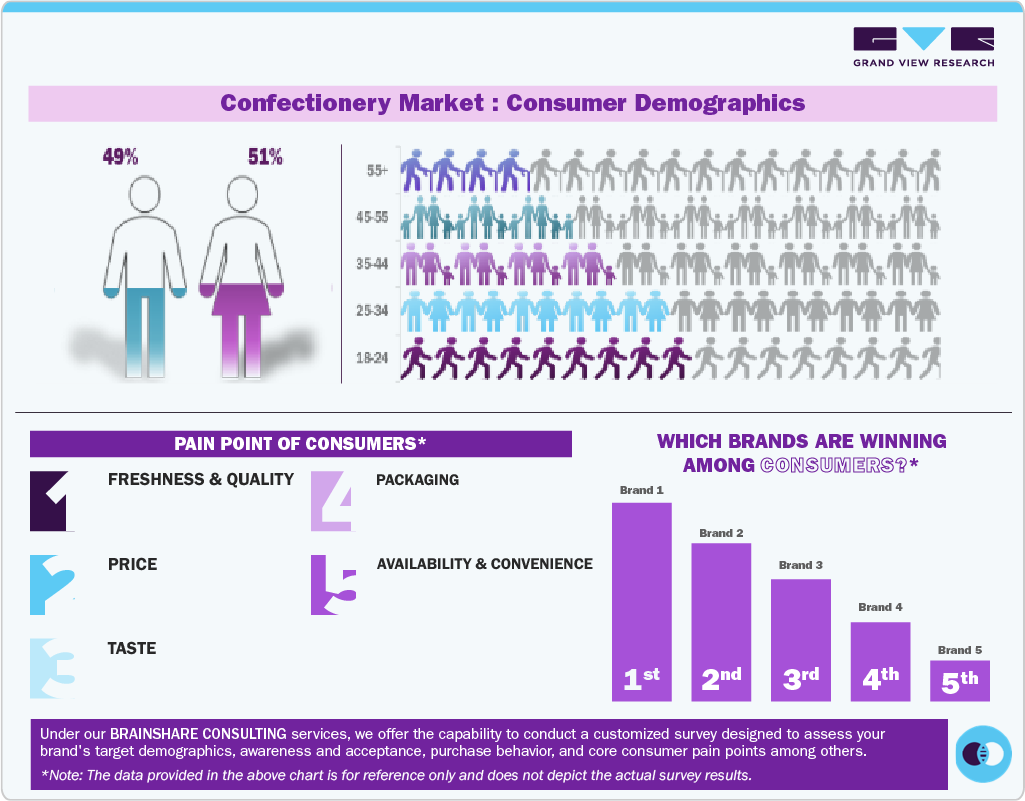
Consumer preferences in confectionery are evolving as consumers seek products that provide indulgence while aligning with changing dietary, lifestyle, and purchasing priorities. SPINS data indicate that conventional products account for 87% of the confectionery market, while natural products are growing at nearly twice the rate of conventional products, reflecting increasing demand for cleaner-ingredient profiles. Specialty products are also gaining distribution as consumers show greater interest in distinctive flavors, textures, and products with unique origins. Functional ingredients are gaining relevance as manufacturers incorporate attributes such as oral-health benefits and added nutritional value into familiar confectionery formats. Smaller portions and lower-sugar formulations are also creating opportunities for consumers to manage consumption while retaining the treat experience. At the same time, interest in international flavors, novel textures, organic products, and fair-trade offerings is broadening product discovery. Digital platforms are further influencing purchasing behavior by increasing exposure to new products and creating additional impulse-purchase opportunities.
Product Insights
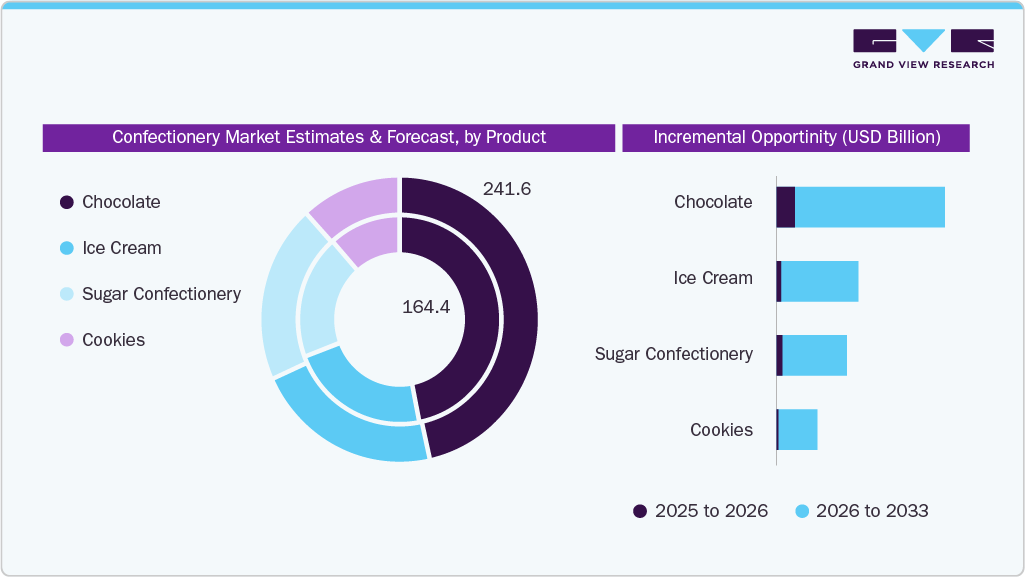
The chocolate segment accounted for the highest revenue share of 46.9% in 2025, supported by its broad consumption base, premium positioning, gifting relevance, and continuous product innovation. Manufacturers are increasingly expanding beyond traditional bars through filled chocolates, layered textures, premium ingredients, limited editions, and co-branded formats to create differentiated consumption occasions. This approach also enables brands to command higher price points while maintaining consumer interest through frequent launches. For instance, Mondelēz International introduced Cadbury Dairy Milk Silk Limited Edition Dubai Chocolate in India in June 2026, combining its established chocolate format with the globally popular Dubai chocolate concept. The company also introduced CÔTE D'OR in India in July 2026, expanding its portfolio to include a premium Belgian chocolate offering. mondelezinternational.com These launches demonstrate how chocolate manufacturers are leveraging premiumization, international flavors, and limited-edition concepts to strengthen consumer engagement and expand value within the largest confectionery product category.
 To learn more about this report, Download Free Sample Report
The sugar confectionery segment is expected to grow at the fastest CAGR of 5.6% from 2026 to 2033, supported by expanding demand for gummies, jellies, chewy candies, mints, and innovative sugar-based formats. Product development is increasingly focused on new textures, fruit-based flavors, plant-based formulations, and lower-sugar options, allowing manufacturers to broaden consumption occasions while retaining the sensory appeal of confectionery. SPINS reported that non-chocolate candies gained 31% share over the past year, while gums and mints grew 13% over three years, highlighting the momentum of sugar confectionery formats. Spins Manufacturers are also adapting established brands to changing preferences. For instance, Mars introduced STARBURST GOODIES in May 2025, a plant-based gummy product positioned with 4 grams of sugar per serving and a source of fiber. The launch demonstrates how sugar confectionery manufacturers are adapting established candy formats to changing consumer preferences while retaining the sensory appeal associated with gummies.
Distribution Channel Insights
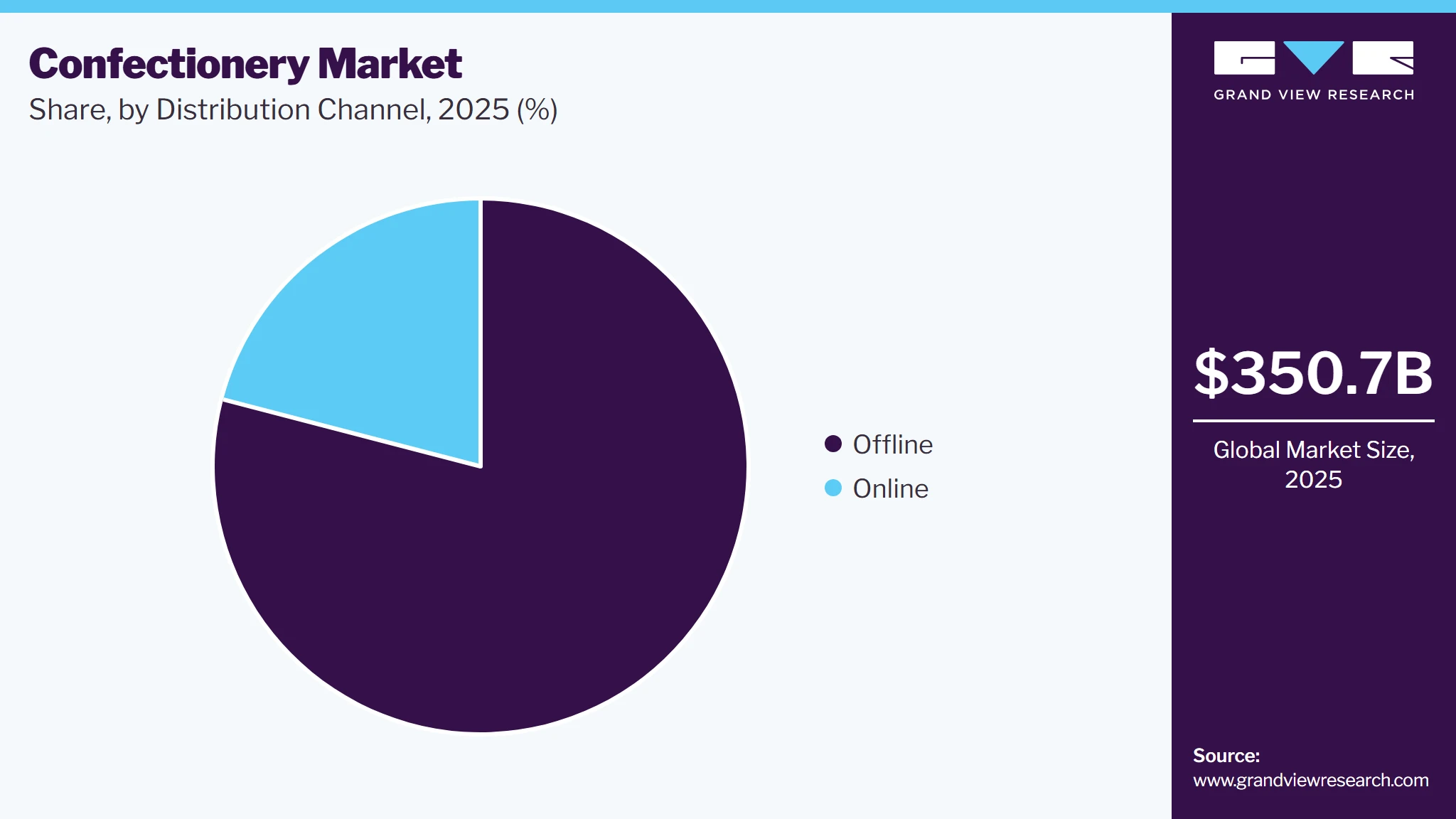
The offline segment dominated the market with a share of 79.0% in 2025, supported by extensive retail accessibility, impulse purchasing, product visibility, and consumers’ preference for immediate product availability. Physical retail also provides manufacturers with greater opportunities to use shelf placement, checkout displays, promotions, and seasonal merchandising to stimulate unplanned purchases. SPINS reported that the MULO (Multi Outlet) channel accounted for approximately 75% of confectionery sales, while convenience stores recorded the fastest channel growth, supported by expanded distribution and price increases. Manufacturers are therefore strengthening physical availability through supermarkets, convenience stores, and traditional retailers while using in-store visibility to support impulse-led consumption.
 To learn more about this report, Download Free Sample Report
The online segment is expected to grow at a CAGR of 5.9% from 2026 to 2033 as consumers increasingly use digital platforms to discover, compare, and purchase products beyond the assortment available through physical stores. E-commerce enables manufacturers to offer wider product ranges, premium formats, seasonal packs, and limited-edition products while providing retailers with greater flexibility in promotions and targeted merchandising. The growth of quick-commerce platforms is further strengthening online confectionery sales by reducing delivery times and making chocolates, candies, and other treats accessible for immediate consumption and gifting occasions. For instance, Ferrero expanded the online availability of its premium chocolate portfolio in India through quick-commerce and e-commerce platforms, allowing products such as Ferrero Rocher and other premium formats to reach consumers beyond conventional retail outlets.
Regional Insights
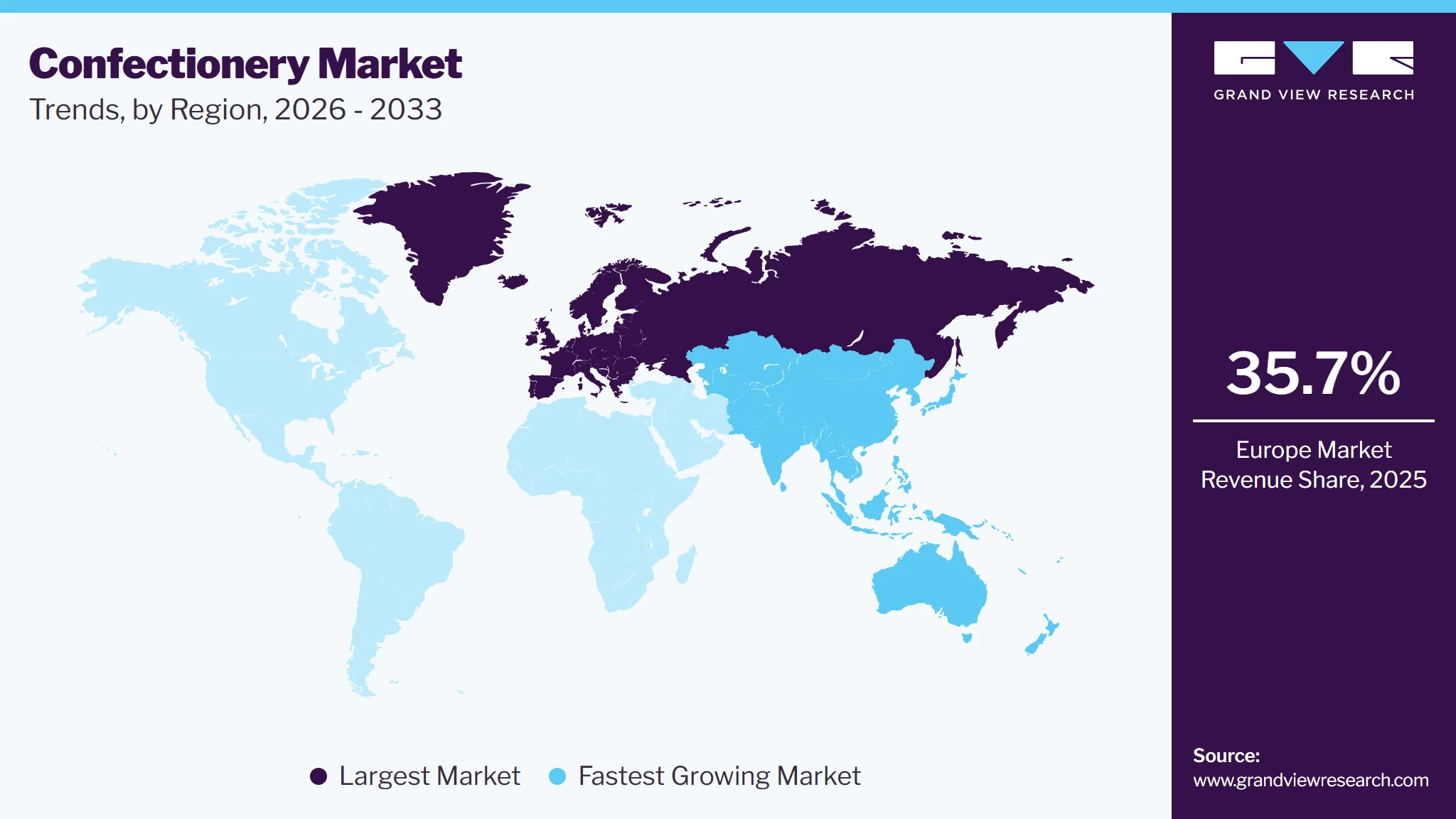
Europe confectionery industry held the largest share of 35.7% of the global market in 2025. The European confectionery industry is increasingly shaped by regulatory-driven reformulation and packaging changes, rather than only by premiumization or product innovation. In the UK, tighter restrictions on high-fat, salt, and sugar (HFSS) products are pushing manufacturers to reduce sugar and saturated fat while maintaining the taste, texture, and appearance expected from established confectionery products. This is particularly challenging for chocolate, where reformulation can affect structure and consumer acceptance.
 To learn more about this report, Download Free Sample Report
Germany Confectionery Market Trends
The confectionery market in the Germany holds the largest market share of 25.6% in 2025. The demand is being influenced by greater consumer attention to value, pack sizes, product transparency, and changing consumption preferences. Rising retail prices are prompting consumers to compare the quantity received with the price paid, increasing the relevance of pack-size strategies, promotional offers, and affordable product formats. At the same time, consumers continue to show interest in new flavor combinations and differentiated confectionery, creating space for products inspired by international tastes and emerging food concepts.
North America Confectionery Market Trends
North America holds a significant revenue share of 27.3% in 2025 for the confectionery market, supported by high category penetration, established retail infrastructure, strong seasonal purchasing, and continuous product innovation. Consumers in the region continue to purchase confectionery for everyday snacking and gifting occasions, while manufacturers are expanding their portfolios with new formats, premium offerings, and seasonal launches. In the U.S. 99.8% of households purchasing confectionery at least once during the year, demonstrating the category’s broad consumer reach. Manufacturers are also responding to demand for new formats, flavors, and textures, particularly among younger consumers.
U.S. Confectionery Market Trends
The confectionery market in the U.S holds the largest share of 78.6% in 2025, supported by frequent snacking, seasonal consumption, product-format innovation, and continued demand for familiar brands with new flavor and texture combinations. Manufacturers are also extending established brands into new formats to capture additional consumption occasions. For instance, Hershey expanded Jolly Rancher beyond its traditional hard-candy format into gummies and ropes, helping the brand reach the No. 5 position among U.S. sweets brands in 2025, with 26% year-over-year retail sales growth. This shows how established brands are using format innovation and familiar flavor profiles to expand consumption occasions and maintain relevance in the U.S. market.
Asia Pacific Confectionery Market Trends
The confectionery market in Asia Pacific is expected to grow at the fastest CAGR of 5.7% from 2026 to 2033 as manufacturers adapt products to local tastes, expanding snack occasions, and rising interest in premium and multisensory formats. The region also benefits from diverse consumer preferences, a young demographic base, expanding retail penetration, and increasing availability of both international and locally relevant confectionery products. Manufacturers are increasingly tailoring flavors, formats, and gifting propositions to country-specific occasions, while premium chocolate is gaining visibility alongside affordable everyday treats. India, in particular, offers considerable consumption headroom supported by its large population, young consumers, and extensive retail network.
The confectionery market in India is expected to grow with a fastest CAGR of 6.4% from 2026 to 2033 supported by a young consumer base, expanding retail access, rising gifting occasions, and increasing experimentation with flavors and formats. Manufacturers are responding to India’s diverse regional preferences through localized products, festival-linked offerings, affordable pack sizes, and premium chocolate propositions. The market is also benefiting from the wider availability of confectionery through traditional trade, modern retail, and digital commerce, allowing brands to reach consumers across different price points. Gifting and cultural celebrations remain particularly relevant, creating additional consumption occasions beyond everyday snacking.
Central & South America Confectionery Market Trends
The confectionery market in CSA is expected to grow with a CAGR of 4.0% from 2026 to 2033, being shaped by strong cultural connections with sweets, growing experimentation with flavors and textures, and the expansion of confectionery into everyday self-reward and social occasions. Consumers are increasingly balancing indulgence with moderation, encouraging manufacturers to explore smaller portions, alternative formulations, and products with added functional or better-for-you attributes. Local ingredients and familiar regional flavors are also gaining relevance as brands seek stronger cultural connections, while collaborations and limited-edition products create additional purchase occasions. For instance, In June 2026, Garoto launched its Sabores do Brasil chocolate line in Brazil, beginning with a Pé de Moleque flavor inspired by a traditional Brazilian sweet and Festa Junina culture, illustrating the use of local flavors to differentiate confectionery products.
MEA Confectionery Market Trends
The confectionery market in MEA is expected to grow with a CAGR of 4.5% from 2026 to 2033 being shaped by strong seasonal consumption, culturally rooted gifting occasions, and growing demand for products that combine indulgence with convenience and better-for-you attributes. Ramadan, Eid, and other cultural celebrations create concentrated purchasing periods, encouraging manufacturers to develop special-edition packaging, gifting assortments, and regionally relevant flavors. At the same time, sugar-reduced, functional, vegan, and portion-controlled confectionery is gaining visibility as consumers seek greater choice without giving up indulgence. Expanding modern retail and travel retail further supports premium and imported confectionery across major urban markets.
Key Confectionery Company Insights
The market is characterized by the presence of several well-established players and a few emerging players. New product launches, partnerships, and acquisitions are one of the key strategic initiatives in the industry.
Key Confectionery Companies:
The following key companies have been profiled for this study on the confectionerymarket.
-
Mondelez International, Inc.
-
Mars, Incorporated
-
The Hershey Company
-
Nestlé S.A.
-
Meiji Co., Ltd.
-
Ferrero Group
-
Chocoladefabriken Lindt & Sprüngli AG
-
Perfetti Van Melle
-
Ezaki Glico Co., Ltd.
-
Haribo GmbH & Co. K.G.
-
Grupo Arcor
-
Pladis
Recent Developments
-
In September 2026, Ferrero launched a new Wonka confectionery range featuring Magic Hat Chocolate Pralines, Oompa Loompa Gummies, Magic Garden Ropes, Purplypurple Milk Chocolate Bar and other products with unexpected flavors, shapes and textures.
-
In June 2026, Planet A Foods introduced ChoViva No Added Sugar, a cocoa-free chocolate alternative formulated without added sugar for confectionery and bakery manufacturers, while retaining a smooth melt and indulgent sensory profile.
-
In January 2026, Mondelēz launched OREO Zero Sugar in Original and Double Stuf varieties, introducing a zero-sugar formulation in a new stand-up pouch containing individually portioned servings for convenience and portion control.
Confectionery Market Report Scope
Report Attribute
Details
Market size in 2025
USD 350.7 billion
Estimated market size in 2026
USD 366.4 billion
Projected market size by 2033
USD 519.3 billion
Growth rate
CAGR of 5.1% from 2026 to 2033
Actual data
2021 - 2025
Forecast period
2026 - 2033
Quantitative units
Revenue in USD million/billion and CAGR from 2026 to 2033
Report coverage
Revenue forecast, company ranking, competitive landscape, growth factors, and trends
Segments covered
Product, distribution channel, region
Regional scope
North America; Europe; Asia Pacific; Central & South America; MEA
Country scope
U.S.; Canada; Mexico; Germany; UK; France; Italy; Spain; China; Japan; India; Brazil
Key companies profiled
Mondelez International, Inc.; Mars, Incorporated; The Hershey Company; Nestlé S.A.; Meiji Co., Ltd.; Ferrero Group; Chocoladefabriken Lindt & Sprüngli AG; Perfetti Van Melle; Ezaki Glico Co. Ltd.; Haribo GmbH & Co. K.G.; Grupo Arcor; Pladis
Customization scope
Free report customization (equivalent up to 8 analyst’s working days) with purchase. Addition or alteration to country, regional & segment scope. Explore purchase options
Global Confectionery Market Report Segmentation
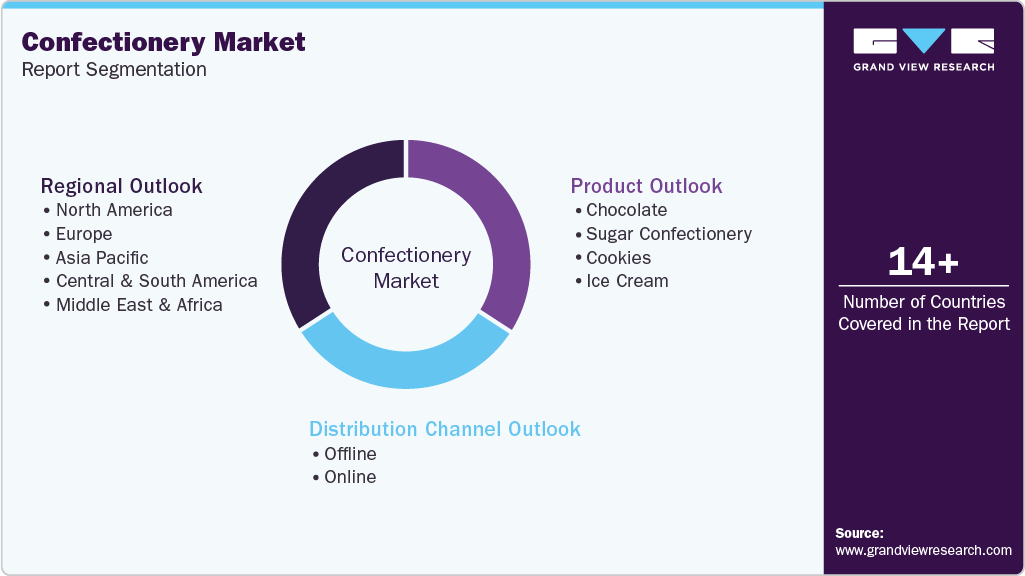
This report forecasts revenue growth at global, regional & country levels and provides an analysis of the latest trends and opportunities in each of the sub-segments from 2021 to 2033. For this study, Grand View Research has segmented the global confectionery market based on product, distribution channel, and region:
 To learn more about this report, Download Free Sample Report
- Product Outlook (Revenue, USD Billion, 2021 - 2033)
-
Chocolate
-
Sugar Confectionery
-
Cookies
-
Ice Cream
-
-
Distribution Channel Outlook (Revenue, USD Billion, 2021 - 2033)
-
Offline
-
Online
-
-
Regional Outlook (Revenue, USD Billion, 2021 - 2033)
-
North America
-
U.S.
-
Canada
-
Mexico
-
-
Europe
-
Germany
-
UK
-
France
-
Italy
-
Spain
-
-
Asia Pacific
-
China
-
India
-
Japan
-
-
Central & South America
-
Brazil
-
-
Middle East & Africa
-
South Africa
-
-
Research Methodology
The confectionery marketfigures in this report are based on a proven research process that combines executive interviews with secondary research from proprietary databases, company filings, and recognized regulatory and institutional sources. Market size is built through value-chain sizing-reconciling supply-side and demand-side estimates-and triangulated with bottom-up and top-down approaches. Every estimate passes multiple levels of expert validation before publication, with eachconfectionerysegment quantified using the revenue-capture definitions in the table below.
Segment Definition
Product
Revenue capture definition
Chocolate
This segment includes the sales of chocolate products made primarily from cocoa solids, cocoa butter, and sugar. Revenue is generated through bars, blocks, pralines, truffles, and filled or flavored chocolate products.
Sugar Confectionery
This segment includes the sales of confectionery products primarily made from sugar, sweeteners, and flavoring ingredients. Revenue is generated through candies, toffees, lollipops, gummies, jellies, and mints.
Cookies
This segment includes the sales of baked products made from flour, sugar, fats, and other ingredients. Revenue is generated through plain, filled, flavored, sandwich, and chocolate-based cookies.
Ice Cream
This segment includes the sales of frozen desserts primarily made from dairy or plant-based ingredients, sugar, and flavorings. Revenue is generated through tubs, cups, cones, bars, sandwiches, and other portioned formats.
Estimation Model
Layer Name
Key Question
Description
Consumer Base Layer
Who consumes confectionery?
Identify the addressable population across relevant age groups and consumer segments with regular confectionery consumption.
Purchase Access Layer
Who can be reached through retail?
Apply country-specific retail penetration and consumer accessibility rates to the addressable population across supermarkets, convenience stores, specialty stores, and e-commerce channels.
Consumption Layer
Who actively purchases confectionery?
Apply confectionery purchase and consumption rates to the reachable consumer base to derive active confectionery buyers.
Monetisation Layer
How much revenue is generated?
Multiply active buyers by estimated annual confectionery spending per consumer and add B2B revenue from foodservice, hospitality, and commercial buyers.
Delivered Customizations
This report has been delivered with the following In-depth customizations
Client Request
Customization Delivered
Value Adds
Global Confectionery Consumer & Preference Landscape
Assessed consumer preferences across chocolate, sugar confectionery, gum, and other confectionery categories, including flavor, texture, portion size, indulgence, and better-for-you attributes.
Helps identify high-demand product attributes and refine consumer targeting strategies.
Global Confectionery Product & Format Assessment
Evaluated product formats, including bars, tablets, boxed chocolates, gummies, candies, jellies, mints, and single-serve products, with emphasis on emerging format innovations.
Supports portfolio optimization, format selection, and the identification of attractive product development opportunities.
Global Confectionery Pricing & Premiumization Landscape
Analyzed pricing tiers, premium positioning, gifting products, specialty ingredients, and differentiated value propositions across major confectionery markets.
Enables pricing strategy development, premium portfolio expansion, and stronger margin opportunities.
Frequently Asked Questions About This Report
Key factors that are driving the confectionery market growth include increasing consumers’ inclination toward gifting these products coupled with rising disposable income and rapid urbanization across the world.
The global confectionery market is expected to grow at a CAGR of 5.1% from 2026 to 2033, reaching USD 519.3 billion by 2033.
Europe dominated the confectionery market with a share of 35.7% in 2025. This is attributable to the increasing popularity and demand for chocolate confectionery products coupled with the rising consumer's preference for organic, and value-added natural ingredients products.
Some key players operating in the confectionery market include Mondelez International, Inc.; Mars, Incorporated; The Hershey Company; Nestlé S.A.; Meiji Co., Ltd.; Ferrero Group; Chocoladefabriken Lindt & Sprüngli AG; Perfetti Van Meller; Ezaki Glico Co., Ltd.; Haribo GmbH & Co. K.G.; Grupo Arcor; and Pladis.
The offline segment led with a 79.0% revenue share in 2025.
Asia Pacific is the fastest growing region over the forecast period.
Chocolate segment leads the confectionery market with the largest share of 46.9% in 2025.
Online distribution channel is the fastest growing channel with a CAGR of 5.9% from 2026 to 2033.
The global confectionery market size was valued at USD 350.7 billion in 2025 and is estimated at USD 366.4 billion for 2026.
About the Author(s)
Consumer F&B Research Team
Consumer Goods · Consumer F&BThis report was authored by the consumer f&b research team at Grand View Research - comprising two research analysts, one senior research analyst, and one industry expert - with specialized expertise in the consumer f&b segment of the consumer goods industry. All findings are based on proprietary consumer goods databases, executive interviews, and regulatory analysis, subject to internal peer review prior to publication.
Last Updated:
Speak to Analyst

Customize this report to your needs - add regions, segments, or data points, with 20% free customization.
Or view our licence options:


ISO 9001:2015 & 27001:2022 Certified
We are GDPR and CCPA compliant! Your transaction & personal information is safe and secure. For more details, please read our privacy policy.


