
- Home
- »
- Next Generation Technologies
- »
-
Agentic Commerce Market Size & Share Report, 2026-2033GVR Report cover
![Agentic Commerce Market (2026 - 2033)Report]()
Agentic Commerce Market (2026 - 2033)
Size, Share & Trends Analysis Report By Interaction Model (C2A, A2A, B2A), By Technology (Multi-Agent Systems, On-Device AI), By Application (Retail & E-commerce, Financial Services & Payments, Travel & Hospitality), By Region, And Segment Forecasts
Market Size, 2025
$5.7BMarket Estimate, 2026
$7.7BMarket Forecast, 2033
$65.5BCAGR, 2026–2033
35.7%Agentic Commerce Market Summary
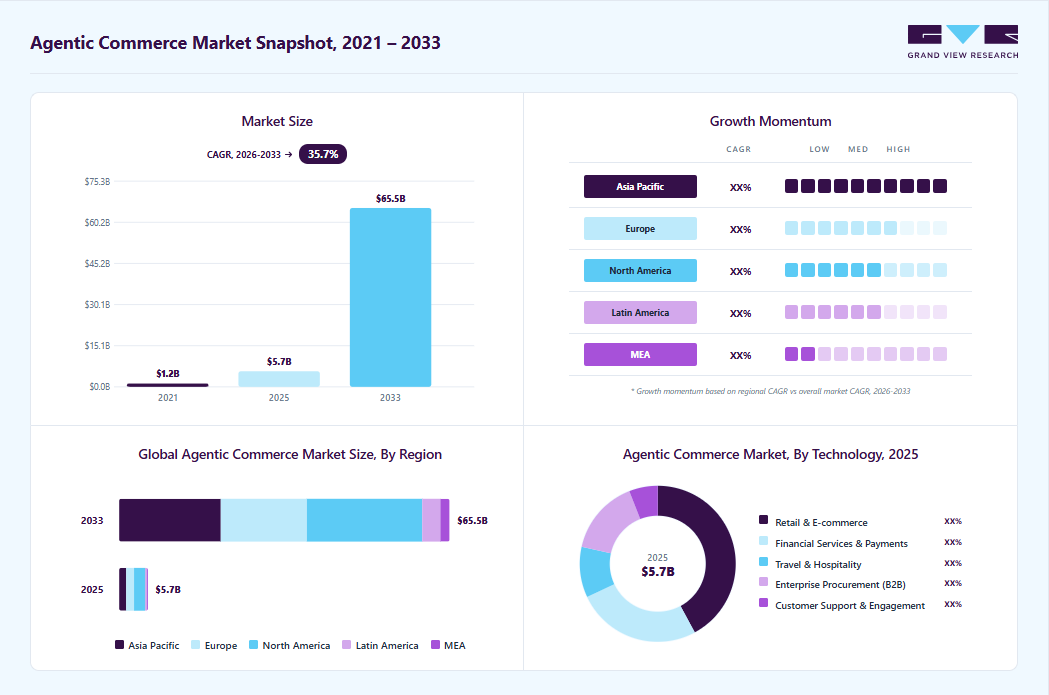
The global agentic commerce market size was valued at USD 5.7 billion in 2025 and is projected to grow from USD 7.7 billion in 2026 to USD 65.5 billion by 2033, at a CAGR of 35.7% from 2026 to 2033. The North America held the largest share of 38.2% of the global market in 2025. This expansion is fueled by the increasing adoption of AI agents that can perform autonomous transactions. Companies are utilizing these agents to deliver personalized customer experiences and improve engagement.
Key Market Trends & Insights
- By interaction model: Consumer-to-Agent (C2A) held the largest revenue share of 53.1% in 2025.
- By technology: Generative AI & large language models (LLMs) held the largest share of 40.9% in 2025.
- By application: Retail and e-commerce dominated the market in 2025.
Regional Highlights
- Largest regional market: North America (38.2% revenue share, 2025)
- Fastest-growing regional market: Asia Pacific (highest CAGR, 2026-2033)
- By country: The U.S. led the North America market in 2025.
Market Size & Forecast
- Market size in 2025: USD 5.7 Billion
- Estimated market size in 2026: USD 7.7 Billion
- Projected market size by 2033: USD 65.5 Billion
- CAGR (2026-2033): 35.7%
Three ways to get this report
Buy it, customize it, or ask a question.Get the Full Report
What the study covers
- FormatsPDF · Excel · Dashboard
- Timeline2026–2033 annual, 2025 base
- Coverage20+ countries, 5 regions
- Companies10+ key players profiled
Customize the Report
20% free customization
- IncludeCountries, segments, points
- TailorTo your product definition
- ExtendDeeper competitor detail
- OrA fully bespoke study
- Turnaround5–10 working days
Ask an Analyst
A direct answer, usually in 1 working day
- AccessReport author, directly
- Reply timeWithin 1 working day
- No sales callDirect answer only
- FormatEmail reply
- CostFree, no cost
Moreover, operational efficiency across e-commerce and digital platforms is driving further market adoption. The global market is witnessing the integration of AI-driven conversational interfaces with seamless payment systems. Users can now complete purchases directly within chat environments, creating frictionless commerce experiences. AI agents are increasingly handling interactions, recommendations, and transactions in real time. Partnerships between AI firms and payment providers are helping establish secure, standardized protocols. This approach ensures interoperability with existing merchant infrastructure and broadens adoption. Agentic commerce is moving toward practical, scalable solutions in everyday digital interactions. For instance, in September 2025, OpenAI, a U.S.-based artificial intelligence company, partnered with Stripe, Inc. to launch Instant Checkout in ChatGPT, allowing users to purchase products directly within the chat using the Agentic Commerce Protocol. The system securely handles orders and payments through merchants’ existing infrastructure, with Stripe providing the underlying payment framework and co-developing the protocol for AI-driven commerce.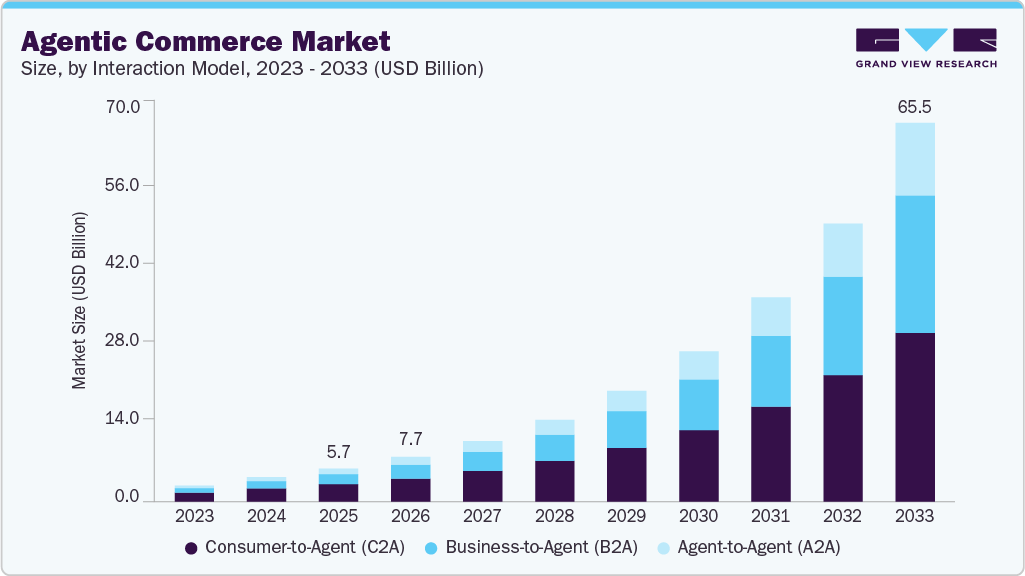
Shopping patterns are moving away from keyword-based search toward AI systems that guide decisions through contextual recommendations. Consumers are increasingly asking assistants what to buy instead of browsing product listings. This change is pushing enterprises to be visible inside conversational AI environments. It raises the need for structured data that AI agents can easily interpret. Companies such as commerce tools are launching agent-ready solutions that make product and pricing data accessible to these systems. This shift is becoming a major driver of growth in agentic commerce. For instance, in November 2025, commercetools GmbH, a digital commerce technology company, launched Agentic Jumpstart. This enterprise solution exposes product, pricing, and availability data to leading AI platforms and enables secure transactions through its AI Hub and Agent Gateway. Built on a composable, cloud-native platform with MCP and ACP support, Agentic Jumpstart lets enterprises test AI-driven channels while keeping governance, security, and operations stable.
Data integration and unified AI platforms are becoming a key focus in the agentic commerce landscape. The most effective systems are those seamlessly embedded within CRMs, marketing automation tools, and data warehouses, ensuring consistent and context-rich operations. Disconnected point tools often create data silos that fragment customer information and reduce outreach precision. Companies such as Outreach and Whistle Ltd are enhancing integration capabilities to unify sales and marketing workflows. These platforms enable real-time synchronization across multiple systems, improving the accuracy of AI-driven insights. Agentic Commerce systems with visibility across all touchpoints, emails, LinkedIn interactions, web activity, and form submissions, gain a competitive edge in targeting and engagement. This integration allows for a more complete understanding of customer intent and behavior. AI models are now required to process a wide range of data types, including text, behavioral logs, and enrichment datasets.
Interaction Model Insights
The Consumer-to-Agent (C2A) segment dominated the market in 2025, accounting for a 53.1% share, as individuals relied on autonomous agents for routine tasks. Consumers used agents for product discovery, comparisons, and everyday digital decisions. This adoption accelerated as agents delivered faster and cleaner interactions than manual searches. Convenience motivated users to hand over repetitive actions to trusted systems. C2A expanded as spending limits, preferences, and mandates made agent actions predictable. Heavy usage improved agent accuracy through continuous feedback loops. These patterns established C2A as the largest activity stream in agentic commerce.
Business-to-Agent (B2A) is growing as enterprises build infrastructures that allow autonomous agents to interact directly with their systems. Businesses are creating structured catalogs, agent-ready APIs, and machine-readable service layers. This redesign is helping companies reach decision points where agents initiate actions before humans intervene. Firms are planning to automate quote requests, inventory checks, and order management through agent-facing channels. Early adopters are testing agent-first environments to support both internal and customer-facing processes. These experiments are expanding the operational scope of B2A interactions. This momentum is moving B2A toward a stronger position within agentic commerce.
Technology Insights
Generative AI and LLMs dominated the market because they handled reasoning, content creation, and decision automation with strong consistency. Their natural-language interfaces made it easy for users and businesses to activate agent workflows. These models processed unstructured inputs effectively, which strengthened agent accuracy across commerce tasks. Enterprises used them to power discovery, recommendations, and transactional dialogues. Their broad capability allowed a single model to manage multiple steps in an autonomous journey. Adoption grew as platforms integrated LLMs into payment flows, shopping actions, and post-purchase support.
Multi-agent systems are growing in the market as organizations shift from single-model intelligence to distributed agent coordination. Specialized agents handle planning, execution, validation, and ongoing monitoring across commerce workflows. This setup reduces dependency on one system and improves reliability in real-time decisions. Companies are planning to use multi-agent networks for complex journeys such as automated procurement and dynamic fulfillment. These systems support modular scaling, allowing each agent to focus on a specific function. Early pilots show smoother task handoffs and quicker resolution of commerce actions.
Application Insights
Retail and e-commerce dominated in market, as these sectors adopted autonomous shopping flows early. Merchants used agents to manage product discovery, recommendations, and instant decision support. Consumers relied on agents to compare items and execute purchases with minimal friction. Retail platforms integrated agent-native APIs to simplify promotions and inventory lookups. High transaction frequency allowed agents to improve their choices through continuous interaction with data. This environment made retail a natural starting point for agent-driven automation. These conditions helped retail and e-commerce secure the strongest presence in the agentic commerce sector.
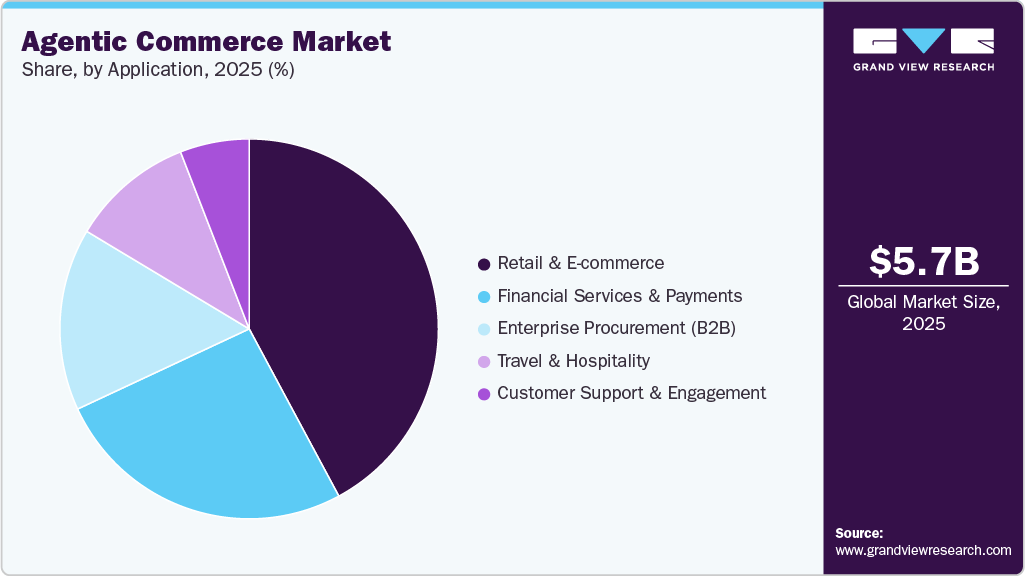
Financial services and payments are growing in agentic commerce as institutions adapt their systems for automated transactions. Banks and fintech firms are adding agent-ready verification, risk checks, and payment orchestration layers. These upgrades help agents conduct transfers, bill payments, and expense routing without manual input. Companies are planning to introduce programmable mandates that allow agents to operate within clear financial boundaries. Adoption is accelerating as firms test agent-triggered lending, savings actions, and investment decisions. Structured data and compliance frameworks make this expansion smoother than earlier digital transitions. This momentum is pushing financial services and payments toward a larger role in agentic commerce.
Regional Insights
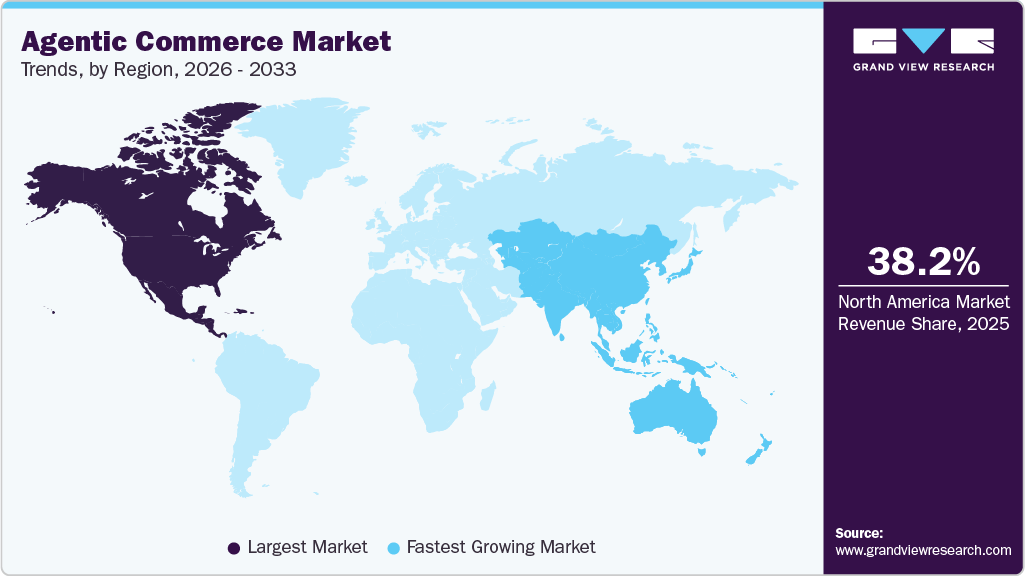
North America held the largest share in the agentic commerce market at 38.2% in 2025, supported by strong enterprise adoption of autonomous agents and increasing integration of AI-driven automation across digital commerce platforms. Strong digital infrastructure supports high-volume agent interactions across retail and payments. Businesses in the region are planning to expand agent-native workflows across customer and operational functions. Investment from major cloud and AI providers accelerates the commercialization of agentic tools.
U.S. Agentic Commerce Market Trends
The agentic commerce market in the U.S. is driven by a shift toward autonomous shopping experiences powered by AI agents. Retailers are integrating agent-ready APIs so systems can handle discovery, comparison, and transactions without manual steps. Enterprises are planning to build structured, machine-readable catalogs that help agents interpret product data accurately.
Europe Agentic Commerce Market Trends
The agentic commerce market in Europe is expanding with a strong shift toward agent-driven personalization across retail and services. Companies are building structured data layers so agents can deliver tailored product matches in real time. This approach helps reduce manual browsing and improves decision accuracy for European consumers. Growing investment in compliance-ready AI systems is reinforcing this trend across the region.
Asia Pacific Agentic Commerce Market Trends
The agentic commerce market in the Asia Pacific is the fastest-growing due to the rapid adoption of mobile-first autonomous shopping. Companies are creating agent-friendly workflows that integrate smoothly with super-apps and digital wallets. This setup allows agents to handle discovery, comparison, and purchases inside unified digital environments. Strong consumer readiness for AI-driven services is accelerating this momentum across the region.
Key Agentic Commerce Company Insights
Some of the key companies in the Agentic Commerce industry include Artisan AI Inc., Google LLC, Mastercard, and others. Organizations are focusing on increasing their customer base to gain a competitive edge in the industry. Therefore, key players are taking several strategic initiatives, such as mergers and acquisitions, and partnerships with other major companies.
-
Artisan AI Inc. builds autonomous business agents that streamline tasks across sales, operations, and procurement. These agents handle multi-step workflows without manual intervention. Their automation approach supports emerging agentic commerce patterns. Companies use Artisan’s agents to execute tasks faster and with fewer errors. This structure positions Artisan AI within the growing agentic commerce ecosystem.
-
Google LLC supports agentic commerce through its work on machine-readable protocols and agent-ready payment frameworks. The company co-developed the Agent Payments Protocol to help AI agents transact securely. Google’s multimodal AI models enable agents to understand queries and execute actions more accurately. Its ecosystem encourages deeper integration of autonomous shopping and task automation. These advances strengthen Google’s presence in agentic commerce.
Key Agentic Commerce Companies:
The following key companies have been profiled for this study on the agentic commerce market.
- Artisan AI Inc.
- Google LLC
- Mastercard
- OpenAI
- Perplexity
- Salesforce, Inc.
- Stripe, Inc.
- TENEO.AI
- Uniphore
- Verofax
Recent Developments:
-
In October 2025, PwC, a UK-based professional services firm, and Stripe Inc. formed a collaboration to accelerate the adoption of agentic commerce and support businesses transitioning to AI-driven transactions. Stripe introduced the Agentic Commerce Protocol, and PwC is helping enterprises test, integrate, and scale it. PwC is guiding clients to become discoverable and agent-ready through structured data, machine-readable content, and connected payment systems.
-
In October 2025, Salesforce, Inc. announced a collaboration with Stripe, Inc. and OpenAI to support the Agentic Commerce Protocol and deliver Instant Checkout through conversational AI on Agentforce Commerce. This collaboration enables merchants to offer faster, AI-guided shopping and secure transactions powered by Stripe’s infrastructure.
Agentic Commerce Market Report Scope
Report Attribute
Details
Market size in 2025
USD 5.7 billion
Estimated market size in 2026
USD 7.7 billion
Projected market size by 2033
USD 65.5 billion
Growth rate
CAGR of 35.7% from 2026 to 2603
Historical data
2021 - 2025
Forecast period
2026 - 2603
Quantitative units
Revenue in USD million/billion and CAGR from 2026 to 2603
Report coverage
Revenue forecast, company ranking, competitive sector, growth factors, and trends
Segment scope
Interaction model, technology, application, region
Region scope
North America; Europe; Asia Pacific; Latin America; MEA
Country scope
U.S.; Canada; Mexico; Germany; UK; France; China; Japan; India; Australia; South Korea; Brazil; KSA; UAE; South Africa
Key companies profiled
Artisan AI Inc.; Google LLC; Mastercard; OpenAI; Perplexity; Salesforce, Inc.; Stripe, Inc.; TENEO.AI; Uniphore; Verofax
Customization scope
Free report customization (equivalent up to 8 analysts’ working days) with purchase. Addition or alteration to country, regional & segment scope
Pricing and purchase options
Avail customized purchase options to meet your exact research needs. Explore purchase options
Global Agentic Commerce Market Report Segmentation
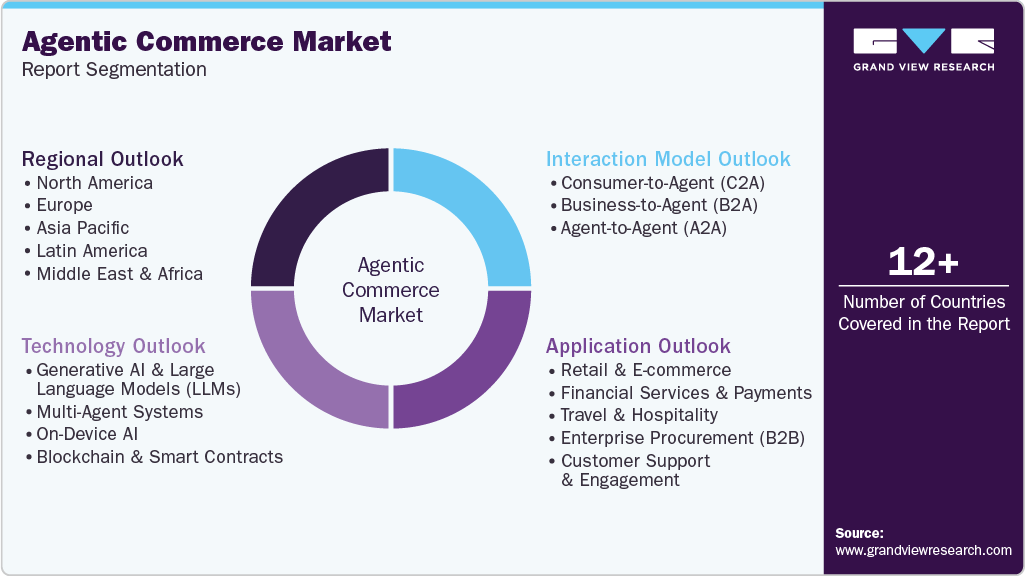
This report forecasts revenue growth at global, regional, and country levels and provides an analysis of the latest industry trends and opportunities in each of the sub-segments from 2021 to 2033. For this study, Grand View Research has segmented the global agentic commerce market based on interaction model, technology, application, and region:
-
Interaction Model Outlook (Revenue, USD Billion, 2021 - 2033)
-
Consumer-to-Agent (C2A)
-
Business-to-Agent (B2A)
-
Agent-to-Agent (A2A)
-
-
Technology Outlook (Revenue, USD Billion, 2021 - 2033)
-
Generative AI & Large Language Models (LLMs)
-
Multi-Agent Systems
-
On-Device AI
-
Blockchain & Smart Contracts
-
-
Application Outlook (Revenue, USD Billion, 2021 - 2033)
-
Retail & E-commerce
-
Financial Services & Payments
-
Travel & Hospitality
-
Enterprise Procurement (B2B)
-
Customer Support & Engagement
-
-
Regional Outlook (Revenue, USD Billion, 2021 - 2033)
-
North America
-
U.S.
-
Canada
-
Mexico
-
-
Europe
-
UK
-
Germany
-
France
-
-
Asia Pacific
-
China
-
Japan
-
India
-
Australia
-
South Korea
-
-
Latin America
-
Brazil
-
-
Middle East & Africa (MEA)
-
KSA
-
UAE
-
South Africa
-
-
Frequently Asked Questions About This Report
Asia Pacific is the fastest-growing region over the forecast period.
The Consumer-to-Agent (C2A) segment led the market with the largest revenue share of 53.1% in 2025.
The generative AI & large language models (LLMs) segment led with a 40.9% revenue share in 2025.
The retail and e-commerce segment dominated the market in 2025 and accounted for the largest share.
The global agentic commerce market size was valued at USD 5.7 billion in 2025 and is estimated at USD 7.7 billion for 2026.
The global agentic commerce market is expected to grow at a CAGR of 35.7% from 2026 to 2033, reaching USD 65.5 billion by 2033.
North America dominated the agentic commerce market with a share of 38.2% in 2025. This is attributable to North America’s advanced digital infrastructure, strong AI adoption, leading technology providers, and a mature e-commerce ecosystem.
Key players include Artisan AI Inc.; Google LLC; Mastercard; OpenAI; Perplexity; Salesforce, Inc.; Stripe, Inc.; TENEO.AI; Uniphore; Verofax.
Key factors that are driving the market growth include technological advancements, AI adoption, rising digital commerce, personalized shopping demand, and a strong e-commerce infrastructure.
About the Author(s)
Next Generation Technologies Research Team
Technology · Next Generation TechnologiesThis report was authored by the next generation technologies research team at Grand View Research - comprising two research analysts, one senior research analyst, and one industry expert - with specialized expertise in the next generation technologies segment of the technology industry. All findings are based on proprietary technology databases, executive interviews, and regulatory analysis, subject to internal peer review prior to publication.
Last Updated:
Speak to Analyst


Customize this report to your needs - add regions, segments, or data points, with 20% free customization.
Or view our licence options:


ISO 9001:2015 & 27001:2022 Certified
We are GDPR and CCPA compliant! Your transaction & personal information is safe and secure. For more details, please read our privacy policy.


