
- Home
- »
- Petrochemicals
- »
-
Agricultural Lubricants Market Size, Share Report, 2026-2033GVR Report cover

Agricultural Lubricants Market (2026 - 2033)
Size, Share & Trends Analysis Report By Product (Engine Oil, Transmission Oil, Hydraulic Fluid, Grease), By Region (North America, Europe, Asia Pacific, Latin America, Middle East & Africa), And Segment Forecasts
Market Size, 2025
$5.2BMarket Estimate, 2026
$5.4BMarket Forecast, 2033
$7.1BCAGR, 2026–2033
4.0%Agricultural Lubricants Market Summary
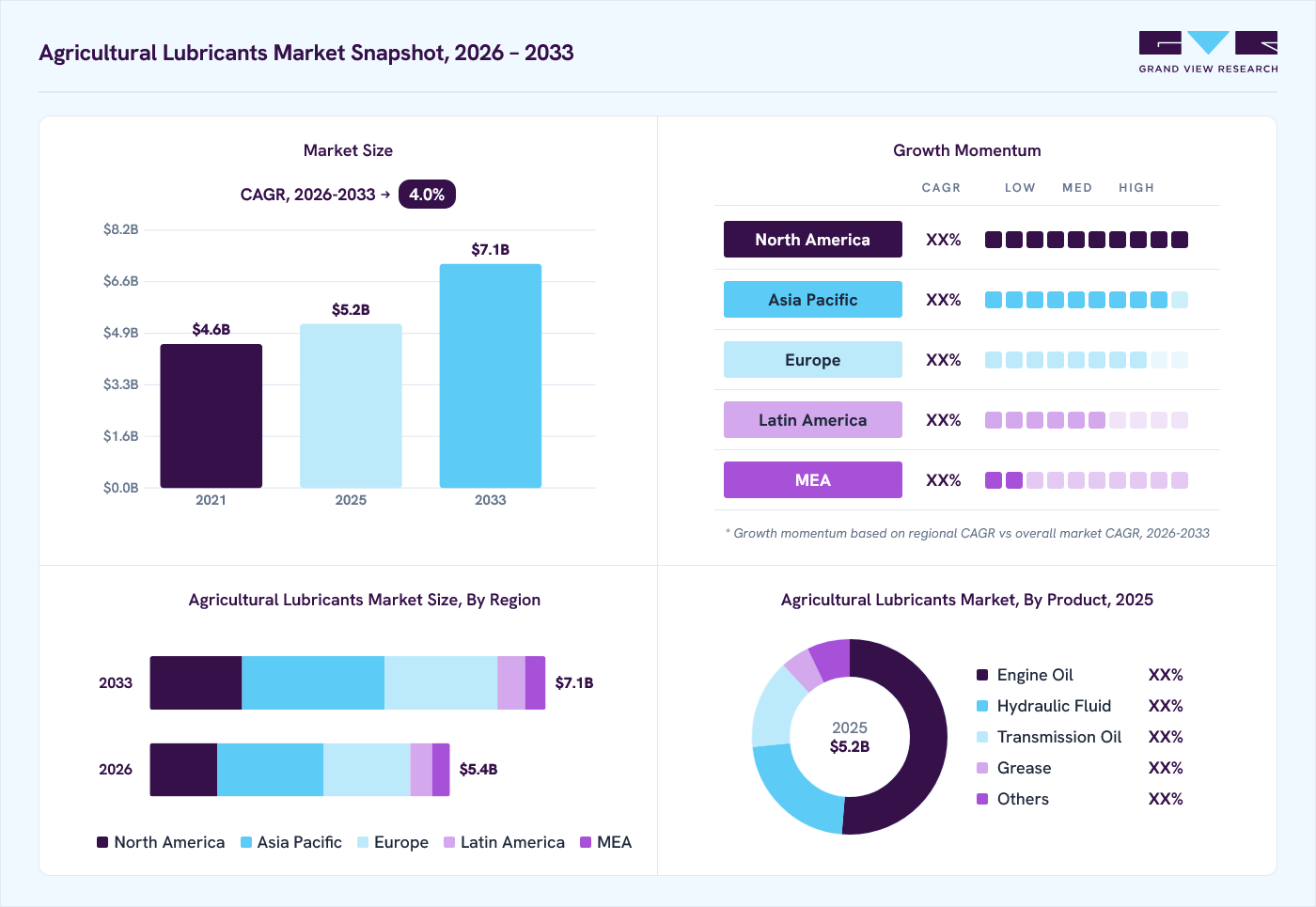
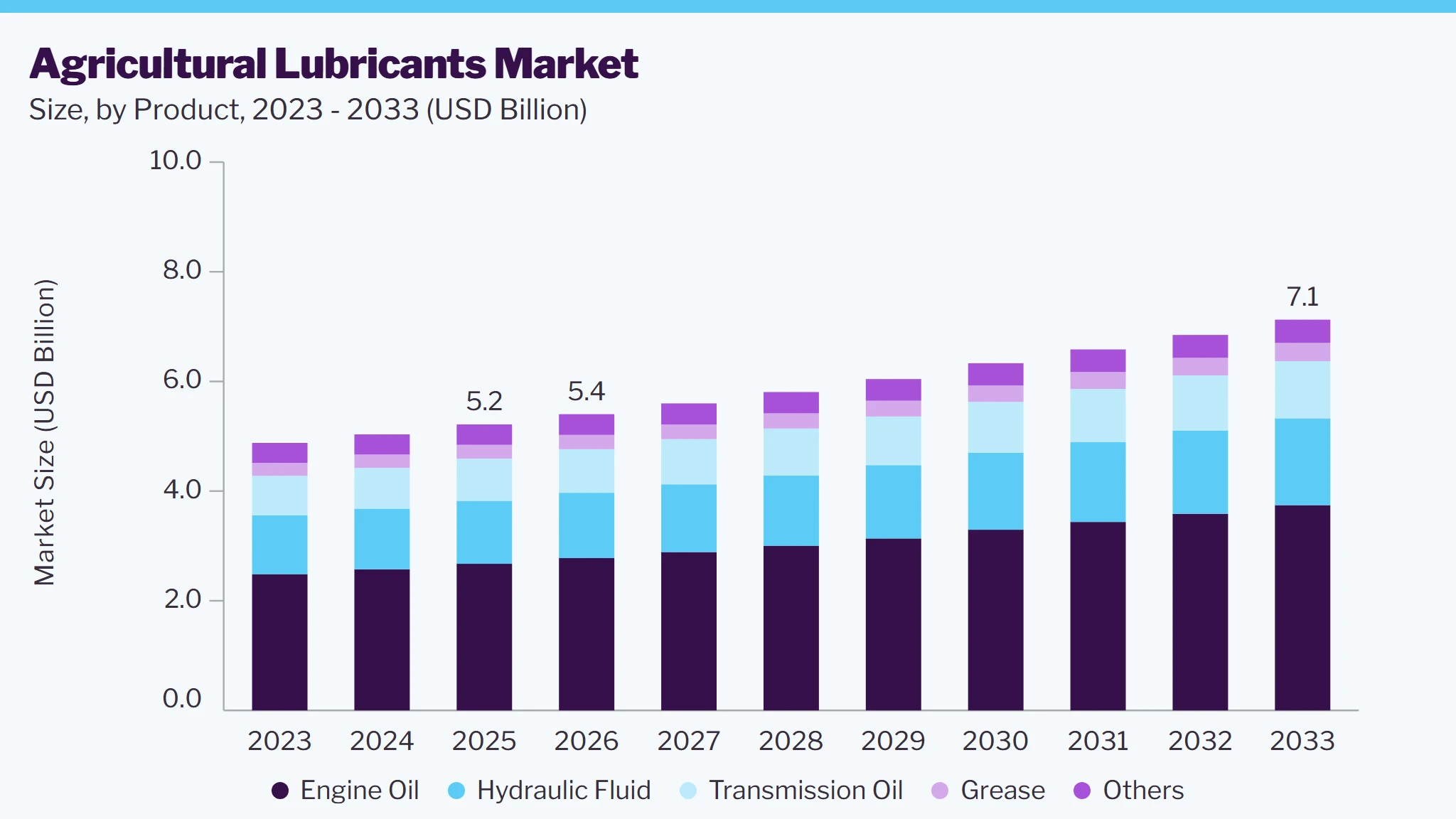
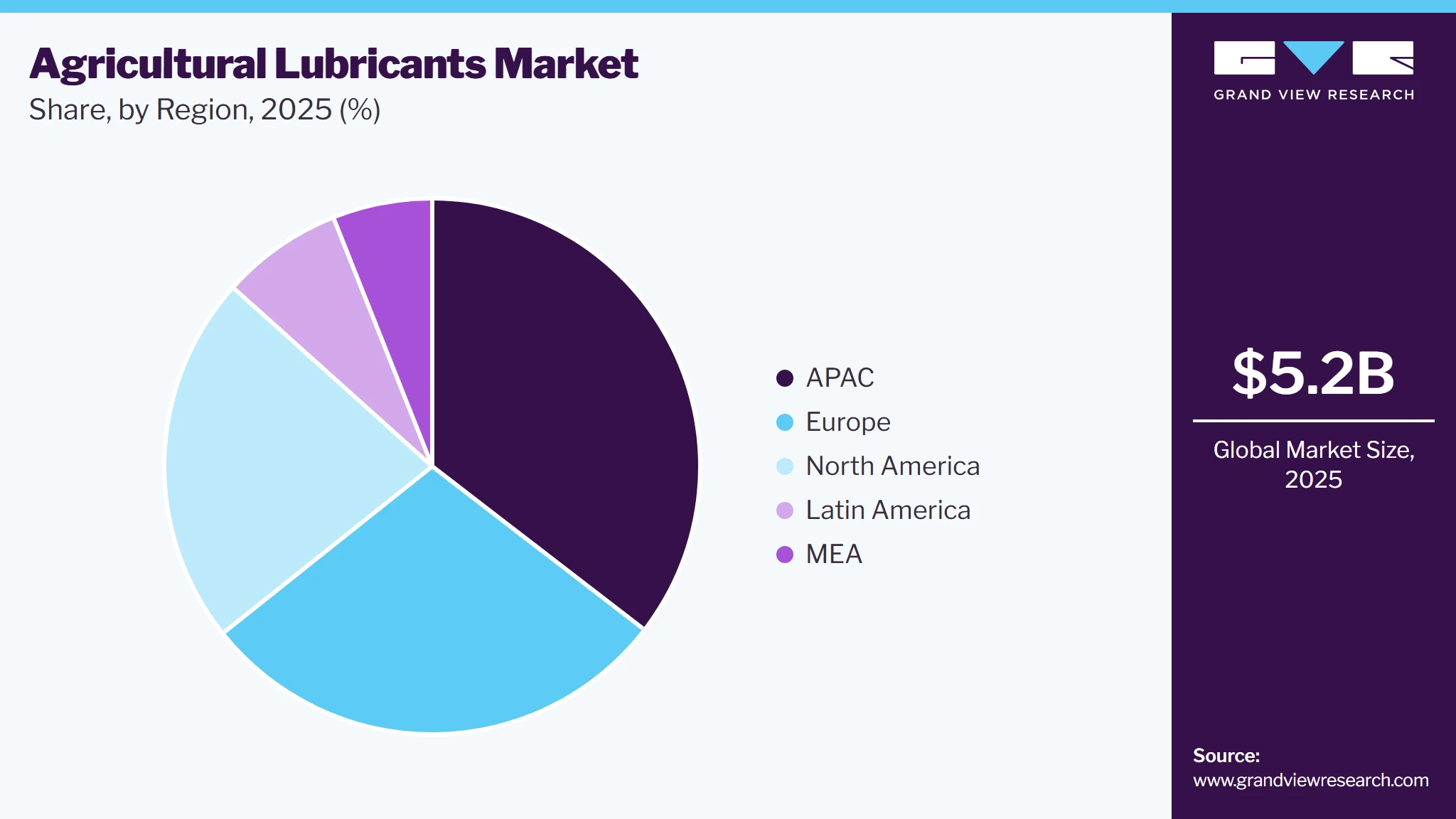
The global agricultural lubricants market size was valued at USD 5.2 billion in 2025 and is projected to grow from USD 5.4 billion in 2026 to USD 7.1 billion by 2033, growing at a CAGR of 4.0% from 2026 to 2033. Asia Pacific dominated the market, accounting for the largest global share of 35.4% in 2025. The growing demand for agricultural machinery and equipment, driven by the increasing need to improve farming productivity, proliferates the market.
 Source: Grand View Research, IR Documents, Primary Interviews, Paid DatabasesTo learn more about this report,
 Download Free Sample Report
Key Market Trends & Insights
- By product: Engine oil segment held the largest revenue share of 51.3% in 2025.
Regional Highlights
- Largest regional market: Asia Pacific (35.4% revenue share, 2025)
- By country: China held the largest share of Asia Pacific in 2025.
Market Size & Forecast
- Market size in 2025: USD 5.2 Billion
- Estimated market size in 2026: USD 5.4 Billion
- Projected market size by 2033: USD 7.1 Billion
- CAGR (2026-2033): 4.0%
Three ways to get this report
Buy it, customize it, or ask a question.Ask an Analyst
Analyst response in 1 business day
- AccessReport author, directly
- Reply timeWithin 1 working day
- No sales callDirect answer only
- FormatEmail reply
- CostFree, no cost
Get the Full Report
What the study covers
- FormatsPDF · Excel · Dashboard
- Timeline2026–2033 annual, 2025 base
- Coverage20+ countries, 5 regions
- Companies10+ key players profiled
Customize the Report
20% free customization
- IncludeCountries, segments, points
- TailorTo your product definition
- ExtendDeeper competitor detail
- OrA fully bespoke study
- Turnaround5–10 working days
As farms become more mechanized, using high-performance lubricants in tractors, harvesters, and other equipment has become essential for ensuring smooth operation, reducing wear and tear, and enhancing fuel efficiency. This has led to a higher demand for specialized products tailored to the needs of agricultural machinery, fueling market growth.Farmers and agricultural businesses increasingly adopt lubricants that meet high-performance standards and align with sustainability goals. Biodegradable and eco-friendly oils are gaining popularity as they reduce the environmental impact of farming operations. As concerns about soil and water contamination increase, the demand for such lubricants is expected to grow, contributing to the overall expansion of the agricultural lubricants market.
 To learn more about this report, Download Free Sample Report
The advancement of technology in the farming sector also plays a pivotal role in the market's growth. Introducing precision and smart farming technologies has led to the development of more advanced and specialized machinery. These technologies require lubricants that offer superior performance, high resistance to extreme operating conditions, and long-lasting protection against rust and corrosion. As these technologies evolve, the need for high-quality, tailored lubricants designed to optimize equipment efficiency and longevity which is driving the market forward.
Furthermore, the growth of large-scale commercial farming and agribusinesses is accelerating the demand for the market. More extensive operations, with their expansive fleets of tractors, plows, harvesters, and irrigation systems, require consistent and reliable lubrication to maintain optimal performance. These businesses recognize the importance of reducing maintenance costs and downtime, which drives them to invest in premium lubricants that offer long-term reliability. The increasing adoption of automated farming equipment and the shift towards more extensive, complex machinery only heightens the need for specialized lubrication solutions.
Market Dynamics
The agricultural lubricants market is experiencing steady growth driven by the increasing mechanization of farming operations, rising adoption of advanced agricultural machinery, and growing demand for high-performance lubricants that enhance equipment efficiency and longevity. Agricultural lubricants are specifically formulated to protect tractors, harvesters, irrigation systems, and other farm equipment operating under harsh conditions, including dust, moisture, heavy loads, and fluctuating temperatures. Expanding agricultural activities, labor shortages encouraging mechanized farming, and the need to reduce maintenance costs are further supporting market growth. Increasing focus on sustainable farming practices and the development of biodegradable lubricants are creating new opportunities for market expansion.
The growing adoption of agricultural machinery across both developed and developing economies is a major driver of the agricultural lubricants market. Farmers are increasingly investing in tractors, combines, sprayers, and other mechanized equipment to improve productivity, reduce labor dependence, and enhance operational efficiency.
These machines require specialized lubricants to minimize wear and tear, improve fuel efficiency, and ensure reliable performance under demanding field conditions. Government initiatives promoting agricultural modernization, expanding farm sizes, and increasing investments in precision farming technologies are further accelerating lubricant demand. As agricultural equipment usage continues to rise globally, the need for high-quality engine oils, hydraulic fluids, transmission oils, and greases is expected to support sustained market growth throughout the forecast period.
Fluctuations in the prices of base oils and additives used in lubricant manufacturing present a significant challenge for the agricultural lubricants market. Changes in crude oil prices, supply chain disruptions, and geopolitical uncertainties can directly impact production costs and profit margins for lubricant manufacturers.
Increasingly stringent environmental regulations governing lubricant formulations, emissions, and disposal practices are creating compliance challenges. Conventional petroleum-based lubricants face growing scrutiny due to concerns regarding soil and water contamination. Manufacturers must invest in research, product reformulation, and regulatory compliance, which can increase operational costs. These factors may limit market growth, particularly in price-sensitive agricultural regions.
The increasing emphasis on sustainable agriculture and environmental protection is creating significant opportunities for the agricultural lubricants market. Farmers, equipment manufacturers, and regulatory authorities are showing growing interest in biodegradable and bio-based lubricants that reduce environmental impact while maintaining equipment performance.
Advancements in lubricant technology are enabling the development of products derived from renewable feedstocks such as vegetable oils and other bio-based materials. These lubricants offer improved biodegradability, lower toxicity, and reduced ecological risks compared to conventional mineral oil-based products. Furthermore, rising adoption of precision agriculture, sustainable farming practices, and eco-friendly machinery maintenance solutions is expanding the market potential for green lubricants. Companies investing in innovative formulations, renewable raw materials, and high-performance bio-lubricant technologies are expected to gain a competitive advantage in the evolving global agricultural lubricants market.
Analyst Perspective
The agricultural lubricants market is expected to witness stable growth over the forecast period, supported by the continued mechanization of farming operations, increasing adoption of advanced agricultural equipment, and rising focus on maximizing machinery efficiency and lifespan. Demand is gradually shifting toward high-performance synthetic and bio-based lubricants that offer enhanced protection, longer drain intervals, and reduced environmental impact. While fluctuations in crude oil prices and stringent environmental regulations remain key challenges, ongoing investments in sustainable lubricant technologies and precision agriculture are creating new growth opportunities. Market participants that focus on product innovation, OEM partnerships, and environmentally responsible formulations are likely to strengthen their competitive position as farmers increasingly seek cost-effective solutions that improve equipment reliability, operational productivity, and sustainability.
Product Insights
Engine oil dominated the product type segment at a revenue share of 51.3% in 2025. Tractors, harvesters, and other agricultural machinery require lubricants that ensure optimal engine performance, reduce wear and tear, and enhance fuel efficiency. As agricultural machinery becomes more sophisticated with advanced technologies, engine oils are being specifically formulated to meet the needs of these high-performance engines, contributing to the segment's growth.
Hydraulic fluid is anticipated to grow significantly over the forecast period. Hydraulic systems are crucial in modern agricultural equipment such as tractors, combines, plows, and forklifts, as they transmit power to various machine components. With the growing mechanization of agriculture and the need for more efficient, reliable equipment, the demand for high-quality hydraulic fluids has surged. These fluids are essential for maintaining the smooth operation of hydraulic systems, ensuring they work efficiently under heavy loads and harsh environmental conditions.
Regional Insights
North America agricultural lubricants market growth is primarily driven by increasing demand for advanced farming equipment. As farmers in the region adopt larger, more complex machinery for better efficiency and productivity, the need for specialized lubricants to ensure optimal performance is rising. Modern equipment, such as tractors, harvesters, and irrigation systems, requires high-performance oils and greases to function effectively, particularly under the intense conditions they face.
 To learn more about this report, Download Free Sample Report
U.S. Agricultural Lubricants Market Trends
With the rising demand for efficiency and higher crop yields, U.S. farmers increasingly rely on advanced machinery such as tractors, harvesters, and irrigation systems. These machines require specialized lubricants to ensure smooth operation, reduce friction, and extend equipment life. As more agricultural equipment is adopted, the need for high-performance lubricants that enhance machinery durability has surged, contributing to market growth.
Asia Pacific Agricultural Lubricants Market Trends
Asia Pacific dominated the agricultural lubricants market with a revenue share of 35.4% in 2025. Asia Pacific is home to some of the world's largest agricultural economies, such as China, India, and Indonesia, where the demand for agricultural products is consistently high. As these countries aim to improve food security and increase crop yields, advanced agricultural machinery is essential. This drives the need for specialized lubricants that enhances the performance and longevity of agricultural equipment, ensuring that they operate efficiently under the intense demands of farming.
China held the highest market revenue share in Asia Pacific in 2025.
Europe Agricultural Lubricants Market Trends
Europe has long been a leader in agricultural innovation, and the increasing mechanization of farming practices continues to drive demand for the market. As European farmers adopt more automated machinery, such as tractors, harvesters, and other equipment, the need for high-quality lubricants to enhance performance, reduce wear, and extend equipment lifespan becomes more crucial. This demand is particularly pronounced in countries with large agricultural sectors, such as France, Germany, and Italy, where machinery maintains high productivity levels.
Latin America Agricultural Lubricants Market Trends
Latin America is anticipated to grow significantly over the forecast period. As agricultural operations in Latin America grow larger and more technologically advanced, the need for specialized lubricants to handle the rigorous demands of modern farming machinery becomes more critical. Mechanized farming has become crucial to meet the region's growing production demands, and farmers rely on equipment to work effectively across large tracts of land. Lubricants prevent wear and tear on machinery components, reduce fuel consumption, and minimize maintenance costs.
Middle East & Africa Agricultural Lubricants Market Trends
The Middle East and African market is expected to grow significantly over the forecast period. With rapid population growth and a growing middle class, particularly in countries such as Saudi Arabia and South Africa, there is a greater emphasis on boosting agricultural productivity. Governments and farmers are investing in modern farming equipment and technologies to meet food demand. This increased mechanization of agriculture necessitates using high-performance lubricants to ensure the smooth operation and longevity of farming machinery, thereby driving the demand for agricultural lubricants in the region.
Key Agricultural Lubricants Company Insights
Some of the key players operating in the market include BP p.l.c., Chevron Corporation, and others.
-
BP p.l.c. is a British multinational oil and gas company and is one of the world’s largest companies, operating in all areas of the industry, including exploration, production, refining, distribution, and marketing. BP offers a range of products and services across various sectors. BP’s agricultural lubricants include high-performance oils that meet the specific requirements of modern farming equipment, ensuring optimal efficiency while contributing to environmental sustainability through reduced emissions.
-
Chevron Corporation is a leading global integrated energy company recognized as the second-largest integrated energy company in the United States. It operates across various segments of the energy sector, including exploration, production, refining, and marketing of oil and natural gas. Chevron produces various finished and base oils for multiple industries. This includes premium products marketed under well-known brands such as Havoline and Delo. These products are designed to improve or maintain fuel economy across different applications.
Key Agricultural Lubricants Companies
The following key companies have been profiled for this study on the agricultural lubricants market.
-
BP p.l.c.
-
Chevron Corporation
-
CLASS KGaA mbH
-
CONDAT
-
Cougar Lubricants International Ltd.
-
Exol Lubricants Limited
-
Exxon Mobil Corporation
-
FRONTIER PERFORMANCE LUBRICANTS, INC.
-
Fuchs
-
Gulf Oil International Ltd.
Competitive Benchmarking
Category
Operating Strategies
Competitive Edge
Weakness
Established Players (BP plc, Chevron Corporation, KLAS KGaA mbH, CONDAT, Exol Lubricants Limited, Exxon Mobil Corporation, FUCHS, Gulf Oil International Ltd.)
- Expand production and distribution of high-performance agricultural lubricants, including engine oils, hydraulic fluids, transmission oils, and greases.
- Invest in advanced lubricant technologies to improve equipment protection, fuel efficiency, and sustainability performance.
- Develop bio-based and environmentally friendly lubricant formulations aligned with evolving agricultural regulations and customer preferences.
- Strengthen market presence through partnerships with agricultural equipment manufacturers, distributors, and farm service providers.
- Strong global manufacturing and distribution networks.
- Extensive R&D capabilities and advanced lubricant formulation expertise.
- Broad product portfolios serving agriculture, automotive, industrial, and off-highway sectors.
- Established brand recognition and long-term relationships with OEMs and large agricultural enterprises.
- Exposure to fluctuations in crude oil and base oil prices.
- High compliance costs associated with environmental and product regulations.
- Large organizational structures can slow response to niche market demands.
- Increasing competition from bio-lubricant and specialty lubricant providers.
Emerging & Specialized Players (Cougar Lubricants International Ltd., FRONTIER PERFORMANCE LUBRICANTS, INC.)
- Focus on niche agricultural applications and customized lubricant solutions for specific machinery and operating conditions.
- Develop cost-effective, biodegradable, and high-performance lubricant products tailored to regional farming requirements.
- Utilize direct sales, distributor partnerships, and digital channels to expand customer reach.
- Emphasize flexibility, technical support, and rapid product innovation.
- Greater agility in addressing emerging customer needs and regional market requirements.
- Ability to offer specialized formulations and customized services.
- Faster product development and commercialization cycles.
- Strong relationships with local distributors and agricultural communities.
- Limited production capacity and geographic reach compared with multinational competitors.
- Lower brand recognition in global markets.
- Dependence on third-party suppliers for base oils and additives.
- Greater vulnerability to raw material cost volatility and pricing pressure from larger manufacturers.
Agricultural Lubricants Market Report Scope
Report Attribute
Details
Market size value in 2025
USD 5.2 billion
Market size value in 2026
USD 5.4 billion
Revenue forecast in 2033
USD 7.1 billion
Growth rate
CAGR of 4.0% from 2026 to 2033
Base year for estimation
2025
Historical data
2021 - 2024
Forecast period
2026 - 2033
Quantitative units
Revenue in USD million/billion, volume in kilotons, and CAGR from 2026 to 2033
Report coverage
Revenue forecast, company ranking, competitive landscape, growth factors, and trends
Segments covered
Product, region
Regional scope
North America; Europe; Asia Pacific; Latin America; MEA
Country scope
U.S.; Canada; Mexico; Germany; UK; France; China; India; Japan; Brazil; Argentina; Saudi Arabia; and South Africa.
Key companies profiled
BP p.l.c.; Chevron Corporation; CLASS KGaA mbH; CONDAT; Cougar Lubricants International Ltd.; Exol Lubricants Limited; Exxon Mobil Corporation; FRONTIER PERFORMANCE LUBRICANTS, INC.; Fuchs; Gulf Oil International Ltd.
Customization scope
Free report customization (equivalent up to 8 analysts' working days) with purchase. Addition or alteration to country, regional & segment scope.
Pricing and purchase options
Avail customized purchase options to meet your exact research needs. Explore purchase options
Global Agricultural Lubricants Market Report Segmentation
This report forecasts revenue and volume growth at global, regional, and country levels and analyzes the latest industry trends in each sub-segment from 2021 to 2033. For this study, Grand View Research has segmented the global agricultural lubricants market report by product, and region:
 To learn more about this report, Download Free Sample Report
-
Product Outlook (Revenue, USD Million; Volume, Kilotons, 2021 - 2033)
-
Engine Oil
-
Transmission Oil
-
Hydraulic Fluid
-
Grease
-
Others
-
-
Regional Outlook (Revenue, USD Million; Volume, Kilotons, 2021 - 2033)
-
North America
-
U.S.
-
Canada
-
Mexico
-
-
Europe
-
Germany
-
UK
-
France
-
-
Asia Pacific
-
China
-
India
-
Japan
-
-
Latin America
-
Brazil
-
Argentina
-
-
Middle East & Africa
-
Saudi Arabia
-
South Africa
-
-
Research Methodology
The agricultural lubricants market figures in this report are based on a proven research process that combines executive interviews with secondary research from proprietary databases, company filings, and recognized regulatory and institutional sources. Market size is built through value-chain sizing - reconciling supply-side and demand-side estimates - and triangulated with bottom-up and top-down approaches. Every estimate passes multiple levels of expert validation before publication, with each agricultural lubricants segment quantified using the revenue-capture definitions in the table below.
Segment Definition
Segment - Product
Revenue capture definition
Engine Oil
Revenue generated from the sale of engine oils used in agricultural machinery such as tractors, harvesters, combines, and irrigation engines. Includes mineral, synthetic, and semi-synthetic engine lubricants designed to reduce friction, prevent wear, and enhance engine performance.
Transmission Oil
Revenue derived from transmission oils used in agricultural equipment gearboxes, transmissions, final drives, and powertrain systems. Covers lubricants formulated to ensure smooth gear operation, wear protection, and efficient power transfer.
Hydraulic Fluid
Revenue generated from hydraulic fluids used in agricultural machinery hydraulic systems, including tractors, loaders, sprayers, and harvesting equipment. Includes products designed for power transmission, corrosion protection, and system efficiency under varying operating conditions.
Grease
Revenue captured from lubricating greases used in bearings, joints, chassis components, wheel hubs, and other agricultural equipment parts requiring long-lasting lubrication and protection against moisture, dust, and heavy loads.
Other Products
Revenue generated from other agricultural lubricant products, including compressor oils, chain oils, gear oils, multifunctional tractor fluids (UTFs), coolant additives, specialty lubricants, and maintenance fluids used in agricultural applications.
Estimation Model
Layer Name
Key Question
Description
Base Oil & Raw Material Supply Layer
What forms is the supply base?
Identify global agricultural lubricant production capacity based on the availability of base oils (mineral oil, synthetic oil, and bio-based oil), additives, thickening agents, and lubricant blending infrastructure. This layer evaluates feedstock supply, refining capabilities, additive manufacturing, blending technologies, quality standards, and production facilities that support agricultural lubricant manufacturing worldwide.
Agricultural Equipment Application Layer
Where is agricultural lubricants utilized?
Estimate the proportion of agricultural lubricants consumed across tractors, harvesters, combines, sprayers, irrigation systems, planting equipment, forestry machinery, and other farm equipment based on machinery penetration, operating conditions, maintenance requirements, and regional mechanization trends.
Lubricant Consumption Intensity Layer
How much is agricultural lubricants used?
Analyze equipment-specific lubricant consumption rates, machinery operating hours, maintenance intervals, fleet sizes, replacement cycles, and agricultural activity levels to determine annual demand for engine oils, hydraulic fluids, transmission oils, greases, and specialty lubricants across key agricultural sectors and geographic regions.
Revenue Layer
How is market revenue generated?
Market revenue is generated through the sale of engine oils, hydraulic fluids, transmission oils, greases, and other specialty lubricants supplied to agricultural equipment owners, farming enterprises, machinery dealerships, maintenance service providers, and agricultural contractors. Revenue is influenced by lubricant type, performance grade, equipment utilization rates, replacement frequency, and regional agricultural mechanization levels worldwide.
Delivered Customizations
This report has been delivered with the following In-depth customizations
Client Request
Customization Delivered
Value Adds
Cross-Segmentation Analysis
Detailed cross-segmentation assessment evaluating the relationship between lubricant product types, equipment applications, and agricultural lubricant consumption patterns. Analysis identifies usage intensity, maintenance requirements, operating conditions, lubricant performance characteristics, replacement cycles, and revenue contribution across intersecting segments such as engine oils in tractors and harvesters, hydraulic fluids in loaders and irrigation equipment, and greases in heavy-duty agricultural machinery.
Supports product portfolio optimization and market prioritization by identifying the most attractive product-application combinations, enabling improved resource allocation, sales targeting, product development strategies, and long-term growth planning across the agricultural lubricants value chain.
Competitive Benchmarking
Comparative evaluation of leading agricultural lubricant manufacturers based on product portfolio breadth, lubricant formulation expertise, manufacturing capacity, distribution networks, raw material sourcing strategies, geographic presence, sustainability initiatives, OEM partnerships, customer relationships, and strategic developments across key regional markets.
Assists competitive intelligence, partnership evaluation, and supplier assessment by providing deeper visibility into market positioning, technological strengths, differentiation strategies, innovation capabilities, operational efficiency, and areas of competitive advantage.
Opportunity Assessment
Comprehensive assessment of emerging opportunities associated with bio-based and biodegradable lubricants, precision agriculture, smart farming equipment, high-performance synthetic lubricants, sustainable machinery maintenance solutions, expanding agricultural mechanization in developing economies, and increasing demand for environmentally responsible lubricant products across global markets.
Helps identify high-growth investment areas, emerging technology opportunities, product innovation priorities, and market expansion strategies, supporting long-term revenue growth and competitive positioning across the agricultural lubricants value chain.
Frequently Asked Questions About This Report
Asia Pacific dominated the global agricultural lubricants market in 2025, accounting for 35.4% of total market revenue. The region's leadership was driven by extensive agricultural activities, rapid farm mechanization, expanding use of tractors and harvesting equipment, and strong agricultural production in countries such as China, India, and Japan. Government support for agricultural modernization and increasing demand for efficient machinery maintenance further contributed to market growth.
A major opportunity lies in the development and commercialization of bio-based and biodegradable agricultural lubricants. Increasing environmental regulations, growing awareness of sustainable farming practices, and demand for eco-friendly machinery maintenance solutions are encouraging lubricant manufacturers to invest in renewable feedstocks and advanced lubricant technologies. These products offer reduced environmental impact while maintaining high equipment performance, creating significant growth potential in both developed and emerging markets.
Sustainability is becoming a critical factor in the agricultural lubricants industry as farmers and equipment operators seek environmentally responsible solutions. Manufacturers are increasingly introducing biodegradable lubricants, reducing carbon emissions during production, improving lubricant recyclability, and utilizing renewable raw materials. These initiatives help minimize soil and water contamination risks while supporting global sustainability goals and regulatory compliance requirements.
The global agricultural lubricants market size was valued at USD 5.2 billion in 2025 and is estimated at USD 5.4 million in 2026.
The global agricultural lubricants market is expected to grow at a compound annual growth rate of 4.0% from 2026 to 2030, reaching USD 7.1 million by 2033.
Engine oil accounted for the largest revenue share, 51.3%, in the agricultural lubricants market in 2025 due to its importance in maintaining the performance and longevity of farming machinery, such as tractors and harvesters.
Some of the key players operating in the agricultural lubricants market include BP p.l.c.; Chevron Corporation; CLASS KGaA mbH; CONDAT; Cougar Lubricants International Ltd.; Exol Lubricants Limited; Exxon Mobil Corporation, among others.
The key factors driving the agricultural lubricants market include the increasing mechanization of farming, which leads to higher demand for machinery and, consequently, lubricants to maintain optimal performance, and the rising focus on sustainability and efficiency in agriculture.
North America is projected to register the fastest growth during the forecast period, with a CAGR of 4.6%. Growth is supported by the increasing adoption of precision farming technologies, rising demand for high-performance synthetic and bio-based lubricants, advanced agricultural machinery utilization, and a growing focus on sustainable farming practices across the United States and Canada.
About the Author(s)
Petrochemicals Research Team
Bulk Chemicals · PetrochemicalsThis report was authored by the petrochemicals research team at Grand View Research - comprising two research analysts, one senior research analyst, and one industry expert - with specialized expertise in the petrochemicals segment of the bulk chemicals industry. All findings are based on proprietary bulk chemicals databases, executive interviews, and regulatory analysis, subject to internal peer review prior to publication.
Last Updated:
Speak to Analyst

Customize this report to your needs - add regions, segments, or data points, with 20% free customization.
Or view our licence options:


ISO 9001:2015 & 27001:2022 Certified
We are GDPR and CCPA compliant! Your transaction & personal information is safe and secure. For more details, please read our privacy policy.


