
- Home
- »
- Next Generation Technologies
- »
-
Agriculture Analytics Market Size & Share Report, 2026-2033GVR Report cover

Agriculture Analytics Market (2026 - 2033)
Size, Share & Trends Analysis Report By Offering (Solutions And Aquaculture Farming), By Application (Precision Farming, Livestock Farming, Aquaculture Farming), By Field Size, By Region, And Segment Forecasts
Market Size, 2025
$3.6BMarket Estimate, 2026
$4.0BMarket Forecast, 2033
$9.9BCAGR, 2026–2033
13.8%Agriculture Analytics Market Summary
The global agriculture analytics market size was valued at USD 3.6 billion in 2025 and is projected to grow from USD 4.0 billion in 2026 to USD 9.9 billion by 2033, at a CAGR of 13.8% from 2026 to 2033. The market in North America dominated with a revenue share of 39.2% in 2025. This growth is driven by the increasing use of IoT sensors and connected agricultural devices.
 Source: Grand View Research, IR Documents, Primary Interviews, Paid DatabasesTo learn more about this report,
 Download Free Sample Report
 Key Market Trends & Insights
- By offering: Solution segment dominated the market, with a revenue share of 59.2% in 2025.
- By application: Precision farming segment held the largest market share of 47.9% in 2025.
- By field size: Large farms segment held the largest revenue share in 2025.
Regional Highlights
- Largest regional market: North America (39.2% revenue share, 2025)
- Fastest-growing regional market: Asia Pacific (highest CAGR, 2026-2033)
- By country: The U.S. held the largest market share in 2025.
Market Size & Forecast
- Market size in 2025: USD 3.6 Billion
- Estimated market size in 2026: USD 4.0 Billion
- Projected market size by 2033: USD 9.9 Billion
- CAGR (2026-2033): 13.8%
Three ways to get this report
Buy it, customize it, or ask a question.Ask an Analyst
Analyst response in 1 business day
- AccessReport author, directly
- Reply timeWithin 1 working day
- No sales callDirect answer only
- FormatEmail reply
- CostFree, no cost
Get the Full Report
What the study covers
- FormatsPDF · Excel · Dashboard
- Timeline2026–2033 annual, 2025 base
- Coverage20+ countries, 5 regions
- Companies10+ key players profiled
Customize the Report
20% free customization
- IncludeCountries, segments, points
- TailorTo your product definition
- ExtendDeeper competitor detail
- OrA fully bespoke study
- Turnaround5–10 working days
The increasing use of predictive analytics and machine learning (ML) in agriculture drives the market. These advanced technologies enable farmers to anticipate future outcomes based on historical and real-time data. By using ML algorithms, analytics platforms detect patterns and trends in data, allowing farmers to forecast yields, predict weather impacts, and identify potential risks such as disease outbreaks or pest infestations. Predictive analytics also help farmers plan their planting and harvesting schedules to optimize crop performance and market timing. This proactive approach improves operational efficiency and enhances profitability by reducing uncertainties in farming. To learn more about this report, Download Free Sample Report
 The rise of digital farming ecosystems drives the agriculture analytics market growth. This ecosystem combine various technologies, including sensors, IoT devices, drones, and software platforms, to create a fully integrated and automated farm management system. Within this ecosystem, agriculture analytics plays a central role in processing and analyzing data from different sources to provide actionable insights. Farmers can monitor field conditions, track equipment performance, and analyze market trends in real-time, all from a single platform. This digital transformation enables farmers to make smarter, data-driven decisions, improve efficiency, and respond quickly to changing conditions.
Additionally, the rapid adoption of smart farming technologies, such as autonomous tractors, drones, and robotic harvesters, drives the agriculture analytics market growth. These technologies generate massive amounts of data that are analyzed to improve farm management practices. For instance, data from sensors in autonomous equipment or drones flying over fields can be used to assess crop conditions, detect variations in growth patterns, and monitor soil health. The analytics derived from these smart farming tools enable farmers to make timely and accurate decisions, enhancing crop yields and reducing resource waste. Integrating smart farming technologies with analytics transforms traditional farming into a more precise, efficient, and automated operation.
Furthermore, climate-smart agriculture (CSA) is gaining traction as farmers seek to adapt to the challenges posed by climate change. Agriculture analytics is a critical application of CSA, helping farmers monitor environmental conditions and implement practices that improve climate resilience. Analytics tools assess the impact of climate variability on crop performance, allowing farmers to adjust their practices to mitigate risks associated with extreme weather events such as droughts, floods, or temperature fluctuations. Additionally, analytics support adopting climate-friendly practices such as carbon sequestration, reduced greenhouse gas emissions, and sustainable land management. As climate-smart agriculture grows, the demand for analytics solutions that support adaptation and resilience will rise. According to an article published by the United States Department of Agriculture (USDA) stated that, over 60,000 farms have adopted climate-smart production practices, covering more than 25 million acres of active farmland. These practices include covering crops, no-till farming, nutrient management, and pasture and forestry management.
Market Dynamics
Agriculture analytics is gaining traction as farmers, agribusinesses, and agricultural organizations increasingly leverage technologies such as predictive analytics, remote sensing, farm management software, weather intelligence, yield forecasting, and crop health monitoring. These offerings enable stakeholders to optimize farming operations, improve resource allocation, and enhance decision-making through real-time data analysis and actionable insights. The growing adoption of precision agriculture, increasing availability of agricultural data, and rising demand for productivity optimization and sustainable farming practices are expected to continue driving growth in the agriculture analytics market.
The rising adoption of precision farming technologies is a major driver of the agriculture analytics market, as modern farmers increasingly rely on data-driven tools to improve productivity, optimize resource utilization, and enhance decision-making. Precision farming technologies such as GPS-guided equipment, drones, sensors, satellite imagery, and automated irrigation systems generate large volumes of agricultural data that require advanced analytics for interpretation. Agriculture analytics platforms help transform this data into actionable insights related to crop health, soil conditions, irrigation requirements, and yield performance. By enabling more accurate and timely farm management decisions, analytics offerings improve operational efficiency and profitability. As precision agriculture adoption expands globally, demand for agriculture analytics continues to grow significantly.
High implementation and deployment costs of analytics offerings represent a significant restraint in the agriculture analytics market because the adoption of advanced analytics platforms often requires substantial investment in software, hardware, connectivity infrastructure, and data collection systems. Farmers and agribusinesses must invest in technologies such as sensors, drones, GPS-enabled equipment, weather monitoring stations, satellite data services, and farm management software to generate the data needed for analytics. These upfront costs can be particularly challenging for small and medium-sized farms with limited financial resources. As a result, many agricultural producers delay or avoid adopting analytics offerings despite their potential long-term benefits.
The growing integration of digital farm management and decision-support platforms presents a significant opportunity for the agriculture analytics market, as farmers increasingly seek centralized offerings that combine data collection, analysis, planning, and operational management into a single ecosystem. Digital farm management platforms aggregate information from machinery, sensors, weather stations, satellite imagery, drones, and field records, while agriculture analytics converts this data into actionable insights. This integration enables farmers to make more informed decisions about planting, irrigation, fertilization, pest control, and harvesting. By improving visibility across farm operations, these platforms enhance productivity, efficiency, and profitability. As digital agriculture adoption accelerates, demand for integrated analytics offerings is expected to grow substantially.
Analyst Perspective
The agriculture analytics market sits at a powerful intersection of digital agriculture adoption, expanding farm data generation, and the growing need to maximize agricultural productivity under resource constraints. The central competitive moat, however, will belong to the provider that integrates agronomic data, satellite imagery, weather intelligence, equipment telemetry, and predictive analytics into a unified decision-support platform, transforming fragmented agricultural datasets into actionable recommendations that improve yields, reduce operational costs, and strengthen resilience across the agricultural value chain.
Offering Insights
Based on offering, the solution segment led the market with the largest revenue share of 59.2% in 2025. The growing demand for easy-to-use, mobile-compatible solutions is a key factor in driving the growth of solution segment. Farmers increasingly seek solutions that provide real-time insights through intuitive interfaces accessible via smartphones and tablets. These mobile applications allow farmers to monitor field conditions, track equipment performance, and analyze crop health. The user-friendly design of these solutions makes it easier for farmers to adopt analytics tools without requiring extensive technical expertise. By simplifying the data collection and analysis process, mobile and user-friendly solutions are helping to expand the reach of agriculture analytics across different farm sizes and regions.
The service segment is anticipated to register CAGR of 11.6% from 2026 to 2033. The shift towards subscription-based and managed services is another major driver for the service segment. Many agriculture analytics providers offer their services through subscription models, where farmers pay a recurring fee for access to analytics tools, support, and regular updates. This model provides flexibility for farmers who may not have the resources to invest in expensive upfront costs for analytics solutions. Managed services offer complete end-to-end management of analytics platforms, including data collection, analysis, and reporting. These services allow farmers to outsource their analytics needs to experts, enabling them to focus on core farming activities while still benefiting from advanced data insights.
Application Insights
Based on application, the precision farming segment led the market with the largest revenue share of 47.9% in 2025. Precision fertilization and variable rate technology (VRT) are becoming increasingly prevalent in the precision farming segment. VRT allows farmers to apply fertilizers and other inputs at variable rates across different areas of a field based on soil and crop conditions. This approach ensures that inputs are used more efficiently, reducing costs and environmental impact. Analytics platforms are crucial in analyzing field data and determining the optimal rates for applying fertilizers, herbicides, and pesticides. The growing awareness of the benefits of VRT in improving resource efficiency and boosting crop yields is driving the demand for analytics tools that support precision fertilization. According to the Association of Equipment Manufacturers, precision farming technologies in 2021 led to a 4% increase in farmers' production, a 7% reduction in fertilizer usage, a 9% decrease in herbicide applications, a 6% reduction in fossil fuel consumption, and a 4% savings in water usage.
The livestock farming segment is expected to grow significantly with a CAGR of 14.0% over the forecast period. Productivity is a major concern in livestock farming, and analytics integration helps farmers optimize feed management, water usage, and overall resource allocation. By analyzing data on animal growth rates, feeding habits, and environmental conditions, analytics platforms provide insights that enable farmers to adjust feeding schedules, optimize the nutrient content of feed, and ensure that animals are growing at an optimal rate. This data-driven approach improves feed efficiency, weight gain, and higher milk or meat production. As the global demand for meat and dairy products rises, the need for analytics solutions that boost productivity and optimize resource use is becoming a significant driver for the livestock farming segment. According to the Brazilian Institute of Geography and Statistics, the value of production reported by parts per million in 2023 reached USD 22.34 billion, a 5.4% increase compared to 2022. Livestock products accounted for USD 20.50 billion, reflecting a 4.5% rise from 2022.
Field Size Insights
Based on field size, the large farms segment led the market with the largest revenue share of 49.6% in 2025. The increased investment in IoT-enabled farm management systems drives the large field size segment. IoT devices, such as soil sensors, weather stations, and moisture probes, are deployed across large fields to collect real-time data on environmental conditions. These devices are connected to agriculture analytics platforms that aggregate and analyze the data, providing insights into when to irrigate, apply fertilizers, or harvest crops. IoT systems offer a scalable solution for managing resources efficiently in large fields where manual monitoring is impractical. As the cost of IoT devices decreases and their capabilities improve, more large-scale farms are adopting these technologies to gain real-time insights and improve field management.
 To learn more about this report, Download Free Sample Report
 The medium field size segment is expected to register the fastest growth rate over the forecast period. The increasing consumer interest in organic and specialty crops is influencing agriculture analytics’ medium field size segment. Medium-sized farms often have the flexibility to diversify their crop offerings, including organic produce and niche market products. Agriculture analytics provides valuable insights into market demand, pest management, and sustainable farming practices, enabling these farms to cultivate and market specialty crops successfully. As consumer preferences continue to evolve toward healthier and more sustainable options, medium-sized farmers are leveraging analytics to adapt their production strategies, which fuels the growth of the agriculture analytics market.
Regional Insights
North America dominated the global agriculture analytics market with the largest revenue share of 39.2% in 2025. North America has large farming operations, particularly in regions such as the Midwest, the Great Plains, and the Canadian Prairies. These large-scale farms need advanced analytics to manage their extensive operations efficiently. Agriculture analytics platforms allow farmers to monitor and optimize thousands of acres of land, analyze crop performance, and predict yield outcomes. The ability to scale data-driven farming practices across large fields is a key driver for the agriculture analytics market, as large-scale farms increasingly rely on these tools to remain competitive and profitable.
 To learn more about this report, Download Free Sample Report
 U.S. Agriculture Analytics Market Trends
The agriculture analytics market in the U.S. held the largest share in the North America region in 2025. The demand for agriculture analytics in the U.S. is experiencing significant growth due to the rise of vertical farming and urban agriculture. These innovative farming methods rely heavily on technology and data analytics to maximize yields and resource efficiency. Agriculture analytics solutions are essential for monitoring and managing conditions in vertical farms, such as light, temperature, and humidity. As urban agriculture grows, the need for analytics solutions supporting these systems will also increase. This trend highlights the potential for analytics to drive innovation in non-traditional farming environments, contributing to the overall growth of the agriculture analytics market.
Asia Pacific Agriculture Analytics Market Trends
Asia Pacific region agriculture analytics market is expected to achieve the fastest CAGR of 15.7% during the forecast period. The Asia Pacific region is witnessing rapid urbanization and population growth, leading to increased demand for food production. As more people move to urban areas, the pressure on agricultural systems to produce sufficient food increases. Agriculture analytics is crucial in enhancing productivity and efficiency in farming practices, enabling farmers to maximize yields from limited land. With advanced data analytics, farmers make informed decisions regarding crop selection, planting schedules, and resource allocation. As urban populations continue to rise, the need for efficient agricultural practices supported by analytics will drive growth in the agriculture analytics market.
Key Agriculture Analytics Company Insights
Some of the key players operating in the market include Trimble Inc., IBM Corporation, Wipro, SAP SE, Iteris, Taranis, Oracle Corporation, Conservis Corporation, and Geosys Inc., among others.
-
Trimble Inc. is a global technology solution provider that offers solutions and services such as land preparation, crop protection and spraying, and water management, among others, providing customers with the ability to improve their work quality while being safe, efficient, and sustainable.
-
International Business Machines Corporation is a technology company that provides comprehensive solutions pertaining to agriculture. The company helps overcome obstacles by combining the power of Artificial Intelligence (AI), analytics, and predictive insights with unique agricultural Internet of Things (IoT).
Wolkus Technology Solutions Private Limited and AGEYE Technologies. are some of the emerging market participants in the target market.
-
Wolkus Technology Solutions Private Limited plays a crucial role in water management, crop protection and particularly in providing a farm-specific micro-climatic forecast and providing solutions for weather risks of the future.
-
AGEYE Technologies is a global agriculture technology solution provider. The company uses computer machine vision, deep learning neural networks and IoT-connected devices to create the next generation of autonomous indoor farms.
Key Agriculture Analytics Companies:
The following key companies have been profiled for this study on the agriculture analytics market.
-
Trimble Inc.
-
IBM Corporation
-
Wipro
-
SAP SE
-
Iteris
-
Taranis
-
Oracle Corporation
-
Conservis Corporation
-
Geosys Inc.
-
Xylem Inc.
-
PrecisionHawk
-
Gro Intelligence
Competitive Benchmarking
Category
Operating Strategies
Competitive Edge
Weakness
Established Players (IBM; Trimble Inc.; Deere & Company; SAP; Oracle)
- Mature players in the agriculture analytics market focus on integrated farm data management platforms. They combine AI, IoT, satellite imagery, and predictive analytics tools. Their solutions support yield forecasting, crop monitoring, and resource optimization. They also expand through partnerships with agribusinesses and precision farming providers.
- Mature players benefit from strong analytics capabilities and global customer networks. Their platforms process large volumes of agricultural data with high accuracy. Advanced AI models improve farm planning and productivity. Strong integration with enterprise and farm management systems enhances adoption.
- These solutions often require significant investment and technical expertise. Data integration from multiple farm sources can be complex. Connectivity limitations may affect the performance of real-time analytics. Smaller farms may face challenges in adopting advanced analytics platforms.
Emerging Players (CropX; Taranis; Prospera Technologies; Regrow Ag)
- Emerging players focus on AI-driven crop intelligence and field analytics solutions. They leverage drones, sensors, and satellite data for real-time insights. Many offer cloud-based platforms through subscription models. Their strategy emphasizes actionable recommendations and easy-to-use analytics tools.
- Emerging players provide specialized analytics for specific farming challenges. Their platforms are flexible and faster to deploy than traditional systems. Strong AI capabilities improve decision-making and operational efficiency. They also innovate rapidly in predictive and sustainability analytics.
- Emerging players have limited market reach and customer bases. Their solutions often rely on third-party data and hardware providers. Funding constraints may affect long-term product development. Lower brand recognition can slow adoption among large agricultural enterprises.
Recent Developments
-
In February 2023, John Deere partnered with Nutrien Ag Solutions Inc., a division of Nutrien, to launch an advanced digital connectivity feature linking the John Deere Operations Center with Nutrien Ag Solutions' Digital Hub. This integration aims to enhance logistics and facilitate the seamless transfer of variable rate agronomic recommendations to equipment, helping growers optimize their operations. The companies have also committed to further integration and developing streamlined solutions to support better growers adopting precision agriculture technology. Growers can control their data access and share it with Nutrien Crop Consultants for tailored recommendations, leading to improved agronomic outcomes.
-
In February 2022, Trimble launched Virtual Farm, an engaging online platform that allows farmers worldwide to explore precision agriculture. In this interactive tool, users can navigate a digital farm and pinpoint common challenges they face daily. Subsequently, farmers are guided to Trimble’s user-friendly, connected solutions tailored to address each challenge. They are connected with a Trimble Ag representative to help determine the best options for their farm.
Agriculture Analytics Market Report Scope
Report Attribute
Details
Market size value in 2025
USD 3.6 billion
Market size value in 2026
USD 4.0 billion
Revenue forecast in 2033
USD 9.9 billion
Growth rate
CAGR of 13.8% from 2026 to 2033
Base year for estimation
2025
Historical data
2021 - 2024
Forecast period
2026 - 2033
Quantitative units
Revenue in USD million/billion and CAGR from 2026 to 2033
Report coverage
Revenue forecast, company market share analysis, competitive landscape, growth factors, and trends
Segments covered
Offering, application, field size, region
Regional scope
North America; Europe; Asia Pacific; Latin America; MEA
Country scope
U.S.; Canada; Mexico; Germany; UK; France; Spain; Italy; China; Japan; India; South Korea; Australia; Brazil; Saudi Arabia; South Africa; UAE
Key companies profiled
Trimble; IBM Corporation; Wipro; SAP; Iteris; Taranis; Oracle Corporation; Conservis Corporation; Geosys Inc.; Xylem Inc.; PrecisionHawk; Gro Intelligence.
Customization scope
Free report customization (equivalent up to 8 analysts' working days) with purchase. Addition or alteration to country, regional & segment scope.
Pricing and purchase options
Avail customized purchase options to meet your exact research needs. Explore purchase options
Global Agriculture Analytics Market Report Segmentation
This report forecasts revenue growths at global, regional, as well as at country levels and offers qualitative and quantitative analysis of the market trends for each of the segment and sub-segments from 2021 to 2033. For this study, Grand View Research has segmented the global agriculture analytics market based on offering, application, field size, and region:
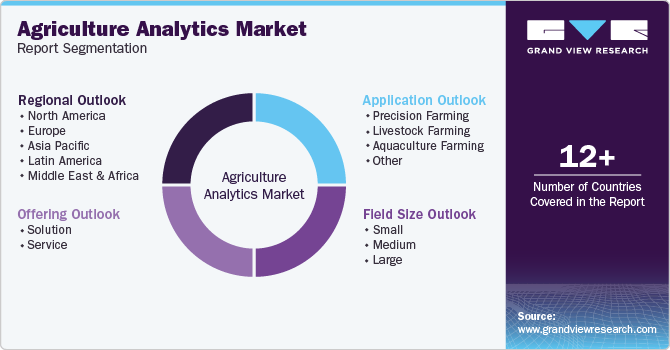 To learn more about this report, Download Free Sample Report
 -
Offering Outlook (Revenue, USD Million, 2021 - 2033)
-
Solution
-
Service
-
-
Application Outlook (Revenue, USD Million, 2021 - 2033)
-
Precision Farming
-
Yield Monitoring
-
Field Mapping
-
Crop Scouting
-
Weather Tracking & Forecasting
-
Irrigation Management
-
Inventory Management
-
Farm Labor Management
-
-
Livestock Farming
-
Milk Harvesting
-
Breeding Management
-
Feeding Management
-
Animal Comfort Management
-
Farm Labor Management
-
-
Aquaculture Farming
-
Other
-
-
Field Size Outlook (Revenue, USD Million, 2021 - 2033)
-
Small
-
Medium
-
Large
-
-
Regional Outlook (Revenue, USD Million, 2021 - 2033)
-
North America
-
U.S.
-
Canada
-
Mexico
-
-
Europe
-
UK
-
Germany
-
France
-
Spain
-
Italy
-
-
Asia Pacific
-
China
-
India
-
Japan
-
Australia
-
South Korea
-
-
Latin America
-
Brazil
-
-
Middle East & Africa
-
UAE
-
Kingdom of Saudi Arabia (KSA)
-
South Africa
-
-
Research Methodology
Segment Definition
Segment - Offering
Revenue capture definition
Solution
The largest share of market value is captured by analytics platforms that process farm, weather, soil, satellite, and machinery data to generate actionable insights. Vendors monetize through SaaS subscriptions, user-based licensing, predictive analytics modules, and premium decision-support capabilities for yield optimization and resource management.
Services
Income is derived from data integration, consulting, implementation, custom analytics development, training, and ongoing technical support. Service providers also secure long-term contracts for analytics outsourcing, agronomic advisory, and performance monitoring programs.
Segment - Application
Revenue capture definition
Precision Farming
Value is created through analytics solutions that support variable-rate application, yield forecasting, crop health monitoring, and field performance optimization. Revenue opportunities expand through recurring subscriptions for real-time decision support and AI-driven agronomic recommendations.
Livestock Farming
Monetization is driven by herd health analytics, feed optimization platforms, animal-tracking systems, and predictive disease-detection tools. Technology providers benefit from recurring software fees and integrated monitoring services that improve livestock productivity and operational efficiency.
Aquaculture Farming
Revenue streams originate from water quality analytics, feeding optimization systems, stock monitoring platforms, and predictive health management solutions. The growing demand for sustainable seafood production continues to support investments in analytics technologies focused on aquaculture.
Others
This segment includes greenhouse farming, horticulture, plantation agriculture, forestry, and specialty crop operations. Market participants generate income through customized analytics platforms, environmental monitoring tools, and specialized farm intelligence services tailored to unique agricultural requirements.
Segment - Field Size
Revenue capture definition
Small Farms
Value is captured through affordable cloud-based analytics platforms, mobile applications, and subscription packages designed for cost-conscious farmers. Adoption is supported by simplified data insights that help improve productivity without requiring substantial technology investments.
Medium Farms
Revenue is generated through integrated analytics solutions that combine crop monitoring, operational planning, equipment management, and resource optimization. These farms increasingly invest in scalable platforms that balance advanced functionality with manageable deployment costs.
Large Farms
The highest-value contracts originate from large-scale agricultural enterprises utilizing enterprise-grade analytics platforms, satellite intelligence, IoT integrations, and AI-driven forecasting systems. Vendors benefit from multi-year agreements, custom deployments, and extensive data management requirements across large farming operations.
Estimation Model
Layer
Question
Analysis
Agricultural Data Opportunity Layer
Who can benefit from agriculture analytics solutions?
Identify farms, agribusinesses, livestock operations, and agricultural stakeholders generating data that can be leveraged to improve productivity, efficiency, and decision-making.
Digital Agriculture Readiness Layer
Who can access agriculture analytics solutions?
Apply connectivity availability, digital farming maturity, sensor deployment, and data infrastructure readiness to determine the reachable market.
Adoption & Utilization Layer
Who actively uses agriculture analytics solutions?
Analyze adoption of farm management software, predictive analytics, yield forecasting, weather intelligence, and precision agriculture applications to identify active users.
Monetization Layer
How much revenue is generated?
Assess revenue generation potential by analyzing spending on analytics platforms, data management solutions, predictive tools, and advisory services, while incorporating recurring revenues from subscriptions, support, and analytics-driven service offerings.
Delivered Customizations
This report has been delivered with the following In-depth customizations
Client Request
Customization Delivered
Value Adds
Farm Data Analytics & Precision Decision-Making Trends
Conducted a focused analysis of agriculture analytics solutions covering crop performance monitoring, yield forecasting, soil analytics, weather intelligence, field mapping, and data-driven farm management practices across diverse farming systems.
Helps stakeholders identify high-growth analytics applications, evaluate digital agriculture adoption trends, and assess commercialization opportunities in data-driven farming solutions.
Predictive Agriculture & Smart Farm Intelligence Adoption Trends
Evaluated adoption trends for AI-powered crop analytics, satellite imagery, drone-based data collection, predictive pest and disease detection, and real-time farm monitoring platforms, including integration with precision farming technologies.
Provides insights into productivity improvement opportunities, emerging smart farming requirements, and commercially attractive analytics solutions supporting operational efficiency and sustainability.
Agricultural Data Ecosystem & Advanced Analytics Opportunity Assessment
Assessed demand for cloud-based agriculture analytics platforms, machine learning-driven decision support tools, farm management software integration, and remote sensing technologies, along with challenges related to data quality, connectivity, and technology adoption.
Supports investment and expansion strategies by identifying underserved agricultural segments, evaluating technology readiness, and strengthening long-term growth opportunities in digital agriculture and predictive farm management.
Frequently Asked Questions About This Report
The solution segment accounted for the largest share of 59.2% in 2025, and services segment is anticipated to be the fastest-growing segment.
Precision farming segment held the largest market share of 47.9% in 2025, while livestock farming segment is fastest growing segment
Large farms segment held the largest revenue share in 2025, while the medium farms segment is expected to register the fastest growth.
Major companies operating in the agriculture analytics market include Trimble; IBM Corporation; Wipro; SAP; Iteris; Taranis; Oracle Corporation; Conservis Corporation; Geosys Inc.; Xylem Inc.; PrecisionHawk; Gro Intelligence.
The global agriculture analytics market size was valued at USD 3.6 billion in 2025 and is estimated to reach USD 4.0 billion in 2026.
The global agriculture analytics market is expected to grow at a CAGR of 13.8% from 2026 to 2033, reaching USD 9.9 billion by 2033.
Key factors driving the increasing use of IoT sensors and connected agricultural devices, rising adoption of precision farming technologies, and growing integration of digital farm management and decision-support platforms.
North America dominated the agriculture analytics market, accounting for a 39.2% revenue share in 2025.
The Asia Pacific region is projected to be the fastest-growing market during the forecast period.
About the Author(s)
Next Generation Technologies Research Team
Technology · Next Generation TechnologiesThis report was authored by the next generation technologies research team at Grand View Research - comprising two research analysts, one senior research analyst, and one industry expert - with specialized expertise in the next generation technologies segment of the technology industry. All findings are based on proprietary technology databases, executive interviews, and regulatory analysis, subject to internal peer review prior to publication.
Last Updated:
Speak to Analyst

Customize this report to your needs - add regions, segments, or data points, with 20% free customization.
Or view our licence options:


ISO 9001:2015 & 27001:2022 Certified
We are GDPR and CCPA compliant! Your transaction & personal information is safe and secure. For more details, please read our privacy policy.


