
- Home
- »
- Next Generation Technologies
- »
-
AI-Based Weather Modelling Market Size Report, 2025-2033GVR Report cover

AI-Based Weather Modelling Market (2025 - 2033)
Size, Share & Trends Analysis Report By Component (Software, Services), By Technology, By End Use, By Region, And Segment Forecasts
Market Size, 2024
$165.7MMarket Estimate, 2026
$235.3MMarket Forecast, 2033
$926.3MCAGR, 2025–2033
21.3%AI-Based Weather Modelling Market Summary
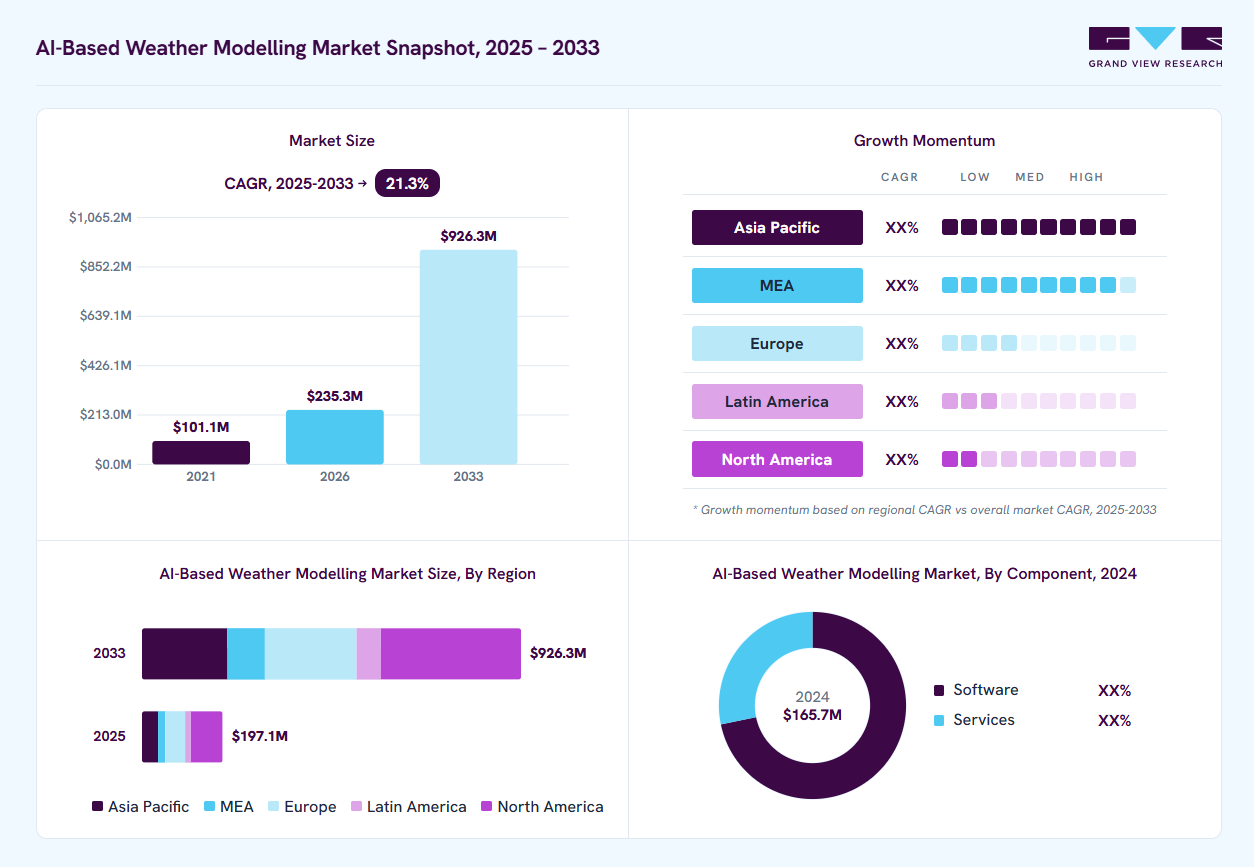
The global AI-Based weather modelling market size was valued at USD 165.7 million in 2024 and is projected to grow from USD 235.3 million in 2026 to USD 926.3 million by 2033, at a CAGR of 21.3% from 2025 to 2033. North America dominated the market, accounting for a revenue share of 40.1% in 2024. The market is driven by various factors such as rising demand for highly accurate, real-time forecasting to mitigate climate risks and natural disasters.
 Source: Grand View Research, IR Documents, Primary Interviews, Paid DatabasesTo learn more about this report,
 Download Free Sample Report
 Key Market Trends & Insights
- The AI-based weather modelling market in the U.S. led the North America market and held the largest revenue share in 2024.
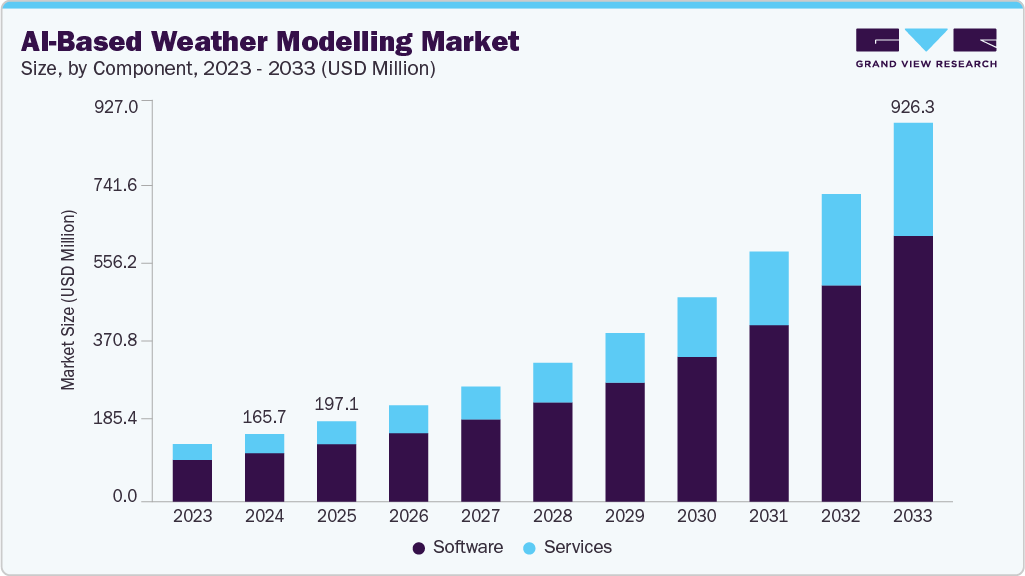
- By component, software led the market, holding the largest revenue share of 71.8% in 2024.
- By technology, machine learning segment held the dominant position in the market.
- By end use, national meteorological agencies & governments held the dominant position in the market.
Market Size & Forecast
- 2024 Market Size: USD 165.7 Million
- 2033 Projected Market Size: USD 926.3 Million
- CAGR (2025-2033): 21.3%
- North America: Largest Market in 2024
- Asia Pacific: Fastest Growing Market
Three ways to get this report
Buy it, customize it, or ask a question.Ask an Analyst
Analyst response in 1 business day
- AccessReport author, directly
- Reply timeWithin 1 working day
- No sales callDirect answer only
- FormatEmail reply
- CostFree, no cost
Get the Full Report
What the study covers
- FormatsPDF · Excel · Dashboard
- Timeline2025–2033 annual, 2024 base
- Coverage20+ countries, 5 regions
- Companies10+ key players profiled
Customize the Report
20% free customization
- IncludeCountries, segments, points
- TailorTo your product definition
- ExtendDeeper competitor detail
- OrA fully bespoke study
- Turnaround5–10 working days
Growing adoption across agriculture, energy, aviation, and maritime sectors for operational efficiency and risk management further fuels demand. Advances in machine learning, big data analytics, and cloud computing, coupled with increasing government initiatives for climate resilience, are accelerating market growth. The AI-based weather modelling market is being driven by rapid advancements in machine learning algorithms, big data analytics, and high performance computing. Increasing availability of satellite imagery, sensor data, and IoT-enabled weather stations enables AI systems to analyze massive volumes of information in real time.
 To learn more about this report, Download Free Sample Report
 AI-based weather modeling approaches improve forecast accuracy by detecting nonlinear climate patterns and short term anomalies. Cloud computing and scalable AI platforms also reduce the cost and time required for complex simulations, encouraging broader adoption. The ability to integrate heterogeneous datasets including atmospheric, oceanic, and geospatial inputs further strengthens predictive capabilities, making AI driven weather modelling more reliable and indispensable across sectors.
Rising economic losses due to extreme weather events are compelling industries and governments to invest in AI-based weather forecasting solutions. Sectors such as aviation, maritime, agriculture, energy, and insurance demand highly accurate, location specific predictions to reduce risks and optimize operations. In aviation and shipping, AI powered forecasts enhance safety and fuel efficiency. In agriculture, they support precision farming and crop protection, while in renewable energy, they improve grid balancing for solar and wind power. Insurance and reinsurance firms increasingly rely on AI based weather models for risk assessment and claims forecasting. The cost savings, efficiency improvements, and risk mitigation benefits act as major growth driver for the market.
Growing climate change concerns and rising frequency of natural disasters are encouraging policy makers and international organizations to promote AI-enhanced weather modelling capabilities. Governments and meteorological agencies are prioritizing the deployment of advanced forecasting systems to improve disaster preparedness and protect communities. International collaborations, such as data-sharing frameworks, further accelerate innovation and model training. Sustainability and climate-resilience goals, aligned with the UN Sustainable Development Goals and national carbon-reduction targets, also drive demand for accurate, AI-enabled predictions. Public-private partnerships, research funding, and regulatory mandates for resilient infrastructure are ensuring continuous investments, solidifying AI’s role in advancing global weather and climate modelling efforts.
Component Insights
The software segment dominated the market with a share of over 71.0% in 2023. The software component of the AI-based weather modelling market is driven by rising demand for advanced analytics platforms capable of processing massive climate datasets in real time. Increasing adoption of cloud-based solutions enables scalable, cost-efficient deployment of AI algorithms for predictive weather insights. Integration of machine learning and deep learning models enhances forecast accuracy, which is essential for sectors such as aviation, energy, and agriculture. Growing investments in user-friendly interfaces, API-based integration, and visualization tools further accelerate adoption. Moreover, government initiatives for disaster preparedness and private sector demand for risk mitigation strengthen software-driven market growth.
The services segment is expected to register a significant CAGR over the forecast period. The services segment in the AI-based weather modelling market is driven by the rising demand for customized, real-time forecasting and analytics. Organizations increasingly seek managed and consulting services to integrate AI-powered models into existing workflows for agriculture, energy, aviation, and disaster management. The surge in climate variability and extreme weather events has accelerated the need for professional services that ensure accuracy, scalability, and actionable insights. In addition, governments, enterprises, and research institutes rely on third-party expertise for model training, cloud deployment, maintenance, and continuous upgrades, fueling robust growth of the services segment globally.
Technology Insights
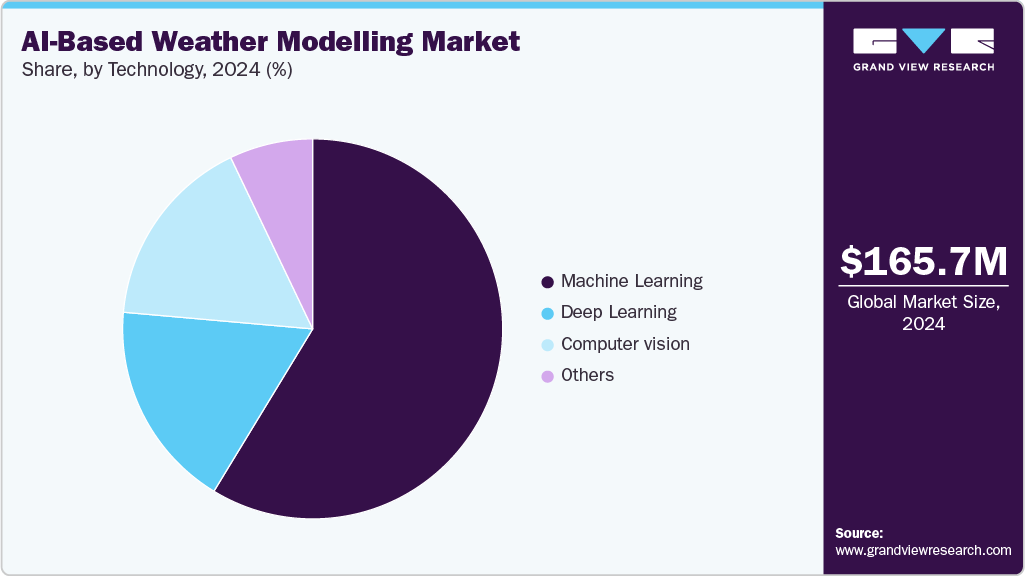
The machine learning segment held the largest market share in 2024, driven by its capability to analyze massive and complex climate datasets with higher speed and accuracy than traditional models. Machine learning algorithms excel at identifying hidden patterns in satellite imagery, radar signals, and historical weather records, enabling more precise short- and long-term forecasts. Growing demand for early warning systems against extreme weather events, coupled with rising applications in agriculture, energy, aviation, and disaster management, is boosting adoption. In addition, the scalability of ML models through cloud platforms and their ability to integrate heterogeneous data sources further strengthen their role in advancing weather prediction accuracy.
 To learn more about this report, Download Free Sample Report
 Deep learning segment is expected to register the fastest CAGR over the forecasted period, driven by its ability to process massive, complex climate and atmospheric datasets with high accuracy and speed. Deep learning models excel at recognizing nonlinear patterns in satellite imagery, radar data, and historical weather records, enabling more precise short-term forecasts and long-range climate projections. Their capability to integrate diverse data sources-such as IoT sensors, oceanic models, and geospatial data further enhances predictive reliability. Increasing demand for early disaster warnings, renewable energy optimization, and agricultural planning is accelerating adoption. Moreover, advances in high-performance computing and cloud infrastructure make large-scale deep learning weather models more feasible and scalable.
End Use Insights
National meteorological agencies & governments accounted for the largest market revenue share, in 2024, driven by the urgent need to enhance climate resilience, disaster preparedness, and public safety. Governments increasingly rely on AI-powered forecasting models to improve the accuracy and timeliness of early warning systems for floods, cyclones, and other extreme weather events. AI enables cost-effective processing of massive climate datasets from satellites, sensors, and radar networks, supporting national climate policies and sustainable development goals. Additionally, rising pressure to modernize legacy forecasting infrastructure, comply with international climate commitments, and strengthen cross-border data sharing initiatives further accelerates adoption of AI-based weather modeling in this segment.
Agriculture & agritech segment is expected to register the fastest CAGR over the forecast period. AI-driven weather modeling is essential for Agriculture & agritech to optimize planting, irrigation, fertilization and pest control, reducing input costs and crop loss. Climate variability and the increasing frequency of extreme events raise demand for predictive risk tools and crop-insurance models. Integration with satellite imagery, IoT sensors, and yield data enables precision applications and automated decision support. Falling sensor and cloud-compute costs plus accessible APIs accelerate adoption among agritech startups and large farms. Regulatory pressure on sustainable water use and supply-chain traceability further incentivizes weather-aware agronomic automation and carbon-smart practices.
Regional Insights
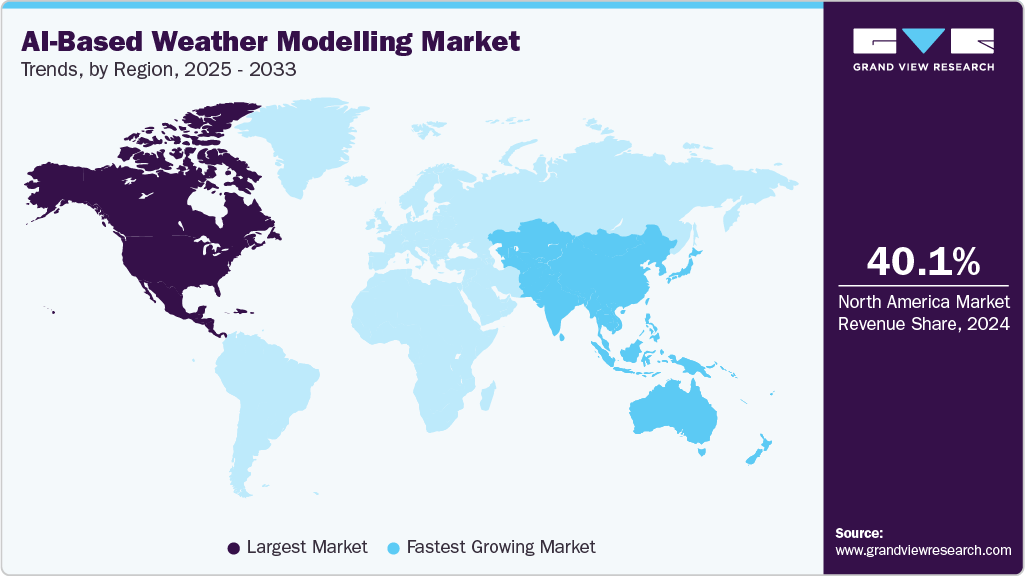
North America AI-based weather modelling market dominated the with a revenue share of over 40.0% in 2024. In North America, the AI-based weather modeling market is driven by rising climate related risks, demand for accurate short- and long term forecasts, and strong government investments in climate resilience. The region’s advanced digital infrastructure, presence of leading AI firms, and integration of predictive analytics in various sectors such as, aviation, energy, and agriculture further accelerate market adoption.
 To learn more about this report, Download Free Sample Report
 U.S. AI-Based Weather Modelling Market Trends
The U.S. AI-based weather modelling industry is expected to grow significantly in 2024 driven by rising climate related risks, frequent extreme weather events, and growing demand for accurate, real-time forecasting. Advancements in AI, big data analytics, and high-performance computing enhance predictive capabilities. Increasing applications in aviation, energy, agriculture, and government emergency planning further accelerate market adoption and investment.
Europe AI-Based Weather Modelling Market Trends
The AI-based weather modelling market in Europe is expected to grow significantly over the forecast period driven by increasing investments in climate resilience, stringent environmental regulations, and the demand for accurate forecasting to support agriculture, energy, aviation, and disaster management. Advancements in supercomputing, data integration from satellites and IoT sensors, and strong government-private sector collaboration further accelerate adoption across industries.
Asia Pacific AI-Based Weather Modelling Market Trends
The AI-based weather modelling industry in the Asia Pacific region is anticipated to be at the fastest CAGR over the forecast period, driven by rapid digitalization, government investments in disaster management, and rising climate uncertainties across the region. Increasing demand for accurate, real-time forecasts from agriculture, aviation, and energy sectors further accelerates adoption. Expanding AI infrastructure, cloud computing penetration, and supportive policy frameworks also fuel market growth across diverse economies.
Key AI-Based Weather Modelling Company Insights
Some key companies in the AI-based weather modelling industry are Google LLC and IBM Corporation.
-
Google LLC, through its DeepMind and AI research divisions, established itself as a key player in AI-based weather modeling. Its various models such as GraphCast and GenCast leverage machine learning to deliver more accurate, medium-range weather predictions. By combining advanced neural networks with real-time satellite and atmospheric data, Google LLC provides high-resolution forecasts that enhance disaster preparedness, agriculture planning, and renewable energy management, positioning it as a technological frontrunner in the AI-driven climate intelligence sector.
-
IBM Corporation is a key player in AI-based weather modeling, supported by its ownership of The Weather Company and its proprietary Deep Thunder and Global High-Resolution Atmospheric Forecasting systems. The company combines AI, supercomputing, and data analytics, enabling hyper-local, real-time, and highly scalable forecasts. Its Watson AI platform further enhances predictive insights for industries such as aviation, agriculture, insurance, and utilities.
Key AI-Based Weather Modelling Companies:
The following are the leading companies in the AI-based weather modelling market. These companies collectively hold the largest market share and dictate industry trends.
- Google LLC
- Microsoft
- IBM Corporation
- NVIDIA Corporation
- AccuWeather, Inc.
- ClimateAi
- The Tomorrow Companies Inc.
- Jupiter
- Atmos Climate
- Open Climate Fix
Recent Developments
-
In July 2025, Palantir Technologies Inc., enterprise operating systems provider, partnered with The Tomorrow Companies Inc. to integrate The Tomorrow Companies Inc.’s proprietary hyper-local weather intelligence into Palantir’s operational decision platforms. The alliance aims to convert near-real-time forecasts and risk signals into automated, end-to-end workflows for defense, aviation, supply-chain, and critical-infrastructure customers, effectively turning probabilistic forecasts into machine-actionable decisions.
-
In June 2025, Google LLC launched Weather Lab, positioning its research models for operational use including experimental cyclone forecasting. These product launches combine advanced graph-based neural models with Google Cloud scale, enabling probabilistic scenario generation and rapid ensemble runs that challenge traditional numerical workflows. Weather Lab displays both live and past cyclone forecasts generated by various AI weather models, alongside physics-based models from the European Centre for Medium-Range Weather Forecasts (ECMWF).
-
In March 2025, University of Cambridge collaborated with Alan Turing Institute, Microsoft Research and the European Centre for Medium Range Weather Forecasts to launch Aardvark Weather, AI weather prediction system, to deliver accurate forecasts tens of times faster and using thousands of times less computing power than current AI and physics-based forecasting systems. The collaboration produced reproducible research showing that end-to-end learned models trained on raw global data can deliver high-quality, fast forecasts using far less supercomputing time.
AI-Based Weather Modelling Market Report Scope
Report Attribute
Details
Market size in 2024
USD 165.7 million
Estimated market size in 2026
USD 235.3 million
Projected market size by 2033
USD 926.3 million
Growth rate
CAGR of 21.3% from 2025 to 2033
Actual data
2021 - 2023
Forecast period
2025 - 2033
Quantitative units
Revenue in USD million/billion and CAGR from 2025 to 2033
Report coverage
Revenue forecast, company ranking, competitive landscape, growth factors, and trends
Segments covered
Component, technology, end use, region
Regional scope
North America; Europe; Asia Pacific; Latin America; MEA
Country scope
U.S.; Canada; Mexico; Germany; UK; France; China; India; Japan; Australia; South Korea; Brazil; UAE; South Africa; KSA
Key companies profiled
Google LLC; Microsoft; IBM Corporation; NVIDIA Corporation; AccuWeather, Inc.; ClimateAi ; The Tomorrow Companies Inc.; Jupiter; Atmos Climate; and Open Climate Fix
Customization scope
Free report customization (equivalent up to 8 analysts working days) with purchase. Addition or alteration to country, regional & segment scope.
Pricing and purchase options
Avail customized purchase options to meet your exact research needs. Explore purchase options
Global AI-Based Weather Modelling Market Report Segmentation
This report forecasts revenue growth at global, regional, and country levels and provides an analysis of the latest industry trends in each of the sub-segments from 2021 to 2033. For this study, Grand View Research has segmented global AI-based weather modelling market report based on component, technology, end use, and region:
 To learn more about this report, Download Free Sample Report
 -
Component Outlook (Revenue, USD Million, 2021 - 2033)
-
Software
-
Services
-
-
Technology Outlook (Revenue, USD Million, 2021 - 2033)
-
Machine Learning
-
Deep Learning
-
Computer vision
-
Others
-
-
End Use Outlook (Revenue, USD Million, 2021 - 2033)
-
National Meteorological Agencies & Governments
-
Aviation & Maritime
-
Energy & Utilities
-
Agriculture & Agritech
-
Others
-
-
Regional Outlook (Revenue, USD Million, 2021 - 2033)
-
North America
-
U.S.
-
Canada
-
Mexico
-
-
Europe
-
Germany
-
UK
-
France
-
-
Asia Pacific
-
China
-
Japan
-
India
-
South Korea
-
Australia
-
-
Latin America
-
Brazil
-
-
Middle East and Africa (MEA)
-
UAE
-
KSA
-
South Africa
-
-
Frequently Asked Questions About This Report
North America dominated the AI-based weather modelling market with a share of 40.1% in 2024. This is attributable to the rising climate related risks, demand for accurate short- and long-term forecasts, and strong government investments in climate resilience. The region’s advanced digital infrastructure, presence of leading AI firms, and integration of predictive analytics in various sectors such as, aviation, energy, and agriculture further accelerate market adoption.
Some key players operating in the AI-based weather modelling market include Google LLC; Microsoft; IBM Corporation; NVIDIA Corporation; AccuWeather, Inc.; ClimateAi ; The Tomorrow Companies Inc. ; Jupiter; Atmos Climate; and Open Climate Fix
Key factors that are driving the AI-based weather modelling market growth include rising demand for highly accurate, real-time forecasting to mitigate climate risks and natural disasters. Growing adoption across agriculture, energy, aviation, and maritime sectors for operational efficiency and risk management fuels the demand.
The global AI-Based weather modelling market size was valued at USD 165.7 million in 2024 and is estimated at USD 235.3 million for 2026.
The global AI-Based weather modelling market is expected to grow at a CAGR of 21.3% from 2025 to 2033, reaching USD 926.3 million by 2033.
About the Author(s)
Next Generation Technologies Research Team
Technology · Next Generation TechnologiesThis report was authored by the next generation technologies research team at Grand View Research - comprising two research analysts, one senior research analyst, and one industry expert - with specialized expertise in the next generation technologies segment of the technology industry. All findings are based on proprietary technology databases, executive interviews, and regulatory analysis, subject to internal peer review prior to publication.
Last Updated:
Speak to Analyst

Customize this report to your needs - add regions, segments, or data points, with 20% free customization.
Or view our licence options:


ISO 9001:2015 & 27001:2022 Certified
We are GDPR and CCPA compliant! Your transaction & personal information is safe and secure. For more details, please read our privacy policy.


