
- Home
- »
- Next Generation Technologies
- »
-
AI Computer Market Size, Share & Trends Report 2026-2033GVR Report cover

AI Computer Market (2026 - 2033)
Size, Share & Trends Analysis Report By Architecture (ARM, x86), By Operating System, By Computing Device (Desktop & Notebooks, Workstations), By Type, By Price, By Region, And Segment Forecasts
Market Size, 2025
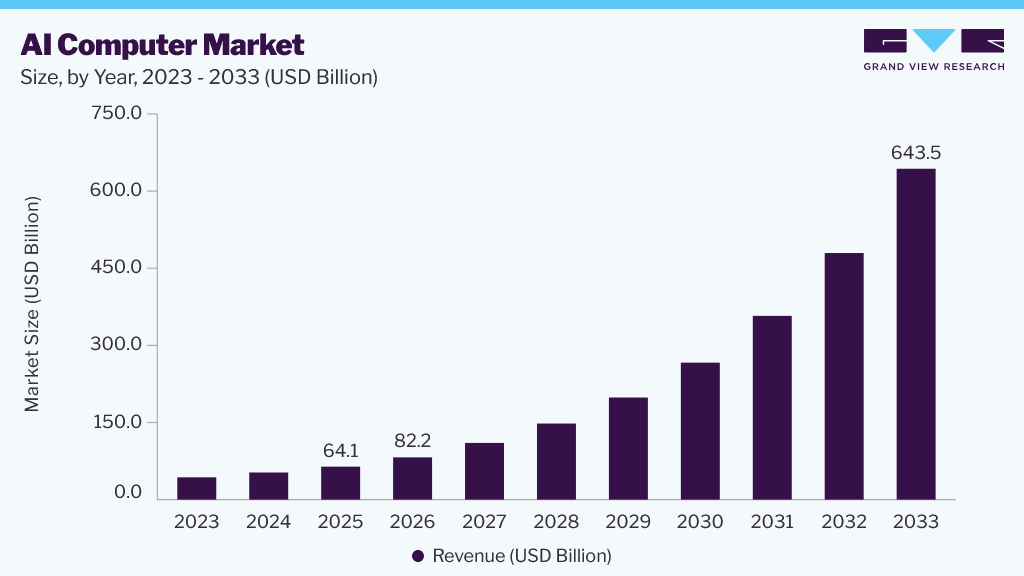
$64.1BMarket Estimate, 2026
$82.2BMarket Forecast, 2033
$643.5BCAGR, 2026–2033
34.2%AI Computer Market Summary
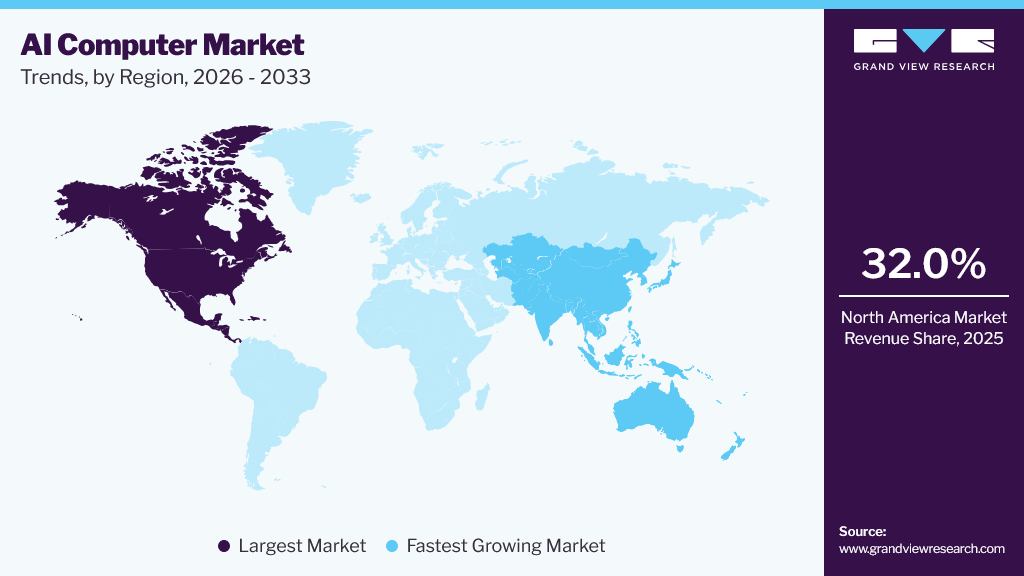
The global AI computer market size was valued at USD 64.1 billion in 2025 and is projected to grow from USD 82.2 billion in 2026 to USD 643.5 billion in 2033, at a CAGR of 34.2% from 2026 to 2033. North America dominated the market, accounting for a revenue share of 32.0% in 2025. AI-powered PCs are designed for processing, mining, and real-time data analysis, making them especially valuable in data-intensive sectors such as finance, healthcare, and retail.
 Source: Grand View Research, IR Documents, Primary Interviews, Paid DatabasesTo learn more about this report,
 Download Free Sample Report
 Key Market Trends & Insights
- By architecture: The ARM architecture segment held the largest market share of around 65.0% in 2025.
- By operating system: The Windows segment held a significant market share of around 50.0% in 2025.
- By computing device: The desktop & notebooks segment held the largest market share of around 54.0% in 2025.
- By type: The hardware-enabled AI PCs segment held the largest market share of around 45.0% in 2025.
- By price: The low range (USD 500 - 1500) segment held the largest market share of around 39.0% in 2025.
Regional Highlights
- Largest regional market: North America (32.0% revenue share, 2025)
- Fastest-growing regional market: Asia Pacific (highest CAGR, 2026-2033)
Market Size & Forecast
- Market size in 2025: USD 64.1 Billion
- Estimated market size in 2026: USD 82.2 Billion
- Projected market size by 2033: USD 643.5 Billion
- CAGR (2026-2033): 34.2%
Three ways to get this report
Buy it, customize it, or ask a question.Ask an Analyst
Analyst response in 1 business day
- AccessReport author, directly
- Reply timeWithin 1 working day
- No sales callDirect answer only
- FormatEmail reply
- CostFree, no cost
Get the Full Report
What the study covers
- FormatsPDF · Excel · Dashboard
- Timeline2026–2033 annual, 2025 base
- Coverage20+ countries, 5 regions
- Companies10+ key players profiled
Customize the Report
20% free customization
- IncludeCountries, segments, points
- TailorTo your product definition
- ExtendDeeper competitor detail
- OrA fully bespoke study
- Turnaround5–10 working days
Integrating high-performance NPUs is a key driver of growth in the market. These NPUs have enabled the creation of advanced AI PCs capable of handling the complex computations required for AI tasks. Moreover, the growing need for data-driven decision-making and automation drives the demand for AI-powered PCs in the enterprise sector. As enterprises continue to manage increasing volumes of data, the demand for AI PCs in this sector is also rising.AI is transforming content creation methods and gaming experiences by creating more realistic environments, smarter NPCs (non-player characters), and more immersive gameplay, as well as providing automated tools for photo, video, and audio editing. Al can analyze content, suggest improvements, remove unwanted elements, and generate content autonomously. This streamlines workflows for professionals and casual creators alike. Intel Corporation (US) introduced the Intel Core Ultra 2005 series of desktop processors in January 2025, with 12 new 65-watt and 35-watt offerings for desktop users. It is equipped with up to 8 performance cores and 16 efficiency cores. It is used for gaming and content-creating applications. AI-driven PCs offer real-time rendering and advanced visual effects for industries such as film production, graphic design, and 3D modeling. This significantly reduces the time required to process complex creative tasks, improving productivity and allowing creators to experiment with more intricate designs.
AI computing is experiencing rapid growth, transforming industries and reshaping daily life. With advancements in machine learning, deep learning, and neural networks, AI systems have become more sophisticated and capable of handling complex tasks like natural language processing, image recognition, and predictive analytics. Integrating AI into various fields, from healthcare and finance to entertainment and autonomous vehicles, is revolutionizing how businesses operate and improving efficiency across sectors.
Developing more powerful processors, such as graphics processing units (GPUs) and specialized AI chips, has significantly boosted AI's computational power. These innovations allow AI systems to process vast amounts of data more quickly, enabling them to learn and adapt more quickly. Moreover, AI algorithms continue to evolve, becoming increasingly accurate and versatile, with applications ranging from personalized recommendations to advanced robotics.
Analyst Perspective
The market for AI-enabled computers is evolving rapidly, as both personal and business computing devices are increasingly designed with integrated artificial intelligence functionality. The proliferation of AI-specific hardware, such as NPUs, GPUs, and dedicated AI-optimized processors, is enabling computing systems to handle increasingly complex workloads on local devices, with lower latency, better responsiveness, and higher efficiency. The increased deployment of AI-enabled notebooks, desktops, and workstations is also driving higher adoption of digital content creation, software development, big data processing, enterprise computing, and numerous other high-performance computing workloads. On-device AI processing has become a strategic priority as customers move toward reduced reliance on cloud services, to lower latency and enhanced data sovereignty. Furthermore, rising competition among processors and computer vendors is accelerating innovation in the AI hardware/software ecosystem.
Architecture Insights
The ARM architecture segment held the largest market share, at around 65.0% in 2025, driven by its energy-efficient design and growing adoption in AI-enabled notebooks, ultraportable devices, and edge computing systems. Arm continues to enhance AI performance through technologies such as Neon, Helium, Scalable Vector Extension (SVE), and Scalable Matrix Extension (SME), enabling efficient execution of AI workloads while reducing power consumption.
The x86 architecture segment is projected to register the fastest CAGR during the forecast period. Intel and AMD continue to integrate AI acceleration capabilities into x86 processors through dedicated NPUs, advanced vector extensions, and optimized AI software libraries. These innovations enable more efficient execution of AI workloads across desktops, notebooks, and enterprise computing systems. For instance, Intel updated its oneAPI Deep Neural Network Library (oneDNN) to add initial support for future Intel Xeon processors featuring Intel Advanced Vector Extensions 10.2 (AVX10.2) and Intel Advanced Matrix Extensions (AMX), demonstrating continued development of AI acceleration capabilities within Intel's x86 processor ecosystem. These developments enable more efficient processing of complex AI models, making x86 processors increasingly suitable for AI workloads.
Operating System Insights
The windows segment held the dominant market share of around 50.0% in 2025. Integrating artificial intelligence (AI) into operating systems, particularly Windows, significantly transforms the computing landscape. Microsoft has been at the forefront of this evolution, embedding AI capabilities into Windows 11 to enhance user experience and system performance. Windows has introduced many AI-driven features to fuel market growth. For instance, in May 2024, Microsoft announced "Copilot+ PC," a category of Windows 11 devices designed to support advanced AI features. These PCs require an onboard AI accelerator, at least 256GB of storage, and at least 16GB of RAM. The first wave of Copilot+ PCs runs on the Qualcomm Snapdragon X Elite system-on-chip, with x86-64-based models featuring AMD Ryzen AI and Intel Core Ultra CPUs expected later in the year.
Apple has significantly enhanced macOS by introducing Apple Intelligence, a personal intelligence system that integrates generative AI models to deliver contextually relevant assistance. Moreover, significant initiatives by Apple are fueling demand in the segment. For instance, in June 2024, Apple announced Apple Intelligence, a groundbreaking personal intelligence system deeply integrated into iOS 18, iPadOS 18, and macOS Sequoia. This innovative technology combines the power of generative models with a user's context to deliver helpful and relevant intelligence across iPhone, iPad, and Mac devices. Apple Intelligence leverages Apple silicon to understand and create language and images, take action across apps, and simplify everyday tasks, while strongly prioritizing user privacy through on-device processing and Private Cloud computing.
Computing Device Insights
The desktop & notebooks segment held the largest market share, at around 54.0%, in 2025. Significant improvements in AI processing hardware are fueling market growth. Graphics Processing Units (GPUs) are becoming the primary processors for AI workloads thanks to their parallel processing capabilities, which are ideal for the massive amounts of calculations involved in AI algorithms. Manufacturers such as NVIDIA, AMD, and Intel have developed AI-optimized GPUs. Even Google's Tensor Processing Units (TPUs) are optimized for machine learning tasks. Moreover, the evolution of CPUs, such as Intel’s Alder Lake and AMD Ryzen series, which incorporate AI acceleration capabilities, enables desktop and notebook systems to handle AI tasks more efficiently.
Workstations in computing systems are evolving rapidly to meet the growing demands of AI applications. Traditional CPUs are being supplemented by GPUs and TPUs, which excel at handling parallel processing tasks necessary for AI, particularly deep learning. High-performance CPUs with multiple cores and specialized hardware, such as NVIDIA A100 GPUs or Graphcore’s IPUs, are increasingly common in AI workstations. These systems also feature large amounts of memory (up to 256GB or more) and fast storage solutions, such as NVMe SSDs, to handle the large datasets and high-speed data processing required by AI workloads. AI workstations are increasingly integrated into scalable, distributed systems that utilize cloud computing resources to meet the demands of larger AI models. Custom AI hardware, such as FPGAs, allows for optimizing specific tasks, improving efficiency in specialized applications.
Type Insights
The hardware-enabled AI PCs segment held the largest market share of around 45.0% in 2025. Hardware-enabled AI PCs are rapidly growing in the AI computing segment due to the increasing demand for more powerful, efficient, and specialized computing resources. These systems integrate advanced hardware, such as GPUs, TPUs, and FPGAs, designed specifically to accelerate AI workloads. The rise of AI-driven applications, including machine learning, deep learning, and data analytics, has driven the need for high-performance computing capabilities. In addition, hardware-enabled AI PCs offer enhanced processing speed and energy efficiency, making them suitable for both research and commercial applications. As AI evolves, this hardware-focused approach is critical for achieving faster, more scalable AI solutions. Companies are investing heavily in developing and deploying these specialized AI systems, fueling market growth.
The advanced AI PCs segment is anticipated to register a significant CAGR over the forecast period. Advanced AI PCs are experiencing significant market growth, driven by integrating specialized hardware and software designed to handle complex AI tasks efficiently. These systems are equipped with powerful processors and AI accelerators, such as Neural Processing Units (NPUs), which enhance performance and energy efficiency. This integration enables AI PCs to perform tasks such as data analysis, machine learning, and real-time decision-making directly on the device, reducing reliance on cloud computing.
Price Insights
The low-range (USD 500-1500) segment held the largest market share, at around 39.0% in 2025, supported by the increasing availability of affordable AI-enabled notebooks with integrated NPUs and AI-optimized processors. Processor vendors such as Intel, AMD, and Qualcomm are expanding AI capabilities across mainstream computing devices, making AI-powered PCs accessible to a broader consumer and enterprise base.
The high range (USD 3600 & above) segment is expected to register the fastest CAGR over the forecast period. The market, particularly for high-end systems priced at USD 3,600 and above, is experiencing significant growth. Analysts anticipate a 10% to 15% price increase for AI-capable PCs, driven by the integration of advanced hardware components such as Neural Processing Units (NPUs) and specialized GPUs.
Regional Insights
The AI computer industry in North America is expected to hold a significant share of the global market, accounting for approximately 32.0% in 2025. The growth is driven by the integration of specialized processors designed to handle AI workloads, thereby enhancing performance and user experience. Major players like Apple and Intel are leading the market due to their M-series chips featuring neural engines in their Mac lineup, and Intel achieving a significant market share despite being a late entrant. The growing adoption of AI technologies across industries further drives demand for AI-capable PCs in the region. This trend is expected to continue, with projections indicating AI-capable PC shipments.
U.S. AI Computer Market Trends
 To learn more about this report, Download Free Sample Report
 The AI computer industry in the U.S. is heavily influenced by the expansion and advancements in AI hardware, including specialized chips such as GPUs, TPUs, and NPUs, which are accelerating AI workloads. Investments in AI infrastructure are also on the rise, with companies like Microsoft and BlackRock launching a $30 billion fund to develop and expand data centers and energy infrastructure in the U.S., aiming to enhance domestic AI capabilities.
Asia Pacific AI Computer Market
The AI computer industry in Asia Pacific is expected to register the fastest CAGR during the forecast period, driven by rapid digital transformation, expanding AI adoption across enterprises, and growing investments in semiconductor manufacturing. Countries such as China, Japan, South Korea, India, and Taiwan are strengthening their AI ecosystems through government initiatives, increasing deployment of AI-enabled PCs, and expanding domestic chip production. Rising demand for AI-powered computing in software development, content creation, education, healthcare, and enterprise applications is further supporting market growth across the region.
Key AI Computer Market Companies' Insights
Some of the key companies in the market include Dell Inc., HP Development Company, L.P., Lenovo, Intel Corporation, Advanced Micro Devices, and others. Organizations focus on increasing their customer base to gain a competitive edge in the industry. Therefore, key players are taking several strategic initiatives, such as mergers and acquisitions and partnerships with other major companies.
-
HP Development Company, L.P. is strengthening its AI computer portfolio through AI-enabled commercial and consumer PCs equipped with Intel Core Ultra, AMD Ryzen AI, and Qualcomm Snapdragon X processors. The company integrates dedicated NPUs, AI-powered productivity features, and advanced collaboration capabilities across its notebook and desktop portfolio to support enterprise and creative workloads. HP continues to expand its AI PC ecosystem through strategic partnerships with leading processor vendors and software providers.
-
NVIDIA Corporation plays a critical role in the AI computer industry through its AI GPUs, AI software ecosystem, and accelerated computing platforms. Its GeForce RTX GPUs, DGX systems, CUDA platform, and AI Enterprise software enable high-performance AI computing across enterprise, research, content creation, and workstation environments. Continuous innovation in AI hardware and software strengthens NVIDIA's leadership in AI-enabled computing.
Key AI Computer Companies:
The following key companies have been profiled for this study on the AI computer market.
-
Apple Inc.
-
Dell Inc.
-
HP Development Company, L.P.
-
Lenovo
-
Intel Corporation
-
Advanced Micro Device
-
NVIDIA Corporation
-
Microsoft
-
Fujitsu
Recent Developments
-
In June 2024, Apple announced Apple Intelligence, a new personal intelligence system for iPhone, iPad, and Mac, deeply integrated into iPadOS 18, iOS 18 and macOS Sequoia. This system combines the power of generative models with personal context to enhance language and image creation, take actions across apps, and simplify everyday tasks. Apple Intelligence prioritizes user privacy through on-device processing and Private Cloud Compute, which uses dedicated Apple silicon servers to handle more complex requests without retaining user data.
-
In September 2024, Lenovo announced a series of groundbreaking AI PCs designed to redefine the future of professional computing. The new lineup includes the ThinkPad X1 Carbon Gen 13 Aura Edition, co-developed with Intel, the ThinkPad T14s Gen 6 AMD, and the ThinkBook 16 Gen 7 series. The ThinkPad X1 Carbon Gen 13 Aura Edition is a premium business laptop weighing less than 1kg, featuring innovative features such as Smart Modes, Smart Share, and Smart Care. The ThinkPad T14S Gen 6 AMD, powered by the latest AMD Ryzen AI processors, delivers a 3X performance boost and exceptional responsiveness.
AI Computer Market Report Scope
Report Attribute
Details
Market size in 2025
USD 64.1 billion
Estimated market size in 2026
USD 82.2 billion
Projected market size by 2033
USD 643.5 billion
Growth rate
CAGR of 34.2% from 2026 to 2033
Base year for estimation
2025
Historical data
2021 - 2025
Forecast period
2026 - 2033
Quantitative units
Revenue in USD billion and CAGR from 2026 to 2033
Report coverage
Revenue forecast, company ranking, competitive landscape, growth factors, and trends
Segments covered
Architecture, operating system, computing device, type, price, region
Regional Scope
North America; Europe; Asia Pacific; Latin America; MEA
Country Scope
U.S.; Canada; UK; Germany; France; China; India; Japan; South Korea; Australia; Brazil; Mexico; KSA; UAE; South Africa
Key companies profiled
Apple Inc.; Dell Inc.; HP Development Company, L.P.; Lenovo; Intel Corporation; Advanced Micro Device; NVIDIA Corporation; Microsoft; Fujitsu
Customization scope
Free report customization (equivalent to 8 analyst working days) with purchase. Addition or alteration to country, regional & segment scope.
Pricing and purchase options
Avail of customized purchase options to meet your exact research needs. Explore purchase options
AI Computer Market Report Segmentation
This report forecasts revenue growth at the global, regional, and country levels and provides an analysis of the latest industry trends and opportunities across each sub-segment from 2021 to 2033. For this study, Grand View Research has segmented the global AI computer market report based on architecture, operating system, computing device, type, price, and region:
-
Architecture Outlook (Revenue, USD Billion, 2021 - 2033)
-
x86
-
ARM
-
-
Operating System Outlook (Revenue, USD Billion, 2021 - 2033)
-
Windows
-
MacOS
-
Others
-
-
Computing Device Outlook (Revenue, USD Billion, 2021 - 2033)
-
Desktop & Notebooks
-
Workstations
-
-
Type Outlook (Revenue, USD Billion, 2021 - 2033)
-
Hardware-enabled AI PCs
-
Next-generation AI PCs
-
Advanced AI PCs
-
-
Price Outlook (Revenue, USD Billion, 2021 - 2033)
-
Low Range (USD 500 - 1500)
-
Mid-Range (USD 1600 - 3500)
-
High Range (3600 & above)
-
-
Regional Outlook (Revenue, USD Billion, 2021 - 2033)
-
North America
-
U.S.
-
Canada
-
Mexico
-
-
Europe
-
UK
-
Germany
-
France
-
-
Asia Pacific
-
China
-
Japan
-
India
-
Australia
-
South Korea
-
-
Latin America
-
Brazil
-
Middle East and Africa
-
KSA
-
UAE
-
South Africa
-
Frequently Asked Questions About This Report
The global AI computer market size was valued at USD 64.1 billion in 2025 and is estimated at USD 82.2 billion for 2026.
The global AI computer market is expected to grow at a CAGR of 34.2% from 2026 to 2033, reaching USD 643.5 billion.
North America dominated with an approximately 32.0% revenue share in 2025.
Key players in the market include Apple Inc.; Dell Inc.; HP Development Company, L.P.; Lenovo; Intel Corporation; Advanced Micro Device; NVIDIA Corporation; Microsoft; Fujitsu. and others.
The ARM architectures segment accounted for the largest revenue share of around 65.0% in 2025.
About the Author(s)
Next Generation Technologies Research Team
Technology · Next Generation TechnologiesThis report was authored by the next generation technologies research team at Grand View Research - comprising two research analysts, one senior research analyst, and one industry expert - with specialized expertise in the next generation technologies segment of the technology industry. All findings are based on proprietary technology databases, executive interviews, and regulatory analysis, subject to internal peer review prior to publication.
Last Updated:
Speak to Analyst

Customize this report to your needs - add regions, segments, or data points, with 20% free customization.
Or view our licence options:


ISO 9001:2015 & 27001:2022 Certified
We are GDPR and CCPA compliant! Your transaction & personal information is safe and secure. For more details, please read our privacy policy.


