
- Home
- »
- Next Generation Technologies
- »
-
AI In Finance Market Size, Share & Trends Report, 2033GVR Report cover

AI In Finance Market (2026 - 2033)
Size, Share & Trends Analysis Report By Technology (Machine Learning, Generative AI, Computer Vision), By Function (Fraud Detection, Risk Management), By End-use (Banks, Insurance Companies), By Region, And Segment Forecasts
Market Size, 2025
$39.5BMarket Estimate, 2026
$50.6BMarket Forecast, 2033
$216.9BCAGR, 2026–2033
23.1%AI In Finance Market Summary
The global AI in finance market size was valued at USD 39.5 billion in 2025 and is projected to grow from USD 50.6 billion in 2026 to USD 216.9 billion by 2033, at a CAGR of 23.1% from 2026 to 2033. North America dominated the market, accounting for the largest revenue share of 37.3% in 2025. The market is experiencing rapid growth as financial institutions increasingly adopt AI technologies to improve efficiency and decision-making. Growing applications in fraud detection, risk management, customer service, investment management, and process automation are driving adoption.
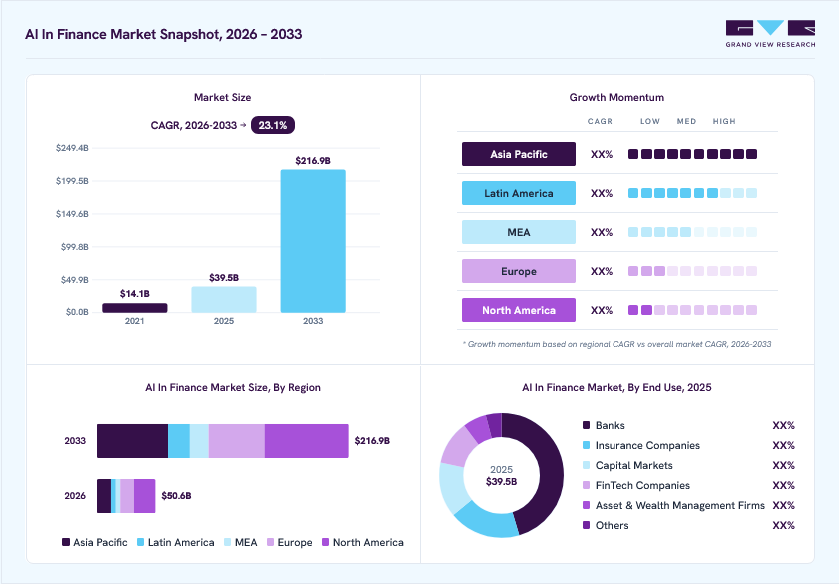 Source: Grand View Research, IR Documents, Primary Interviews, Paid DatabasesTo learn more about this report,
 Download Free Sample Report
Key Market Trends & Insights
- By technology: The machine learning segment led the market and held the largest revenue share of 35.9% in 2025.
- By function: The fraud detection led the market and accounted for the leading revenue share of 26.1% in 2025.
- By end-use: The banks segment held the largest revenue share of 45.3% in 2025.
Regional Highlights
- Largest regional market: North America (37.3% revenue share, 2025)
- Fastest growing regional market: Asia Pacific (highest CAGR, 2026–2033)
- By country: The U.S. held the largest market share in 2025.
Market Size & Forecast
- Market size in 2025: USD 39.5 Billion
- Estimated market size in 2026: USD 50.6 Billion
- Projected market size by 2033: USD 216.9 Billion
- CAGR (2026–2033): 23.1%
GVR research-powered AIAsk Prism AI about the AI in finance marketGet cited answers from GVR research on market growth, segments, regulations and forecasts.Start with✓ Source-linked answers ✓ Market-specific context ✓ Traceable figuresExplore Prism AI ↗
Financial institutions are increasingly adopting AI to automate routine tasks and improve the productivity of financial advisors. AI tools can organize client information, generate meeting insights, and support advisors in preparing for client interactions. These capabilities reduce manual effort and allow advisors to focus more on client relationships and strategic financial discussions. The growing availability of AI-powered advisory tools is also supporting more personalized financial services. This trend is expected to drive further adoption of AI across wealth management and other financial services. For instance, in March 2026, Bank of America launched AI-powered meeting preparation tools for its Merrill and Bank of America Private Bank businesses. These tools assist financial advisors organize relevant client and financial information before meetings, supporting more efficient client interactions and advisory services.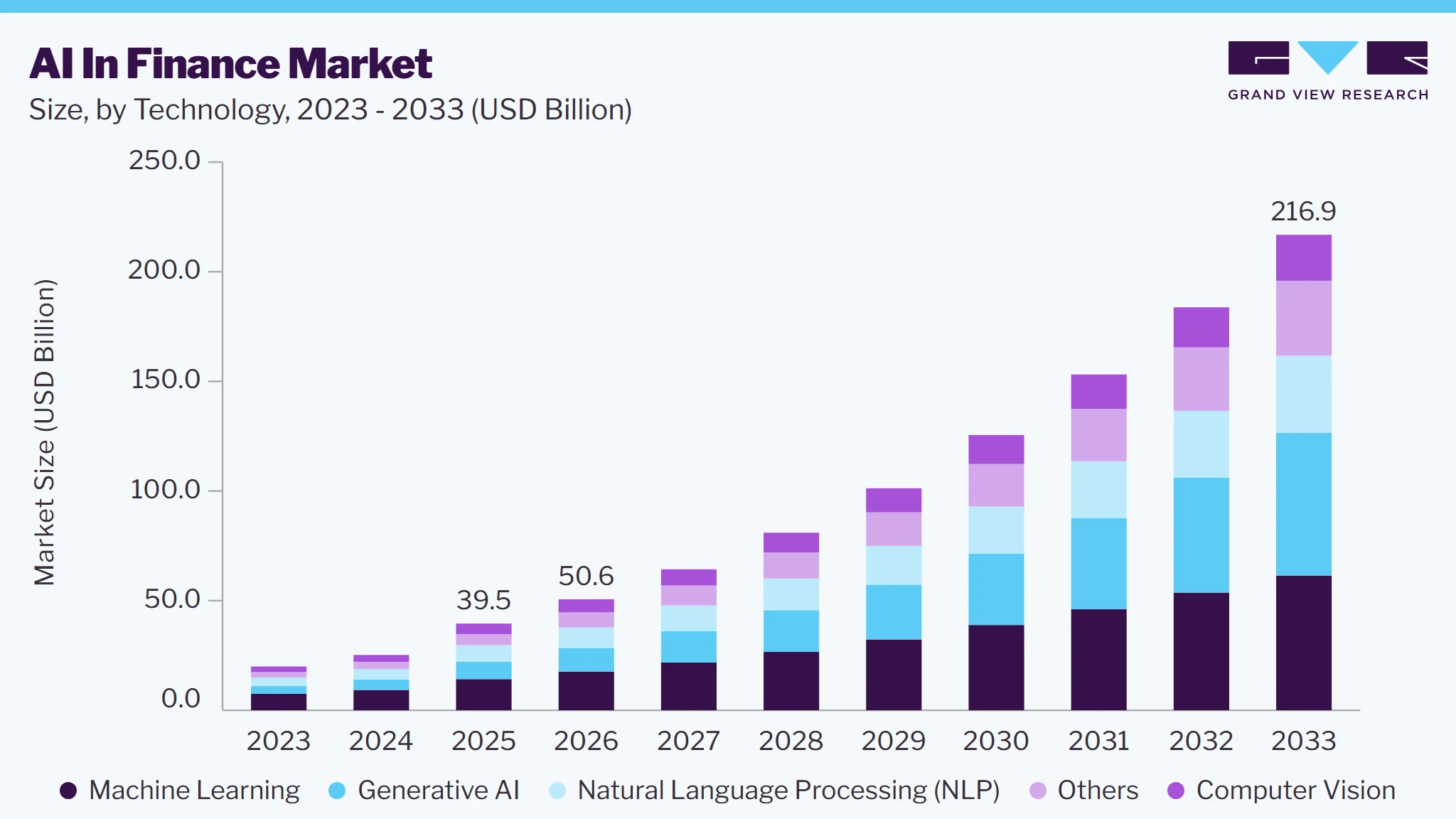 To learn more about this report, Download Free Sample Report
Financial institutions are increasingly using Artificial Intelligence (AI) in finance to deliver personalized financial guidance and improve digital customer experience. AI can analyze customer transaction data and financial behavior to generate tailored insights and recommendations. Conversational AI is enabling customers to interact with financial services using natural-language queries within existing banking applications. These capabilities can help banks improve customer engagement while reducing reliance on manual support. The trend is expected to strengthen as financial institutions integrate applied AI in finance and generative AI in finance more deeply into their digital platforms. For instance, in July 2026, Visa, a digital payments company, introduced AI Financial Assistant to help banks provide personalized financial insights through their existing banking apps. The service enables customers to receive spending insights, ask natural-language questions, and take selected financial actions within the app.
The AI in finance market is witnessing increasing adoption of generative AI as financial institutions seek to improve productivity, customer engagement, and operational efficiency. Banks, fintech companies, insurers, and investment firms are exploring generative AI for customer service, financial analysis, document processing, and intelligent assistants. The technology is also supporting personalized financial services and automating knowledge-intensive tasks. Growing investments in AI infrastructure and cloud platforms are enabling financial institutions to deploy generative AI on a scale. For instance, the GCC applied AI in finance market is expanding as banks and fintech companies across the region adopt generative AI and digital banking solutions. National AI strategies and digital transformation initiatives across GCC countries are further supporting this trend.
Market Dynamics
The Artificial Intelligence (AI) in finance market is driven by growing demand for fraud detection, risk management, automation, and personalized financial services. Advancements in generative AI, machine learning, and cloud computing are expanding AI applications across banking, insurance, investment, and fintech. However, data privacy concerns regulatory requirements, and challenges related to AI explainability may restrain market growth. Increasing adoption of AI-powered financial assistants and agentic AI is creating new opportunities for financial institutions, while legacy system integration, skilled talent shortages, and AI governance challenges remain key market challenges.
Financial institutions are increasingly adopting Artificial Intelligence (AI) in finance to detect fraudulent transactions and suspicious activities. AI analyzes large volumes of financial data in real time to identify unusual transaction patterns. Machine Learning (ML) models can continuously learn from new fraud patterns and improve detection accuracy. AI-based systems also support credit risk assessment by analyzing customer and transaction data. This helps financial institutions reduce financial losses and make faster risk-related decisions.
The growing complexity of financial fraud is further increasing the need for applied AI in finance solutions. Banks and fintech companies are using AI to strengthen anti-money laundering and compliance processes. Automated risk monitoring detects potential threats more quickly than traditional manual approaches. AI also enables financial institutions to assess multiple risk factors simultaneously. As financial transactions become increasingly digital, demand for real-time AI-based fraud and risk management solutions is expected to increase.
Financial institutions handle large volumes of sensitive customer and transaction data, making data privacy a major concern in the Artificial Intelligence (AI) in finance market. AI systems require access to extensive datasets, increasing the risk of data breaches and unauthorized access. Concerns about data misuse can reduce trust in AI-based financial solutions. These risks become more significant as financial institutions adopt cloud-based and generative AI applications. As a result, privacy and security concerns can slow the adoption of applied AI in finance solutions.
Financial institutions must comply with strict data protection and cybersecurity requirements when implementing AI solutions. Ensuring secure data storage, processing, and sharing can increase implementation and compliance costs. Third-party AI platforms may also create concerns regarding the control and protection of sensitive financial data. These challenges can make financial institutions more cautious about deploying AI on a large scale. Consequently, data governance and cybersecurity requirements may restrain the growth of AI in finance market.
Financial institutions are increasingly using Artificial Intelligence (AI) in finance to automate repetitive and time-consuming operational tasks. AI supports activities such as document processing, payment processing, reconciliation, reporting, and customer service. Automation reduces manual workloads and improves operational efficiency. It also enables employees to focus on higher-value activities and complex decision-making. AI-powered automation can reduce processing time and improve the consistency of routine operations. The growing need to improve efficiency and control operating costs is encouraging financial institutions to expand AI adoption.
AI-based automation is also being applied to back-office and administrative processes across financial institutions. Intelligent systems can process large volumes of documents, extract relevant information, and support faster decision-making. Automated workflows can reduce errors associated with manual data entry and repetitive processes. Financial institutions can also scale automated operations without proportionally increasing their workforce. As digital transaction volumes continue to grow, the need for efficient processing is increasing. This trend is supporting the adoption of applied AI in finance and generative AI in finance solutions across the finance sector.
Market Concentration & Characteristics
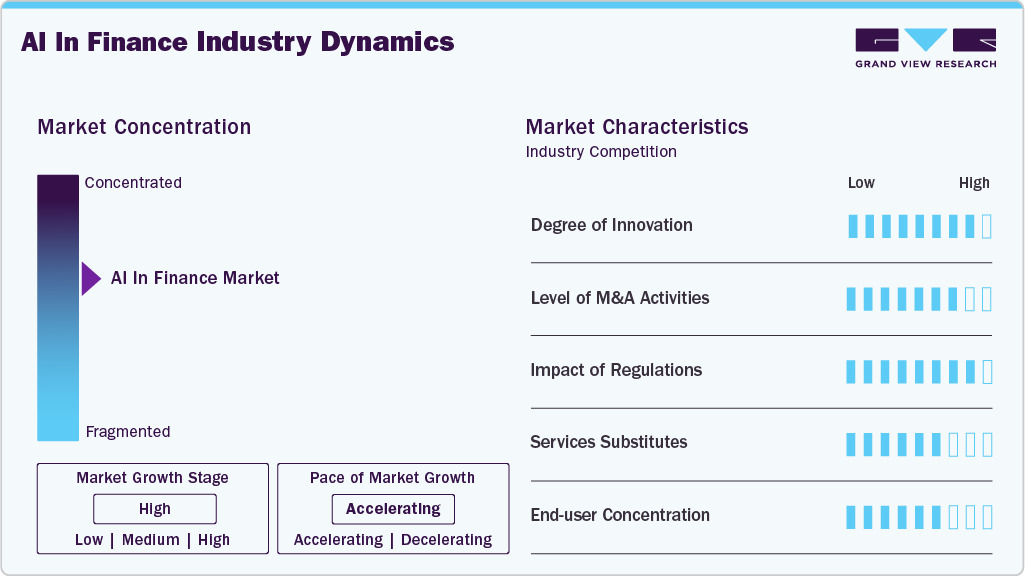
The AI in finance market is fragmented, with competition among global technology companies, financial software providers, fintech firms, and specialized AI vendors. The market includes a wide range of players offering AI solutions across banking, insurance, investment management, payments, and lending. Major technology companies compete alongside specialized providers focused on specific financial applications. This diverse competitive landscape reduces the dominance of any single company across the overall market. The availability of solutions from both established and emerging companies further contributes to market fragmentation. Increasing investments in AI technologies are also attracting new players and expanding competition.
 To learn more about this report, Download Free Sample Report
The fragmented structure is supported by the broad range of AI applications across the financial services industry. Companies compete based on technology capabilities, solution performance, integration, scalability, security, and industry expertise. Large technology providers benefit from extensive infrastructure and established customer relationships, while smaller firms often compete through specialized solutions. Partnerships and collaborations between financial institutions, technology companies, and fintech firms are also common. The expanding use of AI across financial services is expected to maintain a competitive and fragmented market structure.
Analyst Perspective
AI in finance market is expected to maintain strong growth as financial institutions increasingly move from experimentation toward scaled AI deployment across operations, customer service, investment, and financial decision-making. Generative AI (GenAI) and agentic AI are emerging as key growth areas, while automation and productivity improvements are strengthening the business case for adoption. However, data governance, regulatory requirements, legacy-system integration, and the ability to measure AI-driven returns will remain important factors influencing adoption. Increasing investments in the applied AI in finance market, expanding use cases, and growing demand for operational efficiency are expected to support sustained market expansion through the forecast period.
Technology Insights
The machine learning segment led the AI in finance market and accounted for 35.9% of global revenue in 2025. Its dominance is supported by its broad use across fraud detection, credit scoring, risk assessment, and financial forecasting. Financial institutions increasingly use machine learning to analyze large volumes of structured financial data and generate predictive insights. The technology also supports automated decision-making and personalized financial services. Its established adoption and wide range of applications are expected to sustain its strong market position.
The generative AI segment is gaining traction as financial institutions increasingly adopt AI for content generation, document processing, financial research, and customer support. Generative AI can analyze large volumes of structured and unstructured financial information and generate actionable insights. It is also being used for personalized customer interactions through AI-powered assistants and chatbots. Growing investments in generative AI are encouraging financial institutions to expand beyond traditional machine learning applications. The technology is expected to support productivity improvements and automation across banking, insurance, investment, and fintech.
Function Insights
Fraud detection dominated the AI in finance market and accounted for the leading revenue share of 26.1% in 2025, supported by the growing volume of digital transactions and increasing financial fraud. AI-powered systems analyze transaction patterns and customer behavior in real time to identify suspicious activities. Financial institutions are increasingly adopting these solutions to reduce fraud losses and strengthen transaction security. Growing regulatory requirements for secure payments and identity verification are further supporting adoption. As fraud techniques become more sophisticated, demand for AI-based fraud detection solutions is expected to remain strong.
The customer service segment is expected to witness strong growth in the AI in finance market as financial institutions increasingly deploy AI-powered chatbots, virtual assistants, and AI agents. These technologies enable faster responses, 24/7 support, and more personalized customer interactions. The growing need to improve customer experience and reduce service costs is encouraging banks and financial institutions to adopt AI-based solutions. Generative AI is further expanding applications in customer support by enabling more natural and context-aware interactions. Increasing adoption of AI-driven customer service solutions is expected to support strong segment growth through 2033.
End-use Insights
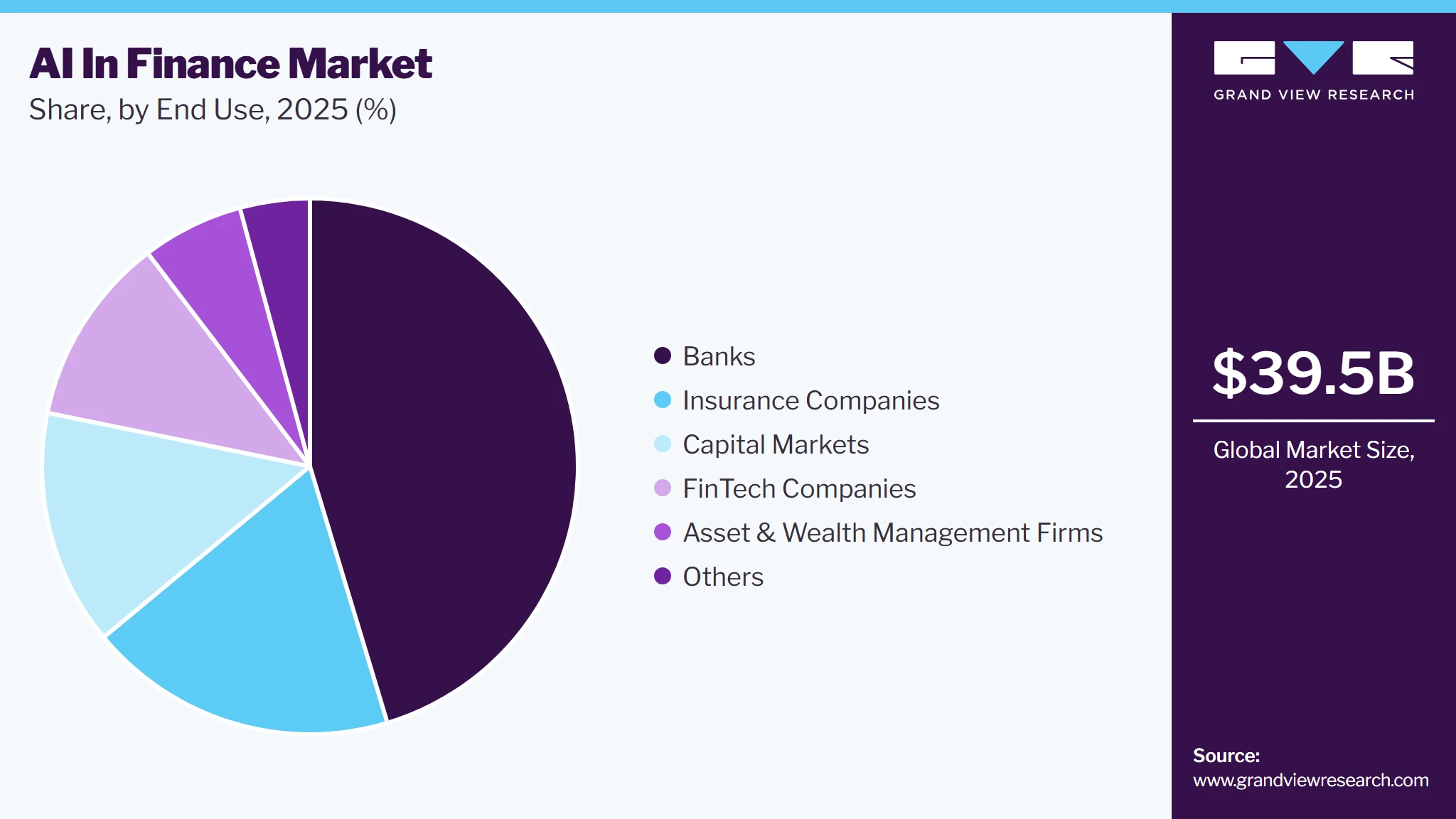
The banks segment dominates the AI in finance market with largest revenue share of 45.3% in 2025 due to the large volume of financial data generated through banking operations. Banks are increasingly adopting AI for customer service, fraud detection, credit assessment, risk management, and process automation. Their strong digital infrastructure and higher technology investments support large-scale AI deployment. AI also assist banks to improve operational efficiency, personalize services, and accelerate decision-making. The growing adoption of AI across core banking functions is expected to maintain the segment’s leading position.
 To learn more about this report, Download Free Sample Report
The FinTech companies segment is expected to witness strong growth in the AI in finance market as fintech firms increasingly integrate AI into lending, payments, fraud detection, customer service, and compliance. AI helps fintech companies automate workflows, improve decision-making, personalize services, and scale operations efficiently. The growing digital transaction ecosystem and pressure to improve profitability are further encouraging AI adoption. Generative AI and AI agents are expanding applications across customer engagement and operational processes. As fintech companies continue embedding AI into core business functions, the segment is expected to grow rapidly through 2033.
Regional Insights
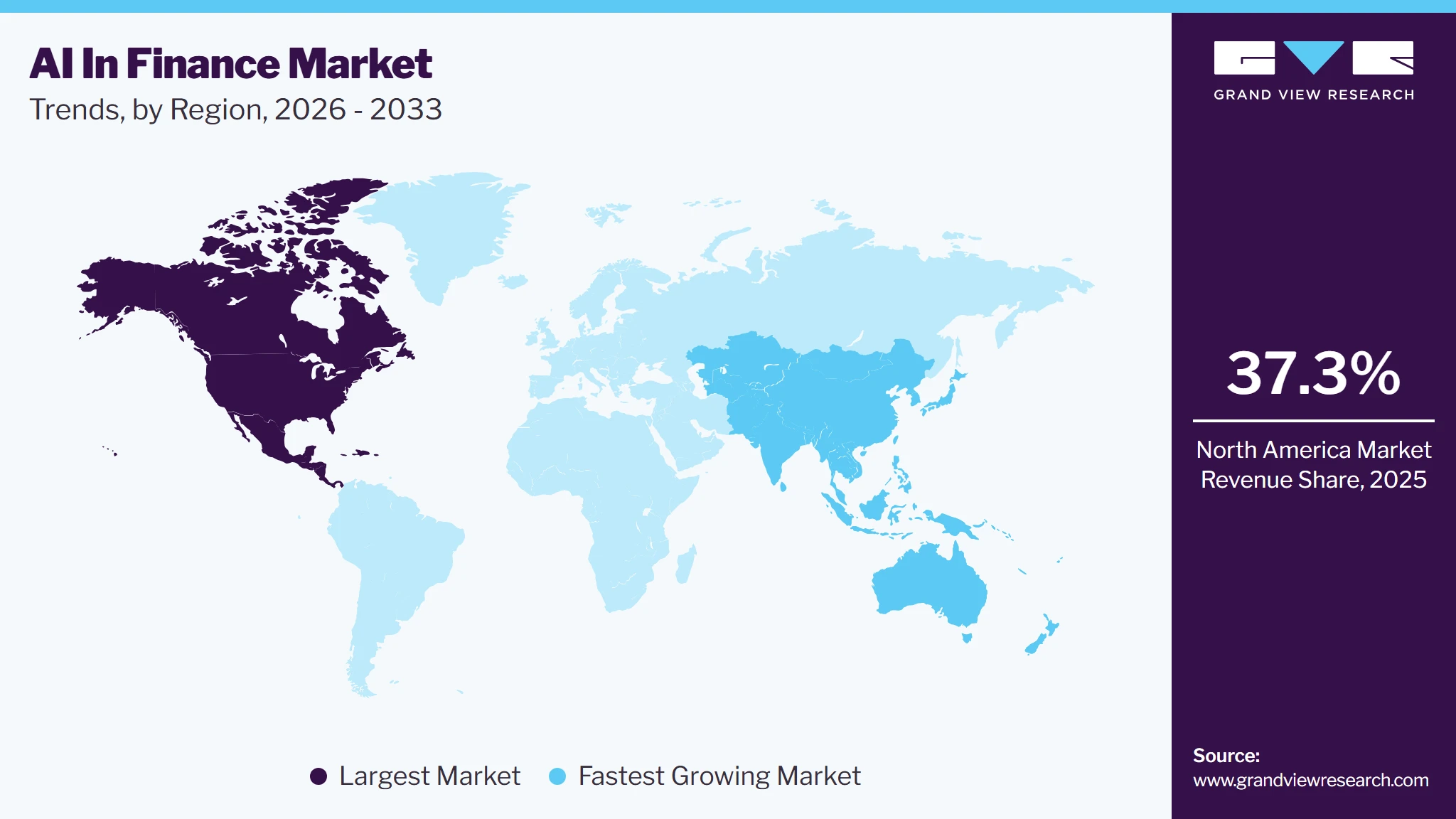
North America AI in finance market holds the largest share of global revenue, accounting for 37.3% in 2025. The region benefits from strong adoption of AI across banking, fintech, insurance, and investment services. High investments in AI technologies and advanced digital infrastructure support the regional market. The presence of major financial institutions and technology companies further accelerates AI deployment. These factors are expected to support North America’s leading position throughout the forecast period.
 To learn more about this report, Download Free Sample Report
U.S. AI In Finance Market Trends
The U.S. holds a leading position in the Artificial Intelligence (AI) in finance market, supported by strong adoption among banks, fintech companies, and financial service providers. The applied AI in finance market is expanding as institutions use AI for automation, customer service, fraud detection, lending, and investment management. Growing investments in generative AI and AI infrastructure are further accelerating adoption. The presence of major technology companies and established financial institutions strengthens the U.S. market. Increasing deployment of AI-powered financial solutions is expected to support continued market growth.
Europe AI In Finance Market Trends
The Europe AI in finance market is expanding across Germany, France, Italy, Spain, the Netherlands, Sweden, Belgium, Austria, the UK, and Switzerland, supported by increasing digitalization, fintech adoption, and investments in financial technologies. Germany and France are applying AI in the finance market, and they are advancing as financial institutions adopt AI for customer service, process automation, lending, investment management, and financial analytics. Meanwhile, Italy and Spain, which have applied AI in the finance market, are gaining momentum as banks and fintech companies leverage AI to enhance operational efficiency and customer experience.
The generative AI in finance market is gaining traction across Europe, with financial institutions exploring applications in document processing, financial research, intelligent assistants, and personalized services. The UK and Switzerland are also contributing to regional growth through their established financial sectors, strong fintech ecosystems, and increasing AI investments. Growing adoption of cloud infrastructure and advanced AI technologies is further supporting the applied AI in finance market. These trends are expected to drive continued expansion of the AI in finance market across Europe.
Asia Pacific AI In Finance Market Trends
Asia Pacific is expected to be the fastest-growing region in the AI in finance market, supported by rapid digital banking adoption and expanding fintech ecosystems. China, India, Japan, and other regional markets are increasingly adopting applied AI for lending, payments, customer service, and financial operations. Growing investments in generative AI and cloud infrastructure are further accelerating AI deployment. The increasing volume of digital financial transactions is generating large datasets for AI applications. These factors are expected to strengthen Asia Pacific’s position as the fastest-growing region in the AI in Finance Market.
Key AI In Finance Market Company Insights
Some key companies in the AI in finance industry are Amazon Web Services, Inc., Microsoft, Google LLC, IBM Corporation among others
-
Amazon Web Services, Inc., is expanding its AI capabilities for financial services through Amazon Bedrock and agentic AI solutions. Its financial-services AI stack supports generative AI, machine learning, automation, analytics, and personalized customer experiences. In 2026, AWS also updated its Financial Services Industry Lens with guidance for generative and agentic AI workloads. AWS is increasingly supporting financial institutions in moving AI applications from pilots into production.
-
Google is expanding its presence in financial services through Google Cloud, Gemini, Vertex AI, and AI agents. Its solutions support customer service, risk management, data analytics, automation, and personalized banking experiences. Google Cloud is increasingly focusing on agentic AI, with financial institutions using AI agents to execute complex tasks and improve operational efficiency. In 2026, Google Cloud also announced collaborations with financial institutions and data providers to expand AI-driven financial intelligence.
Key AI In Finance Companies:
The following key companies have been profiled for this study on the AI in Finance market.
-
Amazon Web Services, Inc.
-
FICO (Fair Isaac Corporation)
-
Google LLC
-
IBM Corporation
-
Microsoft
-
NVIDIA Corporation
-
Oracle
-
Salesforce, Inc.
-
SAS Institute Inc.
-
SAP SE
Competitive Benchmarking
Operating Strategies
Competitive Edge
Weaknesses
Mature Players: Amazon Web Services, Inc., Microsoft, Google LLC, IBM Corporation
- Focus on expanding AI and cloud infrastructure, strengthening strategic partnerships, investing in generative and agentic AI technologies, and continuously enhancing AI-powered financial solutions.
- Strong global presence, extensive AI and cloud infrastructure, diversified service offerings, established customer relationships, and the ability to support large-scale financial AI workloads.
- High infrastructure and operational costs, complex technology portfolios, strict data security requirements, and challenges associated with integrating AI solutions with legacy financial systems.
Emerging Players: FICO (Fair Isaac Corporation), NVIDIA Corporation, Oracle, Salesforce, Inc.
- Focus on developing specialized AI solutions, expanding financial analytics and decisioning capabilities, integrating generative and agentic AI, and building partnerships to strengthen market presence.
- Specialized expertise in financial AI applications, advanced analytics capabilities, industry-specific solutions, flexible offerings, and the ability to address evolving financial services requirements.
- Limited geographic presence, smaller customer base, lower financial resources, and greater dependence on partnerships to expand market reach.
Recent Developments:
-
In February 2026, Oracle launched a new agentic AI platform for retail banking, featuring AI-infused applications, pre-built AI agents, and conversational interfaces. The platform includes agents for application tracking, credit decisioning, collections, and compliance, helping banks improve customer service, automate processes, and enhance operational efficiency.
-
In November 2025, HCLTech and Amazon Web Services (AWS) signed a strategic collaboration agreement to accelerate AI-powered transformation and core modernization in the financial services industry. The partnership will deliver pre-built, industry-compliant solutions for banking, wealth management, and insurance, supported by AWS cloud infrastructure and HCLTech’s financial services expertise.
-
In October 2025, LSEG and Microsoft expanded their strategic partnership to enable financial institutions to connect LSEG’s licensed financial data with Microsoft Copilot Studio and Microsoft 365 Copilot. This partnership supports the development of secure, AI-powered agents using LSEG data, helping financial professionals improve decision-making and productivity.
AI in Finance Market Report Scope
Report Attribute
Details
Market size in 2026
USD 39.5 billion
Estimated market size in 2026
USD 50.6 billion
Projected market size by 2033
USD 216.9 billion
Growth rate
CAGR of 23.1% from 2026 to 2033
Base year for estimation
2025
Actual data
2021 – 2024
Forecast period
2026 – 2033
Quantitative units
Revenue in USD billion and CAGR from 2026 to 2033
Report coverage
Revenue forecast, company ranking, competitive landscape, growth factors, and trends
Segments covered
Technology, function, end-use, region
Regional scope
North America; Europe; Asia Pacific; Latin America; MEA
Country scope
U.S.; Canada; Europe; UK; Germany; France; China; Japan; India; South Korea; Australia; Brazil; KSA; UAE, South Africa
Key companies profiled
Amazon Web Services, Inc.; FICO (Fair Isaac Corporation); Google LLC; IBM Corporation; Microsoft; NVIDIA Corporation; Oracle; Salesforce, Inc.; SAS Institute Inc.; SAP SE
Customization scope
Free report customization (equivalent up to 8 analysts working days) with purchase. Addition or alteration to country, regional & segment scope.
Pricing and purchase options
Avail customized purchase options to meet your exact research needs. Explore purchase options
Global AI In Finance Market Report Segmentation
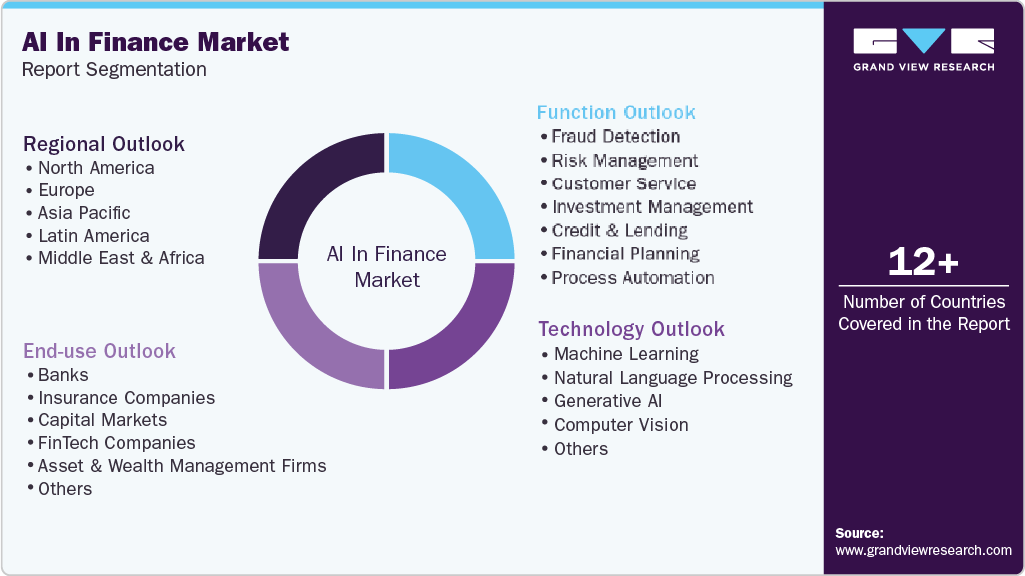
This report forecasts revenue growth at global, regional, and country levels and provides an analysis of the latest industry trends in each of the sub-segments from 2021 to 2033. For this study, Grand View Research has segmented the global AI in finance market report based on technology, function, end-use, and region:
 To learn more about this report, Download Free Sample Report
-
Technology Outlook (Revenue, USD Billion, 2021-2033)
-
Machine Learning
-
Natural Language Processing (NLP)
-
Generative AI
-
Computer Vision
-
Others
-
-
Function Outlook (Revenue, USD Billion, 2021-2033)
-
Fraud Detection
-
Risk Management
-
Customer Service
-
Investment Management
-
Credit & Lending
-
Financial Planning
-
Process Automation
-
-
End-use Outlook (Revenue, USD Billion, 2021 - 2033)
-
Banks
-
Insurance Companies
-
Capital Markets
-
FinTech Companies
-
Asset & Wealth Management Firms
-
Others
-
-
Regional Outlook (Revenue, USD Billion, 2021-2033)
-
North America
-
U.S.
-
Canada
-
Mexico
-
-
Europe
-
UK
-
Germany
-
France
-
-
Asia Pacific
-
China
-
Japan
-
India
-
South Korea
-
Australia
-
-
Latin America
-
Brazil
-
Middle East and Africa (MEA)
-
KSA
-
UAE
-
South Africa
-
-
Research Methodology
The AI in finance market figures in this report are based on a proven research process that combines executive interviews with secondary research from proprietary databases, company filings, and recognized regulatory and institutional sources. Market size is built through value-chain sizing—reconciling supply-side and demand-side estimates—and triangulated with bottom-up and top-down approaches. Every estimate passes multiple levels of expert validation before publication, with each AI in finance segment quantified using the revenue-capture definitions in the table below.
Segment Definition
Segment - Technology
Revenue Capture Definition
Machine Learning
Revenue generated from machine learning-based AI in finance solutions used to analyze financial data, identify patterns, detect anomalies, predict financial outcomes, assess creditworthiness, and support automated decision-making.
Natural Language Processing (NLP)
Revenue generated from NLP-based AI in finance solutions used to analyze financial documents, understand customer queries, process text-based information, support financial research, and automate communication and customer service.
Generative AI
Revenue generated from generative AI in finance solutions used to generate financial content, summarize documents, provide financial insights, support research, deliver personalized recommendations, and power intelligent assistants and AI agents.
Computer Vision
Revenue generated from computer vision-based AI in finance solutions used for document recognition, identity verification, cheque processing, image analysis, fraud detection, and automated processing of visual financial information.
Others
Revenue generated from other AI technologies used in finance, including predictive analytics, deep learning, speech recognition, recommendation systems, and AI-based decision-support solutions.
Segment - Function
Revenue Capture Definition
Fraud Detection
Revenue generated from AI-based fraud detection solutions used to identify fraudulent transactions, suspicious activities, payment fraud, identity fraud, and other financial threats through real-time monitoring and pattern analysis.
Risk Management
Revenue generated from AI-based risk management solutions used to assess, monitor, predict, and manage credit, market, operational, financial, and compliance risks.
Customer Service
Revenue generated from AI-based customer service solutions used for virtual assistants, automated customer support, personalized recommendations, natural-language interactions, and customer engagement.
Investment Management
Revenue generated from AI-based investment management solutions used for investment research, portfolio management, market analysis, asset allocation, trading insights, and investment decision-making.
Credit & Lending
Revenue generated from AI-based credit and lending solutions used for credit scoring, loan underwriting, borrower assessment, credit risk analysis, and automated lending decisions.
Financial Planning
Revenue generated from AI-based financial planning solutions used for budgeting, forecasting, wealth advisory, personalized recommendations, and financial decision support.
Process Automation
Revenue generated from AI-based process automation solutions used to automate document processing, reconciliation, reporting, payment processing, data entry, compliance workflows, and other repetitive financial operations.
Segment – End Use
Revenue Capture Definition
Banks
Revenue generated from AI in finance solutions adopted by retail, commercial, and investment banks for fraud detection, risk management, customer service, lending, investment management, financial planning, and process automation.
Insurance Companies
Revenue generated from AI in finance solutions adopted by insurance companies for underwriting, claims processing, fraud detection, risk assessment, pricing, customer service, and policy management.
Capital Markets
Revenue generated from AI in finance solutions adopted by capital market participants for investment research, trading, portfolio management, market analysis, risk management, compliance, and financial decision-making.
FinTech Companies
Revenue generated from AI in finance solutions adopted by FinTech companies for digital payments, lending, fraud detection, customer service, financial analytics, personalized services, and automated financial operations.
Asset & Wealth Management Firms
Revenue generated from AI in finance solutions adopted by asset and wealth management firms for portfolio optimization, investment research, wealth advisory, risk analysis, client engagement, and personalized investment recommendations.
Others
Revenue generated from AI in finance solutions adopted by other financial service providers and organizations for financial analysis, payments, accounting, compliance, customer engagement, and automated financial operations.
Estimation Model
Layer No.
Layer Name
Key Question
Description
01
End-user Industry Layer
Who creates demand for AI in Finance?
Identifies the total base of organizations generating demand for AI in Finance across end-use segments such as banks, insurance companies, capital markets, FinTech companies, asset & wealth management firms, and other financial service providers that require AI-powered solutions.
02
Adoption / Usage Layer
Who actively adopts AI in Finance?
Filters the addressable market based on digital transformation, increasing financial transaction volumes, demand for fraud detection, risk management, customer service, investment management, credit and lending, financial planning, process automation, and investments in AI technologies.
03
Technology & Infrastructure Layer
Which Technologies are deployed?
Estimates adoption across technologies including Machine Learning, Natural Language Processing (NLP), Generative AI, Computer Vision, and other AI technologies, supported by cloud, on-premise, and hybrid infrastructure for financial applications.
04
Revenue Capture Layer
How is revenue generated in the AI in Finance ecosystem?
Calculates revenue generated from AI software platforms, cloud-based AI services, fraud detection and risk management solutions, customer service applications, investment management, credit and lending solutions, financial planning, process automation, AI-powered financial assistants and agents, analytics, consulting, implementation, integration, maintenance, and managed AI services.
Delivered Customizations
This report has been delivered with the following In-depth customizations
Client Objective
Custom Research Modules Delivered
Strategic Value / Business Impact
Technology & Infrastructure Assessment
- Emerging AI in finance technology trend analysis
- AI infrastructure and innovation pipeline assessment
- Machine learning, Generative AI, NLP, and AI agent adoption assessment
- AI ecosystem and technology partner mapping
- Identified future AI technology opportunities
- Supported AI infrastructure investment planning
- Evaluated technology adoption readiness
- Strengthened ecosystem partnership decisions
Platform Positioning & Competitive Intelligence
- AI in finance platform and solution benchmarking
- Feature and capability comparison
- Pricing and value proposition analysis· Competitive strategy evaluation
- Improved platform differentiation strategy
- Supported pricing optimization
- Identified customer requirements and capability gaps
- Enhanced competitive positioning
Market Entry & Growth Assessment
- Regional market sizing and forecasting
- End-user segmentation and AI adoption analysis
- Competitive landscape benchmarking
- Regulatory and financial ecosystem assessment
- Identified high-growth regional opportunities
- Supported go-to-market strategy development
- Highlighted investment priorities and market risks
- Enabled data-driven expansion planning
Frequently Asked Questions About This Report
Key players include Amazon Web Services, Inc., FICO (Fair Isaac Corporation), Google LLC, IBM Corporation, Microsoft, NVIDIA Corporation, Oracle, Salesforce, Inc., SAS Institute Inc., and SAP SE
The global AI in finance market is expected to grow at a CAGR of 23.1% from 2026 to 2033 to reach USD 216.9 billion by 2033.
North America dominated the market, accounting for the largest revenue share of 37.3% in 2025.
Asia Pacific is the fastest-growing region over the forecast period.
Key factors that are driving the market growth include increasing digitalization, rising demand for automation, growing fraud and risk management needs, demand for personalized financial services, and the adoption of advanced AI technologies.
The machine learning segment led the AI in finance market and accounted for 35.9% of global revenue in 2025, while generative AI segment is the fastest-growing technology.
The fraud detection segment led with a 26.1% revenue share in 2025, while customer service is the fastest-growing segment.
The Banks segment led with a 45.3% revenue share in 2025, while FinTech companies is the fastest-growing segment.
The global AI in finance market size was valued at USD 39.5 billion in 2025 and is estimated at USD 50.6 billion in 2026.
About the Author(s)
Next Generation Technologies Research Team
Technology · Next Generation TechnologiesThis report was authored by the next generation technologies research team at Grand View Research - comprising two research analysts, one senior research analyst, and one industry expert - with specialized expertise in the next generation technologies segment of the technology industry. All findings are based on proprietary technology databases, executive interviews, and regulatory analysis, subject to internal peer review prior to publication.
Last Updated:
Speak to Analyst

Customize this report to your needs - add regions, segments, or data points, with 20% free customization.
Or view our licence options:


ISO 9001:2015 & 27001:2022 Certified
We are GDPR and CCPA compliant! Your transaction & personal information is safe and secure. For more details, please read our privacy policy.


