
- Home
- »
- Next Generation Technologies
- »
-
AI Language Translator Tool Market Size Report, 2026-2033GVR Report cover

AI Language Translator Tool Market (2026 - 2033)
Size, Share, & Trends Analysis Report By Translation Modality (Text & Document Translation, Image & Camera Translation), By Product (Cloud Translation APIs, Speech Translation Tools), By End Use, By Region, and Segment Forecasts
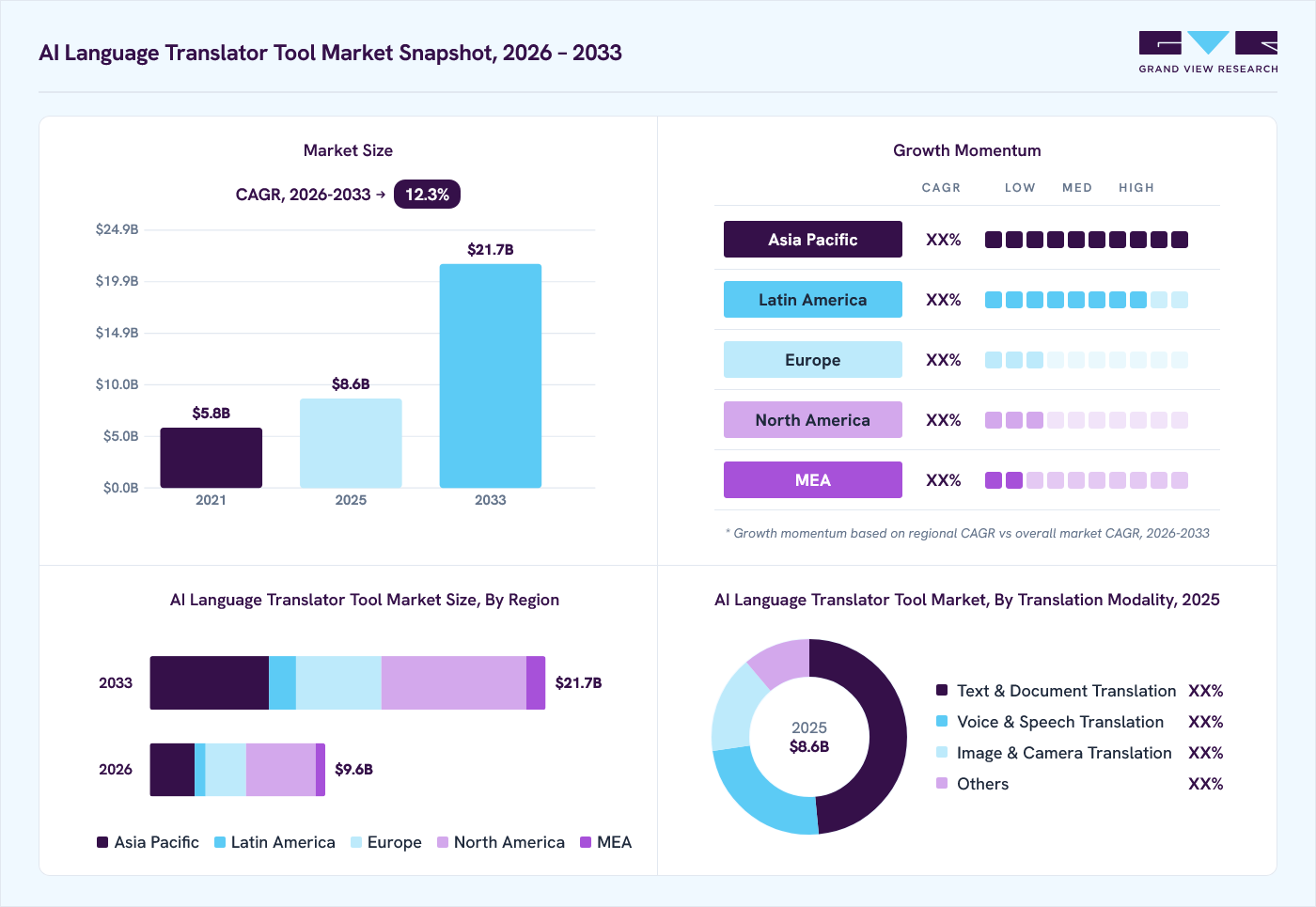
Market Size, 2025
$8.6BMarket Estimate, 2026
$9.6BMarket Forecast, 2033
$21.7BCAGR, 2026–2033
12.3%AI Language Translator Tool Market Summary
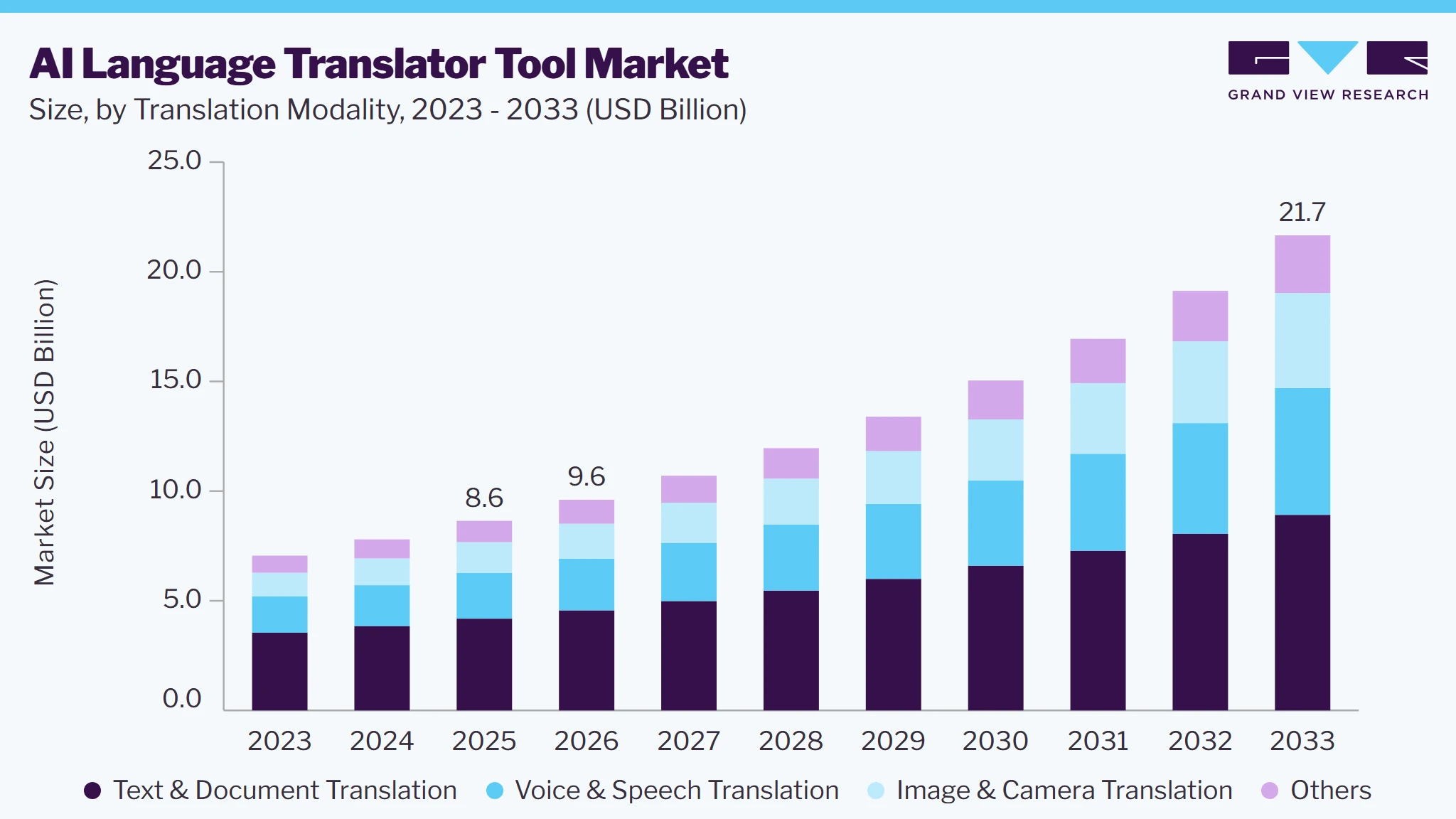
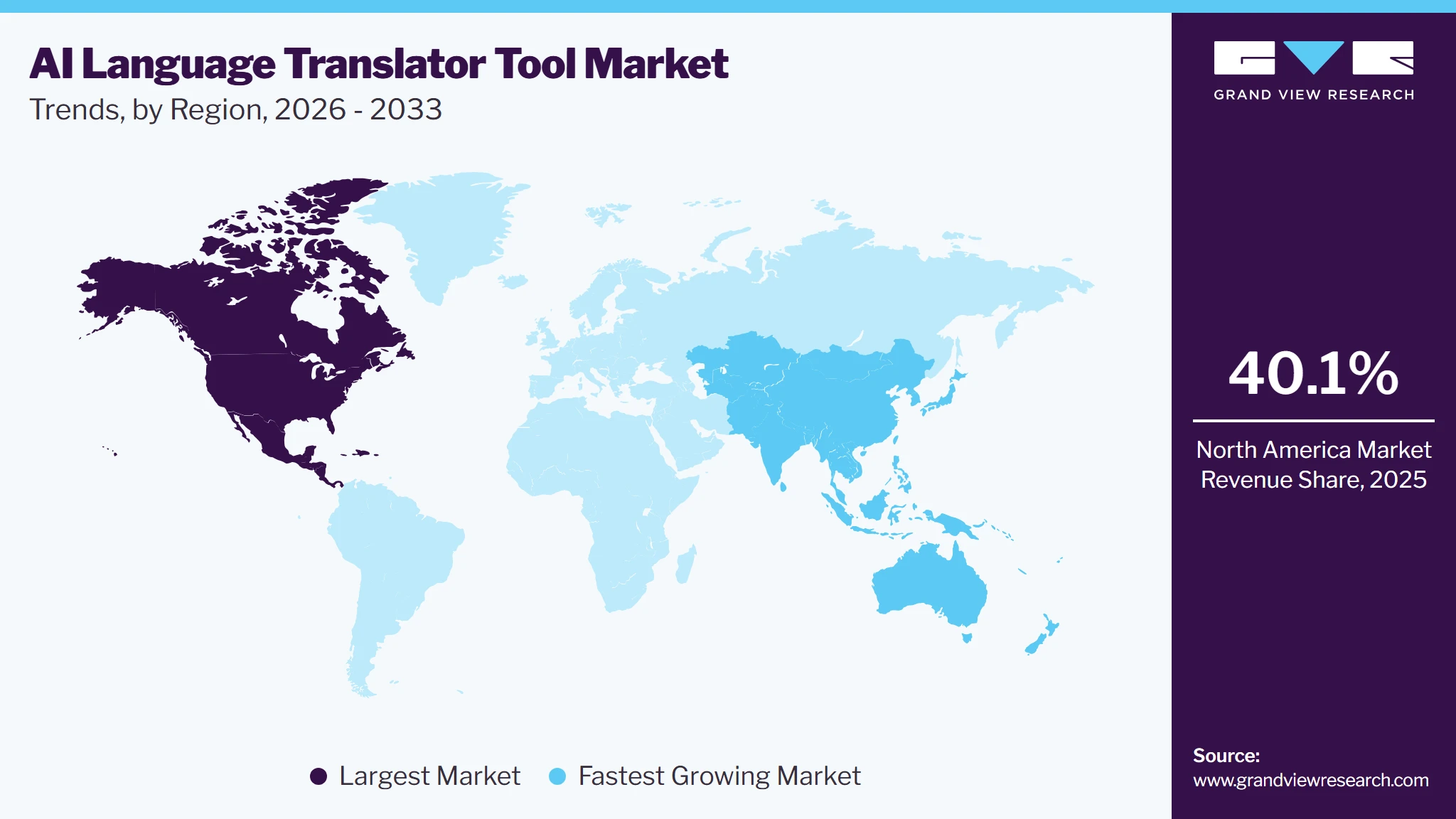
The global AI language translator tool market size was valued at USD 8.6 billion in 2025 and is projected to grow from USD 9.6 billion in 2026 to USD 21.7 billion by 2033, at a CAGR of 12.3% from 2026 to 2033. North America dominated the market, accounting for a revenue share of 40.1% in 2025. The global industry is growing as businesses increasingly adopt AI-powered translation solutions for multilingual communication on the back of advancements in neural machine translation and generative AI to enhance translation accuracy and contextual understanding. As translation quality improves, organizations are expanding the use of these solutions across business communication, customer support, and e-commerce.
 Source: Grand View Research, IR Documents, Primary Interviews, Paid DatabasesTo learn more about this report,
 Download Free Sample Report
 Key Market Trends & Insights
- By translation modality: Text & document translation segment held the largest market share of around 48.4% in 2025.
- By product: Cloud translation APIs segment held the largest market revenue share of 27.0% in 2025.
- By end use: Business communication segment led the market with the largest revenue share in 2025.
Regional Highlights
- Largest regional market: North America (40.1% revenue share, 2025)
- Fastest-growing regional market: Asia Pacific (highest CAGR, 2026-2033)
- Leading country: The U.S. held the largest share in 2025
Market Size & Forecasts
- Market size in 2025: USD 8.6 Billion
- Estimated market size in 2026: USD 9.6 Billion
- Projected market size by 2033: USD 21.7 Billion
- CAGR (2026-2033): 12.3%
Three ways to get this report
Buy it, customize it, or ask a question.Ask an Analyst
A direct answer, usually in 1 working day
- AccessReport author, directly
- Reply timeWithin 1 working day
- No sales callDirect answer only
- FormatEmail reply
- CostFree, no cost
Get the Full Report
What the study covers
- FormatsPDF · Excel · Dashboard
- Timeline2026–2033 annual, 2025 base
- Coverage20+ countries, 5 regions
- Companies10+ key players profiled
Customize the Report
20% free customization
- IncludeCountries, segments, points
- TailorTo your product definition
- ExtendDeeper competitor detail
- OrA fully bespoke study
- Turnaround5–10 working days
The AI language translator tool industry is growing as standalone AI-powered translation platforms continue to develop. These platforms are incorporating context-specific capabilities to improve the relevance and accuracy of translated content. The integration of customizable translation styles enables users to tailor outputs to specific communication requirements. Such capabilities are improving the usability of AI-powered translation solutions across diverse applications. Businesses are increasingly using these platforms to support multilingual communication across different channels. This expansion in use cases is contributing to the overall growth of the AI language translator tool market. Companies are launching translation platforms with these capabilities to meet evolving user needs. For instance, in January 2026, OpenAI launched ChatGPT Translate, a standalone translation service supporting more than 50 languages. The service offers options to adapt translations for contexts such as business-formal and academic communication, supporting the broader adoption of AI-powered translation solutions.
 To learn more about this report, Download Free Sample Report
 The market for AI language translator tool has gained ground with the increasing development of multilingual AI translation models. These models are expanding language coverage to support communication across diverse linguistic groups. Companies are also integrating multimodal capabilities to enable translation of text and image-based content. Such advancements are improving the accessibility and versatility of AI-powered translation solutions. The broader language coverage is supporting the adoption of translation technologies across international markets. For instance, in January 2026, Google LLC introduced TranslateGemma, a new family of open translation models supporting 55 languages and text within images. The models are designed to provide efficient, high-quality translation and can be deployed through platforms such as Vertex AI.
The increasing integration of real-time voice translation capabilities into AI-powered language solutions has boded well for companies expanding their portfolios. These capabilities support multilingual communication across business meetings, customer service, travel, and other real-time interactions. AI-powered voice translation is also improving the ability to facilitate conversations between users speaking different languages. The growing adoption of voice-based interfaces is driving demand for faster, more natural translation experiences. Improvements in speech recognition and AI processing are supporting more accurate real-time translations. These advancements are expanding the use of AI translation across applications that require immediate multilingual communication. As a result, real-time voice translation is contributing to the broader adoption of AI-powered language translator tools.
Market Dynamics
The AI language translator tool market is evolving with increasing focus on accuracy, speed, and seamless multilingual communication. Companies are developing advanced AI-powered solutions to address growing multilingual communication requirements across diverse applications. The rising demand for real-time and context-aware translation is encouraging continuous innovation. Market players are enhancing their solutions to support changing user requirements and expanding use cases.
The increasing use of digital platforms is driving communication across countries, languages, and geographic markets. Businesses are increasingly interacting with international customers, partners, and employees through online channels. The growth of e-commerce and digital services is further increasing the need for multilingual communication. Multilingual websites, social media platforms, and online customer support are creating additional demand for translation solutions. AI-powered language translator tools enable faster and more accessible translation across digital communication channels. These developments are supporting the adoption of AI language translator tools across global markets.
The expansion of remote work and international collaboration is further increasing cross-border digital communication. Companies are using video conferencing, messaging platforms, and collaboration tools to communicate with geographically distributed teams. Language differences can create communication challenges during meetings, customer interactions, and business exchanges. AI-powered translation capabilities are being integrated into digital communication tools to address these challenges. The availability of real-time and automated translation is improving communication efficiency across different languages. This growing reliance on digital communication is contributing to the expansion of the AI language translator tool market.
AI-powered language translator tools may face challenges in delivering accurate translations for complex sentences, technical terminology, and industry-specific content. Differences in grammar, sentence structure, and language patterns can affect the quality of translated output. Regional dialects, cultural references, and idiomatic expressions can further create difficulties for automated translation systems. These limitations may result in errors or loss of meaning during translation. As a result, users may require human review for professional, technical, or sensitive communications.
Contextual understanding remains another challenge for AI language translation solutions across diverse applications. The same word or phrase can have different meanings depending on the context, industry, or communication setting. AI translation systems may sometimes struggle to accurately interpret tone, intent, and culturally specific expressions. Such limitations can affect the reliability of translated content in business and other specialized applications. The need for manual correction can increase the time and effort required to complete translation tasks.
The integration of AI-powered translation capabilities into digital communication platforms is creating new opportunities for market participants. Businesses are increasingly using messaging, collaboration, and customer service platforms to communicate with users across different languages. Embedding translation features directly into these platforms can enable seamless multilingual communication without requiring separate applications. The growing adoption of cloud-based business software is further increasing demand for integrated translation capabilities. These developments are expanding the use of AI language translator tools across enterprise communication applications.
The growing use of e-commerce and digital service platforms is creating additional opportunities for integrated translation solutions. Businesses are using multilingual interfaces to engage customers across international markets and improve online interactions. Translation capabilities embedded within websites and applications can support product information, customer queries, and digital content. The integration of real-time translation into communication platforms can further improve accessibility for users speaking different languages. These developments are expected to create new growth opportunities for the AI language translator tool companies.
Market Concentration & Characteristics
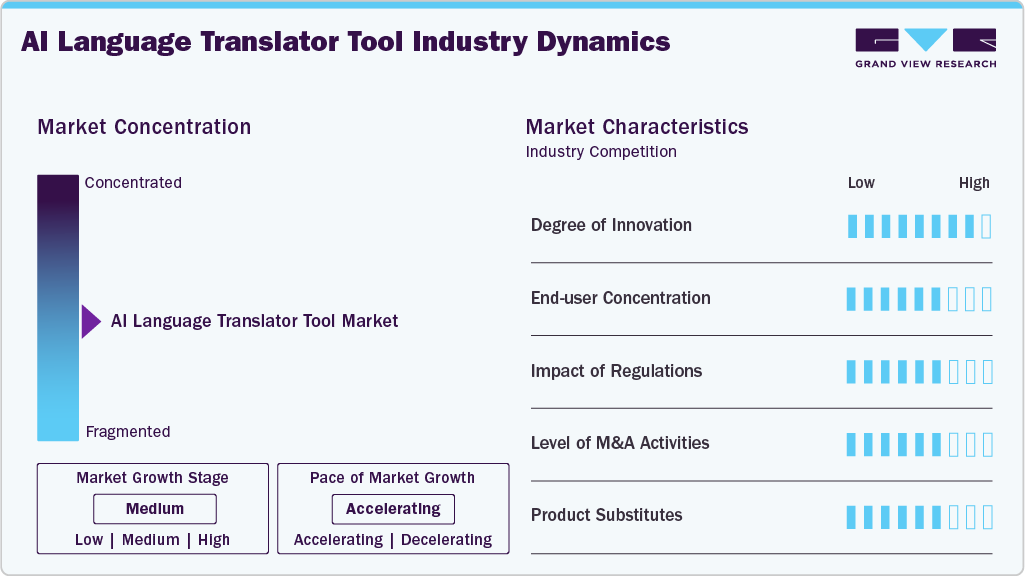
The AI language translator tool market is moderately fragmented, with the presence of global technology companies and specialized translation solution providers. Industry participants are offering solutions across consumer translation, enterprise software, cloud-based APIs, and speech translation applications. The market includes providers with broad technology capabilities as well as companies specializing in translation and language services. This diverse competitive landscape reflects the presence of players serving different user groups and application requirements.
 To learn more about this report, Download Free Sample Report
 Market participants are focusing on product development, platform integration, language support, and improvements in translation accuracy to strengthen their market presence. The growing demand for real-time, context-aware, and AI-powered translation is encouraging providers to expand their capabilities. Increasing integration with digital platforms is also creating opportunities for market participants across different applications. These developments contribute to a dynamic and moderately fragmented competitive landscape.
Analyst Perspective
The AI language translator tool market is entering a strong growth phase as businesses and consumers increasingly adopt AI-powered solutions for multilingual communication. Advancements in natural language processing, speech recognition, contextual understanding, and real-time translation are improving translation accuracy and user experience. Business communication, customer service, travel, education, and e-commerce are expected to remain key application areas. The market is expected to transition toward more real-time, context-aware, and integrated translation solutions as demand for seamless multilingual communication continues to expand.
Translation Modality Insights
The text & document translation segment led the market and accounted for 48.4% of the global revenue in 2025. The segment is widely used for translating documents, websites, emails, and other written content across languages. Businesses rely on text translation for international communication, documentation, and customer interactions. The growing volume of multilingual digital and business content is further driving demand in this segment. These applications are expected to maintain the segment's significant position in the AI language translator tool market.
The image & camera translation segment is growing as users increasingly seek convenient solutions for translating text captured through images. AI-powered camera translation enables users to translate signs, menus, documents, product labels, and other visual content. Improvements in optical character recognition and image processing are enhancing the accuracy and usability of these solutions. The growing use of smartphones and camera-enabled applications is further expanding adoption.
Product Insights
The cloud translation APIs segment dominated the AI language translator tool market share of 27.0% in 2025. Cloud APIs enable businesses and developers to integrate translation capabilities directly into websites, applications, and digital platforms. Their scalability and flexible deployment support translation across a wide range of business and consumer applications. The trend for cloud-based software and digital services has spurred the demand for translation APIs.
The speech translation tools segment is growing with the increasing demand for real-time voice-based multilingual communication. These tools enable users to translate spoken conversations across languages with minimal delay. Businesses are adopting speech translation for meetings, customer service, travel, and international interactions. They bank on these tools due to advancements in speech recognition and natural language processing that have improved the accuracy and responsiveness of these solutions.
End Use Insights
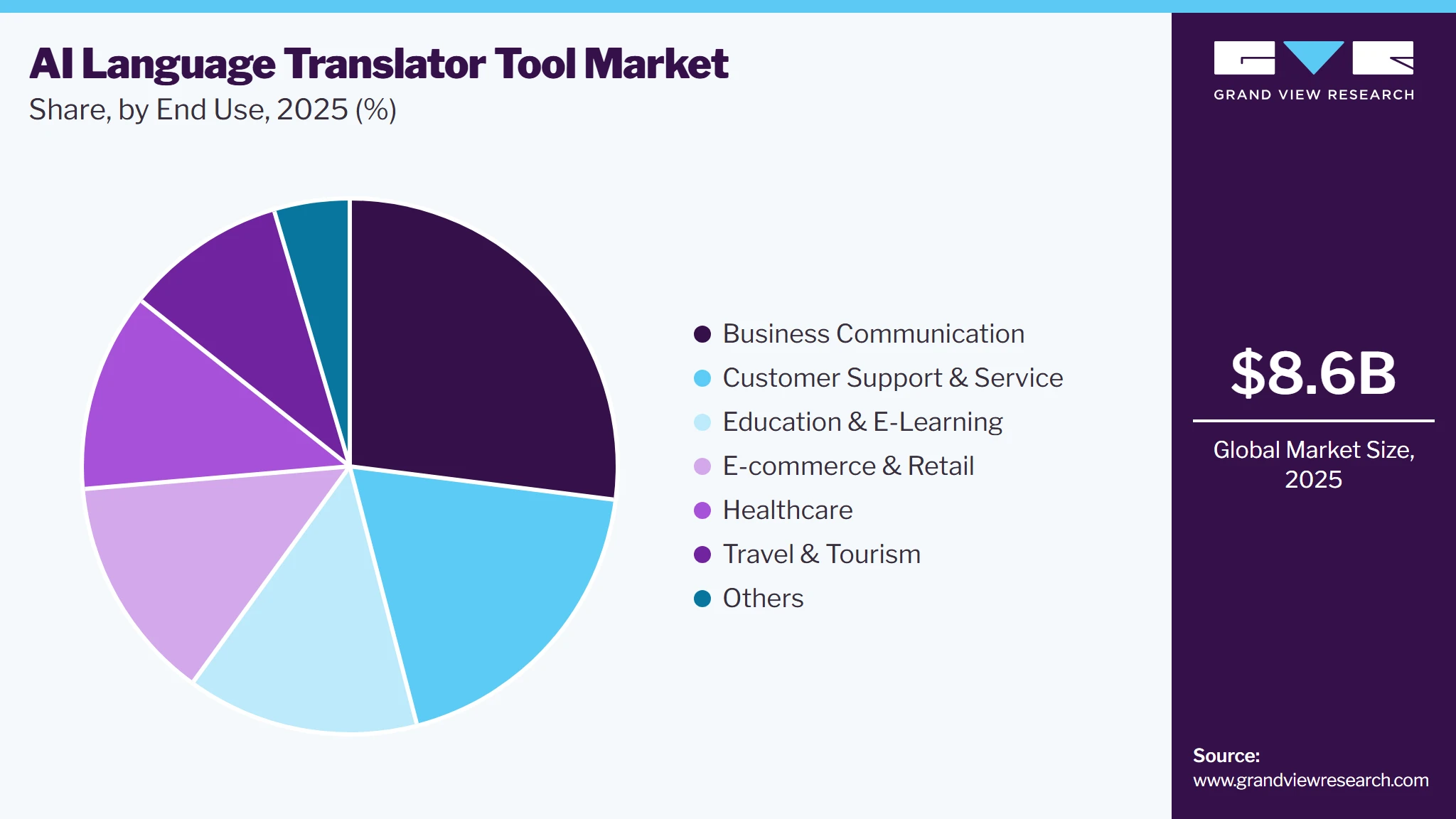
The business communication segment led the AI language translator tool market share of 27.0% in 2025. Businesses increasingly use AI translation tools to support communication with international clients, partners, and employees. These solutions help translate emails, documents, meetings, and other business communications across languages. The expansion of cross-border business activities is further increasing demand for multilingual communication solutions.
 To learn more about this report, Download Free Sample Report
 The e-commerce & retail segment is growing with the increasing expansion of online businesses across international markets. Retailers are using AI translation tools to localize product descriptions, websites, customer support, and other digital content. The growing adoption of cross-border e-commerce is increasing the need for multilingual customer interactions. AI-powered translation enables retailers to communicate with customers across different languages more efficiently.
Regional Insights
North America dominated the AI language translator tool market with 40.1% revenue share in 2025. The region benefits from the widespread adoption of advanced AI and language technologies across businesses and consumers. The presence of established technology infrastructure is supporting the deployment of AI-powered translation solutions. Growing demand for multilingual communication across business, customer service, and digital platforms is further supporting regional adoption.
 To learn more about this report, Download Free Sample Report
 U.S. AI Language Translator Tool Market Trends
The AI language translator tool market in the U.S. is supported by strong adoption of AI technologies across businesses and consumers. The growing need for multilingual communication is increasing the demand for automated translation solutions. Businesses are using these tools across customer service, e-commerce, education, and international communication as advancements in NLP and speech recognition continue to boost the capabilities of translation solutions.
Europe AI Language Translator Tool Market Trends
The AI language translator tool market in Europe is growing due to the region’s diverse linguistic environment. The presence of multiple languages across countries is increasing the need for efficient multilingual communication solutions. Businesses are adopting AI translation tools for cross-border operations, customer support, and digital content. Growing digitalization and advancements in AI technologies are further supporting regional adoption.
Asia Pacific AI Language Translator Tool Market Trends
The AI language translator tool market in the Asia Pacific is expected to exhibit the fastest CAGR over the forecast period as digital communication expands across diverse linguistic markets. The region's large and multilingual population is creating significant requirements for automated translation solutions. Businesses are increasingly adopting AI translation tools for e-commerce, customer service, education, and cross-border communication. Rising digitalization and continued investments in AI technologies are further supporting market development.
Key AI Language Translator Tool Company Insights
Key players operating in the AI language translator tool market include Alibaba Group Holding Limited; Amazon Web Services, Inc., and Baidu, Inc., among others.
-
Amazon Web Services, Inc. has developed Amazon Translate as a neural machine translation service for integrating multilingual translation into applications and digital services. The platform supports both real-time and batch translation for text and documents, enabling businesses to handle multilingual content at scale. It also provides customization features, including custom terminology, formality, brevity, and parallel-data-based translation. These capabilities support applications such as customer service, chat, email, websites, and other cross-lingual communication channels.
-
Baidu, Inc. has expanded its AI language capabilities through large language models, speech technologies, and machine translation solutions. Its AI platform provides large-model text and document translation capabilities, along with terminology customization and automatic source-language detection. Baidu has also expanded its end-to-end speech-language model capabilities to support more natural voice-based AI interactions. These developments are relevant to the growing use of AI-powered translation across text, document, and voice applications.
Key AI Language Translator Tool Companies
The following key companies have been profiled for this study on the AI language translator tool market.
-
Alibaba Group Holding Limited
-
Amazon Web Services, Inc.
-
Baidu, Inc.
-
DeepL SE
-
Google LLC
-
IBM Corporation
-
iFLYTEK Corporation
-
Microsoft
-
Tencent
Competitive Benchmarking
Operating Strategies
Competitive Edge
Weaknesses
Mature Players: Google LLC, Microsoft, Amazon Web Services, Inc.
- Focus on expanding AI-powered translation capabilities, increasing language coverage, integrating translation across digital platforms, developing real-time speech translation, and strengthening enterprise offerings.
- Strong global presence, extensive AI and cloud infrastructure, broad language capabilities, established customer relationships, and the ability to integrate translation into diverse applications.
- High operating and AI development costs, complex product portfolios, and challenges in maintaining consistent translation quality across less widely spoken languages and specialized industry content.
Emerging Players: DeepL SE, RWS Holdings plc, iFLYTEK Corporation
- Focus on improving translation accuracy, developing context-aware and real-time translation capabilities, expanding language coverage, strengthening enterprise solutions, and forming strategic partnerships.
- Specialized language AI expertise, faster product innovation, strong focus on translation quality, flexible solutions, and the ability to address specific enterprise and multilingual communication requirements.
- Limited global reach, smaller customer bases, relatively lower financial resources, and challenges in scaling infrastructure, language coverage, and enterprise adoption.
Recent Developments
- In March 2026,
RWS Holdings plc launched Language Weaver Pro, an enterprise-grade AI translation solution designed to deliver accurate, contextually fluent, and secure translations at scale. The solution is powered by a 100+ billion parameter model developed in collaboration with Cohere and is integrated across the Trados portfolio.
-
In July 2025, DeepL SE expanded its DeepL Voice solution with additional language support, including Mandarin Chinese, Ukrainian, and Romanian, along with translated captions in 35 languages. The company also introduced downloadable meeting transcripts and translations and announced an upcoming Zoom Meetings integration to support real-time multilingual communication.
-
In February 2025, Amazon Web Services, Inc. collaborated with DXC Technology to develop a scalable, near-real-time voice-to-voice translation prototype for Amazon Connect. The solution integrates speech recognition, machine translation, and text-to-speech technologies to enable multilingual conversations between contact-center agents and customers.
AI Language Translator Tool Market Report Scope
Report Attribute
Details
Market size in 2025
USD 8.6 billion
Estimated market size in 2026
USD 9.6 billion
Projected market size by 2033
USD 21.7 billion
Growth rate
CAGR of 12.3% from 2026 to 2033
Actual data
2021 - 2025
Forecast period
2026 - 2033
Quantitative units
Revenue in USD million/billion and CAGR from 2026 to 2033
Report coverage
Revenue forecast, company share, competitive landscape, growth factors, and trends
Segments covered
Translation modality, product, end use, region
Regional scope
North America; Europe; Asia Pacific; Latin America; Middle East and Africa
Country scope
U.S.; Canada; Mexico; UK; Germany; France; China; Japan; India; South Korea; Australia; Brazil; UAE; KSA; South Africa
Key companies profiled
Alibaba Group Holding Limited; Amazon Web Services, Inc.; Baidu, Inc.; DeepL SE; Google LLC; IBM Corporation; iFLYTEK Corporation; Microsoft; Tencent
Customization scope
Free report customization (equivalent to up to 8 analyst working days) with purchase. Addition or alteration to country, regional & segment scope.
Pricing and purchase options
Avail customized purchase options to meet your exact research needs.
Global AI Language Translator Tool Market Report Segmentation
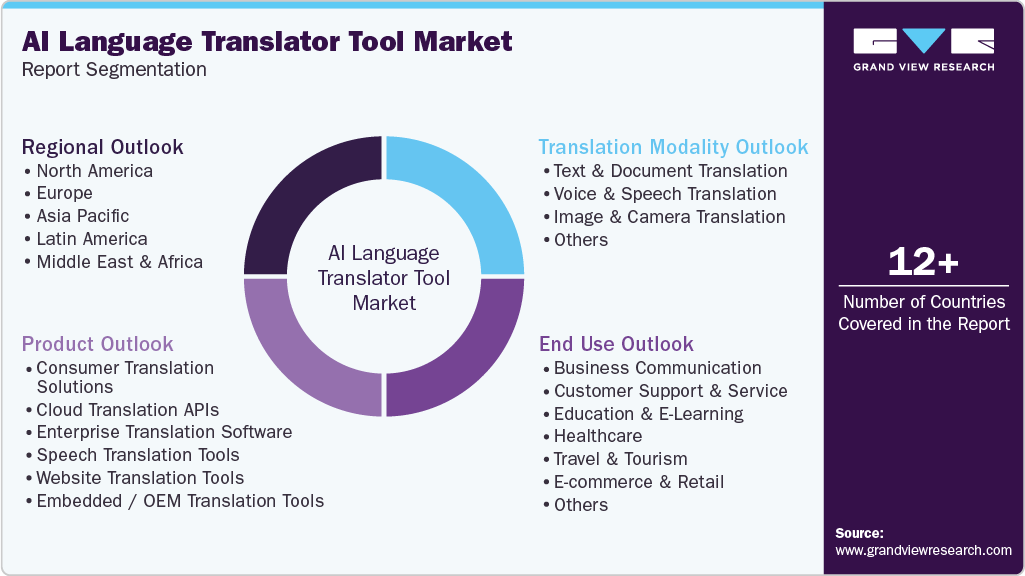
This report forecasts revenue growth at global, regional, and country levels and provides an analysis of the latest industry trends in each of the sub-segments from 2021 to 2033. For this study, Grand View Research has segmented the global AI language translator tool market report based on translation modality, product, end use, and region.
 To learn more about this report, Download Free Sample Report
 -
Translation Modality Outlook (Revenue, USD Billion, 2021 - 2033)
-
Text & Document Translation
-
Voice & Speech Translation
-
Image & Camera Translation
-
Others
-
-
Product Outlook (Revenue, USD Billion, 2021 - 2033)
-
Consumer Translation Solutions
-
Cloud Translation APIs
-
Enterprise Translation Software
-
Speech Translation Tools
-
Website Translation Tools
-
Embedded / OEM Translation Tools
-
-
End Use Outlook (Revenue, USD Billion, 2021 - 2033)
-
Business Communication
-
Customer Support & Service
-
Education & E-Learning
-
Healthcare
-
Travel & Tourism
-
E-commerce & Retail
-
Others
-
-
Regional Outlook (Revenue, USD Billion, 2021 - 2033)
-
North America
-
U.S.
-
Canada
-
Mexico
-
-
Europe
-
UK
-
Germany
-
France
-
-
Asia Pacific
-
China
-
Japan
-
India
-
South Korea
-
Australia
-
-
Latin America
-
Brazil
-
-
Middle East and Africa
-
UAE
-
KSA
-
South Africa
-
-
Research Methodology
The AI language translator tool marketfigures in this report are based on a proven research process that combines executive interviews with secondary research from proprietary databases, company filings, and recognized regulatory and institutional sources. Market size is built through value-chain sizing—reconciling supply-side and demand-side estimates—and triangulated with bottom-up and top-down approaches. Every estimate passes multiple levels of expert validation before publication, with eachAI language translator toolsegment quantified using the revenue-capture definitions in the table below.
Segment Definition
Translation Modality
Revenue Capture Definition
Text & Document Translation
Revenue generated from AI-powered translation of written text, documents, emails, web content, and other text-based materials through software, platforms, subscriptions, or usage-based services.
Voice & Speech Translation
Revenue generated from AI-powered translation of spoken language, including real-time conversations, meetings, calls, and other voice-based interactions through software, subscriptions, APIs, or usage-based services.
Image & Camera Translation
Revenue generated from AI-powered translation of text captured from images, photographs, camera feeds, signs, menus, and other visual content through applications, software, subscriptions, or usage-based services.
Others
Revenue generated from AI-powered translation modalities not covered under text, voice, or image-based translation, including multimodal and specialized translation applications.
Product
Revenue Capture Definition
Consumer Translation Solutions
Revenue generated from consumer-focused AI translation applications and services through subscriptions, premium features, in-app purchases, or other paid offerings.
Cloud Translation APIs
Revenue generated from providing cloud-based AI translation APIs to developers and businesses through usage-based pricing, subscriptions, or enterprise contracts.
Enterprise Translation Software
Revenue generated from AI-powered translation software designed for enterprise use through subscriptions, licensing, usage-based pricing, or customized enterprise contracts.
Speech Translation Tools
Revenue generated from AI-powered speech translation software and services through subscriptions, licensing, API usage, or enterprise contracts.
Website Translation Tools
Revenue generated from AI-powered solutions used to translate and localize websites and web content through subscriptions, usage-based pricing, or enterprise contracts.
Embedded / OEM Translation Tools
Revenue generated from licensing or integrating AI translation capabilities into third-party devices, applications, platforms, and other products through licensing fees, royalties, or usage-based agreements.
End Use
Revenue Capture Definition
Business Communication
Revenue generated from AI translation solutions used for internal and external business communication, including emails, meetings, documents, and cross-border collaboration.
Customer Support & Service
Revenue generated from AI translation solutions used to support multilingual customer interactions through contact centers, chat, voice, and other service channels.
Education & E-Learning
Revenue generated from AI translation solutions used by educational institutions, students, educators, and e-learning platforms for multilingual learning and communication.
Healthcare
Revenue generated from AI translation solutions used for multilingual communication among healthcare providers, patients, medical institutions, and related stakeholders.
Travel & Tourism
Revenue generated from AI translation solutions used by travelers, hotels, airlines, travel agencies, and tourism businesses for multilingual communication and services.
E-commerce & Retail
Revenue generated from AI translation solutions used to translate product information, websites, customer interactions, and other retail and e-commerce content across languages.
Others
Revenue generated from AI translation solutions used across other applications and industries not covered under the specified end-use segments.
Estimation Model
Layer Name
Key Question
Description
End-user Industry Layer
Who creates demand for AI language translator tools?
Identifies the total base of organizations and users generating demand for AI language translator tools across industries such as business services, education, healthcare, travel and tourism, e-commerce and retail, media and entertainment, government, and other sectors requiring multilingual communication.
Adoption / Usage Layer
Who actively adopts AI language translator tools?
Filters the addressable market based on cross-border communication, international business operations, digital content consumption, e-commerce expansion, multilingual customer support, remote collaboration, travel activity, and increasing demand for real-time and automated language translation.
Technology & Infrastructure Layer
Which technologies are deployed?
Estimates adoption across technologies including natural language processing, machine translation, speech recognition, text-to-speech, optical character recognition, large language models, cloud-based translation APIs, and multimodal translation technologies across cloud, on-premise, and hybrid environments.
Revenue Capture Layer
How is revenue generated in the AI language translator tool ecosystem?
Calculates revenue generated from consumer translation solutions, cloud translation APIs, enterprise translation software, speech translation tools, website translation solutions, embedded/OEM translation solutions, subscriptions, licensing, usage-based services, enterprise contracts, implementation, integration, and other translation-related services.
Delivered Customizations
Client Objective
Custom Research Modules Delivered
Strategic Value / Business Impact
Technology & Translation Capability Assessment
Emerging AI translation technology trend analysis
Translation technology innovation pipeline assessment
NLP, LLM, speech recognition, OCR, and multimodal translation adoption assessment
Ecosystem and technology partner mapping
Identified future translation technology opportunities· Supported technology investment planning
Evaluated technology adoption readiness· Strengthened technology partnership decisions
Platform Positioning & Competitive Intelligence
Translation platform and solution benchmarking
Language coverage, accuracy, and feature comparison
Pricing and value proposition analysis
Competitive strategy evaluation
Improved platform differentiation strategy
Supported pricing optimization
Identified customer requirements and capability gaps
- Enhanced competitive positioning
Market Entry & Growth Assessment
Regional market sizing and forecasting
End-use segmentation and adoption analysis
Product and translation modality assessment
Competitive landscape and regulatory environment assessment
Identified high-growth regional and application opportunities
Supported go-to-market strategy development
Highlighted investment priorities and market risks
Enabled data-driven expansion planning
Frequently Asked Questions About This Report
The global AI language translator tool market size was estimated at USD 8.6 billion in 2025 and is expected to reach USD 9.6 billion in 2026.
Asia Pacific is the fastest-growing region over the forecast period.
Some key players operating in the AI language translator tool market include Alibaba Group Holding Limited; Amazon Web Services, Inc.; Baidu, Inc.; DeepL SE; Google LLC; IBM Corporation; IBM Corporation; iFLYTEK Corporation; Microsoft; Tencent
Business communication segment led the market with the largest revenue share in 2025.
The cloud translation APIs segment led with a 27.0% revenue share in 2025 and speech translation tools segment is also the fastest-growing segment.
The global AI language translator tool market is expected to grow at a compound annual growth rate of 12.3% from 2026 to 2033 to reach USD 21.7 billion by 2033.
The text & document translation segment accounted for the largest market share of 48.4% in 2025, owing to the growing demand for accurate and efficient translation of business documents, reports, legal content, and other multilingual text-based materials.
North America dominated the AI language translator tool market with a share of 40.1% in 2025
The AI language translator tool market is driven by growing cross-border communication, rising demand for multilingual content, increasing AI adoption, and the need for faster and more accurate translation services.
About the Author(s)
Next Generation Technologies Research Team
Technology · Next Generation TechnologiesThis report was authored by the next generation technologies research team at Grand View Research - comprising two research analysts, one senior research analyst, and one industry expert - with specialized expertise in the next generation technologies segment of the technology industry. All findings are based on proprietary technology databases, executive interviews, and regulatory analysis, subject to internal peer review prior to publication.
Last Updated:
Speak to Analyst

Customize this report to your needs - add regions, segments, or data points, with 20% free customization.
Or view our licence options:


ISO 9001:2015 & 27001:2022 Certified
We are GDPR and CCPA compliant! Your transaction & personal information is safe and secure. For more details, please read our privacy policy.


