
- Home
- »
- Healthcare IT
- »
-
AI In Medical Scheduling Software Market Size Report, 2033GVR Report cover

AI In Medical Scheduling Software Market (2026 - 2033)
Size, Share & Trends Analysis Report By Product Type (Patient Scheduling, Care Provider Scheduling), By Deployment Model (Cloud-Based, On-Premises), By End Use, By Region, And Segment Forecasts
Market Size, 2025
$200.4MMarket Estimate, 2026
$252.6MMarket Forecast, 2033
$1,451.4MCAGR, 2026–2033
28.4%AI In Medical Scheduling Software Market Summary
The global AI in medical scheduling software market size was valued at USD 200.4 million in 2025 and is projected to grow from USD 252.6 million in 2026 to USD 1,451.4 million by 2033, at a CAGR of 28.4% from 2026 to 2033. North America dominated the market, accounting for a revenue share of 47.6% in 2025. The need for healthcare providers to improve staff allocation, reduce patient wait times, and increase operational efficiency is propelling the growth of AI in medical scheduling software markets.
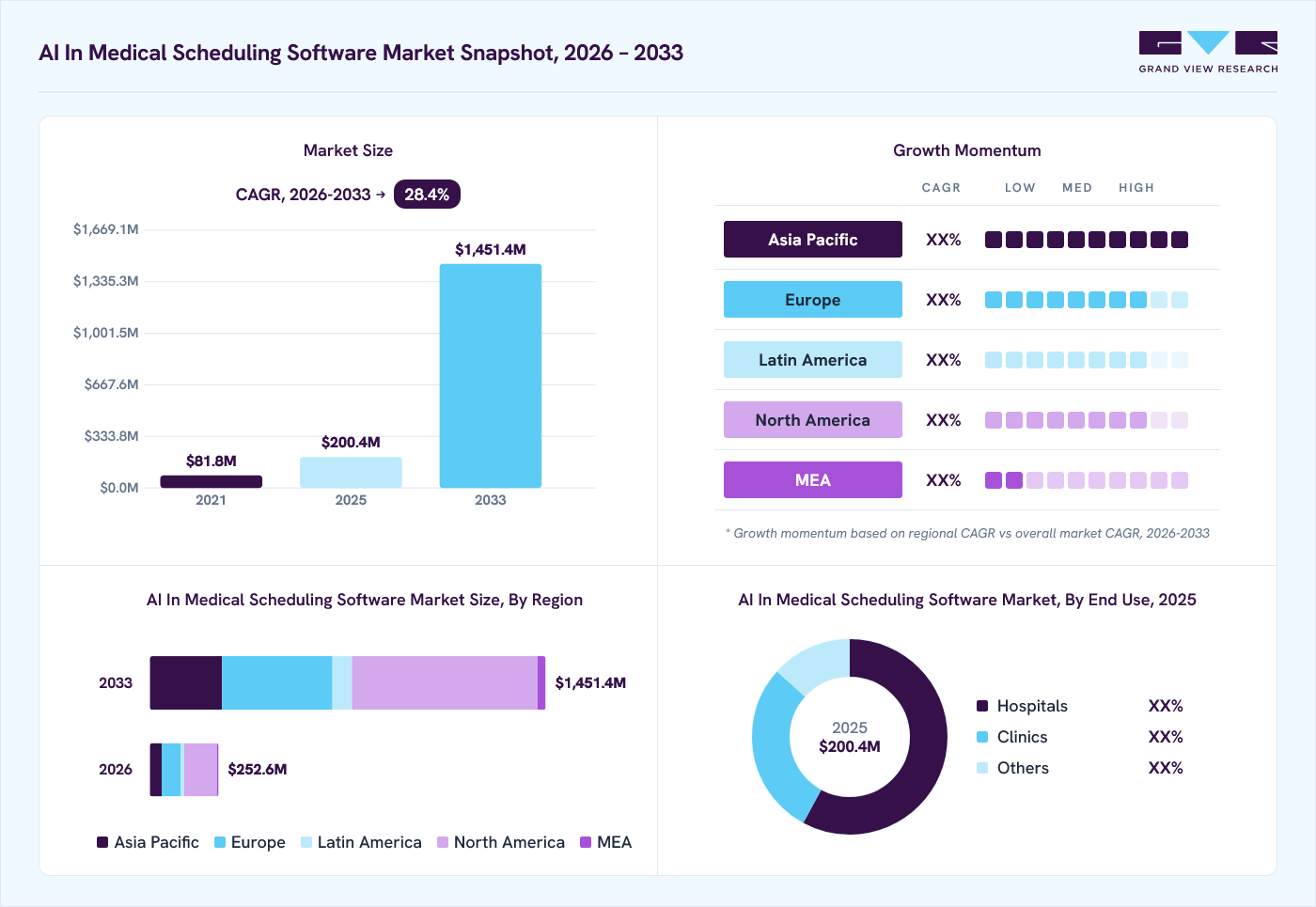 Source: Grand View Research, IR Documents, Primary Interviews, Paid DatabasesTo learn more about this report,
 Download Free Sample Report
 Key Market Trends & Insights
- By product type: Patient scheduling segment dominated the market, with a revenue share of 39.3% in 2025.
- By deployment model: Cloud-based segment held the largest market share of 84.6% in 2025.
- By end use: Hospital segment held the largest revenue share of 58.1% in 2025.
Regional Highlights
- Largest regional market: North America (47.6% revenue share, 2025)
- Fastest-growing regional market: Asia Pacific (highest CAGR, 2026-2033)
- By country: The U.S. held the largest market share in 2025.
Market Size & Forecast
- Market size in 2025: USD 200.4 Million
- Estimated Market Size in 2026: USD 252.6 Million
- Projected Market Size by 2033: USD 1,451.4Million
- CAGR (2026-2033): 28.4%
Three ways to get this report
Buy it, customize it, or ask a question.Ask an Analyst
Analyst response in 1 business day
- AccessReport author, directly
- Reply timeWithin 1 working day
- No sales callDirect answer only
- FormatEmail reply
- CostFree, no cost
Get the Full Report
What the study covers
- FormatsPDF · Excel · Dashboard
- Timeline2026–2033 annual, 2025 base
- Coverage20+ countries, 5 regions
- Companies10+ key players profiled
Customize the Report
20% free customization
- IncludeCountries, segments, points
- TailorTo your product definition
- ExtendDeeper competitor detail
- OrA fully bespoke study
- Turnaround5–10 working days
Predictive analytics can be used to accurately forecast patient no-shows and appointment congestion. To provide individualized appointment organizing and effective use of clinical resources, healthcare organizations are emphasizing workflow automation and better patient experiences.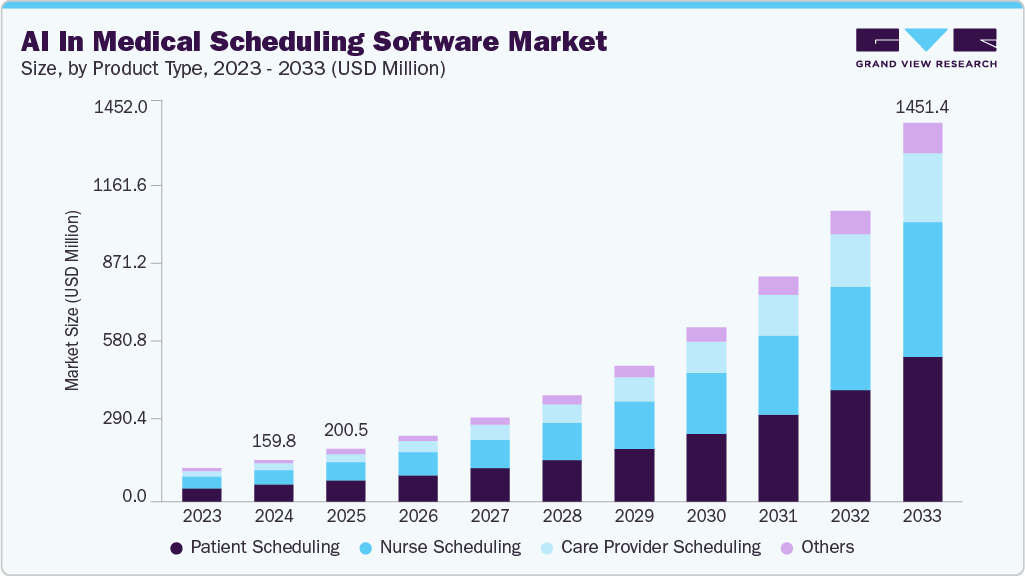 To learn more about this report, Download Free Sample Report
 Healthcare providers use AI-driven scheduling systems to increase staffing levels and operational effectiveness. These systems minimize booking conflicts, ease administrative burdens, and use clinical resources by automating appointment assignments and assigning up workloads between doctors and support personnel. Hospital and clinic operations grow more efficiently, enhancing patient flow and provider productivity. In January 2025, the growing use of the latest innovations to boost productivity and care is demonstrated by a University of Minnesota study that found 65% of U.S. hospitals are effectively utilizing artificial intelligence assisted predictive tools for appointment management.
Healthcare organizations use predictive analytics to forecast patient cancellations, no-shows, and appointment congestion. Artificial intelligence algorithms analyze past data and behavior patterns to identify potential appointment disruptions and prepare proactively. This capability reduces idle time, improves appointment adherence, and ensures more accurate planning of clinical services. In November 2023, Health Policy and Technology published a metanarrative review of AI in patient appointments, demonstrating that implementations vary, and it can optimize appointments, lessen provider workload, and increase satisfaction.
AI software reduces administrative workload and manual labor by automating processes. Improved satisfaction is a result of real-time updates, effective departmental coordination, and customized arrangements. Healthcare facilities benefit from improved operational control and service quality, while its users benefit from shorter wait times, prompt reminders, and flexible appointment completions. In March 2024, Bioengineering highlighted AI’s role in hospital operations, specifically showing how software optimizes staff allocation, appointments, and workflow efficiency, reducing bottlenecks and improving resource utilization.
Market Dynamics
The AI in medical scheduling software market is experiencing steady growth, driven by the increasing complexity of healthcare delivery systems, rising patient volumes, and the growing need for efficient resource optimization across hospitals, clinics, and diagnostic centers. AI-enabled scheduling solutions are widely utilized to automate appointment booking, reduce patient wait times, optimize physician calendars, and streamline coordination across departments such as outpatient care, emergency services, radiology, and specialty consultations. In March 2024, the use of AI to forecast patient no-shows in Saudi Arabian dental clinics was highlighted in an article published in Informatics in Medicine Unlocked. The growing adoption of digital health infrastructure, coupled with the rising demand for improved patient experience and operational efficiency, is significantly contributing to market expansion
The need for healthcare providers to improve staff allocation, reduce patient wait times, and increase operational efficiency is propelling the growth of AI in medical scheduling software markets. Healthcare providers use AI-driven scheduling systems to increase staffing levels and operational effectiveness. These systems minimize booking conflicts, ease administrative burdens, and use clinical resources by automating appointment assignments and assigning up workloads between doctors and support personnel.
Moreover, increasing emphasis on enhancing patient experience through digital engagement and convenience propels the growth of the AI in medical scheduling software industry. Patients increasingly expect seamless self-service options such as online booking and real-time rescheduling, similar to experiences in other consumer industries. AI scheduling systems facilitate this by offering patient-friendly portals and mobile applications with intelligent recommendations based on prior visits, treatment timelines, and provider availability. These solutions improve patient satisfaction, encourage adherence to follow-up care, and foster trust in healthcare providers. For instance, in May 2025, Epic Systems introduced a conversational AI tool that enables patients to schedule appointments via SMS without logging into a portal or waiting on hold. The AI assistant initiates scheduling conversations, offers appointment slots, confirms bookings, and provides MyChart links for details or virtual check-in.
"AI tools autonomously perform tasks such as summarizing information, interacting with patients, scheduling follow-ups, and more. These capabilities can improve the overall patient experience and streamline clinical workflows."
-Garrett Adams, Epic's vice president of research and development
One primary constraint affecting the AI in medical scheduling software market is the growing concern over data privacy and security. Digital health platforms collect sensitive personal information, including medical history, lifestyle habits, and fitness data. This information is highly sensitive and requires robust protection to prevent unauthorized access or breaches. Any breach or unauthorized access to this information can lead to serious consequences such as identity theft or misuse of personal data. In June 2024, concerns regarding privacy and data security in AI-driven healthcare systems were highlighted, as stakeholders emphasized the need for stringent safeguards to protect protected health information, despite widespread AI adoption aimed at improving workflows and clinical outcomes.
The deployment of multimodal AI platforms to improve surgical and operating room (OR) scheduling accuracy. Traditional hospital scheduling systems often rely on manual inputs, historical averages, and clinician judgment, which can lead to significant prediction errors, inefficient OR utilization, and increased operational costs. AI-powered platforms that integrate structured clinical data with unstructured physician notes can substantially enhance scheduling precision and resource allocation. In February 2026, Opmed, in collaboration with Mayo Clinic, demonstrated a multimodal AI scheduling platform that reduced cardiovascular surgical scheduling errors by nearly 50%, improving prediction accuracy, optimizing operating room utilization, and significantly lowering mean absolute error compared to traditional methods.
Case Study: AI-Powered Scheduling Optimization for Imaging Centers
Client Profile
A high-volume diagnostic imaging center faced increasing pressure on scheduling staff due to growing patient demand, protocol selection complexity, and manual coding requirements. The existing workflow relied heavily on staff expertise, creating bottlenecks and inconsistencies in appointment handling.
Challenges
- Manual identification of imaging protocols prolonged scheduling times.
- Staff frequently switched between scheduling and coding tasks, reducing efficiency.
- Scheduling errors occasionally resulted in patient rescheduling and delayed examinations.
- Rising call volumes created operational strain without proportional staffing increases.
Solution Implemented
CCD Health deployed Pax Fidelity, an AI-powered protocol identification solution designed to support schedulers during appointment booking. The platform automatically recommends appropriate imaging protocols based on examination requests, minimizing manual intervention and standardizing decision-making.
Key capabilities included:
- AI-driven protocol identification
- Automated coding assistance
- Scheduling workflow optimization
- Integration with existing appointment management systems
- Real-time decision support for scheduling teams.
Results Achieved (30-Day Evaluation Period)
KPI
Improvement
Calls Handled per Hour
+15.83%
Appointments Scheduled per Hour
+15.74%
Scheduling Accuracy
Improved
Administrative Burden
Reduced
Business Impact
The implementation demonstrated that AI-assisted scheduling can improve staff productivity while reducing operational friction. By automating protocol identification, the imaging center was able to accommodate higher patient volumes without increasing headcount, resulting in improved scheduling efficiency and enhanced patient access.
Key Market Trends
Trend
Overview
Market Impact
Shift from Rule-Based to AI-Driven Scheduling
Healthcare providers are adopting AI-powered scheduling assistants that can autonomously book, reschedule, cancel appointments, and route patients to the appropriate provider based on symptoms, urgency, and availability.
Reduces manual administrative burden, improves scheduling accuracy, and enhances patient access.
Integration with EHR and Practice Management Systems
AI scheduling platforms are increasingly integrating with electronic health record (EHR), revenue cycle management (RCM), and practice management systems to enable real-time provider availability, insurance verification, and appointment synchronization.
Streamlines workflows, reduces duplicate data entry, and enhances operational efficiency.
Expansion of Conversational AI and Virtual Scheduling Assistants
AI chatbots and voice-enabled assistants are being deployed to engage patients, answer queries, collect intake information, and schedule appointments in natural language.
Reduces call center dependence, supports multilingual patient populations, and improves patient satisfaction.
ROI-Driven Procurement Decisions
Buyers are increasingly evaluating AI scheduling solutions based on demonstrated outcomes such as reduced no-show rates, improved scheduling efficiency, increased appointment volumes, and labor cost savings.
Encourages vendors to provide measurable performance metrics and strengthens value-based purchasing decisions.
Emergence of Generative AI Capabilities
Vendors are incorporating generative AI to automate patient communication, summarize scheduling interactions, draft follow-up messages, and personalize appointment reminders.
Enhances patient engagement, reduces administrative tasks, and expands the scope of intelligent scheduling solutions.
Key Takeaway
The market is evolving from basic appointment management tools to intelligent patient access platforms, combining predictive analytics, conversational AI, generative AI, and interoperability capabilities to improve operational efficiency, optimize workforce utilization, and deliver a more consumer-centric healthcare experience.
Market Concentration & Characteristics
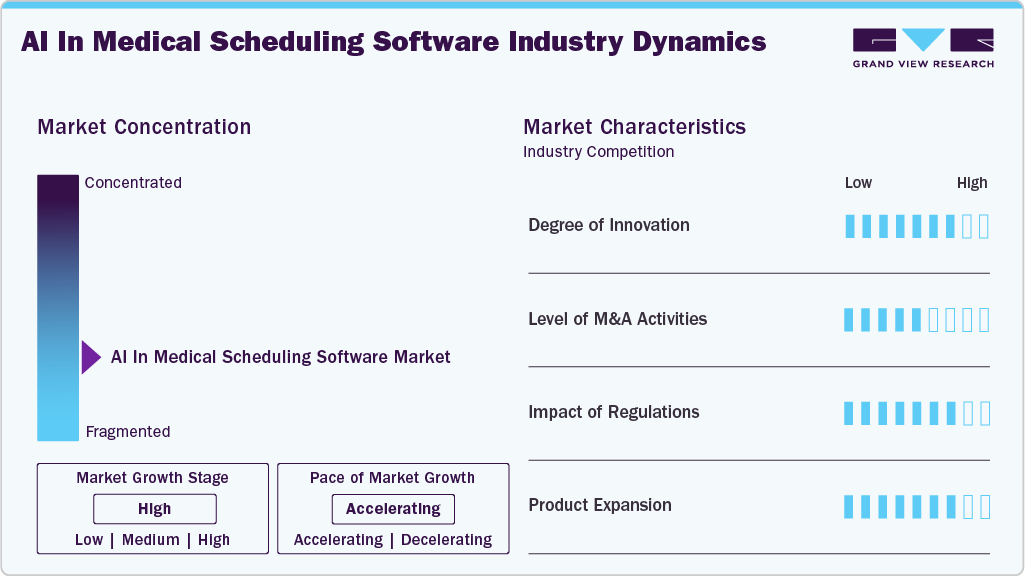
The chart below illustrates the relationship between industry concentration, industry characteristics, and industry participants. The x-axis represents the level of industry concentration, ranging from low to high. The y-axis represents various industry characteristics, including industry competition, level of partnerships & collaboration activities, degree of innovation, impact of regulations, and regional expansion. The AI in medical scheduling software market is fragmented, with several emerging players entering the market. The degree of innovation is high. The level of merger & acquisition activities is moderate. Moreover, the impact of regulations and the regional expansion of the industry is high.
Continuous innovation, with an emphasis on introducing new platforms and solutions that simplify administrative tasks, increase diagnostic accuracy, and improve care delivery, defines the AI in medical scheduling software industry. Industry leaders are combining cloud computing and predictive analytics with their current systems to provide effective, scalable, and intelligent solutions. These enhancements facilitate daily operations and provide more individualized care by allowing healthcare personnel to spend more time with patients and less time on paperwork.
 To learn more about this report, Download Free Sample Report
 The industry is undergoing a moderate amount of merger and acquisition activity, which is driven by the need to gain a competitive edge, consolidate market presence, and strengthen technological capabilities. Businesses integrate complementary technologies, increase product portfolios, and quicken market penetration through strategic acquisitions. These moves also allow companies to share expertise and resources, ultimately bringing more effective solutions to providers faster.
Regulations, such as HIPAA in the U.S. and GDPR in Europe, establish standards for safeguarding patient data privacy and security. Compliance with these regulations is essential for AI applications in healthcare, ensuring the safe handling of information and minimizing the risk of data breaches or unauthorized access. Adhering to these rules also helps build trust with medical service providers, encouraging wider adoption of artificial intelligence solutions.
The industry is growing considerably in terms of geography. Businesses are actively searching for methods to expand their regional reach and enter into emerging markets as a result of the digitization of health care systems and the rising demand for effective AI-enabled scheduling solutions. This expansion enhances flow and overall care delivery by giving providers in new areas access to advanced tools.
Analyst Perspective
The market is driven by various factors such as the increasing demand for healthcare operational efficiency, rising patient volumes, and growing adoption of digital health technologies across hospitals and clinics. The need to reduce appointment no-shows, optimize healthcare workforce utilization, and streamline patient scheduling processes is supporting market expansion. Furthermore, advancements in artificial intelligence, machine learning, predictive analytics, and conversational AI are enhancing scheduling accuracy, resource allocation, and patient engagement, driving broader adoption of AI-powered medical scheduling solutions across healthcare organizations.
Product Type Insights
Based on product type, the patient scheduling segment led the market with the largest revenue share of 39.3% in 2025. The increasing demand for effective appointment organizing solutions and shorter wait times is causing this dominance. Integrating artificial intelligence-powered predictive tools and electronic health records further encourages adoption.In March 2024, the use of AI to forecast patient no-shows in Saudi Arabian dental clinics was highlighted in an article published in Informatics in Medicine Unlocked. Machine learning models such as decision trees, random forests, and multilayer perceptrons are used to optimize appointment arrangements and minimize operational inefficiencies.
The care provider scheduling segment is projected to grow at the fastest CAGR during the forecast period. This growth is fueled by increasing demand for optimized staff allocation and workload management. Healthcare institutions are adopting solutions to improve provider efficiency and overall operational performance.In March 2025, According to a March 2025 Ochsner Journal article, an AI-driven appointment system that streamlined intraoperative transitions of care helped improve anesthesiologists’ work-life balance, lowered burnout rates, and increased patient safety.
Deployment Model Insights
Based on deployment model, the cloud-based segment led the market with the largest revenue share of 84.6% in 2025. Cloud solutions dominates the market due to their flexibility, scalability, and cost-effectiveness. Integration with existing healthcare IT systems and remote accessibility further support widespread adoption. Cloud-based platforms enable rapid updates, features, and analytics tools, which enhance operational efficiency and patient engagement across organizations. Growing demand for telehealth and remote monitoring also contributes to the strong uptake of cloud deployments.
The on-premise segment is anticipated to grow at a significant CAGR from 2025 to 2033.This growth is driven by medical service providers seeking greater control over data security and compliance. Organizations with complex IT infrastructures prefer on-premise solutions for customization and regulatory adherence.On-premise systems are favored by institutions managing sensitive patient data and high-volume clinical operations, where latency and network dependency are critical considerations. Investments in hybrid models and integration with AI-enabled decision-support tools further stimulate on-premise adoption.
End Use Insights
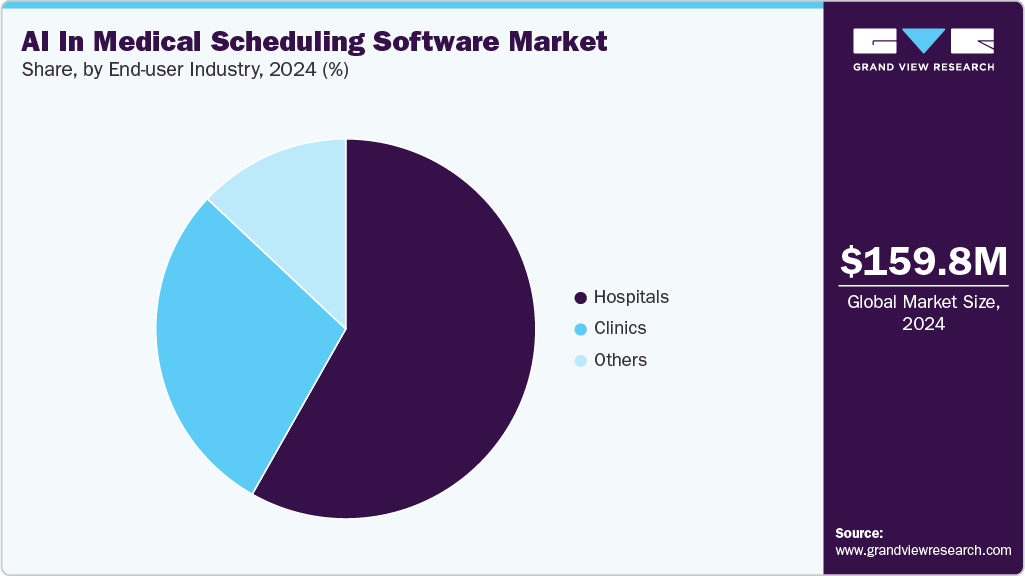
Based on end use, the hospital segment led the market with the largest revenue share of 58.1% in 2025. High patient volumes and the requirement for effective organization across several departments are the leading causes of its dominance. Hospitals are increasingly using AI-enabled solutions to improve care and streamline operations. Hospitals are further encouraged to use advanced software by the growing regulatory emphasis on prompt care and the integration of digital health records. Hospitals are investing in tools to optimize staff allocation and lessen administrative burden.
 To learn more about this report, Download Free Sample Report
 The clinics segment is anticipated to grow at the fastest CAGR from 2025 to 2033.The increased need for more efficient appointment scheduling and better patient care in outpatient settings is driving growth. Smaller healthcare facilities increasingly use them to optimize staffing levels and lessen administrative strain. Adoption is further aided by integration with remote monitoring and telehealth platforms. Clinics use AI analytics to increase overall operational efficiency by streamlining flow and reducing wait times.
Regional Insights
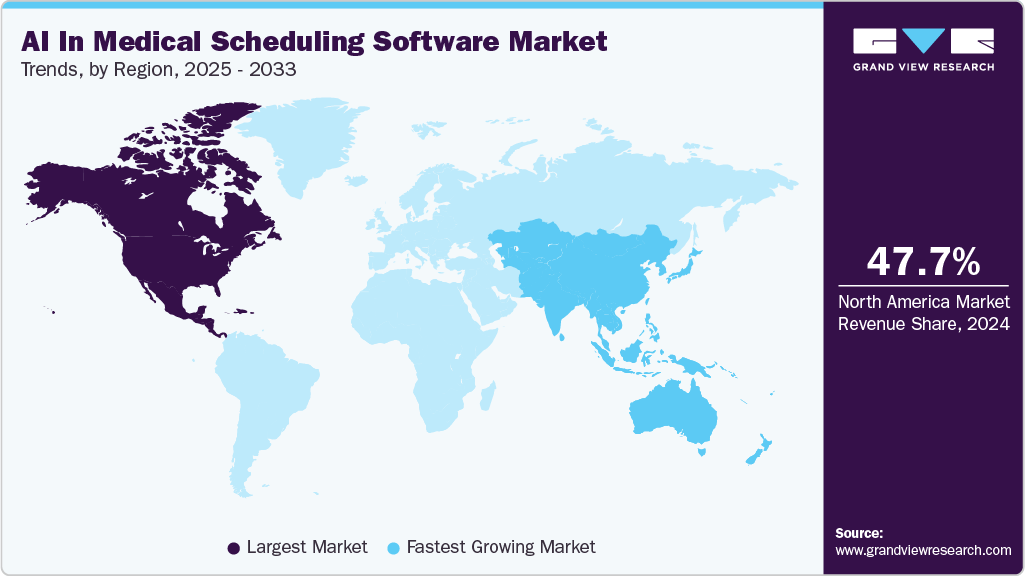
North America dominated the AI in medical scheduling software market with the largest revenue share of 47.6% in 2025. High adoption of advanced healthcare IT systems, extensive technology integration, and robust government support for digital health initiatives are among the key trends driving the market. Due to growing demands for effective arrangements, predictive analytics, and optimal staffing levels in clinics and hospitals, the U.S. leads the region in particular. In May 2025, Epic Systems Corporation introduced an AI-powered SMS appointment scheduling software that allows patients to book and confirm follow-ups, currently live in four organizations.
 To learn more about this report, Download Free Sample Report
 U.S. AI in Medical Scheduling Software Market Trends
The market in the U.S. held the largest share in the North America region in 2025. The availability of advanced technological infrastructure, increased investments in healthcare digitization, and a strong emphasis on patient experience are the primary drivers of growth. Artificial intelligence enabled solutions are being adopted by hospitals and large networks more frequently in an effort to lower operating costs and increase workflow efficiency. In January 2025, according to a report by Health Affairs, 51% of hospitals that predictive models did so specifically to make scheduling easier.
Europe AI in Medical Scheduling Software Market Trends
AI in medical scheduling software market in Europe is expected to witness a significant growth during the forecast period. The growing use of cloud-based platforms, growing awareness of artificial intelligence-driven solutions, and increasing government initiatives to modernize systems all contribute to this. Demand is driven by strategic investments in digital health technologies by nations such as the UK and Germany. In March 2023, the UK government showcased European investment trends and the potential for technology-driven workflow efficiencies in the market when it announced nearly USD 19.4 million in AI healthcare funding to speed diagnosis and increase efficiency.
The AI in medical scheduling software market in the UK is expected to grow over the forecast period, owing to strong NHS support for healthcare digitization, increasing patient demand for efficient appointment management, and rising adoption of technology-enabled solutions. In March 2024, NHS England expanded AI-driven software by Deep Medical across multiple trusts to reduce missed appointments and optimize staff time, following a pilot that cut non-attendances by 30% at Mid and South Essex NHS Foundation Trust. It predicts missed appointments, suggests rescheduling options, and implements backup bookings, improving patient access and efficiency.
Germany AI in medical scheduling software market is expected to grow significantly over the forecast period. This growth is attributed to robust infrastructure, growing investments in digital health solutions, and increasing need for operational efficiency in hospitals and specialty clinics. Integration with EHR systems and predictive analytics is gaining momentum in the region. In September 2025, a Nucamp article highlighted German healthcare providers reduce administrative burdens reducing admin costs by 22%, lowering inbound calls by up to 35%, and trimming documentation time by 10-20% through tools such as AI-powered appointment booking platforms, chatbots, and documentation support, freeing clinicians’ time for patient care.
Asia Pacific AI in Medical Scheduling Software Market Trends
Asia Pacific AI in medical scheduling software market is expected to grow at the fastest CAGR over the forecast period. Rising patient volumes, growing digitization, and government programs supporting the use of advanced technologies constitute all factors contributing to this growth. The market is also being driven by rising investments in smart hospital solutions and expanding infrastructure. In April 2025, according to a study in The Role of Artificial Intelligence in Modern Healthcare: Advances, Challenges, and Future Prospects, hospitals are using artificial intelligence for patient management, appointment scheduling, and workflow optimization, which reduces staff workload and missed appointments.
India AI in medical scheduling software market is witnessing increased demand, fueled by effective appointment management needs, digital healthcare adoption, and supportive government initiatives for smart hospitals. Market expansion is accelerated by private providers' investments, telemedicine adoption, and growing patient awareness. In March 2025, Apollo Hospitals reported plans to increase investment in AI tools to ease doctors’ and nurses’ workload by automating routine tasks such as medical documentation.
AI in medical scheduling software market in China is expected to grow rapidly over the forecast period. Growth is driven by national initiatives such as Healthy China 2030, promoting healthcare IT modernization, an aging population increasing demand for efficient clinical care, and rising adoption of workflow solutions in Chinese hospitals and clinics. In September 2025, according to a study published in Frontiers in Public Health, performance expectancy, cost, digital access, and competence affected use intentions for medical AI chat assistants in China. The study also noted that these chat assistants could be used in clinical workflows.
Latin America AI in Medical Scheduling Software Market Trends
Latin America AI in medical scheduling software market is anticipated to grow at a significant CAGR over the forecast period. Rising investments in digital infrastructure, growing cloud-based solution adoption, and increased hospital and clinic awareness of healthcare tools are the main drivers of this growth. In October 2022, Information reported on machine learning applications in Latin America showing how predictive models can reduce patient no-shows and improve medical appointment scheduling efficiency.
Middle East and Africa AI in Medical Scheduling Software Market Trends
Middle East and Africa AI in medical scheduling software market is expected to grow at a significant CAGR over the forecast period. The market's defining characteristics are growing demand for effective appointments in hospitals and specialty clinics, the digitization of medical systems, and the use of solutions to improve care. Predictive artificial intelligence can substantially enhance hospital operational efficiency and service quality, as evidenced by a study published in Healthcare in October 2024, which showed an AI-based appointment framework improved hospital capacity utilization by 6% and raised patient enrollment by 10% monthly.
Key AI in Medical Scheduling Software Company Insights
Key players operating in the AI in medical scheduling software market are undertaking various initiatives to strengthen their market presence and increase the reach of their products and services. Strategies such as new product launches and partnerships play a key role in propelling market growth.
Key AI in Medical Scheduling Software Companies:
The following are the leading companies in the AI in medical scheduling software market.
- Notable
- Hyro
- Voiceoc
- Veradigm LLC
- Clearwave Corporation
- Analog Informatics Corporation
- ScienceSoft USA Corporation
- Epic Systems Corporation
- CCD HEALTH A GEBBS HEALTHCARE COMPANY
- Zocdoc
- Qualifacts
- eClinicalWorks
Competitive Benchmarking
Category
Operating Strategies
Competitive Edge
Weakness
Established Players (e.g., Epic Systems Corporation, Veradigm LLC,)
- Expand AI-powered scheduling capabilities through product enhancements, cloud-based platforms, EHR integration, predictive analytics, and strategic partnerships with healthcare providers. Focus on improving appointment management, workforce scheduling, patient engagement, and operational efficiency.
- Strong brand recognition, large customer bases, extensive healthcare networks, integrated healthcare IT ecosystems, and significant R&D investments. Their established relationships with hospitals and clinics support rapid adoption and scalability across multiple healthcare settings.
- High implementation and maintenance costs, complex system integration requirements, lengthy sales cycles, and dependence on healthcare IT budgets. Large platform architectures may limit customization and agility for niche customer requirements.
Emerging and Specialized Players (e.g., Hyro, Voiceoc, Clearwave Corporation)
- Focus on AI-driven automation, conversational AI, patient self-scheduling, virtual assistants, workflow optimization, and specialized scheduling solutions. Emphasize cloud-native platforms, interoperability, and rapid deployment capabilities.
- Greater flexibility, faster innovation cycles, specialized AI expertise, and ability to address specific healthcare scheduling challenges. Their focused solutions often provide superior user experience, automation capabilities, and quicker implementation.
- Limited market presence, smaller customer bases, lower brand awareness, and constrained financial resources compared to established healthcare IT vendors. Dependence on partnerships, healthcare provider adoption, and regulatory compliance may restrict long-term expansion.
Recent Developments
-
In July 2025, Qualifacts, an EHR provider for behavioral health organizations, announced its upcoming iQ Agent tool to automate operational tasks such as appointment scheduling and revenue cycle management, reinforcing the growing role of AI in reducing administrative burden and enhancing scheduling efficiency.
-
In October 2024, eClinicalWorks introduced AI-powered solutions including healow Genie, an EHR-integrated contact center that manages appointments, predicts no-shows, and automates scheduling workflows, enhancing efficiency and patient access.
-
In March 2024, Zocdoc launched its Integration Partner Program for EHR and practice management vendors, enabling seamless real-time online patient scheduling and workflow integration. The program, joined by partners such as Elation and DrChrono, is designed to enhance provider growth, patient access, and scheduling efficiency across specialties.
AI in Medical Scheduling Software Market Report Scope
Report Attribute
Details
Market size in 2025
USD 200.4 million
Estimated market size in 2026
USD 252.6 million
Projected market size by 2033
USD 1,451.4 million
Growth rate
CAGR of 28.4% from 2026 to 2033
Historical data
2021 - 2025
Forecast period
2026 - 2033
Quantitative units
Revenue in USD million and CAGR from 2026 to 2033
Report coverage
Revenue forecast, company ranking, competitive landscape, growth factors, and trends
Segments covered
Product type, deployment model, end use, region
Regional scope
North America; Europe; Asia Pacific; Latin America; MEA
Country scope
U.S.; Canada; Mexico; Germany; UK; France; Italy; Spain; Norway; Denmark; Sweden; China; Japan; India; South Korea; Australia; Thailand; Brazil; Argentina; Saudi Arabia; South Africa; UAE; Kuwait
Key companies profiled
Notable; Hyro; Voiceoc; Veradigm LLC; Clearwave Corporation; Analog Informatics Corporation; ScienceSoft USA Corporation; Epic Systems Corporation; CCD HEALTH A GEBBS HEALTHCARE COMPANY; Zocdoc; Qualifacts; eClinicalWorks
Customization scope
Free report customization (equivalent up to 8 analysts' working days) with purchasse. Addition or alteration to country, regional & segment scope.
Pricing and purchase options
Avail customized purchase options to meet your exact research needs. Explore purchase options
Global AI in Medical Scheduling Software Market Report Segmentation
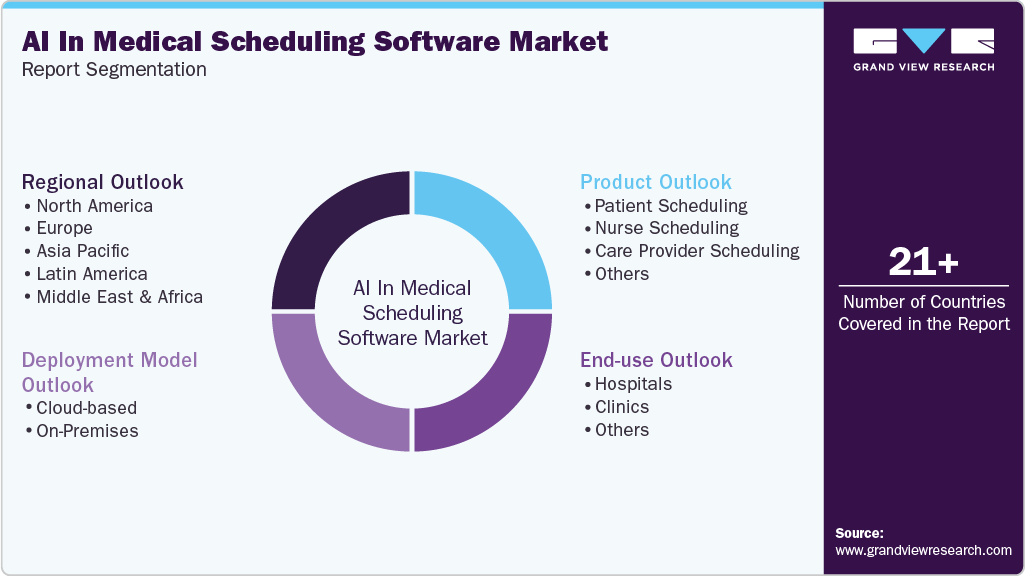
This report forecasts, revenue growth at global, regional, and country levels and provides an analysis of the latest industry trends in each of the sub-segments from 2021 to 2033. For this study, Grand View Research has segmented global AI in medical scheduling software market report based on product type, deployment model, end use, and region.
 To learn more about this report, Download Free Sample Report
 -
Product Type Outlook (Revenue, USD Million, 2021 - 2033)
-
Patient Scheduling
-
Nurse Scheduling
-
Care Provider Scheduling
-
Others
-
-
Deployment Model Outlook (Revenue, USD Million, 2021 - 2033)
-
Cloud-based
-
On-Premises
-
-
End Use Outlook (Revenue, USD Million, 2021 - 2033)
-
Hospitals
-
Clinics
-
Others
-
-
Regional Outlook (Revenue, USD Million, 2021 - 2033)
-
North America
-
U.S.
-
Canada
-
Mexico
-
-
Europe
-
Germany
-
UK
-
France
-
Italy
-
Spain
-
Denmark
-
Sweden
-
Norway
-
-
Asia Pacific
-
China
-
Japan
-
India
-
South Korea
-
Australia
-
Thailand
-
-
Latin America
-
Brazil
-
Argentina
-
-
MEA
-
South Africa
-
Saudi Arabia
-
UAE
-
Kuwait
-
-
Research Methodology
The AI in medical scheduling software market figures in this report are based on a proven research process that combines executive interviews with secondary research from proprietary databases, company filings, and recognized regulatory and institutional sources. Market size is built through value-chain sizing - reconciling supply-side and demand-side estimates - and triangulated with bottom-up and top-down approaches. Every estimate passes multiple levels of expert validation before publication, with each AI In medical scheduling software segment quantified using the revenue-capture definitions in the table below.
Segment Definition
Segment - Product Type
Revenue capture definition
Patient Scheduling
AI-powered software used to automate patient appointment booking, rescheduling, reminders, and waitlist management, improving access to care and reducing no-show rates.
Nurse Scheduling
Scheduling solutions that optimize nurse shift assignments based on staffing requirements, skill sets, availability, labor regulations, and patient care demands.
Care Provider Scheduling
Software is designed to manage and coordinate schedules for physicians, specialists, therapists, and other healthcare professionals, ensuring efficient resource utilization and appointment availability.
Others
Includes scheduling applications for operating rooms, diagnostic imaging, laboratory services, telehealth consultations, and administrative healthcare workflows.
Segment - Deployment Model
Revenue capture definition
Cloud-based
Scheduling software hosted on remote servers and accessed through the internet, offering scalability, real-time updates, remote accessibility, and lower infrastructure costs.
On-Premises
Scheduling software installed and operated on an organization's local servers and IT infrastructure, providing greater control over data management, customization, and security.
Segment - End Use
Revenue capture definition
Hospitals
Large healthcare facilities utilizing AI scheduling solutions to coordinate patient appointments, staff shifts, operating rooms, and clinical resources across multiple departments.
Clinics
Outpatient healthcare centers employing AI scheduling software to streamline appointment management, reduce administrative burden, and enhance patient experience.
Others
Includes ambulatory surgery centers, diagnostic laboratories, imaging centers, rehabilitation facilities, long-term care centers, and telehealth service providers using AI-driven scheduling systems.
Estimation Model
Section
Methodology
1.1 Research Approach
The study uses a hybrid research methodology combining secondary research (industry reports, healthcare IT publications, company reports, and regulatory sources) with primary interviews conducted with hospital administrators, healthcare IT professionals, physicians, and software vendors. Market estimates are based on healthcare workflow requirements, software adoption trends, pricing, and digital health infrastructure.
1.2 Market Estimation Framework
Market size is estimated using a triangulated framework integrating a Demand Model, ASP Revenue Model, and Vendor Revenue Validation Model. Final values are derived through reconciliation of all three approaches.
1.2.1 Demand Model
The demand model evaluates AI scheduling software adoption across patient scheduling, nurse scheduling, and care provider scheduling applications. Estimates are based on healthcare facility volumes, user adoption rates, and AI penetration levels.
1.2.2 ASP Model
The ASP model converts software adoption into revenue using average subscription fees, licensing costs, implementation charges, and deployment-based pricing structures.
1.2.3 Vendor Revenue Model
The vendor model validates market estimates through revenue analysis of AI scheduling software providers, deployment data, customer adoption trends, and partnership activities.
1.3 Forecast Development
Forecasts are developed based on healthcare digitalization, workforce shortages, increasing patient volumes, telehealth expansion, cloud adoption, and advancements in AI technologies.
1.4 Segmentation Method
Market segmentation is based on application, deployment model, end user adoption, pricing levels, and healthcare IT maturity across regions.
1.5 Scope & Assumptions
The study covers patient, nurse, and care provider scheduling solutions across hospitals and clinics. Market values are presented in USD, with both cloud-based and on-premises deployments included.
Delivered Customizations
This report has been delivered with the following In-depth customizations
Client Request
Customization Delivered
Value Adds
Volume Analysis by Graft Type
Developed a comprehensive assessment of AI-enabled scheduling workflows across patient scheduling, nurse scheduling, care provider scheduling, and telehealth appointment management. The study evaluates appointment volumes, scheduling efficiency, no-show rates, resource utilization, patient wait times, and adoption trends across healthcare settings.
Enables stakeholders to identify workflow bottlenecks, optimize appointment allocation, reduce administrative burden, improve healthcare resource utilization, and enhance patient access to care.
Patient Journey & Bone Graft Adoption Analysis
Developed a patient-centric assessment tracking the entire scheduling journey, from appointment booking and reminders to consultation, follow-up visits, and care coordination. The study incorporates patient preferences, provider availability, no-show behavior, scheduling accuracy, and engagement patterns.
Provides actionable insights for improving patient satisfaction, reducing missed appointments, enhancing provider productivity, optimizing care delivery, and strengthening patient retention strategies.
Advanced Bone Regeneration Technology Assessment
Conducted an in-depth evaluation of emerging AI scheduling technologies, including predictive scheduling, machine learning algorithms, conversational AI, virtual assistants, workforce optimization tools, and EHR-integrated scheduling platforms. The study benchmarks technology adoption, operational effectiveness, interoperability, and competitive positioning.
Helps stakeholders identify innovation opportunities, improve product differentiation, accelerate digital transformation initiatives, enhance operational efficiency, and strengthen long-term competitive positioning through advanced AI-driven scheduling capabilities.
Frequently Asked Questions About This Report
Based on product type, the patient scheduling segment led the market with the largest revenue share of 39.3% in 2025.
Based on deployment model, the cloud-based segment led the market with the largest revenue share of 84.6% in 2025.
Based on end use, the hospital segment led the market with the largest revenue share of 58.1% in 2025.
The global AI in medical scheduling software market size was valued at USD 200.4 million in 2025 and is estimated at USD 252.6 million for 2026.
The global AI in medical scheduling software market is expected to grow at a CAGR of 28.4% from 2026 to 2033, reaching USD 1,451.4 million by 2033.
The AI in medical scheduling software market is experiencing steady growth, driven by the increasing complexity of healthcare delivery systems, rising patient volumes, and the growing need for efficient resource optimization across hospitals, clinics, and diagnostic centers. AI-enabled scheduling solutions are widely utilized to automate appointment booking, reduce patient wait times, optimize physician calendars, and streamline coordination across departments such as outpatient care, emergency services, radiology, and specialty consultations.
North America dominated with a 47.6% revenue share in 2025.
Asia Pacific is the fastest-growing region over the forecast period.
About the Author(s)
Healthcare IT Research Team
Healthcare · Healthcare ITThis report was authored by the healthcare it research team at Grand View Research - comprising two research analysts, one senior research analyst, and one industry expert - with specialized expertise in the healthcare it segment of the healthcare industry. All findings are based on proprietary healthcare databases, executive interviews, and regulatory analysis, subject to internal peer review prior to publication.
Last Updated:
Speak to Analyst

Customize this report to your needs - add regions, segments, or data points, with 20% free customization.
Or view our licence options:


ISO 9001:2015 & 27001:2022 Certified
We are GDPR and CCPA compliant! Your transaction & personal information is safe and secure. For more details, please read our privacy policy.


