
- Home
- »
- Healthcare IT
- »
-
AI In Patient Scheduling Software Market Report, 2026-2033GVR Report cover

AI In Patient Scheduling Software Market (2026 - 2033)
Size, Share & Trends Analysis Report By Scheduling Type (Outpatient Scheduling, Specialty Care Scheduling), By Deployment Mode, By End Use, By Region, And Segment Forecasts
Market Size, 2025
$78.8MMarket Estimate, 2026
$99.0MMarket Forecast, 2033
$555.1MCAGR, 2026–2033
27.9%AI In Patient Scheduling Software Market Summary
The global AI in patient scheduling software market size was valued at USD 78.8 million in 2025 and is projected to grow from USD 99.0 million in 2026 to USD 555.1 million by 2033, at a CAGR of 27.9% from 2026 to 2033. North America dominated the market, accounting for a revenue share of 47.0% in 2025. Growing need to reduce administrative inefficiencies and improve healthcare resource utilization, rapid digital transformation across healthcare systems, and the rise of telehealth and value-based care models are some factors contributing to market growth.
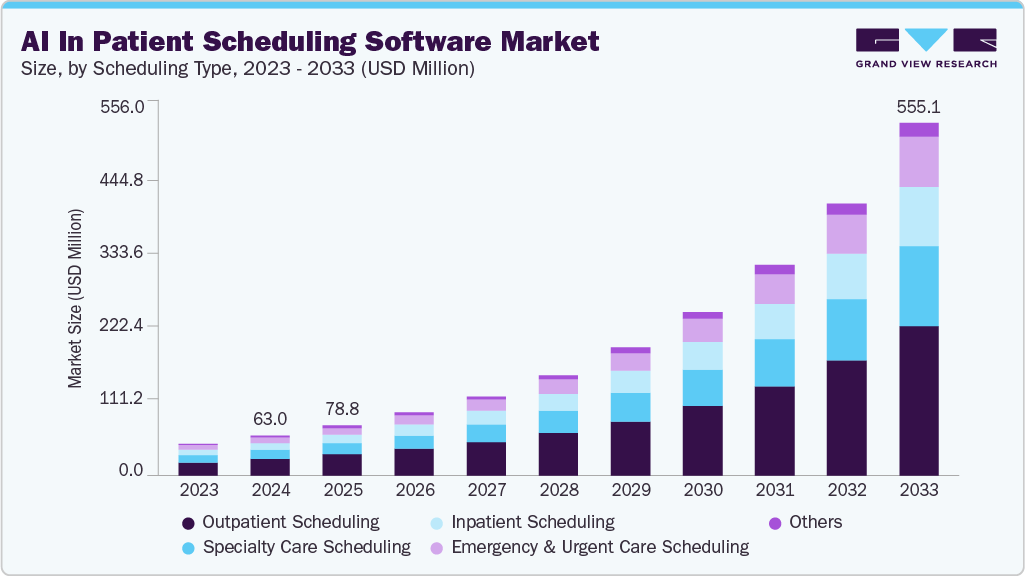 Source: Grand View Research, IR Documents, Primary Interviews, Paid DatabasesTo learn more about this report,
 Download Free Sample Report
 Key Market Trends & Insights
- By scheduling type: Outpatient scheduling segment dominated the market with a revenue share of over 43.0% in 2025.
- By deployment mode: Cloud-based segment held the largest revenue share of over 80.0% in 2025.
- By end use: Hospitals segment led the market in 2025, with a share of over 45.0%.
Regional Highlights
- Largest regional market: North America (47.0% revenue share, 2025)
- Fastest-growing regional market: Asia Pacific (highest CAGR, 2026-2033)
Market Size & Forecast
- Market size in 2025: USD 78.8 Million
- Estimated market size in 2026: USD 99.0 Million
- Projected market size by 2033: USD 555.1 Million
- CAGR (2026-2033): 27.9%
Three ways to get this report
Buy it, customize it, or ask a question.Ask an Analyst
Analyst response in 1 business day
- AccessReport author, directly
- Reply timeWithin 1 working day
- No sales callDirect answer only
- FormatEmail reply
- CostFree, no cost
Get the Full Report
What the study covers
- FormatsPDF · Excel · Dashboard
- Timeline2026–2033 annual, 2025 base
- Coverage20+ countries, 5 regions
- Companies10+ key players profiled
Customize the Report
20% free customization
- IncludeCountries, segments, points
- TailorTo your product definition
- ExtendDeeper competitor detail
- OrA fully bespoke study
- Turnaround5–10 working days
In addition, rising patient volumes, chronic disease burden, and increasing emphasis on patient-centric care and convenience contribute to market growth. Traditional manual scheduling systems often lead to bottlenecks, double bookings, and extended patient wait times. AI-powered platforms optimize appointment allocation by analyzing real-time provider availability, patient preferences, and clinical urgency. This results in higher operational efficiency, reduced no-show rates, and improved patient throughput. In addition, due to the rising patient volumes, healthcare providers are increasingly adopting AI scheduling systems to streamline workflows. For instance, in February 2025, Innovaccer introduced “Agents of Care,” a suite of AI agents for healthcare providers that automate low-value healthcare administrative tasks such as appointment scheduling, protocol intake, referral management, and patient inquiries.Moreover, increasing emphasis on enhancing patient experience through digital engagement and convenience propels the growth of the AI in patient scheduling software industry. Patients increasingly expect seamless self-service options such as online booking and real-time rescheduling, similar to experiences in other consumer industries. AI scheduling systems facilitate this by offering patient-friendly portals and mobile applications with intelligent recommendations based on prior visits, treatment timelines, and provider availability. These solutions improve patient satisfaction, encourage adherence to follow-up care, and foster trust in healthcare providers. For instance, in June 2026, TigerConnect announced launch of its new TigerConnect Scheduling and expansion of its platform, featuring AI-powered automation, and additional TigerConnect Smart Room, a touch-enabled digital whiteboard designed to enable hassle-free experience of collaboration between patients and care teams.
The rise of telehealth and value-based care models highlights the increasing use of AI in patient scheduling software. Virtual care platforms depend on intelligent scheduling systems to manage a high volume of digital appointments while coordinating providers across different geographies and time zones. Similarly, value-based care models necessitate precise scheduling to minimize delays in care, ensure timely interventions, and optimize patient outcomes. For instance, in July 2025, Rush University System for Health launched Rush Connect+, a national direct-to-consumer telehealth membership offering 24/7 virtual urgent care. The service includes access to a human assistant for scheduling appointments and answering questions, AI-powered chatbots, symptom checkers, and same-day specialty care in eight areas.
Market Concentration & Characteristics
The chart below illustrates the relationship between industry concentration, characteristics, and participants. The x-axis represents the level of industry concentration, ranging from low to high. The y-axis represents various industry characteristics, including industry competition, level of M&A activities, degree of innovation, impact of regulations, and regional expansion. The market is fragmented, with several emerging players entering the space. The degree of innovation is high. The level of merger & acquisition activities is moderate. Moreover, the impact of regulations and the regional expansion of the industry is high.
The AI in patient scheduling software market is experiencing high innovation owing to the rapid evolution of digital health technologies and the growing demand for more efficient patient scheduling platforms. Numerous players introduce new AI agents to optimize appointment scheduling and enhance administrative workflows. For instance, in May 2025, Zocdoc launched Zo, an AI phone assistant that instantly answers calls and autonomously manages appointment scheduling 24/7 using natural, conversational language.
The AI in patient scheduling software industry is experiencing a moderate level of merger and acquisition activities undertaken by several key players. This is due to the desire to gain a competitive advantage in the industry, enhance technological capabilities, and consolidate in a rapidly growing market.
Regulations, such as HIPAA in the U.S. and GDPR in Europe, establish standards for safeguarding patient data privacy and security. Compliance with these regulations is essential for AI applications in healthcare, ensuring the safe handling of information and minimizing the risk of data breaches or unauthorized access. Adhering to these rules also builds trust with medical service providers, encouraging wider adoption of artificial intelligence solutions.
Companies within the AI in patient scheduling software market seek geographic expansion strategies to maintain their foothold in emerging markets and attract customers from these regions. The industry is witnessing high geographical expansion, driven by an increasing customer base for AI-enabled appointment scheduling platforms. With the growing adoption of digital healthcare solutions, the market is expected to grow significantly in the coming years, especially in developing countries.
Case Study: Transforming Front Desk Efficiency with Conversational AI in a Small Outpatient Clinic
Introduction:
Small outpatient clinics often struggle with managing high volumes of patient scheduling calls and administrative tasks using limited staff. Manual scheduling results in long hold times, missed follow-ups, patient frustration, and decreased staff productivity. This case study highlights how one small clinic leveraged Curogram's AI-powered appointment booking solution to automate scheduling and improve operational efficiency and patient experience.
Challenges:
The clinic's front desk team was responsible for multiple tasks, including answering phones, coordinating appointments, and verifying insurance, with only a few staff members. Scheduling activities were often reactive and rushed, leading to extended patient wait times, frequent booking errors, and increased patient dissatisfaction. The limited staff capacity amplified difficulties in managing inbound calls, resulting in delayed responses and decreased clinic throughput.
Solution:
The clinic implemented Curogram's AI appointment booking system, allowing patients to schedule appointments via a website chatbot or SMS interface, available 24/7. The AI used natural language processing (NLP) to understand patient requests and matched patients to available slots based on provider availability and visit type. This automation enabled frontline staff to focus on in-person patients while AI efficiently handled routine scheduling tasks.
Results:
- Front desk staff could reallocate time from scheduling calls to supporting on-site patient care.
- Patients appreciated the ease of booking outside traditional office hours without long holds or multiple calls.
- Scheduling accuracy improved, reducing last-minute cancellations and double bookings.
- The automation notably enhanced productivity and patient satisfaction by streamlining appointment workflows.
This case exemplifies the potential of conversational AI solutions in small healthcare practices to alleviate administrative burdens, optimize scheduling accuracy, and elevate the patient experience.
Analyst Perspective
The AI in patient scheduling market is growing due to increasing patient volumes, healthcare workforce shortages, rising demand for convenient appointment access, and the need for efficient clinical resource utilization. Healthcare organizations are increasingly adopting AI-powered scheduling, predictive analytics, automated appointment management, and conversational AI to reduce scheduling errors, minimize wait times, and improve appointment utilization. However, data privacy concerns, EHR integration, costs, regulations, and AI decision reliability, advances in generative AI and automated communication open new opportunities for responsive, personalized healthcare access. Companies combining AI with scheduling workflows, real-time data, and secure communication are poised to benefit from market growth by enhancing efficiency, reducing missed appointments, and providing faster, more convenient care.
Scheduling Type Insights
The outpatient scheduling segment led the AI in patient scheduling software market with the largest revenue share of over 43.0% in 2025, due to the high volume and recurring nature of outpatient appointments across hospitals, clinics, and specialty centers. AI-enabled scheduling solutions offer automation of appointment booking, real-time slot optimization, and patient self-service portals. Moreover, integration with EHRs and patient portals further enhances workflow automation, enabling real-time adjustments based on provider availability and patient preferences. For instance, in February 2026, athenahealth announced the launch of the next generation of its AI-powered patient engagement suite within athenaOne, designed to streamline patient communications with the practice. The suite expansion includes novel capabilities, such as text and voice, that allow patients to connect with a virtual assistant at the doctor's office for various questions and to schedule appointments.
The specialty care scheduling segment is anticipated to grow at the fastest CAGR during the forecast period, due to the increasing complexity and unique requirements of specialty medical services. Specialty care involves diverse clinical workflows with variable appointment lengths, pre-visit preparations, and insurance verifications, demanding advanced scheduling capabilities that traditional systems cannot provide. AI-powered scheduling platforms can dynamically allocate appointments, predict cancellations, and optimize resource utilization, ensuring timely patient access and reduced operational bottlenecks. Increasing patient demand for specialty services and a shortage of specialized providers in many regions further drive the adoption of intelligent scheduling solutions.
Deployment Mode Insights
The cloud-based segment led the AI in patient scheduling software industry with the largest revenue share of over 80.0% in 2025, due to its scalability, flexibility, and ease of deployment across diverse healthcare settings. Cloud solutions enable multi-site integration, allowing hospitals, clinics, and specialty centers to manage appointments and resources from a centralized platform. These platforms support real-time updates, dynamic rescheduling, and predictive analytics without requiring extensive on-premises IT infrastructure. Cloud-based AI scheduling systems also facilitate seamless integration with EHRs, telehealth platforms, and patient portals, enhancing operational efficiency and patient engagement.
The on-premise segment is anticipated to grow at a significant CAGR from 2026 to 2033, driven by healthcare providers’ increasing preference for greater control over data security, privacy, and customization. Many healthcare organizations with stringent internal IT policies and regulatory compliance needs, especially in regions with strict data sovereignty laws, favor on-premises deployment to retain direct control over patient information and IT infrastructure. On-premises solutions provide robust security configurations tailored to specific organizational requirements, helping mitigate concerns over breaches and unauthorized access that are more prevalent in cloud environments.
End Use Insights
The hospitals segment led the market in 2025, with the largest revenue share of over 45.0%, due to the high patient volumes, complex workflows, and multi-department coordination inherent in hospital operations. Hospitals manage a wide range of services, including outpatient consultations, inpatient admissions, diagnostic procedures, and specialty care, creating substantial demand for AI-enabled scheduling solutions. These platforms optimize appointment allocation, reduce wait times, and minimize no-shows, directly improving operational efficiency and resource utilization. Moreover, integration with EHRs, patient portals, and internal management systems allows hospitals to streamline workflows across multiple departments and locations.
The clinics segment is anticipated to grow at the fastest CAGR from 2026 to 2033, due to increasing demand for efficient appointment management in small and medium-sized healthcare settings. Clinics face challenges such as staffing shortages, increasing patient volumes, and limited operational resources, making manual scheduling inefficient and error-prone. AI-powered scheduling solutions automate appointment bookings, send reminders, and manage cancellations, reducing administrative burden and enhancing operational productivity.
Regional Insights
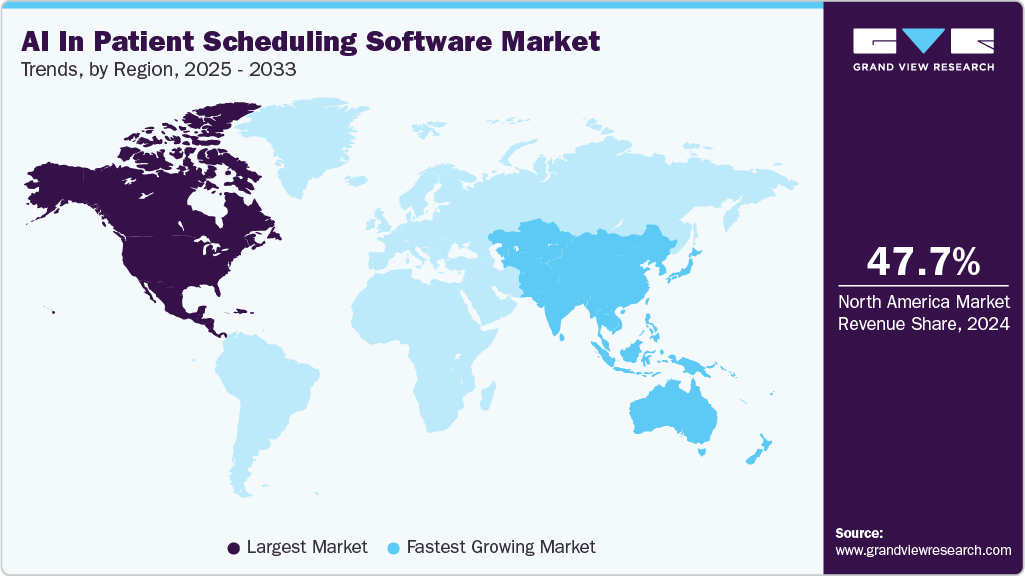
The North America AI in patient scheduling software market accounted for the largest revenue share of 47.0% in 2025. This can be attributed to the region’s advanced healthcare infrastructure, high patient volumes, and strong push for digital transformation. U.S. healthcare providers face significant challenges managing appointment backlogs and no-shows, particularly in large hospital networks. Demand is also rising in Canada as healthcare systems emphasize efficiency and patient-centered care within resource-constrained public systems. Growing investment in healthcare IT and a strong presence of AI innovators further accelerate adoption in the region.
 To learn more about this report, Download Free Sample Report
 U.S. AI In Patient Scheduling Software Market Trends
The U.S. AI in patient scheduling software industry held the largest revenue share in 2025, attributed to the rising healthcare costs and the need for operational efficiency. In addition, value-based care initiatives and reimbursement pressures incentivize hospitals to adopt AI solutions to improve outcomes while reducing costs. Large hospital networks and specialty care centers are increasingly investing in predictive analytics for scheduling. The presence of advanced healthcare IT infrastructure accelerates implementation and innovation in AI scheduling systems.
Europe AI In Patient Scheduling Software Market Trends
The Europe AI in patient scheduling software industry is expected to witness significant growth during the forecast period. European healthcare systems are adopting AI-driven patient scheduling to address chronic staff shortages, long wait times, and increasing patient demands. Moreover, the rising patient demand for mobile-friendly, automated scheduling drives healthcare providers to deploy AI-powered tools that improve operational efficiency and patient satisfaction while supporting multilingual capabilities to serve diverse populations.
The UK AI in patient scheduling software market is expected to grow over the forecast period, owing to strong NHS support for healthcare digitization, increasing patient demand for efficient appointment management, and rising adoption of technology-enabled solutions. Furthermore, integrating AI with telemedicine and NHS electronic records facilitates streamlined patient pathways across primary and secondary care. Investments under the NHS Long Term Plan focus on scalable AI solutions to ensure timely access to care, reduce no-shows, and improve operational resilience.
The AI patient scheduling software market in Germany benefits from advanced healthcare infrastructure and strong government support for digital health initiatives. The German healthcare system emphasizes improving patient access while reducing wait times, driving investment in intelligent scheduling solutions. AI platforms fostering interoperability between providers, optimizing appointment slots, and incorporating multi-language support cater to a diverse population.
Asia Pacific AI In Patient Scheduling Software Market Trends
The Asia Pacific AI in patient scheduling software industry is expected to grow at the fastest CAGR in the coming years. This rapid growth is fueled by expanding healthcare infrastructure, rising internet penetration, and increased digital literacy. Governments actively promote digital health integration, exemplified by initiatives such as India’s Ayushman Bharat Digital Mission, which is accelerating technology adoption in healthcare facilities. The surge in smartphone usage and telemedicine adoption expands demand for AI-based patient scheduling solutions that offer flexibility and accessibility in remote and densely populated areas.
India AI in patient scheduling software market is expected to grow over the forecast period. This growth is propelled by expanding healthcare infrastructure, rising smartphone penetration, and government digital health initiatives such as the Ayushman Bharat Digital Mission (ABDM). AI-driven scheduling platforms offer affordable, scalable solutions to manage high patient volumes and diverse linguistic requirements. Moreover, increasing adoption of telehealth and mobile applications enhances accessibility for rural and urban populations.
The AI in patient scheduling software market in Japan is expected to grow rapidly over the forecast period. Japan’s aging population and high prevalence of chronic diseases are major drivers for AI-enabled patient scheduling. Hospitals and specialty clinics require efficient appointment management to optimize provider availability and reduce wait times. For instance, in May 2025, EUCALIA Inc. and Hippocratic AI partnered to launch Japan's first non-diagnostic, patient-facing Japanese generative AI healthcare agent targeting time-consuming clinical tasks such as appointment scheduling, follow-ups, chronic care check-ins, and medication adherence support. Moreover, telehealth adoption and multi-location coordination increase demand for intelligent scheduling solutions.
Latin America AI In Patient Scheduling Software Market Trends
The Latin America AI patient scheduling industry’s growth is supported by the ongoing digital health modernization and increasing healthcare service demand amid resource constraints. Governments invest in healthcare IT infrastructure to improve service delivery, streamline patient flow, and reduce operational inefficiencies. The rising prevalence of chronic diseases necessitates efficient appointment management systems to handle growing patient loads. Furthermore, mobile health adoption and telehealth services expand access to care, driving the need for AI-driven, cloud-based scheduling platforms that enable real-time booking, reminders, and resource optimization. These trends collectively propel market expansion across the region.
Middle East and Africa AI In Patient Scheduling Software Market Trends
The Middle East and Africa AI in patient scheduling software industry is expected to grow at a significant CAGR over the forecast period. AI adoption in regulatory affairs across the Middle East and Africa is supported by the modernization of healthcare systems and rising clinical research activity. Countries are increasingly adopting digital platforms to improve transparency in regulatory processes. Regional investments in eHealth and smart infrastructure support AI-enabled regulatory operations.
Key AI In Patient Scheduling Software Market Company Insights
Key players operating in the market are undertaking various initiatives to strengthen their market presence and increase the reach of their products and services. Strategies such as new product launches and partnerships play a key role in propelling market growth.
Key AI In Patient Scheduling Software Companies
The following are the leading companies in the AI in patient scheduling software market. These companies collectively hold the largest market share and dictate industry trends.
-
Assort Health
-
Epic Systems Corporation
-
Hyro
-
Notable
-
Relatient
-
UnityAI, Inc.
-
Veradigm LLC
-
Voiceoc
-
Zocdoc
Recent Developments
-
In February 2026, athenahealth launched agentic patient communication tools across its provider network, including AI capabilities for appointment scheduling and rescheduling. The company introduced AI-powered text and voice interactions that allow patients to communicate with healthcare practices and schedule appointments through natural language. Athenahealth also announced an AI powered Waitlist Scheduling feature that can automatically identify appointment slots opened by cancellations and contact patients to fill those slots.
-
In September 2025, Oracle announced new AI capabilities for its Oracle Health Patient Portal that allow patients to receive appointment options and alternative scheduling suggestions. The AI enabled portal is designed to help patients quickly select convenient follow-up care while also providing AI assistance for understanding their medical information.
-
In September 2025, IntelePeer partnered with Planet DDS to integrate advanced conversational AI for dental service organizations (DSOs). This AI-powered platform automates appointment confirmations, reminders, rescheduling, and billing inquiries while reducing no-shows and cancellations.
“Today’s dental service organizations face increasing pressure to deliver both exceptional patient care and operational efficiency-and that’s where innovation makes all the difference. By integrating IntelePeer’s AI-powered platform with Planet DDS, we’re equipping our customers with the tools they need to meet modern patient expectations for seamless, technology-driven communication. This collaboration empowers DSOs to reduce no-shows, optimize appointment scheduling, and ultimately create a more connected, patient-centric experience.”
-Andrew Pullmann, Vice President of Account Management, Planet DDS
-
In September 2025, SoundHound AI partnered with Primary Health Solutions (PHS) to deploy “Denise,” an AI-powered conversational platform to enhance patient engagement. Denise automates scheduling, confirmations, and cancellations via natural speech and text, understands multilingual requests, and complies with HIPAA.
-
In April 2025, Relatient launched Dash Voice AI, an advanced conversational AI feature that automates patient appointment management calls, including confirmations, rescheduling, and cancellations. It integrates with client phone systems for natural conversations and follows provider-specific rules in real time.
AI In Patient Scheduling Software Market Report Scope
Report Attribute
Details
Market size in 2025
USD 78.8 million
Estimated market size in 2026
USD 99.0 million
Projected market size by 2033
USD 555.1 million
Growth rate
CAGR of 27.9% from 2026 to 2033
Base year for estimation
2025
Historical data
2021 - 2024
Forecast period
2026 - 2033
Quantitative units
Revenue in USD million, and CAGR from 2026 to 2033
Report coverage
Revenue forecast, company ranking, competitive landscape, growth factors, and trends
Segments covered
Scheduling type, deployment mode, end use, region
Regional scope
North America; Europe; Asia Pacific; Latin America; MEA
Country scope
U.S.; Canada; Mexico; Germany; UK; France; Italy; Spain; Denmark; Sweden; Norway; China; Japan; India; South Korea; Australia; Thailand; Brazil; Argentina; South Africa; Saudi Arabia; UAE; Kuwait
Key companies profiled
Veradigm LLC; Epic Systems Corporation; Hyro; Assort Health; Notable; Voiceoc; Zocdoc; Relatient; UnityAI, Inc.
Customization scope
Free report customization (equivalent to 8 analyst working days) with purchase. Addition or alteration to country, regional & segment scope.
Pricing and purchase options
Avail of customized purchase options to meet your exact research needs. Explore purchase options
Global AI in Patient Scheduling Software Market Report Segmentation
This report forecasts revenue growth at the global, regional, and country levels and provides an analysis of the latest industry trends and opportunities across each sub-segment from 2021 to 2033. For this study, Grand View Research has segmented the global AI in patient scheduling software market report based on scheduling type, deployment mode, end use, and region:
- Scheduling Type Outlook (Revenue, USD Million, 2021 - 2033)
- Outpatient Scheduling
- Inpatient Scheduling
- Specialty Care Scheduling
- Emergency & Urgent Care Scheduling
- Others
- Deployment Mode Outlook (Revenue, USD Million, 2021 - 2033)
- Cloud-based
- On-Premises
- End Use Outlook (Revenue, USD Million, 2021 - 2033)
- Hospitals
- Clinics
- Diagnostic & Imaging Centers
- Ambulatory Surgical Centers (ASCs)
- Others
- Regional Outlook (Revenue, USD Million, 2021 - 2033)
- North America
- U.S.
- Canada
- Mexico
- Europe
- Germany
- UK
- France
- Italy
- Spain
- Denmark
- Sweden
- Norway
- Asia Pacific
- China
- Japan
- India
- South Korea
- Australia
- Thailand
- Latin America
- Brazil
- Argentina
- MEA
- South Africa
- Saudi Arabia
- UAE
- Kuwait
- North America
Frequently Asked Questions About This Report
North America dominated with an over 47.0% revenue share in 2025.
The global AI in patient scheduling software market size was valued at USD 78.8 million in 2025 and is estimated at USD 99.0 million for 2026.
The global AI in patient scheduling software market is expected to grow at a CAGR of 27.9% from 2026 to 2033, reaching USD 555.1 million.
The outpatient scheduling segment led the AI in patient scheduling software market with the largest revenue share of over 43.0% in 2025.
Key players in the market include Veradigm LLC, Epic Systems Corporation, Hyro, Assort Health, Notable, Voiceoc, Zocdoc, Relatient, UnityAI, Inc., and others.
About the Author(s)
Healthcare IT Research Team
Healthcare · Healthcare ITThis report was authored by the healthcare it research team at Grand View Research - comprising two research analysts, one senior research analyst, and one industry expert - with specialized expertise in the healthcare it segment of the healthcare industry. All findings are based on proprietary healthcare databases, executive interviews, and regulatory analysis, subject to internal peer review prior to publication.
Last Updated:
Speak to Analyst

Customize this report to your needs - add regions, segments, or data points, with 20% free customization.
Or view our licence options:


ISO 9001:2015 & 27001:2022 Certified
We are GDPR and CCPA compliant! Your transaction & personal information is safe and secure. For more details, please read our privacy policy.


