
- Home
- »
- Research
- »
-
AI Voice Agents Market Size And Share Report, 2026-2033GVR Report cover

AI Voice Agents Market (2026 - 2033)
Size, Share & Trends Analysis Report By Agent Type (Inbound Voice Agents, Outbound Voice Agents), By Application (Lead Qualification, Payment Reminders), By End Use, By Region, And Segment Forecasts
Market Size, 2025
$2.5BMarket Estimate, 2026
$3.5BMarket Forecast, 2033
$35.2BCAGR, 2026–2033
39.0%AI Voice Agents Market Summary
The global AI voice agents market size was valued at USD 2.5 billion in 2025 and is projected to grow from USD 3.5 billion in 2026 to USD 35.2 billion by 2033, at a CAGR of 39.0% from 2026 to 2033. The North America market held the largest share of 38.1% of the global market in 2025. The market is growing rapidly as voice-enabled technologies the increasingly adopted across industries.
 Source: Grand View Research, IR Documents, Primary Interviews, Paid DatabasesTo learn more about this report,
 Download Free Sample Report
 Key Market Trends & Insights
- By agent type: The inbound voice agents segment dominated the global AI voice agents industry, accounting for a revenue share of 52.1% in 2025.
- By application: The customer support automation dominated the AI voice agents market in 2025.
- By end use: The BFSI segment dominated the AI voice agent industry in 2025.
Regional Highlights
- Largest regional market: North America (38.1% revenue share, 2025)
- Fastest-growing regional market: Asia Pacific (highest CAGR, 2026-2033)
- By country: The U.S. held the largest market share in 2025.
Market Size & Forecast
- Market size in 2025: USD 2.5 Billion
- Estimated market size in 2026: USD 3.5 Billion
- Projected market size by 2033: USD 35.2 Billion
- CAGR (2026-2033): 39.0%
Three ways to get this report
Buy it, customize it, or ask a question.Ask an Analyst
Analyst response in 1 business day
- AccessReport author, directly
- Reply timeWithin 1 working day
- No sales callDirect answer only
- FormatEmail reply
- CostFree, no cost
Get the Full Report
What the study covers
- FormatsPDF · Excel · Dashboard
- Timeline2026–2033 annual, 2025 base
- Coverage20+ countries, 5 regions
- Companies10+ key players profiled
Customize the Report
20% free customization
- IncludeCountries, segments, points
- TailorTo your product definition
- ExtendDeeper competitor detail
- OrA fully bespoke study
- Turnaround5–10 working days
Businesses are using AI voice agents to enhance customer service, automate operations, and improve user experience. Rising advancements in natural language processing and AI integration are further accelerating market expansion. Voice adoption is increasing the overall use of AI agents as businesses expand automation beyond chat into voice-based interactions. Companies are adopting unified AI systems that function across voice, chat, and SMS, accelerating AI deployment across industries. The growing need for seamless omnichannel communication is driving organizations to implement more advanced, scalable conversational AI solutions. As businesses strive to minimize missed calls and maintain 24/7 engagement, voice-enabled AI agents are being increasingly implemented. This integration across communication channels is contributing to higher enterprise adoption and steady expansion of the AI agent market. For instance, in June 2025, LocaliQ, the digital marketing solutions business of Gannett Co., Inc., launched the Dash AI Voice Agent to enhance prospect engagement through real-time, conversational voice automation. The solution extends Dash’s existing AI capabilities from SMS to voice, enabling businesses to capture, qualify, and convert inbound calls through an omnichannel platform.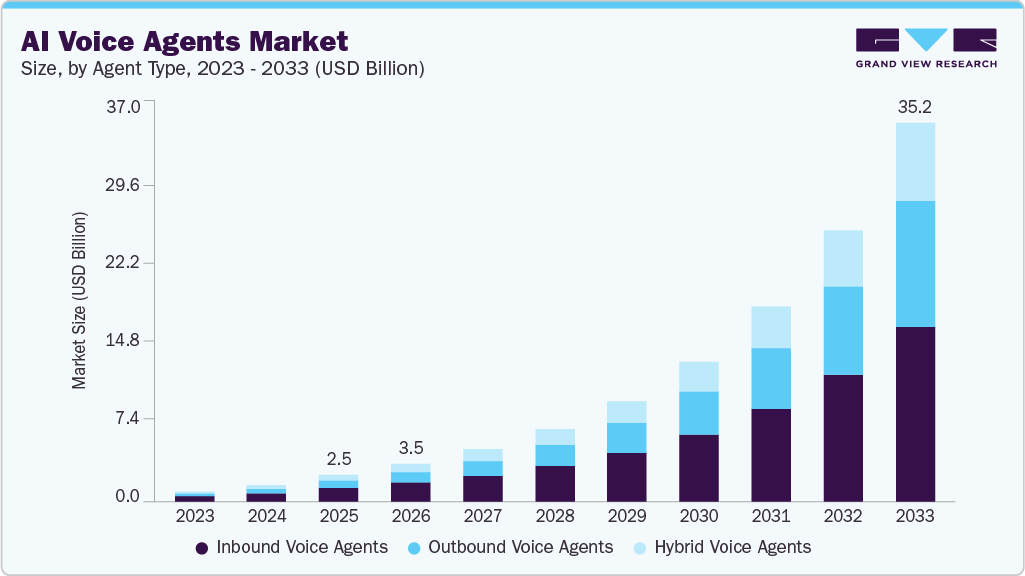 To learn more about this report, Download Free Sample Report
 The demand for affordable, enterprise-grade AI solutions among small and mid-sized businesses is steadily increasing. Earlier, advanced AI tools were mostly adopted by large corporations due to high costs and technical complexity. Now, scalable and cost-effective platforms are making AI accessible to smaller firms. This wider accessibility is expanding the overall customer base for AI vendors. Market adoption is growing beyond large enterprises into the broader SME segment. This trend is contributing to consistent expansion in the overall AI voice agent market. For instance, in May 2025, Omnisenti, a software company in Australia, launched a Voice-First AI Assistant Platform designed for small and mid-sized Australian businesses, combining secure voice automation with proprietary knowledge integration and role-based AI agents. The platform features its Intelligent Virtual Assistant Chawowa, SmartAsk knowledge engine, TeamMates functional agents, and a Private Multi-Agent Control Platform (MCP) to enable scalable, business-specific voice AI deployment with minimal IT complexity.
Faster deployment models are becoming a major focus in the AI voice agents market. Businesses increasingly prefer solutions that can be implemented in days instead of months. Long deployment cycles often delay operational improvements and customer service enhancements. Modern AI platforms are designed with simplified onboarding processes. Many solutions now offer plug-and-play configurations to reduce setup complexity. Cloud-based infrastructure helps eliminate the need for heavy hardware installations. Pre-built integrations with CRM and ERP systems further speed up implementation. Vendors are also offering modular designs that allow businesses to start small and expand gradually. Reduced dependency on large IT teams makes adoption easier for smaller organizations. Quick deployment lowers initial operational disruption. It also enables faster automation of inbound and outbound customer interactions. Overall, rapid implementation models are supporting broader and faster adoption of AI voice agents across industries.
Agent Type Insights
The inbound voice agents segment dominated the global AI voice agents industry, accounting for a revenue share of 52.1% in 2025. Most businesses prioritize automating incoming customer calls such as support requests, inquiries, complaints, and service bookings. Managing high call volumes efficiently remains a critical operational requirement across industries. Inbound voice automation helps reduce waiting times, improve first-call resolution rates, and enhance overall customer experience. It also ensures round-the-clock availability without significantly expanding human support teams. Moreover, businesses use inbound AI agents to maintain consistent communication quality across all interactions. Inbound applications represent the leading segment within the overall voice AI market and continue to see strong adoption across sectors.
The outbound voice agents segment is anticipated to grow at the fastest CAGR from 2026 to 2033. Businesses are increasingly adopting outbound AI agents for proactive customer engagement such as appointment reminders, payment follow-ups, lead qualification, and promotional campaigns. These agents help organizations scale outreach efforts without expanding sales or support teams. Outbound automation also improves response tracking and campaign efficiency through real-time analytics. As companies focus more on proactive communication strategies, demand for outbound voice AI solutions is expected to accelerate during the forecast period.
Application Insights
Customer support automation dominated the AI voice agents market in 2025, driven by the continuous rise in customer interaction volumes across industries such as BFSI, telecom, healthcare, and retail. Businesses handle large volumes of daily calls for inquiries, complaints, technical support, billing issues, and service requests. AI voice agents help manage these interactions efficiently without significantly increasing operational costs or workforce size. They reduce average handling time and improve first-call resolution rates through intelligent routing and instant responses. Companies also benefit from consistent communication quality and standardized responses across all customer touchpoints. Round-the-clock availability strengthens customer satisfaction and improves brand reliability.
The appointment scheduling application is growing due to increasing demand for automated customer interaction and service management. Businesses are adopting intelligent agents to streamline booking processes and reduce manual coordination. Autonomous systems enable real-time scheduling, rescheduling, and cancellation, improving operational efficiency. Integration with customer relationship management platforms enhances personalization and service delivery. Sectors such as healthcare, professional services, and retail increasingly utilize agentic systems for appointment management. Continuous development of AI-driven assistants supports broader adoption of automated scheduling solutions across digital commerce environments.
End Use Insights
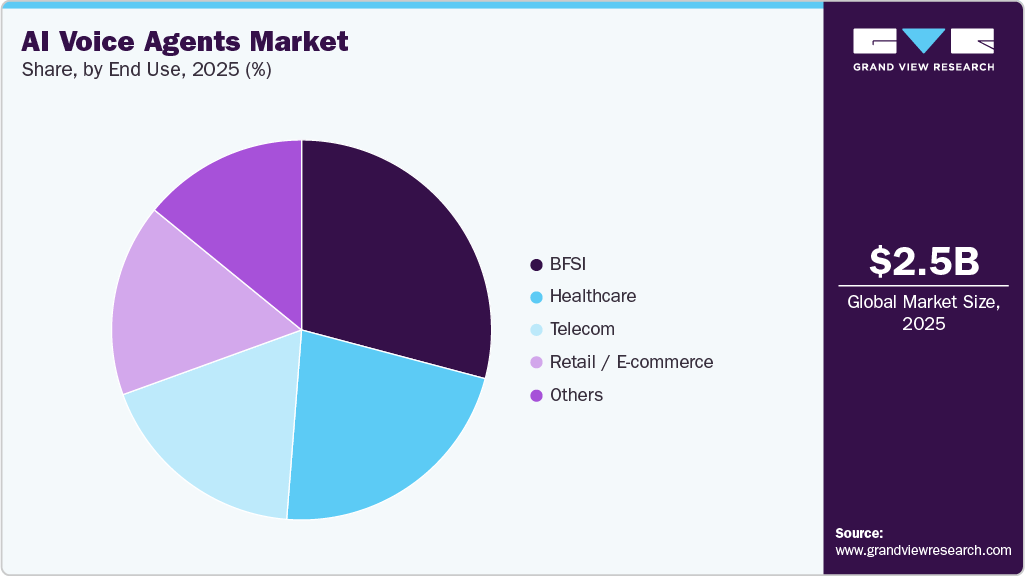
The BFSI segment dominated the AI voice agent industry in 2025, driven by the high volume of customer interactions across banking, insurance, loans, and other financial services. Financial institutions handle frequent inquiries regarding account balances, transaction details, credit card services, policy information, and fraud alerts. AI voice agents help automate these interactions while maintaining accuracy and compliance standards. The need for secure, reliable, and real-time communication has accelerated adoption in this sector. Voice automation also reduces operational costs and improves response efficiency in large customer bases. Integration with core banking and CRM systems enables personalized financial assistance. Moreover, regulatory requirements encourage the use of traceable and audit-friendly AI systems. These factors collectively make BFSI the leading end-use segment in the market for AI voice agents.
 To learn more about this report, Download Free Sample Report
 The healthcare segment is emerging as a growing application area in the AI voice agent market. Hospitals, clinics, and diagnostic centers increasingly use voice AI for appointment scheduling, reminders, and patient follow-ups. Rising patient volumes and administrative workload are driving demand for automation solutions. AI voice agents help reduce missed appointments through automated reminders and confirmations. They also assist patients with basic queries related to services, timings, and prescriptions. Secure handling of patient information supports compliance with healthcare data regulations. Integration with hospital management systems improves coordination and operational efficiency. As healthcare institutions continue to digitize patient engagement processes, the adoption of AI voice agents in this sector is steadily increasing.
Regional Insights
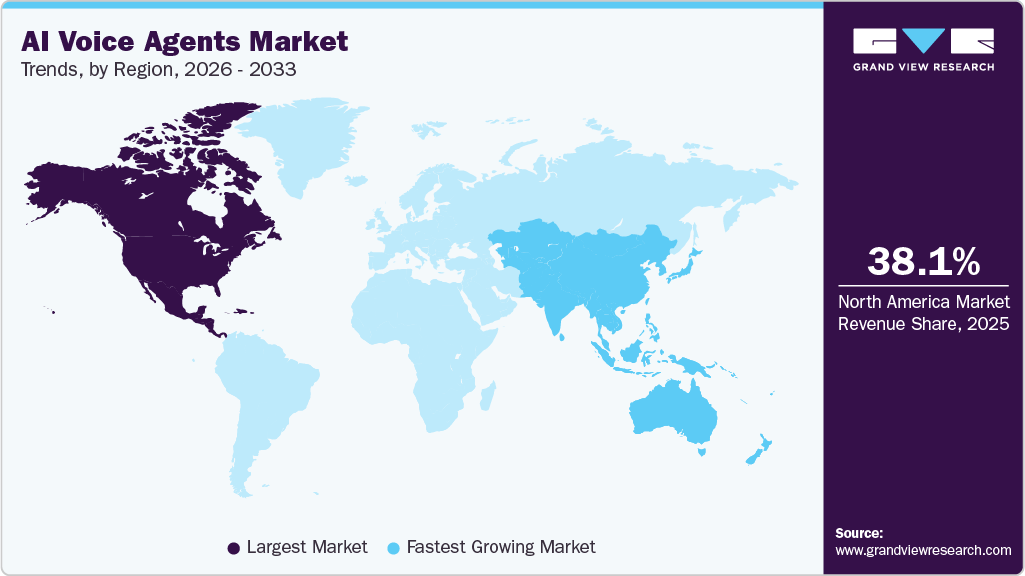
North America holds the largest share in the global AI voice agents market with a share of 38.1% in 2025, driven by widespread adoption across sectors such as BFSI, healthcare, and retail. High technology penetration and strong digital infrastructure support the rapid deployment of AI-driven solutions. Businesses in the region increasingly implement voice agents for customer support, order tracking, and lead management. Rising demand for omnichannel engagement and real-time communication further drives market growth. Regulatory frameworks and a focus on data security enhance trust in AI solutions, strengthening market expansion.
 To learn more about this report, Download Free Sample Report
 U.S. AI Voice Agents Market Trends
The U.S. AI voice agents industry is the largest within North America, driven by strong adoption across BFSI, healthcare, and retail. Businesses leverage AI voice agents for customer support, lead management, and order tracking to improve efficiency. Advanced technology infrastructure and high digital literacy enable the rapid deployment of AI solutions. Focus on data security and regulatory compliance further strengthens trust and market growth in the U.S.
Europe AI Voice Agents Market Trends
The Europe AI voice agents industry is growing steadily, supported by increasing adoption across BFSI, healthcare, and retail, with emphasis on multilingual and regulatory-compliant solutions. Businesses are implementing AI voice agents for customer support, lead management, and order tracking to enhance operational efficiency. Strong digital infrastructure and growing enterprise interest in automation enable wider deployment of AI solutions. Focusing on data privacy, compliance, and omnichannel engagement is driving consistent growth across the region.
Asia Pacific AI Voice Agents Trends
The Asia Pacific AI voice agents market is expected to grow fastest from 2026 to 2033, driven by rapid digital transformation, expanding SMB adoption, and rising adoption of AI technology. Companies will increasingly deploy voice agents for customer support, order tracking, and sales automation to enhance engagement. High smartphone penetration and cloud adoption will accelerate implementation across sectors such as BFSI, retail, and healthcare. Government initiatives, tech innovation, and a focus on scalable, cost-effective solutions will support rapid market expansion. Businesses are likely to prioritize AI agents capable of multilingual support and real-time analytics.
Key AI Voice Agents Company Insights
Some of the key companies in the AI Voice Agents industry include Amazon.com, Inc., Cisco Systems, Inc., Google LLC, IBM Corporation, Microsoft, and Nuance Communications. Organizations are focusing on increasing their customer base to gain a competitive edge in the industry. Therefore, key players are taking several strategic initiatives, such as mergers and acquisitions, and partnerships with other major companies.
-
Google LLC has advanced AI voice agents by integrating them into its cloud and virtual assistant platforms, enabling real-time, natural conversations. Its focus on conversational AI, multilingual support, and context-aware responses enhances customer interactions across industries. Google leverages large language models and machine learning to continuously improve agent intelligence. Businesses benefit from scalable, cloud-based solutions that efficiently handle high call volumes. The company is expanding its offerings to support sales, customer service, and order management workflows.
-
IBM Corporation has developed AI voice agents through its Watson AI platform, emphasizing enterprise-grade deployment. The agents are designed for customer support, order tracking, and operational automation, with strong analytics and reporting capabilities. IBM focuses on secure, private AI models that can integrate with existing enterprise systems. Watson AI agents can understand complex queries and provide contextually relevant responses. The company targets multiple industries, including BFSI, healthcare, and retail, for large-scale implementation. Continuous updates and AI training enhance performance and conversational accuracy.
Key AI Voice Agents Companies:
The following key companies have been profiled for this study on the AI voice agents market.
- Amazon.com, Inc.
- Cisco Systems, Inc.
- Google LLC
- IBM Corporation
- RingCentral, Inc.
- OpenAI
- Microsoft
- Nuance Communications
- Omnisenti
- Salesforce, Inc.
- Verint Systems Inc.
Recent Developments
-
In March 2026, RingCentral, Inc., a cloud communications platform provider, launched AIR Pro, a voice-first agentic AI platform that enables organizations to build and deploy autonomous AI voice agents for customer engagement across voice and digital channels. The platform includes a no-code environment, AIR Pro Studio, allowing businesses to design and deploy AI agents that can understand intent, authenticate users, and execute multi-step actions automatically.
-
In December 2025, Choco Communications GmbH partnered with OpenAI to launch an AI voice agent for the food service industry. The solution can answer calls, take orders, respond to product questions, and recommend items automatically using real-time conversational AI.
AI Voice Agents Market Report Scope
Report Attribute
Details
Market size in 2025
USD 2.5 billion
Estimated market size in 2026
USD 3.5 billion
Projected market size by 2033
USD 35.2 billion
Growth rate
CAGR of 39.0% from 2026 to 2033
Base year for estimation
2025
Historical data
2021 - 2024
Forecast period
2026 - 2033
Quantitative units
Revenue in USD billion and CAGR from 2026 to 2033
Report coverage
Revenue forecast, company ranking, competitive landscape, growth factors, and trends
Segments covered
Agent type, application, end use, region
Regional scope
North America; Europe; Asia Pacific; Latin America; MEA
Country scope
U.S.; Canada; Mexico; UK; Germany; France; China; Japan; India; Australia; South Korea; Brazil; KSA; UAE; South Africa
Key companies profiled
Amazon.com, Inc.; Cisco Systems, Inc.; Google LLC; IBM Corporation; RingCentral, Inc.; OpenAI; Microsoft; Nuance Communications; Omnisenti; Salesforce, Inc.; Verint Systems Inc.
Customization scope
Free report customization (equivalent up to 8 analysts working days) with purchase. Addition or alteration to country, regional & segment scope.
Pricing and purchase options
Avail customized purchase options to meet your exact research needs. Explore purchase options
Global AI Voice Agents Market Report Segmentation
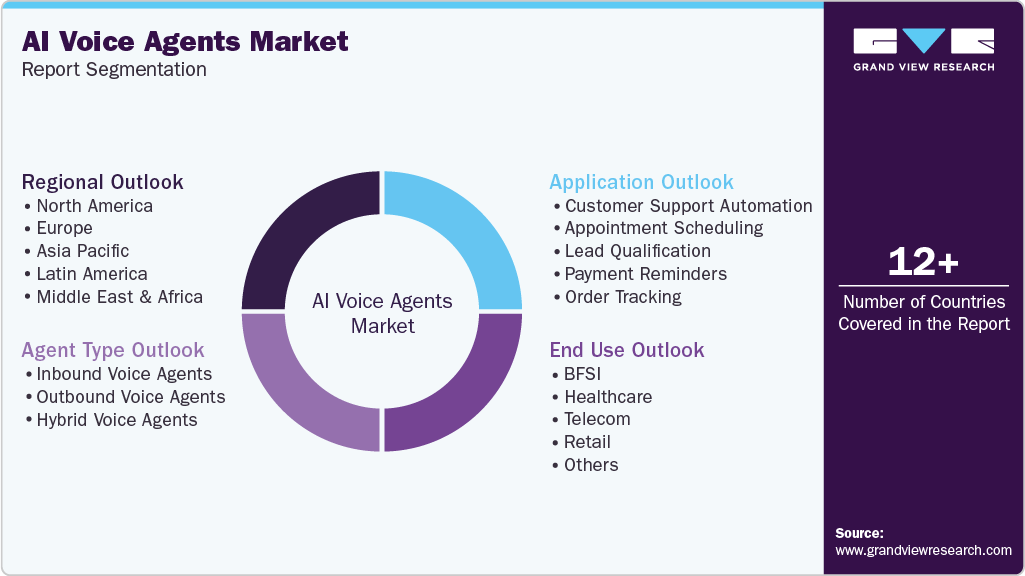
This report forecasts revenue growth at the global, regional, and country levels and provides an analysis of the latest industry trends in each of the sub-segments from 2021 to 2033. For this study, Grand View Research has segmented the global AI Voice Agents market report based on agent type, application, end use, and region:
 To learn more about this report, Download Free Sample Report
 -
Agent Type Outlook (Revenue, USD Billion, 2021-2033)
-
Inbound Voice Agents
-
Outbound Voice Agents
-
Hybrid Voice Agents
-
-
Application Outlook (Revenue, USD Billion, 2021-2033)
-
Customer Support Automation
-
Appointment Scheduling
-
Lead Qualification
-
Payment Reminders
-
Order Tracking
-
-
End Use Outlook (Revenue, USD Billion, 2021-2033)
-
BFSI
-
Healthcare
-
Telecom
-
Retail
-
Others
-
-
Regional Outlook (Revenue, USD Billion, 2021-2033)
-
North America
-
U.S.
-
Canada
-
Mexico
-
-
Europe
-
UK
-
Germany
-
France
-
-
Asia Pacific
-
China
-
Japan
-
India
-
Australia
-
South Korea
-
-
Latin America
-
Brazil
-
-
Middle East and Africa (MEA)
-
KSA
-
UAE
-
South Africa
-
-
Frequently Asked Questions About This Report
Asia Pacific is the fastest-growing region over the forecast period.
The inbound voice agents segment led with a 52.1% revenue share in 2025, while outbound voice agents is the fastest-growing segment.
Customer support automation segment held the largest market share in 2025.
The hospital pharmacies accounted for the largest share in the market, while animal husbandry is the fastest-growing segment.
The global AI voice agents market size was estimated at USD 2.5 billion in 2025 and is expected to reach USD 3.5 billion in 2026.
The global AI voice agents market is expected to grow at a compound annual growth rate of 39.0% from 2026 to 2033 to reach USD 35.2 billion by 2033.
North America dominated the AI voice agents market with a share of 38.1% in 2025.
Some key players operating in the AI voice agents market include Amazon.com, Inc., Cisco Systems, Inc., Google LLC, IBM Corporation, RingCentral, Inc., OpenAI, Microsoft, Nuance Communications, Omnisenti, Salesforce, Inc., Verint Systems Inc.
Key factors include increasing adoption of voice-based interfaces, rising demand for real-time customer engagement, and advancements in speech recognition and natural language processing technologies.
About the Author(s)
Research Research Team
· ResearchThis report was authored by the research research team at Grand View Research - comprising two research analysts, one senior research analyst, and one industry expert - with specialized expertise in the research segment of the industry. All findings are based on proprietary databases, executive interviews, and regulatory analysis, subject to internal peer review prior to publication.
Last Updated:
Speak to Analyst

Customize this report to your needs - add regions, segments, or data points, with 20% free customization.
Or view our licence options:


ISO 9001:2015 & 27001:2022 Certified
We are GDPR and CCPA compliant! Your transaction & personal information is safe and secure. For more details, please read our privacy policy.


