
- Home
- »
- Next Generation Technologies
- »
-
AI Watermarking Market Size & Share, Industry Report, 2033GVR Report cover

AI Watermarking Market (2025 - 2033) Size, Share & Trends Analysis Report By Type (Invisible Watermarking, Visible Watermarking, Hybrid), By Deployment (On-premises, Cloud), By Technology, By End Use (BFSI, Healthcare), By Application, By Region And Segment Forecasts
Market Size, 2024
$427.2MMarket Estimate, 2026
$505.0MMarket Forecast, 2033
$3,072.8MCAGR, 2025–2033
25.3%AI Watermarking Market Summary
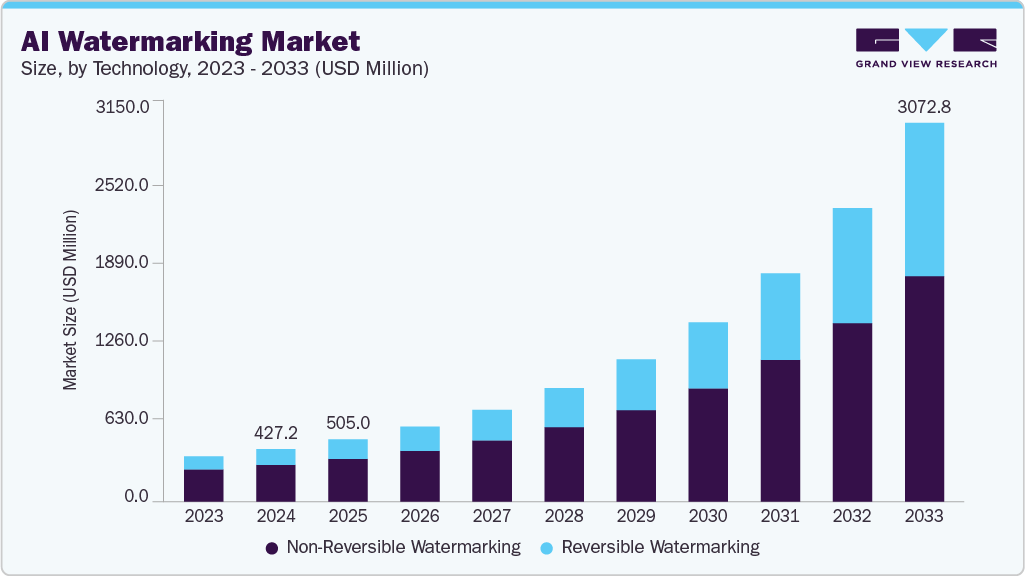
The global AI watermarking market size was estimated at USD 427.2 million in 2024 and is projected to reach USD 3,072.8 million by 2033, growing at a CAGR of 25.3% from 2025 to 2033. This growth is driven by the rising AI-generated content, deepfake & misinformation concerns, intellectual property protection, and regulatory & compliance requirements.
 Source: Grand View Research, IR Documents, Primary Interviews, Paid DatabasesTo learn more about this report,
 Download Free Sample Report
 Key Market Trends & Insights
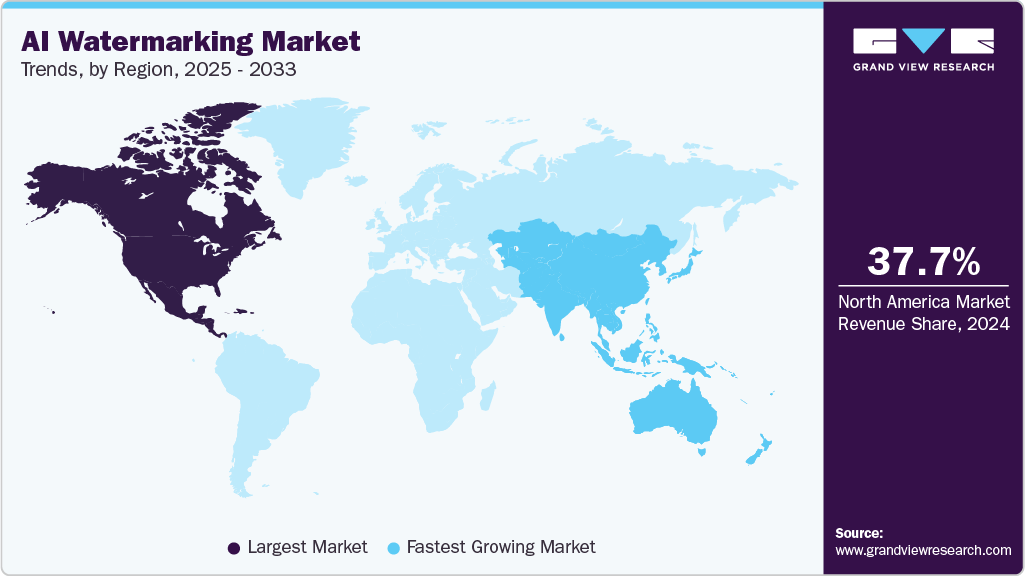
- North America dominated the global AI watermarking industry with the largest revenue share of 37.7% in 2024.
- The AI watermarking market in the U.S. led the North America market and held the largest revenue share in 2024.
- By type, the invisible watermarking led the market, holding the largest revenue share of 61.2% in 2024.
- By deployment, the cloud segment held the dominant position in the market.
- By technology, the non-reversible watermarking segment held the dominant position in the market.
Market Size & Forecast
- 2024 Market Size: USD 427.2 Million
- 2033 Projected Market Size: USD 3,072.8 Million
- CAGR (2025-2033): 25.3%
- North America: Largest market in 2024
- Asia Pacific: Fastest growing market
Three ways to get this report
Buy it, customize it, or ask a question.Ask an Analyst
Analyst response in 1 business day
- AccessReport author, directly
- Reply timeWithin 1 working day
- No sales callDirect answer only
- FormatEmail reply
- CostFree, no cost
Get the Full Report
What the study covers
- FormatsPDF · Excel · Dashboard
- Timeline2025–2033 annual, 2024 base
- Coverage20+ countries, 5 regions
- Companies10+ key players profiled
Customize the Report
20% free customization
- IncludeCountries, segments, points
- TailorTo your product definition
- ExtendDeeper competitor detail
- OrA fully bespoke study
- Turnaround5–10 working days
The AI watermarking industry is primarily driven by the rapid proliferation of AI-generated content across industries, including media, entertainment, and social platforms. With the surge in images, videos, and text created by AI, the demand for reliable authentication mechanisms has intensified. Businesses increasingly require watermarking solutions to safeguard intellectual property, ensure content integrity, and prevent unauthorized reproduction. In addition, the rise of deepfakes, misinformation, and manipulated media has heightened the need for robust verification tools. Governments and regulatory bodies are also introducing stricter guidelines, pushing organizations to adopt watermarking for compliance and risk mitigation.Technological advancements, such as invisible and hybrid watermarking techniques, are further fueling market growth. Invisible watermarking allows content verification without compromising user experience, while hybrid solutions combine visible and hidden marks for enhanced security. Enterprises are increasingly integrating AI-powered watermarking tools into cloud and digital asset management systems, facilitating seamless deployment at scale. The expansion of digital media consumption, including streaming services, social media platforms, and online publishing, drives higher demand for brand protection and content authenticity. Companies seek solutions that protect proprietary content, reinforce brand identity, and mitigate potential legal and financial risks associated with unauthorized usage.
 To learn more about this report, Download Free Sample Report
 Market adoption is also driven by the growing awareness of intellectual property rights and the importance of digital asset security. Watermarking safeguards content and supports monetization strategies and licensing management. Brand-centric applications, such as marketing campaigns and promotional content, benefit from watermarking by ensuring authenticity and maintaining consumer trust. Furthermore, the global expansion of AI technologies and increasing investments in AI-driven cybersecurity solutions enable broader market penetration. Collectively, the convergence of regulatory pressures, technological innovation, and escalating digital content creation positions AI watermarking as an essential solution for enterprises and content creators seeking secure, verifiable, and legally protected digital assets.
Type Insights
The invisible watermarking segment led the market in 2024, accounting for over 61% of global revenue, driven by the rising demand for secure, non-intrusive content protection in an era of AI-generated media. Organizations increasingly require robust authentication mechanisms to prevent unauthorized usage, safeguard intellectual property, and ensure digital content integrity without affecting user experience. The surge in deepfakes, misinformation, and manipulated media further amplifies the need for invisible watermarking solutions. In addition, integration with AI-powered and cloud-based platforms enables scalable deployment across enterprises. Regulatory pressures, brand protection requirements, and the growing volume of digital assets collectively accelerate adoption, positioning invisible watermarking as a crucial tool for content security and verification.
The hybrid segment is predicted to experience the fastest growth in the forecast years, driven by the increasing demand for robust content protection and authentication solutions that combine the advantages of both visible and invisible watermarking. Enterprises and content creators are seeking technologies that safeguard intellectual property while maintaining content integrity and user experience. The rise of AI-generated media, deepfakes, and digital piracy has amplified the need for dual-layer security. Regulatory pressures on content verification and copyright compliance further accelerate adoption. In addition, technological advancements in hybrid watermarking tools, integration with cloud platforms, and growing digital media consumption are key factors propelling market growth globally.
Deployment Insights
The cloud segment accounted for the largest market revenue share in 2024 due to the increasing adoption of cloud-based digital content management and AI-driven solutions. Organizations prefer cloud deployment for its scalability, cost-efficiency, and seamless integration with enterprise systems. Cloud watermarking enables real-time content authentication, remote monitoring, and centralized control of digital assets, reducing operational complexity. Growing demand for Software-as-a-Service (SaaS) platforms, coupled with the rise of remote work and distributed content creation, further drives adoption. In addition, cloud-based solutions support advanced invisible and hybrid watermarking techniques, ensuring secure, accessible, and verifiable protection of intellectual property across global networks.
The on-premises segment is expected to grow significantly during the forecast period. The on-premises AI watermarking industry is driven by enterprises’ growing need for data security, control, and compliance. Organizations handling sensitive or proprietary content prefer in-house deployment to mitigate risks of external breaches and unauthorized access. Regulatory mandates in various industries, such as media, finance, and government, encourage companies to retain full control over watermarking processes. On-premises solutions also offer customization and integration with existing IT infrastructure, supporting enterprise-specific workflows and legacy systems. In addition, increasing concerns about cloud latency, bandwidth, and potential intellectual property exposure drive organizations to adopt local, secure watermarking solutions, ensuring reliability, confidentiality, and adherence to internal governance standards.
Technology Insights
The non-reversible watermarking segment accounted for the largest market revenue share in 2024. The non-reversible watermarking segment is driven by the growing demand for robust content protection and intellectual property enforcement across media, entertainment, and digital platforms. As digital content piracy and unauthorized reproduction escalate, organizations prioritize permanent watermarking solutions that ensure content integrity and traceability. Regulatory compliance and copyright protection requirements further reinforce adoption, particularly in industries handling sensitive or high-value assets. In addition, the surge in AI-generated content and deepfakes amplifies the need for tamper-proof watermarking. Enterprises leverage non-reversible watermarking to safeguard proprietary media, support licensing models, and maintain brand credibility, positioning it as a critical tool in digital content security strategies.
The reversible segment is expected to grow at the fastest CAGR during the forecast period. The reversible watermarking segment is propelled by the growing demand for high-fidelity content protection across sensitive industries such as healthcare, finance, and media, where original data integrity is critical. Organizations require watermarking solutions that allow content verification without permanently altering or degrading the original files. Regulatory compliance, particularly in sectors handling confidential or copyrighted materials, further drives adoption. In addition, advances in AI-powered reversible watermarking techniques enable secure, imperceptible embedding and extraction of marks, supporting digital rights management, traceability, and secure content sharing. The rising need for tamper-proof and fully recoverable digital assets underpins the segment’s sustained growth globally.
Application Insights
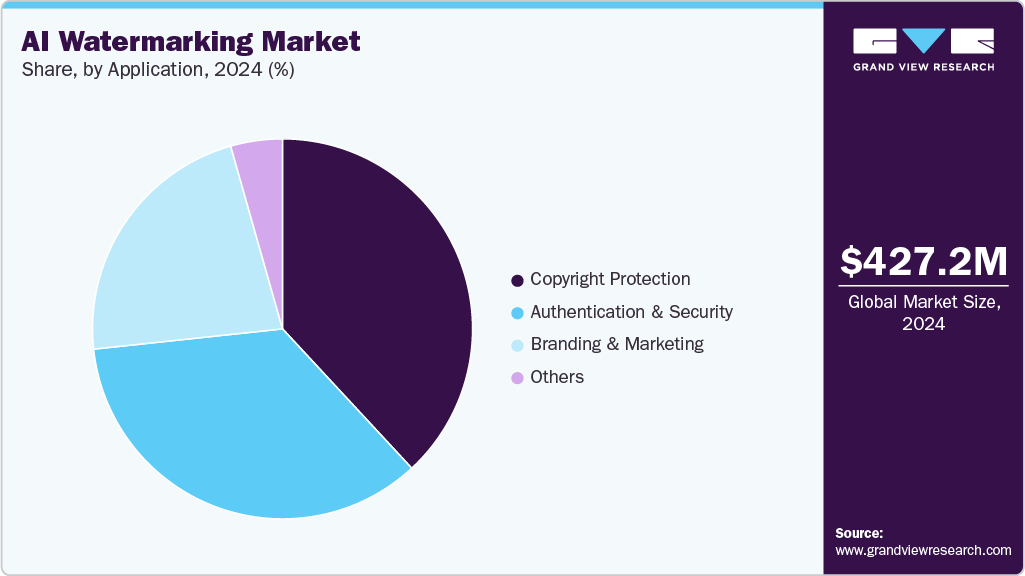
The copyright protection segment accounted for the largest market revenue share in 2024, driven by the rising need to safeguard intellectual property amid growing AI generated content. With rapid digital content creation across media, entertainment, and publishing, organizations face increasing risks of unauthorized use, reproduction, and piracy. Regulatory frameworks and stricter enforcement of copyright laws are compelling businesses to adopt advanced watermarking solutions. Invisible and hybrid watermarking technologies allow secure identification of ownership without compromising content quality. In addition, companies leverage watermarking to support licensing, monetization, and legal enforcement, ensuring content authenticity and protecting revenue streams, thereby driving robust market growth in this segment.
 To learn more about this report, Download Free Sample Report
 The authentication & security segment is expected to grow at the fastest CAGR during the forecast period, driven by escalating concerns over digital content integrity, cyber threats, and the proliferation of AI-generated media. Organizations increasingly require robust verification mechanisms to detect deepfakes, tampering, and unauthorized content distribution. Regulatory mandates and industry standards for data authenticity further accelerate adoption. Technological advancements in invisible and hybrid watermarking enable secure, non-intrusive authentication across platforms, including media, enterprise, and government systems. Rising demand for secure digital transactions, identity protection, and content provenance compels enterprises to integrate AI watermarking solutions, ensuring reliability, compliance, and mitigation of reputational and financial risks.
End Use Insights
The media & entertainment segment accounted for the largest market revenue share in 2024, primarily due to the rising need for content protection, piracy prevention, and regulatory compliance. The expansion of OTT platforms and live streaming services has heightened demand for secure, traceable digital content, while AI-powered advertising necessitates reliable authentication to maintain advertiser and audience trust. In addition, AI watermarking enables media companies to track content usage, facilitating personalized user experiences and targeted recommendations. These factors collectively position AI watermarking as a crucial tool for safeguarding intellectual property, ensuring compliance, and enhancing engagement in the rapidly evolving digital media landscape.
The healthcare segment is anticipated to grow at the fastest CAGR during the forecasted period, driven by the critical need for data integrity, security, and patient privacy. With the rise of electronic health records (EHRs), telemedicine, and AI-assisted diagnostics, protecting sensitive medical information has become paramount. AI watermarking ensures authenticity, prevents unauthorized access, and combats data tampering in imaging, reports, and patient records. Regulatory compliance, such as HIPAA and GDPR, further accelerates adoption. In addition, increasing digitalization of medical imaging and collaboration across hospitals and research institutions creates demand for robust watermarking solutions, ensuring secure sharing of high-value data while maintaining trust and operational efficiency.
Regional Insights
North America AI watermarking industry with a revenue share of over 37% in 2024. The North America AI watermarking industry is primarily driven by the early AI adoption, a robust R&D ecosystem, and the presence of major tech and cybersecurity firms such as Google, Microsoft, and IBM Corporation, which invest heavily in watermarking solutions for content authenticity and IP protection. Regulatory and governance demands, including voluntary agreements with the White House and emerging legislation, are accelerating adoption by enforcing transparency and provenance in AI-generated intelligence. In addition, high-value industries such as media & entertainment, finance, and government are driving demand for robust watermarking to secure sensitive digital assets and combat deepfakes and content tampering.
 To learn more about this report, Download Free Sample Report
 U.S. AI Watermarking Market Trends
The U.S. AI watermarking industry grew significantly in 2024, propelled by heightened concerns over content authenticity and misinformation, especially in generative AI proliferation and deepfakes. Strong regulatory initiatives, including voluntary commitments by AI firms and pending legislation, demand detectable AI-generated content. Advancements in AI-powered watermarking techniques, such as robust, invisible embedding and scalable cloud-based tools, enhance detection reliability. Rising adoption in industries such as media, finance, and government, combined with evolving intellectual property concerns and regulatory compliance requirements,reinforces demand. In addition, increased cybersecurity focuses and innovation in watermarking technologies position the U.S. as a global market leader in the AI Watermarking industry.
Europe AI Watermarking Market Trends
The AI watermarking industry in Europe is expected to grow significantly over the forecast period. The European market is propelled by tightening regulatory momentum, escalating IP protection needs, and enterprise risk management. Rapid adoption of generative AI in media, healthcare, finance, and public sector creates demand for provenance, tamper detection, and audit trails. Broadcaster and publisher anti-deepfake initiatives, interoperability efforts, and procurement mandates accelerate pilots to production. Cloud vendors and model providers embedding native watermark APIs lower integration costs. Cross-border data exchange, digital services taxes, and litigation risk push C-suites to prioritize content authenticity. In addition, rising cyberattacks on AI pipelines and ESG driven governance requirements expand budgets for trustworthy AI controls.
Asia Pacific AI Watermarking Market Trends
The AI watermarking industry in the Asia Pacific region is anticipated to witness the fastest CAGR over the forecast period. Asia Pacific market is propelled by explosive AI adoption across media & entertainment, ecommerce, fintech, and healthcare, escalating IP theft, deepfake risks, and compliance needs, and aggressive digital policies in China, India, Japan, and ASEAN. Enterprises seek tamper-evident provenance for images, video, audio, and models to protect brand equity, monetize content, and meet platform integrity standards. Cloud hyperscalers and local AI startups drive integration into MLOps pipelines, while 5G and edge growth expand real-time verification use cases. Investor funding, government AI safety frameworks, and cross-border content flows accelerate commercialization, with demand skewing toward scalable, low-latency, interoperable solutions and audit-ready analytics.
Key AI Watermarking Company Insights
Some key companies in the AI watermarking industry are Google LLC and Digimarc Corporation.
-
Google LLC DeepMind’s SynthID is prominent for embedding invisible watermarks in AI-generated content across text, images, audio, and video. Its integration into Google’s AI ecosystem ensures wide applicability and reliable detection. By enhancing content provenance and trust, it addresses misinformation challenges, positioning DeepMind as a leading AI watermarking innovator.
-
Digimarc Corporation provides digital watermarking technologies used across industries such as consumer goods and media. Its solutions support content authentication, supply chain traceability, and anti-counterfeiting. By integrating AI, Digimarc enables scalable and verifiable digital content protection, establishing its role in the AI watermarking industry.
Key AI Watermarking Companies:
The following are the leading companies in the AI watermarking market. These companies collectively hold the largest market share and dictate industry trends.
- Google LLC
- Digimarc Corporation
- Clarifai, Inc.
- Beijing Kuangshi Technology Co.,Ltd.
- ZOO Digital Group plc.
- IMATAG
- Kantar Media
- Vobile Group Limited
- Verimatrix
- MarkAny Co., Ltd.
Recent Developments
-
In February 2025, Google launched SynthID, digital watermarks in its Magic Editor’s generative-editing feature in Google Photos. This update embeds invisible metadata into AI edited images, helping users quickly identify manipulated visuals. Google’s text-to-image model is integrated into outputs from Imagen, which signifies a tangible commercialization of watermarking technology in mainstream consumer-facing applications.
-
In August 2024, OpenAI introduced updates to its text watermarking process. The system has proven highly accurate and effective against localized tampering, such as paraphrasing. However, it is less resilient to global tampering techniques, including translation, rewording through another generative model, or inserting and then removing special characters between words, making it relatively easy for bad actors to circumvent.
-
In April 2024, Digimarc Corporation, developer of digital watermarking technologies partnered with DataTrails Inc., an innovator in integrity, transparency, and trust technology, a data integrity and provenance solutions company, to provide a fully integrated content protection system that secures digital content through advanced digital watermarks alongside cryptographic proofs or fingerprints. Combined with provenance metadata, these technologies form a multi-layered framework that verifies digital content authenticity, helping content creators, organizations, and consumers guard against fake data and misinformation.
AI Watermarking Market Report Scope
Report Attribute
Details
Market size value in 2025
USD 505.0 million
Revenue forecast in 2033
USD 3,072.8 million
Growth rate
CAGR of 25.3% from 2025 to 2033
Actual data
2021 - 2024
Forecast period
2025 - 2033
Quantitative units
Revenue in USD billion/million and CAGR from 2025 to 2033
Report coverage
Revenue forecast, company ranking, competitive landscape, growth factors, and trends
Segments covered
Type, deployment, technology, application, end use, region
Regional scope
North America; Europe; Asia Pacific; Latin America; MEA
Country scope
U.S.; Canada; Mexico; Germany; UK; France; China; India; Japan; Australia; South Korea; Brazil; UAE; South Africa; KSA
Key companies profiled
Google; Digimarc Corporation; Clarifai, Inc.; Beijing Kuangshi Technology Co.,Ltd.; ZOO Digital Group plc.; IMATAG; Kantar Media; Vobile Group Limited; Verimatrix; MarkAny Co., Ltd.
Customization scope
Free report customization (equivalent up to 8 analysts working days) with purchase. Addition or alteration to country, regional & segment scope.
Pricing and purchase options
Avail customized purchase options to meet your exact research needs. Explore purchase options
Global AI Watermarking Market Report Segmentation
This report forecasts revenue growth at global, regional, and country levels and provides an analysis of the latest industry trends in each of the sub-segments from 2021 to 2033. For this study, Grand View Research has segmented the global AI watermarking market report based on type, deployment, technology, application, end use, and region.
-
Type Outlook (Revenue, USD Million, 2021 - 2033)
-
Invisible Watermarking
-
Visible Watermarking
-
Hybrid
-
-
Technology Outlook (Revenue, USD Million, 2021 - 2033)
-
Reversible Watermarking
-
Non-Reversible Watermarking
-
-
Deployment Outlook (Revenue, USD Million, 2021 - 2033)
-
On-premises
-
Cloud
-
-
Application Outlook (Revenue, USD Million, 2021 - 2033)
-
Authentication & Security
-
Copyright Protection
-
Branding & Marketing
-
Others
-
-
End Use Outlook (Revenue, USD Million, 2021 - 2033)
-
BFSI
-
Healthcare
-
Media & Entertainment
-
Government & Defense
-
Retail & E-commerce
-
Others
-
-
Regional Outlook (Revenue, USD Million, 2021 - 2033)
-
North America
-
U.S.
-
Canada
-
Mexico
-
-
Europe
-
Germany
-
UK
-
France
-
-
Asia Pacific
-
China
-
Japan
-
India
-
South Korea
-
Australia
-
-
Latin America
-
Brazil
-
-
Middle East and Africa (MEA)
-
UAE
-
KSA
-
South Africa
-
-
Frequently Asked Questions About This Report
The global AI watermarking market size was estimated at USD 427.2 million in 2024 and is expected to reach USD 505.0 million in 2025.
The global AI watermarking market is expected to grow at a compound annual growth rate of 25.3% from 2025 to 2033 to reach USD 3,072.8 million by 2033.
North America dominated the AI watermarking market with a share of 37.7% in 2024. This is attributable to the the early AI adoption, a robust R&D ecosystem, and the presence of major tech and cybersecurity firms such as Google, Microsoft, and IBM Corporation, which invest heavily in watermarking solutions for content authenticity and IP protection.
Some key players operating in the AI watermarking market include Google LLC; Digimarc Corporation; Clarifai, Inc.; Beijing Kuangshi Technology Co.,Ltd.; ZOO Digital Group plc.; IMATAG; Kantar Media; Vobile Group Limited; Verimatrix; and MarkAny Co., Ltd.
Key factors that are driving the AI watermarking market growth include the rising AI-generated content, deepfake & misinformation concerns, intellectual property protection, and regulatory & compliance requirements.
About the Author(s)
Next Generation Technologies Research Team
Technology · Next Generation TechnologiesThis report was authored by the next generation technologies research team at Grand View Research - comprising two research analysts, one senior research analyst, and one industry expert - with specialized expertise in the next generation technologies segment of the technology industry. All findings are based on proprietary technology databases, executive interviews, and regulatory analysis, subject to internal peer review prior to publication.
Last Updated:
Speak to Analyst

Customize this report to your needs - add regions, segments, or data points, with 20% free customization.
Or view our licence options:


ISO 9001:2015 & 27001:2022 Certified
We are GDPR and CCPA compliant! Your transaction & personal information is safe and secure. For more details, please read our privacy policy.


