
- Home
- »
- Digital Media
- »
-
Digital Media Market Size And Share Report, 2026-2033GVR Report cover

Digital Media Market (2026 - 2033)
Size, Share & Trends Analysis Report By Content Type (Video, Audio, Text, Images, Interactive Media Content), By Platform (Smartphone, Television), By Application, By Industry Vertical, By Region, And Segment Forecasts
Market Size, 2025
$1,039.0BMarket Estimate, 2026
$1,163.6BMarket Forecast, 2033
$2,801.7BCAGR, 2026–2033
13.6%Digital Media Market Summary
The global digital media market size was valued at USD 1,039.0 billion in 2025 and is projected to grow from USD 1,163.6 billion in 2026 to USD 2,801.7 billion by 2033, at a CAGR of 13.6% from 2026 to 2033. North America dominated the global market, accounting for the largest revenue share of 38.0% in 2025. The digital media market is primarily driven by the increasing penetration of internet-enabled devices, growing consumption of online content, expansion of social media platforms, rising demand for on-demand streaming and personalized digital experiences, along with advancements in high-speed connectivity such as 4G and 5G, widespread adoption of smartphones and smart TVs, and increasing digital advertising investments by brands seeking targeted and data-driven audience engagement.
 Source: Grand View Research, IR Documents, Primary Interviews, Paid DatabasesTo learn more about this report,
 Download Free Sample Report
 Key Market Trends & Insights
- By content type: Video segment accounted for the largest market share of 37.2% in 2025.
- By platform: Smartphone segment dominated the market, with a share of 42.7% in 2025.
- By application: Marketing and advertising segment dominated the market, with a share of 34.7% in 2025.
- By industry vertical: Entertainment segment dominated the market with a share of 39.6% in 2025.
Regional Highlights
- Largest regional market: North America (38.0% revenue share in 2025)
- Fastest growing regional market: Asia Pacific (highest CAGR 15.2%, 2026-2033)
- By Country: The U.S. held the largest market share in 2025
Market Size & Forecast
- Market size in 2025: USD 1,039.0 Billion
- Estimated market size in 2026: USD 1,163.6 Billion
- Projected market size by 2033: USD 2,801.7 Billion
- CAGR (2026-2033): 13.6%
Three ways to get this report
Buy it, customize it, or ask a question.Ask an Analyst
Analyst response in 1 business day
- AccessReport author, directly
- Reply timeWithin 1 working day
- No sales callDirect answer only
- FormatEmail reply
- CostFree, no cost
Get the Full Report
What the study covers
- FormatsPDF · Excel · Dashboard
- Timeline2026–2033 annual, 2025 base
- Coverage20+ countries, 5 regions
- Companies10+ key players profiled
Customize the Report
20% free customization
- IncludeCountries, segments, points
- TailorTo your product definition
- ExtendDeeper competitor detail
- OrA fully bespoke study
- Turnaround5–10 working days
This rising demand is fueled by advancements in digital media technology, leading to a more diverse range of communication methods and content, which is further fueling the market expansion.The growing popularity of social media advertising and location-based video content has been a significant driver of the digital media market's growth. The visual nature of social media platforms allows businesses to build a strong brand presence and enhance awareness among large user bases, while the rise of short-form, location-targeted video formats like Instagram Reels and TikTok videos enables more effective, data-driven advertising and marketing strategies. The combination of visual branding, targeted reach, and engaging content has made social media a powerful tool for businesses to connect with consumers and achieve their digital marketing objectives, fueling the expansion of the market. To learn more about this report, Download Free Sample Report
 The growing popularity of social media advertising and location-based video content has been a significant driver of the digital media market's growth. The visual nature of social media platforms allows businesses to build a strong brand presence and enhance awareness among large user bases, while the rise of short-form, location-targeted video formats like Instagram Reels and TikTok videos enables more effective, data-driven advertising and marketing strategies. The combination of visual branding, targeted reach, and engaging content has made social media a powerful tool for businesses to connect with consumers and achieve their digital marketing objectives, fueling the expansion of the market.
The rapid expansion of internet infrastructure globally has facilitated greater access to digital content for users around the world. This increased connectivity has led to a surge in online activities ranging from streaming services to social networking platforms. In addition, technological advancements such as improved streaming capabilities, virtual reality (VR), augmented reality (AR), artificial intelligence (AI), and personalized content delivery are enhancing the user experience and driving consumer interest in digital media offerings.
Furthermore, the shift towards mobile consumption, with smartphones becoming the primary devices for accessing digital content, is a significant driver of market growth. As smartphones evolve with larger screens, faster processors, and improved connectivity, they provide a more engaging and seamless user experience for consuming digital media. Mobile-friendly formats, such as responsive websites and dedicated apps, cater specifically to the preferences and behaviors of mobile users, ensuring that content is easily accessible and consumable on the go. This growing dependency on mobile devices for media consumption has led to an increase in digital advertising spending targeted at mobile users, further boosting the digital media market.
Companies operating in the market have adopted various strategies to enhance their market presence. Content diversification is key, offering a broad spectrum of digital content like videos, articles, podcasts, and interactive media to cater to different audience preferences. Leveraging data analytics allows for personalized content recommendations, boosting user engagement and retention. For instance, in April 2023, Netflix announced its global expansion plans aiming to further increase its presence and reach worldwide. The company’s expansion plans include launching in several countries across different regions, investing in local content production, and strengthening partnerships with creators and talent globally. Netflix aims to solidify its position as a leading streaming service by providing diverse and engaging content to subscribers worldwide. Such strategies by key players are expected to fuel market growth in the coming years.
Market Dynamics
The digital media market is experiencing robust growth, driven by the shift toward on-demand and platform-based content consumption, as well as the rising adoption of mobile devices and streaming services. Increased internet penetration, changing consumer viewing habits, and the growing dominance of digital advertising ecosystems are further accelerating market expansion across global regions.
The digital media market is being strongly driven by the rapid shift in consumer preference toward on-demand streaming platforms. Users increasingly expect instant access to content across video, music, and gaming without being tied to traditional broadcast schedules. This change is supported by widespread smartphone adoption, affordable data plans, and improved internet infrastructure, which together make digital content easily accessible anytime and anywhere.
In addition, streaming platforms are continuously enhancing user experience through personalized recommendations, original content production, and multi-device compatibility. This has significantly increased user engagement and subscription growth globally. As a result, media consumption patterns are becoming more fragmented and platform-centric, further accelerating the expansion of the digital media ecosystem.
A major restraint in the digital media market is the increasing concern about data privacy and the growing regulatory scrutiny of how user data is collected, stored, and used. Governments across regions are enforcing stricter data protection laws that require companies to ensure transparency and obtain user consent for data-driven advertising and content personalization. This limits the ability of platforms to fully leverage user data for targeted marketing.
Furthermore, compliance with multiple regional regulations increases operational complexity and cost for digital media companies. Businesses must invest heavily in secure data infrastructure and compliance systems, which can slow down innovation and reduce flexibility in advertising models. These restrictions create challenges for companies heavily dependent on data-driven revenue streams.
The digital media market is witnessing strong opportunities through the diversification of monetization strategies beyond traditional advertising. Subscription-based models, freemium services, and ad-supported streaming platforms are enabling companies to cater to a wider audience base with varying willingness to pay. This hybrid approach is helping businesses stabilize revenue streams while expanding user acquisition.
Furthermore, the rise of the creator economy is opening new revenue channels through influencer marketing, user-generated content, and platform-based monetization tools. Digital platforms are increasingly empowering independent creators to earn directly from audiences through subscriptions, tips, and brand collaborations. This shift is creating a more dynamic and scalable ecosystem for long-term market growth.
Market Concentration & Characteristics
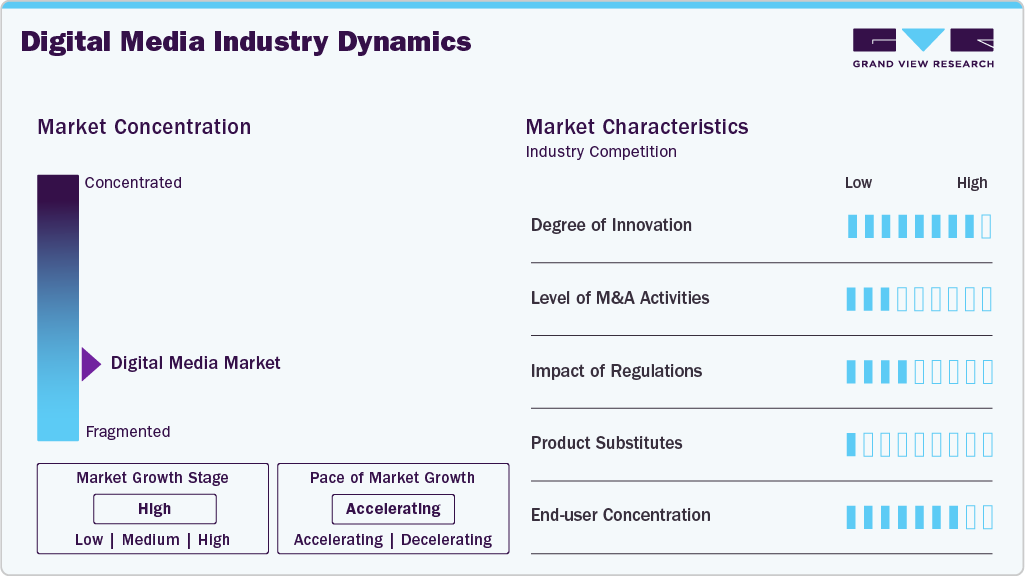
The digital media market is moderately fragmented, comprising global streaming platforms, social media companies, digital publishers, advertising technology firms, and emerging creator economy platforms. The ecosystem is highly technology-driven, supported by advancements in cloud computing, artificial intelligence, data analytics, and recommendation algorithms that enable personalized content delivery at scale. Regulatory influence in the digital media market is moderate to high, primarily shaped by data privacy laws, content moderation requirements, and digital advertising regulations across different regions.
 To learn more about this report, Download Free Sample Report
 Product substitution is relatively low as digital media platforms offer integrated ecosystems for content consumption, creation, and distribution that are difficult to replicate through traditional media channels. Demand remains highly diversified across entertainment, education, marketing, e-commerce, and corporate communication, driven by rising digital consumption, mobile-first audiences, and the growing influence of social and influencer-driven media.
Analyst Perspective
The digital media market is experiencing strong structural growth, driven by rapid expansion of high-speed internet connectivity, smartphone and connected device adoption, over-the-top (OTT) streaming platforms, social media engagement, digital advertising, and on-demand content consumption. Growth is further supported by advancements in artificial intelligence (AI), cloud computing, and content personalization technologies, alongside the increasing popularity of creator-driven content, live streaming, online gaming, podcasts, and digital publishing across consumer and enterprise applications.
Content Type Insights
Based on content type, the video segment led the market with the largest revenue share of 37.2% in 2025 and is expected to grow at a considerable CAGR over the forecast period. The advancements in technology, such as faster internet speeds, improved video streaming capabilities, and the proliferation of mobile devices, have made consuming video content more accessible than ever before. This accessibility has led to a surge in demand for video content, further accelerating the segmental growth. In addition, social media platforms have played a significant role in popularizing video content. Features such as live streaming, stories, and short-form videos have become integral parts of social media experiences, driving user engagement and consumption of video content.
The interactive segment is expected to grow at the fastest CAGR of over 13% from 2024 to 2030. This rapid expansion is driven by the shift towards interactive advertising formats to capture consumer attention in a crowded digital landscape. Interactive ads offer higher engagement rates and better conversion opportunities, making them a preferred choice for advertisers looking to drive results.Consumers are seeking more immersive and engaging experiences across digital platforms. The interactive segment caters to this demand by offering dynamic and interactive content that keeps users actively involved, leading to longer session durations and repeat visits.
Platform Insights
Based on platform, the smartphone segment dominated the market with the largest revenue share of 42.7% in 2025. Smartphones have evolved significantly over the years, offering advanced features such as high-resolution displays, powerful processors, and fast internet connectivity. These technological advancements have made smartphones a preferred choice for consuming digital media content due to the enhanced user experience they provide. In addition, advertisers are increasingly targeting smartphone users due to the large audience base and engagement levels on mobile devices. This has led to a significant increase in mobile advertising spending, further driving the growth of digital media consumption on smartphones.
The computer segment is expected to register the fastest CAGR from 2024 to 2030. The global shift towards remote work, online education, and digital entertainment is expected to continue beyond 2024. As a result, there will be an increased reliance on computers for communication, collaboration, content creation, and entertainment purposes. This trend is likely to fuel the growth of the computer segment in the market.
Application Insights
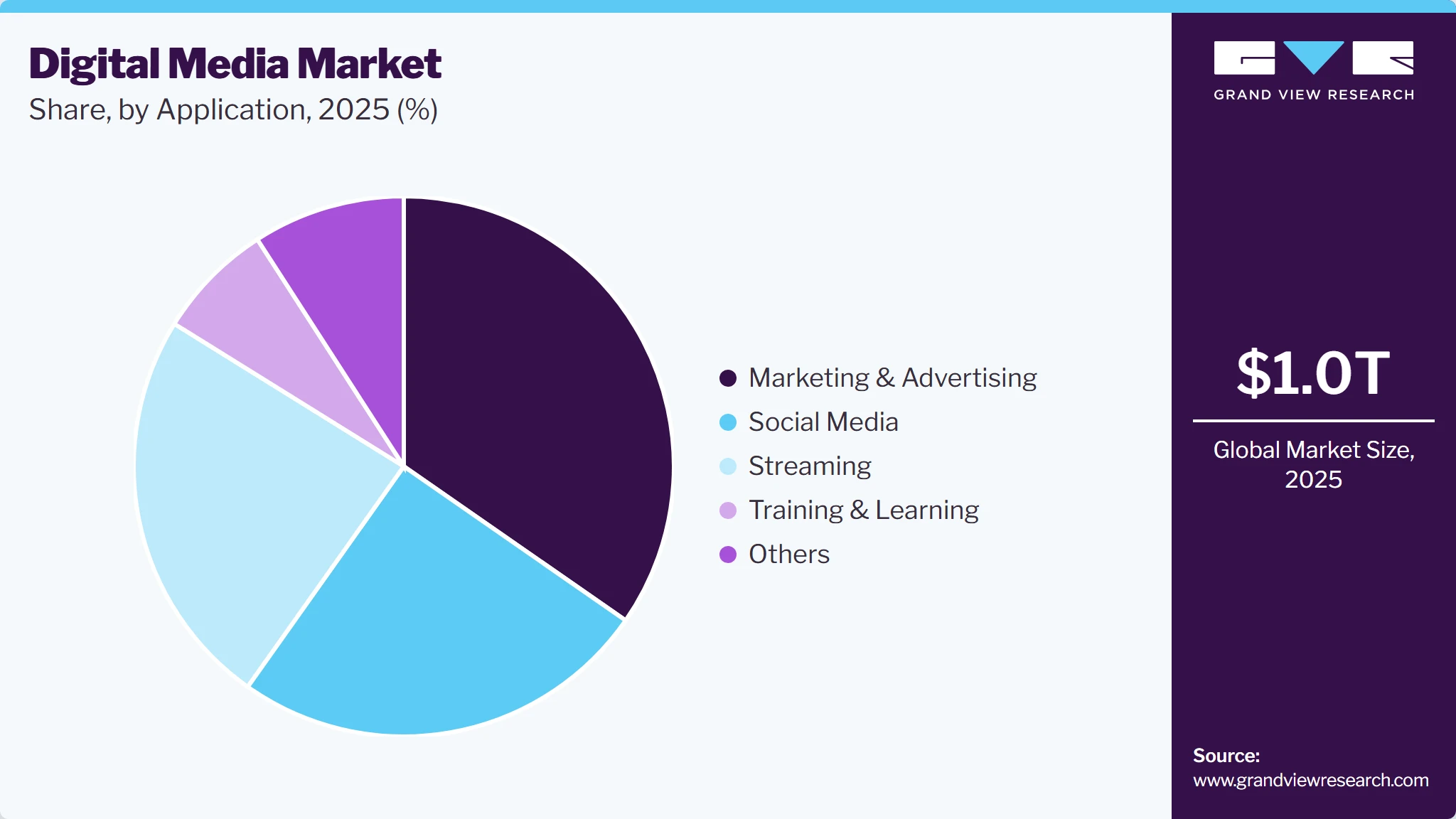
Based on application, the marketing & advertising segment dominated the market with the largest revenue share of 34.7% in 2025. With the proliferation of digital channels such as social media, search engines, email marketing, and mobile apps, companies can implement multi-channel marketing strategies to reach consumers across various touchpoints. This integrated approach increases brand visibility and customer engagement, leading to a larger revenue share within the marketing segment.
 To learn more about this report, Download Free Sample Report
 The streaming segment is anticipated to record the fastest growth from 2024 to 2030. The growing popularity of on-demand content consumption has led to a surge in demand for streaming services. Consumers are increasingly shifting towards digital platforms for entertainment, leading to a rise in subscriptions to streaming services. Streaming platforms are continuously expanding their content libraries by investing in original programming and acquiring rights to popular shows and movies. This diverse range of content attracts more subscribers, driving growth in the streaming segment.
Industry Vertical Insights
Based on industry vertical, the entertainment segment dominated the market with the largest revenue share of 39.6% in 2025. The advancements in technology have significantly enhanced the digital entertainment experience. High-quality streaming services, virtual reality (VR) gaming, interactive content, and personalized recommendations have made digital entertainment more immersive and engaging than ever before. These technological innovations have driven consumer interest and the adoption of digital entertainment platforms.
The retail & e-commerce segment is anticipated to record the fastest growth from 2024 to 2030. The proliferation of smartphones and mobile devices has revolutionized the way people shop. With the convenience of mobile commerce apps and websites, consumers can easily browse, compare prices, and make purchases on the go. This shift towards mobile shopping has significantly boosted e-commerce sales and is expected to continue driving growth in the retail sector.
Regional Insights
North America dominated the digital media market, accounting for the largest revenue share of 38.0% in 2025. This growth can be attributed to the region's advanced technological infrastructure, presence of major tech giants, and strong emphasis on research and innovation. In addition, the region has a high rate of digital technology adoption among consumers. This includes the widespread use of smartphones, tablets, laptops, and other connected devices, which has driven the consumption of digital media content.
 To learn more about this report, Download Free Sample Report
 U.S. Digital Media Market Trends
The digital media market in the U.S. held the largest share in the North America region in 2025. The E-commerce market in the U.S. is highly developed, with a significant portion of retail sales occurring online. This has fueled the growth of digital advertising as businesses seek to reach consumers through online channels.
Europe Digital Media Market Trends
The digital media market in Europe is anticipated to grow at a CAGR of over 12% from 2024 to 2030. This growth is driven by a high level of internet penetration, with a large percentage of its population having access to the internet. As internet connectivity continues to improve and expand across the region, more consumers are gaining access to digital media platforms, leading to increased consumption and demand for digital content.
The UK digital media market is anticipated to grow at a CAGR of over 11% from 2024 to 2030. This growth can be attributed to the trend towards digitalization across various industries in the UK. This shift is driven by technological advancements, changing consumer preferences, and the need for businesses to adapt to digital channels for marketing and distribution. As more companies invest in digital media strategies, the market is expected to experience significant growth.
The digital media market in Germany is expected to grow at a CAGR of over 12% from 2024 to 2030. The growth of the market can be attributed to the popularity of streaming services such as Netflix, Amazon Prime Video, and Disney+. With an increasing number of consumers opting for online streaming platforms over traditional TV services, there is a growing demand for digital content creation and distribution.
The France digital media market is projected to grow at a CAGR of over 12% from 2024 to 2030. Advertisers are increasingly allocating their budgets toward digital advertising channels due to their effectiveness in reaching target audiences and providing measurable results. This shift in advertising expenditure towards digital platforms is fueling the growth of the digital media market in France.
Asia-Pacific Digital Media Market Trends
The digital media market in the Asia-Pacific region is expected to grow at the fastest CAGR of over 14% from 2024 to 2030. The number of internet users in the APAC region has been growing steadily, with China and India leading the way. This rapid expansion of internet access offers a vast pool of potential customers for digital media platforms, driving market growth.
The China digital media market is projected to grow at a CAGR of nearly 14% from 2024 to 2030. The country has a high adoption rate for smartphones and other mobile devices, as reported by Statista. As a result, consumers are increasingly reliant on mobile devices for accessing digital media content such as social media, streaming services, and e-commerce platforms. This trend contributes to market growth in China.
The digital media market in Japan is expected to grow at a CAGR of over 14% from 2024 to 2030. The country has a high adoption rate for smartphones and other mobile devices. As a result, consumers are increasingly reliant on mobile devices for accessing digital media content such as social media, streaming services, and e-commerce platforms. This trend contributes to market growth in Japan.
India digital media market is expected to grow at a CAGR of over 16% from 2024 to 2030. The rapid economic growth is leading to an increase in disposable income and consumer spending power, which is driving the rapid growth of the digital media market in India.
Middle East And Africa Digital Media Market Trends
The digital media market in the Middle East and Africa is expected to grow at a CAGR of over 12% from 2024 to 2030. This growth can be attributed to various factors, such as increasing internet penetration, rising smartphone adoption, a young and tech-savvy population, and a growing demand for digital content and services.
The Saudi Arabia digital media market is anticipated to grow at a CAGR of over 11% from 2024 to 2030. The rising shift towards consuming digital content among consumers driven by factors such as convenience, accessibility, personalized recommendations, diverse content offerings, and improved internet infrastructure is driving market growth in Saudi Arabia.
Key Digital Media Company Insights
Some of the key players operating in the market include Amazon.com, Inc., Netflix Inc., and Kaltura, Inc.
-
Amazon.com, Inc. offers a wide range of cloud-based services and solutions. Amazon’s digital media services include Amazon Prime Video, a popular streaming platform with a vast library of movies and TV shows. Additionally, Amazon Web Services provides cloud infrastructure and content delivery services that support various digital media applications.
-
Netflix, Inc. offers a vast library of movies, TV shows, documentaries, and original content. The company revolutionized the way people consume media by popularizing binge-watching culture through its on-demand streaming model. The company invests heavily in producing original content known as Netflix Originals, which have garnered critical acclaim and audience popularity worldwide.
Kaltura Inc., Apple Inc., and Disney are some of the emerging market participants in the market.
-
Kaltura, Inc., is known for its video platform solutions. The company offers a comprehensive suite of video-related products and services, including video hosting, management, distribution, and monetization tools. The company caters to a diverse range of clients across industries such as media and entertainment, education, enterprise, and more.
-
Disney has made significant strides with the launch of Disney+, its subscription-based streaming service that offers a library of content from its extensive portfolio, including Pixar, Marvel, Star Wars, and National Geographic. The company’s strategic focus on direct-to-consumer streaming services aligns with the shifting landscape of media consumption towards digital platforms.
Key Digital Media Companies
The following key companies have been profiled for this study on the digital media market.
-
Fuji Media Holdings, Inc.
-
Apple, Inc.
-
Disney
-
AT&T
-
Sony Corporation
-
Netflix, Inc.
-
Paramount
-
Charter Communications Inc.
-
Thomson Reuters
-
Amazon.com, Inc.
-
Fox Corporation
-
S&P Global
-
Kaltura, Inc.
Competitive Benchmarking
Category
Operating Strategies
Competitive Edge
Weakness
Established Players (Apple Inc., The Walt Disney Company, Netflix, Inc., Amazon.com, Inc., Paramount Global, Fox Corporation, Sony Corporation)
- Focus on developing and distributing premium digital content through OTT streaming platforms, digital entertainment ecosystems, and direct-to-consumer (D2C) services.
- Invest heavily in original content production, AI-driven content recommendations, global content licensing, live sports, gaming, and multi-device streaming experiences.
- Strong global brand recognition, extensive content libraries, large subscriber bases, proprietary streaming platforms, advanced recommendation algorithms, robust production capabilities, and diversified revenue streams.
- Significant financial resources enable continuous investment in exclusive content, technology innovation, and international market expansion.
- High content production and licensing costs, increasing competition for subscriber acquisition and retention, and dependence on continuous investment in original programming.
- Regulatory challenges across multiple markets, and profitability pressures arising from rising operating expenses and content acquisition costs.
Emerging & Specialized Players ((Fuji Media Holdings, Inc., Kaltura, Inc., Thomson Reuters)
- Focus on producing and distributing television programming, digital broadcasting, streaming services, news, and entertainment content while expanding digital platforms, regional OTT services, and cross-platform audience engagement through advertising and subscription models.
- Strong regional brand recognition, established broadcasting networks, loyal domestic audiences, local content expertise, and long-standing relationships with advertisers and content producers.
- Limited international presence, dependence on regional advertising markets, increasing competition from global streaming platforms, slower digital transformation compared to global media companies, and declining traditional television viewership.
Recent Developments
-
In June 2024, Amazon Prime Video launched Crunchyroll in India, expanding its digital media offerings in the country. Crunchyroll is a popular anime streaming service that will now be available to Indian audiences through Amazon Prime Video. This move aims to cater to the growing demand for anime content in India and enhance the streaming platform’s entertainment options for its subscribers.
-
In June 2024, Netflix, Inc. announced the release of new mobile games available on its platform. As a leading streaming service, Netflix's expansion into mobile gaming represents a strategic move to diversify its content offerings and enhance user engagement within the broader digital media landscape. By providing subscribers with access to a growing library of mobile games, Netflix is positioning itself as a more comprehensive entertainment destination, blending traditional streaming content with interactive gaming experiences.
-
In March 2024, Hulu on Disney+ launched the U.S. for Disney Bundle Subscribers. Hulu's extensive library of over 70,000 TV episodes and movies will now be fully integrated into the Disney+ app, providing Bundle subscribers with greater convenience, value, and discoverability by having the breadth and depth of both Hulu and Disney+ content available in one place.
Digital Media Market Report Scope
Report Attribute
Details
Market size in 2025
USD 1,039.0 billion
Estimated market size in 2026
USD 1,163.6 billion
Projected market size by 2033
USD 2,801.7 billion
Growth rate
CAGR of 13.6% from 2026 to 2033
Base year for estimation
2025
Historical data
2021 - 2024
Forecast period
2026 - 2033
Quantitative units
Revenue in USD billion and CAGR from 2026 to 2033
Report coverage
Revenue forecast, company ranking, competitive landscape, growth factors, and trends
Segments covered
Content type, platform, application, industry vertical, region
Regional scope
North America; Europe; Asia Pacific; Latin America; MEA
Country scope
U.S.; Canada; UK; Germany; France; Italy; Spain; China; Australia; Japan; India; South Korea; Brazil; Mexico; South Africa; Saudi Arabia, U.A.E.
Key companies profiled
Fuji Media Holdings, Inc.; Apple, Inc; Disney; AT&T; Sony Corporation; Netflix, Inc.; Charter Communication Inc.; Thomson Reuters; Paramount; Amazon.com, Inc.; Fox Corporation; S&P Global; Kaltura, Inc.
Customization scope
Free report customization (equivalent up to 8 analysts' working days) with purchase. Addition or alteration to country, regional & segment scope.
Pricing and purchase options
Avail customized purchase options to meet your exact research needs. Explore purchase options
Global Digital Media Market Report Segmentation
This report forecasts revenue growth at global, regional, and country levels and provides an analysis of the latest industry trends in each of the sub-segments from 2021 to 2033. For this study, Grand View Research has segmented the global digital media market report based on content type, platform, application, industry vertical, and region:
-
Content Type Outlook (Revenue, USD Billion, 2021 - 2033)
-
Video
-
Audio
-
Text
-
Images
-
Interactive Media Content
-
Others
-
-
Platform Outlook (Revenue, USD Billion, 2021 - 2033)
-
Smartphone
-
Television
-
Computer
-
Tablets
-
Others
-
-
Application Outlook (Revenue, USD Billion, 2021 - 2033)
-
Marketing & Advertising
-
Training & E-Learning
-
Social Media
-
Streaming
-
Others
-
-
Industry Vertical Outlook (Revenue, USD Billion, 2021 - 2033)
-
Entertainment
-
Retail and E-commerce
-
Healthcare
-
Government
-
BFSI
-
Telecom
-
Automotive
-
Hospitality
-
Non-profit Organizations
-
Publishing
-
Others
-
-
Regional Outlook (Revenue, USD Billion, 2021 - 2033)
-
North America
-
U.S.
-
Canada
-
-
Europe
-
UK
-
Germany
-
France
-
Italy
-
Spain
-
-
Asia Pacific
-
China
-
Australia
-
Japan
-
India
-
South Korea
-
-
Latin America
-
Brazil
-
Mexico
-
-
Middle East & Africa
-
South Africa
-
Saudi Arabia
-
UAE
-
-
Research Methodology
The digital media market figures in this report are based on a proven research process that combines executive interviews with secondary research from proprietary databases, company filings, and recognized regulatory and institutional sources. Market size is built through value-chain sizing - reconciling supply-side and demand-side estimates - and triangulated with bottom-up and top-down approaches. Every estimate passes multiple levels of expert validation before publication, with each digital media segment quantified using the revenue-capture definitions in the table belowd
Segment Definition
Segment - Content Type
Revenue capture definition
Video
Revenue is generated from digital video content, including movies, television shows, live streaming, video-on-demand (VOD), short-form videos, webinars, and user-generated video content through subscriptions, advertising, rentals, and licensing.
Audio
Revenue is generated from digital audio content, including music streaming, podcasts, audiobooks, internet radio, and other audio services through subscriptions, advertising, downloads, and licensing.
Text
Revenue is generated from digital text-based content, including online news, e-books, digital magazines, blogs, newsletters, research publications, and paid subscriptions.
Images
Revenue is generated from digital images, photographs, illustrations, graphics, stock images, and other visual content through licensing, subscriptions, advertising, and direct sales.
Interactive Media Content
Revenue is generated from interactive digital content, including online games, augmented reality (AR), virtual reality (VR), simulations, interactive advertisements, and immersive digital experiences.
Others (Content Type)
Revenue is generated from digital content formats not included under video, audio, text, images, or interactive media, including emerging and hybrid digital content formats.
Segment - Platform
Revenue capture definition
Smartphone
Revenue is generated from digital media consumed through smartphones, including mobile applications, streaming services, mobile gaming, social media, digital advertising, and content subscriptions.
Television
Revenue is generated from digital media accessed through smart televisions, connected TVs (CTV), OTT platforms, and internet-enabled television services.
Computer
Revenue is generated from digital media consumed through desktop and laptop computers, including web-based streaming, digital publishing, online gaming, and digital advertising.
Tablets
Revenue is generated from digital media consumed through tablet devices across streaming, e-learning, gaming, digital publishing, and productivity applications.
Others
Revenue is generated from digital media consumed through other connected devices, including gaming consoles, wearable devices, smart displays, automotive infotainment systems, and digital kiosks.
Segment - Application
Revenue capture definition
Marketing & Advertising
Revenue is generated from digital advertising, branded content, influencer marketing, search advertising, display advertising, programmatic advertising, and other digital promotional activities.
Training & E-Learning
Revenue is generated from online education platforms, virtual classrooms, digital learning content, corporate training programs, learning management systems (LMS), and certification services.
Social Media
Revenue is generated from social networking platforms through advertising, premium subscriptions, creator monetization, digital tipping, virtual goods, and social commerce activities.
Streaming
Revenue is generated from video, music, live event, and cloud gaming streaming services through subscriptions, advertising, pay-per-view, and transactional content access.
Others
Revenue is generated from digital media applications such as enterprise collaboration, digital communications, virtual events, digital publishing, and other emerging use cases.
Segment - Industry Vertical
Revenue capture definition
Entertainment
Revenue is generated from digital media used for movies, television, music, gaming, sports broadcasting, live events, and OTT streaming platforms.
Retail and E-commerce
Revenue is generated from digital media used for product marketing, digital advertising, live commerce, customer engagement, online merchandising, and e-commerce content management.
Healthcare
Revenue is generated from digital media used for telehealth, patient education, medical training, healthcare marketing, public health campaigns, and digital communications.
Government
Revenue is generated from digital media used for public communication, citizen engagement, awareness campaigns, digital governance, and public information services.
BFSI
Revenue is generated from digital media used by banking, financial services, and insurance organizations for customer engagement, financial education, digital marketing, and online communication.
Telecom
Revenue is generated from digital media services provided by telecommunications companies, including mobile entertainment, content distribution, streaming partnerships, and customer engagement platforms.
Automotive
Revenue is generated from digital media used for vehicle marketing, digital showrooms, connected vehicle infotainment, virtual demonstrations, and customer engagement solutions.
Hospitality
Revenue is generated from digital media used by hotels, restaurants, travel companies, and tourism organizations for digital marketing, online bookings, customer engagement, and entertainment services.
Non-profit Organizations
Revenue is generated from digital media used for fundraising campaigns, donor engagement, awareness initiatives, educational content, and community outreach programs.
Publishing
Revenue is generated from digital newspapers, magazines, journals, e-books, research publications, subscription services, digital advertising, and licensed publishing content.
Others
Revenue is generated from digital media solutions adopted across industries such as education, manufacturing, real estate, energy, logistics, legal services, and other sectors not specifically categorized above.
Estimation Model
Layer Name
Key Question
Description
Content Creation & Consumer Demand Layer
Who generates demand for digital media?
Represents the total addressable market for digital media, driven by consumers, enterprises, advertisers, content creators, educational institutions, governments, and media organizations. Demand is fueled by increasing internet penetration, widespread smartphone adoption, rising consumption of video, audio, gaming, and social media content, digital transformation across industries, and the growing creator economy.
Technology & Digital Infrastructure Layer
What technologies enable digital media?
Includes the core technologies and infrastructure supporting digital media creation, storage, delivery, and consumption, such as cloud computing, content delivery networks (CDNs), artificial intelligence (AI), machine learning (ML), big data analytics, 5G and broadband connectivity, edge computing, streaming technologies, digital asset management (DAM), content management systems (CMS), blockchain for digital rights management, and cybersecurity solutions.
Distribution, Platforms & Content Delivery Layer
How is digital media distributed and consumed?
Covers the platforms, service providers, and distribution channels that enable digital media delivery, including OTT streaming platforms, social media platforms, digital publishing platforms, music streaming services, online gaming platforms, podcast platforms, mobile applications, websites, connected TVs, app stores, telecommunications operators, and smart devices. This layer also includes content aggregation, recommendation engines, personalization systems, digital advertising exchanges, and cross-platform content distribution.
Revenue Generation & Monetization Layer
How is revenue generated in the digital media market?
Revenue is generated through subscription services, digital advertising, programmatic advertising, content licensing, pay-per-view (PPV), transactional video-on-demand (TVOD), sponsorships, affiliate marketing, in-app purchases, virtual goods, creator monetization, digital publishing subscriptions, software-as-a-service (SaaS) platforms, data monetization, e-commerce integration, and enterprise digital media solutions.
Delivered Customizations
This report has been delivered with the following In-depth customizations
Client Request
Customization Delivered
Value Adds
Market Sizing, Competitive Landscape & Growth Opportunity Assessment
Assessed the global digital media market size, historical and forecast growth trends, and detailed segmentation by content type (video, audio, text, images, interactive media), platform (smartphone, television, computer, tablets, others), application (marketing & advertising, training & e-learning, social media, streaming, others), and industry vertical (entertainment, retail & e-commerce, healthcare, BFSI, telecom, automotive, hospitality, government, publishing, others).
Supports market entry and expansion strategies, identifies high-growth opportunities across OTT streaming, social media, digital advertising, creator economy, and enterprise digital content platforms, improves investment prioritization, and enables data-driven product and content portfolio planning.
Competitive Benchmarking & Strategic Positioning Analysis
Benchmarked leading digital media companies, streaming service providers, technology platforms, digital publishers, and content providers based on content portfolio, subscriber base, digital advertising capabilities, content personalization, AI-driven recommendation engines, and global reach.
Supports competitive differentiation, strengthens digital content and platform positioning, identifies gaps in content offerings and monetization strategies, improves partnership, acquisition, and investment decisions, and enhances long-term competitive strategy across the digital media ecosystem.
Regional Market Demand & Consumer Engagement Analysis
Analyzed regional demand across North America, Europe, Asia Pacific, Latin America, and the Middle East & Africa, evaluating factors such as internet and smartphone penetration, OTT adoption, digital advertising expenditure, social media usage, e-learning adoption, digital payment infrastructure, content localization, regulatory environment, and consumer media consumption patterns.
Supports geographic expansion planning, identifies high-growth markets driven by increasing digital content consumption and connected device adoption, improves localization and content distribution strategies, enables region-specific partnerships, and strengthens long-term international growth and audience engagement planning.
Frequently Asked Questions About This Report
The global digital media market size was estimated at USD 1,039.0 billion in 2025 and is expected to reach USD 1,163.6 billion in 2026.
The global digital media market is expected to grow at a compound annual growth rate of 13.6% from 2026 to 2033, reaching USD 2,801.7 billion by 2033.
Some key players operating in the digital media market include Amazon.com, Inc., Netflix Inc, Kaltura Inc, Apple Inc, Disney and among others
The increasing demand for digital media content across different sectors such as business, medical, education, financial, and others is driving the market growth. This rising demand is fueled by advancements in digital media technology, leading to a more diverse range of communication methods and content, which is further fueling the market expansion.
The video segment accounted for the largest market share of 37.2% in 2025.
The smartphone segment dominated the market, with a share of 42.7% in 2025.
The marketing and advertising segment dominated the market, with a share of 34.7% in 2025.
The entertainment segment dominated the market, with a share of 39.6% in 2025.
The North America region accounted for the highest revenue share of 38.0% in 2025. This growth can be attributed to the region's advanced technological infrastructure, presence of major tech giants, and strong emphasis on research and innovation. Additionally, the region has a high rate of digital technology adoption among consumers.
About the Author(s)
Digital Media Research Team
Technology · Digital MediaThis report was authored by the digital media research team at Grand View Research - comprising two research analysts, one senior research analyst, and one industry expert - with specialized expertise in the digital media segment of the technology industry. All findings are based on proprietary technology databases, executive interviews, and regulatory analysis, subject to internal peer review prior to publication.
Last Updated:
Speak to Analyst

Customize this report to your needs - add regions, segments, or data points, with 20% free customization.
Or view our licence options:


ISO 9001:2015 & 27001:2022 Certified
We are GDPR and CCPA compliant! Your transaction & personal information is safe and secure. For more details, please read our privacy policy.


