
- Home
- »
- Advanced Interior Materials
- »
-
Air Curtains Market Size, Share & Trends Report, 2026-2033GVR Report cover

Air Curtains Market (2026 - 2033)
Size, Share & Trends Analysis Report By Airflow (Up To 500 m3/h, 500 To 1000 m3/h), By Distribution Channel (Online, Retail Stores), By Application (Residential, Commercial, Industrial), By Deployment, By Region, And Segment Forecasts
Market Size, 2025
$1.0BMarket Estimate, 2026
$1.1BMarket Forecast, 2033
$1.5BCAGR, 2026–2033
5.3%Air Curtains Market Summary
The global air curtains market size was valued at USD 1.0 billion in 2025 and is projected to grow from USD 1.1 billion in 2026 to USD 1.5 billion by 2033, at a CAGR of 5.3% from 2026 to 2033. Asia Pacific dominated the market, accounting for a revenue share of 42.8% in 2025. The market is driven by the growing demand for energy-efficient solutions in commercial and industrial buildings.
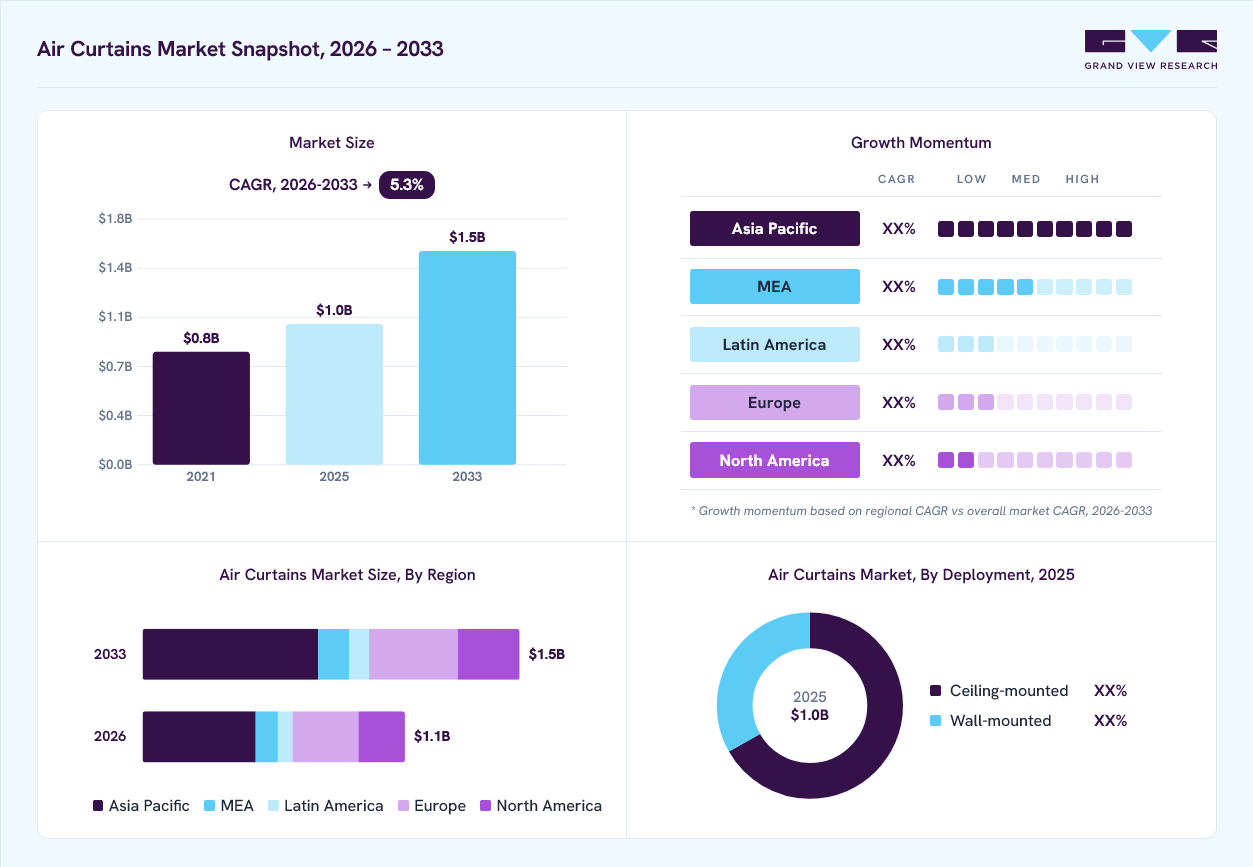 Source: Grand View Research, IR Documents, Primary Interviews, Paid DatabasesTo learn more about this report,
 Download Free Sample Report
Key Market Trends & Insights
- By airflow: 500 to 1000 m3/h segment held the largest market share of 42.1% in 2025.
- By distribution channel: Retail stores segment held the largest market share of 46.8% in 2025.
- By deployment: Ceiling-mounted segment held the largest market share of 66.7% in 2025.
- By application: Commercial segment held the largest market share of 49.7% in 2025.
Regional Highlights
- Largest regional market: Asia Pacific (42.8% revenue share, 2025)
- By country: China held the largest market share in 2025.
Market Size & Forecast
- Market size in 2025: USD 1.0 Billion
- Estimated market size in 2026: USD 1.1 Billion
- Projected market size by 2033: USD 1.5 Billion
- CAGR (2026-2033): 5.3%
Three ways to get this report
Buy it, customize it, or ask a question.Ask an Analyst
Analyst response in 1 business day
- AccessReport author, directly
- Reply timeWithin 1 working day
- No sales callDirect answer only
- FormatEmail reply
- CostFree, no cost
Get the Full Report
What the study covers
- FormatsPDF · Excel · Dashboard
- Timeline2026–2033 annual, 2025 base
- Coverage20+ countries, 5 regions
- Companies10+ key players profiled
Customize the Report
20% free customization
- IncludeCountries, segments, points
- TailorTo your product definition
- ExtendDeeper competitor detail
- OrA fully bespoke study
- Turnaround5–10 working days
Air curtains help maintain indoor air temperature, reducing HVAC load and energy costs. Rising environmental awareness and stringent energy-saving regulations are further boosting adoption. Another key driver is the heightened focus on hygiene and air quality across healthcare, food processing, and retail sectors. Air curtains act as a barrier against dust, insects, and pollutants, enhancing cleanliness and comfort. Technological advancements like sensor-based and automatic air curtains are gaining traction. Additionally, government mandates for air handling in public infrastructure are supporting market expansion. To learn more about this report, Download Free Sample Report
Market Dynamics
The global air curtains market is influenced by increasing emphasis on energy efficiency, indoor air quality, and climate control across commercial, industrial, and institutional facilities. Growing adoption of air curtains in retail stores, hospitality, healthcare, food processing, and cold storage environments is strengthening product demand by minimizing conditioned air loss while maintaining hygienic and comfortable indoor spaces. Continuous advancements in motor efficiency, sensor-based automation, and low-noise operation are expanding application potential in both new installations and retrofit projects. At the same time, stringent building energy regulations and sustainability initiatives are encouraging the integration of air curtains into modern building designs. However, relatively high installation costs and limited awareness among small commercial establishments may restrict wider adoption in price-sensitive markets.
The growing focus on reducing energy consumption in commercial and industrial buildings is accelerating the adoption of air curtains. By minimizing the exchange of conditioned indoor air with the outside environment, air curtains reduce HVAC energy losses while maintaining stable indoor temperatures. Their ability to improve occupant comfort, lower operating costs, and support compliance with green building standards is expanding deployment across retail stores, airports, healthcare facilities, warehouses, and hospitality establishments.
The relatively high capital cost of air curtain systems, along with installation and maintenance requirements, remains a challenge for wider market penetration. Small commercial establishments and budget-conscious end users often prioritize lower-cost alternatives, particularly in developing economies. In addition, improper sizing or installation can reduce system effectiveness, discouraging adoption where technical expertise is limited.
Increasing demand for contamination control, insect prevention, and temperature separation in healthcare facilities, food processing plants, pharmaceutical manufacturing, and cold storage facilities is creating new opportunities for the air curtains market. At the same time, the integration of air curtains with smart building management systems, occupancy sensors, and energy monitoring platforms is enhancing operational efficiency, supporting broader adoption in modern commercial and industrial infrastructure.
Market Concentration & Characteristics
The industry is moderately fragmented, with the presence of numerous regional and international players. While a few major companies hold significant market shares, a large number of smaller firms cater to niche or regional demands. Innovation and customization differentiate many of these players, preventing dominance by a single entity. This competitive landscape fosters continuous product development and pricing pressure.
The market experiences a moderate to high degree of innovation, driven by the need for energy efficiency and enhanced indoor air quality. Manufacturers are integrating IoT and automation to improve performance and user control. Innovation is also focused on noise reduction and aesthetic design for commercial settings. These advancements help companies differentiate in a competitive landscape.
 To learn more about this report, Download Free Sample Report
The level of M&A activity in the air curtains market is moderate, with companies seeking strategic expansion and technology acquisition. Larger players often acquire smaller regional firms to strengthen distribution networks. M&A also facilitates diversification into HVAC and related climate control segments. These consolidations help firms enhance market presence and product portfolios.
Government regulations around energy efficiency and building codes significantly impact the air curtains market. Compliance with environmental and safety standards drives product innovation and material selection. In many regions, incentives for green buildings encourage the adoption of air curtains. Manufacturers must continually adapt to evolving regulatory frameworks to stay competitive.
Analyst Perspective
The air curtains market is experiencing steady growth, driven by increasing demand for energy-efficient building operations, improved indoor air quality, and effective environmental separation at entrances. Adoption is rising across retail, healthcare, hospitality, warehousing, and cold storage facilities, where air curtains help reduce conditioned air loss and limit the entry of dust, insects, and airborne contaminants. Growing emphasis on sustainable buildings and energy regulations is accelerating demand for advanced systems with EC motors, automatic sensors, smart controls, and HVAC integration. Manufacturers offering efficient, reliable, and application-specific air curtain solutions are expected to benefit from sustained long-term market opportunities.
Airflow Insights
Based on airflow, the 500 to 1000 m3/h segment led the market with the largest revenue share of 42.1% in 2025, due to its versatility in small-to-medium commercial spaces such as retail stores, restaurants, and office entrances. These units balance performance and energy efficiency, making them a popular choice among cost-conscious buyers. Their ease of installation and suitability for a variety of door sizes further support their widespread use. Increasing awareness of indoor air management and temperature control boosts demand in this segment.
Air curtains with 1000 to 1500 m³/h capacity are gaining traction in larger commercial environments like supermarkets, hospitals, and warehouses. Their higher airflow makes them ideal for maintaining strong air barriers in wider or taller doorways. Growing investment in large-scale infrastructure and emphasis on HVAC efficiency are fueling this segment’s growth. The trend toward automation and energy-saving solutions also contributes to its rising popularity.
Distribution Channel Insights
Based on distribution channel, the retail stores segment led the market with the largest revenue share of 46.8% in 2025, owing to immediate product availability and personalized customer service. Many consumers still prefer physical inspection before purchasing ventilation equipment. Established brand presence and after-sales support through retail networks enhance trust. These outlets also benefit from walk-in traffic and upselling opportunities.
The online segment is the fastest-growing distribution channel due to rising digitalization and expanding e-commerce platforms. Customers prefer online channels for convenience, wider product selection, and transparent pricing. Manufacturers are also focusing on direct-to-consumer models, boosting online sales. The pandemic accelerated this shift, which continues post-COVID due to sustained consumer behavior changes.
Deployment Insights
Based on deployment, the ceiling-mounted segment led the market with the largest revenue share of 66.7% in 2025. Ceiling-mounted air curtains dominate the market due to their seamless integration into modern commercial and industrial interiors. They offer space-saving advantages, making them ideal for high-traffic areas like malls, airports, and hospitals. These systems provide efficient airflow without obstructing entryways or aesthetics.
Wall-mounted air curtains are witnessing rapid growth due to their flexibility and ease of installation, especially in compact or retrofit applications. They are increasingly used in small retail stores, restaurants, and service entrances where ceiling space is limited. The growing trend of upgrading older buildings with minimal structural changes supports demand. Additionally, cost-effectiveness and straightforward maintenance are driving their adoption.
Application Insights
Based on application, the commercial segment led the market with the largest revenue share of 49.7% in 2025 due to high deployment in retail outlets, shopping malls, hotels, and office buildings. These establishments prioritize indoor comfort, energy efficiency, and hygiene, which air curtains effectively support. Constant foot traffic in commercial spaces makes air barrier solutions essential for climate control. Additionally, increasing adoption of smart and aesthetically integrated HVAC systems fuels segment growth.
 To learn more about this report, Download Free Sample Report
The industrial segment is growing rapidly due to rising awareness of temperature regulation and contamination control in manufacturing units, warehouses, and cold storage facilities. Air curtains help reduce energy costs by maintaining stable internal environments, especially at loading docks and service doors. Strict regulatory standards for hygiene and air quality in industries like food processing and pharmaceuticals also drive adoption. Expansion of logistics and warehousing infrastructure further accelerates demand.
Regional Insights
North America air curtains market is expected to grow at a significant CAGR of 4.1%, driven by stringent energy efficiency regulations and rising concerns over indoor air quality. The U.S. and Canada are investing in advanced HVAC systems across the commercial and healthcare sectors. High adoption of smart technologies and automation accelerates market expansion. Renovation of aging infrastructure also contributes to rising demand.
U.S. Air Curtains Market Trends
The air curtains market in the U.S. accounted for 70.5% share, due to strong regulatory frameworks promoting energy efficiency and indoor air quality. High usage in commercial buildings like supermarkets, hospitals, and cold storage facilities supports demand.
Mexico air curtains market is supported by rapid urban development and growing investments in commercial infrastructure. Rising focus on improving indoor environments and managing energy use is encouraging adoption. Demand is particularly strong in retail, hospitality, and healthcare sectors.
Europe Air Curtains Market Trends
The air curtains market in Europe is growing steadily due to strict environmental standards and the region’s focus on sustainable construction. Countries like Germany, the UK, and France are integrating air curtains into modern building designs. Emphasis on energy savings and occupant comfort drives adoption. Government-backed retrofitting programs also enhance market penetration.
Germany air curtains market dominates the European region due to its strong emphasis on energy conservation and sustainable building practices. The widespread implementation of environmental standards has led to increased use of energy-efficient ventilation systems. The country’s well-developed commercial and industrial sectors further support consistent demand. Renovation of older buildings to meet new efficiency goals also contributes to market leadership.
The air curtains market in the UK is driven by rising investment in modern HVAC technologies across sectors like retail, healthcare, and logistics. Updated building regulations and energy-saving targets are pushing more businesses to adopt air curtains.
Asia Pacific Air Curtains Market Trends
Asia Pacific dominated the air curtains market with the largest revenue share of 42.8% in 2025 in the global air curtains market, fueled by rapid urbanization, infrastructure development, and rising demand for energy-efficient solutions. Countries like China, India, and Japan are investing heavily in commercial and industrial projects. Government initiatives promoting green buildings further boost market growth. Increasing awareness of indoor air quality also supports widespread adoption.
 To learn more about this report, Download Free Sample Report
The air curtains market in China held the largest share in the Asia Pacific region in 2025. China air curtains market dominates the Asia Pacific due to extensive urban development and continuous investment in commercial and industrial infrastructure. Government initiatives promoting energy efficiency and better indoor air management have accelerated adoption. High demand from sectors like retail, healthcare, and food processing supports market strength.
The air curtains market in India is witnessing strong market growth, supported by expanding sectors such as retail, hospitality, healthcare, and logistics. Rising awareness of energy-efficient solutions and indoor air quality is driving adoption across urban centers. Increased construction activity and infrastructure upgrades are also contributing to market momentum.
Middle East & Africa Air Curtains Market Trends
The air curtains market in the Middle East & Africa is experiencing moderate growth, fueled by increasing investments in commercial complexes and public infrastructure. The hot climate drives demand for temperature control solutions like air curtains. Countries like the UAE and Saudi Arabia are incorporating advanced HVAC systems in large-scale projects. Gradual economic development and urbanization support market expansion.
Saudi Arabia air curtains market dominates the Middle East & Africa due to its expanding commercial and industrial infrastructure. The country’s extreme climate creates a high demand for efficient cooling and air management solutions. Major projects in sectors like retail, hospitality, and logistics are driving installations. Additionally, sustainability goals under Vision 2030 are encouraging wider adoption of energy-efficient technologies like air curtains.
Latin America Air Curtains Market Trends
The air curtains market in Latin America is supported by expanding commercial infrastructure and increasing awareness of energy-efficient technologies. Countries like Brazil and Mexico are investing in retail, hospitality, and healthcare sectors. Rising urban population and improved construction activities contribute to demand. However, cost sensitivity slightly restrains wider adoption.
Brazil air curtains market is supported by growth in the retail, food service, and healthcare industries. Increasing focus on maintaining indoor air quality and reducing energy consumption is boosting demand. Ongoing urban development and commercial construction are creating more opportunities for air curtain installations. Rising awareness of efficient HVAC solutions is also contributing to the country's strong market position.
Key Air Curtains Company Insights
Key players operating in the air curtains market are undertaking various initiatives to strengthen their presence and increase the reach of their products and services. Strategies such as expansion activities and partnerships are key in propelling the market growth.
Key Air Curtains Companies:
The following key companies have been profiled for this study on the air curtains market.
-
Panasonic Corporation
-
Airtecnics
-
Thermoscreens
-
Solar and Palau
-
Frico AB
-
Mars Air Systems.
-
Meech International
-
Novovent
-
Systemair.
-
TPI Corporation
-
Envirotec Ltd.
-
Powered Aire Inc.
-
Biddle Air Systems Ltd.
-
VTS Group
-
Aleco
Competitive Benchmarking
Category
Operating Strategies
Competitive Edge
Weakness
Established Players (e.g., Panasonic Corporation, Systemair AB, Frico AB, Berner International LLC, Mars Air Systems, Biddle Air Systems, Soler & Palau Ventilation Group)
- Focus on expanding global distribution networks and strengthening partnerships with HVAC contractors, distributors, and building solution providers.
- Invest in energy-efficient, low-noise, and smart air curtain technologies while expanding product portfolios for commercial, industrial, and institutional applications.
- Extensive manufacturing capabilities, established global distribution networks, and broad product portfolios serving multiple end-use industries.
- Strong brand recognition, proven product reliability, advanced engineering expertise, and comprehensive after-sales service capabilities.
- High manufacturing and operating costs associated with continuous product innovation and global operations.
- Longer product development cycles and organizational complexity can reduce responsiveness to rapidly changing regional market requirements.
Emerging & Regional Players (e.g., Airtecnics, Thermoscreens, Powered Aire Inc.)
- Focus on customized air curtain solutions for niche commercial and industrial applications while strengthening regional distribution channels.
- Leverage application-specific innovation, customer collaborations, and competitive pricing to expand market presence and improve customer acquisition.
- Greater flexibility in developing customized products tailored to local building requirements and specialized applications.
- Faster product development cycles, responsive customer support, and strong expertise in regional markets.
- Limited manufacturing capacity and financial resources compared to multinational competitors.
- Lower global brand recognition and narrower international distribution networks, restricting expansion into large-scale global projects.
Recent Developments
-
In May 2025, Airtècnics introduced three new air curtain models tailored for cold storage rooms and industrial freezers. These solutions enhance climate separation, minimize thermal loss, and boost energy efficiency. Designed to prevent warm air infiltration, they help maintain optimal storage conditions, reduce moisture buildup, and prevent ice formation-ultimately improving refrigeration system performance and safety.
-
January 2024, Thermoscreens launched a new IP66-rated air curtain, specifically designed for harsh and hygiene-sensitive environments such as food processing plants and washdown areas. The unit provides full protection against dust and powerful water jets, ensuring reliable performance in demanding conditions. It helps maintain climate control while supporting strict cleanliness standards. This product reflects Thermoscreens’ focus on delivering robust and efficient air management solutions for industrial applications.
Air Curtains Market Report Scope
Report Attribute
Details
Market size in 2025
USD 1.0 billion
Estimated market size in 2026
USD 1.1 billion
Projected market size by 2033
USD 1.5 billion
Growth rate
CAGR of 5.3% from 2026 to 2033
Base year for estimation
2025
Historical data
2021 - 2024
Forecast period
2026 - 2033
Quantitative units
Revenue in USD billion and CAGR from 2026 to 2033
Report coverage
Revenue forecast, company ranking, competitive landscape, growth factors, and trends
Segments covered
Airflow, distribution channel, deployment, application, region
Regional scope
North America; Europe; Asia Pacific; Latin America; Middle East & Africa
Country scope
U.S.; Canada; Mexico; UK; Germany; France; Spain; Italy; China; Japan; India; Australia; South Korea; Brazil; Argentina; Saudi Arabia; South Africa; UAE
Key companies profiled
Airtecnics; Frico AB; Mars Air Systems; Biddle Air Systems; Thermoscreens; Berner International LLC; Powered Aire Inc.; Systemair AB; Soler & Palau Ventilation Group (S&P); Panasonic Corporation.
Customization scope
Free report customization (equivalent up to 8 analysts' working days) with purchase. Addition or alteration to country, regional & segment scope.
Pricing and purchase options
Avail customized purchase options to meet your exact research needs. Explore purchase options
Global Air Curtains Market Report Segmentation
This report forecasts revenue growth at global, regional, and country levels and provides an analysis of the latest industry trends in each of the sub-segments from 2021 to 2033. For this study, Grand View Research has segmented the global air curtains market report based on airflow, distribution channel, deployment, application, and region:
-
Airflow Outlook (Revenue, USD Million, 2021 - 2033)
-
Up to 500 m3/h
-
500 to 1000 m3/h
-
1000 to 1500 m3/h
-
Above 1500 m3/h
-
-
Distribution Channel Outlook (Revenue, USD Million, 2021 - 2033)
-
Online
-
Retail Stores
-
Wholesale Stores
-
Others
-
-
Deployment Outlook (Revenue, USD Million, 2021 - 2033)
-
Wall-mounted
-
Ceiling-mounted
-
-
Application Outlook (Revenue, USD Million, 2021 - 2033)
-
Residential
-
Commercial
-
Industrial
-
-
Regional Outlook (Revenue, USD Million, 2021 - 2033)
-
North America
-
U.S.
-
Canada
-
Mexico
-
-
Europe
-
Germany
-
France
-
Italy
-
Spain
-
UK
-
-
Asia Pacific
-
China
-
India
-
Japan
-
South Korea
-
Australia
-
-
Latin America
-
Brazil
-
Argentina
-
-
Middle East and Africa
-
Saudi Arabia
-
UAE
-
South Africa
-
-
Research Methodology
The air curtains market figures in this report are based on a proven research process that combines executive interviews with secondary research from proprietary databases, company filings, and recognized regulatory and institutional sources. Market size is built through value-chain sizing - reconciling supply-side and demand-side estimates - and triangulated with bottom-up and top-down approaches. Every estimate passes multiple levels of expert validation before publication, with each air curtains segment quantified using the revenue-capture definitions in the table below.
Segment Definition
Segment - Airflow
Revenue Capture Definition
Up to 500 m³/h
Revenue generated from the sale of air curtains with airflow capacity up to 500 m³/h, primarily designed for small entrances in residential properties, offices, and compact retail outlets.
500 to 1000 m³/h
Revenue generated from the sale of air curtains with airflow capacity ranging from 500 to 1,000 m³/h, widely used across medium-sized commercial establishments, restaurants, and healthcare facilities.
1000 to 1500 m³/h
Revenue generated from the sale of air curtains with airflow capacity between 1,000 and 1,500 m³/h, suitable for larger commercial entrances, supermarkets, warehouses, and institutional buildings.
Above 1500 m³/h
Revenue generated from the sale of air curtains with airflow capacity exceeding 1,500 m³/h, intended for large industrial facilities, logistics centers, manufacturing plants, airports, and high-traffic entrances.
Segment - Distribution Channel
Revenue Capture Definition
Online
Revenue generated from the sale of air curtains through e-commerce platforms, manufacturer websites, and online industrial equipment distributors.
Retail Stores
Revenue generated from the sale of air curtains through retail outlets, home improvement stores, and HVAC equipment showrooms.
Wholesale Stores
Revenue generated from the sale of air curtains through wholesalers and distributors supplying HVAC contractors, builders, and commercial buyers.
Others
Revenue generated from the sale of air curtains through direct manufacturer sales, system integrators, project-based procurement, and authorized dealer networks.
Segment - Deployment
Revenue Capture Definition
Wall-mounted
Revenue generated from the sale of wall-mounted air curtains installed above doorways to provide efficient air separation across commercial, industrial, and institutional facilities.
Ceiling-mounted
Revenue generated from the sale of ceiling-mounted or concealed air curtains designed for seamless integration into suspended ceilings in commercial buildings, hospitality facilities, and premium retail spaces.
Segment - Application
Revenue Capture Definition
Residential
Revenue generated from the sale of air curtains for residential applications, including homes, apartments, and private residential complexes requiring improved indoor climate control.
Commercial
Revenue generated from the sale of air curtains for commercial applications, including retail stores, shopping malls, hotels, restaurants, offices, hospitals, and educational institutions.
Industrial
Revenue generated from the sale of air curtains for industrial applications, including manufacturing facilities, warehouses, cold storage units, logistics centers, food processing plants, and pharmaceutical production sites.
Estimation Model
Layer Name
Key Question
Description
Building Entrance & Climate Control Demand Layer
Where are air curtains required?
Analyze demand across commercial buildings, retail stores, supermarkets, healthcare facilities, hospitality, industrial facilities, warehouses, cold storage, and transportation hubs. Assess entrance frequency, indoor climate control requirements, energy conservation needs, and hygiene requirements to establish the addressable demand for air curtains.
Construction & Building Modernization Layer
Where is new equipment demand being created?
Evaluate investments in commercial construction, industrial infrastructure, retail expansion, cold chain facilities, healthcare projects, and building renovation activities. Assess greenfield developments, HVAC upgrades, and energy-efficiency initiatives that drive procurement of new air curtains.
Product Adoption Layer
Which air curtain products and channels are being used to deploy the air curtains?
Segment demand by airflow, deployment, application, and distribution channel. Apply adoption rates based on entrance dimensions, building occupancy, energy efficiency requirements, hygiene standards, and HVAC system integration. Assess the increasing adoption of automatic sensor-based controls, EC motors, and energy-efficient air curtain systems to improve operational performance and reduce energy consumption.
Revenue Generation Layer
How much market revenue is generated?
Estimate annual shipments of air curtains by airflow, deployment, application, and region. Quantify revenues generated exclusively from the sale of new air curtains supplied to commercial, industrial, and institutional customers through OEMs, distributors, and HVAC contractors.
Delivered Customizations
This report has been delivered with the following In-depth customizations
Client Request
Customization Delivered
Value Adds
Competitive Benchmarking
A competitive benchmarking analysis was conducted by evaluating established air curtain manufacturers based on product portfolio, air velocity performance, energy efficiency, technological capabilities, manufacturing footprint, distribution network, strategic initiatives, financial strength, innovation focus, and competitive positioning within the air curtains market.
This benchmarking enabled stakeholders to assess competitive strengths, identify product and technology differentiation opportunities, understand evolving market strategies, and develop effective competitive positioning and growth strategies across commercial, industrial, and institutional applications.
Regional Segmentation
A comprehensive regional analysis was provided across major markets, highlighting demand patterns, construction activity, energy efficiency regulations, manufacturing ecosystems, climate conditions, and end-use industry adoption influencing the air curtains market. The assessment also evaluated the contribution of major countries to regional market performance.
The regional insights enabled stakeholders to identify high-growth markets, optimize expansion strategies, allocate investments efficiently, and tailor product portfolios to regional building standards, climate requirements, and industry-specific demand.
Opportunity Assessment
A detailed opportunity assessment was conducted by evaluating emerging application areas, advancements in energy-efficient and sensor-enabled air curtain systems, evolving end-user requirements, and investment trends across the air curtains market. The analysis identified high-growth opportunities across commercial buildings, healthcare facilities, food processing plants, cold storage, transportation hubs, and smart building infrastructure.
This assessment enabled stakeholders to prioritize high-potential investment opportunities, align product development with evolving customer requirements, strengthen innovation strategies, and capitalize on expanding demand for energy-efficient, hygienic, and automated entrance climate control solutions.
Frequently Asked Questions About This Report
Asia Pacific dominated the air curtains market with a 42.8% revenue share in 2025.
Asia Pacific is anticipated to be one of the fastest-growing regional markets over the forecast period, driven by rapid urbanization, expanding commercial construction, increasing investments in retail and hospitality infrastructure, and growing awareness of energy-efficient building solutions.
The ceiling-mounted segment accounted for the largest revenue share of 66.7% in 2025.
The retail stores segment accounted for the largest revenue share of 46.8% in 2025.
The global air curtains market size was valued at USD 1.0 billion in 2025 and is estimated at USD 1.1 billion for 2026.
The global air curtains market is expected to grow at a CAGR of 5.3% from 2026 to 2033, reaching USD 1.5 billion by 2033.
Some of the key players operating in the global air curtains market include Airtecnics; Frico AB; Mars Air Systems; Biddle Air Systems; Thermoscreens; Berner International LLC; Powered Aire Inc.; Systemair AB; Soler & Palau Ventilation Group (S&P); Panasonic Corporation.
The global air curtains market is primarily driven by the growing emphasis on energy conservation and the need to maintain indoor air quality in buildings. Increasing urban development, commercial expansion, and the adoption of smart HVAC technologies further support market growth.
Commercial segment accounted for a share of 49.7% in 2025 due to high deployment in retail outlets, shopping malls, hotels, and office buildings. These establishments prioritize indoor comfort, energy efficiency, and hygiene, which air curtains effectively support. Constant foot traffic in commercial spaces makes air barrier solutions essential for climate control.
About the Author(s)
Advanced Interior Materials Research Team
Advanced Materials · Advanced Interior MaterialsThis report was authored by the advanced interior materials research team at Grand View Research - comprising two research analysts, one senior research analyst, and one industry expert - with specialized expertise in the advanced interior materials segment of the advanced materials industry. All findings are based on proprietary advanced materials databases, executive interviews, and regulatory analysis, subject to internal peer review prior to publication.
Last Updated:
Speak to Analyst

Customize this report to your needs - add regions, segments, or data points, with 20% free customization.
Or view our licence options:


ISO 9001:2015 & 27001:2022 Certified
We are GDPR and CCPA compliant! Your transaction & personal information is safe and secure. For more details, please read our privacy policy.


