
- Home
- »
- Advanced Interior Materials
- »
-
Air Diffusers Market Size, Share & Trends Report, 2026-2033GVR Report cover
![Air Diffusers Market (2026 - 2033)Report]()
Air Diffusers Market (2026 - 2033)
Size, Share & Trends Analysis Report By Product (Ceiling Diffusers, Wall Diffusers, Floor Diffusers) By Type (Electronic Diffusers, Thermal Diffusers), By End-use, By Distribution Channel, By Application, By Region, And Segment Forecasts
Market Size, 2025
$2.2BMarket Estimate, 2026
$2.4BMarket Forecast, 2033
$3.2BCAGR, 2026–2033
4.4%Air Diffusers Market Summary
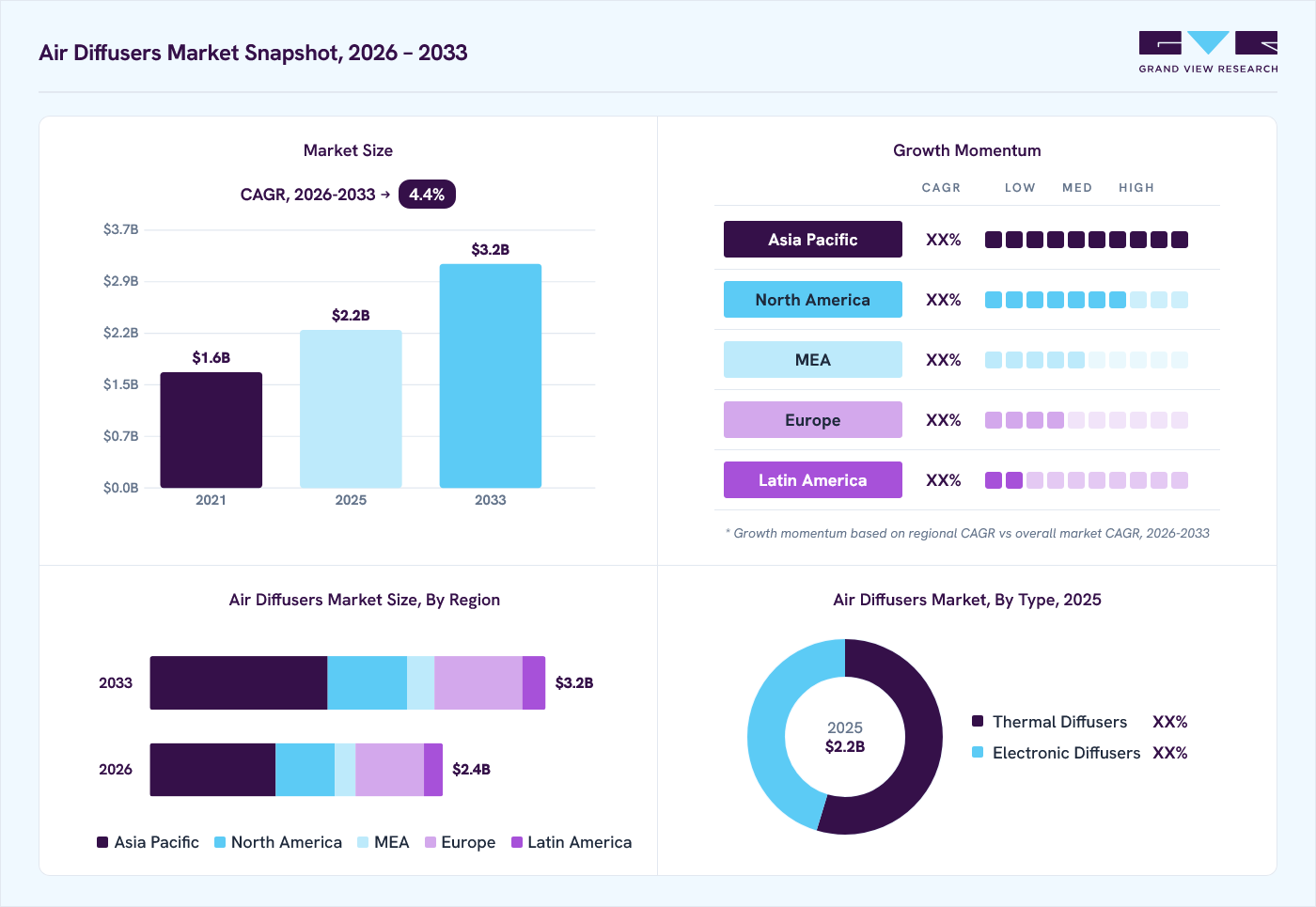
The global air diffusers market size was valued at USD 2.2 billion in 2025 and is projected to grow from USD 2.4 billion in 2026 to USD 3.2 billion by 2033, growing at a CAGR of 4.4% from 2026 to 2033. Asia Pacific dominated the market, accounting for the largest global share of 42.6% in 2025. Market growth is primarily driven by the increasing demand for enhanced indoor air quality, energy-efficient HVAC systems, and wellness-oriented living environments.
Key Market Trends & Insights
- By type: Thermal diffusers segment held the largest revenue share of 54.7% in 2025.
- By product: Ceiling diffusers segment held the largest revenue share of 29.8% in 2025.
- By distribution channel: Retail stores segment held the largest share of 45.7% in 2025.
- By application: New installation segment held the largest revenue share of 58.0% in 2025.
- By end-use: Commercial segment held the largest revenue share of 50.4% in 2025.
Regional Highlights
- Largest regional market: Asia Pacific (42.6% revenue share, 2025)
- By country: China held the largest share of Asia Pacific in 2025.
Market Size & Forecast
- Market size in 2025: USD 2.2 Billion
- Estimated market size in 2026: USD 2.4 Billion
- Projected market size by 2033: USD 3.2 Billion
- CAGR (2026-2033): 4.4%
The rising adoption of smart home technologies and growing awareness of environmental sustainability are further fueling innovation in diffuser design, materials, and automation capabilities. These factors are contributing to the broader integration of advanced air diffusers in both residential and commercial applications.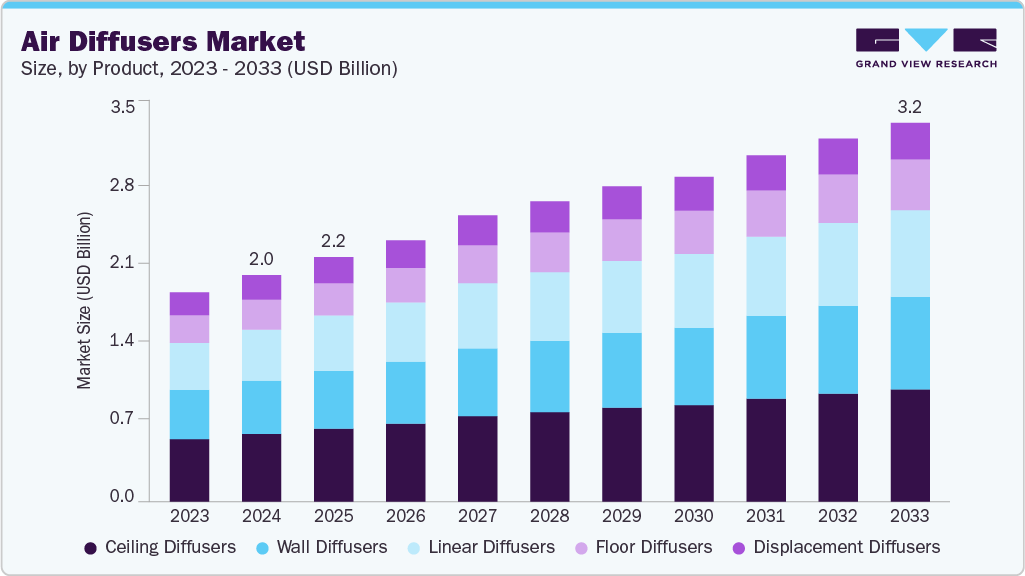
Technological advancements are significantly transforming the market. Modern smart diffusers come equipped with features such as app connectivity, programmable timers, voice control, and customizable settings, allowing users to conveniently manage air quality and scent levels. These innovations not only enhance user experience but also promote energy efficiency and sustainability. As consumers increasingly seek smart and connected home solutions, such advanced diffusers are gaining strong traction, especially among tech-savvy and eco-conscious buyers.
Market Dynamics
The air diffusers market is driven by growing demand for efficient HVAC systems across commercial, residential, healthcare, and industrial buildings. Increasing construction activities, urbanization, and investments in energy-efficient infrastructure are supporting market growth. Demand for improved indoor air quality and ventilation performance is encouraging adoption of advanced air distribution solutions. However, fluctuations in construction spending and high installation costs may affect market expansion. Technological advancements in smart HVAC systems and green building initiatives are creating new opportunities for air diffuser manufacturers globally.
Modern air diffusers help optimize airflow distribution, reduce energy consumption, and improve occupant comfort by enhancing HVAC system performance. Governments and building owners are investing in energy-efficient infrastructure to meet sustainability goals and lower operating costs. Growing adoption of green building standards and energy conservation regulations is further supporting demand for advanced air diffusers in commercial offices, healthcare facilities, educational institutions, and residential buildings worldwide.
Replacing or upgrading existing air distribution systems often requires modifications to ceilings, ductwork, and HVAC infrastructure, increasing project expenses. Small businesses and budget-conscious building owners may delay upgrades due to the associated capital investment. In older buildings, installation complexity can further raise labor and maintenance costs. These factors can limit the adoption of advanced air diffusers, particularly in cost-sensitive markets and renovation projects.
The rapid growth of smart buildings and increasing emphasis on indoor air quality present significant opportunities for the air diffusers market. Building operators are adopting intelligent HVAC systems that optimize airflow, temperature control, and ventilation performance. Advanced air diffusers integrated with sensors and automated building management systems help improve occupant comfort while enhancing energy efficiency. Rising awareness of health and wellness in indoor environments, particularly in healthcare, commercial, and educational facilities, is expected to accelerate demand for innovative air diffuser solutions in the coming years.
Market Concentration & Characteristics
The global air diffusers industry is moderately fragmented, with a few key global players dominating through technological leadership, innovation, and strong service networks. Leading companies drive growth through innovation, partnerships, and acquisitions, but the presence of numerous regional and local manufacturers sustains strong competition. The market’s structure reflects a balance between established global brands and emerging players, creating opportunities for differentiation through technology, design, and sustainability initiatives. For instance, in May 2025,Aroma Amplifier launched its innovative, eco-friendly aromatherapy diffuser, introducing a cordless solution for natural, toxin-free home wellness. Designed to combat synthetic scents and sensory overload, the diffuser uses pure essential oils to promote focus, calm, and relaxation. With a commitment to sustainability and mindful living, Aroma Amplifier offers consumers a healthier, chemical-free alternative for enhancing their indoor environment.
The market exhibits a high degree of innovation, driven by rising demand for energy efficiency, indoor air quality, and wellness solutions. Manufacturers are introducing advanced features such as smart controls, customizable airflow, noise reduction, and IoT integration. Eco-friendly technologies and aesthetic enhancements also play a key role, as consumers seek both functionality and style in diffusers.
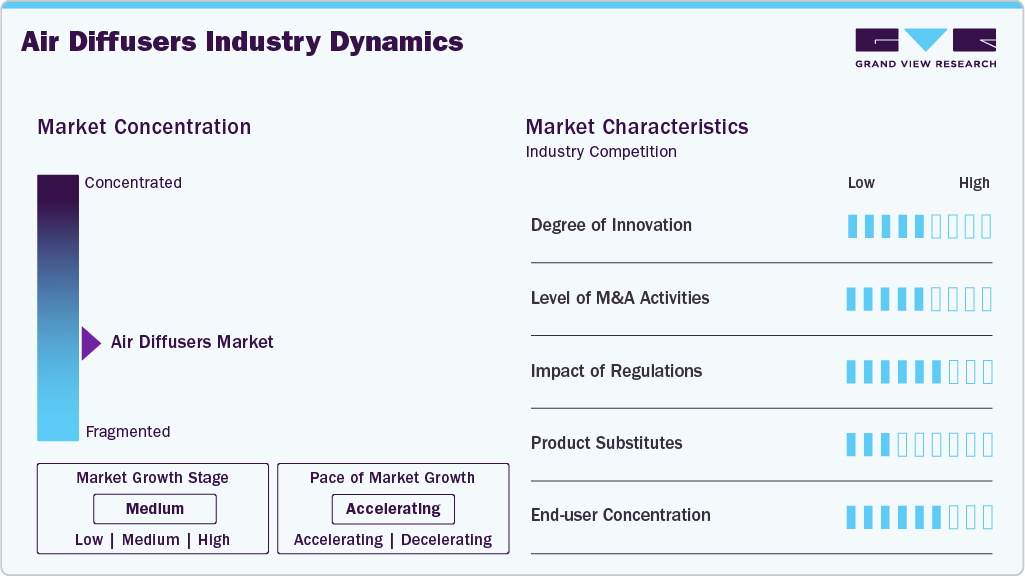
The market has experienced steady merger and acquisition activity, as companies aim to strengthen their product portfolios, expand geographic presence, and enhance technological capabilities. Larger players often acquire regional manufacturers or innovative startups to gain a competitive edge and tap into emerging market segments. For instance, in July 2024, Bosch acquired the global HVAC business of Johnson Controls-Hitachi for USD 8 billion, marking its largest acquisition ever. This move significantly strengthens Bosch’s position in the HVAC market, expanding its reach in residential and light commercial sectors and enhancing its capabilities in heating, ventilation, and air conditioning solutions.
Regulations are shaping the market by driving manufacturers to develop products that meet stricter indoor air quality, energy efficiency, and environmental standards. Governments and regulatory bodies are promoting low-emission, eco-friendly designs and encouraging the adoption of diffusers that support sustainable building practices. These requirements are pushing innovation and ensuring safer, healthier indoor environments across residential, commercial, and industrial applications.
Analyst Perspective
The air diffuser market is expected to grow steadily due to increasing demand for energy-efficient HVAC systems, rising construction activity, and greater emphasis on indoor air quality. Commercial buildings, healthcare facilities, educational institutions, and residential projects are driving installation demand. Manufacturers are focusing on innovative diffuser designs that improve airflow performance, reduce noise levels, and support smart building integration. Asia Pacific is expected to lead market growth due to rapid urbanization and infrastructure development, while North America and Europe benefit from renovation projects and stringent energy-efficiency regulations.
Product Insights
Based on product, the ceiling diffusers segment led the market with the largest revenue share of 29.8% in 2025. Their ability to distribute air evenly while maintaining aesthetic appeal makes them a preferred choice for modern HVAC systems. Demand is further driven by their compatibility with energy-efficient and green building designs, supporting better indoor air quality.
The wall diffusers segment is growing rapidly as compact spaces, modular construction, and renovation projects seek flexible air distribution solutions. Their ease of installation, especially in retrofits or buildings with limited ceiling space, boosts their adoption. Wall diffusers are increasingly favored in residential, hospitality, and small commercial settings, where efficient, targeted airflow and aesthetic integration are essential.
Type Insights
Based on type, the thermal diffusers segment led the market with the largest revenue share of 54.7% in 2025. Widely used in commercial buildings, offices, and industrial spaces, these diffusers ensure uniform airflow without complex controls. Their reliability, low maintenance, and compatibility with sustainable building standards make them a preferred choice in large-scale HVAC applications.
The electronic diffusers segment is growing rapidly due to rising demand for smart, programmable air distribution solutions. These diffusers enable precise control of airflow, temperature, and air quality through sensors and automation. Increasing adoption of smart home and building technologies, along with a focus on customization and energy efficiency, is driving the popularity of electronic diffusers across both residential and commercial sectors.
Distribution Channel Insights
Based on distribution channel, the retail stores segment led the market with the largest revenue share of 45.7% in 2025. Retail outlets offer a wide variety of designs and brands, catering to both residential and small business buyers. Personalized assistance, immediate availability, and the ability to compare products on-site strengthen retail stores’ leadership in this market segment.
The wholesale stores segment is expected to grow due to rising bulk demand from contractors, builders, and commercial project developers. Wholesale channels provide cost advantages, streamlined procurement, and large inventory options that appeal to businesses managing large-scale installations.
Application Insights
Based on application, the new installation segment led the market with the largest revenue share of 58.0% in 2025. Builders prefer installing modern, energy-efficient diffusers from the start to meet environmental standards, enhance indoor air quality, and ensure optimal performance, making new installations the leading application in the market.
The replacement segment is growing rapidly as older air diffusers are upgraded to meet modern energy efficiency standards and improve indoor comfort. Rising awareness of air quality, retrofitting of aging buildings, and stricter ventilation regulations drive this trend. Consumers and businesses increasingly choose advanced diffuser models to enhance performance, aesthetics, and compliance with green building practices.
End Use Insights
Based on end-use, the commercial segment led the market with the largest revenue share of 50.4% in 2025 due to high demand from offices, malls, hospitals, airports, and hotels, where large-scale, efficient air distribution is critical. Commercial buildings prioritize indoor air quality, energy efficiency, and compliance with ventilation standards, driving significant investment in advanced air diffusers to ensure comfort, health, and sustainability in these high-traffic, regulated environments.
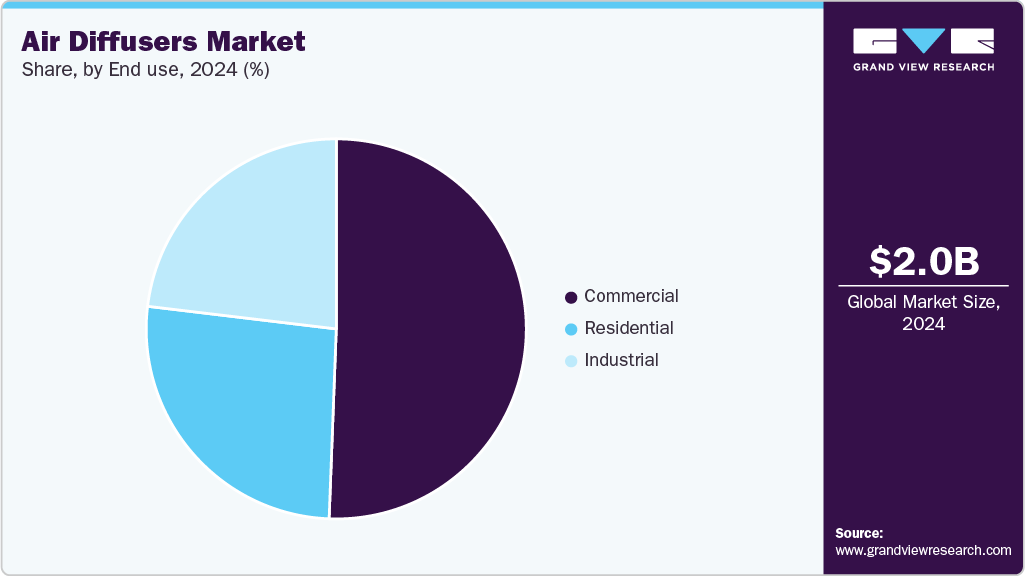
The residential segment is growing rapidly as homeowners increasingly seek better indoor air quality, comfort, and energy-efficient ventilation solutions. Rising urbanization, smart home adoption, and greater awareness of health and wellness contribute to this trend. Modern housing developments and renovations favor stylish, compact diffusers that integrate with HVAC systems, supporting the segment’s accelerated growth across both new and existing homes.
Regional Insights
The North America air diffusers industry is expected to grow at a 4.4% CAGR during the forecast period, driven by rising demand for energy-efficient HVAC systems and wellness-focused products. The region’s strong focus on indoor air quality, sustainable building practices, and smart technologies is driving the adoption of advanced air diffusers. Both commercial and residential sectors are contributing to this expansion, supported by ongoing infrastructure development and renovation activities.
U.S. Air Diffusers Market Trends
The air diffusers industry in the U.S. is expected to grow at a CAGR of 4.1% from 2026 to 2033. U.S. dominates the North America market, driven by increasing adoption of smart homes, green buildings, and wellness solutions. Demand for advanced HVAC systems and aromatherapy diffusers is rising across residential, commercial, and hospitality sectors.
Mexico’s air diffusers industry is growing rapidly due to expanding urbanization, infrastructure development, and rising awareness of indoor air quality. The increasing adoption of modern HVAC systems in residential and commercial buildings, along with a growing preference for affordable and energy-efficient diffusers, is fueling demand. Retail expansion and greater availability of eco-friendly products further support market growth in Mexico.
Europe Air Diffusers Market Trends
The Europe air diffusers industry is witnessing strong growth driven by strict environmental regulations, energy efficiency goals, and widespread adoption of green building practices. Increasing awareness of indoor air quality, coupled with the rise of smart buildings and wellness trends, is boosting demand for advanced, sustainable air diffusers across residential, commercial, and industrial sectors throughout the region.
Germany’s air diffusers industry is growing rapidly as the country focuses on sustainable construction and energy-efficient HVAC systems. Strong government regulations promoting eco-friendly building solutions and indoor air quality drive demand. Both new construction projects and retrofits in commercial and residential spaces are adopting advanced air diffusers to meet high environmental standards and enhance occupant comfort.
The UK’s air diffusers industry is fueled by a rise in residential renovations, smart home adoption, and stricter building regulations focused on ventilation and energy efficiency. Increasing consumer focus on indoor air quality and wellness, along with expanding commercial and hospitality sectors, is further accelerating demand for modern, efficient air diffusers.
Asia Pacific Air Diffusers Market Trends
Asia Pacific dominated the air diffusers market with the largest revenue share of 42.6% in 2025, driven by rising urbanization, expanding construction activities, and increasing focus on indoor air quality. Growing disposable incomes and demand for energy-efficient, smart ventilation solutions further fuel adoption. Additionally, cultural preferences for wellness and aromatherapy encourage the use of both HVAC and aroma diffusers across residential and commercial spaces in the region.
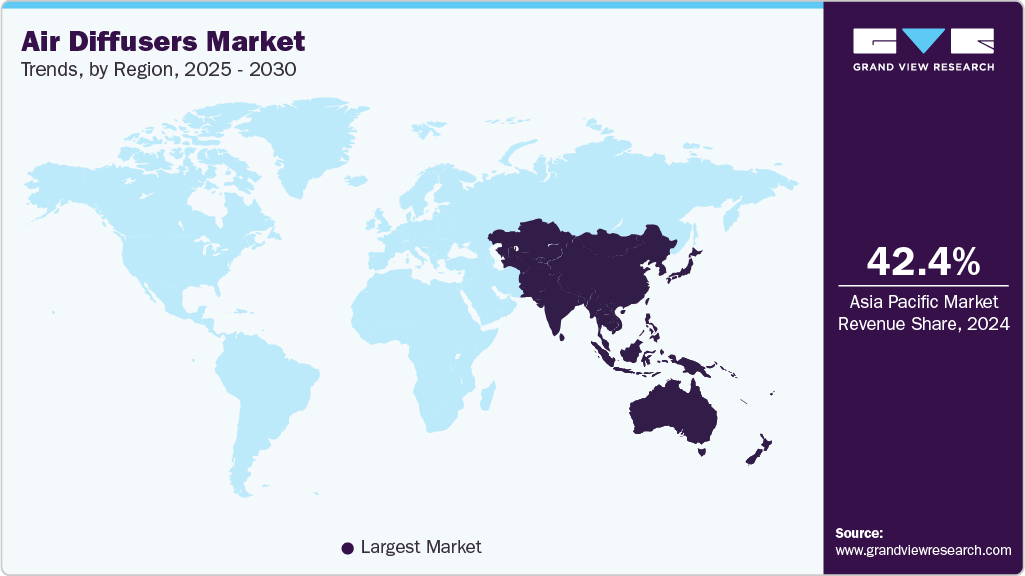
The air diffusers market in the China held the largest share in the Asia Pacific region in 2025, as it is growing rapidly, due to rapid urban development, rising middle-class incomes, and strong demand for modern HVAC systems. Consumers are increasingly seeking smart, energy-efficient, and aesthetically appealing air diffusers for homes and offices. The country’s large-scale construction projects and focus on eco-friendly buildings also contribute to sustained market growth.
The India air diffusers industry is growing rapidly, with risingdemand for better indoor air quality in urban centers and smart cities. Increasing awareness of wellness, the popularity of aromatherapy, and government initiatives for energy-efficient buildings drive adoption. Growth in the residential, commercial, and hospitality sectors, along with wider product availability through retail and e-commerce, further supports market expansion.
Middle East & Africa Air Diffusers Market Trends
The Middle East & Africa air diffusers industry is poised for steady growth over the forecast period due to rapid urbanization, expanding construction activities, and a strong cultural preference for fragrances. Rising awareness of indoor air quality and wellness is boosting demand for both HVAC and aromatherapy diffusers. The region’s hospitality, residential, and commercial sectors are adopting modern, energy-efficient diffusers to enhance comfort and indoor environments.
Saudi Arabia’s air diffusers industry is growing as demand rises for premium, fragrance-focused products that align with cultural preferences. The country’s booming hospitality sector, luxury housing developments, and focus on wellness are driving the adoption of stylish, eco-friendly diffusers. Consumers and businesses alike are embracing advanced diffuser technologies that combine smart features with traditional and modern scent solutions to enrich indoor spaces.
Latin America Air Diffusers Market Trends
The air diffusers industry in Latin America is growing steadily, supported by increasing focus on wellness and rising demand for improved indoor air quality. Growth in retail networks, hospitality projects, and green building initiatives further fuels the adoption of modern air diffusers across the region.
Brazil air diffusers industry is experiencing strong growth as consumers seek natural, eco-friendly alternatives to traditional air fresheners. The popularity of aromatherapy, combined with rising awareness of indoor air quality and well-being, is boosting demand. Both residential and commercial sectors are adopting stylish, energy-efficient diffusers that blend functionality with aesthetic appeal, supporting continued market expansion in the country.
Key Air Diffusers Company Insights
Some of the key players operating in the market include Greenheck Fan Corporation, TROX GmbH, Systemair AB, and Titus HVAC.
-
TROX GmbH specializes in manufacturing air diffusers, air-handling units, fire and smoke dampers, filters, and acoustic systems for commercial, industrial, and healthcare applications. Known for its focus on innovation, TROX invests heavily in research and development to deliver energy-efficient, high-performance solutions that enhance indoor air quality and support sustainable building practices worldwide.
-
Greenheck Fan Corporation is a prominent manufacturer of air movement, control, and distribution products. Its offerings include fans, blowers, dampers, louvers, grilles, registers, and diffusers designed for commercial and industrial buildings. Greenheck is recognized for durable, energy-efficient solutions that improve ventilation and air quality. The company emphasizes innovation and reliability, serving applications ranging from office buildings to critical environments such as hospitals and cleanrooms.
Key Air Diffusers Companies:
The following key companies have been profiled for this study on the air diffusers market.
-
TROX GmbH
-
Systemair AB
-
Titus HVAC
-
Aldes Group
-
Luwa Air Engineering AG
-
Rentschler REVEN
-
Roccheggiani SPA
-
Dospel
-
Imeksan HVAC Company
-
Alfa Mega Inc.
-
Halton Group
-
Price Industries
-
Ruskin Company
-
Krueger-HVAC
-
Greenheck Fan Corporation
Competitive Benchmarking
Category
Operating Strategies
Competitive Edge
Weakness
Established Players (e.g. TROX GmbH; Systemair AB; Titus HVAC; Aldes Group; Halton Group; Price Industries; Greenheck Fan Corporation; Ruskin Company)
- Focus on expanding comprehensive air diffuser portfolios including ceiling, wall, floor, linear, and displacement diffusers for residential, commercial, and industrial HVAC applications.
- Invest in advanced airflow management technologies, energy-efficient designs, and integration with smart building systems.
- Strengthen partnerships with HVAC contractors, engineering firms, architects, and building developers to support large-scale construction and retrofit projects.
- Strong engineering expertise in air distribution, ventilation, and indoor air quality solutions.
- Broad product portfolios with extensive customization capabilities and compliance with international HVAC standards.
- Well-established global manufacturing, distribution, and after-sales service networks with strong brand recognition.
- High manufacturing, material, and product development costs associated with advanced HVAC solutions.
- Dependence on construction activity, commercial real estate investments, and building renovation cycles.
- Longer product development timelines to meet evolving energy-efficiency and ventilation regulations.
Emerging & Regional Players (e.g Luwa Air Engineering AG; Rentschler REVEN; Roccheggiani SPA; Dospel; Imeksan HVAC Company; Alfa Mega Inc.)
- Focus on specialized and application-specific air diffuser solutions for commercial buildings, industrial facilities, healthcare environments, and regional HVAC markets.
- Expand market presence through customized product development, regional distribution partnerships, and project-based sales.
- Emphasize cost-effective designs, installation flexibility, and localized customer support services.
- Competitive pricing and greater flexibility in addressing project-specific ventilation requirements.
- Ability to cater to regional building standards, architectural preferences, and HVAC specifications.
- Agile operations enabling quicker response to changing customer demands and construction trends.
- Limited financial resources for large-scale research, technology development, and international expansion.
- Smaller manufacturing capacity and distribution networks compared to global HVAC leaders.
- Lower participation in large multinational construction and infrastructure projects due to limited global presence and brand recognition.
Recent Developments
-
In April 2024,Greenheck Group announced its expansion in the Knoxville, Tennessee, campus with a $300 million investment. The project, featuring manufacturing, warehousing, office, and R&D facilities, is being built in multiple phases and is expected to begin operations by summer 2026.
-
In April 2024, TROX expanded its wall diffuser portfolio with the launch of CHM and CHS models, offering flexible solutions for spaces with or without suspended ceilings. These new diffusers are designed to deliver optimized air distribution, improved aesthetics, and easier integration into various room types. Their innovative design supports enhanced indoor air quality while meeting modern architectural and ventilation requirements.
Air Diffusers Market Report Scope
Report Attribute
Details
Market size value in 2025
USD 2.2 billion
Market size value in 2026
USD 2.4 billion
Revenue forecast in 2033
USD 3.2 billion
Growth rate
CAGR of 4.4% from 2026 to 2033
Base year for estimation
2025
Historical data
2021 - 2024
Forecast period
2026 - 2033
Quantitative units
Revenue in USD billion, and CAGR from 2026 to 2033
Report coverage
Revenue forecast, company ranking, competitive landscape, growth factors, and trends
Segments covered
Product, type, end use, distribution channel, application, region
Regional scope
North America; Europe; Asia Pacific; Latin America; Middle East & Africa
Country scope
U.S.; Canada; Mexico; UK; Germany; France; Spain; Italy; China; Japan; India; Australia; South Korea; Brazil; Argentina; Saudi Arabia; South Africa; UAE
Key companies profiled
TROX GmbH; Systemair AB; Titus HVAC; Aldes Group; Luwa Air Engineering AG; Rentschler REVEN; Roccheggiani SPA; Dospel; Imeksan HVAC Company; Alfa Mega Inc.; Halton Group; Price Industries; Ruskin Company; Krueger-HVAC; Greenheck Fan Corporation
Customization scope
Free report customization (equivalent up to 8 analysts' working days) with purchase. Addition or alteration to country, regional & segment scope.
Pricing and purchase options
Avail customized purchase options to meet your exact research needs. Explore purchase options
Global Air Diffusers Market Report Segmentation
This report forecasts revenue growth at global, regional, and country levels and provides an analysis of the latest industry trends in each of the sub-segments from 2021 to 2033. For this study, Grand View Research has segmented the global air diffusers market report based on product, type, end use, distribution channel,application, and region.
-
Product Outlook (Revenue, USD Million, 2021 - 2033)
-
Ceiling Diffusers
-
Wall Diffusers
-
Floor Diffusers
-
Linear Diffusers
-
Displacement Diffusers
-
-
Type Outlook (Revenue, USD Million, 2021 - 2033)
-
Electronic diffusers
-
Thermal diffusers
-
-
End Use Outlook (Revenue, USD Million, 2021 - 2033)
-
Residential
-
Commercial
-
Industrial
-
-
Distribution Channel Outlook (Revenue, USD Million, 2021 - 2033)
-
Online
-
Retail Stores
-
Wholesale Stores
-
Others
-
-
Application Outlook (Revenue, USD Million, 2021 - 2033)
-
New Installation
-
Replacement
-
-
Regional Outlook (Revenue, USD Million, 2021 - 2033)
-
North America
-
U.S.
-
Canada
-
Mexico
-
-
Europe
-
Germany
-
France
-
Italy
-
Spain
-
UK
-
-
Asia Pacific
-
Brazil
-
Argentina
-
-
Latin America
-
China
-
India
-
Japan
-
South Korea
-
Australia
-
-
Middle East and Africa
-
Saudi Arabia
-
UAE
-
South Africa
-
-
Research Methodology
The air diffusers market figures in this report are based on a proven research process that combines executive interviews with secondary research from proprietary databases, company filings, and recognized regulatory and institutional sources. Market size is built through value-chain sizing - reconciling supply-side and demand-side estimates - and triangulated with bottom-up and top-down approaches. Every estimate passes multiple levels of expert validation before publication, with each air diffusers segment quantified using the revenue-capture definitions in the table below.
Segment Definition
Segment - Product
Revenue Capture Definition
Ceiling Diffusers
Revenue captured from air diffusers installed in ceilings to distribute conditioned air uniformly in commercial, residential, healthcare, and institutional buildings.
Wall Diffusers
Revenue generated from wall-mounted air diffusers designed for controlled airflow distribution where ceiling installation is impractical or space-constrained.
Floor Diffusers
Revenue derived from floor-mounted air diffusers used in underfloor air distribution systems across offices, commercial buildings, and specialized facilities.
Linear Diffusers
Revenue generated from linear air diffusers providing continuous airflow distribution, commonly used in modern commercial, hospitality, and premium architectural projects.
Displacement Diffusers
Revenue captured from displacement diffusers supplying low-velocity conditioned air near floor level for enhanced ventilation efficiency and indoor air quality.
Segment - End Use
Revenue Capture Definition
Residential
Revenue captured from air diffuser sales for homes, apartments, residential complexes, and other housing applications requiring indoor air distribution.
Commercial
Revenue generated from installations in offices, retail spaces, hospitals, hotels, educational institutions, and other commercial building environments.
Industrial
Revenue derived from air diffusers used in manufacturing facilities, warehouses, processing plants, laboratories, and industrial ventilation systems.
Segment - Distribution Channel
Revenue Capture Definition
Online
Revenue generated through e-commerce platforms, company websites, and digital sales channels offering air diffusers directly to customers.
Retail Stores
Revenue captured from sales through hardware stores, home improvement outlets, HVAC equipment retailers, and building supply stores.
Wholesale Stores
Revenue derived from bulk sales through wholesalers supplying contractors, distributors, HVAC installers, and commercial project developers.
Others
Revenue generated through direct manufacturer sales, project-based procurement contracts, distributors, and specialized industrial supply channels.
Segment - Application
Revenue Capture Definition
New Installation
Revenue captured from air diffusers installed in newly constructed residential, commercial, industrial, and institutional building projects.
Replacement
Revenue generated from replacement of existing air diffusers due to renovation, maintenance requirements, efficiency upgrades, or equipment wear.
Segment -
Type
Revenue Capture Definition
Electronic Diffusers
Revenue generated from electronically controlled air diffusers integrated with smart HVAC systems for automated airflow regulation and energy optimization.
Thermal Diffusers
Revenue derived from conventional thermal air diffusers designed to distribute heated or cooled air efficiently within indoor environments.
Estimation Model
Layer Name
Key Question
Description
HVAC Demand Assessment Layer
Where are air diffusers required?
Analyze demand across residential, commercial, institutional, and industrial buildings. Assess HVAC installations in offices, hospitals, hotels, airports, educational institutions, retail spaces, manufacturing facilities, and data centers to establish the addressable demand for air diffusers.
Building Construction & HVAC Investment Layer
Where is new equipment demand being created?
Evaluate investments in residential and commercial construction, infrastructure development, HVAC retrofits, and smart building projects. Assess greenfield developments, renovation activities, and energy-efficiency upgrades that generate demand for new air diffuser installations.
Product Adoption Layer
Which air diffuser technologies are being deployed?
Segment demand by product type (Ceiling, Linear Slot, Swirl, Floor, Nozzle, Others), material, application, and end-use sector. Apply adoption rates based on airflow performance, architectural requirements, energy efficiency, occupant comfort, and HVAC system design. Assess the growing adoption of adjustable, high-performance, and aesthetically integrated diffuser solutions.
Revenue Layer
How much market revenue is generated?
Estimate annual shipments of air diffusers by product type, application, and region. Quantify revenues generated exclusively from the sale of new air diffusers supplied to HVAC OEMs, contractors, distributors, and building developers.
Delivered Customizations
This report has been delivered with the following In-depth customizations
Client Request
Customization Delivered
Value Adds
Regional Segmentation
Detailed regional analysis covered North America, Europe, Asia Pacific, Latin America, and the Middle East & Africa, with country-level assessment of key markets. The study evaluated construction activity, commercial real estate development, urbanization trends, smart building adoption, HVAC installations, green building initiatives, government infrastructure spending, and demand from residential, commercial, industrial, healthcare, and hospitality sectors influencing air diffuser demand.
Helped identify high-growth regions, country-specific opportunities, and evolving building construction trends, supporting market entry strategies, regional expansion planning, and identification of emerging HVAC and infrastructure development hubs.
Competitive Benchmarking
Comprehensive benchmarking assessed major participants based on product portfolio, manufacturing strength, product customization, regional presence, aftermarket services, and distribution networks. The study also compared established and emerging players operating in the air diffuser market.
Assisted clients in evaluating competitor positioning, technological capabilities, and market gaps while supporting strategic planning, partnership opportunities, product differentiation, and investment decisions across residential, commercial, and industrial HVAC applications.
Opportunity Assessment
In-depth opportunity assessment analyzed smart building developments, green construction initiatives, indoor air quality requirements, energy-efficiency regulations, commercial infrastructure expansion, healthcare facility construction, and building renovation projects. The study identified emerging opportunities in smart air diffusers, automated airflow control systems, sustainable HVAC solutions, and advanced ventilation technologies designed to improve energy performance and occupant comfort.
Enabled clients to identify high-growth investment areas, prioritize regional expansion, and evaluate future revenue opportunities while supporting product development, technology adoption, and long-term growth strategies in the air diffuser market.
Frequently Asked Questions About This Report
The ceiling diffusers segment led the market with the largest revenue share of 29.8% in 2025.
Based on end use, the commercial segment led the market with the largest revenue share of 50.4% in 2025.
Based on distribution channel, the retail stores segment led the market with the largest revenue share of 45.7% in 2025.
Asia Pacific dominated the air diffusers market with the largest revenue share of 42.6% in 2025.
The global air diffusers market size was valued at USD 2.2 billion in 2025 and is estimated at USD 2.4 billion for 2026.
Based on type, the thermal diffusers segment accounted for the largest revenue share of 54.7% in 2025.
Some of the key players operating in the global air diffusers market include TROX GmbH, Systemair AB, Titus HVAC, Aldes Group, Luwa Air Engineering AG, Rentschler REVEN, Roccheggiani SPA, Dospel, Imeksan HVAC Company, Alfa Mega Inc., Halton Group, Price Industries, Ruskin Company, Krueger-HVAC, Greenheck Fan Corporation.
Key factors driving the global air diffusers market include rising demand for energy-efficient HVAC systems, growing awareness of indoor air quality, rapid urbanization, and increasing adoption of smart building technologies.
The global air diffusers market is expected to grow at a CAGR of 4.4% from 2026 to 2033, reaching USD 3.2 billion by 2033.
About the Author(s)
Advanced Interior Materials Research Team
Advanced Materials · Advanced Interior MaterialsThis report was authored by the advanced interior materials research team at Grand View Research - comprising two research analysts, one senior research analyst, and one industry expert - with specialized expertise in the advanced interior materials segment of the advanced materials industry. All findings are based on proprietary advanced materials databases, executive interviews, and regulatory analysis, subject to internal peer review prior to publication.
Last Updated:
Speak to Analyst


Customize this report to your needs — add regions, segments, or data points, with 20% free customization.
Or view our licence options:


ISO 9001:2015 & 27001:2022 Certified
We are GDPR and CCPA compliant! Your transaction & personal information is safe and secure. For more details, please read our privacy policy.


