
- Home
- »
- Advanced Interior Materials
- »
-
Aircraft Fairings Market Size And Share Report, 2026-2033GVR Report cover

Aircraft Fairings Market (2026 - 2033)
Size, Share & Trends Analysis Report By Application (Fuselage, Nose, Engine, Landing Gear), By End-use (Commercial, Commercial, General Aviation), By Region (North America, Asia Pacific, Central & South America), And Segment Forecasts
Market Size, 2025
$2.4BMarket Estimate, 2026
$2.6BMarket Forecast, 2033
$4.1BCAGR, 2026–2033
6.9%Aircraft Fairings Market Summary
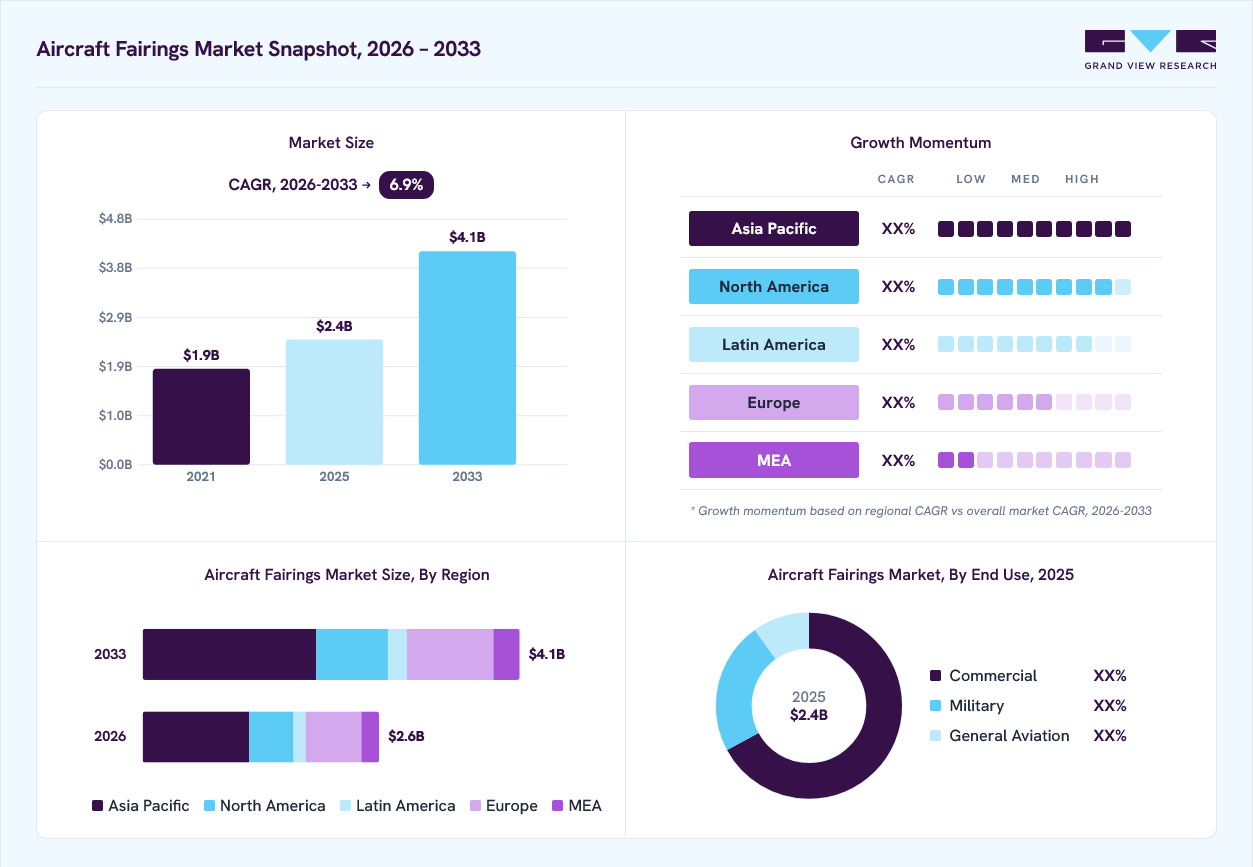
The global aircraft fairings market size was valued at USD 2.4 billion in 2025 and is projected to grow from USD 2.6 billion in 2026 to USD 4.1 billion by 2033, at a CAGR of 6.9% from 2026 to 2033. Asia Pacific dominated the market, accounting for a revenue share of 45.0% in 2025. The demand is driven by ongoing focus by aviation industry on fuel efficiency, noise reduction, and overall aerodynamic performance.
 Source: Grand View Research, IR Documents, Primary Interviews, Paid DatabasesTo learn more about this report,
 Download Free Sample Report
Key Market Trends & Insights
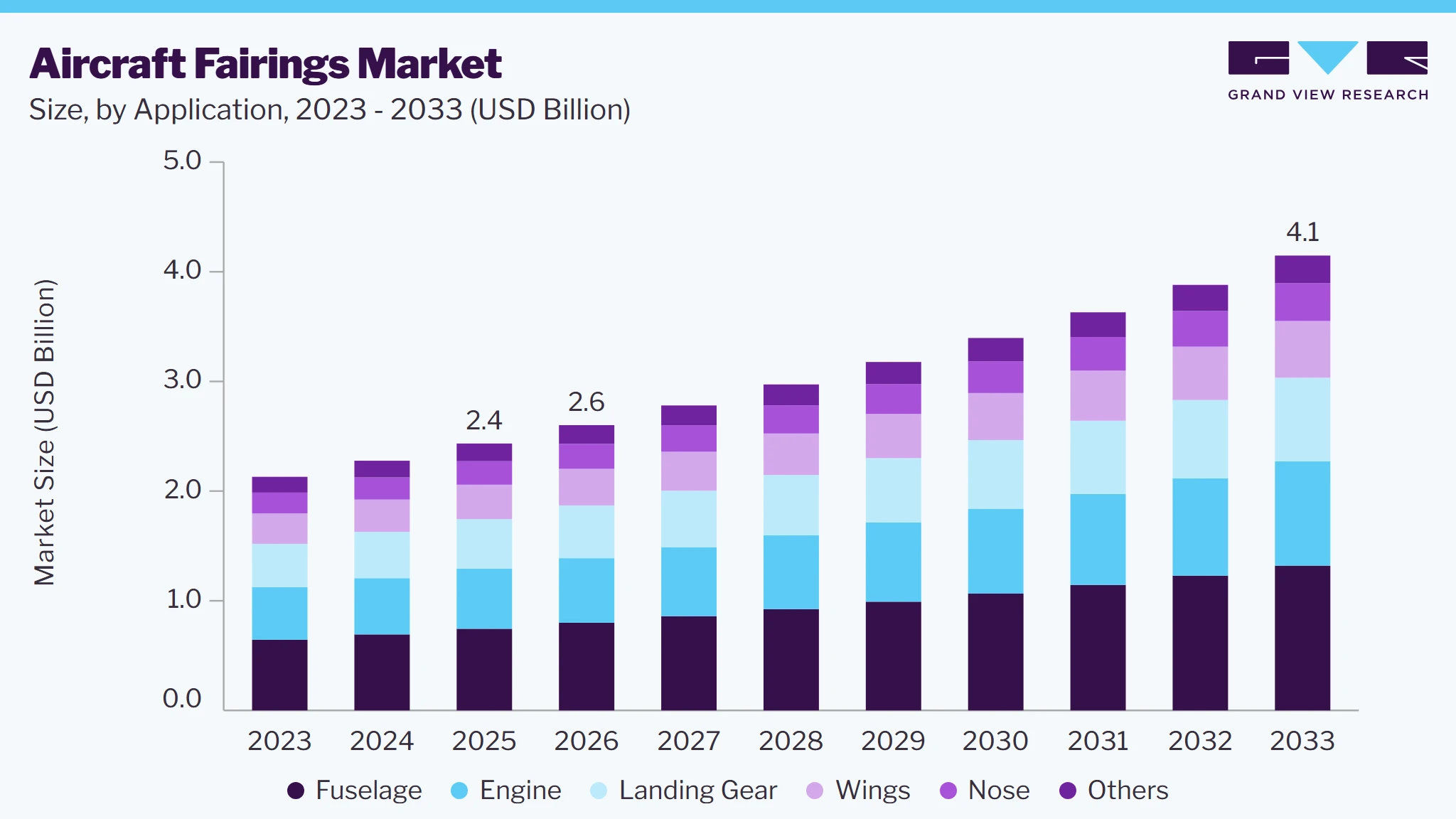
- By application: Fuselage segment led the market with the largest revenue share of 30.6% in 2025.
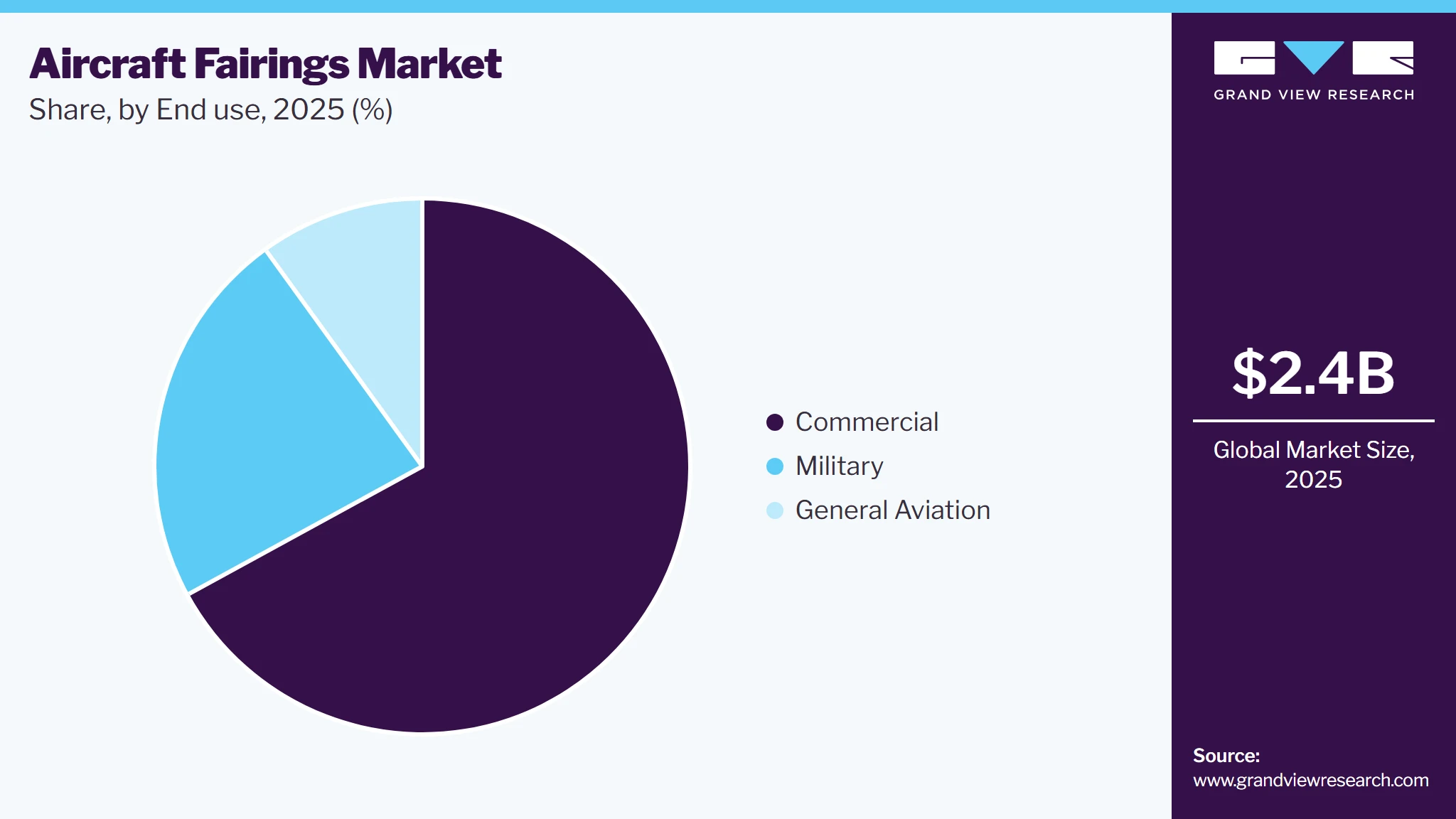
- By end use: Commercial segment led the market with the largest revenue share of 67.0% in 2025.
Regional Highlights
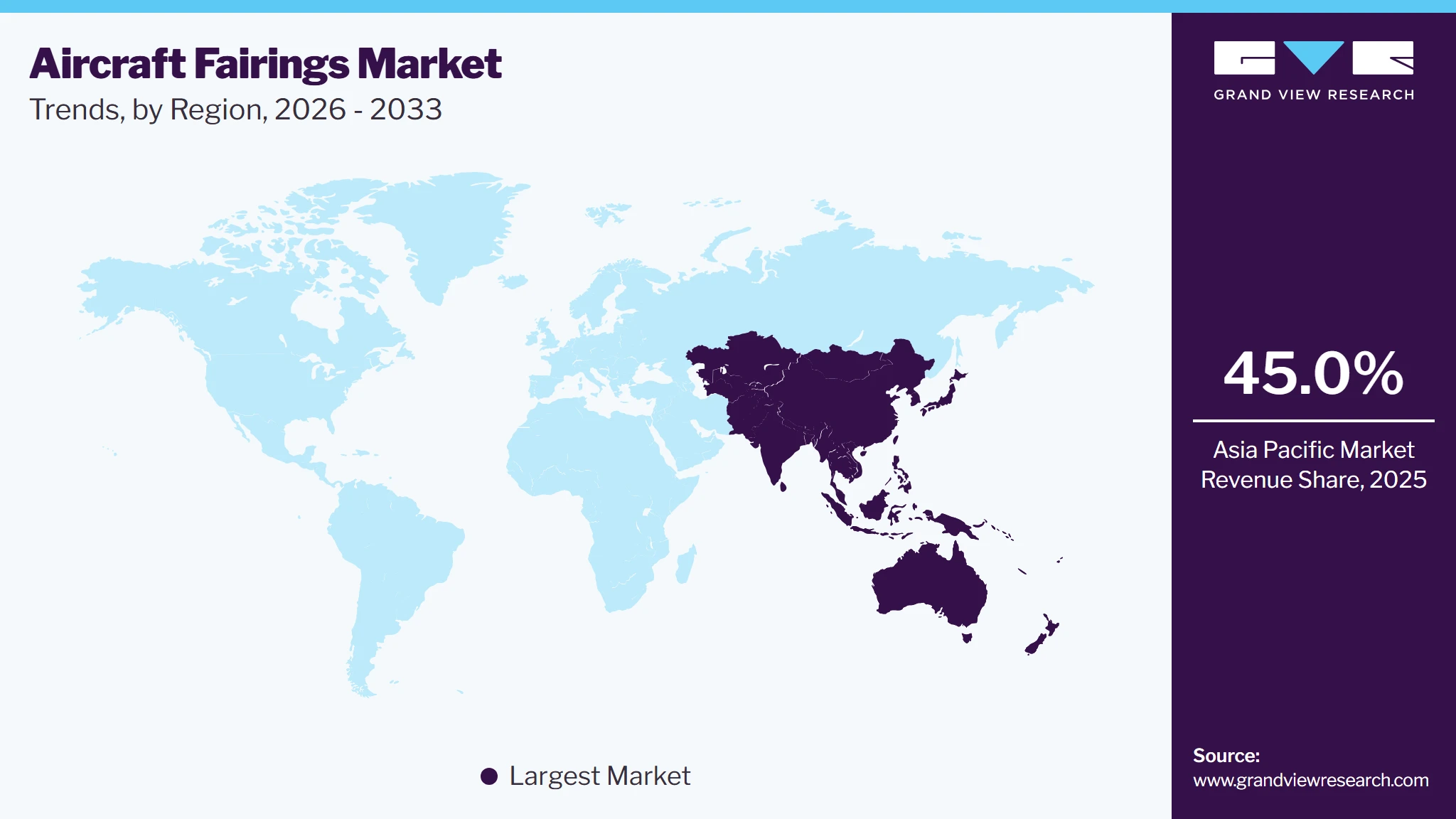
- Largest regional market: Asia Pacific (45.0% revenue share, 2025)
- By country: The China held the largest market share in 2025.
Market Size & Forecast
- Market size in 2025: USD 2.4 Billion
- Estimated market size in 2026: USD 2.6 Billion
- Projected market size by 2033: USD 4.1 Billion
- CAGR (2026-2033): 6.9%
Prism AI by Grand View Research Free to tryAsk a question about the aircraft fairings marketTry asking✓Every figure cited from GVR research Prefer the report? Download free sample →Fairings reduce drag by streamlining the aircraft’s external surface, which is critical for improving fuel economy and cutting emissions-both high priorities for commercial airlines and regulatory bodies. This makes fairings essential components in next-generation aircraft design. In addition, as global air travel continues to rebound and expand, airlines are upgrading their fleets with newer, more efficient models. Military aviation is also seeing modernization trends, with newer platforms requiring advanced, lightweight fairings that can withstand high-performance conditions. Innovations in composite materials and 3D printing are further expected to push demand by making production more efficient and customizable.
 To learn more about this report, Download Free Sample Report
The demand for aircraft fairings is likely to be hampered by high cost associated with the development and certification of new fairing technologies. Strict safety and performance regulations in aviation require extensive testing and long approval timelines, which may delay product rollouts or deter smaller manufacturers from entering the market.
Prominent market players are investing heavily in R&D to develop lighter, more durable fairings using composite materials and advanced manufacturing techniques like additive manufacturing. Many are also forming long-term supply agreements with aircraft OEMs to secure stable demand and reduce procurement cycles. These partnerships enable quicker adoption of newer designs while ensuring compliance with strict aerospace standards.
Market Dynamics
The aircraft fairings market is witnessing steady growth owing to increasing commercial aircraft production, fleet modernization programs, and the growing adoption of lightweight composite materials. Aircraft manufacturers are focusing on improving aerodynamic performance and reducing fuel consumption, leading to higher demand for advanced fairings across fuselage, wings, engines, and landing gear applications. Rising investments in next-generation aircraft, expanding maintenance, repair, and overhaul (MRO) activities, and increasing defense aircraft procurement are further supporting market expansion. Additionally, advancements in composite manufacturing technologies and the replacement of aging aircraft components continue to create opportunities for innovation and long-term market growth.
The increasing production of commercial aircraft to meet growing global passenger and cargo traffic is a major driver of the aircraft fairings market. Airlines are expanding and modernizing their fleets with fuel-efficient aircraft, prompting OEMs to increase manufacturing output. Every new aircraft requires multiple fairings for the fuselage, wings, engines, nose, and landing gear, directly contributing to market demand. The recovery of the aviation industry and rising aircraft deliveries are further accelerating the need for high-performance fairing systems.
In addition, defense organizations across several countries are investing in advanced fighter aircraft, military transport aircraft, and unmanned aerial vehicles (UAVs), all of which utilize specialized fairings designed for aerodynamic efficiency and component protection. The growing preference for lightweight composite fairings helps reduce aircraft weight, improve fuel efficiency, and lower operating costs, encouraging manufacturers to integrate advanced materials into new aircraft platforms.
The high cost of manufacturing advanced composite aircraft fairings remains a significant challenge for the market. Carbon fiber composites, specialized resins, precision molding processes, and stringent aerospace certification requirements increase production costs compared to conventional metallic components. In addition, manufacturers must comply with rigorous quality, safety, and durability standards, which require extensive testing and validation. These factors raise overall production expenses and can limit adoption among cost-sensitive aircraft programs and smaller aviation manufacturers.
The aviation industry's increasing focus on fuel efficiency and carbon emission reduction is creating significant opportunities for aircraft fairing manufacturers. Aircraft OEMs are investing in next-generation composite materials, recyclable thermoplastics, and advanced manufacturing technologies such as automated fiber placement and additive manufacturing to develop lighter and more durable fairings. As airlines seek to reduce operating costs and comply with environmental regulations, demand for innovative aerodynamic fairings that enhance aircraft performance while lowering fuel consumption is expected to grow, creating new opportunities for material suppliers and component manufacturers.
Market Concentration & Characteristics
The aircraft fairings industry shows moderate to high concentration, with a few key players holding significant shares. These firms leverage their technical capabilities, global supply networks, and economies of scale to stay competitive. Smaller or niche firms often compete through specialization, offering customized fairings for military or UAV applications.
 To learn more about this report, Download Free Sample Report
The threat of substitution in the aircraft fairings industry is relatively low, as fairings serve a highly specialized function in aircraft aerodynamics and systems protection. While advancements in aircraft design could lead to slight design modifications or material changes, it is unlikely that fairings themselves could be replaced entirely by another solution, due to the strict performance and safety requirements.
Analyst Perspective
The aircraft fairings market is expected to witness steady growth over the forecast period, supported by increasing aircraft production, fleet modernization initiatives, and the aviation industry's continued focus on fuel efficiency and lightweight aircraft designs. The growing adoption of advanced composite materials is enabling manufacturers to develop fairings with improved strength, lower weight, and enhanced aerodynamic performance. In addition, rising investments in commercial aviation, expanding defense procurement programs, and increasing maintenance, repair, and overhaul (MRO) activities are creating sustained demand for both OEM and replacement fairings. As aircraft manufacturers continue to prioritize operational efficiency and sustainability, innovation in composite manufacturing technologies and next-generation aerodynamic components is expected to remain a key factor shaping the competitive landscape and long-term market growth.
Application Insights
Based on application, Fuselage segment led the market with the largest revenue share of 30.6% in 2025. Fuselage fairings are increasingly in demand as aircraft manufacturers strive to improve overall aerodynamics. These components reduce drag along the body of the aircraft, directly enhancing fuel efficiency which is a critical cost-saving measure for airlines. With the increasing fleet renewal, the fuselage fairings are being upgraded with advanced composites that are lighter and more durable, leading to rise in demand for fuselage in the coming years.
The engine fairings segment is expected to grow at a significant CAGR over the forecast period. The growth is accelerated by rising demand due to the push for more efficient and quieter propulsion systems. As newer, high-bypass engines become standard, fairings must be redesigned to fit larger, more powerful engines while minimizing noise and drag. This evolution is likely to drive a need for highly engineered fairing components tailored to specific engine architectures.
End-use Insights
Based on end use, commercial segment led the market with the largest revenue share of 67.0% in 2025. Commercial aviation is the largest consumer of aircraft fairings, with airlines worldwide focusing on reducing operating costs through improved aerodynamics. With rising passenger travel across countries, the demand for aircraft fairings due to the need for new, fuel-efficient aircraft is expected to increase over the forecast period.
 To learn more about this report, Download Free Sample Report
The military segment is anticipated to grow at the fastest CAGR during the forecast period, owing to rising defense budgets and modernization programs which are likely to fuel the demand for stealth-optimized and high-performance fairings. Moreover, next-gen fighter jets and drones, which require precision aerodynamic components, often rely on custom-engineered fairings made from radar-absorbing or thermal-resistant materials. These factors are anticipated to boost the demand for aircraft fairings in military end use in the coming years.
Regional Insights
The aircraft fairings market in North America is growing as the region remains a core market due to the presence of major aircraft OEMs, a large commercial fleet, and strong defense spending. Ongoing investments in next-gen commercial and military aircraft in the region are expected to keep fairing demand consistently high.
U.S. Aircraft Fairings Market Trends
The aircraft fairings market in the U.S. is growing due to robust commercial aviation activity and substantial military R&D programs. American aerospace firms are pushing innovation in fairing design, especially in the fields of lightweight composites and stealth technologies.
Asia Pacific Aircraft Fairings Market Trends
Asia Pacific dominated the aircraft fairings market with the largest revenue share of 45.0% in 2025. The Asia Pacific region is witnessing a boom in air traffic and domestic aircraft production, especially in countries like India and Indonesia. As local airlines expand their fleets and governments invest in aviation infrastructure, demand for high-performance fairings is naturally rising.
 To learn more about this report, Download Free Sample Report
The aircraft fairings market in the China held the largest share in the Asia Pacific region in 2025. The airing fairings market in China is aggressively developing its domestic aviation capabilities, including the C919 and military aircraft programs. With a strong emphasis on reducing dependency on Western components, the country is investing in local fairing manufacturing, driving the demand for technologically advanced solutions.
Europe Aircraft Fairings Market Trends
The aircraft fairings market in Europe is heavily focused on sustainable aviation, pushing for lower-emission aircraft. This regional priority is boosting demand for aerodynamic components like fairings that contribute to greener flight. Collaborative aerospace programs (e.g., Airbus initiatives) also create steady demand.
The Germany aircraft fairings market is expected to grow at a significant CAGR over the forecast period. Germany, as a key hub of precision engineering and aircraft parts manufacturing, plays a vital role in the European fairings market. With strong ties to Airbus and a thriving defense sector, demand for high-spec fairings is strong and consistent.
Latin America Aircraft Fairings Market Trends
The aircraft fairings market in Latin America is growing steadily, driven by fleet expansion of regional airlines and cargo carriers. The region is also seeing rising MRO (maintenance, repair, and overhaul) activity, contributing to aftermarket fairing demand.
Middle East & Africa Aircraft Fairings Market Trends
The aircraft fairings market in Middle East & Africa is expected to grow at the fastest CAGR during the forecast period. Gulf carriers are continuing to invest in next-gen fleets, which supports fairing demand, particularly for widebody and luxury aircraft. Moreover, in Africa, infrastructure development and growing air connectivity are setting the stage for increased long-term demand.
Key Aircraft Fairings Company Insights
Some of the prominent players operating in global industry include Airbus and Boeing.
-
Airbus was established in 1970 and is headquartered in Leiden, Netherlands. The group operates through three business segments, namely Airbus commercial aircraft, Airbus Helicopters, and Airbus defense & space. Its global presence includes France, Germany, Spain, and the UK, fully owned subsidiaries in the U.S., China, Japan, India, and the Middle East, and spare parts centers in Hamburg, Frankfurt, Washington, Beijing, Dubai, and Singapore.
-
Boeing was established in 1916 and is headquartered in Washington, U.S. It operates through four business segments, namely Commercial Airplanes (BCA), Defense, Space & Security (BDS), Global Services (BGS), and Boeing Capital (BCC).
Kaman Aerosystems and FDC Composites are some of the emerging market participants in aircraft fairings industry.
-
Kaman Aerosystems was established in 1945 and is headquartered in Bloomfield, Connecticut, United States. The company operates as a division of Kaman Corporation and specializes in the design and manufacturing of complex aerospace components and systems. Its offerings include composite structures, metallic assemblies, precision bearings, and flight-critical parts for both commercial and defense aircraft. Kaman maintains operations across the U.S. and supports a global customer base through strategic partnerships and service networks.
-
FDC Composites was founded in 2004 and is headquartered in Saint-Jean-sur-Richelieu, Quebec, Canada. The company specializes in the manufacturing of high-performance composite parts for the aerospace and transportation sectors. Its core capabilities include advanced fabrication of aircraft interiors, fairings, and structural components using carbon fiber and other lightweight materials. FDC Composites serves clients across North America and Europe, with a strong focus on custom solutions and quality certifications such as AS9100.
Key Aircraft Fairings Companies
The following key companies have been profiled for this study on the aircraft fairings market.
-
Airbus
-
Boeing
-
ShinMaywa
-
NORDAM
-
Malibu Aerospace
-
Strata Manufacturing
-
Royal Engineered Composites
-
Fiber Dynamics Inc.
-
FDC Composites
-
Kaman Aerosystems
Competitive Benchmarking
Category
Operating Strategies
Competitive Edge
Weakness
Established Players (e.g., Airbus, Boeing, Safran, Spirit AeroSystems, GKN Aerospace, Daher)
- Invest in advanced composite materials and lightweight fairing technologies.
- Maintain long-term supply agreements with major aircraft OEMs and defense organizations.
- Expand global manufacturing capacity and aftermarket (MRO) service capabilities.
- Strong global brand presence and established customer relationships.
- Extensive R&D capabilities with advanced manufacturing technologies.
- Broad product portfolios serving both commercial and military aircraft programs.
- High manufacturing and certification costs.
- Dependence on aircraft production rates and OEM delivery schedules.
- Longer development cycles due to stringent aerospace regulations.
Emerging & Regional Players (e.g., ShinMaywa Industries, The NORDAM Group, Strata Manufacturing, Malibu Aerospace, Royal Engineered Composites, Fiber Dynamics Inc.)
- Focus on niche composite fairings and customized aerostructure solutions.
- Build partnerships with Tier-1 suppliers and leading aircraft manufacturers.
- Invest in advanced composite fabrication and precision manufacturing capabilities.
- High flexibility in customized and low-volume production.
- Specialized expertise in composite engineering and repair solutions.
- Faster response to customer-specific requirements and regional demand.
- Limited global footprint and brand recognition.
- Lower production capacity compared to large aerospace manufacturers.
- Heavy reliance on contracts from major OEMs and Tier-1 suppliers.
Aircraft Fairings Market Report Scope
Report Attribute
Details
Market size in 2025
USD 2.4 billion
Estimated market size in 2026
USD 2.6 billion
Projected market size by 2033
USD 4.1 billion
Growth rate
CAGR of 6.9% from 2026 to 2033
Base year for estimation
2025
Historical data
2021 - 2024
Forecast period
2026 - 2033
Quantitative units
Revenue in USD billion and CAGR from 2026 to 2033
Report coverage
Revenue forecast, company ranking, competitive landscape, growth factors, and trends
Segments covered
Application, end use, and region.
Regional scope
North America; Europe; Asia Pacific; Latin America; Middle East & Africa
Country scope
U.S.; Canada; Mexico; U.K.; Germany; France; Italy; Spain; China; India; Japan; South Korea
Key companies profiled
Airbus; Boeing; ShinMaywa Industries; The NORDAM Group; Malibu Aerospace; Strata Manufacturing; Royal Engineered Composites; Fiber Dynamics Inc.; FDC Composites; Kaman Aerosystems; Spirit AeroSystems; FACC AG; GKN Aerospace; Safran; Daher.
Customization scope
Free report customization (equivalent up to 8 analysts' working days) with purchase. Addition or alteration to country, regional & segment scope.
Pricing and purchase options
Avail customized purchase options to meet your exact research needs. Explore purchase options
Global Aircraft Fairings Market Report SegmentationThis report forecasts revenue growth at global, regional, and country levels and provides an analysis of the latest industry trends in each of the sub-segments from 2021 to 2033. For this study, Grand View Research has segmented the global aircraft fairings market report based on application, end-use, and region:
 To learn more about this report, Download Free Sample Report
-
Application Outlook (Revenue, USD Million, 2021 - 2033)
-
Fuselage
-
Nose
-
Engine
-
Landing Gear
-
Wings
-
Others
-
-
End-use Outlook (Revenue, USD Million, 2021 - 2033)
-
Commercial
-
Military
-
General Aviation
-
-
Regional Outlook (Revenue, USD Million, 2021 - 2033)
-
North America
-
U.S.
-
Canada
-
Mexico
-
-
Europe
-
Germany
-
UK
-
France
-
Italy
-
Spain
-
-
Asia Pacific
-
China
-
India
-
Japan
-
South Korea
-
-
Central & South America
-
Middle East & Africa
-
Research Methodology
The aircraft fairings market figures in this report are based on a proven research process that combines executive interviews with secondary research from proprietary databases, company filings, and recognized regulatory and institutional sources. Market size is built through value-chain sizing - reconciling supply-side and demand-side estimates - and triangulated with bottom-up and top-down approaches. Every estimate passes multiple levels of expert validation before publication, with each aircraft fairings segment quantified using the revenue-capture definitions in the table below.
Segment Definition
Application
Revenue Capture Definition
Fuselage
Revenue generated from the sale of aerodynamic fuselage fairings and composite coverings used around the aircraft body, wing-to-body junctions, tail connections, and other structural interfaces to reduce drag and improve aerodynamic performance.
Nose
Revenue generated from the sale of nose fairings, radomes, and protective aerodynamic covers installed at the front section of aircraft to protect radar systems, avionics, and navigation equipment.
Engine
Revenue generated from the sale of engine fairings, nacelles, fan cowls, thrust reverser fairings, inlet fairings, exhaust fairings, and other aerodynamic engine enclosure components used across commercial and military aircraft.
Landing Gear
Revenue generated from the sale of landing gear fairings, landing gear doors, wheel covers, and protective aerodynamic enclosures designed to minimize drag and protect landing gear systems.
Wings
Revenue generated from the sale of wing root fairings, flap track fairings, wingtip fairings, wing-body fairings, and other aerodynamic wing components that enhance aircraft efficiency and performance.
Others
Revenue generated from the sale of tail cone fairings, empennage fairings, antenna fairings, belly fairings, sensor housings, and other specialized aerodynamic covers used in various aircraft systems.
End Use
Revenue Capture Definition
Commercial
Revenue generated from the sale of aircraft fairings supplied for commercial passenger aircraft, cargo aircraft, and regional jets through OEM production and aftermarket replacement activities.
Military
Revenue generated from the sale of aircraft fairings supplied for military fighter aircraft, transport aircraft, helicopters, surveillance aircraft, and unmanned aerial vehicles (UAVs) for both new production and fleet modernization programs.
General Aviation
Revenue generated from the sale of aircraft fairings supplied for business jets, private aircraft, light aircraft, training aircraft, and recreational aviation platforms for OEM and aftermarket applications.
Estimation Model
Layer No.
Layer Name
Key Question
Description
01
Aircraft Production Analysis
How many commercial, military, and general aviation aircraft are produced and delivered annually?
Estimate the addressable market by evaluating global aircraft production, fleet expansion, and aircraft deliveries across key end-use sectors.
02
Fairing Penetration Assessment
What types and quantities of fairings are installed on different aircraft platforms?
Analyze the adoption of fuselage, nose, engine, landing gear, wing, and other fairings based on aircraft type, configuration, and material usage.
03
OEM & Aftermarket Demand Analysis
What is the demand for aircraft fairings across new production and replacement activities?
Assess fairing demand generated through OEM aircraft manufacturing, fleet modernization, maintenance, repair, and overhaul (MRO) activities across commercial, military, and general aviation sectors.
04
Revenue Estimation
What is the total revenue generated from aircraft fairing sales?
Estimate market revenue by combining aircraft production, fairing penetration, and replacement demand across commercial, military, and general aviation applications.
Delivered Customizations
This report has been delivered with the following In-depth customizations
Client Request
Customization Delivered
Value Adds
Regional Segmentation
Delivered a comprehensive regional assessment covering North America, Europe, Asia Pacific, Latin America, and the Middle East & Africa, along with country-level analysis for key aviation markets. The report included market size estimates, growth trends, demand outlook, regulatory landscape, and regional aircraft manufacturing and MRO activities.
Enabled identification of high-growth regions, investment hotspots, and region-specific demand drivers, supporting strategic expansion and market entry decisions.
Competitive Benchmarking
Delivered detailed profiling of leading aircraft fairing manufacturers, including company overviews, product portfolios, strategic developments, market positioning, and competitive landscape analysis. The report also categorized companies into established and emerging players with an assessment of their operating strategies, competitive strengths, and limitations.
Provided clear competitive intelligence, helping clients benchmark competitors, identify strategic partnerships, evaluate market positioning, and understand industry best practices.
Opportunity Assessment
Delivered an in-depth evaluation of current and emerging growth opportunities across aircraft types, fairing applications, composite material adoption, aircraft modernization programs, and aftermarket (MRO) demand. The analysis also highlighted technology trends and future investment areas influencing market expansion.
Helped identify high-potential revenue opportunities, emerging technology adoption trends, and attractive investment areas, enabling informed business development and long-term growth strategies.
Frequently Asked Questions About This Report
The global aircraft fairings market size was estimated at USD 2.4 billion in 2025 and is projected to grow from USD 2.6 billion in 2026.
The global aircraft fairings market is expected to grow at a compound annual growth rate of 6.9% from 2026 to 2033 to reach USD 4.1 billion by 2033.
Asia Pacific dominated the aircraft fairings market with the largest revenue share of 45.0% in 2025. The region benefits from expanding aircraft manufacturing, rising air travel demand, increasing investments in aerospace infrastructure, and the growing presence of aircraft component suppliers.
China held the largest share of the Asia Pacific aircraft fairings market in 2025. The country's strong aerospace manufacturing base, increasing commercial aircraft demand, government support for domestic aircraft programs, and expanding MRO capabilities have strengthened its market position.
The fuselage segment accounted for the largest revenue share of 30.6% in 2025. Its leading position is attributed to the extensive use of fuselage fairings to improve aerodynamic efficiency, reduce drag, and enhance fuel economy across commercial, military, and general aviation aircraft.
The commercial segment held the largest revenue share of 67.0% in 2025. Strong aircraft deliveries, growing air passenger traffic, airline fleet expansion, and increasing demand for fuel-efficient aircraft continue to drive demand for aircraft fairings in the commercial aviation sector.
Asia Pacific is expected to be the fastest-growing regional market during the forecast period, driven by increasing aircraft production, rising defense procurement, expanding airline fleets, growing investments in indigenous aerospace manufacturing, and continuous development of aviation infrastructure.
Some of the key players operating in the aircraft fairings market include Airbus; Boeing; ShinMaywa Industries; The NORDAM Group; Malibu Aerospace; Strata Manufacturing; Royal Engineered Composites; Fiber Dynamics Inc.; FDC Composites; Kaman Aerosystems; Spirit AeroSystems; FACC AG; GKN Aerospace; Safran; Daher.
The market is primarily driven by increasing commercial aircraft production, growing demand for lightweight composite fairings, expanding global airline fleets, rising defense aircraft procurement, aircraft modernization programs, and increasing maintenance, repair, and overhaul (MRO) activities. Continuous advancements in composite materials and aerodynamic technologies are also supporting long-term market growth.
About the Author(s)
Advanced Interior Materials Research Team
Advanced Materials · Advanced Interior MaterialsThis report was authored by the advanced interior materials research team at Grand View Research - comprising two research analysts, one senior research analyst, and one industry expert - with specialized expertise in the advanced interior materials segment of the advanced materials industry. All findings are based on proprietary advanced materials databases, executive interviews, and regulatory analysis, subject to internal peer review prior to publication.
Last Updated:
Speak to Analyst

Customize this report to your needs - add regions, segments, or data points, with 20% free customization.
Or view our licence options:


ISO 9001:2015 & 27001:2022 Certified
We are GDPR and CCPA compliant! Your transaction & personal information is safe and secure. For more details, please read our privacy policy.


