
- Home
- »
- Next Generation Technologies
- »
-
Airport Kiosk Market Size, Share & Growth Report 2026-2033GVR Report cover

Airport Kiosk Market (2026 - 2033)
Size, Share & Trends Analysis Report By Component (Hardware, Software), By Type (Self-Bag-Drop Kiosks, Immigration & Border Control Kiosks), By Deployment (Cloud), By Technology, By End Use, And Segment Forecasts
Market Size, 2025
$2.4BMarket Estimate, 2026
$2.6BMarket Forecast, 2033
$5.3BCAGR, 2026–2033
10.6%Airport Kiosk Market Summary
The global airport kiosk market size was valued at USD 2.4 billion in 2025 and is projected to grow from USD 2.6 billion in 2026 to USD 5.3 billion by 2033, at a CAGR of 10.6% from 2026 to 2033. The market in North America dominated with a revenue share of 31.2% in 2025. The growing demand for automated check-in and boarding processes is driving market growth.
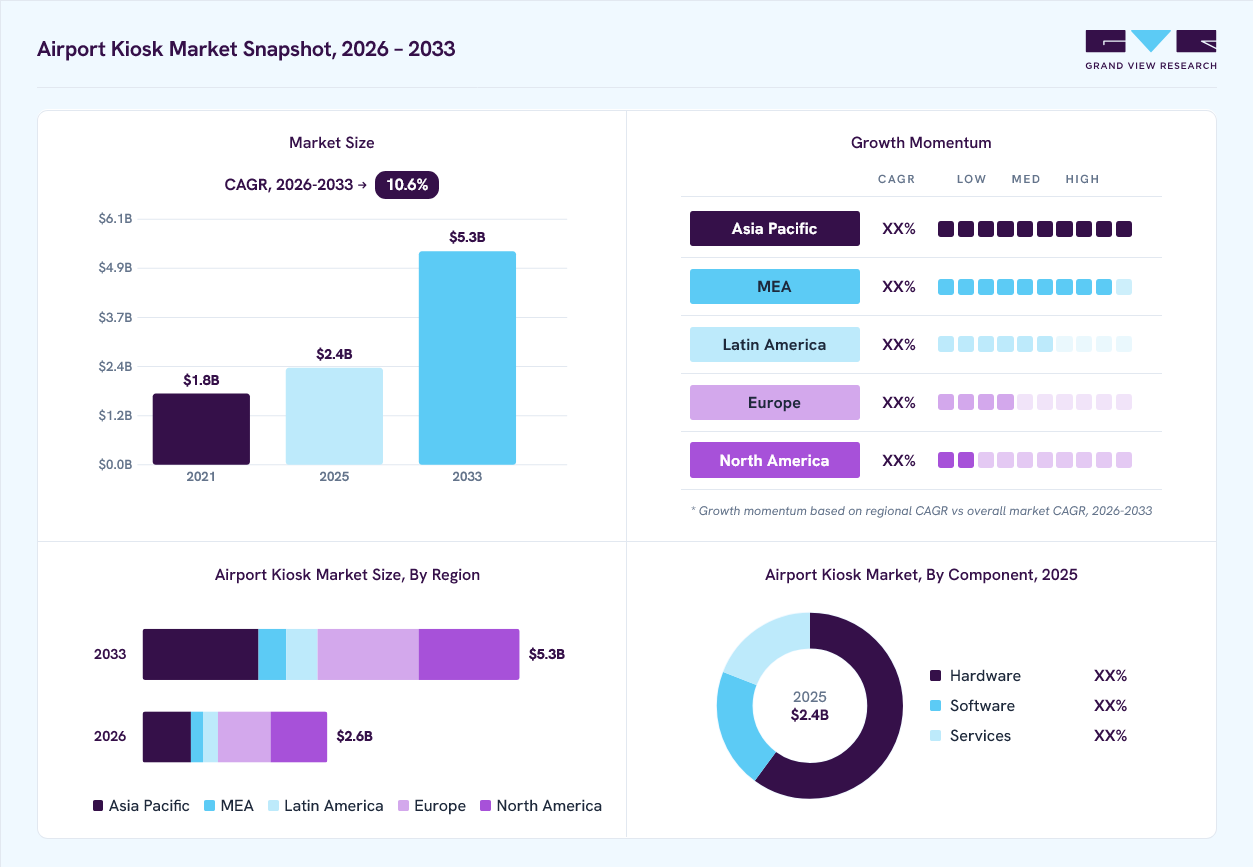 Source: Grand View Research, IR Documents, Primary Interviews, Paid DatabasesTo learn more about this report,
 Download Free Sample Report
Key Market Trends & Insights
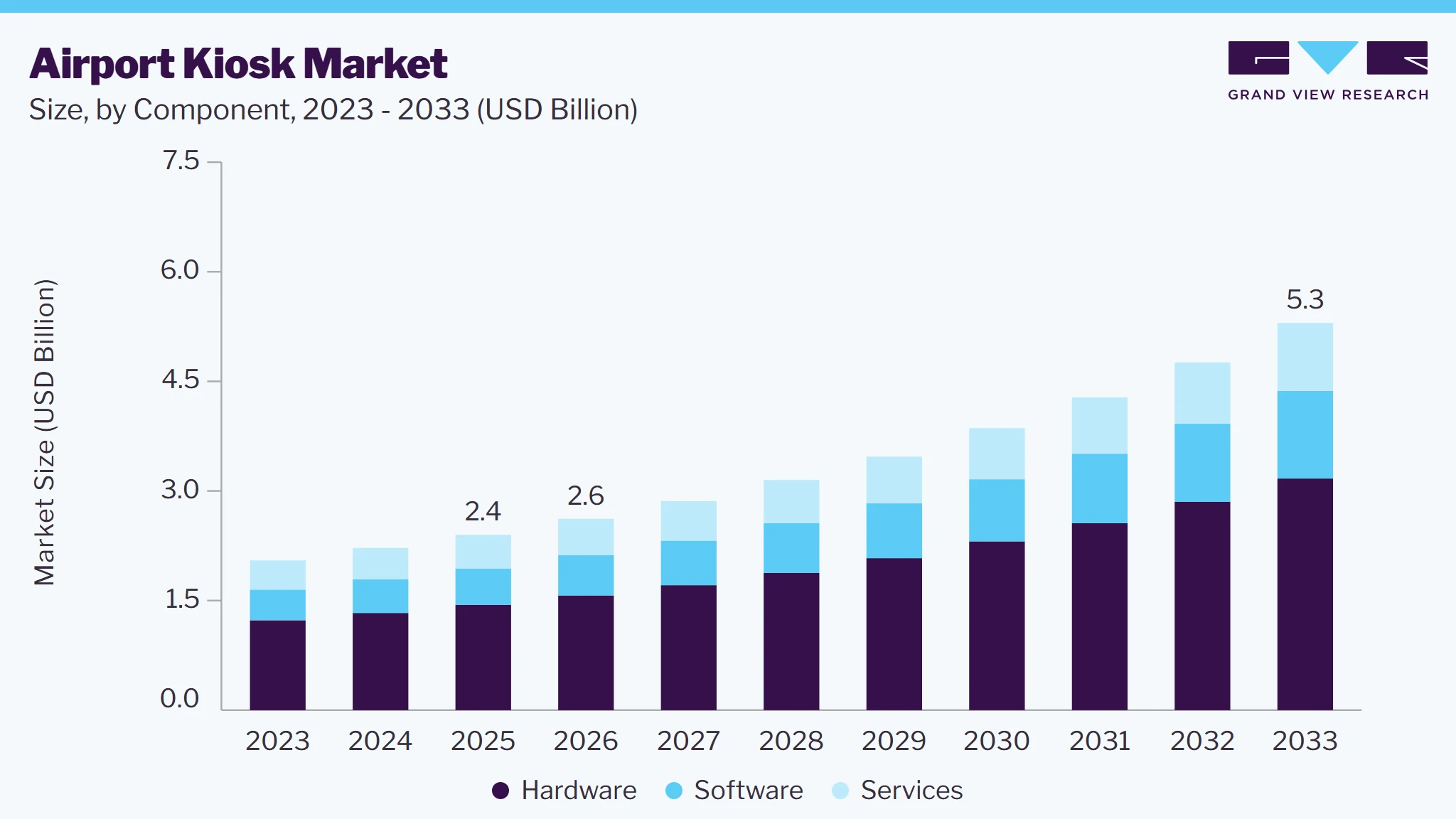
- By component: Hardware segment held the largest market share of 59.9% in 2025.
- By type: Self-check-in kiosks segment held the largest market share of 31.0% in 2025.
- By deployment: On-premises segment held the largest market share of 66.0% in 2025.
- By technology: Touchscreen-based segment held the largest market share of 44.3% in 2025.
- By end use: Airports segment held the largest market share in 2025.
Regional Highlights
- Largest regional market: North America (31.2% revenue share, 2025)
- Fastest-growing regional market: Asia Pacific (highest CAGR, 2026-2033)
- By country: The U.S. held the largest market share in 2025
Market Size & Forecast
- Market size in 2025: USD 2.4 Billion
- Estimated market size in 2026: USD 2.6 Billion
- Projected market size by 2033: USD 5.3 Billion
- CAGR (2026-2033): 10.6%
Prism AI by Grand View Research Free to tryAsk a question about the airport kiosk marketTry asking✓Every figure cited from GVR research Prefer the report? Download free sample →The increasing adoption of biometric and identity verification technologies is driving market growth across the airport kiosk industry. Airports increasingly integrate facial recognition, fingerprint authentication, iris scanning, passport verification, digital identity management, and automated passenger authentication systems into kiosk-based processing environments. Biometric-enabled kiosks provide secure identity verification while supporting faster passenger movement across check-in, security, immigration, and boarding processes throughout modern airport terminals. Airlines and airport authorities increasingly deploy identity-integrated kiosk systems that improve authentication accuracy and support more seamless passenger processing across domestic and international travel operations. The continued expansion of biometric airport infrastructure contributes to sustained demand for advanced airport kiosk platforms.
 To learn more about this report, Download Free Sample Report
The growing integration of mobile and omnichannel passenger ecosystems is driving market growth. Travelers increasingly use airline applications, digital wallets, online booking platforms, mobile boarding passes, loyalty programs, and real-time travel management tools, all of which require seamless integration with physical airport infrastructure. Airport kiosks increasingly integrate with mobile devices, reservation systems, customer relationship management platforms, baggage tracking applications, and digital identity services to provide a consistent passenger experience across digital and physical touchpoints. Airlines increasingly deploy omnichannel kiosk solutions that connect online interactions with in-terminal self-service functionality across the entire travel journey. The continued integration of mobile and airport technologies contributes to market growth for connected airport kiosk platforms.
The increasing demand for multilingual and personalized passenger services is driving growth in the global market. International airports increasingly serve diverse passenger populations that require language localization, customized travel information, route guidance, recommendations for ancillary services, accessibility support, and personalized travel assistance at different stages of airport processing. Self-service kiosks increasingly offer multilingual interfaces, personalized flight information, loyalty program integration, travel notifications, airport navigation, and destination-specific assistance, thereby improving passenger engagement and service accessibility. Airport operators increasingly invest in intelligent kiosk platforms that adapt services according to passenger profiles and travel contexts across global aviation networks. The continued emphasis on personalized airport experiences contributes to sustained demand for advanced airport kiosk technologies.
The growing adoption of data-driven airport management is driving market growth within the airport kiosk industry. Airport authorities and airlines increasingly use kiosk-generated operational data, passenger flow analytics, queue monitoring, service utilization metrics, transaction records, behavioral insights, and predictive operational intelligence to optimize terminal performance and strategic planning across commercial aviation operations. Airport kiosks increasingly serve as intelligent data-collection points that provide real-time visibility into passenger movement, processing efficiency, resource utilization, and terminal demand patterns across airport environments. Operators increasingly prioritize kiosk platforms that integrate analytics capabilities with broader airport management systems and digital operational control platforms. The continued expansion of data-driven airport operations contributes to market growth for intelligent airport kiosk solutions.
Market Dynamics
The airport kiosk industry is experiencing strong growth as airports and airlines increasingly invest in self-service technologies to improve passenger processing efficiency and reduce operational bottlenecks. Self-check-in, baggage drop, boarding pass issuance, biometric verification, ticketing, and information kiosks are becoming integral components of modern airport operations as passenger traffic continues to recover and expand globally. Airports are adopting kiosk solutions to minimize queue times, optimize terminal space utilization, reduce staffing requirements, and enhance the overall passenger experience by delivering faster, more convenient service. In addition, the growing deployment of contactless technologies, biometric authentication, and integrated airport management systems is accelerating the modernization of passenger processing infrastructure across airports of all sizes.
The growing expansion of smart airport infrastructure is driving growth in the airport kiosk industry, as airports increasingly invest in intelligent, connected, and automated terminal environments that improve passenger processing and operational efficiency across multiple service functions. Smart airport development increasingly includes digital check-in systems, biometric identity management, IoT-enabled infrastructure, artificial intelligence platforms, cloud-based operational networks, predictive analytics, and integrated passenger service technologies, all of which require advanced self-service kiosk deployment throughout airport terminals. Modern airport operators increasingly view kiosks as essential digital touchpoints that connect passengers with broader smart airport ecosystems and automated operational platforms. Airlines and airport authorities increasingly deploy intelligent kiosk infrastructure that supports real-time data exchange, automated service delivery, and seamless integration with airport management systems.
High installation and infrastructure costs for airport kiosk deployments are constraining growth in the airport kiosk industry, as airports and airlines often require substantial upfront capital before large-scale self-service automation projects can be implemented across terminal operations. Modern airport kiosks require specialized hardware, biometric devices, document scanners, payment systems, networking equipment, power infrastructure, security integration, software platforms, and terminal redesign, all of which significantly increase deployment expenses across multiple airport service areas. Large international airports may need hundreds of kiosks distributed across check-in halls, baggage zones, boarding areas, information centers, and commercial retail spaces, creating significant financial commitments for infrastructure development and technology integration. Airport operators increasingly face challenges in balancing modernization objectives with budget constraints and long-term infrastructure planning priorities.
The increasing demand for modular and portable kiosk solutions is creating significant opportunities in the airport kiosk industry, as airports seek flexible infrastructure that can be deployed, relocated, expanded, or reconfigured to meet changing passenger traffic patterns and terminal operational requirements. Traditional fixed kiosk installations often require extensive construction and permanent infrastructure modifications, whereas modular kiosk systems offer greater adaptability to seasonal traffic fluctuations, temporary terminal expansions, special events, airline relocations, and operational restructuring in airport environments. Airport operators increasingly prefer solutions that can be installed rapidly with minimal disruption to existing terminal operations and passenger flow management. Modular kiosk architectures increasingly allow airports to expand self-service capacity incrementally rather than committing to large permanent infrastructure projects.
Analyst Perspective
The airport kiosk market is increasingly defined by the transformation of airports into digitally connected passenger processing environments rather than by kiosk hardware alone. Competitive advantage is shifting toward providers that can integrate biometric identity verification, airline systems, baggage handling platforms, payment technologies, and airport operational software into seamless self-service workflows. As airports face rising passenger volumes and increasing pressure to improve throughput without proportionally expanding terminal infrastructure, kiosk deployments are becoming a strategic tool for optimizing capacity and enhancing operational resilience. Over the long term, the market is expected to evolve toward multifunctional, software-driven self-service platforms that support personalized passenger journeys, real-time operational coordination, and increasingly automated airport ecosystems.
Component Insights
The hardware segment led the market with the largest revenue share of 59.9% in 2025. The increasing deployment of biometric authentication technologies is driving market growth within the hardware segment of the airport kiosk industry. Airports increasingly incorporate facial recognition cameras, fingerprint scanners, iris recognition devices, document authentication hardware, and identity verification equipment into self-service kiosks to improve passenger authentication and automated processing across check-in, security, immigration, and boarding operations. Biometric hardware requires high-resolution imaging systems, secure processing modules, advanced sensors, and integrated identity verification components, significantly increasing hardware demand across airport automation projects. Airlines and airport authorities are increasingly investing in next-generation biometric kiosk hardware that enables faster passenger movement and more secure identity verification within integrated airport ecosystems.
The software segment is anticipated to grow at the fastest CAGR during the forecast period. The increasing adoption of cloud-based airport management platforms is driving market growth within the software segment of the airport kiosk industry. Airports increasingly migrate passenger service systems, airline integration platforms, analytics engines, operational databases, and infrastructure management applications to cloud environments, enabling centralized coordination across multiple terminals, airlines, and airport service functions. Cloud-enabled kiosk software allows airports to deploy updates rapidly, manage kiosk fleets remotely, synchronize operational data in real time, and scale services according to passenger demand across geographically distributed airport operations. Airlines increasingly seek cloud-based software architectures that reduce infrastructure complexity while improving interoperability across domestic and international airport networks.
Type Insights
The self-check-in kiosks segment led the market with the largest revenue share of 31.0% in 2025. The increasing integration of mobile and digital travel ecosystems is driving market growth across the self-check-in kiosks segment of the airport kiosk industry. Travelers increasingly use airline applications, digital boarding passes, online booking platforms, loyalty programs, mobile payment systems, and digital identity services, all of which require seamless synchronization with physical airport infrastructure. Self-check-in kiosks increasingly connect with mobile devices to retrieve reservations, update passenger profiles, process ancillary services, verify travel documents, and issue baggage tags and boarding credentials within integrated digital travel environments. Airlines increasingly deploy software platforms that create consistent passenger experiences across websites, mobile applications, kiosks, and airport touchpoints throughout the travel experience.
The immigration & border control kiosks segment is expected to grow at the fastest CAGR from 2026 to 2033. The growing adoption of biometric identity verification is driving market growth within the immigration and border control kiosks segment of the airport kiosk industry. Border authorities increasingly incorporate facial recognition, fingerprint authentication, iris scanning, electronic passport reading, digital identity matching, and automated passenger verification into self-service immigration processing environments across international airports. Biometric-enabled kiosks increasingly provide secure and accurate identity verification while supporting faster passenger movement through immigration checkpoints and border inspection areas. Governments increasingly invest in advanced biometric infrastructure that improves traveler authentication, fraud prevention, document validation, and operational coordination across national border control systems.
Deployment Insights
The on-premises segment accounted for the largest market revenue share in 2025. The on-premises segment is driving growth as airports and airlines increasingly require localized control over mission-critical passenger-processing infrastructure that operates continuously in high-security aviation environments. Airport operations involve identity verification, boarding authorization, baggage management, payment processing, immigration functions, and real-time coordination with airline and government systems, often requiring direct control over software, hardware, networking, and operational infrastructure. On-premises kiosk deployments allow airport operators to maintain complete ownership of operational systems while reducing dependence on external connectivity for essential passenger processing functions. Airports increasingly prioritize infrastructure that provides immediate operational responsiveness and localized management across complex terminal environments.
The cloud segment is expected to grow at the fastest CAGR from 2026 to 2033. The growing integration of smart airport technologies is driving market growth across the cloud segment. Modern airports increasingly deploy IoT-enabled infrastructure, biometric authentication systems, artificial intelligence platforms, passenger analytics engines, digital signage networks, baggage automation technologies, and operational control centers, all of which require centralized cloud connectivity for efficient coordination. Cloud-based kiosk platforms increasingly serve as connected nodes within broader smart airport ecosystems, exchanging real-time operational data across multiple airport systems and digital infrastructure platforms. Airport operators increasingly invest in cloud-enabled architectures that support intelligent automation, predictive analytics, and enterprise-wide operational visibility across complex terminal environments.
Technology Insights
The touchscreen-based segment led the market with the largest revenue share of 44.3% in 2025. The expansion of digital retail and ancillary service sales is driving growth in the touchscreen-based segment. Airports and airlines increasingly use touchscreen kiosks to promote baggage upgrades, lounge access, seat selection, travel insurance, transportation services, parking reservations, retail offers, food ordering, and other ancillary revenue opportunities through highly interactive digital interfaces. Touchscreen platforms enable dynamic product presentation, personalized recommendations, promotional campaigns, real-time pricing updates, and secure payment processing within integrated airport commerce environments. Commercial aviation operators increasingly deploy interactive retail-oriented kiosk interfaces that combine passenger processing with digital merchandising and service monetization across terminal ecosystems.
The contactless/touchless segment is expected to grow at the fastest CAGR from 2026 to 2033. The growing demand for secure digital identity management is driving growth in the contactless and touchless segments. Airports increasingly require technologies capable of securely processing biometric identities, electronic passports, digital visas, mobile credentials, travel authorizations, and encrypted passenger authentication across high-security aviation environments. Contactless kiosks increasingly incorporate advanced identity verification software, secure biometric processing, encrypted communications, digital certificate management, and automated traveler authentication capabilities that strengthen both security and passenger convenience. Governments and airport authorities increasingly deploy secure, touchless identity infrastructure to meet modern border management and aviation security requirements in international travel environments.
End Use Insights
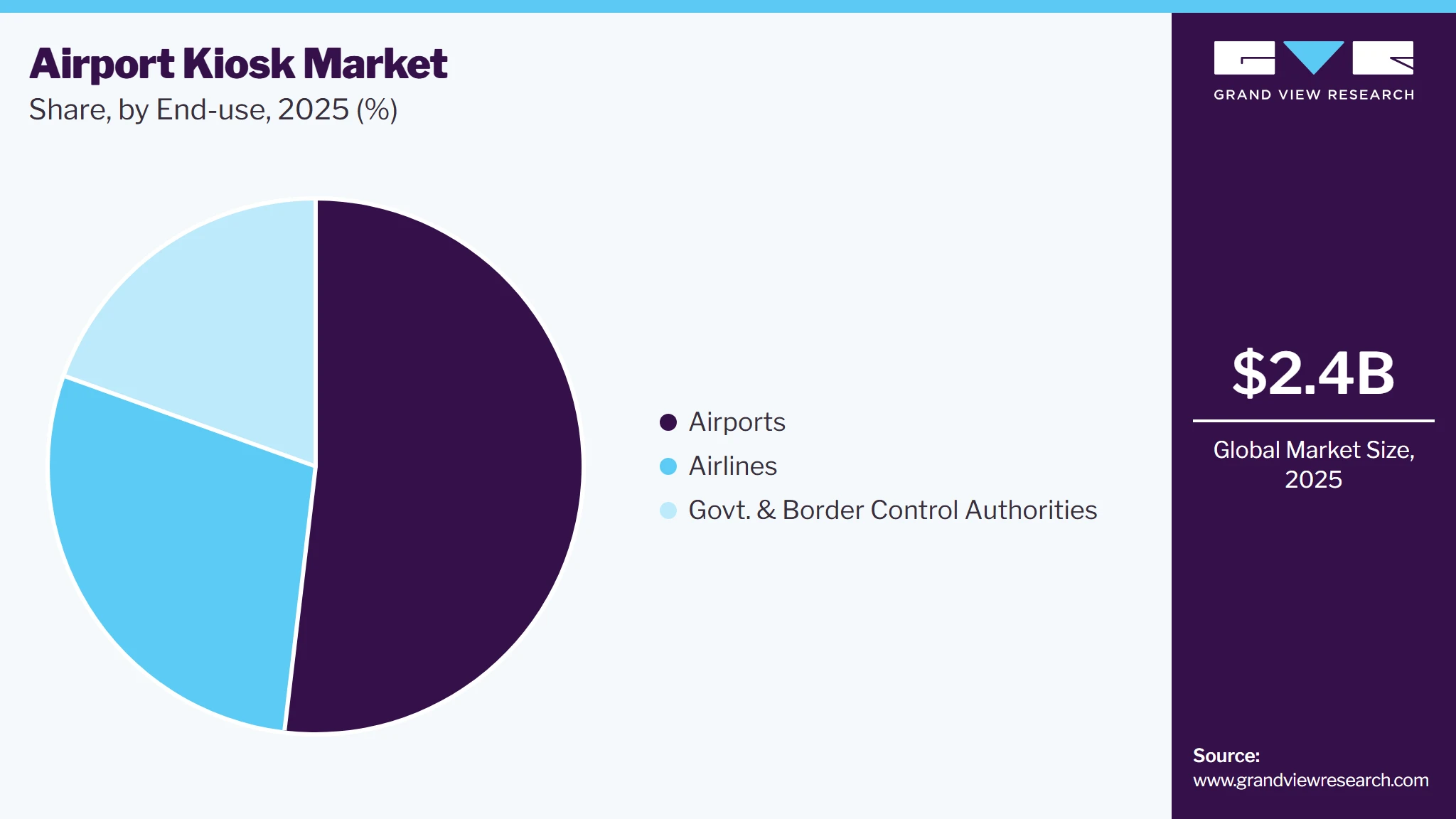
The airports segment led the market with the largest revenue share of 51.9% in 2025. The growing expansion of non-aeronautical revenue opportunities is driving market growth across the airports segment. Airports increasingly use kiosk infrastructure not only for passenger processing but also for retail transactions, food ordering, transportation booking, parking services, lounge access, advertising engagement, travel insurance, ancillary airline purchases, and other commercial services that generate additional revenue streams for airports. Interactive kiosks increasingly support digital merchandising, personalized promotions, real-time retail offers, payment processing, and passenger engagement across commercial terminal environments. Airport operators increasingly invest in multifunctional kiosk platforms that combine operational efficiency with commercial revenue generation across expanding airport ecosystems.
 To learn more about this report, Download Free Sample Report
The airlines segment is anticipated to grow at the fastest CAGR during the forecast period. The increasing use of passenger analytics and operational intelligence is driving market growth within the airlines segment. Airlines increasingly analyze kiosk transactions, passenger behavior, check-in patterns, baggage activity, queue conditions, service utilization, ancillary purchase behavior, and operational performance metrics to continuously improve the customer experience and optimize airport operations. Airport kiosks increasingly generate valuable real-time data that supports demand forecasting, staffing optimization, flight operations planning, passenger segmentation, and personalized service delivery across airline networks. Airline operators increasingly invest in intelligent kiosk platforms that combine self-service functionality with advanced analytics capabilities and enterprise-level operational intelligence.
Regional Insights
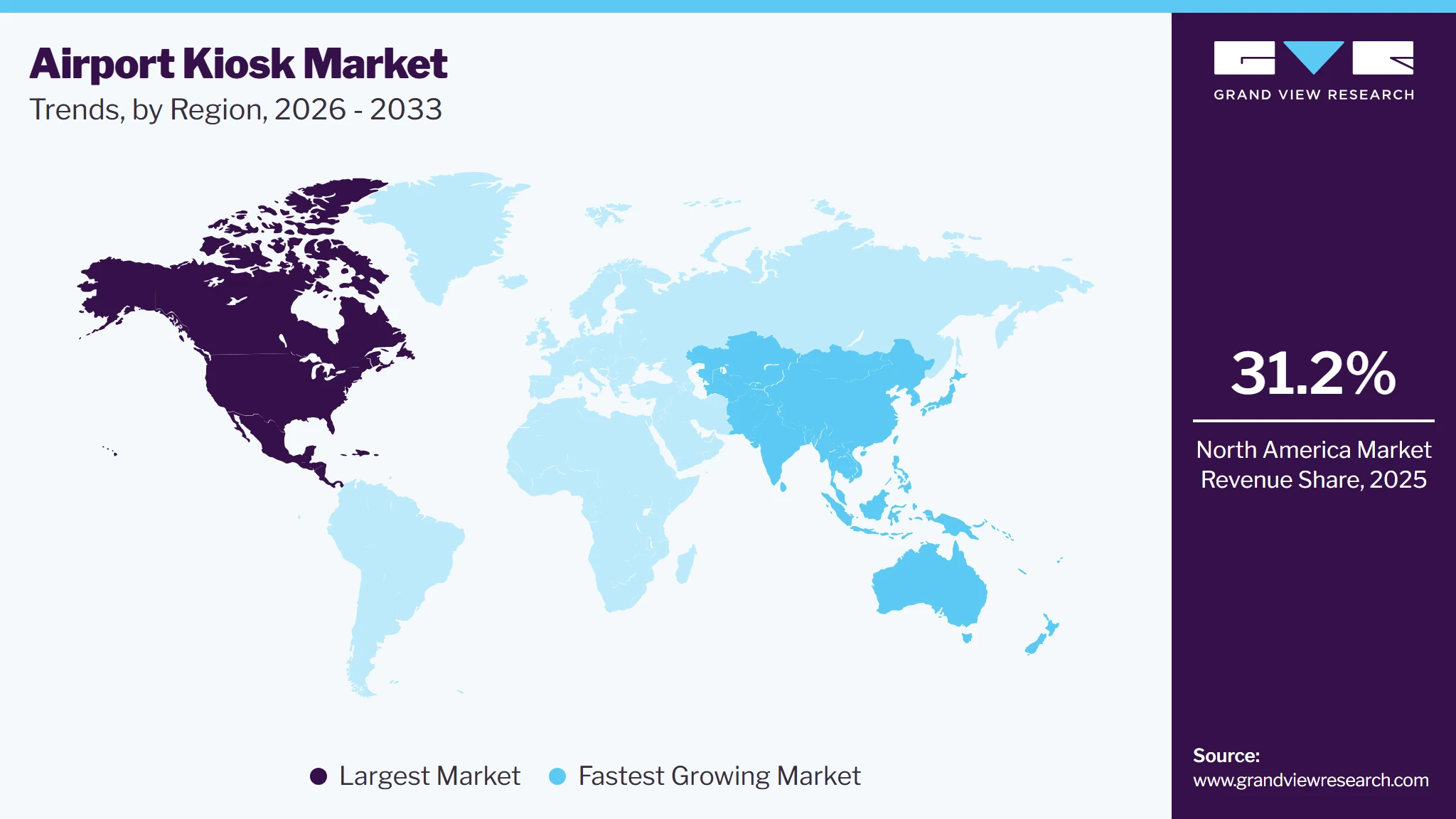
North America dominated the global airport kiosk market with the largest revenue share of 31.2% in 2025. The increasing investment in airport commercial services is driving market growth across the North America market. Airports increasingly use kiosk infrastructure for retail transactions, food ordering, transportation booking, parking services, lounge access, travel insurance, advertising engagement, digital merchandising, and other commercial passenger services that generate non-aeronautical revenue across terminal environments. Interactive kiosks increasingly combine operational passenger processing with digital retail functionality and personalized commercial engagement across expanding airport ecosystems. Airport operators increasingly invest in multifunctional kiosk platforms that support both operational efficiency and commercial revenue generation across domestic and international terminals.
 To learn more about this report, Download Free Sample Report
U.S. Airport Kiosk Market Trends
The airport kiosk market in the U.S. accounted for the largest market revenue share in North America in 2025. The increasing demand for contactless passenger services is driving market growth across the U.S. market. Travelers increasingly prefer digital interactions that minimize physical contact with airline personnel, shared surfaces, payment terminals, printed documents, and manual processing procedures throughout airport journeys. Contactless kiosks increasingly support QR code scanning, mobile integration, digital boarding passes, contactless payments, biometric authentication, and automated document verification, improving passenger convenience across terminal environments. Airports increasingly invest in touchless processing technologies that strengthen both operational efficiency and passenger experience across multiple service functions.
Asia Pacific Airport Kiosk Market Trends
The airport kiosk market in the Asia Pacific is expected to grow at the fastest CAGR from 2026 to 2033. The growth of air passenger traffic is driving market growth in the Asia Pacific. The region continues experiencing strong growth in domestic aviation, international tourism, business travel, regional connectivity, and low-cost carrier expansion, creating substantial pressure on airport passenger processing infrastructure across multiple countries. Self-service kiosks increasingly enable airports to manage large passenger volumes more efficiently by reducing queue formation, accelerating check-in, supporting baggage processing, and improving boarding preparation in high-traffic terminal environments. Airport authorities are increasingly investing in automated passenger processing technologies that enhance operational efficiency and support growing aviation demand across regional airport networks.
The China airport kiosk market is projected to grow at a significant CAGR during the forecast period. The increasing investment in airport commercial services is driving market growth across the China market. Airports increasingly use kiosk infrastructure for retail transactions, food ordering, transportation booking, parking services, lounge access, travel insurance, advertising engagement, digital merchandising, and other commercial passenger services that generate non-aeronautical revenue across terminal environments. Interactive kiosks increasingly combine operational passenger processing with digital retail functionality and personalized commercial engagement across expanding airport ecosystems. Airport operators increasingly invest in multifunctional kiosk platforms that support both operational efficiency and commercial revenue generation across domestic and international terminals.
The airport kiosk market in India is projected to grow significantly during the forecast period. The growing use of data-driven airport management is driving market growth in the Indian market. Airport authorities increasingly analyze passenger flows, queue conditions, transaction volumes, service utilization, processing times, terminal congestion patterns, equipment performance, and operational efficiency metrics to continuously optimize airport operations in complex aviation environments. Airport kiosks increasingly generate valuable operational data that supports predictive passenger flow management, staffing optimization, infrastructure utilization, terminal planning, and long-term airport development strategies across large airport networks. Airport operators increasingly seek intelligent kiosk platforms that provide advanced analytics and operational intelligence alongside self-service functionality across expanding national aviation ecosystems.
Europe Airport Kiosk Market Trends
The airport kiosk market in Europe is anticipated to grow steadily from 2026 to 2033. The growing adoption of smart airport technologies is driving market growth across the European market. Airports increasingly deploy IoT-enabled infrastructure, artificial intelligence platforms, cloud-based operational systems, passenger analytics engines, digital signage networks, baggage automation technologies, and integrated airport management platforms, all of which require intelligent kiosk deployment throughout terminal environments. Airport kiosks increasingly serve as connected digital touchpoints that exchange real-time operational data with broader smart airport ecosystems and support automated passenger services across multiple airport functions. Airport operators increasingly prioritize kiosk infrastructure that integrates seamlessly with enterprise-level airport management systems and intelligent operational networks across expanding aviation facilities.
The UK airport market is expected to grow significantly during the forecast period. The growing use of geospatial intelligence for infrastructure planning is driving market growth as agricultural businesses increasingly utilize mapping services when designing drainage systems, irrigation layouts, farm roads, storage facilities, and operational improvements. Agricultural mapping provides detailed terrain analysis that improves engineering accuracy while reducing planning uncertainty for agricultural development projects. Better infrastructure planning enhances operational efficiency while supporting future production expansion across farming enterprises. Geographic information simplifies investment planning while improving long-term farm performance.
The airport kiosk industry in Germany is expected to grow at a substantial CAGR during the forecast period. Germany's increasing deployment of centralized airport command and operational control systems is driving market growth within the German market. Modern airport operations increasingly rely on centralized monitoring environments that coordinate passenger processing, security operations, terminal management, equipment diagnostics, maintenance planning, airline operations, and resource allocation through integrated digital infrastructure. Airport kiosks increasingly connect directly with centralized operational control platforms that enable remote management, real-time performance monitoring, predictive maintenance coordination, software administration, and enterprise-wide operational visibility across large airport facilities. Airport authorities are investing in highly connected kiosk ecosystems that strengthen centralized management capabilities across complex airport environments.
Key Airport Kiosk Company Insights
Some prominent players in the airport kiosk industry include Collins Aerospace and Amadeus IT Group SA.
-
Collins Aerospace is a global aerospace and defense technology company. The company provides advanced systems and technologies for commercial aviation, military aviation, airports, space, and connected travel environments. Collins Aerospace provides self-service passenger processing solutions that support automated airport operations and seamless traveler experiences. The products enable passengers to complete check-in, boarding pass issuance, baggage tag printing, identity verification, and other travel-related processes independently, helping airports and airlines reduce queues, improve throughput, and optimize terminal operations.
-
Amadeus IT Group SA is a global travel technology company headquartered in Spain, specializing in software and technology solutions for airlines, airports, travel agencies, hospitality providers, and other participants in the travel ecosystem. Amadeus provides a comprehensive portfolio of self-service passenger processing solutions designed to streamline airport operations and enhance traveler convenience. The solutions enable passengers to perform check-in, seat selection, boarding pass printing, baggage tag printing, and other travel-related transactions independently, reducing queue times and improving airport throughput.
Key Airport Kiosk Companies
The following key companies have been profiled for this study on the airport kiosk market.
-
Advanced Kiosks
-
Amadeus IT Group SA
-
Collins Aerospace
-
Embross
-
Eye-In Media
-
imageHOLDERS
-
Ingscreen Technology Co., Ltd
-
Kiosk Innovations
-
Livewire Digital
-
REDYREF
-
Servy
-
Shenzhen Lean Kiosk Systems Co.,LTD
-
ShiningLtd.
Competitive Benchmarking
Operating Strategies
Competitive Edge
Weakness
Mature Players: Amadeus IT Group; NCR Voyix; Embross; Materna IPS
- Established players focus on self-service airport kiosks for check-in, bag drop, document verification, and passenger processing across major international airports.
- They invest in biometric authentication, touchless interfaces, airline integration, and centralized airport management systems to improve passenger throughput and operational efficiency.
- These companies benefit from established relationships with airports, certified aviation technologies, and extensive integration experience with airline and airport IT systems.
- Their global service networks and ability to support large multi-airport deployments strengthen reliability and long-term customer retention.
- Complex procurement processes and compliance with strict aviation security and operational standards can increase deployment time and costs.
- Dependence on airport infrastructure investments and airline modernization budgets may also affect market growth.
Emerging Players: Elenium Automation; KIOSK Information Systems; Olea Kiosks; Vision-Box
- Emerging players focus on biometric-enabled kiosks, modular self-service terminals, and AI-assisted passenger processing solutions for airports and transportation hubs.
- They emphasize flexible deployment to meet evolving requirements for airport automation and passenger services.
- These companies offer agile product development in biometric identification and contactless passenger processing.
- Their flexible kiosk architectures and innovation-focused approaches enable quicker adaptation to changing airport operational and security requirements.
- Smaller international deployment footprints and limited long-term airport contracts can restrict large-scale expansion.
- Competition from established aviation technology providers and lengthy airport certification processes may also slow market penetration.
Recent Developments
-
In October 2025, Embross deployed its Odyssey Common Use Passenger Processing System (CUPPS) at Edmonton International Airport, Victoria International Airport, and Kelowna International Airport, expanding its presence across Western Canada. Each implementation was tailored to the operational infrastructure and passenger volume requirements of the respective airport. At Edmonton International Airport, which handles nearly 8 billion passengers annually, the deployment included more than 200 CUPPS workstations along with a suite of self-service kiosks.
-
In September 2025, Perth Airport in Western Australia partnered with Amadeus to implement an end-to-end biometric passenger processing system spanning check-in through boarding. Built on Amadeus’ open platform and integrated with seamless travel touchpoints, the solution is designed to enhance operational efficiency and improve the passenger journey. As part of the initiative, the airport is expanding its self-service infrastructure by installing nearly 100 new check-in kiosks and replacing almost 40 conventional check-in counters with Amadeus bag-drop units.
-
In April 2025, Collins Aerospace launched upgraded capabilities for its SelfServ solution, an integrated common-use self-service solution designed to improve passenger convenience and airport operational efficiency. The enhanced platform combines check-in and self-service bag drop within a new, user-friendly kiosk interface, allowing travelers to independently manage key stages of their journey. When integrated with the SelfPass biometric identity solution, passengers can enroll their biometric information at the kiosk.
Airport Kiosk Market Report Scope
Report Attribute
Details
Market size in 2025
USD 2.4 billion
Estimated market size in 2026
USD 2.6 billion
Projected market size by 2033
USD 5.3 billion
Growth rate
CAGR of 10.6% from 2026 to 2033
Base year for estimation
2025
Historical data
2021 - 2024
Forecast period
2026 - 2033
Quantitative units
Revenue in USD million/billion, and CAGR from 2026 to 2033
Report coverage
Revenue forecast, company share, competitive landscape, growth factors, and trends
Segments covered
Component, type, deployment, technology, end use, region
Regional scope
North America; Europe; Asia Pacific; Latin America; MEA
Country scope
U.S.; Canada; Mexico; UK; Germany; France; China; India; Japan; Australia; South Korea; Brazil; UAE; Saudi Arabia; and South Africa
Key companies profiled
Advanced Kiosks; Amadeus IT Group SA; Collins Aerospace; Embross; Eye-In Media; imageHOLDERS; Ingscreen Technology Co., Ltd; Kiosk Innovations; Livewire Digital; REDYREF; Servy; Shenzhen Lean Kiosk Systems Co., LTD; ShiningLtd.
Customization scope
Free report customization (equivalent to 8 analysts working days) with purchase. Addition or alteration to country, regional & segment scope.
Pricing and purchase options
Avail customized purchase options to meet your exact research needs. Explore purchase options
Global Airport Kiosk Market Report Segmentation
This report forecasts revenue growth at global, regional, and country levels and provides an analysis of the latest industry trends in each of the sub-segments from 2021 to 2033. For this study, Grand View Research has segmented the global airport kiosk market report based on component, type, deployment, technology, end use, and region:
-
Component Outlook (Revenue, USD Billion, 2021 - 2033)
-
Hardware
-
Software
-
Services
-
-
Type Outlook (Revenue, USD Billion, 2021 - 2033)
-
Self-Check-In Kiosks
-
Self-Bag-Drop Kiosks
-
Boarding Pass Kiosks
-
Information & Wayfinding Kiosks
-
Immigration & Border Control Kiosks
-
Others
-
-
Deployment Outlook (Revenue, USD Billion, 2021 - 2033)
-
Cloud
-
On-premise
-
-
Technology Outlook (Revenue, USD Billion, 2021 - 2033)
-
Touchscreen-Based
-
Contactless / Touchless
-
Biometric-Enabled
-
RFID & Barcode-Based
-
Others
-
-
End Use Outlook (Revenue, USD Billion, 2021 - 2033)
-
Airports
-
Airlines
-
Government & Border Control Authorities
-
-
Regional Outlook (Revenue, USD Billion, 2021 - 2033)
-
North America
-
U.S.
-
Canada
-
Mexico
-
-
Europe
-
Germany
-
UK
-
France
-
-
Asia Pacific
-
China
-
India
-
Japan
-
South Korea
-
Australia
-
-
Latin America
-
Brazil
-
-
Middle East & Africa
-
UAE
-
Saudi Arabia
-
South Africa
-
-
Research Methodology
The airport kiosk market figures in this report are based on a proven research process that combines executive interviews with secondary research from proprietary databases, company filings, and recognized regulatory and institutional sources. Market size is built through value-chain sizing-reconciling supply-side and demand-side estimates-and triangulated with bottom-up and top-down approaches. Every estimate passes multiple levels of expert validation before publication, with each airport kiosk segment quantified using the revenue-capture definitions in the table below.
Segment Definition
Component
Revenue capture definition
Hardware
The largest component segment, capturing value through self-service kiosk terminals, touchscreens, biometric scanners, passport readers, printers, baggage tag units, barcode scanners, RFID readers, cameras, and payment devices deployed across airport terminals. Airport modernization programs, passenger traffic growth, and terminal expansion projects continue to drive significant investment in physical kiosk infrastructure.
Software
Market value is created through kiosk operating systems, passenger processing applications, biometric authentication platforms, flight information integration, queue management software, remote monitoring tools, and analytics platforms. Vendors increasingly monetize through recurring software licensing, cloud-based management platforms, and continuous feature upgrades that improve passenger processing efficiency.
Services
Commercial opportunities arise from kiosk installation, system integration, maintenance, technical support, managed operations, software updates, cybersecurity, and airport consulting services. Airports and airlines increasingly outsource kiosk lifecycle management to specialized service providers to ensure high availability and regulatory compliance.
Type
Revenue capture definition
Self-Check-In Kiosks
The largest kiosk segment generates value by enabling passengers to complete check-in, seat selection, document verification, and boarding pass issuance without assistance from airline staff. Airlines and airports invest heavily in these kiosks to reduce queue times, improve passenger throughput, and lower operating costs.
Self-Bag-Drop Kiosks
Commercial demand is driven by automation of baggage check-in and tagging processes, allowing passengers to complete baggage drop independently before security screening. Adoption is increasing as airports seek to optimize terminal space utilization and accelerate passenger processing during peak travel periods.
Boarding Pass Kiosks
Value is captured through kiosks dedicated to boarding pass printing, itinerary retrieval, and access to travel documents for passengers who require physical boarding credentials. These systems remain important in airports serving diverse passenger groups and varying levels of digital adoption.
Information & Wayfinding Kiosks
Market activity is centered on interactive kiosks that provide terminal navigation, flight information, airport services, retail directories, transportation guidance, and multilingual passenger assistance. Airports deploy these solutions to improve passenger experience and reduce pressure on customer service personnel.
Immigration & Border Control Kiosks
Premium revenue opportunities arise from biometric and document verification kiosks used for automated passport control, customs declarations, identity verification, and border processing. Government agencies invest in these systems to enhance security, improve border efficiency, and increase passenger processing capacity.
Others
This category includes payment kiosks, lounge access kiosks, ticketing kiosks, parking kiosks, retail ordering kiosks, and other specialized airport self-service terminals. Growing airport digitalization continues to create opportunities for customized passenger service kiosks across terminal operations.
Deployment
Revenue capture definition
Cloud
The largest kiosk segment generates value by enabling passengers to complete check-in, seat selection, document verification, and boarding pass issuance without assistance from airline staff. Airlines and airports invest heavily in these kiosks to reduce queue times, improve passenger throughput, and lower operating costs.
On-Premise
Commercial demand is driven by automation of baggage check-in and tagging processes, allowing passengers to complete baggage drop independently before security screening. Adoption is increasing as airports seek to optimize terminal space utilization and accelerate passenger processing during peak travel periods.
Technology
Revenue capture definition
Touchscreen-Based
The largest technology segment, capturing value through interactive passenger interfaces used for check-in, wayfinding, baggage processing, ticketing, and information services. Touchscreen kiosks remain widely deployed due to their intuitive user experience and compatibility with diverse airport applications.
Contactless / Touchless
Commercial demand is accelerating as airports adopt QR code scanning, gesture control, NFC, mobile integration, and voice-assisted interfaces to reduce physical contact and improve passenger safety. Post-pandemic operational priorities have significantly increased investment in touchless airport technologies.
Biometric-Enabled
Premium value is created through facial recognition, fingerprinting, iris scanning, and other biometric technologies integrated into passenger identification and border processing workflows. Governments and airport operators increasingly invest in biometric kiosks to strengthen security, accelerate passenger verification, and support seamless travel experiences.
RFID & Barcode-Based
Market activity is driven by technologies that automate baggage tracking, boarding verification, passenger identification, and document processing, using RFID tags and barcode scanners. Airlines and airports deploy these solutions to improve operational accuracy and reduce manual processing errors.
Others
This segment includes AI-enabled kiosks, multilingual interfaces, IoT-connected terminals, payment-enabled systems, and emerging intelligent passenger service technologies. Continuous innovation in airport automation is expanding the range of advanced kiosk capabilities across passenger processing environments.
End Use
Revenue capture definition
Airports
The largest technology segment, capturing value through interactive passenger interfaces used for check-in, wayfinding, baggage processing, ticketing, and information services. Touchscreen kiosks remain widely deployed due to their intuitive user experience and compatibility with diverse airport applications.
Airlines
Commercial demand is accelerating as airports adopt QR code scanning, gesture control, NFC, mobile integration, and voice-assisted interfaces to reduce physical contact and improve passenger safety. Post-pandemic operational priorities have significantly increased investment in touchless airport technologies.
Government & Border Control Authorities
Premium value is created through facial recognition, fingerprinting, iris scanning, and other biometric technologies integrated into passenger identification and border processing workflows. Governments and airport operators increasingly invest in biometric kiosks to strengthen security, accelerate passenger verification, and support seamless travel experiences.
Estimation Model
Layer No.
Layer
Question
Analysis
01
Passenger Processing Layer
Which airport processes are handled through kiosks?
Identify passenger-facing airport functions that can be self-serviced, including check-in, boarding pass issuance, baggage tagging, bag drop initiation, immigration pre-processing, security verification support, wayfinding, lounge access, ticketing, and passenger information services. This layer defines market demand by evaluating how airports reduce queues, improve passenger throughput, and enhance operational efficiency through automated self-service interactions across terminal operations.
02
Airport Operations Integration Layer
What enables kiosks to operate within airport ecosystems?
Assess the integration requirements with airline reservation systems, departure control systems, baggage handling infrastructure, biometric identity platforms, airport operational databases, payment systems, and security and border-control networks. Deployment depends on interoperability, cybersecurity, regulatory compliance, multilingual interfaces, accessibility standards, and the ability to operate reliably in high-traffic airport environments.
03
Self-Service Orchestration Layer
How are airport kiosks incorporated into terminal workflows?
Analyze how airports and airlines deploy kiosk networks across check-in halls, bag-drop zones, transfer areas, boarding gates, customs and immigration checkpoints, and passenger service areas. Operators increasingly combine kiosks with biometric authentication, mobile check-in integration, contactless interactions, remote monitoring, and centralized management platforms to optimize passenger flow and reduce staffing requirements across multiple terminal touchpoints.
04
Passenger Experience & Infrastructure Value Layer
How is commercial value generated within the airport kiosk ecosystem?
Evaluate revenue streams from kiosk hardware, software licensing, biometric modules, maintenance contracts, managed kiosk services, analytics platforms, advertising displays, and airport retail integrations. Additional value is created through lower passenger processing costs, increased terminal capacity utilization, improved on-time performance, enhanced traveler satisfaction, and recurring revenues from software updates, support services, and long-term airport infrastructure modernization programs.
Delivered Customizations
This report has been delivered with the following In-depth customizations
Client Request
Customization Delivered
Value Adds
Self-Service Passenger Processing & Airport Automation Trends
Conducted a focused analysis of airport kiosk adoption across check-in, bag tag printing, baggage drop, immigration support, boarding assistance, and passenger information services at international and domestic airports.
Helps stakeholders identify high-demand self-service applications, evaluate airport automation trends, and assess commercialization opportunities in passenger processing technologies.
Passenger Flow Optimization & Contactless Travel Adoption Trends
Evaluated adoption trends for biometric kiosks, contactless check-in, digital identity verification, multilingual interfaces, mobile integration, and queue management solutions designed to improve passenger throughput and reduce congestion.
Provides insights into evolving airport efficiency requirements, traveler experience priorities, and commercially attractive kiosk capabilities supporting faster and more seamless airport operations.
Smart Airport Infrastructure & Integrated Passenger Services Opportunity Assessment
Assessed demand for kiosks integrated with airline reservation systems, airport operational databases, biometric authentication platforms, payment systems, and real-time passenger analytics, along with challenges related to cybersecurity, interoperability, accessibility compliance, and large-scale terminal deployment.
Supports investment and expansion strategies by identifying next-generation airport technology opportunities, evaluating infrastructure readiness, and strengthening long-term growth potential in connected and intelligent airport service ecosystems.
Frequently Asked Questions About This Report
The airports segment led with a 51.9% revenue share in 2025, while the airlines segment is the fastest-growing.
The global airport kiosk market size was valued at USD 2.4 billion in 2025 and is estimated at USD 2.6 billion for 2026.
The global airport kiosk market is expected to grow at a CAGR of 10.6% from 2026 to 2033, reaching USD 5.3 billion by 2033.
Key factors include growing demand for automated check-in and boarding processes, the increasing adoption of biometric and identity verification technologies, and the growing integration of mobile and omnichannel passenger ecosystems.
North America dominated the market with 31.2% revenue share in 2025.
Asia Pacific is the fastest-growing region over the forecast period.
The hardware segment led with an 59.9% revenue share in 2025, while software is the fastest-growing segment.
The self-check-in kiosks segment led with an 31.0% revenue share in 2025, while immigration & border control kiosks is the fastest-growing segment.
On-premises held the largest share of 66.0%, while cloud is the fastest-growing segment.
Key players operating in the airport kiosk market include Advanced Kiosks, Amadeus IT Group SA, Collins Aerospace, Embross, Eye-In Media, imageHOLDERS, Ingscreen Technology Co., Ltd, Kiosk Innovations, Livewire Digital, REDYREF, Servy, Shenzhen Lean Kiosk Systems Co.,LTD, ShiningLtd.
About the Author(s)
Next Generation Technologies Research Team
Technology · Next Generation TechnologiesThis report was authored by the next generation technologies research team at Grand View Research - comprising two research analysts, one senior research analyst, and one industry expert - with specialized expertise in the next generation technologies segment of the technology industry. All findings are based on proprietary technology databases, executive interviews, and regulatory analysis, subject to internal peer review prior to publication.
Last Updated:
Speak to Analyst

Customize this report to your needs - add regions, segments, or data points, with 20% free customization.
Or view our licence options:


ISO 9001:2015 & 27001:2022 Certified
We are GDPR and CCPA compliant! Your transaction & personal information is safe and secure. For more details, please read our privacy policy.


