
- Home
- »
- Renewable Chemicals
- »
-
Algae Oil Market Size, Share, Global Industry Analysis Report, 2025GVR Report cover
![Algae Oil Market Size, Share & Trends Report]()
Algae Oil Market (2018 - 2025) Size, Share & Trends Analysis, By Grade (Fuel, Food, Feed), By Application (Biofuel, Dietary Supplement, F&B, Animal Feed), By Region, And Segment Forecasts
Report Overview
The global algae oil market size was valued at USD 1.38 billion in 2015 and is expected to grow at a CAGR of 4.3% over the forecast period on account of its increased use in biofuel applications due to its lower carbon footprint. The algae oil would be an attractive investment alternative as it offers a solution for depleting fossil fuels.
U.S. algae oil market revenue, by application, 2014-2025, (USD Million)
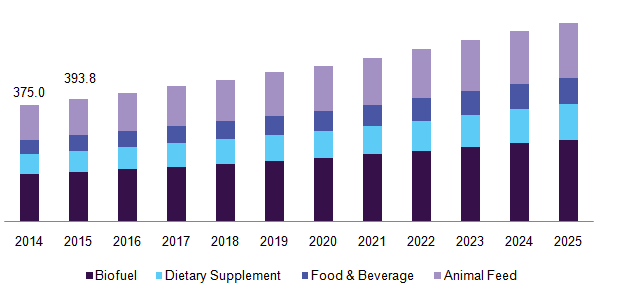
The market demand has been rising in food & beverage and dietary supplement industry on account of its increasing use as omega-3 fatty acids, phycocyanin, antioxidants, proteins, and others. The rising popularity of natural products in dietary supplement industry has boosted the need for plant-based health supplements and is expected to propel market growth over the next nine years. It can also be used as specialty oil in the food industry owing to low content of saturated and trans fats, which makes it a healthy choice. The growth of application segments particularly in North America and Europe is expected to have a positive impact on the industry.
Biofuel was estimated as the largest application segment and is projected to gain a significant share on account of its growing use as a sustainable fuel. Biofuel is also being used increasingly as an alternative renewable fuel in blending biodiesel, gasoline, jet fuel, and others. It is a very attractive investment option for non-oil producing nations, since it is environmentally friendly and low sulfur-emitting fuel production method. Emergence of alternative renewable fuel sector across geographies is expected to propel market demand over the next nine years.
Algae oil offers more nutritional value in comparison with grain feed as it contains omega-3, which is leading the demand in animal feed sector. Also, it has an advantage over the land crops which are used as animal feed, since algae cultivation requires less quantity of water and land. In addition, rising consumption from animal feed sector is expected to drive the algae oil market from 2015 to 2025.
Specific temperature and humidity conditions along with other parameters for algae cultivation, & harvesting, coupled with high price of the product are expected to pose a challenge for industry growth. Additionally, a considerable area required for the production of algae may restrain the industry growth over the coming years.
Market Dynamics
Growing consumer preference for plant-based nutrition products is increasing demand for algae oil across dietary supplement and functional food industries. Algae oil serves as a sustainable alternative to fish oil for omega-3 fatty acids such as DHA and EPA, making it highly suitable for vegan and vegetarian consumers. Rising health awareness regarding cardiovascular health, cognitive development, and nutritional supplementation is encouraging manufacturers to incorporate algae-derived ingredients into food products, infant formula, and nutritional supplements. The expanding demand for clean-label, environmentally sustainable ingredients is also driving the global commercial adoption of algae oil.
The aquaculture and animal nutrition industries are further contributing to market expansion through the growing use of algae oil in feed formulations. Algae-derived oils provide essential fatty acids while reducing dependence on marine fish resources used in conventional feed production. Investments in sustainable aquaculture practices and renewable biological resources are encouraging broader utilization of algae-based nutritional ingredients across food and feed manufacturing applications worldwide.
The wide availability of alternative omega-3 sources continues to limit demand growth for algae oil across the nutritional and food industries. Fish oil, flaxseed oil, krill oil, and other plant-based oils remain widely established in dietary supplement and functional food markets due to stronger consumer familiarity and broader commercial availability. Many manufacturers prefer conventional omega-3 ingredients because of existing supply chains, lower product costs, and established market acceptance. Competitive pricing from alternative nutritional oils can reduce the adoption of algae-derived products in cost-sensitive applications. Large-scale fish oil production and extensive retail presence also create strong competition for algae oil manufacturers seeking to expand their markets. Dependence on premium product positioning may further restrict algae oil penetration within mass-market food and supplement categories globally.
Application insights
Animal feed was estimated as the second largest application segment accounting for over 27% of the global volume in 2015. The presence of micronutrients and proteins as primary ingredients of animal feed obtained from algae oil is expected to boost its demand over the next nine years.
Food & beverage application was estimated at over USD 150 million in 2015. It can be used in the production of various types of edible oil products. Escalating growth in the food industry and increasing health conciseness is expected to further encourage the market growth over the forecast period.
Global algae oil market volume, by grade, 2015
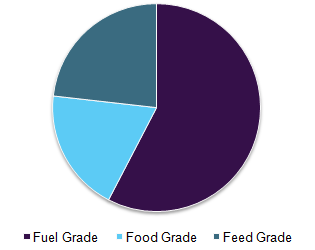
The biofuel and dietary supplement application segmented cumulatively accounted for more than 60% of the global revenue share in 2015. Increased demand for these applications can be attributed to the factors such as environmental benefits, and a rich source of omega-3.
Grade insights
The fuel grade segment was valued at USD 779.2 million in 2015 and is anticipated to register a CAGR of 4.5% during the next nine years. The fuel grade was the largest segment by volume accounting for more than 57% of the global market in 2015. It is used in the processing of biofuel which includes biodiesel, jet fuel, gasoline, and others.
Various environmental advantages of the product include lower carbon footprint, less greenhouse gas emissions, and consume carbon dioxide. Hence, different grades of algae oil are expected to witness significant growth over the forecast period.
Regional Insights
The U.S. accounted for the over 80% of the North America market volume in 2015 on account of rising need from the biofuel application segment. The innovative use of cultivation and harvesting technology to provide quality algae oil as per fuel industry requirement is expected to have a positive impact on the industry over next nine years.
Demand in Asia Pacific was valued at over USD 300 million in 2015. This growth is attributed to the development of various application sectors including biofuel, food & beverage, dietary supplements and animal feed. Asia Pacific is expected to remain the second largest market during the period 2016 to 2025.
Increasing demand from China on account of government mandates to control pollution is anticipated to result in higher overall production capacity. Substantial demand from the biofuel industry in Asia Pacific is expected to boost the market over the forecast period.
Algae Oil Market Share Insights
Key players in the market include TerraVia Holdings, Inc, Diversified Energy Corporation, Algix, LLC, and Cellana Inc.Intense competition has made producers focus on the affordable pricing structure, integrated supply chain, and product quality differentiation. Hence, companies have been investing in integrating the supply chain to maintain market share along with a focus on sustainable growth.
In October 2014, Algix, LLC, was assigned by the government to clean pond scum of 10,000 acres’ catfish farms and use for conversion to biodegradable plastics. The company capitalized this as an opportunity to set up algae treatment plant which yields approximately 200 million pounds of bio-plastic resin.
Competitive Benchmarking
Operating Strategies
Competitive Edge
Weaknesses
Mature Players: DSM-Firmenich; Corbion N.V.; DIC Corporation; BASF SE; Cargill
- Major algae oil manufacturers focus on expanding omega-3 ingredient production for dietary supplements, infant nutrition, and functional food applications. Strategic partnerships strengthen commercialization across the global nutrition and wellness industries.
- These companies invest in large-scale algae cultivation and advanced extraction technologies. Product diversification supports broader penetration across food, feed, and pharmaceutical sectors.
- Leading manufacturers possess advanced microalgae cultivation technologies and strong research capabilities supporting high-purity omega-3 oil production. Established global distribution networks strengthen commercial market accessibility significantly.
- Integrated supply chains and regulatory expertise improve product consistency and quality assurance. Strong brand recognition also supports long-term customer relationships across the nutritional industry.
- Large algae oil manufacturers face substantial production and infrastructure costs associated with commercial microalgae cultivation operations. Maintaining profitability remains challenging during fluctuating raw material and energy prices.
- Dependence on premium nutrition markets may limit broader mass-market penetration. Long commercialization timelines for algae-based innovations can also affect revenue expansion rates.
Emerging Players: Cellana Inc.; Algatech; Polaris Nutritional Lipids
- Emerging algae oil companies concentrate on niche nutritional applications and customized omega-3 ingredient development for specialized commercial customers. Flexible production models effectively support targeted product innovation strategies.
- These manufacturers expand through biotechnology partnerships and regional distribution collaborations. Focus on sustainable algae cultivation strengthens differentiation within competitive nutritional ingredient markets.
- Emerging players provide specialized algae strains and customized lipid formulations for targeted food and nutraceutical applications. Agile operational structures enable faster innovation and product adaptation.
- Sustainability-focused production methods strengthen positioning among environmentally conscious consumers and manufacturers. Smaller organizations also demonstrate stronger flexibility in niche application development.
- Limited production capacities restrict large-volume algae oil supply capabilities for multinational food and nutrition manufacturers globally. Smaller companies also face difficulties scaling commercial cultivation infrastructure efficiently.
- Lower financial resources may slow research expansion and international distribution growth. Limited brand recognition can also reduce competitiveness against established nutritional ingredient manufacturers.
Algae Oil Market Report Scope
Report Attribute
Details
Market size value in 2019
USD 1.63 billion
Revenue forecast in 2025
USD 2.09 billion
Growth Rate
CAGR of 4.3% from 2019 to 2025
Base year for estimation
2018
Historical data
2014 - 2017
Forecast period
2019 - 2025
Quantitative units
Revenue in USD billion and CAGR from 2019 to 2025
Report coverage
Revenue forecast, company ranking, competitive landscape, growth factors, and trends
Segments covered
Grade, application, region
Regional scope
North America; Europe; Asia Pacific; Central & South America; Middle East & Africa
Country scope
U.S., UK, Germany, China, India, Brazil
Key companies profiled
TerraVia Holdings, Inc, Diversified Energy Corporation, Algix, LLC, and Cellana Inc.
Customization scope
Free report customization (equivalent up to 8 analysts working days) with purchase. Addition or alteration to country, regional & segment scope.
Pricing and purchase options
Avail customized purchase options to meet your exact research needs. Explore purchase options
Segments covered in the reportThis report forecasts revenue growth at global, regional & country levels and provides an analysis on the latest trends and opportunities in each of the sub-segments from 2014 to 2025. For the purpose of this study, Grand View Research has segmented the algae oil market on the basis of grade, application, and region:
-
Grade Outlook (Volume, Gallons; Revenue, USD Million; 2014 - 2025)
-
Fuel Grade
-
Food Grade
-
Feed Grade
-
-
Application Outlook (Volume, Gallons; Revenue, USD Million; 2014 - 2025)
-
Biofuel
-
Dietary Supplement
-
Food & Beverage
-
Animal Feed
-
-
Regional Outlook (Volume, Gallons, Revenue, USD Million; 2014 - 2025)
-
North America
-
U.S.
-
-
Europe
-
UK
-
Germany
-
-
Asia Pacific
-
China
-
India
-
-
South & Central America
-
Brazil
-
-
Middle East and Africa
-
Delivered Customizations
This report has been delivered with the following In-depth customizations
Client Request
Customization Delivered
Value Adds
Cross-segmentation
Detailed cross-segmentation analysis of the algae oil market by grade and application, including market size comparison, demand distribution, consumption trends, and revenue contribution across interconnected segment combinations.
Support strategic planning and product positioning through improved understanding of high-growth application areas, evolving demand patterns, and grade-specific commercial opportunities across industrial and nutritional sectors.
Competitive Benchmarking
Comparative assessment of algae oil manufacturers based on production capacity, algae cultivation technologies, product portfolio strength, extraction capabilities, sustainability initiatives, distribution networks, and strategic partnerships across food, nutraceutical, and biofuel industries.
Assist competitive intelligence and supplier evaluation activities through enhanced visibility into manufacturer positioning, operational strengths, technological capabilities, and market competitiveness within the global algae oil industry.
Opportunity Assessment
Assessment of emerging opportunities associated with vegan nutrition demand, sustainable omega-3 ingredient adoption, aquaculture feed expansion, renewable biofuel development, and increasing use of algae-derived ingredients in cosmetics and functional foods globally.
Help identify future growth areas and high-potential application segments by deepening understanding of plant-based nutrition trends, sustainability-focused product development, and the expanding commercial use of algae-derived oils worldwide.
Frequently Asked Questions About This Report
The global algae oil market size was estimated at USD 1.63 billion in 2019 and is expected to reach USD 2.09 billion in 2020.
The global algae oil market is expected to grow at a compound annual growth rate of 4.3% from 2019 to 2025 to reach USD 2.09 billion by 2025.
Fuel grade dominated the algae oil market with a share of 51.5% in 2019. This is attributable to factors such as environmental benefits, and a rich source of omega 3.
Some key players operating in the algae oil market include TerraVia Holdings, Inc, Diversified Energy Corporation, Algix, LLC, and Cellana Inc.
Key factors that are driving the market growth include rising use in biofuel applications due to its lower carbon footprint.
About the Author(s)
Renewable Chemicals Research Team
Specialty & Chemicals · Renewable ChemicalsThis report was authored by the renewable chemicals research team at Grand View Research - comprising two research analysts, one senior research analyst, and one industry expert - with specialized expertise in the renewable chemicals segment of the specialty & chemicals industry. All findings are based on proprietary specialty & chemicals databases, executive interviews, and regulatory analysis, subject to internal peer review prior to publication.
Last Updated:
Speak to Analyst


Need a Tailored Report?
Customize this report to your needs — add regions, segments, or data points, with 20% free customization.
Or view our licence options:


ISO 9001:2015 & 27001:2022 Certified
We are GDPR and CCPA compliant! Your transaction & personal information is safe and secure. For more details, please read our privacy policy.












