
- Home
- »
- Renewable Chemicals
- »
-
Algae Oil Market Size, Share & Growth Report, 2026-2033GVR Report cover

Algae Oil Market (2026 - 2033)
Size, Share & Trends Analysis By Grade (Fuel, Food, Feed), By Application (Biofuel, Dietary Supplement, F&B, Animal Feed), By Region (North America, Asia Pacific, Europe), And Segment Forecasts
Market Size, 2025
$2.1BMarket Estimate, 2026
$2.2BMarket Forecast, 2033
$3.0BCAGR, 2026–2033
4.7%Algae Oil Market Summary
The global algae oil market size was valued at USD 2.1 billion in 2025 and is projected to grow from USD 2.2 billion in 2026 to USD 3.0 billion in 2033, at a CAGR of 4.7% from 2026 to 2033. North America dominated the market, accounting for largest a revenue share of 30.0% in 2025. Algae oil would be an attractive investment alternative, as it offers a solution to the depletion of fossil fuels.
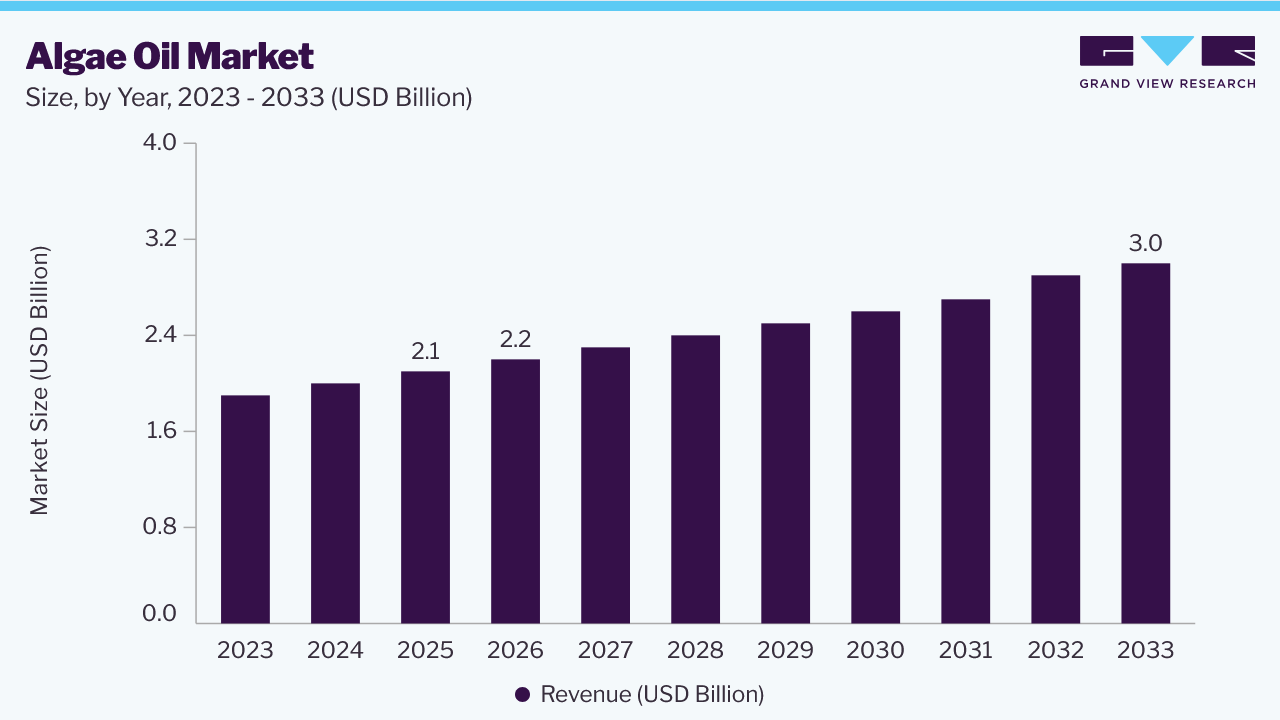 Source: Grand View Research, IR Documents, Primary Interviews, Paid DatabasesTo learn more about this report,
 Download Free Sample Report
Key Market Trends & Insights
- By application: The animal feed segment held the largest market share of over 25.0% in 2025.
- By grade: The fuel grade segment accounted for the largest revenue share in 2025.
Regional Highlights
- Largest regional market: North America (35.0% revenue share, 2025)
- Fastest-growing regional market: Asia Pacific (fastest CAGR, 2026-2033)
Market Size & Forecast
- Market size in 2025: USD 2.1 Billion
- Estimated market size in 2026: USD 2.2 Billion
- Projected market size by 2033: USD 3.0 Billion
- CAGR (2026-2033): 4.7 %
Prism AI by Grand View Research Free to tryAsk a question about the algae oil marketTry asking✓Every figure cited from GVR research Prefer the report? Download free sample →The algae oil industry is experiencing steady demand from the food & beverage and dietary supplement industries, driven by growing consumer preference for plant-based, sustainable nutrition. Rich in omega-3 fatty acids, antioxidants, proteins, and pigments such as phycocyanin, algae oil is increasingly incorporated into functional foods, nutraceuticals, and vegan dietary supplements. Growing awareness of preventive healthcare and the expanding adoption of clean-label ingredients across North America, Europe, and the Asia Pacific continue to support market growth.
The food industry is also utilizing algae oil as a healthier alternative to conventional edible oils due to its favorable fatty acid profile and low levels of saturated fat. Regulatory approvals for algal DHA and EPA ingredients, coupled with rising demand for sustainable marine-derived alternatives to fish oil, have further strengthened the adoption of these ingredients in food formulations and infant nutrition.
The biofuel segment continues to represent a key growth avenue as governments and energy companies invest in low-carbon fuels to achieve decarbonization targets. Advances in algae cultivation technologies and ongoing research into sustainable aviation fuel (SAF), renewable diesel, and biodiesel have renewed interest in algae-derived lipids as next-generation biofuel feedstocks. However, commercial deployment remains constrained by production economics, thereby limiting large-scale adoption compared with conventional biofuel feedstocks.
In the animal nutrition sector, algae oil is gaining traction as a sustainable source of omega-3 fatty acids for aquaculture, livestock, and pet food applications. Compared with traditional fish oil, algae-derived ingredients offer a more environmentally sustainable supply while reducing dependence on marine resources. Their cultivation also requires significantly less arable land than conventional oilseed crops, supporting broader sustainability objectives across the feed industry.
Despite favorable long-term prospects, the market continues to face challenges associated with high production costs, energy-intensive cultivation and extraction processes, and the need for tightly controlled growing conditions. Scaling commercial production while improving yield, reducing processing costs, and enhancing strain productivity remains critical for broader adoption across both nutritional and industrial applications.
Analyst Perspective
The algae oil market is gaining importance as a sustainable source of valuable oils across multiple industries. Rising demand for plant-based ingredients and sustainable alternatives is driving adoption in food, nutrition, and personal care products. However, high production costs, complex cultivation and extraction processes, and limited production capacity remain key challenges to large-scale commercialization. Advances in biotechnology and cultivation systems are creating opportunities to improve production efficiency and reduce operational costs. Growing applications in nutritional supplements, functional foods, and renewable fuels are further expanding market potential. Continued technological innovation and broader end-use adoption are expected to support long-term market growth.
Application insights
The animal feed segment dominated the algae oil market, accounting for a significant revenue share in 2025, driven by the growing use of algae-derived omega-3 fatty acids, proteins, and other bioactive nutrients in aquaculture, livestock, and pet nutrition. Feed manufacturers are increasingly incorporating algae-based ingredients as sustainable alternatives to fish oil to improve animal health and nutritional quality while reducing reliance on marine resources. For instance, in July 2025, Corbion received regulatory approval in China for its AlgaPrime DHA, enabling broader commercialization of algae-derived omega-3 ingredients for aquaculture feed applications.
The food & beverage segment is expected to witness a significant CAGR over the forecast period, supported by rising demand for plant-based, functional, and clean-label ingredients. Algae oil is increasingly used in edible oils, dairy alternatives, infant nutrition, beverages, and fortified food products due to its favorable fatty acid profile and high levels of DHA and EPA. Growing consumer awareness of preventive health, coupled with increasing demand for sustainable nutritional ingredients, is expected to continue driving adoption throughout the forecast period.
Grade insights
The fuel-grade segment dominated the algae oil industry, accounting for the largest revenue share in 2025 and is expected to grow steadily during the forecast period. Algae oil is used as a feedstock for producing renewable fuels, including biodiesel, renewable diesel, and sustainable aviation fuel (SAF), owing to its high lipid content and favorable sustainability profile. Growing investments in low-carbon fuel technologies and supportive government policies aimed at reducing greenhouse gas emissions continue to strengthen demand for fuel-grade algae oil. For instance, in January 2025, Enilive commenced sustainable aviation fuel (SAF) production at its Gela biorefinery, adding approximately 400,000 tonnes of annual SAF production capacity.
Fuel-grade algae oil offers several environmental benefits, including lower lifecycle carbon emissions, reduced dependence on fossil fuels, and the ability of algae cultivation systems to capture carbon dioxide during biomass growth. However, large-scale commercialization remains constrained by high production costs and limited feedstock availability. Continued advancements in algae cultivation, harvesting, and extraction technologies are expected to improve production efficiency and support broader adoption across the renewable fuels industry over the forecast period.
Regional Insights
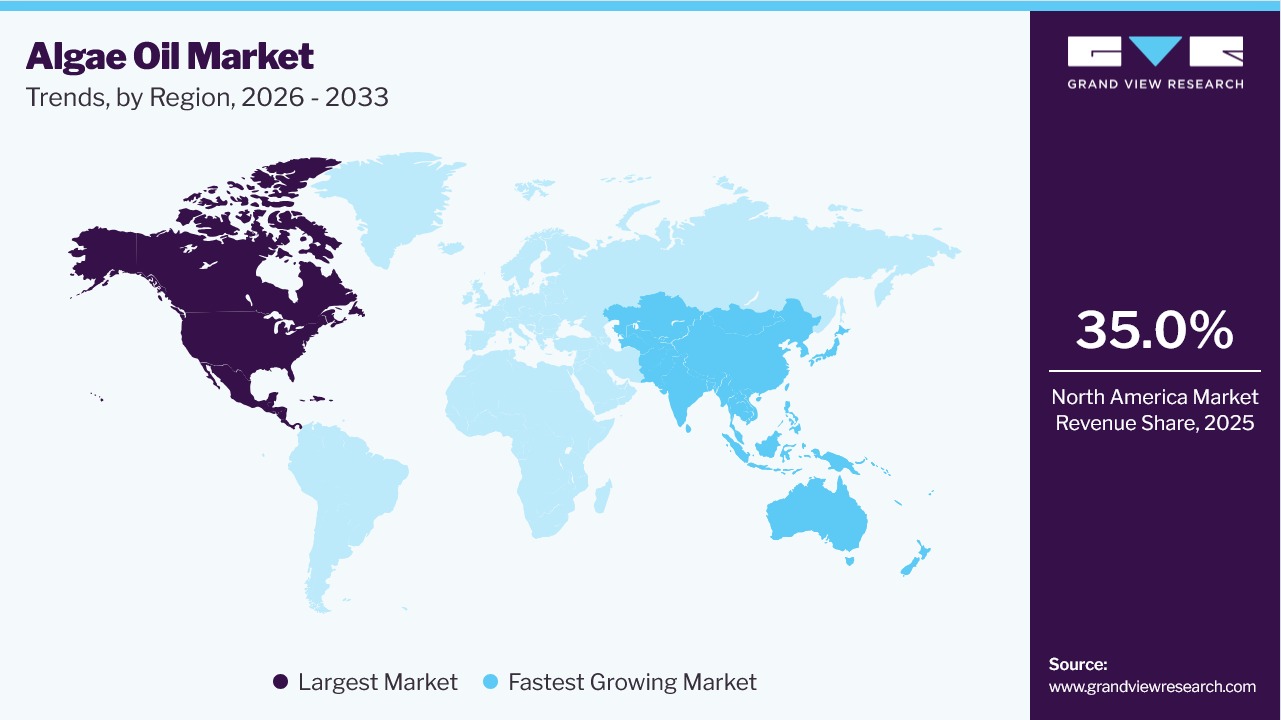
North America accounted for the largest share of the global algae oil market in 2025, supported by strong demand across dietary supplements, functional foods, animal nutrition, and renewable fuel applications. The U.S. represented the majority of the regional market, driven by the presence of leading algae biotechnology companies, advanced production infrastructure, and supportive investments in sustainable bio-based products. In addition, growing consumer demand for plant-based omega-3 ingredients has spurred the adoption of algal oil across food and nutraceutical applications.
 To learn more about this report, Download Free Sample Report
The region is also at the forefront of innovation in algae cultivation, precision fermentation, and extraction technologies, improving production efficiency and product quality. Continued investments in low-carbon fuels, sustainable aviation fuel (SAF), and next-generation biofuel technologies, supported by favorable government initiatives, are expected to further drive demand for algae oil across industrial and energy applications during the forecast period.
Asia Pacific Algae Oil Market Trends
Asia Pacific accounted for a significant share of the global algae oil industry in 2025, and is expected to grow at the fastest CAGR over the forecast period. The market growth is driven by expanding demand from the food & beverage, dietary supplements, animal nutrition, and renewable fuel industries. The region is expected to remain one of the fastest-growing markets through 2033, supported by rising health awareness, increasing consumption of plant-based nutritional ingredients, and continued investments in sustainable biotechnology.
Regional manufacturers are actively expanding algae-based product portfolios to address growing demand for sustainable omega-3 ingredients. For instance, in September 2025, Rohto Pharmaceutical launched an algae-derived DHA/EPA supplement in Japan, utilizing cultivated algae as a sustainable source of omega-3 fatty acids for consumers.
The China algae oil market is a key growth area, supported by government initiatives promoting low-carbon technologies, bio-based manufacturing, and sustainable industrial development. In addition, increasing investments in algae cultivation, coupled with growing interest in renewable fuels and alternative protein sources across China, Japan, South Korea, and Southeast Asia, are expected to support long-term market expansion during the forecast period.
Key Algae Oil Company Insights
The algae oil market is characterized by established biotechnology companies and ingredient manufacturers focused on expanding production capacity, improving extraction technologies, and strengthening commercial partnerships. Key market participants include Corbion, Veramaris, DSM-Firmenich, AlgiSys Biosciences, Cellana Inc., and AlgaPrime (Corbion), among others. Companies are increasingly prioritizing product innovation, cost optimization, regulatory approvals, and strategic collaborations to expand their presence across the food & beverage, dietary supplements, animal nutrition, and biofuel sectors.
Competition centers on improving production efficiency, enhancing supply chain resilience, and scaling commercial manufacturing to reduce production costs and meet the growing demand for sustainable algae-derived ingredients. Strategic investments in cultivation technologies, precision fermentation, and downstream processing continue to strengthen market positioning. For instance, in September 2025, Veramaris partnered with Merwetank to establish dedicated bulk algae oil storage infrastructure, enhancing supply security, logistics efficiency, and distribution capabilities for customers across global markets.
Key Algae Oil Companies
The following key companies have been profiled for this study on the Algae Oil Market:
-
DSM-Firmenich AG
-
Corbion N.V.
-
Cargill, Incorporated
-
Cellana, Inc.
-
Cyanotech Corporation
-
DIC Corporation
-
Algatech Ltd.
-
Veramaris
-
Algenol Biotech LLC
Recent Developments
- In April 2025, MiAlgae announced plans to establish a new production facility in Grangemouth, Scotland, to expand the manufacturing capacity of its sustainable microalgae-based omega-3 ingredients. The investment is intended to meet growing demand from the aquaculture and pet food industries, strengthen the commercial supply of fish-free algal oil, and reduce reliance on marine-derived omega-3 sources.
- In March 2025, DSM-Firmenich secured a favorable ruling in a UK patent dispute protecting its algal DHA oil technology. The decision reinforced the company's intellectual property covering key production processes for high-purity algal omega-3 ingredients, strengthening its competitive position and supporting continued investment in algae-based nutritional innovations.
Algae Oil Market Report Scope
Report Attribute
Details
Market size in 2025
USD 2.1 billion
Estimated market size in 2026
USD 2.2 billion
Projected market size by 2033
USD 3.0 billion
Growth rate
CAGR of 4.7% from 2026 to 2033
Base year for estimation
2025
Historical data
2021 – 2024
Forecast period
2026 – 2033
Quantitative units
Revenue in USD billion and CAGR from 2026 to 2033
Report coverage
Revenue forecast, company ranking, competitive landscape, growth factors, and trends
Segments covered
Grade, application, region
Regional scope
North America; Europe; Asia Pacific; Central & South America; Middle East & Africa
Country scope
U.S.; UK; Germany; China; India; Brazil
Key companies profiled
DSM-Firmenich AG; Corbion N.V.; Cargill, Incorporated; Cellana, Inc.; Cyanotech Corporation; DIC Corporation; Algatech Ltd.; Veramaris; Algenol Biotech LLC
Customization scope
Free report customization (equivalent up to 8 analysts working days) with purchase. Addition or alteration to country, regional & segment scope.
Pricing and purchase options
Avail of customized purchase options to meet your exact research needs. Explore purchase options
Global Algae Oil Market Report Segmentation
This report forecasts revenue & volume growth at the global, regional & country levels and provides an analysis of the latest industry trends and opportunities in each of the sub-segments from 2021 to 2033. For this study, Grand View Research has segmented the global algae oil market report based on grade, application, and region:
-
Grade Outlook (Volume, Gallons; Revenue, USD Billion, 2021 - 2033)
-
Fuel Grade
-
Food Grade
-
Feed Grade
-
-
Application Outlook (Volume, Gallons; Revenue, USD Billion, 2021 - 2033)
-
Biofuel
-
Dietary Supplement
-
Food & Beverage
-
Animal Feed
-
-
Regional Outlook (Volume, Gallons, Revenue, USD Billion, 2021 - 2033)
-
North America
-
U.S.
-
-
Europe
-
UK
-
Germany
-
-
Asia Pacific
-
China
-
India
-
-
South & Central America
-
Brazil
-
-
Middle East and Africa
-
Frequently Asked Questions About This Report
The global algae oil market size was valued at USD 2.1 billion in 2025 and is estimated at USD 2.2 billion for 2026.
The global algae oil market is expected to grow at a CAGR of 4.7 % from 2026 to 2033, reaching USD 3.0 billion.
North America dominated with an approximately 35.0 % revenue share in 2025.
Key players in the market include DSM-Firmenich AG; Corbion N.V.; Cargill, Incorporated; Cellana, Inc.; Cyanotech Corporation; DIC Corporation; Algatech Ltd.; Veramaris; and Algenol Biotech LLC.
The animal feed segment accounted for the largest revenue share of over 25.0% in 2025.
About the Author(s)
Renewable Chemicals Research Team
Specialty & Chemicals · Renewable ChemicalsThis report was authored by the renewable chemicals research team at Grand View Research - comprising two research analysts, one senior research analyst, and one industry expert - with specialized expertise in the renewable chemicals segment of the specialty & chemicals industry. All findings are based on proprietary specialty & chemicals databases, executive interviews, and regulatory analysis, subject to internal peer review prior to publication.
Last Updated:
Speak to Analyst

Customize this report to your needs - add regions, segments, or data points, with 20% free customization.
Or view our licence options:


ISO 9001:2015 & 27001:2022 Certified
We are GDPR and CCPA compliant! Your transaction & personal information is safe and secure. For more details, please read our privacy policy.


