
- Home
- »
- Advanced Interior Materials
- »
-
Aluminum Composite Panels Market Size Report, 2026-2033GVR Report cover
![Aluminum Composite Panels Market (2026 - 2033)Report]()
Aluminum Composite Panels Market (2026 - 2033)
Size, Share & Trends Analysis Report By Product (PVDF, Polyester, Laminating Coating, Oxide Film), By Application (Construction, Automotive, Advertising Boards, Railways), By Region, And Segment Forecasts
Market Size, 2025
$6.9BMarket Estimate, 2026
$7.3BMarket Forecast, 2033
$12.1BCAGR, 2026–2033
7.4%Aluminum Composite Panels Market Summary
The global aluminum composite panels market size was valued at USD 6.9 billion in 2025 and is projected to grow from USD 7.3 billion in 2026 to USD 12.1 billion by 2033, at a CAGR of 7.4% from 2026 to 2033. Asia Pacific dominated the global market with the largest revenue share of 41.1% in 2025. The increasing the application scope of lightweight aluminum composite panels in the construction industry for insulation is projected to drive the market growth.

Key Market Trends & Insights
- By application: Construction segment held the largest revenue share of 54.4% in 2025.
- By product: Polyvinylidene fluoride (PVDF) segment accounted for the largest revenue share of 36.5% in 2025.
Regional Highlights
- Largest regional market: Asia Pacific (41.1% revenue share, 2025)
- By country: The China held the largest market share in 2025.
Market Size & Forecast
- Market size in 2025: USD 6.9 Billion
- Estimated market size in 2026: USD 7.3 Billion
- Projected market size by 2033: USD 12.1 Billion
- CAGR (2026-2033): 7.4%
These composite panels provide features, such as lower thickness, high insulation, and superior sealing, which are crucial for building structures. Also, ACPs offer excellent air and water barriers, flexibility, high load performance, and durability, which is expected to positively impact market growth over the forecast period. The U.S. government has set regulations in which light-duty automobiles should achieve Corporate Average Fuel Efficiency (CAFE) standards of 54.5 mpg by 2025. The federal proposal to improve CAFE standards is thus expected to serve as a major impetus for the incorporation of lightweight materials, such as aluminum composites, into automobiles, thereby driving the market.
Sandwich panels are majorly used in the design and construction of transportation systems, such as aircraft, satellites, missiles, and high-speed trains, to reduce the structural weight. Aluminum composites are used for the manufacturing of sandwich panels, thereby propelling the market growth over the forecast period. Furthermore, technological advancements in the manufacturing process of ACP sheets and panels are expected to have a significant impact on the overall market.
The growing popularity of green buildings is also projected to fuel product demand on account of eco-friendly characteristics of these materials. Several regulations and safety standards, such as LEED and British Safety Standards, govern the building and structure and also favor the incorporation of ACPs. Also, ACPs provide high tensile strength and reduce the overall weight of the building structure, which makes them one of the potential materials for the modern construction industry.
Market Dynamics
The aluminum composite panels market is experiencing steady growth driven by increasing construction activity, rapid urbanization, and rising demand for aesthetically appealing, lightweight, and durable façade materials. ACPs offer advantages such as corrosion resistance, design flexibility, ease of installation, and favorable strength-to-weight characteristics, making them widely used in commercial buildings, residential projects, transportation infrastructure, signage, and interior applications. Growing investments in modern architecture, infrastructure development, and energy-efficient building solutions are further supporting market expansion.
The increasing adoption of aluminum composite panels in building façades and exterior cladding applications is a key factor driving market growth. Architects, developers, and building owners are increasingly seeking materials that combine visual appeal with durability, weather resistance, and low maintenance requirements. ACPs provide extensive design flexibility through a wide range of colors, finishes, textures, and customization options, making them suitable for contemporary architectural designs.
Additionally, rapid urbanization and growing investments in commercial complexes, airports, healthcare facilities, educational institutions, and high-rise buildings are creating sustained demand for advanced façade systems. The growing focus on renovation and modernization of existing buildings is also contributing to ACP consumption. As construction activities continue to expand globally, the demand for aluminum composite panels is expected to increase significantly, supporting long-term market growth.
The aluminum composite panels market faces challenges due to fluctuations in the prices of key raw materials, particularly aluminum and petrochemical-based core materials. Changes in aluminum prices, energy costs, trade policies, and supply chain disruptions can significantly impact manufacturing costs and profit margins for ACP producers. In highly competitive markets, manufacturers may face difficulties in passing increased costs to customers, creating pricing pressures and affecting profitability. These challenges can limit market growth, particularly in price-sensitive construction projects where cost considerations play a critical role in material selection.
The increasing focus on sustainable construction and enhanced building safety is creating significant growth opportunities for the aluminum composite panels market. Governments, architects, and developers are increasingly adopting materials that support green building objectives, improve energy efficiency, and comply with evolving fire safety regulations. This trend is driving demand for recyclable aluminum composite panels, low-emission manufacturing processes, and fire-retardant ACP products across residential, commercial, and institutional buildings. Additionally, the expansion of smart city projects, urban infrastructure development, and large-scale renovation activities is further increasing the need for high-performance façade materials that combine aesthetics, durability, and regulatory compliance. As sustainability and safety continue to become key priorities in the construction industry, the adoption of advanced aluminum composite panels is expected to accelerate, creating substantial opportunities for market growth.
Analyst Perspective
The aluminum composite panels market is transitioning from a volume-driven building materials segment toward a more performance- and compliance-oriented industry, where growth is increasingly influenced by fire safety requirements, sustainability considerations, and architectural specifications. While demand continues to be supported by commercial construction, infrastructure development, renovation activities, and signage applications, long-term success will depend on manufacturers' ability to offer differentiated products through advanced coating technologies, fire-retardant cores, customized finishes, and environmentally responsible manufacturing practices. As project owners and regulators place greater emphasis on building safety, durability, and lifecycle performance, companies with strong product portfolios, technical capabilities, and established distribution networks are likely to capture greater value, while suppliers competing primarily on price may face margin pressure and increasing competition from alternative façade and cladding materials.
Product Insights
The polyvinylidene fluoride (PVDF) segment accounted for the largest revenue share of 36.1% in 2024, owing to a wide range of applications including lightweight construction, high-speed trains, and advertisement boards. Also, their features, such as corrosion and wear resistance and durability, are expected to benefit the segment growth. PE panels are also among the majorly used products owing to properties, such as extreme rigidity, surface flatness, smoothness, and thermal as well as acoustical insulation. It is expected to register notable growth in the future due to benefits, such as easy fabrication and processing.
The laminating coating segment is expected to grow at a CAGR of 6.4% during the forecast period. Laminating coating ACPs are manufactured through multi-layer extrusion lamination and primarily used for lamination applications in the construction industry. The use of oxide film in the production of ACPs provides several advantages, such as fire protection and UV, corrosion, and acid resistance. These properties are crucial in the construction and automotive industries. Thus, this is also estimated to boost market development.
Application Insights
Based on application, the construction segment led the market with the largest revenue share of 54.4% in 2025 and is expected to grow at the fastest CAGR over the forecast period. Eco-friendly characteristics offered by the product are expected to increase its demand for green buildings, thereby propelling the growth of the aluminum composite panel industry. Benefits, such as thermal & acoustic insulation and corrosion resistance offered by the product are also expected to fuel their demand in the modern construction industry. Also, rising product use in decorative and cladding applications to meet transition energy and building standards is likely to augment the segment growth product over the next few years.

The advertising boards segment is expected to grow a CAGR of 6.5% over the forecast period. Rapidly expanding advertising, marketing, and mass media industry worldwide has resulted in increased expenditure on advertising boards. ACPs are broadly used for these boards as they are subjected to extreme environmental conditions, such as humidity, moisture, temperature fluctuations, and pollution. The railway application segment is also projected to witness considerable growth. Moreover, these composites help reduce the overall weight of trains resulting in improved speed and reduced power consumption.
Regional Insights
The North America aluminum composite panels industry accounted for a substantial revenue share of 26.8% in 2024. The industry is expected to grow as a result of the region's growing number of green buildings. The expansion of North America is being aided by an increase in governmental programs and initiatives to foster better infrastructure. In addition, the increase is anticipated to be boosted by the increasing usage of panels in cladding and ornamental applications to meet evolving architectural and energy standards. Increased manufacturing of hybrid and electric cars in North America will also bode well for the market's expansion.
U.S. Aluminum Composite Panels Market Trends
The U.S. construction industry has been experiencing a resurgence fueled by urbanization trends, population growth, and increased investments in infrastructure development. Aluminum composite panels are increasingly used for facades, interior applications, and signage due to their aesthetic appeal and durability. Moreover, with a growing emphasis on sustainable building practices, ACPs are gaining traction as they are recyclable and can contribute to energy-efficient building designs.
Asia Pacific Aluminum Composite Panels Market Trends
Asia Pacific dominated the aluminum composite panels market with the largest revenue share of 41.1% in 2025. The rapidly growing construction industry, especially in emerging economies like China, India, Indonesia, and Vietnam, is anticipated to have a positive impact on the regional market. The rising population coupled with government schemes promoting basic amenities and high demand for affordable housing are also among the major factors driving the region’s growth.

The aluminum composite panels market in the China held the largest share in the Asia Pacific region in 2025. As the country continues its urban expansion, there is a rising demand for modern and sustainable construction materials.
Europe Aluminum Composite Panels Market Trends
The Europe aluminum composite panel industry is anticipated to grow at a CAGR of 6.1% over the forecast period. Many European countries are tightening regulations regarding energy efficiency in buildings, particularly in the wake of the European Union’s environmental goals. ACPs are known for their excellent insulation properties, which help improve the thermal efficiency of buildings. Combining energy efficiency, reduced environmental impact, and longevity makes ACPs attractive for developers looking to meet sustainability targets while reducing operational costs.
Key Aluminum Composite Panels Company Insights
Some of the key players operating in the market include Arconic, Alcoa Corporation, and others. The global aluminum composite panels market is highly competitive as major companies focus on the development of advanced products with superior characteristics and also demonstrate their brand strength through well-known trademarked products. Production capacity expansion and product customizations are also expected to be among the key strategic initiatives adopted by these companies to gain competitive advantages. Global companies in developed regions like North America and Europe are facing strong price competition from Chinese manufacturers.
Key Aluminum Composite Panels Companies
The following key companies have been profiled for this study on the aluminum composite panels market.
-
Arconic
-
Mitsubishi Engineering-Plastics Corporation
-
Alcoa Corporation
-
Fairfield Metal
-
Shanghai Yaret Industrial Group Co., Ltd.
Competitive Benchmarking
Category
Operating Strategies
Competitive Edge
Weakness
Established Players (Arconic, Mitsubishi Engineering-Plastics Corporation, Alcoa Corporation)
- Focus on high-performance ACP solutions, product innovation, global market expansion, and strategic partnerships with construction, infrastructure, and industrial customers. Continuous investment in advanced coatings, fire-resistant panels, and sustainable building material solutions.
- Strong brand recognition, extensive global distribution networks, advanced manufacturing capabilities, diversified product portfolios, and long-standing relationships with architects, contractors, and project developers.
- Higher operating costs and exposure to fluctuations in aluminum prices and construction activity. Large organizational structures may also limit flexibility in addressing niche regional requirements.
Emerging Players (Fairfield Metal, Shanghai Yaret Industrial Group Co., Ltd.)
- Focus on regional expansion, cost-competitive ACP offerings, and strengthening presence in commercial construction, signage, and infrastructure applications. Emphasis on customized products and responsive customer service to capture market share.
- Competitive pricing, operational flexibility, faster response to regional demand trends, and ability to serve specific customer requirements through customized solutions.
- Limited global footprint, lower brand visibility compared to multinational competitors, narrower distribution networks, and relatively smaller production capacities that may restrict large-scale project participation.
Recent Developments
-
In June of 2023, Alumaze, a company specializing in aluminum composite panels (ACP), unveiled a fresh lineup of offerings. This included ACP sheets that were produced within their recently established facility situated in the Vizianagaram district. The swift construction of this manufacturing plant, accomplished within a span of eight months, was underpinned by a significant investment totaling USD 6 million. This strategic expansion was prompted by the escalating market demand for aluminum panels, particularly for applications in interior design and signage.
-
In January 2021, Alucopanel, a UAE-based manufacturer of aluminum composite panels, announced the launch of the country’s first government-approved non-combustible grade aluminum composite panel recommended for building projects with high levels of fire protection. The launch makes Alucopanel the first civil A1-grade aluminum composite panel with defense certification in the world.
Aluminum Composite Panels Market Report Scope
Report Attribute
Details
Market size in 2025
USD 6.9 billion
Estimated market size in 2026
USD 7.3 billion
Projected market size by 2033
USD 12.1 billion
Growth rate
CAGR of 7.4% from 2026 to 2033
Base year for estimation
2025
Historical data
2021 - 2024
Forecast period
2026 - 2033
Quantitative units
Volume in million square feet and Revenue in USD million/billion and CAGR from 2026 to 2033
Report coverage
Revenue forecast, company ranking, competitive landscape, growth factors, and trends
Segments covered
Product, application, region
Regional scope
North America; Europe; Asia Pacific; Latin America; MEA
Country scope
U.S.; Canada; Mexico; Germany; France; Italy; U.K.; Spain; China; India; Japan; South Korea; Thailand; Australia; Brazil; Saudi Arabia
Key companies profiled
Arconic; Mitsubishi Engineering-Plastics Corporation; Alcoa Corporation; Fairfield Metal; Shanghai Yaret Industrial Group Co., Ltd.
Customization scope
Free report customization (equivalent up to 8 analysts' working days) with purchase. Addition or alteration to country, regional & segment scope.
Pricing and purchase options
Avail customized purchase options to meet your exact research needs. Explore purchase options
Global Aluminum Composite Panels Market Report Segmentation
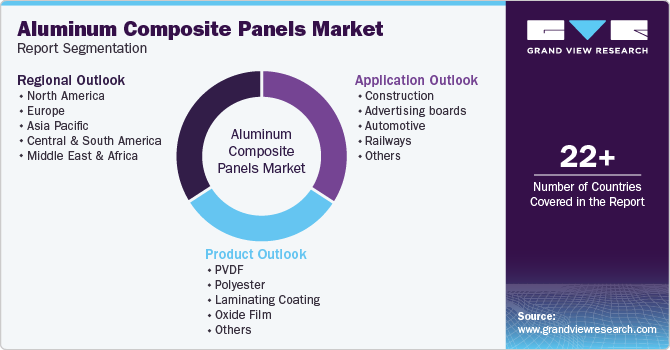
This report forecasts volume & revenue growth at regional & country levels and provides an analysis on the industry trends in each of the sub-segments from 2021 to 2033. For the purpose of this study, Grand View Research has segmented the global aluminum composite panels market report based on product, application, and region:
-
Product Outlook (Volume, Million Square Feet; Revenue, USD Million, 2021 - 2033)
-
PVDF
-
Polyester
-
Laminating Coating
-
Oxide Film
-
Others
-
-
Application Outlook (Volume, Million Square Feet; Revenue, USD Million, 2021 - 2033)
-
Construction
-
Automotive
-
Cars
-
Doors
-
Hoods
-
Wings
-
Side Panels
-
Others
-
-
Commercial Vehicle
-
Trailers
-
-
Advertising Boards
-
Railways
-
Others
-
-
Regional Outlook (Volume, Million Units; Revenue, USD Million, 2021 - 2033)
-
North America
-
U.S.
-
Canada
-
Mexico
-
-
Europe
-
UK
-
Germany
-
France
-
Italy
-
Spain
-
-
Asia Pacific
-
China
-
Japan
-
India
-
Australia
-
Thailand
-
South Korea
-
-
Central & South America
-
Brazil
-
-
Middle East and Africa
-
Saudi Arabia
-
-
Research Methodology
Segment Definition
Segment - Product
Revenue Capture Definition
PVDF
Revenue generated from aluminum composite panels coated with polyvinylidene fluoride (PVDF), primarily used in exterior building façades, cladding systems, architectural applications, and infrastructure projects requiring superior weather resistance, UV stability, and long-term durability.
Polyester
Revenue generated from polyester-coated aluminum composite panels used in interior decoration, signage, retail fit-outs, commercial spaces, and cost-sensitive construction applications where moderate weather resistance and aesthetic appeal are required.
Laminating Coating
Revenue generated from aluminum composite panels featuring laminated decorative surfaces, including wood, stone, metallic, brushed, and specialty finishes used in architectural, interior design, and commercial applications.
Oxide Film
Revenue generated from anodized or oxide-film aluminum composite panels offering enhanced corrosion resistance, metallic appearance, and durability for premium architectural, transportation, and industrial applications.
Others
Revenue generated from aluminum composite panels utilizing specialty coatings such as FEVE, nano-coatings, anti-bacterial coatings, anti-static coatings, and other advanced surface treatment technologies serving niche and high-performance applications.
Segment - Application
Revenue Capture Definition
Construction
Revenue generated from aluminum composite panels used in exterior façades, cladding systems, curtain walls, canopies, partitions, ceilings, interior decoration, and architectural applications across residential, commercial, institutional, and industrial buildings.
Automotive
Revenue generated from aluminum composite panels used in commercial vehicles, buses, trailers, recreational vehicles, electric vehicles, and automotive interior and exterior components where lightweight construction and aesthetic appeal are required.
Advertising Boards
Revenue generated from aluminum composite panels utilized in outdoor and indoor signage, billboards, display boards, retail branding, wayfinding systems, exhibition structures, and advertising applications.
Railways
Revenue generated from aluminum composite panels used in railway coaches, metro systems, station infrastructure, passenger terminals, platform structures, and transportation-related interior and exterior applications.
Others
Revenue generated from aluminum composite panel applications across marine, aerospace, furniture, industrial equipment, modular construction, kiosks, and other end-use sectors not included in the above categories.
Estimation Model
Layer Name
Key Question
Description
Addressable Panel Demand Layer
How large is the potential market for ACPs?
Estimate global demand for façade, cladding, signage, and transportation panels across construction and industrial sectors to determine the total addressable panel area.
ACP Adoption Layer
How much of the addressable market use ACPs?
Apply ACP penetration rates across end-use industries, considering substitution of alternative materials such as glass, steel, fiber cement, and solid aluminum panels.
Segment Conversion Layer
How is ACP demand distributed across report segments?
Allocate ACP volume across applications (Construction, Automotive, Advertising Boards, Railways, Others) and product types (PVDF, Polyester, Laminating Coating, Oxide Film, Others) based on industry usage patterns.
Revenue Layer
How much revenue is generated?
Apply regional average selling prices (ASP) by product category and aggregate revenues across all applications and geographies to derive the total market size.
Delivered Customizations
This report has been delivered with the following In-depth customizations
CLIENT REQUEST
CUSTOMIZATION DELIVERED
VALUE ADDS
Pricing Analysis
Analysis of pricing trends across ACP product categories including PVDF, Polyester, Laminating Coating, Oxide Film, and Other specialty panels. Covers regional pricing variations and application-wise pricing differences.
Supports pricing strategy development, procurement planning, supplier evaluation, and cost optimization by highlighting key pricing drivers across products and regions.
Regional Segmentation Analysis
Detailed assessment of market size, growth potential, demand drivers, construction activity, infrastructure investments, and competitive landscape across North America, Europe, Asia Pacific, Latin America, and Middle East & Africa. Includes country-level opportunity mapping and demand outlook for major ACP-consuming markets.
Helps identify high-growth regions, prioritize market expansion strategies, evaluate regional demand patterns, and support resource allocation decisions.
Technology Assessment
Evaluation of key ACP manufacturing and coating technologies, including PVDF coatings, polyester coatings, laminating technologies, oxide film treatments, fire-retardant core technologies, and sustainable panel manufacturing processes. Analysis covers performance characteristics, technology adoption trends, regulatory compliance, and innovation developments across end-use industries.
Supports technology benchmarking, product development planning, investment prioritization, and understanding of evolving performance, safety, and sustainability requirements in the ACP market.
Frequently Asked Questions About This Report
The global aluminum composite panels market size was estimated at USD 6.9 million in 2025 and is expected to reach USD 7.3 million in 2026.
The key factors driving the aluminum composite panels market include the rising popularity of antibacterial and anti-toxic panels in commercial and industrial construction activities around the world.
Some of the key players operating in the aluminum composite panel market include Arconic; Mitsubishi Engineering-Plastics Corporation; Alcoa Corporation; Fairfield Metal; Shanghai Yaret Industrial Group Co., Ltd.
Asia Pacific dominated the global aluminum composite panels market with a revenue share of 41.1% in 2025.
PVDF dominated the aluminum composite panel market with a share of 36.1% in 2025 owing to its lightweight material, high mechanical quality, and low cost.
The construction segment led the market with the largest revenue share of 54.4% in 2025 and is expected to grow at the fastest CAGR over the forecast period.
India is the fastest-growing country in the aluminum composite panels market.
The global aluminum composite panels market is expected to grow at a compound annual growth rate (CAGR) of 7.4% from 2026 to 2033, reaching USD 12.1 million by 2033.
About the Author(s)
Advanced Interior Materials Research Team
Advanced Materials · Advanced Interior MaterialsThis report was authored by the advanced interior materials research team at Grand View Research - comprising two research analysts, one senior research analyst, and one industry expert - with specialized expertise in the advanced interior materials segment of the advanced materials industry. All findings are based on proprietary advanced materials databases, executive interviews, and regulatory analysis, subject to internal peer review prior to publication.
Last Updated:
Speak to Analyst

Need a Tailored Report?
Customize this report to your needs — add regions, segments, or data points, with 20% free customization.
Or view our licence options:


ISO 9001:2015 & 27001:2022 Certified
We are GDPR and CCPA compliant! Your transaction & personal information is safe and secure. For more details, please read our privacy policy.












