
- Home
- »
- Paints, Coatings & Printing Inks
- »
-
Aluminum Oxide Market Size & Share Report, 2026-2033GVR Report cover
![Aluminum Oxide Market (2026 - 2033)Report]()
Aluminum Oxide Market (2026 - 2033)
Size, Share & Trends Analysis Report By Form (Nanoparticles, Powder, Pellets), By End Use (Aluminum Smelting, Abrasives, Refractories, Ceramics, Chemicals), By Region, And Segment Forecasts
Market Size, 2025
$56.1BMarket Estimate, 2026
$58.3BMarket Forecast, 2033
$82.5BCAGR, 2026–2033
5.1%Aluminum Oxide Market Summary
The global aluminum oxide market size was valued at USD 56.1 billion in 2025 and is projected to grow from USD 58.3 billion in 2026 to USD 82.5 billion by 2033, at a CAGR of 5.1% from 2026 to 2033. Asia Pacific dominated the market, accounting for the largest revenue share of 62.7% in 2025. Market growth is supported by the continued expansion of aluminum production and downstream conversion industries, where alumina remains a fundamental feedstock for primary aluminum smelting.

Key Market Trends & Insights
- By form: The powder segment held the dominating revenue share of 57.6% in 2025.
- By end use: The aluminum smelting held the largest revenue share capturing a 41.9% revenue share.
Regional Highlights
- Largest Region: Asia Pacific (62.7% revenue share, 2025)
- Fastest-growing Region: Asia Pacific (fastest CAGR, 2026-2033)
- By country: China held the largest market share in 2025.
Market Size & Forecast
- Market size in 2025: USD 56.1 Billion
- Estimated market size in 2026: USD 58.3 Billion
- Projected market size by 2033: USD 82.5 Billion
- CAGR (2026-2033): 5.1%
Increasing requirements for lightweight materials across automotive, transportation, electrical equipment, packaging, and construction are strengthening the underlying demand for alumina and, consequently, aluminum oxide. Consumption of non-metallurgical alumina is broadening across abrasives, refractories, ceramics, and chemical applications, creating a more diversified demand base beyond conventional smelter-grade consumption. The scale of the upstream industry remains substantial, with China alone accounting for 82.4 million tonnes of alumina production in 2023, equivalent to 58% of global output according to USGS data.
An important opportunity lies in the shift toward higher-value and application-specific aluminum oxide products. Demand for specialty alumina is increasing, where customers require controlled particle size, purity, morphology, thermal performance, or chemical characteristics rather than commodity-grade material. This creates opportunities for manufacturers to move toward differentiated products serving advanced ceramics, refractory solutions, polishing, battery materials, flame-retardant systems, and other technically demanding applications. Hindalco, for example, identifies specialty alumina as a strategic growth area and highlights applications such as flame retardants, battery-grade materials, and semiconductor-related uses.
Market Dynamics
The aluminum oxide market is shaped by the interplay of industrial production requirements, raw material availability, energy economics, product specifications, environmental considerations, and downstream technology adoption. While the large-volume market remains closely linked to the aluminum value chain, competitive dynamics are becoming more differentiated as manufacturers address increasingly specialized requirements. The resulting market structure favors producers capable of combining reliable access to feedstock, efficient refining, technical capabilities, consistent quality, and the ability to serve both commodity and specialized applications.
The fundamental demand driver is the continued use of aluminum across transportation, packaging, construction, electrical systems, and consumer products. As aluminum applications expand, alumina requirements rise correspondingly because alumina is the primary intermediate used in aluminum production. The scale of this relationship provides aluminum oxide producers with a broad industrial demand base and links market growth directly to long-term trends in lightweight material adoption.
Alumina refining requires substantial energy input, making production economics sensitive to electricity, fuel, steam, and other utility costs. Regional differences in energy prices can materially affect refinery competitiveness and influence decisions regarding production utilization, capacity expansion, and asset rationalization. Energy intensity therefore remains an important constraint on producers operating without access to competitively priced power and efficient processing infrastructure.
The strongest value-creation opportunity is the expansion of specialty and high-purity alumina grades designed for applications where standard material cannot meet performance requirements. Products serving advanced ceramics, battery technologies, semiconductor-related applications, flame retardants, and specialized polishing or refractory systems can provide manufacturers with greater differentiation than conventional bulk alumina. The development of application-specific grades can therefore support portfolio upgrading and deeper customer integration.
Market Concentration & Characteristics
The global aluminum oxide market exhibits a moderately concentrated-to-concentrated competitive structure, with a substantial portion of production controlled by large, vertically integrated alumina and aluminum producers. China remains the dominant production center, accounting for approximately 60% of global alumina production, supported by extensive refining capacity and integrated bauxite-to-aluminum value chains. Alongside major Chinese producers, companies such as Alcoa, Rio Tinto, RUSAL, Norsk Hydro, South32, Hindalco, and EGA maintain significant regional or international positions. This structure creates meaningful entry barriers through capital-intensive refining infrastructure, access to bauxite resources, energy requirements, established logistics networks, and long-term customer relationships.
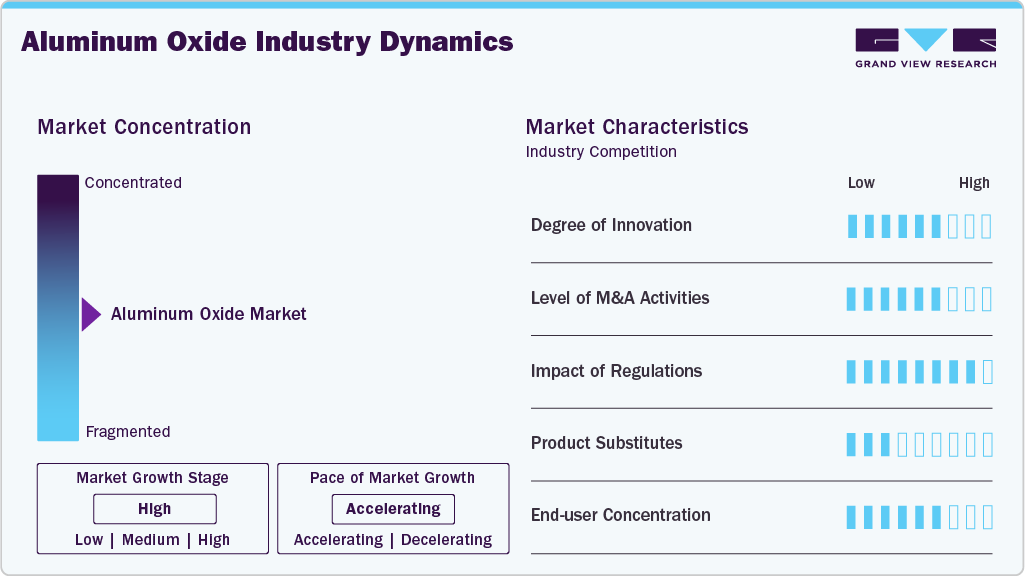
The market is characterized by a clear distinction between high-volume metallurgical alumina and differentiated non-metallurgical/specialty alumina. Metallurgical-grade material accounts for the core volume base and is closely linked to primary aluminum production, while specialty grades compete on purity, particle characteristics, thermal performance, consistency, and application-specific specifications. Large producers increasingly combine scale-driven cost efficiency with product differentiation, operational optimization, supply-chain integration, and lower-carbon production initiatives. Alcoa, for example, operates six alumina refineries across Australia, Brazil, and Spain and supplies both smelter-grade and non-metallurgical alumina, illustrating the industry's movement toward diversified product portfolios rather than reliance on a single commodity-grade product.
Analyst Perspective
The aluminum oxide market is expected to remain fundamentally supported by sustained alumina demand from the global aluminum value chain, while cost competitiveness, raw material security, refinery efficiency, and product quality will increasingly determine supplier positioning. The market is also becoming more differentiated as producers pursue specialty and non-metallurgical applications alongside large-volume smelter-grade alumina, creating opportunities for companies that can combine scale with technical capabilities and reliable supply.
Form Insights
The powder segment held the largest revenue share of 57.6% in 2025 due to its versatility, established processing infrastructure, and compatibility with high-volume industrial applications. Its controlled particle-size characteristics enable efficient handling, blending, compaction, and incorporation into abrasives, refractories, ceramics, polishing compounds, and other formulations. The availability of multiple powder specifications also allows manufacturers to tailor surface area, purity, crystallinity, and particle-size distribution to specific end-use requirements, reinforcing its position as the preferred commercial form.
The nanoparticles segment is the fastest growing form segment, with a CAGR of 5.6% from 2026 to 2033. Aluminum oxide nanoparticles are gaining traction as manufacturers increasingly seek higher-performance materials with enhanced surface-area-to-volume ratios and finely controlled functional properties. Their small particle size supports applications requiring improved dispersion, surface interaction, wear resistance, thermal performance, and precision material engineering, particularly across advanced ceramics, electronics, coatings, polishing, and specialty composites. The growing development of application-specific, high-performance alumina grades is encouraging producers to expand their capabilities in sub-micron and nanoscale materials, creating a strong pathway for nanoparticle adoption.
End Use Insights
The aluminum smelting segment held the largest revenue share of 41.9% in 2025, because alumina is the essential feedstock for primary aluminum production, creating a direct and structurally embedded link between alumina consumption and global smelting capacity. The scale of primary aluminum manufacturing, together with the continued operation and expansion of integrated bauxite alumina aluminum production systems, sustains substantial baseline demand. USGS notes that most of the alumina produced globally is ultimately used as feedstock for aluminum metal production, reinforcing the structural importance of smelting to aluminum oxide consumption.

The electronics & electrical segment is projected to grow with a CAGR of 5.9% from 2026 to 2033, as aluminum oxide is increasingly utilized where electrical insulation, thermal management, dielectric performance, wear resistance, and dimensional stability are critical. Growth in power electronics, electronic components, insulating substrates, and advanced ceramic systems is driving greater use of high-performance alumina materials capable of withstanding demanding operating conditions. The broader expansion of electrical infrastructure and increasingly sophisticated electronic systems is therefore creating additional demand for higher-specification aluminum oxide beyond traditional bulk applications.
Regional Insights
Asia Pacific held the largest revenue share of 62.7% in 2025. Asia Pacific benefits from its deep integration across the bauxite-alumina-aluminum value chain, supported by extensive refining capacity and a large downstream manufacturing base. Strong activity in automotive, construction, packaging, electrical equipment, and industrial manufacturing sustains alumina consumption, while the region's established processing ecosystem enables producers to supply both commodity and application-specific aluminum oxide grades efficiently.

China Aluminum Oxide Market Trends
China's position is strengthened by the density of its downstream industrial ecosystem, which allows alumina producers to serve large domestic requirements across aluminum, ceramics, abrasives, refractories, and chemical manufacturing. The country also possesses substantial alumina processing infrastructure; USGS data identify 25 alumina processing plants in China and estimate annual alumina capacity at approximately 91.2 million tonnes.
North America Aluminum Oxide Market Trends
North American demand is supported by the region's advanced manufacturing base and continued requirement for engineered materials across aerospace, automotive, electronics, industrial equipment, and construction. Aluminum oxide consumption is additionally sustained by abrasives, refractories, ceramics, and chemical applications, creating a diversified demand structure that reduces reliance on a single downstream industry.
The U.S. aluminum oxide market is driven by the combination of primary aluminum requirements and established non-metallurgical applications. In 2025, U.S. alumina production was estimated at approximately 710,000 tonnes, with around 70% directed toward primary aluminum smelters and the remainder used in abrasives, ceramics, chemicals, and refractories. This diversified consumption profile supports demand across both metallurgical and specialty applications.
Europe Aluminum Oxide Market Trends
European demand is supported by high-value manufacturing and stringent performance requirements for industrial materials. Established automotive, aerospace, engineering, refractory, ceramic, and electronics industries generate demand for consistent and technically specified aluminum oxide. The region's focus on energy efficiency and lower-emission manufacturing is also encouraging producers and users to prioritize higher-efficiency processing and differentiated material solutions.
Latin America Aluminum Oxide Market Trends
Latin America benefits from its strong bauxite and alumina production base, particularly in Brazil, combined with established aluminum processing and export infrastructure. The region's resource availability provides an important foundation for competitive alumina production, while construction, transportation, packaging, and industrial activity create downstream requirements for aluminum and related oxide products.
Middle East & Africa Aluminum Oxide Market Trends
The region is gaining importance through large-scale investments in integrated aluminum value chains, particularly alumina refining and primary aluminum production in the Gulf. Access to competitively positioned energy resources, strategic proximity to Asian and European markets, and investment in mining and refining infrastructure are strengthening the region's role as an international alumina supply and processing hub. The IAI separately tracks the Gulf region within its primary aluminum production statistics, reflecting its established role in the global aluminum industry.
Key Global Aluminum Oxide Company Insights
The global aluminum oxide competitive landscape is led by large, vertically integrated producers with strong positions across bauxite mining, alumina refining, and primary aluminum production. Leading companies are strengthening their positions through capacity optimization, resource security, operational efficiency, specialty alumina development, geographic diversification, and lower-carbon production initiatives. Competitive differentiation is increasingly shifting beyond production scale toward cost efficiency, product consistency, supply reliability, technical capabilities, and access to high-value applications, particularly as demand expands across advanced ceramics, electronics, abrasives, and other specialty end uses.
-
Aluminum Corporation of China Limited (CHALCO) is a major vertically integrated participant in the global aluminum oxide market, with operations spanning bauxite resources, alumina refining, primary aluminum, chemical alumina, and related materials. Its broad product portfolio includes both metallurgical and chemical alumina, enabling the company to serve large-volume aluminum smelters as well as higher-specification industrial applications. CHALCO's scale, integrated resource base, and established Chinese production network provide a strong cost and supply-position advantage, while ongoing investment in alumina capacity further reinforces its role in the global aluminum oxide supply chain. The company commenced construction of two new 1.5 million-tonne-per-year alumina production lines in Dalian, highlighting its continued focus on strengthening refining capacity.
-
Alcoa Corporation maintains a strong position in the aluminum oxide market through an integrated bauxite mining and alumina refining platform spanning multiple geographies. Its alumina business supplies both internal aluminum operations and third-party customers, giving the company exposure to the broader alumina market while maintaining vertical integration across the aluminum value chain. In 2025, Alcoa produced approximately 9.64 million tonnes of alumina and shipped 8.83 million tonnes to third-party customers, demonstrating its substantial global supply capability.
Key Aluminum Oxide Companies
The following key companies have been profiled for the study on the aluminum oxide market.
-
Aluminum Corporation of China Limited (CHALCO)
-
Alcoa Corporation
-
China Hongqiao Group Limited
-
Rio Tinto
-
United Company RUSAL
-
Norsk Hydro
-
South32
-
Hindalco Industries
-
Emirates Global Aluminium (EGA)
-
Xinfa Group
Competitive Benchmarking
Operating Strategies
Competitive Edge
Weaknesses
Mature Players: Aluminum Corporation of China Limited (CHALCO), Alcoa Corporation, China Hongqiao Group Limited, Rio Tinto, United Company RUSAL, Norsk Hydro
- Mature players focus on large-scale, vertically integrated operations spanning bauxite mining, alumina refining, and, in most cases, primary aluminum production. Their strategies emphasize securing captive raw materials, optimizing refinery utilization, improving energy efficiency, rationalizing high-cost assets, and strengthening long-term customer relationships. Increasing attention is also being placed on decarbonization, process optimization, low-carbon alumina/aluminum production, and portfolio rationalization to protect margins through commodity cycles.
- Strong production scale, established resource positions, integrated supply chains, technical expertise, global customer networks, and financial capacity provide significant barriers to entry. Their ability to manage bauxite procurement, refining, logistics, and downstream aluminum operations within an integrated system supports cost competitiveness and supply reliability. Diversified geographic footprints also provide greater resilience against individual-market disruptions.
- High exposure to commodity-price volatility, energy costs, environmental regulations, and capital-intensive refinery operations. Large asset bases can reduce operational flexibility and require substantial investment for modernization and decarbonization. Chinese-focused producers additionally face concentration risk, while internationally exposed players face greater geopolitical, trade, and regulatory complexity.
Emerging Players: South32, Hindalco Industries, Emirates Global Aluminium (EGA), Xinfa Group
- These players are pursuing capacity optimization, resource security, vertical integration, geographic expansion, and higher-value product development to strengthen their competitive positions. Strategic emphasis includes expanding or optimizing alumina refining assets, securing long-term bauxite resources, improving production efficiency, developing specialty/high-purity alumina capabilities, and strengthening downstream integration. The focus is increasingly shifting from volume growth alone toward portfolio quality, operational resilience, and value-added applications.
- Strong regional positions, integrated production platforms, access to strategic bauxite resources, and opportunities to expand into specialty and higher-margin alumina products provide differentiation. Hindalco benefits from its integrated Indian and international platform, EGA from its strategically located UAE-based value chain, South32 from high-quality long-life assets, and Xinfa from large-scale Chinese manufacturing integration.
- Comparatively smaller global geographic reach and customer diversification than the largest multinational producers. Expansion strategies require substantial capital investment and may face challenges related to energy availability, environmental approvals, raw-material security, logistics, and technology requirements for specialty grades. Greater regional concentration can also increase exposure to local regulatory and market conditions.
Aluminum Oxide Market Report Scope
Report Attribute
Details
Market size in 2025
USD 56.1 Billion
Estimated market size in 2026
USD 58.3 billion
Projected market size by 2033
USD 82.5 billion
Growth rate
CAGR of 5.1% from 2026 to 2033
Base year for estimation
2025
Historical data
2021 - 2024
Forecast period
2026 - 2033
Quantitative units
Revenue in USD million/billion, volume in kilotons, and CAGR from 2026 to 2033
Report coverage
Revenue forecast, volume forecast, company ranking, competitive landscape, growth factors, and trends
Segments covered
Form, End Use, and Region
Country scope
U.S.; Canada; Mexico; Germany; UK; France; Italy; Spain; China; India; Japan; South Korea; Brazil; Argentina; Saudi Arabia; South Africa
Key companies profiled
Aluminum Corporation of China Limited (CHALCO); Alcoa Corporation; China Hongqiao Group Limited; Rio Tinto; United Company RUSAL; Norsk Hydro; South32; Loba Chemie Pvt. Ltd; Emirates Global Aluminium (EGA); Xinfa Group
Customization scope
Free report customization (equivalent up to 8 analysts’ working days) with purchase. Addition or alteration to country, regional & segment scope.
Pricing and purchase options
Avail customized purchase options to meet your exact research needs. Explore purchase options
Global Aluminum Oxide Market Report Segmentation
This report forecasts volume & revenue growth at regional, and country levels and provides an analysis of the latest industry trends in each of the sub-segments from 2021 to 2033. For this study, Grand View Research has segmented the global aluminum oxide market report based on form, end use and country:

-
Form Outlook (Revenue, USD Million; Volume, Kilotons; 2021 - 2033)
-
Nanoparticles
-
Powder
-
Pellets
-
Other Form
-
-
End Use Outlook (Revenue, USD Million; Volume, Kilotons; 2021 - 2033)
-
Aluminum Smelting
-
Abrasives
-
Refractories
-
Ceramics
-
Chemicals
-
Medical
-
Electronics & Electrical
-
Other End Uses
-
-
Region Outlook (Revenue, USD Million; Volume, Kilotons; 2021 - 2033)
-
North America
-
U.S.
-
Canada
-
Mexico
-
-
Europe
-
Germany
-
UK
-
France
-
Italy
-
Spain
-
-
Asia Pacific
-
China
-
India
-
Japan
-
South Korea
-
-
Latin America
-
Brazil
-
Argentina
-
-
Middle East & Africa
-
Saudi Arabia
-
South Africa
-
-
Research Methodology
The aluminum oxide market figures in this report are based on a proven research process that combines executive interviews with secondary research from proprietary databases, company filings, and recognized regulatory and institutional sources. Market size is built through value-chain sizing—reconciling supply-side and demand-side estimates—and triangulated with bottom-up and top-down approaches. Every estimate passes multiple levels of expert validation before publication, with each aluminum oxide segment quantified using the revenue-capture definitions in the table below.
Segment Definition
Segment - Form
Revenue capture definition
Nanoparticles
Revenue generated from the sale of aluminum oxide produced in nanoscale particle form, typically used in advanced ceramics, coatings, electronics, polishing, biomedical applications, and other high-performance applications.
Powder
Revenue generated from the sale of aluminum oxide in conventional powdered form, including fine, medium, and coarse powders used across abrasives, refractories, ceramics, metallurgy, chemicals, and other industrial applications.
Pellets
Revenue generated from the sale of aluminum oxide manufactured in pelletized or granulated form, primarily used where controlled particle size, handling, feeding, or reduced dust generation is required, including metallurgical and refractory applications.
Other Form
Revenue generated from aluminum oxide supplied in forms other than nanoparticles, powder, or pellets, including granules, beads, tablets, suspensions, dispersions, and application-specific processed forms.
Segment -End Use
Revenue capture definition
Aluminum Smelting
Revenue generated from aluminum oxide supplied as alumina feedstock for the production of primary aluminum through the electrolytic smelting process.
Abrasives
Revenue generated from aluminum oxide used as an abrasive material in grinding wheels, coated abrasives, blasting media, cutting tools, polishing products, and surface-finishing applications.
Refractories
Revenue generated from aluminum oxide used in refractory products and formulations that require high-temperature resistance, including refractory bricks, castables, monolithics, and furnace linings.
Ceramics
Revenue generated from aluminum oxide used as a raw material or functional component in technical, advanced, structural, and industrial ceramic products requiring hardness, wear resistance, thermal stability, or electrical insulation.
Chemicals
Revenue generated from aluminum oxide used as a raw material, catalyst support, adsorbent, filler, or intermediate in chemical processing and the manufacture of specialty chemicals and related products.
Medical
Revenue generated from high-purity aluminum oxide used in medical and healthcare applications, including biomedical ceramics, orthopedic components, dental applications, and other medical-grade products.
Electronics & Electrical
Revenue generated from aluminum oxide used in electronic and electrical components and materials, including electrical insulation, substrates, semiconductor-related applications, heat-management components, and other high-purity electronic materials.
Other End Use
Revenue generated from aluminum oxide used in applications not covered under aluminum smelting, abrasives, refractories, ceramics, chemicals, medical, or electronics & electrical, including water treatment, filtration, engineered coatings, and specialty industrial applications.
Estimation Model
Layer No.
Layer Name
Key Question
Description
01
Market Scope & Definition
What is included in the aluminum oxide market?
Defines the market boundary based on aluminum oxide products sold commercially across different forms, grades, purity levels, and end-use applications. Revenue from downstream products manufactured using aluminum oxide is excluded.
02
Production Volume Assessment
How much aluminum oxide is produced?
Estimates aluminum oxide production volumes by major producing country and region using producer disclosures, government statistics, trade data, industry publications, and company-level production information.
03
End-Use Consumption Assessment
Where is aluminum oxide consumed?
Maps aluminum oxide consumption across aluminum smelting, abrasives, refractories, ceramics, chemicals, medical, electronics & electrical, and other applications.
04
Revenue Estimation
What is the market value?
Calculates market revenue by multiplying estimated sales volume by the corresponding average selling price for each form, and application category.
Delivered Customizations
This report has been delivered with the following In-depth customizations
Client Request
Customization Delivered
Value Adds
Cross-Segmentation Analysis
The relationship between aluminum oxide product form, and end-use application was assessed to evaluate demand across calcined alumina, tabular alumina, fused alumina, reactive alumina, and other grades. The analysis examined consumption across aluminum smelting, abrasives, refractories, ceramics, chemicals, and other industrial applications, with emphasis on grade-specific performance requirements and application suitability.
Enables identification of the most attractive grade-form-application combinations and demand pockets. Supports product portfolio optimization, specification targeting, and application-specific commercialization strategies.
Competitive Benchmarking
Leading aluminum oxide manufacturers were benchmarked based on production capacity, alumina refining and processing capabilities, product portfolio, vertical integration, raw material access, geographic footprint, distribution network, technology capabilities, sustainability initiatives, and strategic developments. Competitive positioning across major end-use industries was also evaluated.
Helps identify competitive strengths, cost and operational advantages, capacity positioning, and market gaps. Supports strategic differentiation, supplier assessment, partnership evaluation, and expansion planning.
Opportunity Assessment
Growth opportunities were assessed across aluminum smelting, abrasives, refractories, ceramics, chemicals, and specialty/high-purity applications. The assessment also examined opportunities associated with rising aluminum production, infrastructure and construction activity, increasing demand for advanced ceramics and abrasives, and growing requirements for high-purity alumina in specialized applications.
Enables identification of high-potential end-use segments, product opportunities, and emerging demand areas. Supports investment prioritization, capacity planning, product development, and long-term growth strategies.
Frequently Asked Questions About This Report
The aluminum oxide market size was USD 56.1 billion in 2025 and is expected to reach 58.3 billion by 2026.
The aluminum oxide market is anticipated to grow at a CAGR of 5.1% from 2026 to 2033 and projected to reach 82.5 billion by 2033.
Based on form, powder dominated with a share of 57.6% in 2025.
Asia Pacific held the largest revenue share of 62.7% in 2025. Asia Pacific benefits from its deep integration across the bauxite–alumina–aluminum value chain, supported by extensive refining capacity and a large downstream manufacturing base. Strong activity in automotive, construction, packaging, electrical equipment, and industrial manufacturing sustains alumina consumption, while the region's established processing ecosystem enables producers to supply both commodity and application-specific aluminum oxide grades efficiently.
Market growth is supported by the continued expansion of aluminum production and downstream conversion industries, where alumina remains a fundamental feedstock for primary aluminum smelting. Increasing requirements for lightweight materials across automotive, transportation, electrical equipment, packaging, and construction are strengthening the underlying demand for alumina and, consequently, aluminum oxide.
Key players include Aluminum Corporation of China Limited (CHALCO); Alcoa Corporation; China Hongqiao Group Limited; Rio Tinto; United Company RUSAL; Norsk Hydro; South32; Loba Chemie Pvt. Ltd; Emirates Global Aluminium (EGA); Xinfa Group
Nanoparticles is fastest growing segment with revenue CAGR of 5.6% during forecast period.
In terms of end use, aluminum smelting led the segment with a revenue share of 41,9% in 2025.
Electronics & electrical is fastest growing segment with revenue CAGR of 5.9% during forecast period.
About the Author(s)
Paints, Coatings & Printing Inks Research Team
Bulk Chemicals · Paints, Coatings & Printing InksThis report was authored by the paints, coatings & printing inks research team at Grand View Research - comprising two research analysts, one senior research analyst, and one industry expert - with specialized expertise in the paints, coatings & printing inks segment of the bulk chemicals industry. All findings are based on proprietary bulk chemicals databases, executive interviews, and regulatory analysis, subject to internal peer review prior to publication.
Last Updated:
Speak to Analyst


Customize this report to your needs — add regions, segments, or data points, with 20% free customization.
Or view our licence options:


ISO 9001:2015 & 27001:2022 Certified
We are GDPR and CCPA compliant! Your transaction & personal information is safe and secure. For more details, please read our privacy policy.


