
- Home
- »
- Advanced Interior Materials
- »
-
Aluminum Welding Wires Market Size Report, 2026-2033GVR Report cover

Aluminum Welding Wires Market (2026 - 2033)
Size, Share & Trends Analysis Report By Alloy Type (Aluminum-Silicon Alloys, Aluminum-Magnesium Alloys, Pure Aluminum), By End Use (Aerospace, Transportation, Building & Construction, Energy, Oil & Gas) By Region, And Segment Forecasts
Market Size, 2025
$477.8MMarket Estimate, 2026
$504.1MMarket Forecast, 2033
$749.0MCAGR, 2026–2033
5.8%Aluminum Welding Wires Market Summary
The global aluminum welding wires market size was valued at USD 477.8 million in 2025 and is projected to grow from USD 504.1 million in 2026 to USD 749.0 million by 2033, at a CAGR of 5.8% from 2026 to 2033. Asia Pacific dominated the market, accounting for a revenue share of 37.0% in 2025. The global aluminum welding wires market is driven by the growing adoption of aluminum across automotive, aerospace, marine, transportation, construction, and general manufacturing applications, where its lightweight properties, corrosion resistance, and favorable strength-to-weight ratio support material substitution and component fabrication.
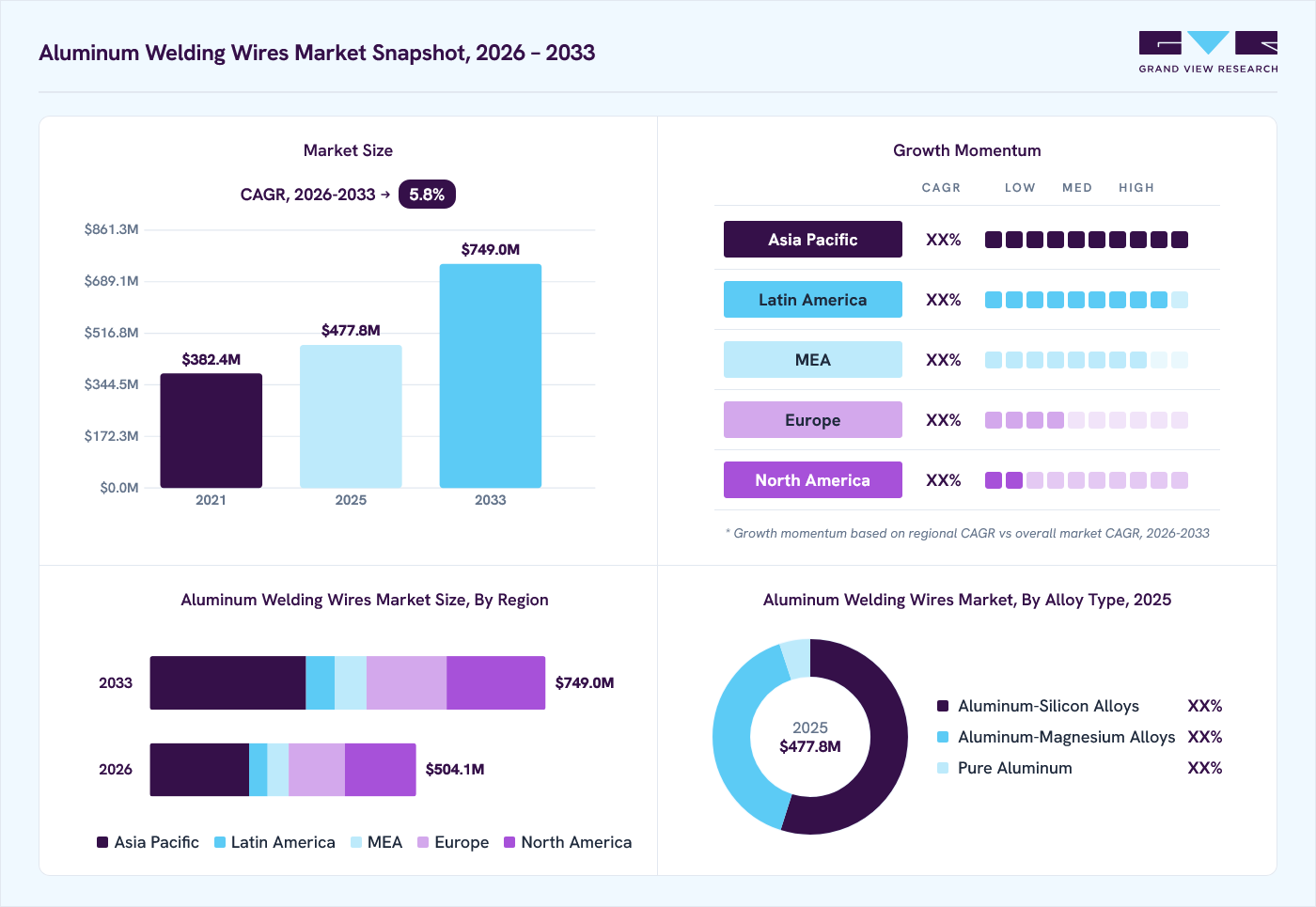 Source: Grand View Research, IR Documents, Primary Interviews, Paid DatabasesTo learn more about this report,
 Download Free Sample Report
Key Market Trends & Insights
- By alloy type: Aluminum-magnesium alloys segment dominated the market, with a revenue share of 54.8% in 2025.
- By end use: Transportation segment held the largest market share of 30.1% in 2025.
Regional Highlights
- Largest regional market: Asia Pacific (37.0% revenue share, 2025)
- By country: China held the largest market share in 2025.
Market Size & Forecast
- Market Size in 2025: USD 477.8 Million
- Estimated market size in 2026: USD 504.1 Million
- Projected Market Size by 2033: USD 749.0 Million
- CAGR (2026-2033): 5.8%
GVR research-powered AIAsk Prism AI about the aluminum welding wires marketGet cited answers from GVR research on market growth, segments, regulations and forecasts.Start with✓ Source-linked answers ✓ Market-specific context ✓ Traceable figuresExplore Prism AI ↗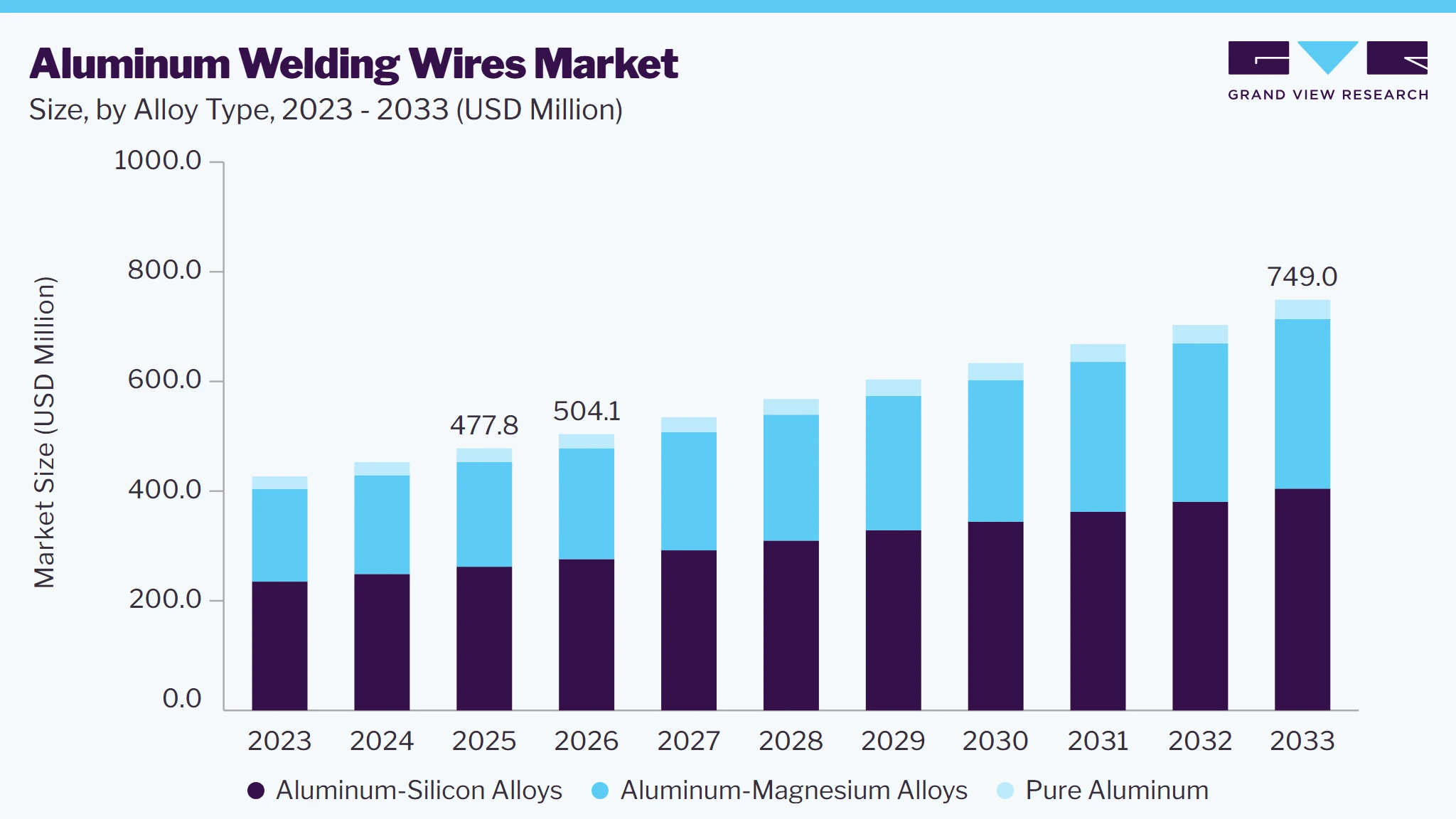 To learn more about this report, Download Free Sample Report
Increasing vehicle lightweighting and the expansion of electric mobility are creating demand for aluminum welding wires in body structures, battery enclosures, and other lightweight components. Additionally, the expansion of automated and robotic welding in high-volume manufacturing is increasing the need for welding wires that deliver consistent feeding, stable arc performance, and reliable weld quality. Growth in shipbuilding, infrastructure development, renewable energy equipment, and industrial fabrication is further broadening consumption across end-use sectors. Advancements in aluminum alloy formulations and welding technologies are also improving process efficiency and weld integrity, supporting the use of aluminum welding wires in applications requiring higher productivity, dimensional accuracy, and durable joints.Market Dynamics
The global aluminum welding wires market is evolving with increasing emphasis on lightweight fabrication, weld quality, process efficiency, and material compatibility across automotive, aerospace, transportation, marine, construction, and industrial manufacturing. Manufacturers are expanding product portfolios across aluminum alloy compositions and wire specifications to address application-specific requirements. Technological development is increasingly focused on improving wire feeding consistency, arc stability, weld integrity, and compatibility with automated and robotic welding systems, while manufacturers are also strengthening production precision and quality control to meet the requirements of high-volume and performance-sensitive applications.
The market is driven by the increasing use of aluminum in automotive, electric vehicles, aerospace, rail, marine, and industrial equipment manufacturing. Aluminum enables weight reduction while providing corrosion resistance and favorable mechanical performance, encouraging its substitution for heavier materials in structural and fabricated components. The expansion of electric mobility is further increasing the use of aluminum in vehicle structures, battery enclosures, and associated components. As aluminum consumption expands across these applications, demand for compatible welding wires is increasing to support reliable joining, fabrication efficiency, and production scalability.
The relatively higher cost of aluminum welding wires compared with conventional steel welding consumables can constrain adoption in price-sensitive fabrication applications. Aluminum also requires greater control over welding parameters because of its thermal characteristics, oxide layer, and sensitivity to heat input. Variations in alloy composition, surface condition, and wire feeding can affect weld quality and increase the likelihood of defects, rework, or material waste. These factors can increase equipment, operator training, and process-control requirements, particularly for manufacturers transitioning from conventional welding materials.
The increasing integration of automated and robotic welding across automotive, transportation, industrial fabrication, and other high-volume manufacturing operations presents significant opportunities for aluminum welding wire suppliers. Automated production requires welding consumables with consistent dimensions, controlled surface quality, reliable feeding, and stable arc characteristics to maintain repeatable weld performance. Demand for lightweight components in electric vehicles, battery systems, transportation equipment, and advanced industrial machinery is also creating opportunities for specialized aluminum alloy wires designed for automated and high-precision fabrication processes.
Market Concentration & Characteristics
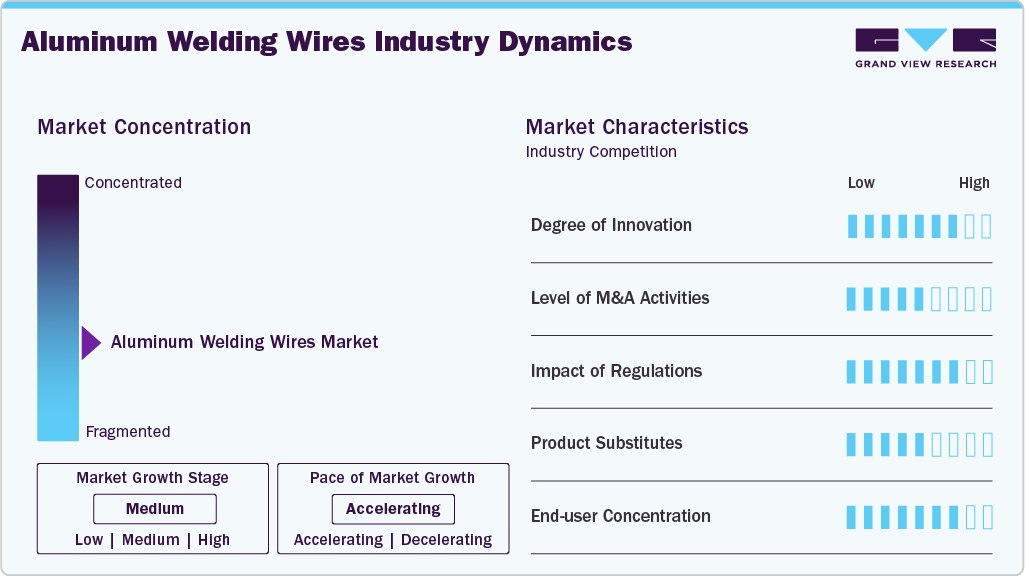
The global aluminum welding wires market is characterized by a fragmented and competitive structure, comprising established welding consumable manufacturers and specialized regional suppliers. Competitive positioning is influenced by manufacturing capacity, alloy development expertise, product consistency, technical capabilities, and distribution coverage. Large manufacturers generally serve automotive, aerospace, transportation, marine, construction, and industrial customers, while regional suppliers compete through localized production, application-specific products, pricing, and customer responsiveness.
Product differentiation is primarily based on alloy composition, wire diameter, surface quality, feeding characteristics, and compatibility with specific welding processes and base materials. Manufacturers are increasingly focusing on consistent wire geometry, controlled surface characteristics, stable feeding, and repeatable weld performance to meet the requirements of automated and robotic welding applications. Regulatory requirements also influence product qualification, quality assurance, chemical composition, labeling, and market access, particularly as governments strengthen quality-control requirements for aluminum and aluminum-alloy products.
 To learn more about this report, Download Free Sample Report
Industry consolidation is shaped by acquisitions, strategic investments, and geographic expansion aimed at strengthening welding consumable portfolios and manufacturing capabilities. M&A activity enables manufacturers to broaden their product offerings, access specialized technologies, expand regional distribution networks, and strengthen relationships with industrial customers. At the same time, regulatory compliance and customer qualification requirements create entry barriers for smaller manufacturers, favoring suppliers with established production systems, quality-control capabilities, technical expertise, and reliable supply networks.
Analyst Perspective
The global aluminum welding wires market is being shaped by the broader transition toward lightweight materials and higher-efficiency manufacturing processes. Increasing aluminum utilization across transportation, automotive, aerospace, marine, and industrial applications is strengthening the underlying demand for compatible welding consumables. Greater adoption of automated welding is shifting purchasing priorities toward wire consistency, process stability, and weld quality rather than price alone. Manufacturers with diversified alloy portfolios, strong process expertise, and the ability to supply application-specific products are positioned to address evolving fabrication requirements.
Alloy Type Insights
Aluminum-silicon alloys accounted for the largest revenue share of 54.8% in the global aluminum welding wires market. Their favorable weldability, strong compatibility with commonly used aluminum base materials, and resistance to weld cracking make them suitable for a broad range of fabrication requirements. These alloys are widely utilized in automotive components, transportation equipment, construction structures, machinery, and general metal fabrication, where consistent weld performance and joint reliability are required.
Aluminum-magnesium alloys are projected to register the fastest CAGR during the forecast period. Their high strength, corrosion resistance, and suitability for structural applications make them increasingly relevant for transportation, marine, automotive, and industrial fabrication. Growing demand for lightweight yet durable components, particularly in applications requiring improved mechanical performance and resistance to harsh operating conditions, is supporting greater adoption of aluminum-magnesium welding wires.
End Use Insights
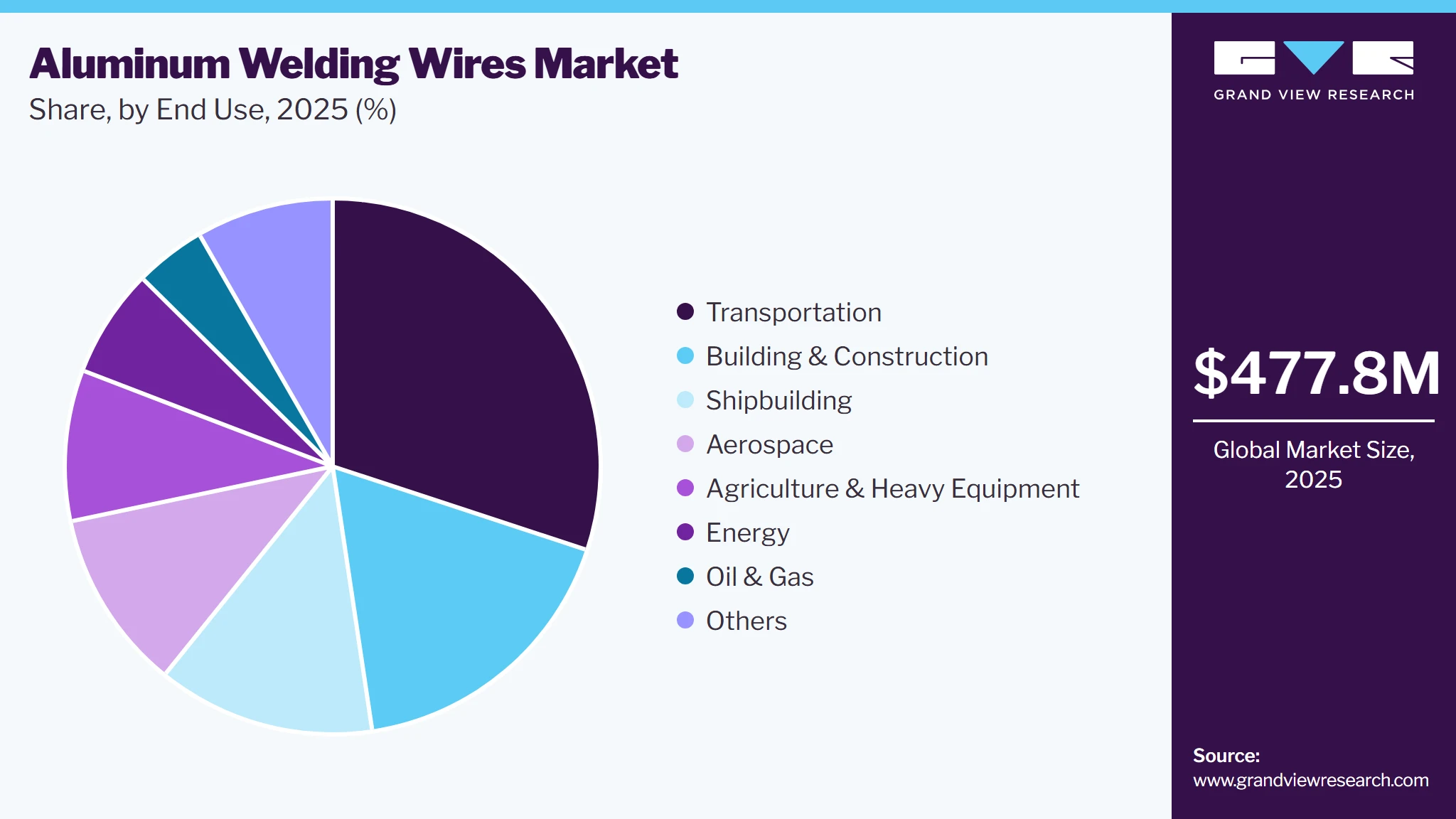
Transportation accounted for the largest revenue share in the global aluminum welding wires market, driven by the extensive use of aluminum in automotive, rail, commercial vehicles, and other mobility applications. Aluminum welding wires are widely utilized for joining lightweight body structures, frames, panels, and other fabricated components where weight reduction, corrosion resistance, and structural performance are important. The expansion of electric vehicles and increasing focus on vehicle efficiency are further encouraging aluminum component adoption, supporting demand for compatible welding consumables.
 To learn more about this report, Download Free Sample Report
Aerospace is projected to register the fastest CAGR of 6.9% during the forecast period. The sector is increasingly incorporating aluminum and aluminum alloys in aircraft structures and components to achieve weight reduction while maintaining required strength and durability. Growing aircraft production, fleet modernization, and demand for efficient manufacturing processes are creating additional requirements for high-quality aluminum welding wires. Increasing emphasis on precise fabrication, reliable joints, and advanced welding processes is further supporting the adoption of aluminum welding consumables in aerospace applications.
Regional Insights
North America is a mature market for aluminum welding wires, supported by established automotive, aerospace, transportation, marine, construction, and industrial manufacturing sectors. Increasing use of aluminum for lightweight vehicle structures, aircraft components, transportation equipment, and fabricated assemblies is supporting consumable demand. The expansion of electric vehicle manufacturing is increasing the use of aluminum in body structures, battery enclosures, and related components.
U.S. Aluminum Welding Wires Market Trends
The U.S. represents the largest market within North America, supported by substantial automotive, aerospace, defense, machinery, and transportation manufacturing capacity. Increasing aircraft production and fleet modernization are creating requirements for aluminum fabrication and welding consumables. Automotive manufacturers are expanding the use of aluminum components to reduce vehicle weight and improve efficiency. Electric vehicle and battery manufacturing is also broadening applications for aluminum welding wires.
Mexico is emerging as an important market for aluminum welding wires through the expansion of automotive, transportation equipment, machinery, and industrial manufacturing. The country's integration with North American production networks is supporting the localization of component manufacturing and fabrication activities. Increasing production of lightweight vehicle structures and aluminum-based assemblies is expanding welding wire requirements.
Europe Aluminum Welding Wires Market Trends
Europe maintains a well-established aluminum welding wires market, supported by automotive, aerospace, rail, marine, construction, machinery, and industrial equipment manufacturing. The region's emphasis on lightweight vehicle design and electrification is expanding the use of aluminum in structural and fabricated components. Aircraft and transportation manufacturers continue to require aluminum joining solutions for weight-sensitive applications. Increasing automation across manufacturing operations is raising demand for consistent wire specifications and dependable process performance.
Germany represents a significant European market, underpinned by its strong automotive, machinery, transportation, aerospace, and industrial manufacturing base. Aluminum is increasingly incorporated into vehicle structures, electric mobility components, machinery, and lightweight industrial assemblies. Automotive production therefore remains an important source of demand for aluminum welding wires. The country's advanced manufacturing environment supports extensive use of robotic and automated welding equipment.
The UK market is supported by aerospace, automotive, marine, rail, construction, and specialized industrial manufacturing. Aerospace applications provide an important demand base because aluminum remains widely used in lightweight aircraft structures and components. Automotive manufacturers are also incorporating aluminum into selected vehicle and electric mobility applications. Marine and rail manufacturing create additional requirements for corrosion-resistant and lightweight fabricated components.
Asia Pacific Aluminum Welding Wires Market Trends
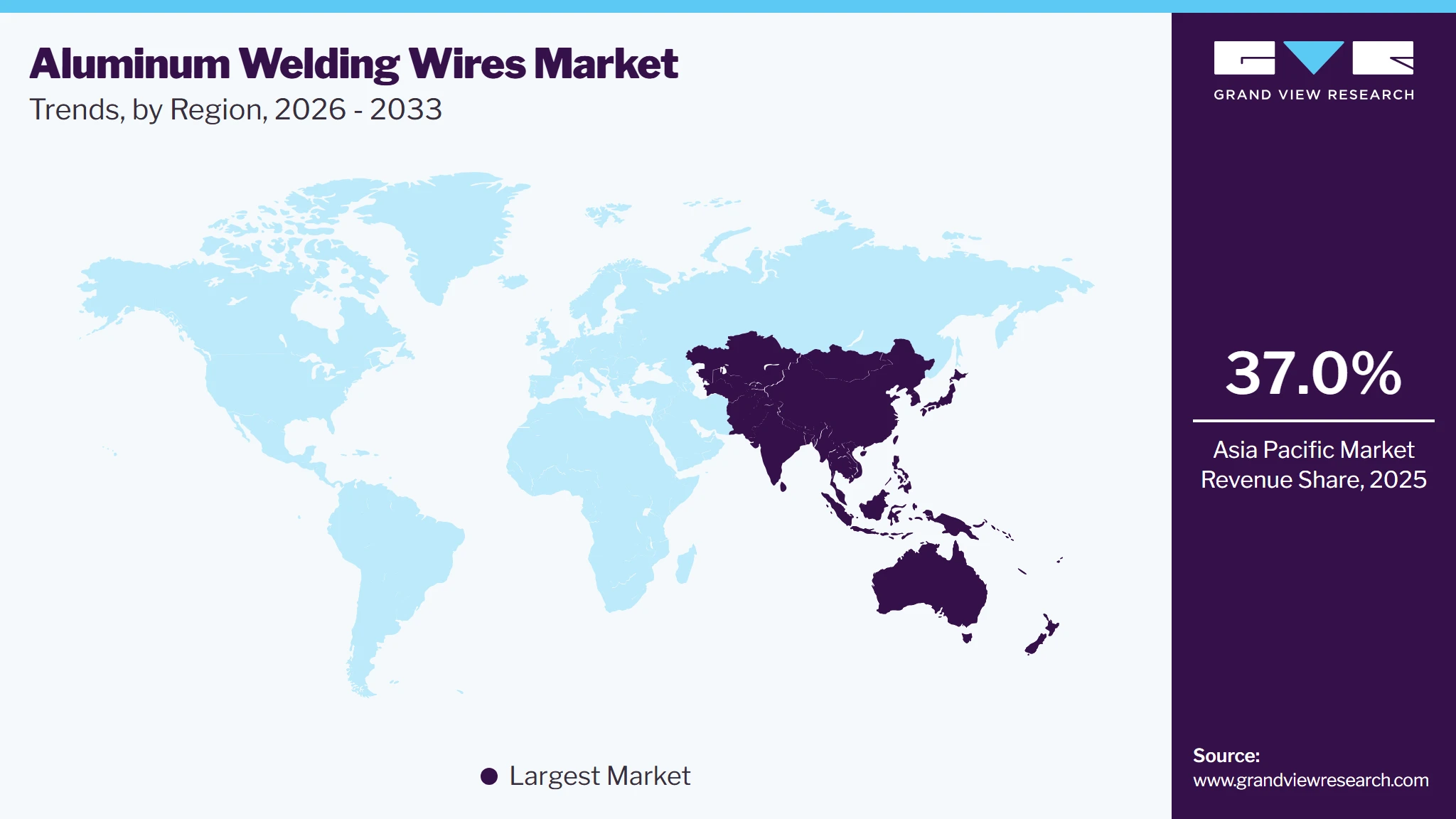
Asia Pacific dominated the audio codec market with the largest revenue share of 37.0% in 2025. Asia Pacific represents a significant and expanding market for aluminum welding wires, supported by large-scale automotive production, electric vehicle manufacturing, shipbuilding, rail, construction, machinery, and industrial fabrication. Rapid expansion of manufacturing capacity is increasing the volume of aluminum components requiring joining and assembly. The region's growing electric mobility industry is creating additional applications in vehicle structures and battery-related components. Shipbuilding and rail manufacturing provide further demand for aluminum welding consumables.
 To learn more about this report, Download Free Sample Report
China is a major market within Asia Pacific, supported by extensive automotive, electric vehicle, shipbuilding, rail, construction, and machinery manufacturing. High production volumes of aluminum-intensive components create substantial requirements for welding consumables across industrial fabrication. The country's expanding electric vehicle industry is increasing the use of aluminum in vehicle structures and battery-related assemblies.
India is an emerging market for aluminum welding wires, supported by expanding automotive, rail, construction, defense, machinery, and general manufacturing activities. Increasing industrial production is broadening the use of aluminum in vehicle components, fabricated structures, transportation equipment, and machinery. Growth in electric vehicle manufacturing is creating new applications for lightweight aluminum components. Expansion of rail and infrastructure projects is also contributing to demand for aluminum fabrication.
Middle East & Africa Aluminum Welding Wires Market Trends
The Middle East & Africa market is supported by expanding construction, transportation, energy infrastructure, industrial manufacturing, and fabrication activities. Increasing investment in infrastructure development and diversification of manufacturing capabilities is creating applications for aluminum welding wires in structural fabrication, transportation equipment, machinery, and industrial components. Adoption of modern welding equipment and greater emphasis on fabrication productivity are also supporting market development.
Saudi Arabia represents an emerging market within the region, supported by infrastructure development, industrial diversification, transportation projects, and investments in manufacturing capacity. Expansion of fabrication activities across construction, industrial equipment, and transportation applications is creating demand for aluminum welding consumables. Increasing adoption of advanced production technologies is further supporting the use of aluminum welding wires in higher-value fabrication operations.
Latin America Aluminum Welding Wires Market Trends
Latin America is supported by automotive manufacturing, transportation equipment, construction, industrial fabrication, and expanding infrastructure investment. Increasing use of lightweight materials across vehicle and industrial applications is broadening the addressable market for aluminum welding wires. Modernization of manufacturing facilities and gradual adoption of automated welding technologies are also contributing to demand for higher-consistency welding consumables.
Brazil represents a significant regional market, supported by its automotive, transportation, machinery, construction, and industrial manufacturing base. Aluminum is increasingly used in vehicle components, fabricated structures, and industrial equipment where weight reduction and corrosion resistance are important. Expansion of manufacturing capacity and investments in modern welding and fabrication technologies are supporting demand for aluminum welding wires across diverse industrial applications.
Key Aluminum Welding Wires Company Insights
Some of the key players operating in the market include ESAB, Lincoln Electric, ITW, Sumitomo Electric Industries among others.
-
ESAB is a global provider of welding and cutting technologies, offering a comprehensive portfolio of welding equipment, consumables, automation systems, and fabrication solutions. The company maintains a broad aluminum filler-metal portfolio, including aluminum MIG wires and TIG rods formulated for different alloy compositions and welding requirements. Its aluminum welding solutions serve applications across transportation, automotive, construction, marine, and general industrial fabrication, strengthening its position in the global aluminum welding wires market.
-
Lincoln Electric is a global manufacturer of welding equipment, consumables, automation solutions, and cutting systems, serving a wide range of industrial and fabrication applications. The company offers aluminum welding wires across multiple alloy grades and diameters, including products designed for MIG and TIG welding processes. Its aluminum consumables are used in transportation, automotive, shipbuilding, construction, and general fabrication, supported by the company's established manufacturing capabilities and extensive distribution network.
Key Aluminum Welding Wires Companies
The following key companies have been profiled for this study on the aluminum welding wires market:
-
ESAB
-
Lincoln Electric
-
ITW (Illinois Tool Works)
-
Sumitomo Electric Industries
-
GARG INOX
-
Novametal Group
-
WA Group
-
ANAND ARC
-
KaynakTekniği Sanayi ve Ticaret A.Ş.
-
Tianjin Bridge
-
Weld Atlantic
-
Changzhou Huatong Welding
-
Jinglei Welding
-
Shandong Juli Welding
-
Elisental
Competitive Benchmarking
Operating strategies
Competitive Edge
Weakness
Mature Players: ESAB, Lincoln Electric, ITW (Illinois Tool Works), Sumitomo Electric Industries, GARG INOX, Novametal Group, WA Group
- Focus on diversified aluminum welding wire portfolios covering multiple alloy grades, diameters, and welding applications across automotive, transportation, marine, construction, and industrial fabrication.
- Leverage established manufacturing networks, technical expertise, quality-control capabilities, and broad distribution channels to serve application-specific welding requirements.
- Strong brand recognition, established customer relationships, and extensive distribution networks provide broad market access.
- Broad product portfolios and technical capabilities allow these companies to serve diverse aluminum alloy and welding-process requirements.
- Large organizational structures and extensive manufacturing operations can result in higher operating complexity and longer product-development cycles.
- Established product portfolios may limit flexibility in responding quickly to highly specialized or regional customer requirements.
Emerging Players: ANAND ARC, KaynakTekniği Sanayi ve Ticaret A.Ş., Tianjin Bridge, Weld Atlantic, Changzhou Huatong Welding, Jinglei Welding, Shandong Juli Welding, Elisental
- Concentrate on aluminum welding wires and filler metals tailored to specific alloy grades, welding processes, wire dimensions, and end-use applications.
- Expand market presence through regional distributors, direct industrial relationships, export networks, and competitive product offerings.
- Specialized product knowledge and focused manufacturing capabilities enable greater responsiveness to specific customer requirements.
- Competitive pricing, flexible production capabilities, and regional market expertise can strengthen their position in price-sensitive and specialized applications.
- More limited geographic coverage and distribution infrastructure compared with established multinational manufacturers.
- Lower brand recognition and smaller production scale can create challenges in securing large OEM contracts and long-term supply agreements.
Recent Developments
-
In May 2026, Lincoln Electric introduced the AlumaFab aluminum MIG welding system, designed to improve productivity and consistency in aluminum fabrication. The system is compatible with aluminum welding wires and incorporates a dedicated aluminum MIG power source and wire-feeding configuration to support reliable wire feeding and welding performance. The launch expands Lincoln Electric’s aluminum welding portfolio and strengthens its offering for industrial aluminum fabrication applications.
-
In July 2026, Komax Shanghai partnered with Ningbo Boway Alloy, SBT Ultrasonic Technology, and TE Connectivity to accelerate aluminum wiring solutions for China’s electric vehicle industry. The collaboration combines expertise in aluminum alloy materials, terminal processing, ultrasonic welding, and automated wire processing to support the replacement of copper with aluminum in automotive wiring. The initiative aims to enable lighter vehicle components, improve production efficiency, and support the growing demand for lightweight wiring solutions in electric vehicles.
Aluminum Welding Wires Market Report Scope
Report Attribute
Details
Market size in 2025
USD 477.8 million
Estimated market size in 2026
USD 504.1 million
Projected market size by 2033
USD 749.0 million
Growth rate
CAGR of 5.8% from 2026 to 2033
Historical data
2021 - 2024
Forecast period
2026 - 2033
Quantitative units
Revenue in USD million and CAGR from 2026 to 2033
Report coverage
Revenue forecast, company ranking, competitive landscape, growth factors, and trends
Segments covered
Alloy type, end use, region
Regional scope
North America; Europe; Asia Pacific; Latin America; Middle East & Africa
Country scope
U.S.; Canada; Mexico; UK; Germany; France; Italy; Spain; China; Japan; India; Australia; South Korea; Brazil; Argentina; UAE; Saudi Arabia; South Africa
Key companies profiled
ESAB; Lincoln Electric; ITW (Illinois Tool Works); Sumitomo Electric Industries; GARG INOX; Novametal Group; WA Group; ANAND ARC; KaynakTekniği Sanayi ve Ticaret A.Ş.; Tianjin Bridge; Weld Atlantic; Changzhou Huatong Welding; Jinglei Welding; Shandong Juli Welding; Elisental
Customization scope
Free report customization (equivalent up to 8 analysts working days) with purchase. Addition or alteration to country, regional & segment scope.
Pricing and purchase options
Avail customized purchase options to meet your exact research needs. Explore purchase options
Global Aluminum Welding Wires Market Report Segmentation
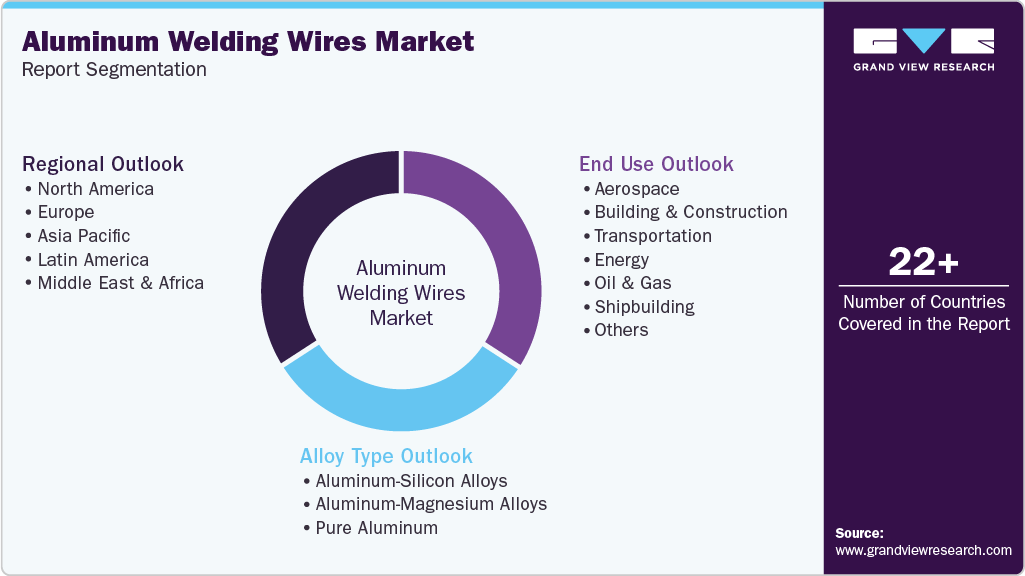
This report forecasts revenue growth at global, regional, and country levels and provides an analysis of the latest industry trends in each of the sub-segments from 2021 to 2033. For this study, Grand View Research has segmented the global aluminum welding wires market report based on alloy type, end use, and region.
 To learn more about this report, Download Free Sample Report
-
Alloy Type Outlook (Revenue, USD Million, 2021 - 2033)
-
Aluminum-Silicon Alloys
-
Aluminum-Magnesium Alloys
-
Pure Aluminum
-
-
End Use Outlook (Revenue, USD Million, 2021 - 2033)
-
Aerospace
-
Building & Construction
-
Transportation
-
Energy
-
Oil & Gas
-
Shipbuilding
-
Agriculture & Heavy Equipment
-
Others
-
-
Regional Outlook (Revenue, USD Million, 2021 - 2033)
-
North America
-
U.S.
-
Canada
-
Mexico
-
-
Europe
-
Germany
-
Spain
-
France
-
Italy
-
UK
-
-
Asia Pacific
-
China
-
India
-
Japan
-
Australia
-
South Korea
-
-
Latin America
-
Brazil
-
Argentina
-
-
Middle East and Africa
-
Saudi Arabia
-
UAE
-
South Africa
-
-
Research Methodology
The aluminum welding wires market figures in this report are based on a proven research process that combines executive interviews with secondary research from proprietary databases, company filings, and recognized regulatory and institutional sources. Market size is built through value-chain sizing-reconciling supply-side and demand-side estimates-and triangulated with bottom-up and top-down approaches. Every estimate passes multiple levels of expert validation before publication, with each aluminum welding wires segment quantified using the revenue-capture definitions in the table below.
Segment Definition
Alloy Type
Revenue Capture Definition
Aluminum-Silicon Alloys
Revenue generated from sales of aluminum-silicon alloy welding wires across different grades, diameters, specifications, and packaging formats.
Aluminum-Magnesium Alloys
Revenue generated from sales of aluminum-magnesium alloy welding wires across different grades, diameters, specifications, and packaging formats.
Pure Aluminum
Revenue generated from sales of pure aluminum welding wires across commercially available grades, sizes, specifications, and packaging formats.
End Use
Revenue Capture Definition
Aerospace
Revenue generated from sales of aluminum welding wires to aerospace manufacturers, component suppliers, maintenance providers, and related distributors.
Building & Construction
Revenue generated from sales of aluminum welding wires to construction companies, fabricators, contractors, manufacturers, and distributors.
Transportation
Revenue generated from sales of aluminum welding wires to automotive, rail, commercial vehicle, and other transportation-related manufacturers and suppliers.
Energy
Revenue generated from sales of aluminum welding wires to energy equipment manufacturers, fabricators, contractors, suppliers, and distributors.
Oil & Gas
Revenue generated from sales of aluminum welding wires to oil and gas equipment manufacturers, fabricators, contractors, suppliers, and distributors.
Shipbuilding
Revenue generated from sales of aluminum welding wires to shipyards, marine equipment manufacturers, fabricators, suppliers, and distributors.
Agriculture & Heavy Equipment
Revenue generated from sales of aluminum welding wires to agricultural machinery and heavy equipment manufacturers, fabricators, suppliers, and distributors.
Others
Revenue generated from sales of aluminum welding wires across customer categories not classified under the specified end-use segments.
Estimation Model
Layer Name
Key Question
Description
End-use Welding Demand Layer
Where are aluminum welding wires required?
Assess aluminum fabrication and joining requirements across automotive and transportation, aerospace, marine, construction, energy, industrial machinery, and general manufacturing. Evaluate aluminum component production, lightweighting trends, repair requirements, and welding intensity to establish addressable demand.
Aluminum Fabrication & Production Layer
Where is new wire demand being generated?
Analyze vehicle production, aircraft manufacturing, shipbuilding, construction activity, industrial equipment production, and expansion of aluminum fabrication facilities. Evaluate new production capacity, automation investments, and increasing use of aluminum structures that create demand for welding wires. Aluminum welding wires are widely used across automotive, aerospace, marine, construction, and other fabrication applications.
Product & Process Adoption Layer
Which aluminum welding wires are being adopted?
Segment demand by product form, alloy type, welding process, wire diameter, application, and end use. Assess adoption based on weldability, strength, corrosion resistance, base-metal compatibility, deposition requirements, and process conditions. Consider the use of solid and flux-cored wires and MIG and TIG welding processes across different applications.
Revenue Generation Layer
How is market revenue calculated?
Estimate annual volumes of aluminum welding wires sold across product types, welding processes, end-use industries, and regions. Convert volumes into revenues using segment-specific manufacturer selling values and validate estimates against company revenues, production activity, trade data, and industry demand indicators.
Delivered Customizations
We have successfully delivered the following deep-dive customizations:
Client Request
Customization Delivered
Value Adds
Regional Segmentation
A detailed regional assessment was conducted for the global aluminum welding wires market, evaluating demand across automotive, transportation, construction, marine, aerospace, and industrial fabrication sectors. The analysis considered aluminum consumption, welding activity, manufacturing output, fabrication capacity, and adoption of aluminum components across major regions.
Enabled the client to compare regional market attractiveness, identify high-demand markets for aluminum welding wires, and prioritize geographic expansion. The findings supported regional sales planning, distributor selection, and resource allocation.
Competitive Benchmarking
Leading aluminum welding wire manufacturers were benchmarked based on alloy grades, wire diameters, welding processes, product specifications, manufacturing capabilities, certifications, application coverage, and geographic presence.
Provided a structured assessment of competitor portfolios, technical capabilities, product differentiation, and market positioning. The analysis helped identify portfolio gaps, benchmark product performance, and refine competitive strategies.
Opportunity Assessment
Market opportunities were assessed across automotive, electric vehicles, transportation, construction, marine, aerospace, and general fabrication applications, focusing on aluminum lightweighting, corrosion resistance, material substitution, and increasing use of aluminum structures.
Helped the client identify high-potential applications and underserved demand areas, supporting product portfolio expansion, grade development, technology investments, market-entry decisions, and long-term sales planning.
Frequently Asked Questions About This Report
Aluminum-magnesium alloys segment dominated the market, with a revenue share of 54.8% in 2025, supported by their favorable weldability and broad use in automotive, transportation, construction, and general fabrication applications.
Transportation segment held the largest market share of 30.1% in 2025 while aerospace segment is second fastest growing market.
Demand is driven by the increasing use of aluminum for lightweight vehicle structures, improved fuel efficiency, corrosion resistance, and weight reduction across automotive, rail, marine, and other transportation applications.
The global aluminum welding wires market was valued at USD 477.8 million in 2025 and is estimated USD 504.1 million in 2026.
The market is projected to grow at a CAGR of 5.8% from 2026 to 2033, projected to reach USD 749.0 million by 2033.
Asia Pacific dominated the global aluminum welding wires market with the largest revenue share of 37.0% in 2025.
Key players include ESAB, Lincoln Electric, ITW (Illinois Tool Works), Sumitomo Electric Industries, GARG INOX, Novametal Group, WA Group, ANAND ARC, KaynakTekniği Sanayi ve Ticaret A.Ş., Tianjin Bridge, Weld Atlantic, Changzhou Huatong Welding, Jinglei Welding, Shandong Juli Welding, and Elisental.
About the Author(s)
Advanced Interior Materials Research Team
Advanced Materials · Advanced Interior MaterialsThis report was authored by the advanced interior materials research team at Grand View Research - comprising two research analysts, one senior research analyst, and one industry expert - with specialized expertise in the advanced interior materials segment of the advanced materials industry. All findings are based on proprietary advanced materials databases, executive interviews, and regulatory analysis, subject to internal peer review prior to publication.
Last Updated:
Speak to Analyst

Customize this report to your needs - add regions, segments, or data points, with 20% free customization.
Or view our licence options:


ISO 9001:2015 & 27001:2022 Certified
We are GDPR and CCPA compliant! Your transaction & personal information is safe and secure. For more details, please read our privacy policy.


