
- Home
- »
- Medical Devices
- »
-
Amniotic Membrane Market Size & Share Report, 2033GVR Report cover

Amniotic Membrane Market (2026 - 2033)
Size, Share & Trends Analysis Report By End Use (Hospitals, Ambulatory Surgical Centers, Specialty Clinics, Research Institutes and Academic Institutes), By Product, By Application, By Region, And Segment Forecasts
Market Size, 2025
$4.6BMarket Estimate, 2026
$5.2BMarket Forecast, 2033
$12.4BCAGR, 2026–2033
13.1%Amniotic Membrane Market Summary
The global amniotic membrane market size was valued at USD 4.6 billion in 2025 and is projected to grow from USD 5.2 billion in 2026 to USD 12.4 billion in 2033, at a CAGR of 13.1% from 2026 to 2033. North America dominated the market, accounting for a largest revenue share of 33.0% in 2025. The amniotic membrane, known for its bacteriostatic and pain-relief properties, is primarily used in wound healing. Rising awareness of the clinical benefits of amniotic membrane therapies has led to more transplant procedures and greater utilization of tissue-based products. Additionally, growing donor participation and advancements in tissue preservation and processing techniques are further supporting market expansion.
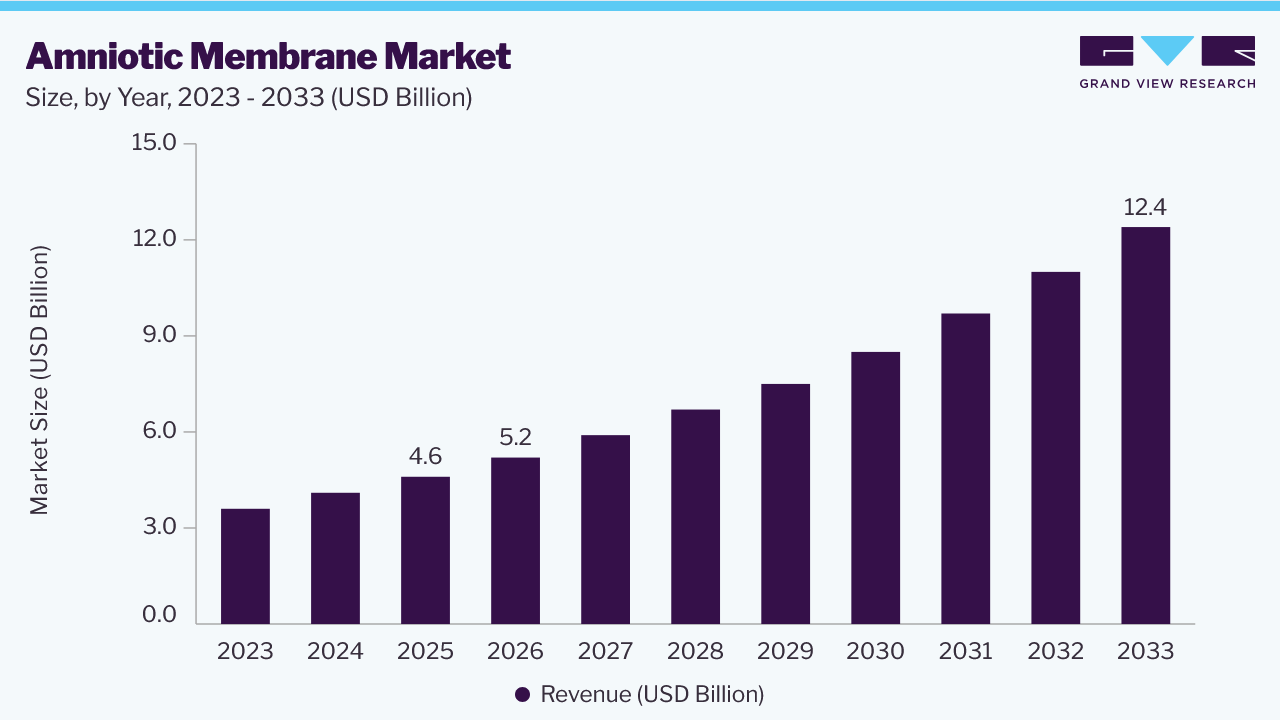 Source: Grand View Research, IR Documents, Primary Interviews, Paid DatabasesTo learn more about this report,
 Download Free Sample Report
Key Market Trends & Insights
- By product: The cryopreserved amniotic membrane segment held the largest market share of around 60.0% in 2025.
- By application: The others segment held the largest market share of over 42.0% in 2025.
- By end-use: The hospitals segment held the largest market share of over 39.0% in 2025.
Regional Highlights
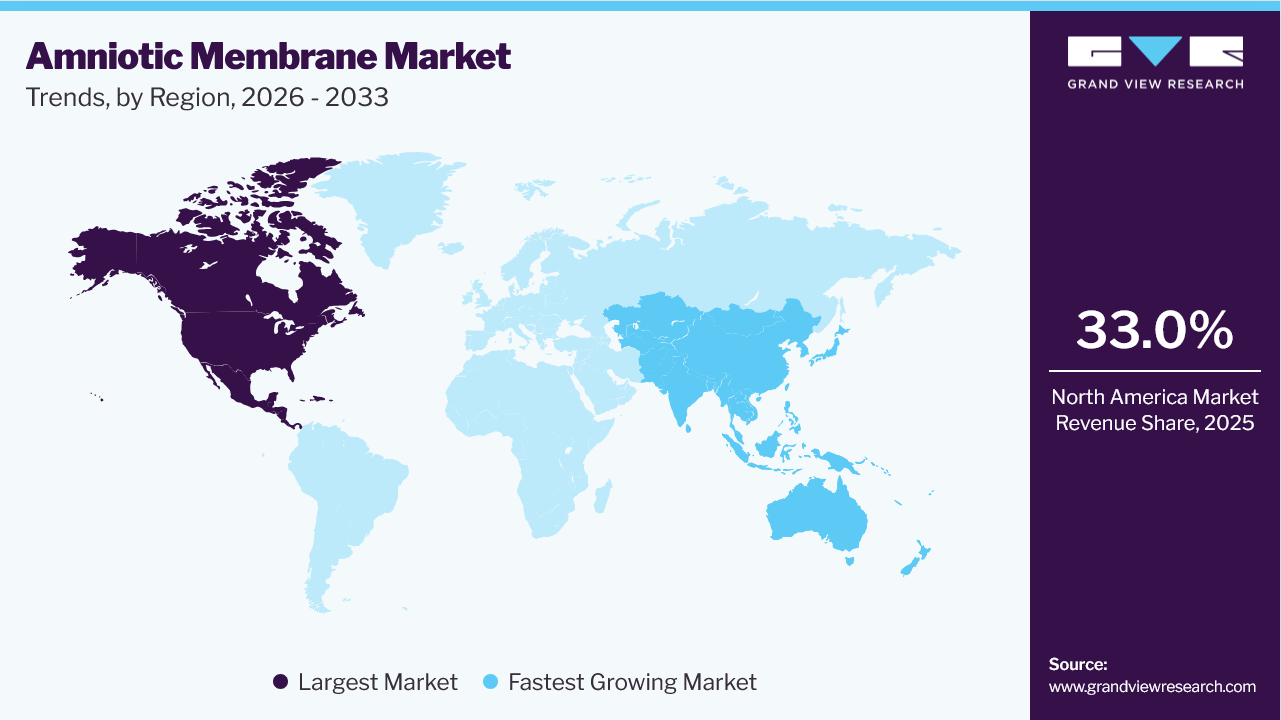
- Largest regional market: North America (33.0% revenue share, 2025)
- Fastest-growing regional market: Asia Pacific (highest CAGR, 2026-2033)
Market Size & Forecast
- Market size in 2025: USD 4.6 Billion
- Estimated market size in 2026: USD 5.2 Billion
- Projected market size by 2033: USD 12.4 Billion
- CAGR (2026-2033): 13.1%
Three ways to get this report
Buy it, customize it, or ask a question.Ask an Analyst
Analyst response in 1 business day
- AccessReport author, directly
- Reply timeWithin 1 working day
- No sales callDirect answer only
- FormatEmail reply
- CostFree, no cost
Get the Full Report
What the study covers
- FormatsPDF · Excel · Dashboard
- Timeline2026–2033 annual, 2025 base
- Coverage20+ countries, 5 regions
- Companies10+ key players profiled
Customize the Report
20% free customization
- IncludeCountries, segments, points
- TailorTo your product definition
- ExtendDeeper competitor detail
- OrA fully bespoke study
- Turnaround5–10 working days
Amniotic membrane products are extensively used in the treatment of ocular surface disorders, including bacterial keratitis, corneal ulcers, cataracts, glaucoma, bullous keratopathy, corneal degeneration, ocular dystrophies, and eyelid reconstruction procedures. The growing global geriatric population has increased ophthalmic surgeries, thereby generating significant demand for tissue-based regenerative products.
For instance, in June 2024, BioTissue introduced CAM360 AmnioGraft, a hydrated, shelf-stable, cryopreserved amniotic membrane solution designed the treat dry eye disease and other ocular surface disorders. The ringless regenerative therapy was developed to enable earlier intervention, enhance patient comfort, and simplify storage and clinical use. By improving convenience, accessibility, and treatment outcomes, this innovation is expected to support broader adoption of amniotic membrane-based therapies and contribute to overall market growth.
Increasing research activity in stem cell and regenerative medicine, substantial R&D investments, and the rising volume of surgical procedures worldwide are expected to further accelerate market expansion. For instance, in January 2025, researchers published a study in Stem Cell Research & Therapy demonstrating that human amniotic membrane mesenchymal stem cells inhibited the progression of experimental pulmonary fibrosis through the delivery of miR-181a-5p targeting TGFBR1. These findings highlight the regenerative and anti-fibrotic potential of amniotic membrane-derived stem cells, support the development of novel therapeutic applications, and expand opportunities within the industry.
Analyst Perspective
The global amniotic membrane market is experiencing robust growth, driven by increasing adoption of regenerative therapies across ophthalmology, chronic wound care, orthopedics, and surgical applications. Cryopreserved amniotic membrane products continue to account for the largest market share owing to their ability to preserve key biological components that support tissue regeneration and improved clinical outcomes. Rising investments in regenerative medicine, continuous product innovation, expanding clinical evidence, and increasing physician awareness are further accelerating global adoption. Companies that invest in advanced preservation technologies, broaden clinical indications, strengthen distribution networks, and secure favorable regulatory and reimbursement pathways are expected to be well-positioned for long-term market growth.
Product Insights
The cryopreserved amniotic membrane segment held the largest market share of around 60.0% in 2025 and is anticipated to register the fastest CAGR over the forecast period. Cryopreserved amniotic membrane (CAM) is a biologically active tissue preserved through cryogenic freezing to maintain its structural integrity and biological functionality. This preservation method involves storing the membrane at ultra-low temperatures, typically in liquid nitrogen, to retain key therapeutic components, including growth factors, cytokines, and extracellular matrix proteins that play critical roles in tissue repair and regeneration. CAM is widely utilized across multiple medical specialties due to its unique regenerative properties.
In ophthalmology, CAM is used to treat corneal defects, including persistent epithelial defects, ulcers, and chemical burns, thereby promoting healing and reducing inflammation and scar formation. In wound care, it is used to manage chronic wounds such as diabetic foot ulcers, venous leg ulcers, and pressure injuries by providing a biological scaffold that supports cellular proliferation and tissue regeneration. Furthermore, its anti-inflammatory and antimicrobial properties help reduce the risk of infection and promote a favorable healing environment.
Application Insights
The others segment held the largest market share of over 42.0% in 2025. Beyond ophthalmology and wound care, amniotic membrane applications extend to dermatology, dentistry, and gynecology. In dermatology, it is used the treat burns, chronic ulcers, and skin graft donor sites, leveraging its regenerative properties to accelerate healing. In dentistry, amniotic membranes support periodontal procedures and oral tissue regeneration while reducing inflammation and improving recovery outcomes. Gynecological applications include treatment of vaginal atrophy and use as a biological barrier during pelvic surgical procedures. These diverse applications benefit from the membrane’s anti-inflammatory, antimicrobial, and tissue-regenerative properties, expanding its utilization across numerous medical specialties.
The ophthalmology segment is anticipated to witness the fastest CAGR over the forecast period. Amniotic membranes are widely used in the treatment of ocular surface disorders, including corneal ulcers, persistent epithelial defects, and chemical burns. Their anti-inflammatory, anti-scarring, and regenerative properties promote rapid healing while reducing the risk of infection and scarring. In addition, they are commonly used in pterygium surgery and conjunctival reconstruction procedures. Growing demand is supported by their ability to improve patient outcomes, restore vision, and enhance overall ocular health. For instance, in November 2025, researchers published a study in Scientific Reports demonstrating that amniotic membrane transplantation effectively promoted retinal hole closure in a rabbit model by supporting retinal tissue regeneration and structural repair. These findings further strengthen the potential of amniotic membrane-based regenerative therapies in ophthalmology and encourage continued research and clinical translation.
End Use Insights
The hospitals segment accounted for the largest revenue share of over 39.0% in 2025. Hospitals benefit from the regenerative properties, anti-inflammatory effects, and scar-reduction capabilities of amniotic membrane products, making them valuable for treating chronic wounds, corneal defects, and reconstructive surgical conditions. Demand within hospital settings is driven by the need for advanced therapeutic solutions that improve patient outcomes and accelerate recovery, reinforcing the importance of amniotic membranes in modern clinical practice.
The ambulatory surgical centers (ASCs) segment is anticipated to witness the fastest CAGR over the forecast period. ASCs utilize amniotic membrane products in outpatient procedures for their regenerative and anti-inflammatory properties, which support healing and minimize postoperative complications. Common applications include ophthalmic procedures such as pterygium excision and minor wound management interventions. The operational efficiency, cost-effectiveness, and rapid patient turnover associated with ASCs make them well-suited for advanced minimally invasive treatments. According to Definitive Healthcare’s SurgeryCenterView data, the U.S. had more than 12,400 ambulatory surgery centers, with California accounting for the highest number, reflecting the continued expansion of outpatient surgical infrastructure and the increasing adoption of same-day surgical care.
Regional Insights
The North America amniotic membrane market dominated the global industry, accounting for around 33.0% revenue in 2025. The growth is supported by advanced healthcare infrastructure, a strong presence of leading industry participants, and increasing adoption of regenerative medicine technologies. The region’s favorable regulatory environment continues to facilitate the commercialization of innovative amniotic membrane products and support broader clinical utilization. For instance, in August 2025, BioLab Holdings announced that the U.S. FDA’s Tissue Reference Group recognized five of its amniotic membrane allografts as regulated solely under Section 361, reinforcing their regulatory pathway and supporting broader clinical adoption. Ongoing advancements in preservation technologies and expanding use in ophthalmic and wound care applications are expected to further strengthen regional market growth. Continued investments in research and development also contribute to the market’s positive outlook.
 To learn more about this report, Download Free Sample Report
Asia Pacific Amniotic Membrane Market Trends
The amniotic membrane market in Asia Pacific is expected to register the fastest CAGR over the forecast period. China and Japan are anticipated to remain key contributors to regional growth. The increasing availability of skilled healthcare professionals, improvements in healthcare infrastructure, and rising awareness of regenerative therapies are expected to support market expansion. The region is also witnessing growing clinical adoption of amniotic membrane-based therapies, particularly within ophthalmology. For instance, in June 2025, researchers from Kyoto Prefectural University of Medicine published a 21-year retrospective study demonstrating the long-term effectiveness and sustained clinical use of amniotic membrane transplantation in severe ocular surface disorders. These findings reinforce the therapeutic value of amniotic membrane-based treatments and support broader clinical adoption across the region.
Key Amniotic Membrane Market Company Insights
The amniotic membrane market remains highly competitive, with major participants, including Amnio Technology, LLC and Applied Biologics LLC, maintaining strong market positions. Leading companies are actively pursuing both organic and inorganic growth strategies, including product innovation, strategic collaborations, acquisitions, mergers, partnerships, and geographic expansion initiatives to address evolving customer requirements and strengthen their competitive positioning.
Key Amniotic Membrane Companies
The following key companies have been profiled for this study on the amniotic membrane market:
-
Amnio Technology, LLC
-
Applied Biologics LLC
-
Human Regenerative Technologies, LLC
-
Integra LifeSciences
-
LifeNet Health
-
Katena Products, Inc.
-
MiMedx Group, Inc.
-
Skye Biologics Holdings, LLC
-
BioTissue
-
Organogenesis Inc.
-
Amniox Medical Inc.
Recent Developments
- In October 2025, MIMEDX expanded its surgical product portfolio with the launch of AMNIOFIX Injectable, broadening the clinical applications of its dehydrated human amnion/chorion membrane (dHACM) technology. The product was developed to support tissue healing, repair, and regeneration across a wider range of surgical and orthopedic procedures. By extending the use of amniotic membrane-derived therapies into additional clinical settings, the launch is expected to strengthen adoption and support growth within the amniotic membrane market.
- In August 2024, Organogenesis provided a development update for ReNu, its cryopreserved amniotic suspension allograft for the treatment of knee osteoarthritis, reporting completion of enrollment in its second Phase III clinical trial involving 594 patients. The company also confirmed plans to submit a Biologics License Application (BLA) by the end of 2025. This milestone highlights continued progress in the clinical development of amniotic tissue-based regenerative therapies and is expected to support future market expansion through broader therapeutic applications and potential regulatory approval.
- In February 2024, Verséa introduced a point-of-care platform for amniotic membrane grafting. This innovation facilitates rapid and effective testing, enhancing patient care in ophthalmology by providing immediate diagnostic results and treatment options.
Amniotic Membrane Market Report Scope
Report Attribute
Details
Market size in 2025
USD 4.6 billion
Estimated market size in 2026
USD 5.2 billion
Projected market size by 2033
USD 12.4 billion
Growth rate
CAGR of 13.1% from 2026 to 2033
Base year for estimation
2025
Historical data
2021 – 2024
Forecast period
2026 – 2033
Quantitative units
Revenue in USD billion, and CAGR from 2026 to 2033
Report coverage
Revenue forecast, company ranking, competitive landscape, growth factors, and trends
Segments covered
Product, application, end use, region
Regional scope
North America; Europe; Asia Pacific; Latin America; Middle East & Africa
Country scope
U.S.; Canada; Mexico; UK; Germany; France; Italy; Spain; Denmark; Sweden; Norway; Japan; China; India; Australia; Thailand; South Korea; Brazil; Argentina; South Africa; Saudi Arabia; UAE; Kuwait
Key companies profiled
Amnio Technology, LLC; Applied Biologics LLC; Human Regenerative Technologies, LLC; Integra LifeSciences, LifeNet Health, Katena Products, Inc.; MiMedx Group, Inc.; Skye Biologics Holdings, LLC; BioTissue; Organogenesis Inc.; Amniox Medical Inc.
Customization scope
Free report customization (equivalent up to 8 analysts working days) with purchase. Addition or alteration to country, regional & segment scope.
Pricing and purchase options
Avail of customized purchase options to meet your exact research needs. Explore purchase options
Amniotic Membrane Market Report Segmentation
This report forecasts revenue growth at the global, regional, and country levels and provides an analysis of the latest industry trends and opportunities across each sub-segment from 2021 to 2033. For this study, Grand View Research has segmented the global amniotic membrane market report based on product, application, end use, and region:
-
Product Outlook (Revenue, USD Billion, 2021 - 2033)
-
Cryopreserved Amniotic Membrane
-
Dehydrated Amniotic Membrane
-
-
Application Outlook (Revenue, USD Billion, 2021 - 2033)
-
Surgical Wounds
-
Ophthalmology
-
Others
-
-
End Use Outlook (Revenue, USD Billion, 2021 - 2033)
-
Hospitals
-
Ambulatory Surgical Centers
-
Specialty Clinics
-
Research Institutes and Academic Institutes
-
-
Regional Outlook (Revenue, USD Billion, 2021 - 2033)
-
North America
-
U.S.
-
Canada
-
Mexico
-
-
Europe
-
UK
-
Germany
-
France
-
Italy
-
Spain
-
Denmark
-
Sweden
-
Norway
-
-
Asia Pacific
-
Japan
-
China
-
India
-
Australia
-
South Korea
-
Thailand
-
-
Latin America
-
Brazil
-
Argentina
-
-
Middle East and Africa
-
South Africa
-
Saudi Arabia
-
UAE
-
Kuwait
-
-
Frequently Asked Questions About This Report
Key players in the market include Amnio Technology, LLC, Applied Biologics LLC, Human Regenerative Technologies, LLC, Integra LifeSciences, LifeNet Health, Katena Products, Inc., MiMedx Group, Inc., Skye Biologics Holdings, LLC, BioTissue, Organogenesis Inc., and others.
The cryopreserved amniotic membrane segment accounted for the largest revenue share of around 60.0% in 2025.
The global amniotic membrane market size was valued at USD 4.6 billion in 2025 and is estimated at USD 5.2 billion in 2026.
The global amniotic membrane market is expected to grow at a CAGR of 13.1% from 2026 to 2033, reaching USD 12.4 billion in 2033.
North America dominated with approximately 33.0% revenue share in 2025.
About the Author(s)
Medical Devices Research Team
Healthcare · Medical DevicesThis report was authored by the medical devices research team at Grand View Research - comprising two research analysts, one senior research analyst, and one industry expert - with specialized expertise in the medical devices segment of the healthcare industry. All findings are based on proprietary healthcare databases, executive interviews, and regulatory analysis, subject to internal peer review prior to publication.
Last Updated:
Speak to Analyst

Customize this report to your needs - add regions, segments, or data points, with 20% free customization.
Or view our licence options:


ISO 9001:2015 & 27001:2022 Certified
We are GDPR and CCPA compliant! Your transaction & personal information is safe and secure. For more details, please read our privacy policy.


