
- Home
- »
- Animal Feed and Feed Additives
- »
-
Animal Feed Plant-based Protein Isolates Market Report, 2033GVR Report cover

Animal Feed Plant-based Protein Isolate Market (2026 - 2033)
Size, Share & Trends Analysis Report By Source (Sunflower Protein, Soybean Protein, Pea Protein, Canola Protein, Potato Protein), By Form (Powder, Liquid), By Application, By Region, And Segment Forecasts
Market Size, 2025
$2.4BMarket Estimate, 2026
$2.6BMarket Forecast, 2033
$4.2BCAGR, 2026–2033
7.4%Animal Feed Plant Based Protein Isolate Market Summary
The global animal feed plant-based protein isolate market size was valued at USD 2.4 billion in 2025 and is projected to grow from USD 2.6 billion in 2026 to USD 4.2 billion by 2033, growing at a CAGR of 7.4% from 2026 to 2033. Asia Pacific dominated the market, accounting for the largest global share of 40.4% in 2025. Rising demand for sustainable, high efficiency animal nutrition is accelerating adoption of plant based protein isolates as cost effective and nutritionally consistent alternatives to traditional feed proteins.
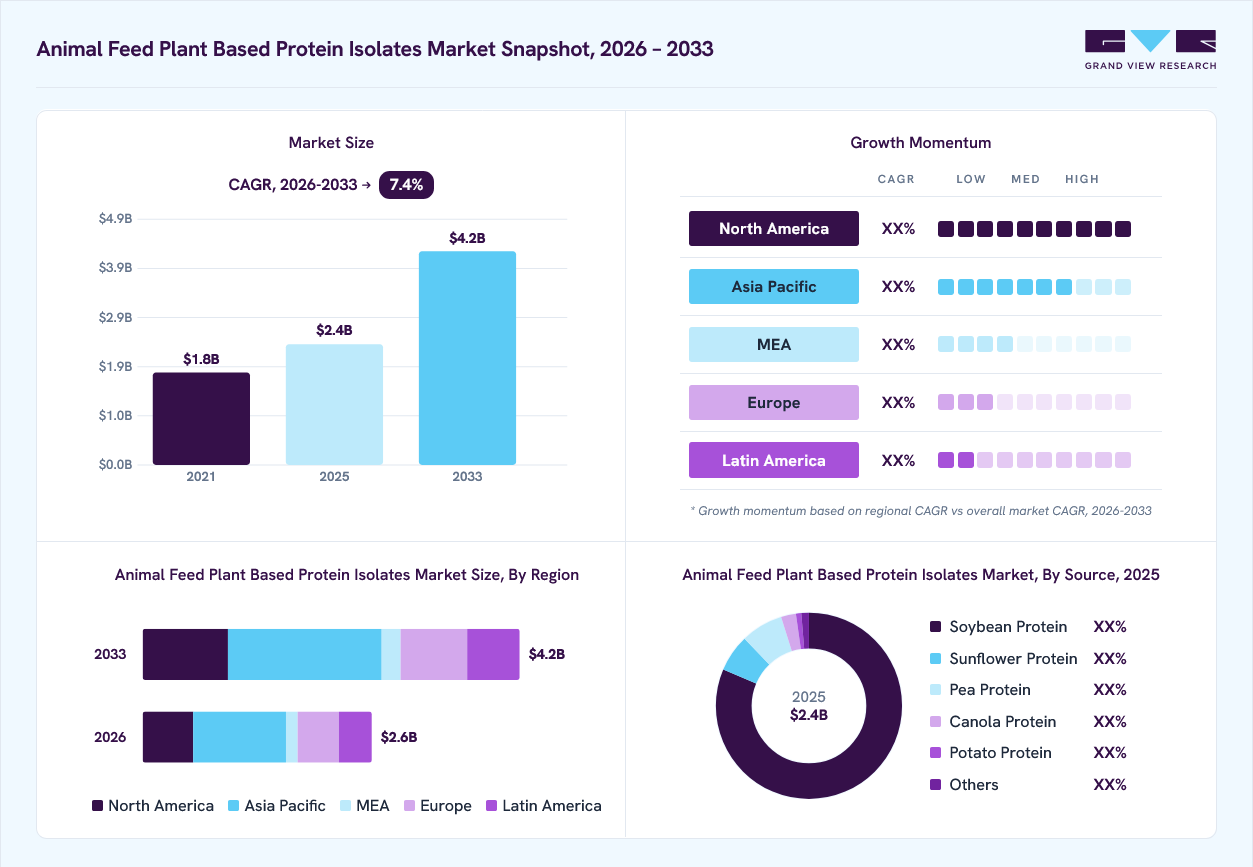 Source: Grand View Research, IR Documents, Primary Interviews, Paid DatabasesTo learn more about this report,
 Download Free Sample Report
Key Market Trends & Insights
- By source: Soybean protein segment held the largest market share of 81.3% in 2025.
- By application: Poultry feed segment accounted for the largest share of 43.7% in 2025.
- By form: Powder segment accounted for the largest share of 80.7% of market revenue in 2025.
Regional Highlights
- Largest regional market: Asia Pacific (40.4% revenue share, 2025)
- Fastest-growing regional market: North America (fastest CAGR, 2026-2033)
- By country: China held the largest share of Asia pacific in 2025.
Market Size & Forecast
- Market size in 2025: USD 2.4 Billion
- Estimated market size in 2026: USD 2.6 Billion
- Projected market size by 2033: USD 4.2 Billion
- CAGR (2026-2033): 7.4%
Three ways to get this report
Buy it, customize it, or ask a question.Ask an Analyst
Analyst response in 1 business day
- AccessReport author, directly
- Reply timeWithin 1 working day
- No sales callDirect answer only
- FormatEmail reply
- CostFree, no cost
Get the Full Report
What the study covers
- FormatsPDF · Excel · Dashboard
- Timeline2026–2033 annual, 2025 base
- Coverage20+ countries, 5 regions
- Companies10+ key players profiled
Customize the Report
20% free customization
- IncludeCountries, segments, points
- TailorTo your product definition
- ExtendDeeper competitor detail
- OrA fully bespoke study
- Turnaround5–10 working days
The animal feed plant based protein isolate market is expanding as livestock producers seek reliable and high quality protein sources that improve feed performance and animal health. Plant isolates offer high protein concentration and balanced amino acid profiles, which enhance digestibility and growth rates in animals. This makes them a practical substitute for conventional protein inputs that often face supply volatility and quality inconsistency. To learn more about this report, Download Free Sample Report
Economic considerations are also shaping this shift, as plant derived proteins provide relatively stable pricing compared to animal based sources. Feed manufacturers are prioritizing ingredients that can optimize feed conversion ratios while controlling production costs. At the same time, increasing scrutiny on resource efficiency has encouraged the use of plant proteins that require fewer inputs and generate lower environmental impact during production.
Innovation in processing techniques has improved the functional properties of plant protein isolates, enabling better solubility, absorption, and integration into various feed formulations. This has expanded their usability across multiple animal categories, reinforcing their role in modern feed strategies. As demand for efficient protein utilization continues to rise, the market is positioned to grow steadily with a strong focus on performance, consistency, and sustainability.
Market Dynamics
The animal feed plant-based protein isolates market is experiencing robust growth driven by the increasing demand for sustainable and high-quality feed ingredients, rising livestock production, and growing concerns regarding the environmental impact of conventional animal-based protein sources. Plant-based protein isolates, derived from sources such as soy, pea, wheat, canola, and other legumes, provide concentrated protein content with high digestibility and balanced amino acid profiles, making them valuable ingredients in animal nutrition. The expansion of the poultry, swine, aquaculture, and pet food industries, coupled with increasing focus on feed efficiency and animal health, is accelerating market adoption. Advancements in protein extraction technologies and growing investments in sustainable feed solutions are creating favorable conditions for market expansion.
The growing need for sustainable animal nutrition solutions is a major driver of the animal feed plant-based protein isolates market. Livestock producers are increasingly seeking high-protein feed ingredients that can improve growth performance, feed conversion ratios, and overall animal health while reducing dependence on traditional animal-derived proteins and fishmeal.
Plant-based protein isolates offer consistent nutritional quality, high protein concentration, and enhanced digestibility, making them suitable for a wide range of animal feed applications. Rising global meat consumption, expanding aquaculture production, and increasing awareness of sustainable farming practices are further driving demand. Feed manufacturers are incorporating plant protein isolates into specialized feed formulations to support efficient livestock production and meet evolving consumer expectations regarding sustainability and responsible sourcing.
Variability in the availability and pricing of raw materials such as soybeans, peas, wheat, and other protein-rich crops presents a significant challenge for the animal feed plant-based protein isolates market. Crop yield fluctuations caused by adverse weather conditions, changing agricultural policies, and supply chain disruptions can affect raw material supply and increase production costs.
The production of high-purity protein isolates requires advanced processing technologies, including extraction, purification, and drying processes, which can be capital-intensive. These factors contribute to higher product costs compared to conventional feed ingredients. Competition from alternative protein sources and concerns regarding antinutritional factors in certain plant proteins may also limit market penetration in some regions.
The growing emphasis on sustainable agriculture and environmentally responsible livestock production is creating significant opportunities for the animal feed plant-based protein isolates market. Feed producers and livestock farmers are increasingly adopting plant-based protein ingredients to reduce environmental footprints, improve resource efficiency, and support sustainable supply chains.
Technological advancements in protein extraction, fermentation-assisted processing, and ingredient optimization are improving the nutritional profile and functionality of plant protein isolates. Emerging protein sources such as fava bean, chickpea, lupin, and canola isolates are further diversifying product offerings and expanding application opportunities. Additionally, increasing investments in alternative proteins, circular agriculture initiatives, and sustainable aquaculture feed development are expected to create substantial growth prospects. Companies focusing on innovation, nutritional enhancement, and sustainable sourcing strategies are likely to strengthen their competitive position in the evolving global animal feed plant-based protein isolates market.
Market Concentration & Characteristics
The market shows moderate concentration, with a mix of established global players and emerging regional manufacturers competing on product quality, consistency, and supply reliability. This structure exists because large companies benefit from advanced processing capabilities and strong distribution networks, while smaller firms enter by targeting niche formulations and specialized feed requirements.
 To learn more about this report, Download Free Sample Report
It is characterized by strong emphasis on product standardization, functional performance, and cost efficiency, as buyers demand predictable nutritional outcomes and scalable solutions. This focus develops because feed producers prioritize ingredients that improve animal growth and feed conversion while maintaining stable input costs and ensuring compatibility with diverse feed applications.
Analyst Perspective
The global animal feed plant-based protein isolates market is positioned for strong growth, driven by increasing demand for sustainable and high-quality feed ingredients, rising livestock and aquaculture production, and growing emphasis on improving feed efficiency and animal performance. Soy protein isolates remain the most widely utilized product type due to their high protein concentration, balanced amino acid profile, established supply chain, and broad acceptance across poultry, livestock, aquaculture, and pet food applications. The growing adoption of alternative protein sources in animal nutrition, increasing focus on reducing dependence on fishmeal and animal-derived proteins, and expanding investments in sustainable feed solutions continue to strengthen market demand across both developed and emerging regions.
Source Insights
The soybean protein segment dominated the market in 2025, accounting for 81.3% of total revenue, reflecting its widespread availability and well established role in animal nutrition. Soybean based isolates offer a highly balanced amino acid profile, making them suitable for a wide range of livestock and aquaculture applications. Their consistent quality and large scale production help maintain stable pricing, which is critical for feed manufacturers managing costs. In addition, familiarity with soybean processing and integration into feed systems has reinforced its position as the primary protein source across global feed operations.
The sunflower protein segment is projected to record the fastest growth, with a CAGR of 8.1% from 2026 to 2033, driven by increasing interest in diversifying protein sources. Sunflower protein isolates are gaining attention due to their favorable digestibility and lower dependency on common allergenic crops. They also provide an alternative in regions where sunflower cultivation is prominent, supporting localized supply chains. As feed producers seek to reduce reliance on a single dominant protein source and improve formulation flexibility, sunflower based proteins are emerging as a promising option for future growth.
Form Insights
The powder segment led the market in 2025, accounting for 80.7% of total revenue, and is also the fastest growing with a CAGR of 7.5%. This dominance is driven by its practicality in large scale feed production, where ease of storage, longer shelf life, and efficient transportation are critical. Powdered protein isolates allow precise mixing and uniform distribution in feed formulations, ensuring consistent nutritional output. Their stability during handling and compatibility with existing feed processing systems make them the preferred choice, supporting both widespread adoption and continued growth.
The liquid segment is gaining traction as feed producers explore more specialized formulations that require improved nutrient dispersion and faster absorption. Liquid protein isolates are easier to blend in certain applications, particularly where uniform coating or rapid intake is needed. They are being used in targeted feeding systems that demand higher efficiency and controlled nutrient delivery. Although adoption is currently lower compared to powders, increasing interest in performance focused feed solutions is gradually expanding the role of liquid formats in the market.
Application Insights
The poultry feed segment dominated the market and accounted for the largest revenue share of 43.7% in 2025, while also growing at the fastest rate with a CAGR of 7.6%. This position is driven by the need for high efficiency feed solutions in poultry production, where rapid growth cycles require consistent and high quality protein intake. Plant based protein isolates help improve digestibility and support better feed conversion, allowing producers to achieve optimal output. Their uniform composition and cost control advantages make them highly suitable for large scale poultry operations, supporting continued expansion.
 To learn more about this report, Download Free Sample Report
The livestock feed segment holds a notable share, supported by steady demand across cattle, swine, and other farm animals. Producers are incorporating plant based protein isolates to improve nutritional balance and maintain animal health over longer production cycles. These proteins contribute to better feed utilization and consistent performance, which is essential for maintaining productivity. The need to balance feed costs with reliable growth outcomes is encouraging wider use, positioning this segment as a stable part of the overall market.
Regional Insights
Asia Pacific held the largest share of the market in 2025, accounting for 40.4% of revenue, driven by the region’s high demand for efficient and scalable animal nutrition solutions. The dominance is linked to the large livestock and aquaculture base, where consistent protein supply is essential for maintaining productivity. Feed manufacturers in this region increasingly prefer plant based protein isolates due to their stable availability and cost efficiency compared to traditional inputs. In addition, rising focus on improving feed quality and optimizing output has encouraged the adoption of high protein, easily digestible ingredients, strengthening the region’s leading position.
 To learn more about this report, Download Free Sample Report
China Animal Feed Plant Based Protein Isolate Market Trends
China held the highest market revenue share in Asia Pacific in 2025. China animal feed plant based protein isolate market is driven by the scale of its livestock and aquaculture industries, which require large volumes of reliable and cost effective feed ingredients. Efforts to improve feed efficiency and reduce dependence on fluctuating traditional protein supplies are encouraging the use of plant based protein isolates. The need to stabilize production costs while maintaining high output levels is also influencing feed formulation strategies. Increasing focus on optimizing resource use and enhancing productivity across intensive farming systems is accelerating market adoption.
North America Animal Feed Plant Based Protein Isolate Market Trends
North America is projected to grow at the fastest rate, with a CAGR of 7.8% from 2026 to 2033, supported by increasing emphasis on precision nutrition and sustainable feed practices. Producers in this region are actively shifting toward ingredients that enhance feed conversion and reduce dependency on conventional protein sources. Strong investment in research and product development is enabling the creation of advanced plant protein formulations with improved functionality. At the same time, growing awareness around environmental impact and resource efficiency is encouraging the use of plant derived proteins, accelerating market expansion across diverse animal feed applications.
U.S. animal feed plant based protein isolate market is supported by a highly organized livestock and poultry sector that depends on consistent and nutritionally optimized feed inputs. Large scale soybean cultivation ensures steady raw material availability for protein isolate production, reducing supply uncertainty. Feed producers are increasingly incorporating plant based protein isolates to improve feed conversion efficiency and maintain predictable performance outcomes. Strong emphasis on sustainable agriculture and efficient resource utilization is also influencing adoption, as producers aim to balance productivity with environmental considerations while maintaining cost stability.
Europe Animal Feed Plant Based Protein Isolate Market Trends
The Europe market is shaped by strict regulatory frameworks focused on environmental protection and responsible livestock farming practices. Feed manufacturers are adopting plant based protein isolates to comply with sustainability expectations and reduce reliance on traditional protein sources. There is also a strong preference for high quality and traceable feed ingredients, which supports the use of refined plant proteins with consistent nutritional profiles. Continuous innovation in feed formulation and growing demand for efficient protein utilization are further contributing to market development across the region.
Germany animal feed plant based protein isolate market plays a crucial role within Europe due to its advanced feed production systems and strong focus on animal nutrition standards. The demand for precise and high performance feed solutions has increased the use of plant based protein isolates that offer consistent quality and digestibility. Well established processing technologies enable efficient integration of these proteins into compound feed. The country’s emphasis on sustainable livestock management and strict quality control practices also supports the transition toward plant derived protein sources.
Latin America Animal Feed Plant Based Protein Isolate Market Trends
The Latin America market benefits from strong agricultural output, particularly in soybean production, which supports the availability of raw materials for plant protein isolates. The region’s livestock sector is heavily export oriented, requiring consistent feed quality to meet international standards. Producers are incorporating plant based protein isolates to improve growth efficiency and maintain competitive positioning in global markets. The focus on maximizing feed performance while managing input costs is encouraging wider adoption of these protein sources.
Middle East & Africa Animal Feed Plant Based Protein Isolate Market Trends
The Middle East and Africa market is developing as countries invest in strengthening local livestock and aquaculture production. Limited access to traditional feed resources has increased reliance on alternative protein inputs such as plant based isolates. Feed producers are adopting these ingredients to enhance efficiency and ensure consistent supply in challenging production environments. Growing attention to food security and the need for scalable, resource efficient feed solutions are supporting gradual market expansion across the region.
Key Animal Feed Plant Based Protein Isolate Company Insights
The two key dominant manufacturers in the market are Cargill, Incorporated and Glanbia plc, both recognized for their strong global presence and extensive capabilities in developing plant based protein ingredients for animal nutrition applications.
-
Cargill, Incorporated operates as a global food and agriculture company with a broad portfolio of ingredients used in animal nutrition. It develops plant based protein isolates that support balanced feed formulations for livestock and poultry. Its integrated operations enable consistent quality and efficient processing, while its global footprint allows it to address diverse nutritional requirements across multiple animal production systems.
-
Glanbia plc is a global nutrition company focused on producing high quality protein ingredients for both human and animal nutrition. Its plant based protein solutions are designed to enhance feed performance and support animal health. The company emphasizes innovation and product development, enabling advanced formulations that align with evolving feed requirements and sustainability considerations across modern livestock production systems.
Key Animal Feed Plant Based Protein Isolate Companies:
The following key companies have been profiled for this study on the animal feed plant based protein isolate market.
-
The Scoular Company
-
Cargill, Incorporated
-
Hamlet Protein
-
Glanbia PLC
-
Ingredion Incorporated
-
A&B Ingredients Inc.
-
HL Agro Products Pvt. Ltd.
-
Roquette Frères
-
ADM (Archer Daniels Midland Company)
-
Emsland Group
Competitive Benchmarking
Category
Operating Strategies
Competitive Edge
Weakness
Established Global Ingredient & Feed Nutrition Leaders (Cargill, Incorporated, ADM (Archer Daniels Midland Company), Ingredion Incorporated, Roquette Frères, Glanbia PLC)
- Expand production of soy, pea, canola, and specialty plant protein isolates for animal nutrition applications.
- Invest in advanced protein extraction, concentration, and functionalization technologies to improve digestibility and efficiency.
- Strengthen integrated supply chains through direct sourcing, crop processing, and global distribution networks.
- Develop sustainable protein solutions supporting alternative feed formulations and reduced dependence on animal-derived proteins.
- Extensive global manufacturing and procurement infrastructure.
- Strong relationships with feed manufacturers, integrators, and livestock producers.
- Broad ingredient portfolios and significant R&D capabilities.
- Ability to ensure large-scale, consistent supply and regulatory compliance across multiple regions.
- Exposure to agricultural commodity price volatility.
- High capital investment requirements for protein processing facilities.
- Complex supply chains are vulnerable to weather-related crop disruptions.
- Increasing competition from emerging alternative protein suppliers.
Specialized Plant Protein and Feed Ingredient Manufacturers (Hamlet Protein, The Scoular Company, Emsland Group, A&B Ingredients Inc., HL Agro Products Pvt. Ltd.)
- Focus on highly digestible plant protein ingredients for poultry, swine, aquaculture, and young animal nutrition.
- Develop value-added protein concentrates and isolates tailored to species-specific nutritional requirements.
- Collaborate with feed producers to create customized formulations and performance-enhancing feed solutions.
- Emphasize sustainability, traceability, and non-GMO ingredient offerings where applicable.
- Deep expertise in feed nutrition and animal performance optimization.
- Strong positioning in niche and premium feed ingredient segments.
- Ability to provide customized technical support and formulation assistance.
- Greater flexibility in developing specialized products for targeted applications.
- Smaller global footprint compared to multinational agribusiness companies.
- Limited economies of scale in sourcing and production.
- Dependence on selected crop sources and regional supply chains.
- Higher sensitivity to fluctuations in demand from specific livestock sectors.
Recent Developments
-
In February 2026, Roquette launched NUTRALYS Pea 850F, a next-generation pea protein isolate delivering a cleaner, neutral taste by reducing vegetal notes at source, enabling simplified labels, improved sensory performance, and versatile use in plant-based, high-protein food and beverage formulations.
-
In October 2025,Leaft Foods introduced Alfalfa Protein Concentrate, a sustainable leaf-based protein for pet food, delivering meat-like nutrition with significantly lower carbon emissions. The ingredient integrates into existing processes and supports premium, environmentally friendly formulations for global pet nutrition markets.
Animal Feed Plant Based Protein Isolate Market Report Scope
Report Attribute
Details
Market size value in 2025
USD 2.4 billion
Market size value in 2026
USD 2.6 billion
Revenue forecast in 2033
USD 4.2 billion
Growth rate
CAGR of 7.4% from 2026 to 2033
Base year for estimation
2025
Historical data
2021 - 2024
Forecast period
2026 - 2033
Quantitative units
Revenue in USD million/billion, volume in kilotons, and CAGR from 2026 to 2033
Report coverage
Revenue forecast, company ranking, competitive landscape, growth factors, and trends
Segments covered
Source, form, application, region
Regional scope
North America; Europe; Asia Pacific; Latin America; MEA
Country scope
U.S.; Canada; Mexico; Brazil; Argentina; Germany; UK; Italy; Spain; France; China; Japan; South Korea; Saudi Arabia; South Africa
Key companies profiled
The Scoular Company; Cargill, Incorporated; Hamlet Protein; Glanbia PLC; Ingredion Incorporated; A&B Ingredients Inc.; HL Agro Products Pvt. Ltd.; Roquette Frères; ADM (Archer Daniels Midland Company); Emsland Group
Customization scope
Free report customization (equivalent up to 8 analysts' working days) with purchase. Addition or alteration to country, regional & segment scope.
Pricing and purchase options
Avail customized purchase options to meet your exact research needs. Explore purchase options
Global Animal Feed Plant Based Protein Isolate Market Report Segmentation
This report forecasts revenue growth at global, regional, and country levels and provides an analysis of the latest industry trends in each of the sub-segments from 2021 to 2033. For this study, Grand View Research has segmented the global animal feed plant based protein isolate market report based on source, form, application and region.
 To learn more about this report, Download Free Sample Report
-
Source Outlook (Volume, Kilotons; Revenue, USD Billion, 2021 - 2033)
-
Sunflower Protein
-
Soybean Protein
-
Pea Protein
-
Canola Protein
-
Potato Protein
-
Other Sources
-
-
Form Outlook (Volume, Kilotons; Revenue, USD Billion, 2021 - 2033)
-
Powder
-
Liquid
-
-
Application Outlook (Volume, Kilotons; Revenue, USD Billion, 2021 - 2033)
-
Poultry Feed
-
Broilers
-
Layers
-
Turkey
-
-
Aqualculture Feed
-
Fish
-
Crustaceans
-
Mollusks
-
-
Livestock Feed
-
Swine
-
Cattle (Beef and Dairy)
-
Sheep and Goats
-
-
Pet Food
-
Dogs
-
Cats
-
Other Pets
-
-
-
Regional Outlook (Volume, Kilotons; Revenue, USD Billion, 2021 - 2033)
-
North America
-
U.S.
-
Canada
-
Mexico
-
-
Europe
-
Germany
-
UK
-
Italy
-
Spain
-
France
-
-
Asia Pacific
-
China
-
Japan
-
South Korea
-
-
Latin America
-
Brazil
-
Argentina
-
-
Middle East & Africa
-
Saudi Arabia
-
South Africa
-
-
Research Methodology
The animal feed plant based protein isolate market figures in this report are based on a proven research process that combines executive interviews with secondary research from proprietary databases, company filings, and recognized regulatory and institutional sources. Market size is built through value-chain sizing - reconciling supply-side and demand-side estimates - and triangulated with bottom-up and top-down approaches. Every estimate passes multiple levels of expert validation before publication, with each animal feed plant based protein isolate segment quantified using the revenue-capture definitions in the table below.
Segment Definition
Segment - Source
Revenue capture definition
Sunflower Protein
Income attributed to sunflower-based protein isolates supplied to feed manufacturers for livestock, poultry, aquaculture, and specialty animal nutrition products.
Soybean Protein
Market value generated from soybean protein isolates incorporated into feed formulations requiring highly concentrated and digestible plant-derived protein.
Pea Protein
Earnings associated with pea protein isolates are utilized as sustainable protein ingredients in commercial animal feed and nutritional supplements.
Canola Protein
Sales derived from canola protein isolate products marketed for improving amino acid availability and protein enrichment in feed rations.
Potato Protein
Value created through the use of potato-derived protein isolates in premium and performance-oriented feed applications across animal species.
Other Source
Revenue contribution from alternative plant protein isolates, including wheat, rice, lupin, chickpea, fava bean, hemp, and other emerging botanical sources.
Segment - Form
Revenue capture definition
Powder
Market proceeds generated from dry-form protein isolates distributed as standalone ingredients or blended into compound feed products.
Liquid
Value obtained from liquid protein isolate preparations supplied for specialized feeding programs and industrial feed processing operations.
Segment - Application
Revenue capture definition
Poultry Feed
Revenue generated from the utilization of plant-based protein isolates in feed products formulated for chickens, turkeys, ducks, and other poultry species.
Livestock Feed
Market value is attributed to protein isolated ingredients incorporated into feed rations for cattle, swine, sheep, goats, and other farm animals.
Aquaculture Feed
Income derived from supplying plant-based protein isolates for fish, shrimp, and other aquatic species requiring high-quality alternative protein sources.
Pet Food
Revenue associated with protein isolate applications in dog, cat, and companion animal nutrition products, including dry food, wet food, treats, and specialized diets.
Estimation Model
Layer Name
Key Question
Description
Animal Feed Plant Based Protein Isolates Production Layer
What forms is the supply base?
Identify global production capacity for plant-based protein isolates based on the availability of protein-rich crops such as soybeans, peas, canola, sunflower, potatoes, wheat, and other plant sources, along with extraction technologies, fractionation processes, purification capabilities, protein concentration levels, quality certifications, and manufacturing infrastructure. This layer establishes the foundational supply network supporting animal nutrition applications worldwide.
Application Adoption Layer
Where is animal feed plant based protein isolates utilized?
Assess the distribution of plant-based protein isolate consumption across poultry feed, livestock feed, aquaculture feed, pet food, and other animal nutrition applications based on feed formulation practices, nutritional requirements, species-specific demand, and regional feeding trends.
Consumption Intensity Layer
How much is animal feed plant based protein isolates used?
Analyze feed inclusion rates, compound feed production volumes, livestock population trends, aquaculture output, pet food manufacturing activity, and protein requirement levels to quantify annual demand for plant-based protein isolates across major end-use segments and geographic regions.
Revenue Layer
How is market revenue generated?
Market revenue is generated through the sale of soybean protein isolates, pea protein isolates, canola protein isolates, sunflower protein isolates, potato protein isolates, and other plant-derived protein ingredients supplied to feed manufacturers, premix producers, aquafeed companies, livestock nutrition providers, and pet food manufacturers globally.
Delivered Customizations
This report has been delivered with the following In-depth customizations
Client Request
Customization Delivered
Value Adds
Cross-Segmentation Analysis
Analysis of the relationship between source, form, and application segments, identifying consumption trends, inclusion rates, performance requirements, and revenue contribution across key combinations such as soybean protein powder in poultry feed and pea protein powder in aquaculture feed.
Supports product portfolio optimization and market prioritization by identifying the most attractive source-form-application combinations, enabling improved resource allocation, sales targeting, product development strategies, and long-term growth planning across the animal feed plant-based protein isolates value chain.
Competitive Benchmarking
Comparative evaluation of leading animal feed plant-based protein isolate manufacturers based on product portfolio breadth across protein sources, processing and extraction capabilities, manufacturing capacity, raw material sourcing strategies, geographic presence, sustainability initiatives, end-use specialization across key regional markets.
Assists competitive intelligence, partnership evaluation, and supplier assessment by providing deeper visibility into market positioning, technological strengths, differentiation strategies, innovation capabilities, operational efficiency, and areas of competitive advantage.
Opportunity Assessment
Comprehensive assessment of emerging opportunities associated with novel plant protein sources, advanced extraction technologies, high-purity protein isolate development, sustainable feed ingredients, aquaculture feed innovation, livestock nutrition enhancement, pet food premiumization, and growing demand for alternative protein solutions across global feed markets.
Helps identify high-growth investment areas, emerging application opportunities, technology development priorities, product diversification strategies, and market expansion opportunities, supporting long-term revenue growth and competitive positioning across the animal feed plant-based protein isolates value chain.
Frequently Asked Questions About This Report
The global animal feed plant based protein isolate market size was valued at USD 2.4 billion in 2025 and is estimated at USD 2.6 billion for 2026.
Some of the key players operating in the animal feed plant based protein isolate market include The Scoular Company, Cargill, Incorporated, Hamlet Protein, Glanbia PLC, Ingredion Incorporated, A&B Ingredients Inc., HL Agro Products Pvt. Ltd., Roquette Frères, ADM (Archer Daniels Midland Company), Emsland Group.
The animal feed plant based protein isolate market is expanding as livestock producers seek reliable and high quality protein sources that improve feed performance and animal health. Plant isolates offer high protein concentration and balanced amino acid profiles, which enhance digestibility and growth rates in animals. This makes them a practical substitute for conventional protein inputs that often face supply volatility and quality inconsistency.
The soybean protein segment led the market with an 81.3% revenue share in 2025, while the sunflower protein segment is expected to grow at the fastest rate.
The poultry feed segment held the largest revenue share of 43.7% in 2025 and is also the fastest-growing segment.
The powder segment held the largest share of 80.7% in 2025 and is also the fastest-growing form segment.
Asia Pacific dominated the market with a 40.4% revenue share in 2025.
The global animal feed plant based protein isolate market is expected to grow at a CAGR of 7.4% from 2026 to 2033, reaching USD 4.2 billion by 2033.
North America is the fastest-growing region over the forecast period.
About the Author(s)
Animal Feed and Feed Additives Research Team
Specialty & Chemicals · Animal Feed and Feed AdditivesThis report was authored by the animal feed and feed additives research team at Grand View Research - comprising two research analysts, one senior research analyst, and one industry expert - with specialized expertise in the animal feed and feed additives segment of the specialty & chemicals industry. All findings are based on proprietary specialty & chemicals databases, executive interviews, and regulatory analysis, subject to internal peer review prior to publication.
Last Updated:
Speak to Analyst

Customize this report to your needs - add regions, segments, or data points, with 20% free customization.
Or view our licence options:


ISO 9001:2015 & 27001:2022 Certified
We are GDPR and CCPA compliant! Your transaction & personal information is safe and secure. For more details, please read our privacy policy.


