
- Home
- »
- Plastics, Polymers & Resins
- »
-
Anti-Static Polymer Compounds Market Report, 2025-2033GVR Report cover
![Anti-Static Polymer Compounds Market (2025 - 2033)Report]()
Anti-Static Polymer Compounds Market (2025 - 2033)
Size, Share & Trends Analysis Report By Formulation (Masterbatches, Pre-Compounded Anti-Static Compounds), By End Use (Electronics & Electricals, Packaging), By Region And Segment Forecasts
Market Size, 2024
$1.3BMarket Estimate, 2026
$1.5BMarket Forecast, 2033
$2.4BCAGR, 2025–2033
7.0%Anti-Static Polymer Compounds Market Summary
The global Anti-Static polymer compounds market size was valued at USD 1.3 billion in 2024 and is projected to grow from USD 1.5 billion in 2026 to USD 2.4 billion by 2033, at a CAGR of 7.0% from 2025 to 2033. Asia Pacific dominated the market, accounting for a revenue share of 46.4% in 2024. Growing demand from the packaging sector is driving the market, as companies seek antistatic compounds to prevent dust attraction and protect products during storage and transport.

Key Market Trends & Insights
- The anti-static polymer compounds market in China accounted for the largest market revenue share in the Asia Pacific in 2024.
- By formulation, the functional coatings and films segment is expected to grow at a substantial CAGR of 8.0% from 2025 to 2033.
- By end use, the packaging segment is expected to expand at a substantial CAGR of 7.3% through the forecast period.
Market Size & Forecast
- 2024 Market Size: USD 1.31 billion
- 2033 Projected Market Size: USD 2.42 billion
- CAGR (2025-2033): 7.0%
- Asia Pacific: Largest market in 2024
In addition, rapid growth in e-commerce is pushing packaging manufacturers to adopt materials with built-in static control. Materials and formulation sophistication are redefining what anti-static polymer compounds can deliver. Formulators are moving beyond simple surface treatments toward internally conductive and permanent antistatic systems that preserve long term performance while retaining polymer processability and appearance.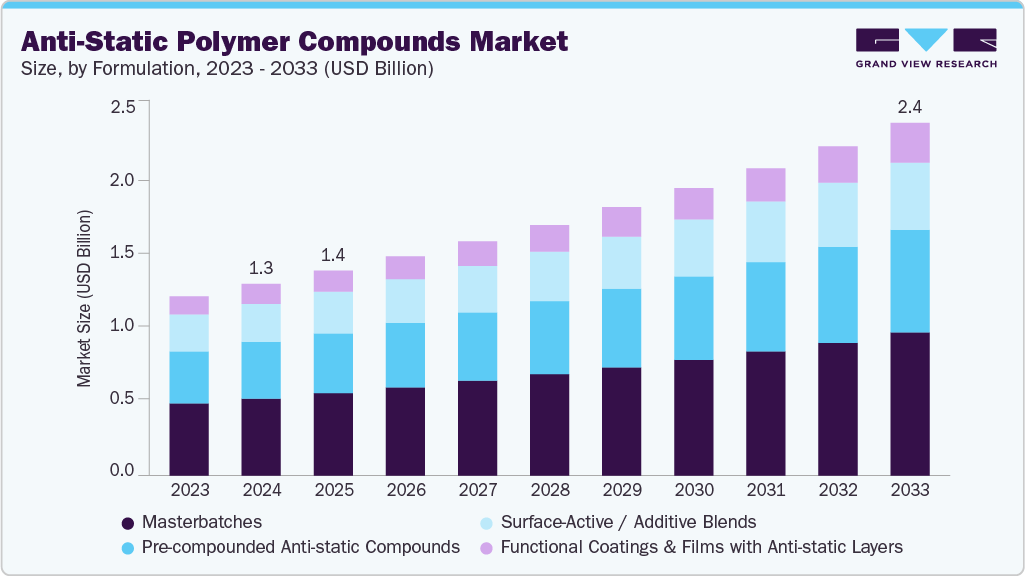
There is growing emphasis on low-loading conductive solutions such as nanotubes, engineered masterbatches, and tailored ionic additives so that electrical performance is achieved without sacrificing mechanical properties or color. This technical maturation is enabling broader adoption across demanding end uses from precision electronic components to consumer-facing packaging.
Drivers, Opportunities & Restraints
The primary demand engine for anti-static polymer compounds remains the proliferation of sensitive electronics and stricter electrostatic discharge control across manufacturing and supply chains. Miniaturization of components, higher assembly automation, and the global expansion of semiconductor and electronics manufacturing require reliable in-built static control rather than after-market fixes. At the same time, adjacent sectors such as automotive electrification and medical device manufacturing are specifying conductive or antistatic materials at the part level, pushing compounders to supply application-specific formulations.
Value creation sits at the intersection of product differentiation and system-level integration. Suppliers that can deliver transparent antistatic compounds, recyclable or low migration chemistries, and easy drop-in masterbatches will win business from high volume packaging and consumer electronics customers. There is also a clear runway to capture specification requirements for electric vehicle battery enclosures, flexible printed electronics, and next-generation telecom hardware, where static control must be balanced with weight savings and design aesthetics. Strategic collaborations with OEMs and tier one converters to co-develop validated formulations will open premium margins.
The cost and regulatory profile of effective antistatic technologies constrain faster uptake. Many high-performing conductive fillers require relatively high loadings or premium chemistries that increase material cost and can alter part appearance or processing. Regulators are also intensifying scrutiny on additive migration and environmental persistence, which raises the validation burden for food contact, medical, and consumer applications. These technical and compliance hurdles lengthen qualification cycles and favour incumbents with proven track records, slowing market entry for smaller innovators.
Market Concentration & Characteristics
The market growth stage of the anti-static polymer compounds industry is moderate, and the growth rate is increasing. The market shows slight fragmentation, with key players holding significant influence. Major companies like 3M Company, DuPont de Nemours, Inc., BASF SE, Arkema Group, Clariant AG, Evonik Industries AG, Eastman Chemical Company, Solvay S.A., PolyOne Corporation, RTP Company, Premix Group, Huntsman Corporation, and others play a crucial role in shaping market trends. These leading firms often drive innovation, launching new products, technologies, and applications to meet changing industry needs.
Innovation in anti-static polymer compounds industry is being driven by materials science breakthroughs that lower the conductivity threshold while preserving polymer aesthetics and processability. Recent research emphasizes segregated conductive networks, graphene and carbon nanotube architectures, and engineered polymer electrolytes that deliver volume conductivity at minimal filler loading, reducing weight and optical impact. Process innovations such as compatibilized masterbatches and reactive extrusion enable stable, non-migrating antistatic performance that survives thermal and mechanical stress. These technical advances are shifting the conversation from simple additive dosing to co-engineered material systems tailored for specific manufacturing and end-use validation.
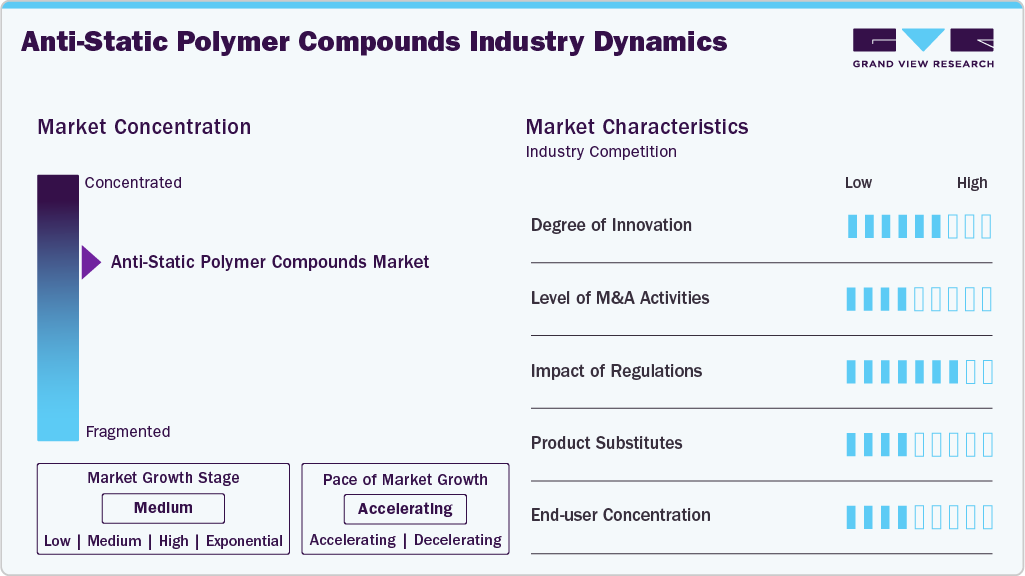
The anti-static polymer compounds industry faces credible substitution from surface engineering and non-bulk solutions that can meet antistatic requirements without altering part formulation. Functional coatings and ultra-thin antistatic films, plasma treatments, and metallized protective layers are increasingly specified where clarity, low filler content, or recyclability are priorities, because they control surface resistivity while leaving core polymer properties intact. In many packaging and display applications, vapor-deposited or coated antistatic layers and validated low-migration coatings present a faster route to compliance and lighter qualification burdens than reformulating base resins. For compounders, the practical response is to bundle performance guarantees, recycling compatibility, and rapid validation support to neutralize the appeal of these substitute approaches.
Formulation Insights
The masterbatches segment led the market with the largest revenue share of 40.18% in 2024, and is forecasted to grow at the fastest 7.1% CAGR from 2025 to 2033. The masterbatches segment is vital in the anti-static polymer compounds industry, serving as an essential formulation method. Masterbatches consist of concentrated blends of anti-static additives mixed within a carrier resin, which can be seamlessly blended into base polymers during processing. This method guarantees an even distribution of anti-static agents within the polymer matrix, improving the material’s capability to discharge static charges and avoid electrostatic accumulation.
The functional coatings & films segment is anticipated to grow at a substantial CAGR of 8.0% through the forecast period. Functional coatings and films play a crucial role in the anti-static polymer compounds industry. These coatings and films are directly applied to the surfaces of polymers or finished products to provide anti-static characteristics, preventing the accumulation of static charge and safeguarding delicate components. They are extensively utilized in sectors such as electronics, packaging, automotive, and medical fields, where protection at the surface level is essential. Functional coatings and films present benefits such as straightforward application, specific performance characteristics, and the capability to enhance the durability, transparency, and chemical resistance of the surface, all while preserving the mechanical properties of the underlying polymer. This makes them a valuable option for industries looking for dependable and adaptable anti-static solutions.
End Use Insights
The electronics and electricals segment led the market with the largest revenue share of 35.36% in 2024, and is forecasted to grow at the fastest 7.5% CAGR from 2025 to 2033. The electronics and electrical sector plays a crucial role in the anti-static polymer compounds industry, spurred by the essential requirement to safeguard sensitive components against electrostatic discharge (ESD). ESD can lead to hidden defects, decreased reliability, and potentially severe failures in devices such as integrated circuits, transistors, and memory chips.
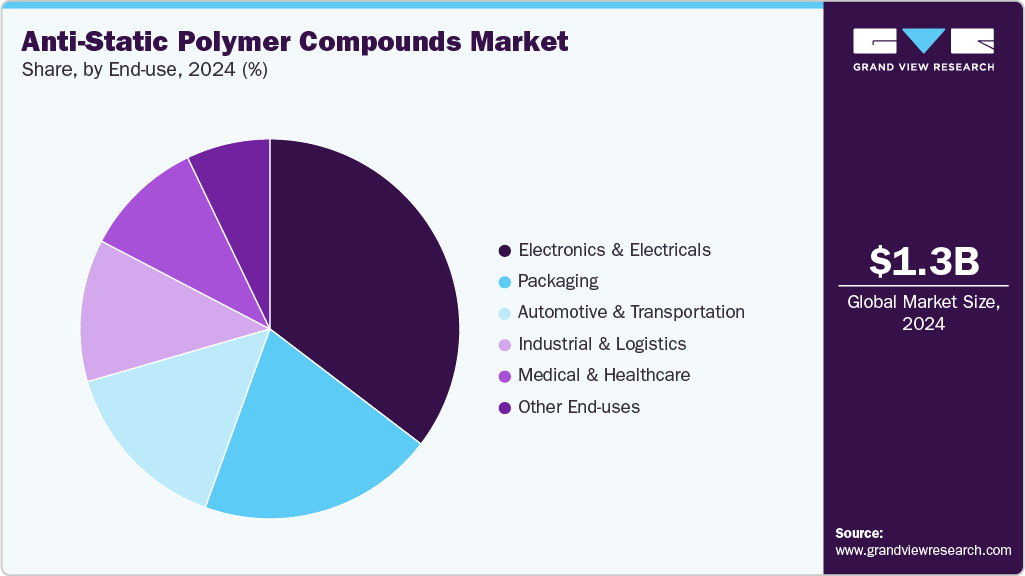
The packaging segment is expected to expand at a substantial CAGR of 7.3% through the forecast period. The packaging segment’s uptake of antistatic polymer compounds is propelled by logistics complexity and e-commerce scale, which increase particulate attraction and handling damage risk for sensitive goods. Brands seek intrinsic static control in films and rigid packaging to reduce dust pickup, improve downstream automation performance, and lower returns from cosmetic defects. At the same time, sustainability expectations are pushing demand for low-migration, recyclable antistatic solutions that meet circularity goals while protecting product integrity during long distribution chains.
Regional Insights & Trends
The anti-static polymer compounds market in North America is witnessing consistent growth, spurred by a rising demand in sectors like electronics, automotive, packaging, and textiles. This market growth is mainly driven by the escalating requirement to safeguard delicate electronic parts from electrostatic discharge (ESD), which can lead to product malfunctions and safety concerns.
U.S. Anti-Static Polymer Compounds Market Trends
The anti-static polymer compounds market in the U.S. is experiencing consistent growth, propelled by the increasing demand in sectors like electronics, automotive, packaging, and textiles. This market growth is mainly driven by the growing requirement to safeguard sensitive electronic parts from electrostatic discharge, which can lead to product malfunctions and safety concerns.
Asia Pacific Anti-Static Polymer Compounds Market Trends
Asia Pacific dominated the anti-static polymer compounds market with the largest revenue share of 46.43% in 2024 and is expected to grow at the fastest CAGR of 7.4% over the forecast period, fueled by an accelerating electronics and electric vehicle ecosystem that is both scale-hungry and cost-sensitive.
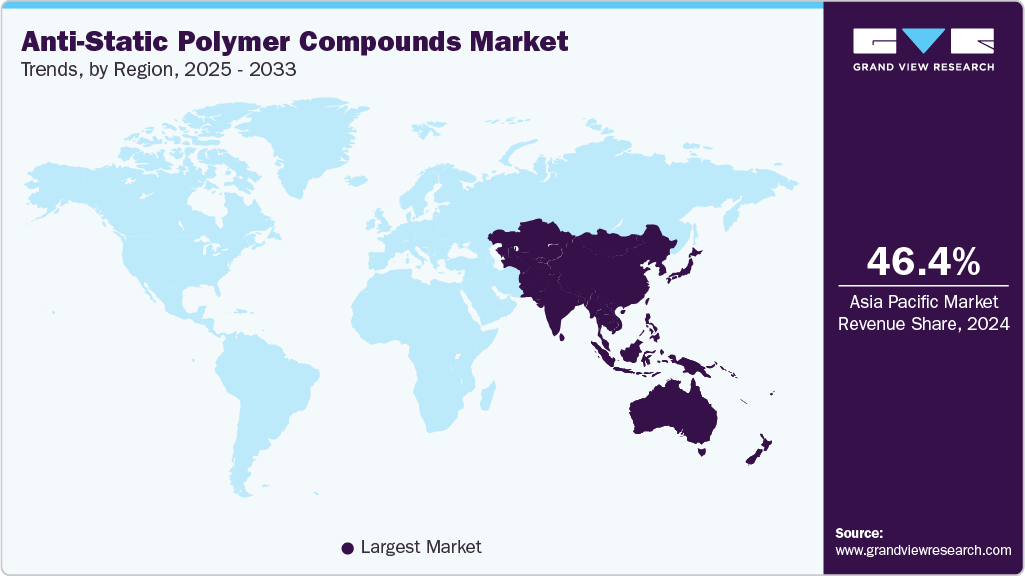
The region leads global plastics production and is rapidly expanding EV plastics and battery enclosure manufacturing, creating sustained demand for conductive and antistatic compounds that balance conductivity with weight and cost targets. Market winners will be those who offer application-engineered masterbatches and validated supply arrangements across multiple APAC manufacturing hubs to support short lead times and high-volume consumption.
Europe Anti-Static Polymer Compounds Market Trends
The anti-static polymer compounds market in Europe is seeing consistent growth, propelled by rising demand in sectors like electronics, automotive, packaging, and textiles. This market development is mainly driven by the growing necessity to safeguard delicate electronic components from electrostatic discharge (ESD), which has the potential to lead to product malfunctions and safety concerns.
Anti-Static Polymer Compounds Company Insights
The anti-static polymer compounds industry is highly competitive, with several key players dominating the landscape. Major companies include 3M Company, DuPont de Nemours, Inc., BASF SE, Arkema Group, Clariant AG, Evonik Industries AG, Eastman Chemical Company, Solvay S.A., PolyOne Corporation, RTP Company, Premix Group, and Huntsman Corporation. The anti-static polymer compounds industry is characterized by a competitive landscape with several key players driving innovation and market growth. Major companies in this sector are investing heavily in research and development to enhance the performance, cost-effectiveness, and sustainability of their types.
Key Anti-Static Polymer Compounds Companies:
The following are the leading companies in the anti-static polymer compounds market. These companies collectively hold the largest market share and dictate industry trends.
- 3M Company
- DuPont de Nemours, Inc.
- BASF SE
- Arkema Group
- Clariant AG
- Evonik Industries AG
- Eastman Chemical Company
- Solvay S.A.
- PolyOne Corporation
- RTP Company
- Premix Group
- Huntsman Corporation
Recent Developments
-
In May 2025, Spain's Delta Tecnic announced the acquisition of Italy's Impact Formulators Group. Delta Tecnic, a specialist in color and additive masterbatches for various industries, including wire and cable, expanded its portfolio by acquiring the Italian company. This move broadened Delta Tecnic's geographical reach and product offerings, supporting its strategy to grow internationally.
-
In March 2025, LyondellBasell signed an agreement with Nexeo Plastics to distribute its Engineered Polymers portfolio across Europe. This partnership aimed to expand the reach of LyondellBasell’s high-performance polymer solutions, such as anti-static polymer compounds, including products for automotive, electrical, and industrial applications. Nexeo Plastics leveraged its established network to provide local support and access to these compounds in 40 European countries.
Anti-Static Polymer Compounds Market Report Scope
Report Attribute
Details
Market size in 2024
USD 1.3 billion
Estimated market size in 2026
USD 1.5 billion
Projected market size by 2033
USD 2.4 billion
Growth rate
CAGR of 7.0% from 2025 to 2033
Base year for estimation
2024
Historical data
2021 - 2023
Forecast period
2025 - 2033
Quantitative units
Revenue in USD million/billion, Volume in Kilotons, and CAGR from 2025 to 2033
Report coverage
Revenue forecast, competitive landscape, growth factors, and trends
Market Segmentation
Formulation, end use, region
Regional scope
North America; Europe; Asia Pacific; Latin America; Middle East & Africa
Country Scope
U.S.; Canada; Mexico; Germany; France; UK; Spain; Italy; China; Japan; India; South Korea; Brazil; Argentina; Saudi Arabia; South Africa; UAE
Key companies profiled
3M Company; DuPont de Nemours, Inc.; BASF SE; Arkema Group; Clariant AG; Evonik Industries AG; Eastman Chemical Company; Solvay S.A.; PolyOne Corporation; RTP Company; Premix Group; Huntsman Corporation
Customization scope
Free report customization (equivalent up to 8 analyst’s working days) with purchase. Addition or alteration to country, regional & segment scope
Pricing and purchase options
Avail customized purchase options to meet your exact research needs. Explore purchase options
Global Anti-Static Polymer Compounds Market Report Segmentation
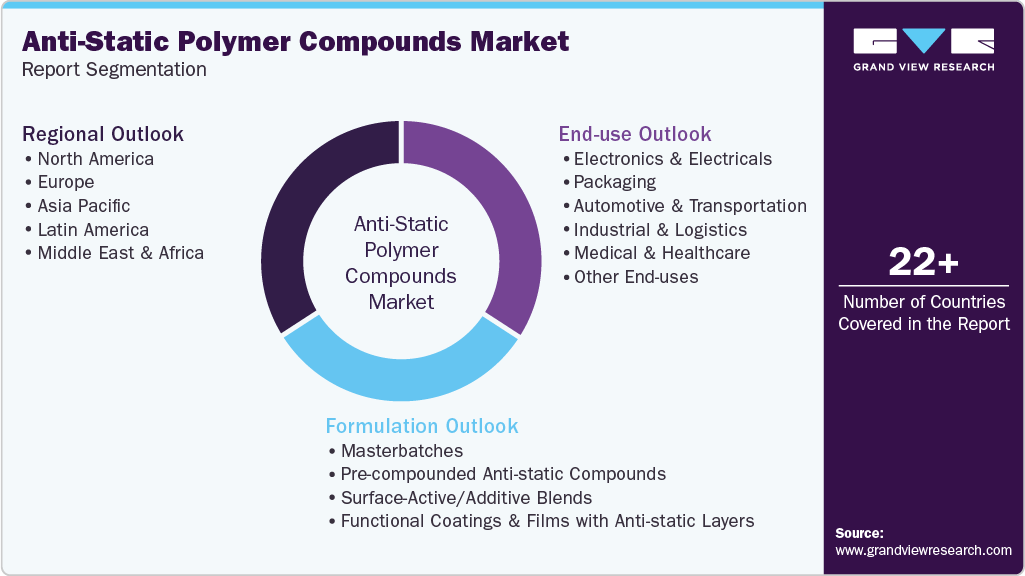
This report forecasts revenue growth at the global, regional, and country levels and provides an analysis of the latest industry trends in each of the sub-segments from 2021 to 2033. For this study, Grand View Research has segmented the global anti-static polymer compounds market report based on the formulation, end use, and region:
-
Formulation Outlook (Volume, Kilotons; Revenue, USD Million, 2021 - 2033)
-
Masterbatches
-
Pre-compounded Anti-static Compounds
-
Surface-Active / Additive Blends
-
Functional Coatings & Films with Anti-static Layers
-
-
End Use Outlook (Volume, Kilotons; Revenue, USD Million, 2021 - 2033)
-
Electronics & Electricals
-
Packaging
-
Automotive & Transportation
-
Industrial & Logistics
-
Medical & Healthcare
-
Other end-uses
-
-
Regional Outlook (Volume, Kilotons; Revenue, USD Million, 2021 - 2033)
-
North America
-
U.S.
-
Canada
-
Mexico
-
-
Europe
-
Germany
-
UK
-
France
-
Italy
-
Spain
-
-
Asia Pacific
-
China
-
India
-
Japan
-
South Korea
-
-
Latin America
-
Brazil
-
Argentina
-
-
Middle East & Africa
-
Saudi Arabia
-
South Africa
-
UAE
-
-
Frequently Asked Questions About This Report
The Anti-Static Polymer Compounds market was estimated at around USD 1.3 billion in 2024 and is expected to reach approximately USD 1.5 billion in 2026.
The Anti-Static Polymer Compounds market is expected to grow at a compound annual growth rate (CAGR) of 7.0% from 2025 to 2033, reaching approximately USD 2.4 billion by 2033.
Masterbatches dominated the anti-static polymer compounds market across all product segments in terms of revenue, accounting for a 40.18% market share in 2024, and are forecasted to grow at a 7.1% CAGR from 2025 to 2033. The masterbatches segment is crucial in the anti-static polymer compounds market, serving as a vital formulation method.
The key players in the Anti-Static Polymer Compounds market include 3M Company, DuPont de Nemours, Inc., BASF SE, Arkema Group, Clariant AG, Evonik Industries AG, Eastman Chemical Company, Solvay S.A., PolyOne Corporation, RTP Company, Premix Group, and Huntsman Corporation.
Growing demand from the packaging sector is driving the market, as companies seek antistatic compounds to prevent dust attraction and protect products during storage and transport. In addition, rapid growth in e-commerce is pushing packaging manufacturers to adopt materials with built-in static control.
About the Author(s)
Plastics, Polymers & Resins Research Team
Bulk Chemicals · Plastics, Polymers & ResinsThis report was authored by the plastics, polymers & resins research team at Grand View Research - comprising two research analysts, one senior research analyst, and one industry expert - with specialized expertise in the plastics, polymers & resins segment of the bulk chemicals industry. All findings are based on proprietary bulk chemicals databases, executive interviews, and regulatory analysis, subject to internal peer review prior to publication.
Last Updated:
Speak to Analyst

Customize this report to your needs — add regions, segments, or data points, with 20% free customization.
Or view our licence options:


ISO 9001:2015 & 27001:2022 Certified
We are GDPR and CCPA compliant! Your transaction & personal information is safe and secure. For more details, please read our privacy policy.












