
- Home
- »
- Medical Devices
- »
-
Antibody Drug Conjugates CDMO Market Size Report, 2033GVR Report cover

Antibody Drug Conjugates Contract Development & Manufacturing Organization Market (2026 - 2033)
Size, Share & Trends Analysis Report By Service , By Workflow, By Source, By Technology, By Therapeutic Area, By End Use, By Region, And Segment Forecasts
Market Size, 2025
$9.4BMarket Estimate, 2026
$10.5BMarket Forecast, 2033
$23.0BCAGR, 2026–2033
11.9%Antibody Drug Conjugates CDMO Market Summary
The global antibody drug conjugates contract development & manufacturing organization (CDMO) market size was valued at USD 9.4 billion in 2025 and is projected to grow from USD 10.5 billion in 2026 to USD 23.0 billion by 2033, at a CAGR of 11.9% from 2026 to 2033. The market in North America dominated with a revenue share of 43.8% in 2025. The market growth is driven by rapid expansion of the global ADC clinical pipeline, increasing approvals of ADC-based oncology therapies, and rising outsourcing of technically complex manufacturing activities.
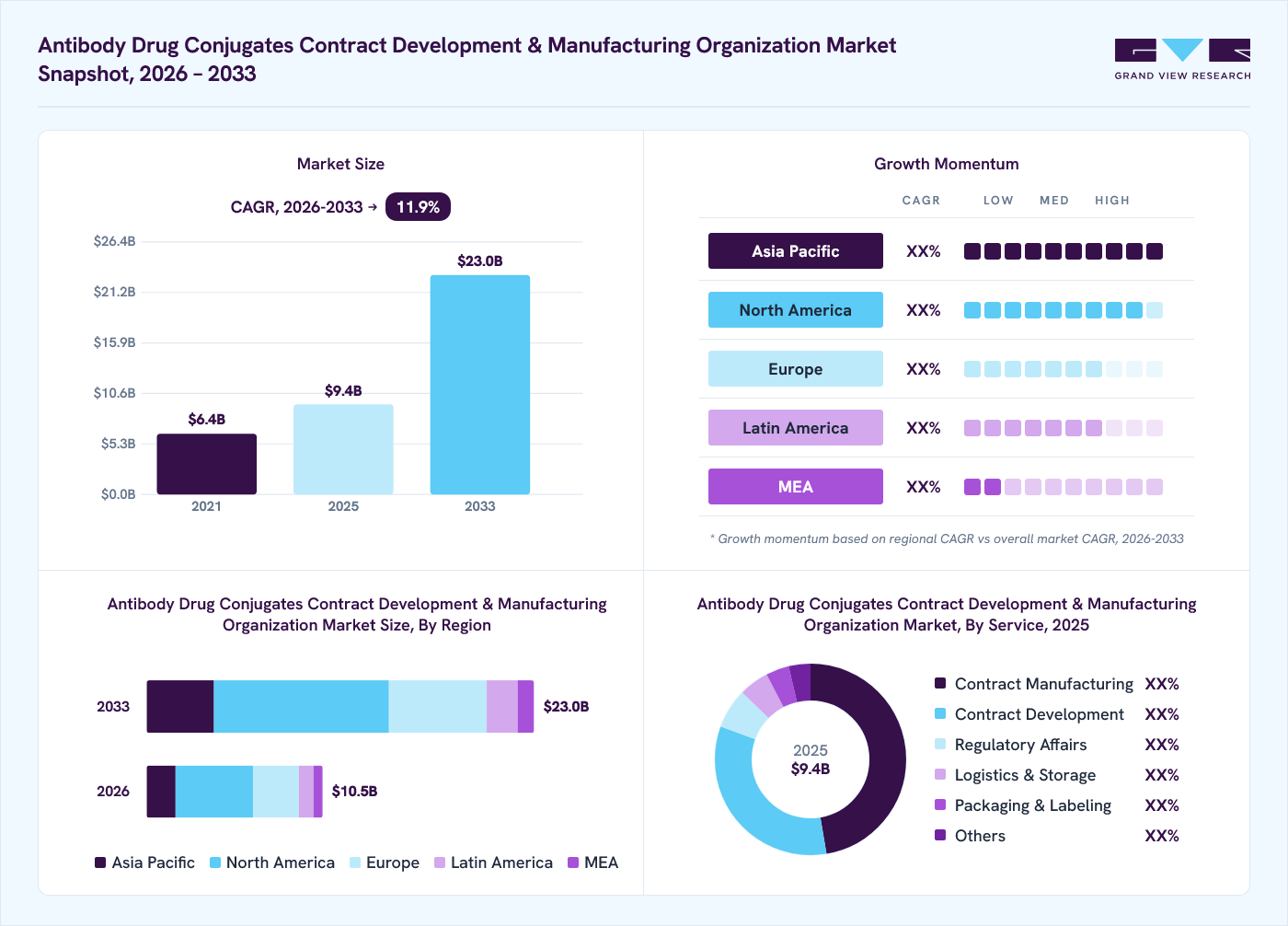 Source: Grand View Research, IR Documents, Primary Interviews, Paid DatabasesTo learn more about this report,
 Download Free Sample Report
Key Market Trends & Insights
- By service: Contract manufacturing segment held the largest market share of 47.3% in 2025.
- By workflow: Commercial segment held the largest market share of 63.9% in 2025.
- By source: Microbial segment held the largest market share of 61.3% in 2025.
- By technology: Cleavable linker segment held the largest market share of 54.3% in 2025.
- By therapeutic area: Oncology segment held the largest market share of 26.5% in 2025.
- By end use: Large pharma & biotech companies segment held the largest market share of 51.6% in 2025.
Regional Highlights
- Largest regional market: North America (43.8% revenue share, 2025)
- Fastest-growing regional market: Asia Pacific (highest CAGR, 2026-2033)
- By country: The U.S. held the largest market share in 2025
Market Size & Forecast
- Market size in 2025: USD 9.4 Billion
- Estimated market size in 2026: USD 10.5 Billion
- Projected market size by 2033: USD 23.0 Billion
- CAGR (2026-2033): 11.9%
Prism AI by Grand View Research Free to tryAsk a question about the antibody drug conjugates contract development & manufacturing organization marketTry asking✓Every figure cited from GVR research Prefer the report? Download free sample →
In addition, the demand is supported by requirements for high-potency payload synthesis, linker development, site-specific conjugation, advanced analytical characterization, GMP bioconjugation, and sterile fill-finish. Besides, most biopharma companies are increasingly relying on specialized CDMOs to reduce capital investment, access containment infrastructure, and accelerate clinical-to-commercial scale-up.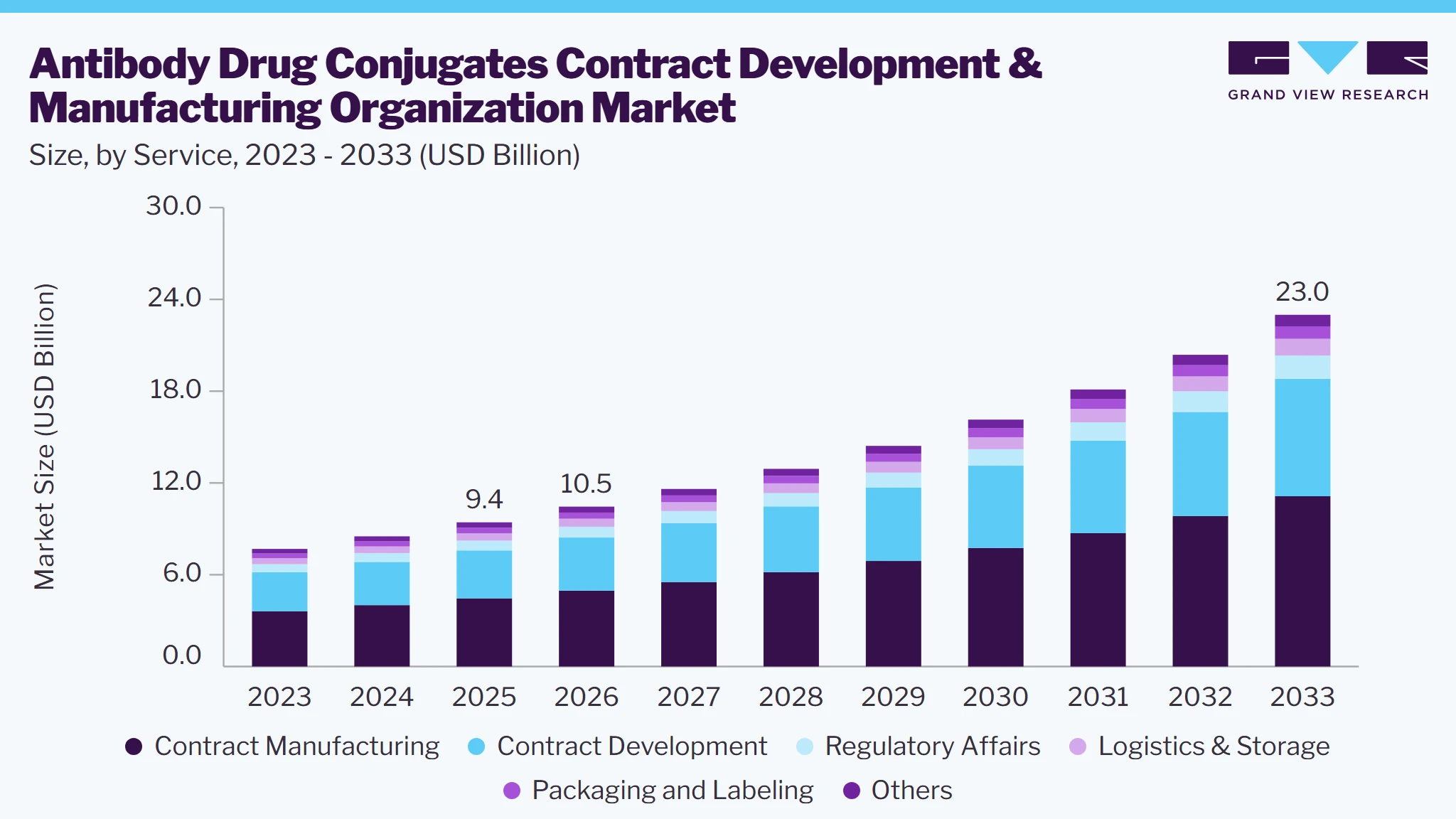 To learn more about this report, Download Free Sample Report
In addition, growing adoption of integrated development models, commercial capacity expansions, and increasing investment in next-generation ADC platforms are strengthening long-term outsourcing demand across North America, Europe, and Asia Pacific.
Market Dynamics
The antibody drug conjugates (ADC) contract development & manufacturing organization market is shifting towards high-value, capability-driven outsourcing landscape, supported by increasing ADC pipeline complexity and growing demand for specialized manufacturing expertise. Currently, most market participants are strengthening integrated bioconjugation platforms, commercial-scale capacity, analytical capabilities, and flexible manufacturing infrastructure to capture increasing clinical and commercial outsourcing opportunities. Service portfolios are expanding across linker-payload development, antibody preparation, conjugation, purification, formulation, drug substance manufacturing, and drug-product production.
In addition, technological advancement is expected to drive the market growth as such as next-generation linker-payload systems, site-specific conjugation, advanced analytical characterization, and improved process-control technologies are reshaping the ADC development and manufacturing requirements. These developments are increasing demand for CDMOs with specialized technical capabilities and scalable GMP infrastructure.
Moreover, shifting trends in competitive landscape towards end-to-end lifecycle partnerships, with market participants pursuing capacity expansions, strategic investments, acquisitions, and technology partnerships are expected to drive the market growth. Besides, contract allocation is increasingly determined by technical expertise, commercial-scale readiness, capacity availability, regulatory capabilities, execution timelines, and supply-chain integration. Thus, CDMOs capable of supporting seamless clinical-to-commercial transitions are expected to strengthen their competitive positioning as ADC outsourcing demand expands.
The expanding clinical and commercial ADC pipeline is one of the key driver for specialized CDMO services. ADC development requires coordination across monoclonal antibody production, highly potent payload synthesis, linker manufacturing, conjugation, purification, characterization, formulation, and sterile drug-product operations, creating manufacturing requirements that differ materially from conventional biologics. As programs advance from early clinical development toward pivotal trials and commercialization, batch volumes, validation requirements, analytical workloads, and supply-security expectations increase substantially. This creates recurring outsourcing opportunities across both development and manufacturing activities.
The commercial significance of the pipeline is increasingly evident. Lonza reported approximately 850 ADC molecules in development in 2025, illustrating the scale of future manufacturing requirements. Furthermore, ADC developers frequently use CDMOs because of the specialized infrastructure and expertise required for manufacturing; Lonza has mentioned that it had estimated that around 70% of ADC developers rely on CDMO support. Thus, expanding pipeline and progressive shift towards outsourcing demand from smaller clinical contracts toward higher-value, long-duration commercial manufacturing agreements are expected to drive the market growth over the estimated time period.
ADC manufacturing involves multiple technically interdependent components, creating significant operational complexity for both sponsors and CDMOs. Variability in antibody characteristics, linker stability, payload potency, conjugation efficiency, drug-to-antibody ratio, aggregation, purification performance, and final formulation can materially influence product quality. Manufacturing operations must therefore combine biologics expertise with highly potent compound handling, sophisticated analytical characterization, containment infrastructure, and rigorous process controls.
This complexity can extend development timelines and increase the cost of transferring processes between facilities or suppliers. Every additional handoff across antibody manufacturing, linker-payload production, conjugation, testing, and fill-finish can introduce coordination requirements, comparability considerations, logistics dependencies, and scheduling risk. Integrated ADC manufacturing models are consequently being positioned specifically to reduce supplier handoffs and associated supply-chain risks.
The challenge becomes particularly important during scale-up, where laboratory processes must translate reproducibly into GMP manufacturing. High containment requirements for cytotoxic components further increase facility and operational demands. These factors can restrict the number of CDMOs capable of supporting technically challenging ADC programs through commercial scale.
A significant market opportunity is emerging around integrated end-to-end ADC development and manufacturing platforms. Traditionally, sponsors may engage separate providers for antibody production, linker-payload synthesis, conjugation, analytical testing, and drug-product manufacturing. Consolidating these activities within coordinated CDMO networks can reduce technology-transfer interfaces, simplify project governance, improve scheduling visibility, and strengthen supply-chain control.
The opportunity extends beyond operational convenience. Integrated providers can potentially capture a larger proportion of expenditure generated by each ADC program while establishing longer customer relationships spanning early development through commercial supply. Lonza describes an integrated model incorporating payload, linker, antibody, bioconjugation, and drug-product capabilities within a coordinated manufacturing framework. Samsung Biologics is similarly expanding bioconjugation operations spanning antibody preparation, conjugation, purification, formulation, and bulk drug substance manufacturing.
Demand for these platforms should strengthen as developers seek fewer manufacturing interfaces and faster progression toward clinical and commercial milestones. CDMOs combining biologics, HPAPI, conjugation, analytical, and sterile fill-finish capabilities therefore have an opportunity to differentiate through integrated lifecycle management rather than standalone manufacturing capacity.
Market Concentration & Characteristics
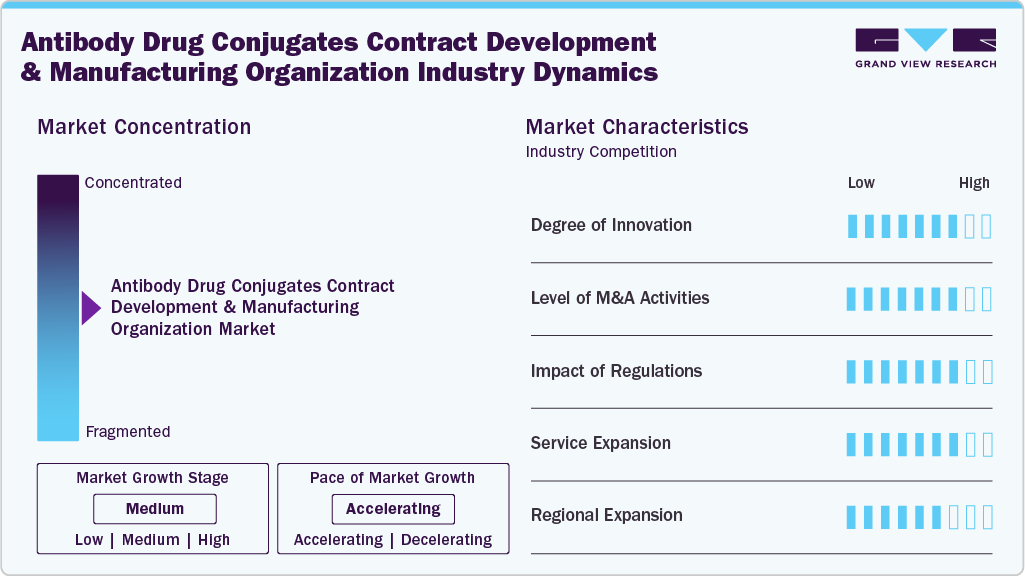
The antibody drug conjugates CDMO market growth stage is moderate, and growth is accelerating. The market is characterized by the degree of innovation, level of M&A activities, regulatory impact, service expansion, and regional expansion.
Innovation in the Antibody Drug Conjugates CDMO market is accelerating with the adoption of site-specific conjugation, next-generation linker technologies, novel high-potency payloads, advanced analytical characterization, and automated manufacturing platforms. CDMOs are increasingly integrating commercial conjugation technologies with improved drug-to-antibody ratio control, enhanced payload stability, and scalable GMP processes. These advancements improve product consistency, process reproducibility, and development efficiency, while enabling manufacturers to support increasingly complex ADC architectures, including bispecific ADCs and next-generation bioconjugates.
 To learn more about this report, Download Free Sample Report
M&A and strategic partnership activity is increasing as CDMOs seek to expand capabilities across antibody manufacturing, linker-payload synthesis, bioconjugation, HPAPI production, analytical testing, and sterile fill-finish. Acquisitions are increasingly used to create integrated ADC development and manufacturing platforms and reduce dependence on external suppliers. Partnerships between specialized technology providers and large-scale manufacturers also enable faster capability expansion. This consolidation strengthens technical expertise, expands geographic reach, improves commercial-scale readiness, and supports more comprehensive clinical-to-commercial ADC manufacturing solutions.
Regulatory requirements significantly influence ADC CDMO operations due to the complexity of biologics manufacturing, cytotoxic payload handling, process validation, product characterization, and GMP compliance. Regulatory authorities increasingly emphasize control of critical quality attributes, drug-to-antibody ratio, free payload, aggregation, impurities, stability, and manufacturing consistency. CDMOs must therefore maintain robust quality systems, validated analytical methods, containment controls, and detailed documentation. Strong regulatory experience is becoming an important selection criterion for sponsors seeking efficient clinical development, technology transfer, regulatory submissions, and commercial manufacturing.
ADC CDMOs are expanding beyond standalone conjugation services toward integrated development and manufacturing offerings covering antibody production, linker-payload synthesis, process development, analytical testing, formulation, fill-finish, packaging, regulatory support, and commercial supply. This service expansion allows sponsors to reduce vendor interfaces and manage complex manufacturing programs through fewer strategic partners. Providers are also strengthening capabilities in scale-up, technology transfer, stability testing, and supply-chain management, positioning themselves as lifecycle partners capable of supporting ADC programs from early development through commercialization.
Regional expansion is accelerating as ADC CDMOs establish and enlarge manufacturing infrastructure across North America, Europe, and Asia Pacific. Investments are increasingly focused on dedicated bioconjugation suites, high-containment payload facilities, biologics capacity, analytical laboratories, and commercial-scale manufacturing. Asia Pacific, particularly South Korea, China, and India, is gaining importance due to expanding biologics capabilities and competitive manufacturing ecosystems. Whereas, U.S. and European capacity additions are supporting supply-chain localization, proximity to major biotechnology clusters, and stronger clinical-to-commercial manufacturing continuity.
Analyst Perspective
The ADC CDMO market is becoming a critical biologics outsourcing segment as sponsors demand combined expertise in biologics and potent small-molecule manufacturing. Future growth favors integration, specialization, and reliability over raw capacity. CDMOs delivering end-to-end services-from payload chemistry and conjugation to final fill-finish-will capture top-tier program value, while niche players with proprietary platforms retain strong appeal. Because contract decisions are now capability-driven rather than price-driven, high-containment assets, flexible facilities, and advanced analytics represent prime investment targets. This shift is sparking strategic partnerships, targeted expansions, and selective consolidation to serve a growing late-stage pipeline.
Impact of U.S. Tariffs on the Global Antibody Drug Conjugates Contract Development & Manufacturing Organization Market
U.S. tariff measures are expected to have indirect impact on the biological safety testing services market by increasing the landed cost of imported laboratory instruments, analytical equipment, reagents, consumables, specialty chemicals, and replacement components used by testing laboratories. Recent U.S. trade actions continue to use additional tariffs across selected imported products and economies, increasing procurement uncertainty for industries dependent on globally sourced inputs. Biological safety testing providers may consequently experience higher operating expenses across sterility, bioburden, endotoxin, viral safety, mycoplasma, and related analytical workflows.
Large testing organizations are comparatively better positioned to mitigate these pressures through bulk purchasing, diversified sourcing, supplier negotiations, and regional procurement networks. Smaller laboratories may face greater margin pressure if higher input costs cannot be fully transferred to pharmaceutical and biotechnology customers. Tariffs can additionally encourage laboratories to qualify alternative domestic or tariff-exempt suppliers, increasing near-term validation and procurement requirements.
Moreover, the tariff environment may accelerate localization of laboratory supply chains and inventory buffering for critical consumables. However, biological safety testing demand itself should remain comparatively resilient, as testing is fundamentally linked to regulatory compliance, quality assurance, biologics development, and product-release requirements. Thus, tariffs are more likely to influence service pricing, procurement strategies, and laboratory margins than materially reduce testing volumes.
Technological Advancements
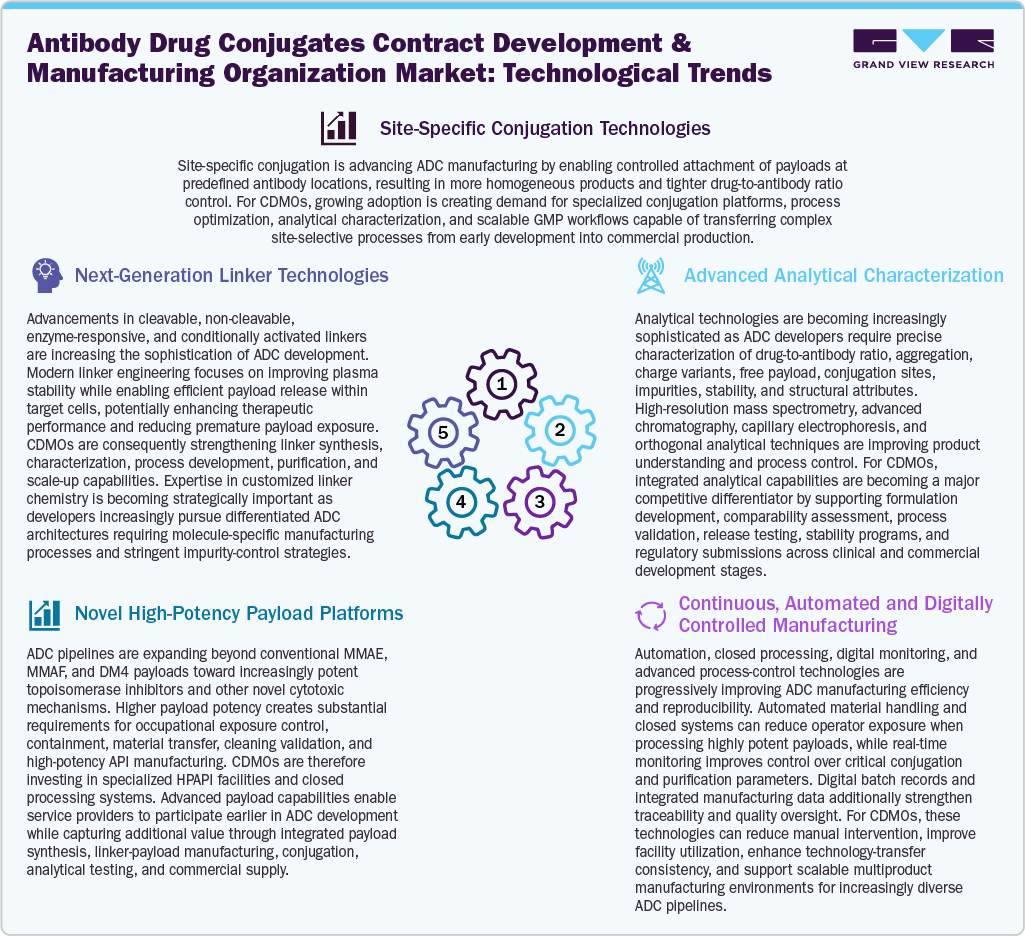
Technological advancement in the antibody drug conjugates CDMO market is driven by enhanced product precision, manufacturing reproducibility, containment, scalability, and analytical control. Site-specific conjugation technologies are enabling more homogeneous ADCs with controlled drug-to-antibody ratios, while next-generation linker systems are improving stability and targeted payload-release characteristics. Simultaneously, adoption of increasingly potent and structurally diverse payloads is raising requirements for specialized HPAPI infrastructure, closed processing, occupational containment, and sophisticated impurity-control strategies. In addition, analytical innovation is becoming equally critical as complex ADC architectures require detailed assessment of conjugation sites, aggregation, charge variants, free payload, structural integrity, and stability. High-resolution mass spectrometry, chromatography, and complementary characterization platforms are therefore becoming integral to process development and commercial manufacturing.
 To learn more about this report, Download Free Sample Report
Automation and digital process control further strengthen manufacturing consistency by reducing manual intervention, improving traceability, and enabling tighter monitoring of critical process parameters. Collectively, these advancements are shifting ADC outsourcing from conventional manufacturing toward technology-intensive, integrated development platforms. CDMOs combining commercial or differentiated conjugation expertise, advanced linker-payload capabilities, high-containment manufacturing, sophisticated analytics, and digitally controlled scalable production are consequently positioned to capture higher-value programs and support increasingly complex ADC candidates from development through commercialization.
Pricing Model Analysis
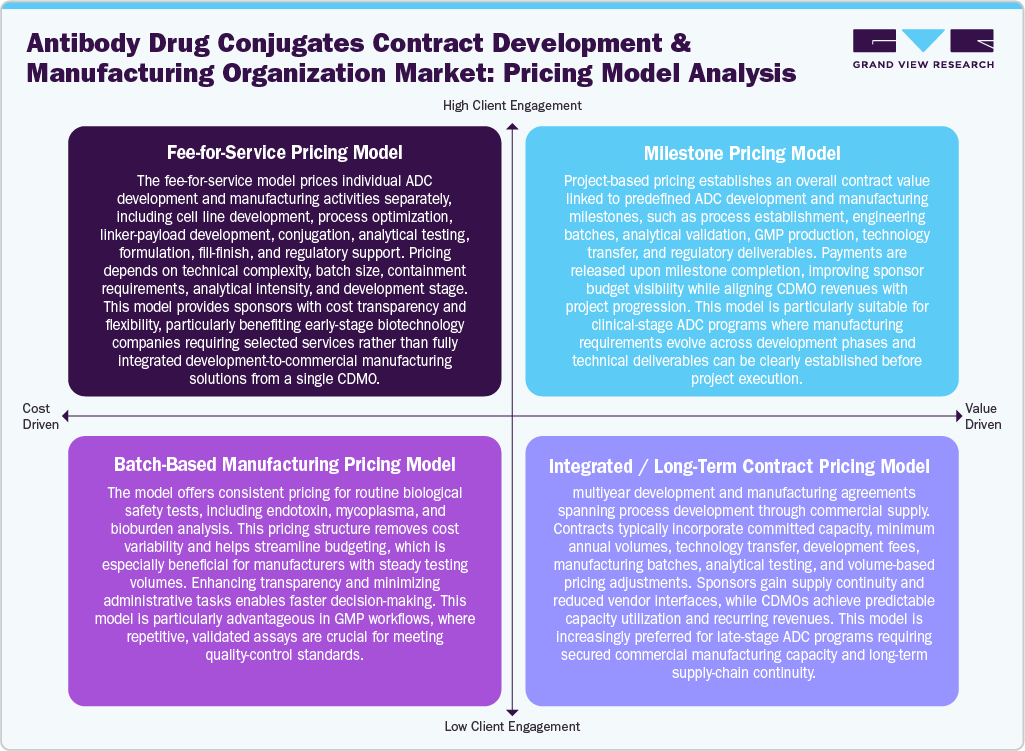
Pricing in the antibody drug conjugates contract development & manufacturing organization market is determined by a combination of technical complexity, development stage, manufacturing scale, service integration, capacity commitment, and specialized infrastructure requirements. Early-stage programs frequently utilize fee-for-service or milestone-based structures because development requirements remain variable and sponsors require flexibility across process development, conjugation optimization, analytical characterization, and clinical manufacturing. As programs mature, batch-based pricing becomes increasingly relevant, with contract values influenced by batch scale, facility occupancy, containment classification, purification requirements, release testing, and manufacturing frequency.
 To learn more about this report, Download Free Sample Report
Late-stage and commercial ADC programs increasingly favor integrated or long-term contractual structures that combine development, technology transfer, manufacturing, analytical services, and secured capacity. These arrangements can incorporate minimum-volume commitments, reserved manufacturing slots, volume discounts, and multiyear supply provisions.
Across all models, pricing premiums are influenced by high-potency payload handling, complex linker chemistry, site-specific conjugation, sophisticated analytical requirements, and stringent GMP controls. Consequently, ADC CDMO pricing is increasingly value- and capability-driven rather than purely volume-driven. Providers offering integrated antibody, linker-payload, conjugation, analytical, and fill-finish capabilities can potentially command higher contract values by reducing technology-transfer interfaces, execution risk, and overall development timelines.
Service Insights
Based on service, the contract manufacturing segment led the market with the largest revenue share of 47.3% in 2025. The growth is driven by substantial outsourcing requirements for antibody production, linker-payload manufacturing, conjugation, purification, drug substance production, and finished drug-product manufacturing. ADC production requires specialized high-containment infrastructure, GMP facilities, complex analytical controls, and experienced technical personnel, making internal manufacturing capital intensive. Increasing numbers of late-stage and commercial ADC programs further generate larger batch volumes and recurring manufacturing contracts. CDMOs with integrated clinical-to-commercial capabilities are therefore capturing significant demand through long-term supply agreements and commercial manufacturing partnerships.
On the other hand, the contract development segment is projected to grow at a significant CAGR during the forecast period. The segment is driven by the expanding pipeline of early-stage ADC candidates and increasing technical complexity associated with linker-payload selection, conjugation optimization, process development, and analytical characterization. Pharmaceutical and biotechnology companies increasingly engage CDMOs during early development to access specialized expertise without establishing dedicated infrastructure. Growing adoption of site-specific conjugation, novel payloads, and advanced linker technologies is further increasing development requirements. Demand for cell line development, process optimization, analytical method development, scale-up, and technology transfer is consequently strengthening contract development activity across the ADC lifecycle.
Workflow Insights
Based on workflow, the commercial segment led the market with the largest revenue share of 63.9% in 2025. The growth is driven by higher manufacturing value associated with approved ADC products. Commercial programs require recurring large-scale production, validated processes, extensive quality control, supply-chain continuity, regulatory compliance, and reliable capacity allocation. Besides, growing adoption of approved ADC therapies and continued expansion into additional indications are increasing commercial production requirements. Compared with clinical manufacturing, commercial contracts typically generate greater revenue per program through repeated batches and longer contract durations, strengthening demand for CDMOs capable of providing validated bioconjugation, drug substance, analytical, and drug-product manufacturing capabilities.
The clinical segment is anticipated to register the fastest growth during the forecast period due to rapidly expanding number of ADC candidates progressing through Phase I, Phase II, and Phase III development. Increasing exploration of novel tumor targets, next-generation payloads, bispecific ADCs, and alternative conjugation technologies is generating substantial requirements for small-to-medium GMP batches, analytical testing, formulation development, stability studies, and clinical supply. Emerging biotechnology companies are particularly dependent on outsourced manufacturing during clinical development, creating opportunities for CDMOs offering flexible capacity, rapid technology transfer, scalable processes, and integrated development-to-manufacturing support.
Source Insights
Based on source, the microbial segment led the market with the largest revenue share of 61.3% in 2025. The growth is driven by its established application in producing selected recombinant components, enzymes, proteins, and process-related materials used across ADC development and manufacturing workflows. Microbial systems offer relatively rapid production cycles, scalable fermentation, established process economics, and comparatively straightforward upstream operations. Their manufacturing flexibility supports development and production requirements where bacterial or yeast expression is technically appropriate. Continued utilization of microbial platforms across supporting bioprocessing applications therefore contributes to their market position within the broader outsourced ADC development and manufacturing ecosystem.
On the other hand, the mammalian segment is projected to grow at a significant CAGR duringthe forecast period. The segment is driven by its central role in producing monoclonal antibodies used as the targeting component of ADCs. Increasing development of complex antibodies, engineered antibodies, bispecific formats, and next-generation targeting constructs is strengthening demand for mammalian expression systems, particularly CHO-based production platforms. CDMOs are expanding mammalian cell culture, upstream processing, purification, and integrated antibody-to-conjugation capabilities to support these programs. Increasing preference for end-to-end manufacturing strengthens demand for facilities combining mammalian antibody production with downstream ADC conjugation and analytical services.
Technology Insights
Based on technology, the cleavable linker segment led the market with the largest revenue share of 54.3% in 2025. The growth is driven by their extensive utilization across commercial and clinical-stage ADC programs. These linkers are designed to remain comparatively stable during systemic circulation while enabling controlled payload release following internalization into target cells. Protease-sensitive, acid-sensitive, and other condition-responsive mechanisms support effective intracellular drug release and, depending on payload characteristics, potential bystander activity. Their established application across multiple ADC architectures generates significant CDMO demand for linker synthesis, linker-payload manufacturing, conjugation development, analytical characterization, process optimization, and commercial-scale production.
The non-cleavable linker segment is anticipated to register the significant growth during the forecast period due to increasing emphasis on ADC stability, controlled intracellular processing, and reduction of premature payload release during systemic circulation. Non-cleavable architectures can provide strong plasma stability because payload liberation generally depends on lysosomal degradation of the antibody component. Growing development of next-generation ADCs focused on improved therapeutic index and predictable pharmacokinetic behavior is supporting further evaluation of these systems. CDMOs are strengthening linker synthesis, conjugation optimization, analytical characterization, and scalable manufacturing capabilities for differentiated non-cleavable ADC platforms.
Therapeutic Area Insights
Based on therapeutic area, the oncology segment led the market with the largest revenue share of 26.5% in 2025. The growth is driven by strong concentration of approved products and clinical-stage ADC candidates within cancer treatment. ADCs provide a targeted mechanism for delivering highly potent cytotoxic agents to tumor-associated antigens, supporting their development across breast cancer, lymphoma, leukemia, urothelial cancer, lung cancer, gastric cancer, and other solid tumors. Continued expansion of target antigens and treatment indications is increasing demand for outsourced development and manufacturing. Thus, oncology generates substantial requirements across linker-payload production, bioconjugation, analytical testing, clinical manufacturing, and commercial supply.
On the other hand, the neurological disorders segment is projected to grow at a significant CAGR duringthe forecast period. The segment is driven by antibody-based targeted delivery technologies increasingly attract research interest in complex central nervous system diseases. Advances in antibody engineering, blood-brain barrier transport mechanisms, conjugation technologies, and targeted payload delivery are expanding the potential application of conjugate platforms beyond established oncology indications. In addition, CDMOs with advanced antibody engineering, conjugation, analytical, and early-stage development capabilities are positioned to support emerging programs.
End Use Insights
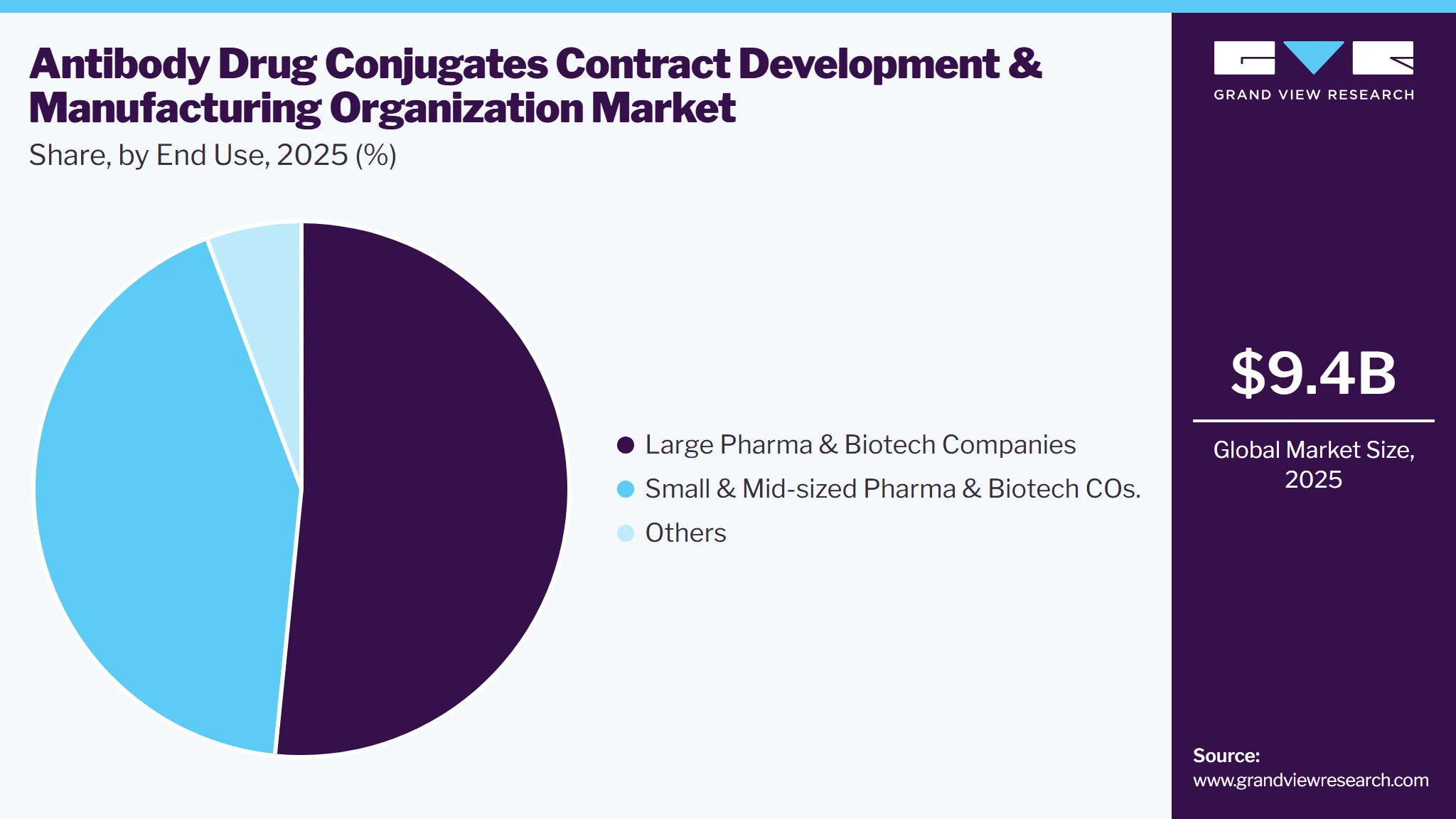
Based on end use, the large pharma & biotech companies segment led the market with the largest revenue share of 51.6% in 2025. The growth is driven by extensive oncology portfolios, higher numbers of late-stage and commercial programs, and greater manufacturing expenditure per asset. These organizations increasingly use CDMOs to complement internal capacity, secure specialized linker-payload and bioconjugation expertise, diversify supply chains, and manage commercial production requirements. Large companies also frequently require multiple manufacturing sites, validated processes, regulatory support, and long-term supply arrangements. Consequently, their larger program volumes and commercial-scale requirements translate into substantial contract values for integrated ADC CDMO providers.
 To learn more about this report, Download Free Sample Report
The small and mid-sized pharma and biotechnology companies segment is anticipated to register the fastest growth during the forecast period. The segment growth is due to Small and mid-sized pharma and biotechnology companies are expected to register the fastest growth as emerging ADC developers increasingly depend on external partners for specialized development and manufacturing infrastructure. Establishing internal HPAPI handling, linker-payload synthesis, conjugation, analytical, and GMP manufacturing capabilities requires significant capital and technical expertise, making outsourcing economically attractive. These companies frequently engage CDMOs from early process development through clinical manufacturing and scale-up. Expanding biotechnology pipelines, licensing activity, and investment in next-generation ADC platforms are therefore increasing demand for flexible, technically specialized, and integrated CDMO partnerships.
Regional Insights
North America Antibody Drug Conjugates CDMO Market Trends
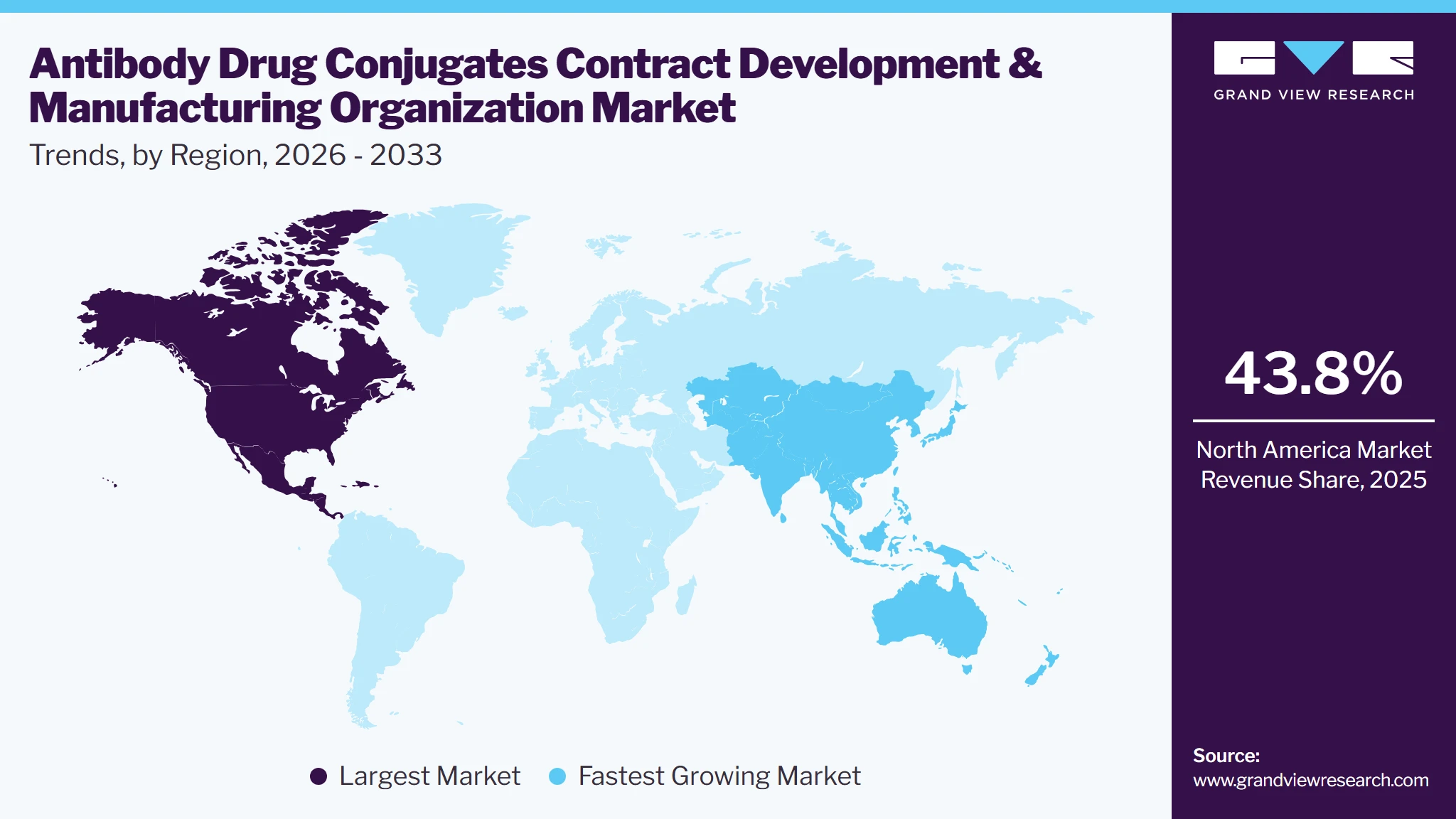
North America dominated the antibody drug conjugates CDMO market with the largest revenue share of 43.8% in 2025, driven by expanding oncology pipeline, substantial biotechnology investment, advanced biologics manufacturing infrastructure, and strong adoption of outsourced ADC development and manufacturing services. North America possesses established capabilities spanning monoclonal antibody production, linker-payload processing, bioconjugation, analytical characterization, and sterile manufacturing. The increasing regulatory maturity of ADCs, including FDA guidance addressing clinical pharmacology and bioanalytical considerations, is further strengthening the development ecosystem. Continued expansion of U.S.-based manufacturing capacity is expected to improve supply-chain resilience and accelerate clinical-to-commercial ADC outsourcing.
 To learn more about this report, Download Free Sample Report
U.S. Antibody Drug Conjugates CDMO Market Trends
The antibody drug conjugates CDMO market in the U.S. held the largest share in the North America region in 2025. The country’s growth is supported by an oncology-focused biotechnology ecosystem, a substantial pipeline of ADC clinical programs, specialized bioconjugation expertise, and access to advanced commercial-scale biologics manufacturing infrastructure. Growing emphasis on domestic and regionally integrated manufacturing is encouraging additional investment in U.S.-based capacity. Samsung Biologics’ expansion of its U.S. manufacturing presence through the acquisition of its Rockville asset reflects increasing industry focus on geographically diversified manufacturing networks. Demand is increasingly shifting toward integrated CDMO platforms combining development, analytical testing, conjugation, scale-up, and commercial manufacturing capabilities.
The antibody drug conjugates CDMO market in Canada is expected to grow steadily over the forecast period, driven is supported by the country’s established biotechnology ecosystem, increasing oncology research activities, developing biologics manufacturing capabilities, and participation of Canadian biotechnology companies and academic institutions in advanced therapeutic development. Proximity to the U.S. pharmaceutical industry also creates opportunities for cross-border development and manufacturing collaborations. In the near term, outsourcing opportunities are expected to remain concentrated across process development, analytical characterization, early-stage manufacturing, and specialized bioconjugation services rather than large-scale commercial production. Continued investment in domestic biomanufacturing infrastructure is expected to progressively strengthen Canada’s competitiveness within specialized ADC outsourcing.
Europe Antibody Drug Conjugates CDMO Market Trends
Europe accounted for a significant share of the global antibody drug conjugates CDMO market in 2025, driven by mature pharmaceutical manufacturing infrastructure, established biologics expertise, specialized high-potency API capabilities, and the presence of an extensive CDMO network. Regulatory approvals and continued development of ADC therapies, including Enhertu, Kadcyla, Elahere, Tivdak, and Blenrep, demonstrate the increasing importance of ADCs within the European oncology landscape. Competitive differentiation among CDMOs is increasingly centered on integrated linker-payload manufacturing, conjugation, analytical development, commercial-scale production, and high-containment infrastructure capable of safely handling increasingly potent payloads used in next-generation ADC platforms..
The antibody drug conjugates CDMO market in Germany held the largest share of the European market in 2025. The country benefits from mature pharmaceutical manufacturing industry, advanced chemical synthesis capabilities, established biologics expertise, and sophisticated quality-control infrastructure. Germany is particularly well positioned for ADC outsourcing programs requiring the integration of high-potency small-molecule manufacturing with biologics processing and conjugation capabilities. Demand is increasingly concentrated across linker-payload synthesis, analytical characterization, process development, GMP manufacturing, and technology-transfer services. In addition, Germany’s central role within the European pharmaceutical supply chain provides access to regional clinical programs and supports multinational pharmaceutical companies seeking EU-based, regulatory-compliant manufacturing and commercial supply capabilities..
The UK antibody drug conjugates CDMO market is expected to grow significantly over the forecast period. The market growth is supported by the country’s established biotechnology research ecosystem, strong oncology innovation landscape, substantial early-stage drug development activity, and expertise in biologics and advanced manufacturing. The UK provides attractive opportunities for specialized CDMOs offering bioconjugation development, linker-payload chemistry, bioanalytical testing, process development, and clinical manufacturing. Expansion of the targeted oncology therapy pipeline is expected to increase the addressable opportunity for ADC outsourcing providers. Competitive positioning will increasingly depend on CDMOs’ ability to convert early scientific expertise into scalable, regulatory-compliant GMP processes supporting clinical development, registration, and eventual commercial manufacturing.
Asia Pacific Antibody Drug Conjugates CDMO Market Trends
Asia Pacific is projected to register the fastest CAGR during the forecast period, driven by expanding ADC development pipelines, increasing biopharmaceutical R&D expenditure, competitive manufacturing economics, and substantial investment in biologics and bioconjugation infrastructure. South Korea is emerging as an important ADC manufacturing hub, supported by dedicated infrastructure incorporating bioconjugation development, quality control, MSAT, high-potency containment, and manufacturing capabilities reaching 500 liters. Samsung Biologics’ involvement in multiple ADC development programs further demonstrates increasing regional outsourcing activity. China, Japan, India, and South Korea collectively provide a strengthening ecosystem for clinical development, specialized manufacturing, and commercial-scale ADC production.
The antibody drug conjugates CDMO market in China is rapidly growing due to rapidly growing due to expanding domestic biotechnology pipeline and increasing oncology drug development activity. The country has established substantial biologics manufacturing infrastructure while progressively strengthening capabilities in linker-payload chemistry, high-potency processing, and bioconjugation. In addition, growing development of sophisticated, targeted therapies by domestic biotechnology companies is increasing demand for analytical development, clinical manufacturing, process scale-up, and commercial supply services. China’s established outsourcing ecosystem also enables providers to integrate antibody manufacturing with analytical and drug-product services. Competitive differentiation is increasingly shifting beyond manufacturing cost toward technological capabilities, development speed, regulatory compliance, and integrated service offerings as Chinese developers increasingly target international clinical development and commercialization..
The antibody drug conjugates CDMO market in Japan is driven by sophisticated pharmaceutical industry, strong oncology research capabilities, and increasing adoption of targeted therapies. The country’s growing involvement in advanced biologic modalities is creating opportunities for specialized ADC development and manufacturing services. Japan’s regulatory framework is increasingly addressing ADCs and other complex therapeutic modalities, particularly analytical, quality, and product-characterization requirements. PMDA evaluation of newer ADC therapies, including belantamab mafodotin, further reflects continued regulatory and clinical activity. Outsourcing opportunities are particularly concentrated in analytical characterization, conjugation, process development, clinical manufacturing, and technology-transfer services for pharmaceutical and biotechnology companies requiring flexible manufacturing capacity beyond internal infrastructure.
India Antibody Drug Conjugates CDMO market is supported by competitive manufacturing economics, increasing pharmaceutical R&D activity, and growing biologics capabilities. The availability of a skilled scientific workforce, established pharmaceutical outsourcing infrastructure, and increasing investment in complex drug manufacturing are strengthening India’s position within the ADC value chain. The country’s cost competitiveness and technical capabilities continue to support pharmaceutical R&D outsourcing, alongside continued growth in domestic pharmaceutical innovation. Emerging ADC opportunities include linker and payload synthesis, HPAPI manufacturing, analytical development, process development, and clinical supply. Further investment in high-containment facilities, GMP biologics infrastructure, bioconjugation capabilities, and international regulatory compliance will be critical for capturing larger commercial-scale ADC manufacturing contracts..
Latin America Antibody Drug Conjugates CDMO Market Trends
The antibody drug conjugates CDMO market in Latin America is expected to witness significant growth, supported by expanding oncology research, increasing clinical-trial activity, and improving biopharmaceutical infrastructure. Government initiatives focused on strengthening domestic pharmaceutical production are also expected to support regional market development. However, dedicated commercial-scale ADC manufacturing capabilities remain comparatively limited. Consequently, near-term opportunities are expected to remain concentrated in clinical supply, analytical testing, packaging, logistics, and selected biologics manufacturing services. Brazil represents a major regional growth center, while Mexico and Argentina provide additional pharmaceutical manufacturing and clinical research capabilities. Increasing technology-transfer collaborations could gradually strengthen local advanced-therapy manufacturing and reduce dependence on imported complex biologics.
Brazil Antibody Drug Conjugates CDMO marketis driven by expanding oncology research, strengthening clinical-trial infrastructure, and government-supported investment in domestic biopharmaceutical manufacturing. Financing directed toward biotechnology manufacturing infrastructure for medicines targeting cancer and autoimmune diseases demonstrates the country’s increasing strategic emphasis on localized biologics production. Brazil’s clinical research environment is also undergoing regulatory and structural development aimed at increasing participation in international clinical studies. Although dedicated ADC manufacturing capabilities remain at a developing stage, opportunities are emerging across biologics manufacturing, analytical services, clinical supply, process development, and technology transfer. Continued infrastructure investment could progressively support localized conjugation capabilities and, over the longer term, commercial-scale ADC manufacturing.
Middle East & Africa Antibody Drug Conjugates CDMO Market Trends
The Middle East and Africa antibody drug conjugates CDMO market is projected to grow steadily, driven by growing oncology investment, pharmaceutical localization programs, and developing clinical research infrastructure. Government strategies aimed at strengthening domestic biotechnology and pharmaceutical capabilities are also creating opportunities for advanced therapeutic manufacturing. However, dedicated ADC manufacturing infrastructure remains relatively limited, resulting in continued dependence on international CDMOs for complex bioconjugation and commercial production. Near-term opportunities are therefore concentrated across clinical supply management, analytical support, packaging, storage, and regional distribution. Over the longer term, biotechnology investments across Gulf countries could facilitate technology-transfer partnerships and selective localization of biologics and specialized manufacturing capabilities.
The UAE Antibody Drug Conjugates CDMO market is anticipated driven by increasing life-sciences investment, advanced oncology infrastructure, precision-medicine initiatives, and pharmaceutical localization strategies. Dubai’s research priorities encompassing genomic cancer research, novel biomarkers, immunotherapy, and targeted treatment approaches provide a supportive ecosystem for advanced oncology modalities such as ADCs. Continued investment in specialized cancer treatment infrastructure is also strengthening the broader oncology ecosystem. Although domestic ADC conjugation and commercial manufacturing capabilities remain limited, the UAE has the potential to establish a strategic position in clinical supply management, analytical services, regional distribution, technology-transfer partnerships, and, over time, specialized biologics and bioconjugation manufacturing serving Middle Eastern markets.
Key Companies & Market Share Insights
The key players operating across the market are adopting strategic initiatives such as service launches, mergers & acquisitions, partnerships & agreements, and expansions to gain a competitive edge in the market. For instance, in June 2026, Shilpa Biologicals commissioned a new GMP ADC manufacturing facility in Dharwad, India. The facility provides integrated ADC drug-substance capabilities covering payload synthesis, linker development/manufacturing, monoclonal antibody production, ADC conjugation, and GMP purification. It is designed to meet major regulatory standards, including U.S. FDA and EMA requirements.
Key Antibody Drug Conjugates CDMO Companies
The following key companies have been profiled for this study on the antibody drug conjugates CDMO market.
-
Recipharm AB
-
Samsung Biologics
-
Lonza Group
-
Piramal Pharma Solutions
-
Sterling Pharma Solutions
-
Sartorius AG
-
Catalent, Inc.
-
WuXi Biologics
-
AbbVie Contract Manufacturing
-
Merck KGaA (MilliporeSigma)
-
Thermo Fisher Scientific (Patheon)
-
CordenPharma
-
Cambrex
-
Abzena
-
Ajinomoto Bio-Pharma Services
Competitive Benchmarking
Category
Operating Strategies
Competitive Edge
Weakness
Established Players (Lonza Group, Samsung Biologics, Piramal Pharma Solutions)
- Established participants are strengthening integrated ADC development-to-commercialization platforms through investments in bioconjugation, highly potent payload handling, analytical characterization, antibody manufacturing, and sterile drug-product capabilities. Their strategies increasingly emphasize network integration, capacity expansion, technology transfer, long-term customer partnerships, and single-provider models designed to reduce supply-chain handoffs and accelerate clinical-to-commercial transitions.
- Established players benefit from strong GMP infrastructure, global manufacturing networks, regulatory experience, capital availability, and capabilities spanning multiple ADC production stages. Their ability to integrate antibody production, linker-payload processing, conjugation, analytical testing, scale-up, and drug-product manufacturing creates significant customer value by simplifying technology transfer and supporting programs through commercialization at scale.
- Large integrated CDMOs can face longer internal decision cycles, less flexibility for small development programs, complex facility scheduling, and comparatively high project costs. Capacity allocation may favor late-stage or commercial programs, potentially limiting responsiveness for emerging biotechnology companies requiring small batches, rapid process modifications, customized workflows, or highly specialized conjugation technologies.
Emerging Players (Q1 Scientific, Roylance Stability Storage Limited, Q Laboratories)
- Emerging and specialist participants focus on differentiated scientific capabilities, flexible development models, selective capacity expansion, and high-value niches such as linker-payload development, HPAPI handling, bioconjugation, analytical characterization, and clinical manufacturing. Their strategies prioritize biotech customers, customized programs, faster project execution, technical collaboration, and capability expansion through investments, partnerships, and targeted acquisitions.
- Their principal advantage is specialization, allowing deeper technical engagement and greater flexibility for complex or early-stage ADC programs. Smaller integrated teams can facilitate faster decision-making, tailored conjugation development, customized analytical approaches, and responsive technology transfer. Expertise in novel linker-payload chemistry and difficult bioconjugation processes can provide meaningful differentiation against standardized large-scale platforms.
- Emerging specialists generally possess smaller manufacturing networks, lower commercial-scale capacity, narrower geographic reach, and greater dependence on external partners for selected ADC components. Limited balance-sheet capacity can constrain major infrastructure investments. As programs transition toward commercialization, customers may also require broader supply-chain redundancy, larger-scale GMP capacity, and global regulatory support than specialists independently provide.
Recent Developments
-
In September 2025, Abzena expanded its AbZelectPRO cell-line development platform through the launch of two next-generation GS-knockout CHO-K1 expression systems, including an ADCC+ platform for afucosylated proteins. The expansion strengthens Abzena's upstream biologics capabilities within its broader integrated biologics and bioconjugate CDMO offering.
-
In February 2025, Samsung Biologics brought its standalone ADC facility online in February 2025, expanding its end-to-end bioconjugation development and manufacturing offering. The dedicated infrastructure supports development through manufacturing and includes high-potency containment, integrated QC/MSAT laboratories, and bioconjugation processing at scales reaching 500 L.
Antibody Drug Conjugates CDMO Market Report Scope
Report Attribute
Details
Market size in 2025
USD 9.4 billion
Estimated market size in 2026
USD 10.5 billion
Projected market size by 2033
USD 23.0 billion
Growth rate
CAGR of 11.9% from 2026 to 2033
Actual data
2021 - 2025
Forecast period
2026 - 2033
Quantitative units
Revenue in USD million/billion and CAGR from 2026 to 2033
Report coverage
Revenue forecast, company ranking, competitive landscape, growth factors, and trends
Segments covered
Service, workflow, source, technology, therapeutic area, end use, and region
Regional scope
North America; Europe; Asia Pacific; Latin America; MEA
Country scope
U.S.; Canada; Mexico; UK; Germany; France; Italy; Spain; Denmark; Sweden; Norway; China; India; Japan; Australia; South Korea; Thailand; Brazil; Argentina; South Africa; UAE; Saudi Arabia; Kuwait; Qatar; Oman
Key companies profiled
Recipharm AB; Samsung Biologics; Lonza Group; Piramal Pharma Solutions; Sterling Pharma Solutions; Sartorius AG; Catalent, Inc.; WuXi Biologics; AbbVie Contract Manufacturing; Merck KGaA (MilliporeSigma); Thermo Fisher Scientific (Patheon); CordenPharma; Cambrex; Abzena; Ajinomoto Bio-Pharma Services
Customization scope
Free report customization (equivalent up to 8 analysts working days) with purchase. Addition or alteration to country, regional & segment scope.
Pricing and purchase options
Avail customized purchase options to meet your exact research needs. Explore purchase options
Global Antibody Drug Conjugates CDMO Market Report Segmentation
This report forecasts revenue growth at global, regional, and country levels and provides an analysis of the latest industry trends in each of the sub-segments from 2021 to 2033. For this study, Grand View Research has segmented the global antibody drug conjugates CDMO market report based on service, workflow, source, technology, therapeutic area, end use, and region.
-
Service Outlook (Revenue, USD Million, 2021 - 2033)
-
Contract Development
-
Cell Line Development
-
Process Development & Optimization
-
Upstream
-
Downstream
-
-
Analytical Testing & Method Validation
-
Scale-up & Tech Transfer
-
-
Contract Manufacturing
-
API Manufacturing
-
Finished Drug Products Manufacturing
-
-
Logistics & Storage
-
Packaging and Labeling
-
Regulatory Affairs
-
Others
-
-
Workflow Outlook (Revenue, USD Million, 2021 - 2033)
-
Clinical
-
Commercial
-
-
Source Outlook (Revenue, USD Million, 2021 - 2033)
-
Mammalian
-
Microbial Expression
-
-
Technology Outlook (Revenue, USD Million, 2021 - 2033)
-
Cleavable Linker
-
Non-cleavable Linker
-
Linkerless
-
Linker Technology Type
-
VC
-
Sulfo-SPDB
-
VA
-
Hydrazone
-
Others
-
-
Payload Technology
-
MMAE
-
MMAF
-
DM4
-
Camptothecin
-
-
Others
-
-
Therapeutic Area Outlook (Revenue, USD Million, 2021 - 2033)
-
Oncology
-
Blood Cancer
-
Leukemia
-
Lymphoma
-
Multiple Myeloma
-
-
Breast Cancer
-
Urothelial Cancer & Bladder Cancer
-
Other Cancer
-
-
Infectious Diseases
-
Neurological Disorders
-
Cardiovascular Disease
-
Metabolic Disorders
-
Autoimmune Diseases
-
Others
-
-
End Use Outlook (Revenue, USD Million, 2021 - 2033)
-
Large Pharma & Biotech Companies
-
Small & Mid-sized Pharma & Biotech Companies
-
Others
-
-
Regional Outlook (Revenue, USD Million, 2021 - 2033)
-
North America
-
U.S.
-
Canada
-
Mexico
-
-
Europe
-
UK
-
Germany
-
France
-
Italy
-
Spain
-
Denmark
-
Sweden
-
Norway
-
-
Asia Pacific
-
China
-
India
-
Japan
-
Australia
-
South Korea
-
Thailand
-
-
Latin America
-
Brazil
-
Argentina
-
-
Middle East & Africa
-
South Africa
-
UAE
-
Saudi Arabia
-
Kuwait
-
Qatar
-
Oman
-
-
Research Methodology
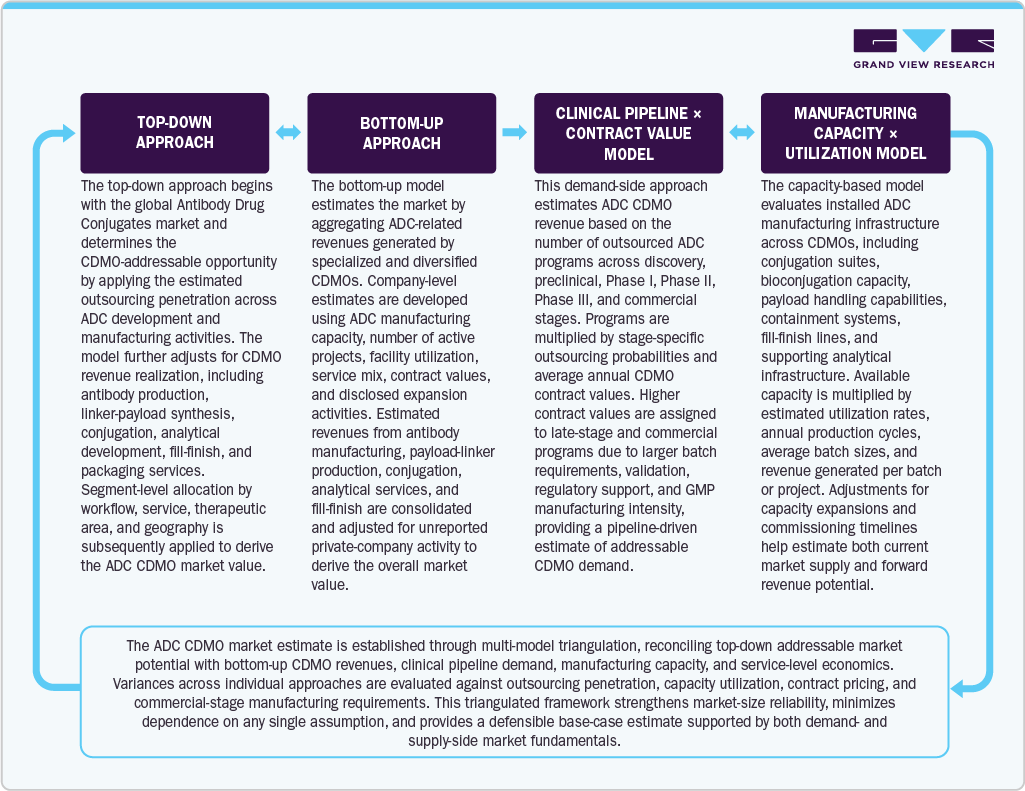
The antibody drug conjugates contract development & manufacturing organization market figures in this report are based on a proven research process that combines executive interviews with secondary research from proprietary databases, company filings, and recognized regulatory and institutional sources. Market size is built through value-chain sizing-reconciling supply-side and demand-side estimates-and triangulated with bottom-up and top-down approaches. Every estimate passes multiple levels of expert validation before publication, with each antibody drug conjugates contract development & manufacturing organization segment quantified using the revenue-capture definitions in the table below.
Segment Definition
Service
Revenue capture definition
Contract Development
The segment captures revenue generated by providing contract development services for antibody-drug conjugates (ADCs) to pharmaceutical, biotechnology, and other end users. The segment includes ADC molecule development, antibody and payload development support, linker selection, conjugation process development, formulation development, process characterization, preclinical development support, analytical development, and preparation of development-stage manufacturing processes.
Cell Line Development
The segment captures revenue generated by providing cell line development services for antibody components used in ADCs to end users. The segment includes host cell selection, vector construction, transfection, clone screening and selection, monoclonality assessment, cell bank development, stability studies, productivity optimization, and development of high-yielding cell lines for monoclonal antibody production.
Process Development & Optimization
The segment captures revenue generated by providing process development and optimization services for ADC manufacturing to end users. The segment includes development and optimization of antibody production, linker-payload handling, conjugation processes, purification, formulation, process parameter optimization, drug-to-antibody ratio control, impurity reduction, yield improvement, process robustness studies, and scale-up preparation.
Upstream
The segment captures revenue generated by providing upstream process development services for the antibody component of ADCs to end users. The segment includes cell culture media development, feed strategy optimization, seed train development, bioreactor process development, cell growth optimization, expression optimization, process parameter control, and optimization of monoclonal antibody production prior to downstream purification and conjugation.
Downstream
The segment captures revenue generated by providing downstream process development services for ADCs and their antibody intermediates to end users. The segment includes clarification, chromatography, filtration, purification, concentration, buffer exchange, viral clearance, removal of unconjugated payload and process-related impurities, purification of conjugated antibodies, and optimization of product recovery, purity, and stability.
Analytical Testing & Method Validation
The segment captures revenue generated by providing analytical testing and method validation services for ADCs to end users. The segment includes identity, purity, potency, drug-to-antibody ratio, aggregation, free drug, residual solvents, impurities, stability, charge variants, molecular weight, conjugation assessment, microbiological testing, bioassays, analytical method development, qualification, validation, and release testing.
Scale-up & Tech Transfer
The segment captures revenue generated by providing scale-up and technology transfer services for ADCs to end users. The segment includes transfer of laboratory-scale processes to pilot and commercial manufacturing, scale-up of antibody production and conjugation processes, manufacturing process transfer, analytical method transfer, process comparability studies, equipment adaptation, engineering runs, documentation transfer, and manufacturing readiness activities.
Contract Manufacturing
The segment captures revenue generated by providing contract manufacturing services for ADCs to pharmaceutical, biotechnology, and other end users. The segment includes GMP production of monoclonal antibodies, linker-payload intermediates, conjugated drug substance, finished ADC drug products, clinical and commercial batch manufacturing, aseptic processing, formulation, filling, and associated manufacturing support.
API Manufacturing
The segment captures revenue generated by providing API/drug-substance manufacturing services for ADCs to end users. The segment includes manufacture of monoclonal antibody intermediates, cytotoxic payloads, linkers, linker-payload intermediates, antibody conjugation, purification of conjugated drug substance, bulk ADC production, GMP batch manufacturing, in-process controls, release testing, and bulk drug-substance storage.
Finished Drug Products Manufacturing
The segment captures revenue generated by providing finished drug product manufacturing services for ADCs to end users. The segment includes formulation of ADC drug substance, sterile filtration, aseptic filling, vial filling, lyophilization where applicable, capping, inspection, finished-product testing, clinical and commercial batch production, and preparation of finished dosage forms for distribution.
Logistics & Storage
The segment captures revenue generated by providing logistics and storage services for ADCs and associated materials to end users. The segment includes temperature-controlled storage, cold-chain management, handling and transportation of cytotoxic/high-potency materials, clinical and commercial inventory management, warehousing, shipment coordination, distribution, sample storage, chain-of-custody management, and monitoring of required storage conditions.
Packaging and Labeling
The segment captures revenue generated by providing packaging and labeling services for ADC products to end users. The segment includes primary and secondary packaging, vial labeling, carton packaging, clinical trial labeling, serialization where applicable, tamper-evident packaging, batch-specific labeling, country-specific labeling, packaging validation, artwork management, and preparation of packaged products for clinical or commercial distribution.
Regulatory Affairs
The segment captures revenue generated by providing regulatory affairs services for ADC development and commercialization to end users. The segment includes regulatory strategy, preparation and submission of IND/CTA, BLA/MAA and related dossiers, CMC documentation, regulatory authority interactions, submission management, compliance support, lifecycle management, responses to regulatory queries, and support for clinical and commercial manufacturing approvals.
Others
The segment captures revenue generated by providing other CDMO services for ADCs to end users that are not classified under the major service categories. The segment includes formulation support, stability studies, quality assurance, quality control, microbial and sterility testing, supply-chain support, clinical trial material management, comparability studies, validation services, consulting, documentation support, and other specialized ADC development or manufacturing services.
Workflow
Revenue capture definition
Clinical
The segment captures revenue generated by providing CDMO services for Antibody Drug Conjugates (ADCs) intended for clinical-stage development to pharmaceutical, biotechnology, and other end users. The segment includes process and analytical development, cell line development, antibody and linker-payload manufacturing, conjugation, formulation development, scale-up, GMP manufacturing of clinical trial material, aseptic fill-finish, analytical and stability testing, clinical packaging and labeling, storage and distribution, technology transfer, and regulatory/CMC support for Phase I, Phase II, and Phase III clinical development.
Commercial
The segment captures revenue generated by providing CDMO services for commercially approved or market-supplied Antibody Drug Conjugates (ADCs) to pharmaceutical, biotechnology, and other end users. The segment includes commercial-scale antibody and linker-payload manufacturing, ADC conjugation, bulk drug substance/API manufacturing, formulation, aseptic fill-finish, finished drug product manufacturing, process validation, analytical and release testing, commercial packaging and labeling, serialization, storage, cold-chain logistics, supply-chain management, technology transfer, regulatory compliance, and lifecycle management support.
Source
Revenue capture definition
Mammalian
The segment captures revenue generated by providing CDMO services for Antibody Drug Conjugates (ADCs) using mammalian expression systems to pharmaceutical, biotechnology, and other end users. The segment includes development and manufacturing of ADC antibody components using mammalian cell lines, primarily CHO, HEK293, NS0, and other suitable mammalian systems. It covers cell line development, cell banking, upstream cell culture, downstream purification, process development and optimization, scale-up, analytical testing, GMP antibody manufacturing, and preparation of purified monoclonal antibodies for subsequent linker-payload conjugation.
Microbial Expression
The segment captures revenue generated by providing CDMO services for Antibody Drug Conjugates (ADCs) using microbial expression systems to pharmaceutical, biotechnology, and other end users. The segment includes development and manufacturing of antibody fragments, recombinant proteins, enzymes, and other ADC-related biological components using bacterial and yeast expression systems, including E. coli, Pichia pastoris/Komagataella phaffii, and other suitable microbial hosts. It covers strain development, fermentation, upstream processing, downstream purification, process optimization, scale-up, analytical testing, and GMP manufacturing.
Technology
Revenue capture definition
Cleavable Linker
The segment captures revenue generated by providing CDMO services for Antibody Drug Conjugates (ADCs) incorporating cleavable linker technology to pharmaceutical, biotechnology, and other end users. The segment includes ADCs employing linkers designed to release cytotoxic payloads in response to intracellular conditions such as protease activity, acidic pH, or reducing environments, including peptide-, hydrazone-, and disulfide-based cleavable linkers.
Non-cleavable Linker
The segment captures revenue generated by providing CDMO services for ADCs incorporating non-cleavable linker technology to end users. The segment includes ADCs using chemically stable linkers that remain attached to the payload during intracellular processing and typically release an active payload-containing metabolite following lysosomal degradation of the antibody.
Linkerless
The segment captures revenue generated by providing CDMO services for ADCs utilizing linkerless conjugation approaches to end users. The segment includes ADC technologies in which the payload is directly attached to the antibody or targeting molecule without a conventional intermediary linker structure, including suitable direct conjugation and chemically engineered attachment approaches.
Linker Technology Type
The segment captures revenue generated by providing CDMO services for ADCs based on specific linker chemistries to end users. The segment includes VC, Sulfo-SPDB, VA, hydrazone, and other linker technologies used to connect antibodies with cytotoxic or other therapeutic payloads and control payload stability and release.
VC (Valine-Citrulline)
The segment captures revenue generated by providing CDMO services for ADCs incorporating valine-citrulline (VC) linker technology to end users. The segment includes ADCs employing protease-cleavable VC peptide linkers designed to remain relatively stable in systemic circulation and enable intracellular payload release following enzymatic cleavage, particularly within lysosomal compartments.
Sulfo-SPDB
The segment captures revenue generated by providing CDMO services for ADCs incorporating Sulfo-SPDB linker technology to end users. The segment includes ADCs using the hydrophilic, disulfide-containing Sulfo-SPDB linker for antibody-payload conjugation, enabling intracellular payload release through reduction of the disulfide bond.
VA (Valine-Alanine)
The segment captures revenue generated by providing CDMO services for ADCs incorporating valine-alanine (VA) linker technology to end users. The segment includes ADCs employing protease-cleavable VA peptide linkers designed for controlled intracellular cleavage and subsequent release of the conjugated therapeutic payload.
Hydrazone
The segment captures revenue generated by providing CDMO services for ADCs incorporating hydrazone linker technology to end users. The segment includes ADCs using acid-labile hydrazone linkers designed to facilitate payload release under acidic intracellular conditions, particularly within endosomal and lysosomal compartments.
Others - Linker Technology
The segment captures revenue generated by providing CDMO services for ADCs incorporating other linker technologies to end users. The segment includes disulfide linkers, glucuronide linkers, carbonate linkers, phosphatase-cleavable linkers, other peptide linkers, and proprietary or emerging linker chemistries not classified under VC, Sulfo-SPDB, VA, or hydrazone.
Payload Technology
The segment captures revenue generated by providing CDMO services for ADCs based on specific therapeutic payload technologies to end users. The segment includes MMAE, MMAF, DM4, camptothecin-based payloads, and other highly potent cytotoxic or therapeutic payloads requiring specialized development, conjugation, analytical, containment, and manufacturing capabilities.
MMAE
The segment captures revenue generated by providing CDMO services for ADCs incorporating monomethyl auristatin E (MMAE) payload technology to end users. The segment includes development, conjugation, analytical testing, and manufacturing of ADCs containing MMAE, a highly potent microtubule-disrupting auristatin payload.
MMAF
The segment captures revenue generated by providing CDMO services for ADCs incorporating monomethyl auristatin F (MMAF) payload technology to end users. The segment includes development, conjugation, analytical testing, and manufacturing of ADCs containing MMAF, a highly potent auristatin-based microtubule inhibitor with relatively limited passive membrane permeability.
DM4
The segment captures revenue generated by providing CDMO services for ADCs incorporating DM4 payload technology to end users. The segment includes development, conjugation, analytical testing, and manufacturing of ADCs containing DM4, a maytansinoid-derived cytotoxic payload that inhibits microtubule assembly and cell division.
Camptothecin
The segment captures revenue generated by providing CDMO services for ADCs incorporating camptothecin-derived payload technology to end users. The segment includes ADCs containing topoisomerase I inhibitor payloads derived from the camptothecin class, including relevant derivatives such as SN-38 and exatecan-based payloads, along with associated conjugation, analytical, and manufacturing services.
Others Technology
The segment captures revenue generated by providing CDMO services for Antibody Drug Conjugates (ADCs) based on other technologies to pharmaceutical, biotechnology, and other end users. The segment includes emerging, proprietary, or less commonly used ADC technologies that are not classified under cleavable linker, non-cleavable linker, linkerless, specified linker technology types, or specified payload technologies. It may include alternative linker chemistries, novel conjugation platforms, site-specific conjugation technologies, next-generation payload systems, and other specialized ADC technology approaches.
Therapeutic Area
Revenue capture definition
Oncology
The segment captures revenue generated by providing CDMO services for Antibody Drug Conjugates (ADCs) intended for oncology applications to pharmaceutical, biotechnology, and other end users. The segment includes ADC development and manufacturing programs targeting hematological malignancies and solid tumors, including blood cancers, breast cancer, urothelial/bladder cancer, and other cancer types.
Blood Cancer
The segment captures revenue generated by providing CDMO services for ADCs intended for the treatment of blood cancers to end users. The segment includes ADC programs targeting hematological malignancies, primarily leukemia, lymphoma, multiple myeloma, and other cancers affecting blood, bone marrow, and lymphatic tissues.
Leukemia
The segment captures revenue generated by providing CDMO services for ADCs intended for leukemia applications to end users. The segment includes ADC programs targeting acute and chronic leukemias, including acute myeloid leukemia (AML), acute lymphoblastic leukemia (ALL), chronic lymphocytic leukemia (CLL), and other leukemia types.
Lymphoma
The segment captures revenue generated by providing CDMO services for ADCs intended for lymphoma applications to end users. The segment includes ADC programs targeting Hodgkin lymphoma, non-Hodgkin lymphoma, diffuse large B-cell lymphoma, anaplastic large cell lymphoma, and other lymphoid malignancies.
Multiple Myeloma
The segment captures revenue generated by providing CDMO services for ADCs intended for multiple myeloma applications to end users. The segment includes ADC development and manufacturing programs targeting malignant plasma cells and relevant tumor-associated antigens for the treatment of multiple myeloma.
Breast Cancer
The segment captures revenue generated by providing CDMO services for ADCs intended for breast cancer applications to end users. The segment includes ADC programs targeting HER2-positive, HER2-low, triple-negative, and other molecular subtypes of breast cancer using relevant tumor-associated antigens.
Urothelial Cancer & Bladder Cancer
The segment captures revenue generated by providing CDMO services for ADCs intended for urothelial and bladder cancer applications to end users. The segment includes ADC programs targeting locally advanced, metastatic, and other forms of urothelial carcinoma and bladder malignancies.
Other Cancer
The segment captures revenue generated by providing CDMO services for ADCs intended for other oncology applications to end users. The segment includes ADC programs targeting lung, gastric/gastroesophageal, ovarian, cervical, colorectal, prostate, pancreatic, head & neck, endometrial, and other solid or hematological cancers not separately categorized.
Infectious Diseases
The segment captures revenue generated by providing CDMO services for ADCs or antibody-conjugate therapeutics intended for infectious disease applications to end users. The segment includes development and manufacturing programs targeting bacterial, viral, fungal, parasitic, and other infectious pathogens using antibody-directed delivery approaches.
Neurological Disorders
The segment captures revenue generated by providing CDMO services for ADCs or antibody-conjugate therapeutics intended for neurological applications to end users. The segment includes programs targeting neurological and neurodegenerative disorders using antibody-mediated targeted delivery of therapeutic payloads.
Cardiovascular Disease
The segment captures revenue generated by providing CDMO services for ADCs or antibody-conjugate therapeutics intended for cardiovascular applications to end users. The segment includes targeted antibody-conjugate programs developed for cardiovascular and vascular diseases using disease-associated molecular targets.
Metabolic Disorders
The segment captures revenue generated by providing CDMO services for ADCs or antibody-conjugate therapeutics intended for metabolic disorder applications to end users. The segment includes targeted conjugate programs for metabolic and related disorders involving disease-specific molecular pathways or cellular targets.
Autoimmune Diseases
The segment captures revenue generated by providing CDMO services for ADCs or antibody-conjugate therapeutics intended for autoimmune disease applications to end users. The segment includes programs designed to selectively target pathogenic immune cells or disease-associated molecular targets in autoimmune and immune-mediated disorders.
Others
The segment captures revenue generated by providing CDMO services for ADCs and related antibody-conjugate therapeutics intended for other therapeutic areas to end users. The segment includes ophthalmology, inflammatory diseases, rare diseases, fibrotic disorders, and other therapeutic applications not classified under oncology, infectious diseases, neurological, cardiovascular, metabolic, or autoimmune diseases.
End Use
Revenue capture definition
Large Pharma & Biotech Companies
The segment captures revenue generated by providing CDMO services for Antibody Drug Conjugates (ADCs) to large pharmaceutical and biotechnology companies. The segment includes services provided to established organizations with extensive drug development pipelines and commercial operations, covering ADC development, process optimization, clinical and commercial manufacturing, conjugation, analytical testing, fill-finish, packaging, regulatory support, storage, and supply-chain services.
Small & Mid-sized Pharma & Biotech Companies
The segment captures revenue generated by providing CDMO services for Antibody Drug Conjugates (ADCs) to small and mid-sized pharmaceutical and biotechnology companies. The segment includes services provided to emerging and mid-scale drug developers requiring outsourced capabilities for ADC development, cell line and process development, conjugation, analytical testing, scale-up, clinical and commercial manufacturing, fill-finish, regulatory support, and related services.
Others
The segment captures revenue generated by providing CDMO services for Antibody Drug Conjugates (ADCs) to other end users not classified under large or small & mid-sized pharmaceutical and biotechnology companies. The segment includes academic and research institutions, government research organizations, nonprofit organizations, virtual biotechnology companies, research consortia, and other organizations engaged in ADC research, development, or commercialization.
Estimation Model
 To learn more about this report, Download Free Sample Report
Delivered Customizations
This report has been delivered with the following In-depth customizations
Client Request
Customization Delivered
Value Adds
Extensive Segmentation & Cross-Segmentation Analysis
The study can be customized to provide deeper segmentation and cross-analysis across service, workflow, source, linker technology, payload technology, therapeutic area, end use, development stage, and manufacturing scale. Cross-segmentation may include service-by-workflow, linker-by-payload, therapeutic area-by-workflow, and end use-by-service analysis, along with assessment of conjugation, HPAPI handling, analytical testing, fill-finish, and commercial manufacturing requirements.
Enables granular identification of high-growth ADC outsourcing pockets, supports prioritization of attractive service-technology combinations, and helps CDMOs, investors, and biopharma sponsors identify capability gaps and higher-value development and manufacturing opportunities.
Regional Extension & ADC Manufacturing Opportunity Mapping
The report can include country-level or sub-regional analysis across North America, Europe, Asia Pacific, Latin America, and the Middle East & Africa. Customization may cover ADC pipeline concentration, bioconjugation infrastructure, HPAPI capacity, biologics manufacturing capabilities, regulatory environment, outsourcing penetration, facility expansions, commercial manufacturing readiness, and regional demand-supply gaps across key countries.
Supports geographic expansion strategy, manufacturing-site prioritization, investment planning, capacity allocation, and identification of underserved markets with increasing demand for ADC development, conjugation, analytical, and commercial manufacturing services.
Market Entry Strategy & Competitive Dynamics
The study can be expanded to assess market-entry opportunities for established CDMOs, specialty bioconjugation providers, HPAPI manufacturers, and biologics companies entering the ADC outsourcing market. Analysis may include market attractiveness, capability benchmarking, pricing models, customer requirements, competitive intensity, partnership opportunities, acquisition targets, technology differentiation, service gaps, and build-versus-partner strategies across the ADC value chain.
Helps evaluate market attractiveness, competitive positioning, partnership or acquisition opportunities, pricing feasibility, required capability investments, and go-to-market strategies for new entrants or CDMOs expanding their ADC service portfolio.
Pipeline, Volume, Capacity & Emerging Technology Analysis
Customization can include the number of ADC programs by development phase, estimated outsourced projects, clinical and commercial batch requirements, conjugation volumes, payload demand, facility utilization, and available bioconjugation capacity. Emerging trend assessment may cover site-specific conjugation, novel linker-payload platforms, next-generation payloads, bispecific ADCs, dual-payload ADCs, automated closed processing, advanced analytical characterization, and integrated end-to-end ADC manufacturing models.
Provides demand validation beyond revenue estimates, improves market forecast robustness, identifies potential capacity constraints, and highlights emerging technologies and manufacturing capabilities likely to influence CDMO investment and outsourcing decisions during the forecast period.
Frequently Asked Questions About This Report
The global antibody drug conjugates contract development & manufacturing organization (CDMO) market size was valued at USD 9.4 billion in 2025 and is estimated at USD 10.5 billion for 2026.
The global antibody drug conjugates CDMO market is expected to grow at a CAGR of 11.9% from 2026 to 2033, reaching USD 23.0 billion by 2033.
Based on service, the contract manufacturing segment held the largest market share of 47.3% in 2025.
North America antibody drug conjugates contract development and manufacturing organization market held the largest share of 43.8% of the global market in 2025.
Some of the key players operating in the antibody drug conjugates contract development and manufacturing organization market include Recipharm AB, Samsung Biologics, Lonza Group, Piramal Pharma Solutions, Sterling Pharma Solutions, Sartorius AG, Catalent, Inc., WuXi Biologics, AbbVie Contract Manufacturing, Merck KGaA (MilliporeSigma), Thermo Fisher Scientific (Patheon) , CordenPharma, Cambrex, Abzena, Ajinomoto Bio-Pharma Services.
Based on workflow, the commercial segment held the largest market share of 63.9% in 2025.
Based on source, the microbial segment held the largest market share of 61.3% in 2025.
Based on therapeutic area, the oncology segment held the largest market share of 26.5% in 2025.
Key factors that are driving the market growth include rapid expansion of the global ADC clinical pipeline, increasing approvals of ADC-based oncology therapies, and rising outsourcing of technically complex manufacturing activities. In addition, the demand is supported by requirements for high-potency payload synthesis, linker development, site-specific conjugation, advanced analytical characterization, GMP bioconjugation, and sterile fill-finish.
Based on technology, the cleavable linker segment held the largest market share of 54.3% in 2025.
About the Author(s)
Medical Devices Research Team
Healthcare · Medical DevicesThis report was authored by the medical devices research team at Grand View Research - comprising two research analysts, one senior research analyst, and one industry expert - with specialized expertise in the medical devices segment of the healthcare industry. All findings are based on proprietary healthcare databases, executive interviews, and regulatory analysis, subject to internal peer review prior to publication.
Last Updated:
Speak to Analyst

Customize this report to your needs - add regions, segments, or data points, with 20% free customization.
Or view our licence options:


ISO 9001:2015 & 27001:2022 Certified
We are GDPR and CCPA compliant! Your transaction & personal information is safe and secure. For more details, please read our privacy policy.


